Normal view

Today — 12 February 2026Main stream

Snapdragon 8 Elite Gen 5 vs 8 Gen 5 vs 8 Elite: Benchmark scores, spec sheet, and key differences

11 February 2026 at 17:14
Snapdragon 8 Elite Gen 5 vs Snapdragon 8 Gen 5 vs Snapdragon 8 Elite

The original Snapdragon 8 Elite was introduced in 2024 as the company’s first mobile chipset featuring an Oryon CPU, then came the Snapdragon 8 Elite Gen 5 next year as its successor, which was earlier supposed to launch as Snapdragon 8 Elite Gen 2, but Qualcomm had a different plan.

A few weeks after the Snapdragon 8 Elite Gen 2’s announcement, Qualcomm followed up with the Snapdragon 8 Gen 5 as an affordable flagship alternative for premium mid-range devices. While it appears to be a successor to Snapdragon 8 Elite, the latter actually delivers better performance. The inconsistent naming scheme from Qualcomm is confusing many people, so we’ve created this detailed post explaining how the Snapdragon 8 Elite Gen 5, Snapdragon 8 Gen 5, and Snapdragon 8 Elite stack up against each other.

Here’s the spec sheet for a quick overview:

Snapdragon 8 Elite Gen 5Snapdragon 8 Gen 5Snapdragon 8 Elite
AnnouncedSeptember 2025November 2025October 2024
Process nodeTSMC’s 3nm (N3P)TSMC’s 3nm (N3P)TSMC’s 3nm (N3E)
CPU cores8-core8-core8-core
CPU cores2 x 4.61GHz — Oryon (3rd gen)
6 x 3.63GHz — Oryon (3rd gen)
2 x 3.8GHz — Oryon (3rd gen)
6 x 3.32GHz — Oryon (3rd gen)
2 x 4.32GHz — Oryon (2nd gen)
6 x 3.53GHz — Oryon (2nd gen)
GPUAdreno 840
Ray tracing support
Snapdragon Elite Gaming features
Adreno 829
Ray tracing support
Snapdragon Elite Gaming features
Adreno 830
Ray tacing support
Snapdragon Elite Gaming features
NPUQualcomm Hexagon NPU
Agentic AI support
Qualcomm Hexagon NPU
Agentic AI support
Qualcomm Hexagon NPU
MemoryLPDDR5X, up to 5.3GHzLPDDR5X, up to 4.8GHzLPDDR5X, up to 5.3GHz
StorageUFS 4.1UFS 4.1UFS 4.0
CameraQualcomm Spectra ISP (Triple AI-ISPs, 20-bit)
up to 320MP single camera
up to 108MP single camera (MFNR, ZSL, 30fps)
up to 48MP triple camera (MFNR, ZSL, 30fps)
up to 4K/120fps video recording
real-time semantic segmentation (limitless)
Advanced Professional Video (APV) codec
Qualcomm Spectra ISP (Triple AI-ISPs, 20-bit)
up to 320MP single camera
up to 108MP single camera (MFNR, ZSL, 30fps)
up to 48MP triple camera (MFNR, ZSL, 30fps)
up to 4K/120fps video recording
real-time semantic segmentation
Qualcomm Spectra ISP (Triple AI-ISPs, 18-bit)
up to 320MP single camera
up to 108MP single camera (MFNR, ZSL, 30fps)
up to 48MP triple cameras (MFNR, ZSL, 30fps)
real-time semantic segmentation (limitless)
up to 8K/30fps video recording
ConnectivitySnapdragon X85 5G modem
download speed: 12.5Gbps (peak)
upload speed: 3.7Gbps (peak)
Wi-Fi 7 (peak speed: 5.8Gbps)
Bluetooth 6.0
Snapdragon X80 5G modem
download speed: 10Gbps (peak)
upload speed: 3.5Gbps (peak)
Wi-Fi 7 (peak speed:5.8 Gbps)
Bluetooth 6.0
Snapdragon X80 5G modem
download speed: 10Gbps (peak)
upload speed: 3.5Gbps (peak)
Wi-Fi 7 (peak speed: 5.8 Gbps)
Bluetooth 6.0

Snapdragon 8 Elite Gen 5 vs 8 Gen 5 vs 8 Elite: Benchmark numbers

Note: The benchmark tests were performed on the iQOO 15 (Snapdragon 8 Elite Gen 5), OnePlus 15R (Snapdragon 8 Gen 5), and OnePlus 13 (Snapdragon 8 Elite).

Geekbench performance
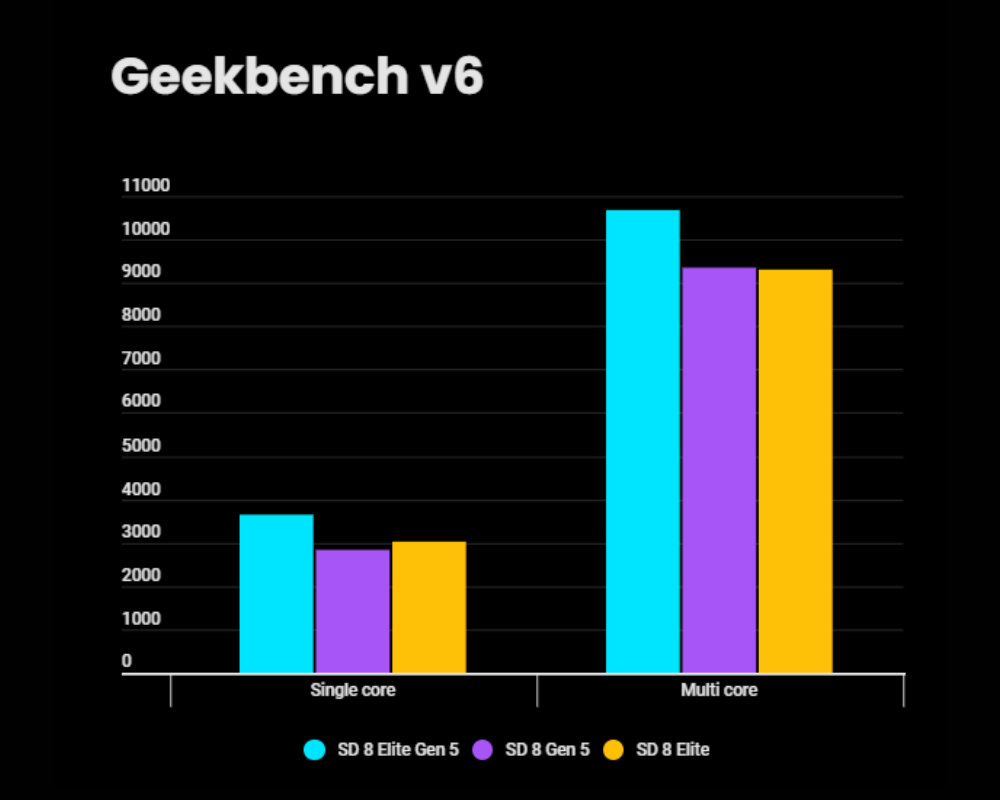
Snapdragon 8 Elite Gen 5 vs 8 Gen 5 vs 8 Elite - Geekbench score

The Snapdragon 8 Elite Gen 5, unsurprisingly, achieves the highest score in both single-core and multi-core tests (3649, 10682), followed by the Snapdragon 8 Elite, which gets about 7% higher single-core score than the Snapdragon 8 Gen 5, while the multi-core scores for the two chips don’t have a big difference.

Single coreMulti core
SD 8 Elite Gen 53,64910,682
SD 8 Gen 52,8379,352
SD 8 Elite3,0269,306

AnTuTu performance

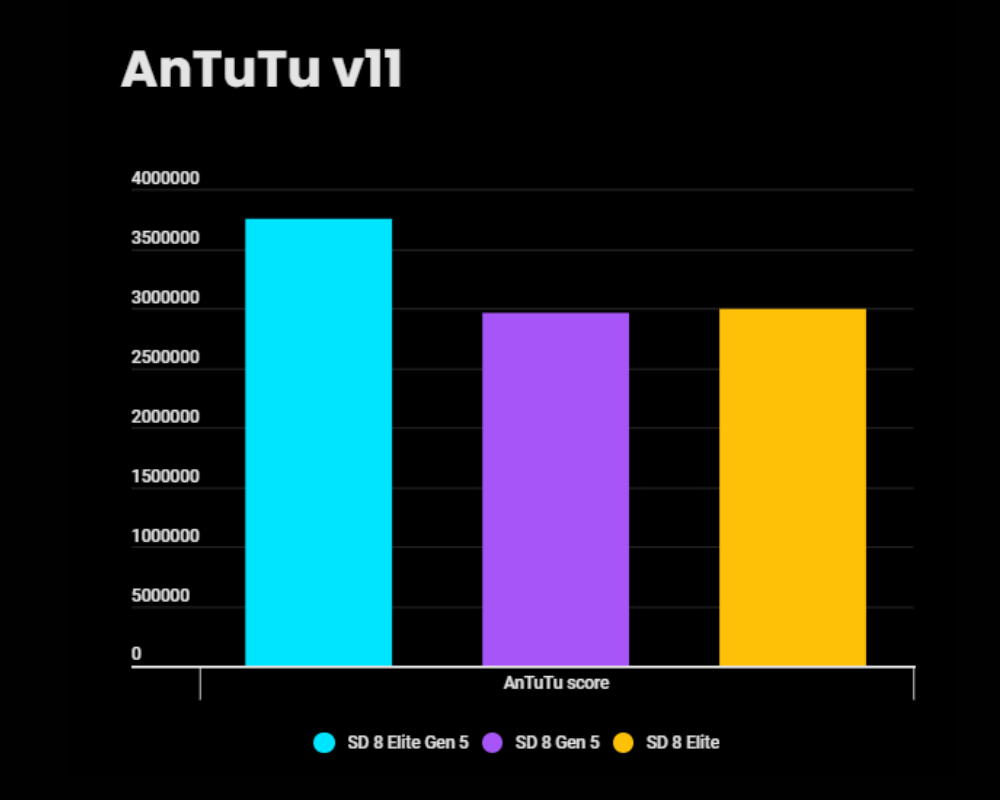
Snapdragon 8 Elite Gen 5 vs 8 Gen 5 vs 8 Elite - AnTuTu score

The Snapdragon 8 Elite Gen 5 is far ahead of the other two, with a total score above 3.7 million. The Snapdragon 8 Elite almost touches the 3 million mark, while the Snapdragon 8 Gen 5 is just below it, scoring 2.96 million points.

AnTuTu score
SD 8 Elite Gen 53,751,084
SD 8 Gen 52,961,236
SD 8 Elite2,994,563

3DMark performance

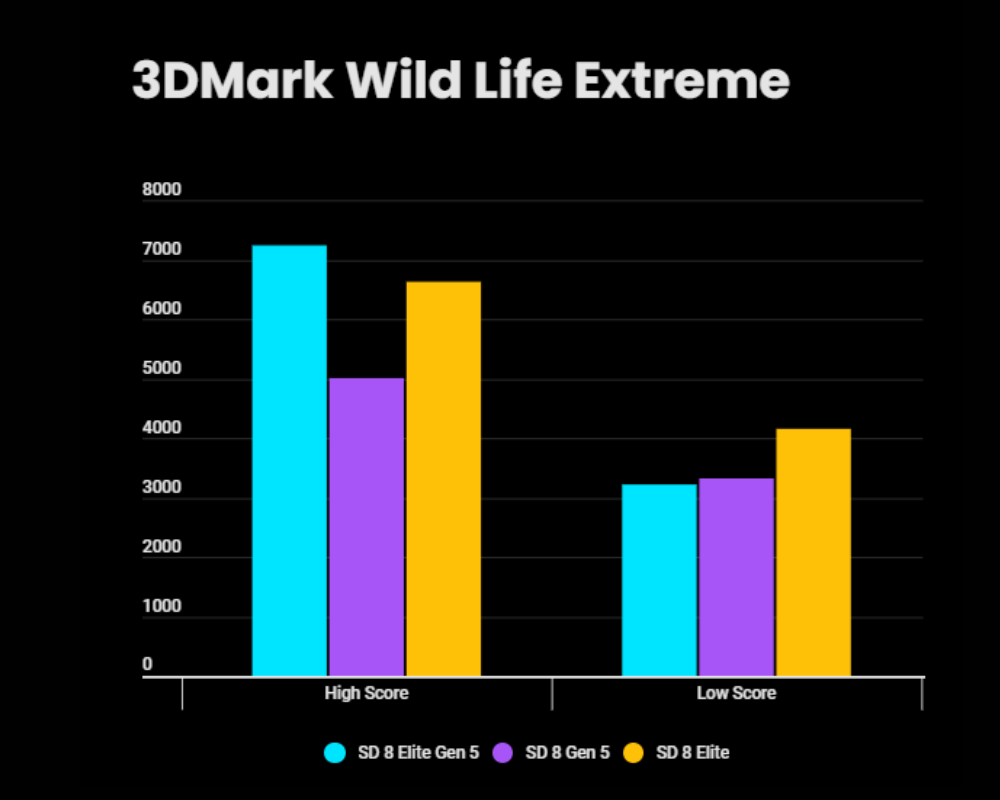
Snapdragon 8 Elite Gen 5 vs 8 Gen 5 vs 8 Elite - 3DMark Wild Life Extreme score

The result isn’t any different on 3DMark than AnTuTu and Geekbench. The Snapdragon 8 Elite Gen 5 pulls off the best high score in the Wild Life Extreme test, followed by the Snapdragon 8 Elite and then the Snapdragon 8 Gen 5.

High scoreLow score
SD 8 Elite Gen 57,2403,219
SD 8 Gen 55,0093,321
SD 8 Elite6,6284,155

However, things get interesting when you look at low scores. The Snapdragon 8 Elite Gen 5 has the worst low score of 3,219. In contrast, the Snapdragon 8 Gen 5 scores 3,321 points, and the Snapdragon 8 Elite scores 4,155 points. This could mean a higher gaming stability on a Snapdragon 8 Elite-powered device than on devices powered by the other two chipsets. However, that also depends on the software tuning, gaming optimizations, and cooling solution of a device.

The benchmarks focus solely on performance and don’t address other important aspects, such as connectivity and camera capabilities. Let’s talk about them and other important stuff in the following section to get the complete picture.

Snapdragon 8 Elite Gen 5 vs 8 Gen 5 vs 8 Elite: Key differences

CPU, GPU, and NPU

The Snapdragon 8 Elite Gen 5 and 8 Gen 5 have been manufactured using TSMC’s 3nm (N3P) node, which offers slightly improved performance and efficiency over the N3E node used for the Snapdragon 8 Elite.

All three Qualcomm chips have the same 2+6 core configuration. The Snapdragon 8 Elite Gen 5 and 8 Gen 5 feature third-generation Oryon CPU, while the Snapdragon 8 Elite has a second-generation Oryon CPU. Despite a generation older CPU, the 8 Elite beats the 8 Gen 5 on benchmarks because its cores run at higher clock speeds.

As for graphics rendering, the Snapdragon 8 Elite Gen 5 features the powerful Adreno 840 GPU with excellent ray tracing capabilities, along with a full suite of Snapdragon Elite Gaming features to enhance the gaming experience further. In contrast, the 8 Gen 5 has an Adreno 829, and the 8 Elite has Adreno 830. Both GPUs support ray tracing and offer Snapdragon Elite Gaming features.

Now, coming to AI capabilities, the Snapdragon 8 Elite Gen 5 features the largest and most capable NPU with agentic AI support. The NPU performance of the two other chips is nearly identical, but the Snapdragon 8 Gen 5’s official page mentions agentic AI support, whereas the Snapdragon 8 Elite doesn’t.

Camera and Imaging

The camera capabilities of the Snapdragon 8 Elite Gen 5 and 8 Gen 5 are nearly identical, except that the latest Elite chip features Advanced Professional Video (APV) codes for near-lossless, pro-grade capture and limitless real-time semantic segmentation. The Snapdragon 8 Elite features a lower-bit ISP, while the rest of its specs are mostly the same as those of the Snapdragon 8 Gen 5.

Connectivity

While all three Qualcomm chips offer robust connectivity features, the Snapdragon 8 Elite Gen 5 excels by delivering higher download and upload speeds over 5G. The rest of the connectivity specs are almost the same.

The post Snapdragon 8 Elite Gen 5 vs 8 Gen 5 vs 8 Elite: Benchmark scores, spec sheet, and key differences appeared first on Gizmochina.
Android 17 beta is coming soon, confirms Google

11 February 2026 at 10:36
Android 17 beta 1 release

Google has just released Android 16 QPR3 Beta 2.1 to Google Pixels, and that would be the final release based on the current OS. The company has now officially confirmed that it’s working on Android 17 and that the first beta build will be released soon.

Android 17 Beta 1 releasing soon

The first public beta of Android 17 will be released soon, says Google. Notably, this won’t be a Developer Preview build. If you’ve followed the development cycles for an upcoming Android OS in the past, you’d know that first builds are generally labelled Developer Preview builds (Android 16 had two of them), and then beta builds are released, but that’s changing this year with Android 17.

Google says Android 17 Beta 1 “builds on top of Android 16 QPR platform release and includes the latest bug fixes and improvements to stability and performance.” Past leaks suggest several new features and improved gaming capabilities are coming to the upcoming Android OS, among many other improvements. We’ll learn more about the changes once the first beta build goes live, which could arrive as early as this month or next month, while the stable build of Android 17 should land around June 2026.

Google Pixel users will have the first bite, as always. Those currently on Android 16 QPR3 Beta 2.1 and choose to remain enrolled in the Android Beta Program will automatically receive the Android 17 Beta 1 update. If they don’t want to receive the beta update, they must opt out of the beta program.

As for the other brands, the Android 17 beta update may arrive on select devices a few weeks after it is released to Google Pixels. We’ll continue to track the development and update you on the same in our Android 17 section. Remember to visit the section regularly for the latest updates. Or, join our Telegram channel to get instant notifications about the latest happenings in tech.

The post Android 17 beta is coming soon, confirms Google appeared first on Gizmochina.

Yesterday — 11 February 2026Main stream

5 HyperOS 3 features that make it better than stock Android

10 February 2026 at 15:49
HyperOS 3 features
HyperOS 3 features

HyperOS 3 is one of the biggest upgrades to Xiaomi devices to date, bringing loads of new features and improvements across the system. It’s based on Android 16, but on top of that, Xiaomi has introduced several exciting and useful features in HyperOS 3 that make the stock Android feel like a less feature-rich update.

Here are the five HyperOS 3 features that make it better than stock Android.

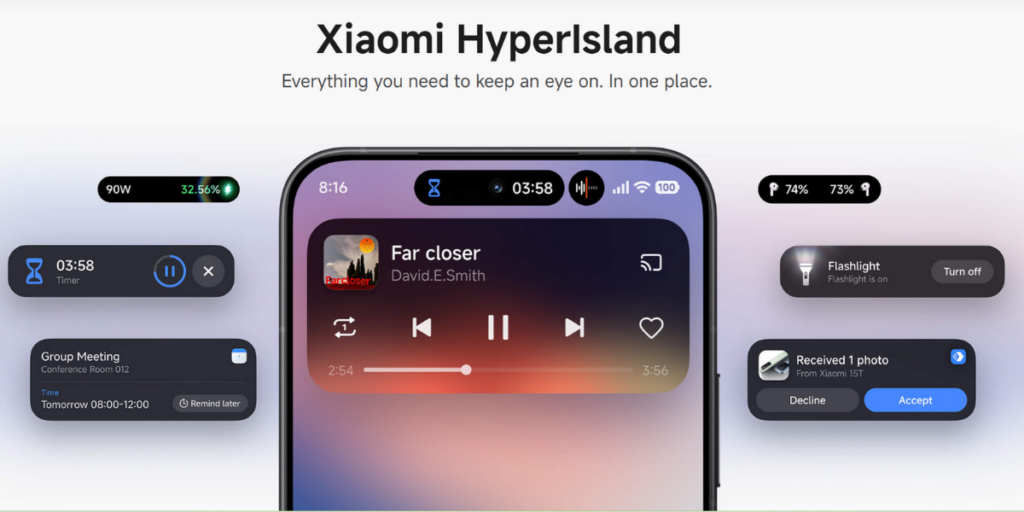
1. HyperIsland with multitasking capabilities

Android 16 adds Live Updates to show ongoing tasks (delivery, ride, etc.) in the notification area and on the lock screen, but HyperOS 3 goes much further with HyperIsland. Xiaomi’s implementation features a dedicated pill-style hub at the top of the screen with the ability to show multiple live activities at once (up to three), letting users monitor several concurrent tasks simultaneously and interact with each individually.

HyperIsland offers rich inline controls (play/pause, call actions, accept/decline, navigation shortcuts, etc.) and supports gestures like tapping to expand and swiping to switch islands. What’s more interesting is that users can swipe down an island to open the related app into a floating window for instant multitasking. The Live Updates in Android 16 have fewer controls and don’t offer floating-window behavior for islands.

Xiaomi’s HyperIsland also offers better integration with system features and extends support to a wide range of third-party apps like WhatsApp, YouTube, and Spotify. At the same time, Android 16’s Live Updates work best with Google’s own apps and depend heavily on app developers to make the required changes.

2. Cinematic lock screen and AI dynamic wallpapers (with deeper editing)

HyperOS 3 lock screen
Lock screen in HyperOS 3

HyperOS 3.0 focuses on offering a redefining lock-screen experience with new AI-assisted features and deeper customization, while stock Android 16 focuses more on core OS usability than on lock-screen creativity.

The new AI Cinematic Lock Screen feature in HyperOS 3 creates a story-like, cinematic effect each time you unlock, and the AI Dynamic Wallpapers feature transforms your photos into stunning cinematic visuals. HyperOS 3 also features smoother lock-screen transitions, like AOD to lock screen to home screen, making the lock screen feel more premium and lively.

HyperOS 3 - AI Dynamic Wallpapers
HyperOS 3 - AI Cinematic Lock Screen

In short, Android 16’s lock screen is clean and functional but less focused on creativity and personalization, but HyperOS 3 explicitly promotes personalized editing. 

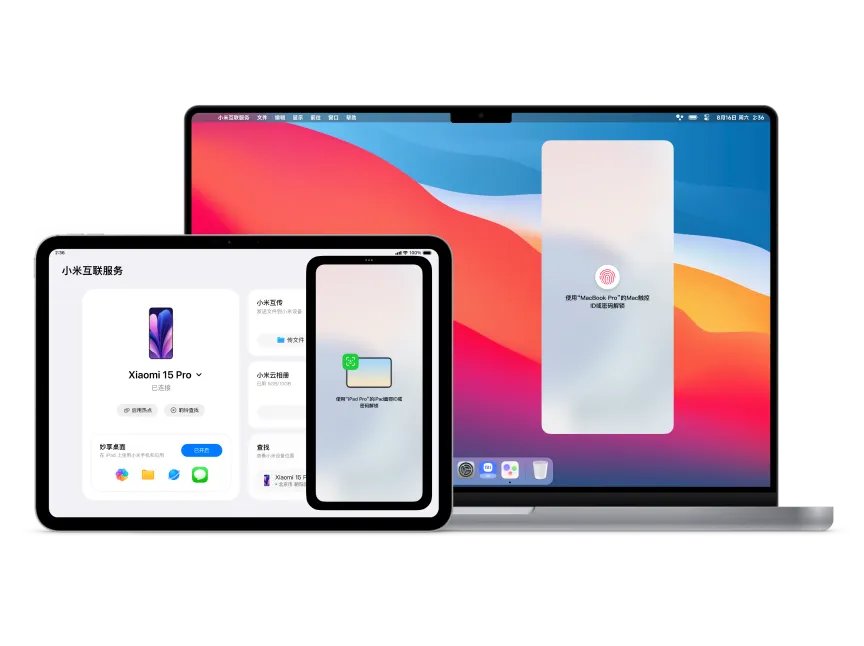
3. Much stronger cross-ecosystem features, including Apple integration

HyperOS 3 improved interconnectivity

HyperOS 3.0 excels at cross-device connectivity, especially with Apple devices, while stock Android 16 mostly focuses on bridging gaps among Android devices.

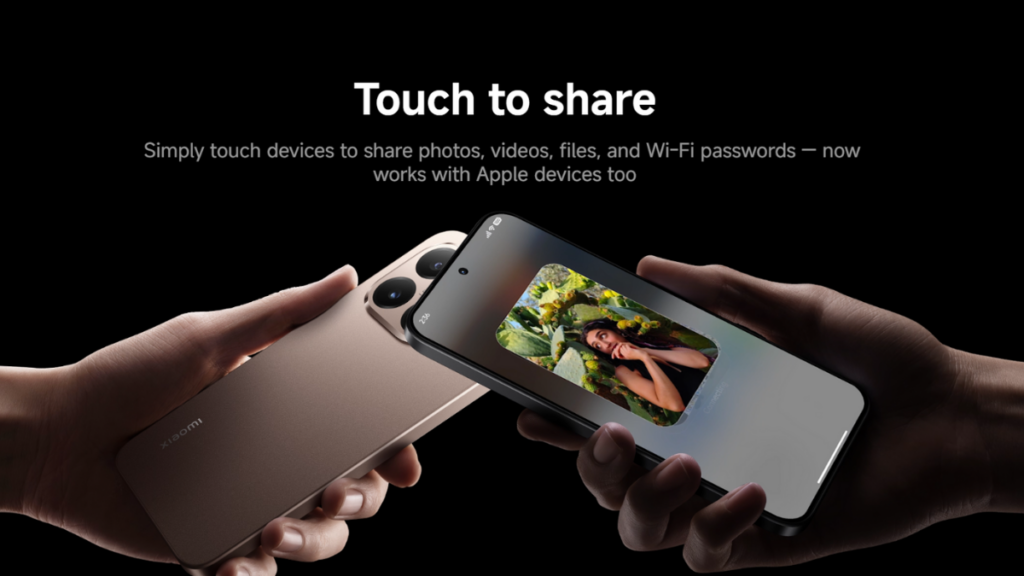
HyperOS 3 - Touch to Share

The “Touch to share” feature on HyperOS 3.0 now works with Apple devices too. So, you can now share photos, videos, files, and Wi-Fi passwords with Apple devices simply by touching both devices. Users can also run Xiaomi phone apps on iPad using the Home Screen+ feature with full support for iPad multitasking. Plus, they can unlock their Xiaomi devices using Touch ID or Face ID.

Apple devices can connect to a Xiaomi hotspot with just one tap. Additionally, users can instantly locate their Xiaomi phones from Apple devices, further strengthening Xiaomi’s cross-ecosystem capabilities.

4. HyperAI for smarter writing, transcription, and translation

HyperOS 3.0 provides a suite of AI features as a part of HyperAI, while stock Android 16 relies on Google apps (Gemini, Translate, Photos, etc.) to deliver the most visible AI features.

HyperOS 3 - AI Writing
HyperOS 3 - AI Speech Recognition

The AI Writing feature in HyperOS 3.0 can rewrite text in multiple styles, generate captions for images, and features a “DeepThink mode” for longer content in Notes. The AI Speech Recognition helps reduce background noise, convert speech to text while recording, and generate an instant summary when the recording ends.

HyperOS 3 - AI Search

HyperAI also offers AI Search to search the web for instant answers, generate AI summaries of search results, and find on-device content quickly, while the AI Translate feature does live interpretation for calls/meetings, bilingual subtitles by transcribing and translating audio, and an offline mode for face-to-face conversation translation.

5. Stronger privacy and security layer

The stock Android 16 features Android Protection, which layers multiple protections, such as Theft Detection Lock, offline device lock, USB protection, and anti-scam safeguards. Many of them are also available on Xiaomi devices running HyperOS 3, but the software also includes several security features developed by Xiaomi that are not present in stock Android 16.

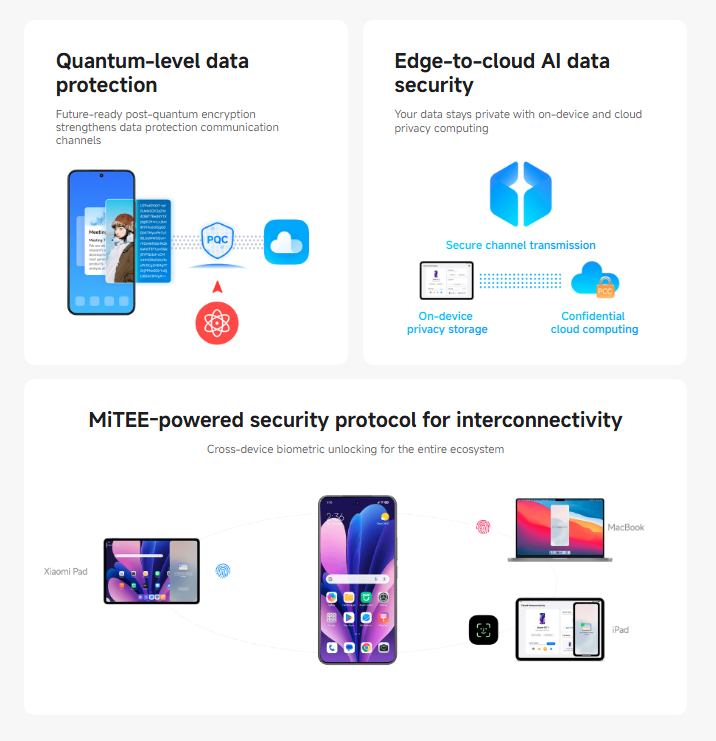
HyperOS 3 security features

HyperOS 3 offers Quantum-level data protection for protection against future quantum attacks on communications. It also features Edge-to-cloud AI data security, ensuring data stays private with on-device and cloud privacy computing, and MiTEE‑powered security protocols for interconnectivity.

So, HyperOS 3.0, based on Android 16, is a pretty significant upgrade for Xiaomi devices, bringing plenty of additional features and improvements over stock Android 16.

Also read:
1. Xiaomi HyperOS 3.1 update: New features, smarter UI, & more
2. HyperOS 3.1 vs HyperOS 3: Every features, changes, & full eligible device list

To ensure you don’t miss out on the important updates from Xiaomi, remember to visit the Xiaomi section on this website regularly. Alternatively, you can join us on Telegram to get instant notifications about the latest HyperOS updates, along with the biggest tech headlines.

The post 5 HyperOS 3 features that make it better than stock Android appeared first on Gizmochina.

❌
❌