
Normal view

Today — 13 February 2026Main stream

Xiaomi 17 Max Roundup: Design, Display, Camera, Performance, and More

12 February 2026 at 21:21
Xiaomi 17 Pro Max

Xiaomi’s 2026 flagship lineup already has four members. Now the company is reportedly adding a sixth in the form of the Xiaomi 17 Max. That’s a lot of phones in one series. But based on what has surfaced so far, the 17 Max will have its own distinguishing feature in the lineup. 

Most of what we know so far comes from a steady stream of rumors, along with a few related reports. Nothing is official yet, but the details have been consistent enough to sketch a fairly clear picture of what Xiaomi might be planning.

An 8,000mAh battery is the headline feature

If there’s one spec that defines the Xiaomi 17 Max right now, it’s the battery.

According to multiple leaks, the phone will pack an 8,000mAh battery. That’s bigger than the already substantial 7,500mAh unit inside the Xiaomi 17 Pro Max. 

More importantly, none of the flagships from brands like Samsung or Apple come close to this capacity. So it’s not difficult to imagine Xiaomi marketing this around multi-day usage, heavy gaming, or extended video streaming without worrying about a charger.

Xiaomi could pair this with 100W wired charging and 50W wireless charging. These numbers are in line with the Pro Max model, which also supports 100W wired and 50W wireless charging, along with 22.5W reverse wireless charging.

Big display, flat panel

The “Max” name also points to a large screen, and leaks back that up. According to reports, it will feature a flat OLED display measuring either 6.8 inches or 6.9 inches. For context, the Pro Max also features a 6.9-inch 2K 120Hz OLED panel. 

One of the clearer differentiators within the Xiaomi 17 lineup is the presence of a secondary rear display on the Pro and Pro Max models. The 17 Max, despite its name, will not include this feature.

Xiaomi 17
Xiaomi 17

Multiple comments from Digital Chat Station suggest that the 17 Max will skip the rear-facing secondary screen. Instead, its design is said to be closer to the standard Xiaomi 17.

This decision likely serves two purposes. First, it helps Xiaomi maintain a clear hierarchy in the lineup. The Pro Max can keep its more experimental design elements, while the Max focuses on battery and scale. Second, it probably keeps costs and complexity down.

Snapdragon 8 Elite Gen 5 inside

Under the hood, the Xiaomi 17 Max is likely to use the same chipset as the rest of the Xiaomi 17 series, i.e., the Snapdragon 8 Elite Gen 5. That would place it on equal footing with the Xiaomi 17, 17 Pro, and 17 Pro Max in terms of raw performance. 

For users, that means the 17 Max should handle demanding games, heavy multitasking, and AI features just as well as its siblings. The real differences will likely come down to battery capacity, camera configuration, and design.

Cameras

As for the optics, early leaks suggest that the Xiaomi 17 Max might borrow the OmniVision Light Fusion 950 primary camera from the standard Xiaomi 17, while improving overall photography performance. It was also tipped to include a periscope telephoto lens that could outperform most models in the series, excluding the 17 Ultra.

More recent information, however, suggests that the 17 Max could feature a 200-megapixel Samsung ISOCELL HPE main sensor (1/1.4-inch), paired with a 50-megapixel Sony IMX8-series periscope telephoto sensor (1/1.953-inch) and a 50-megapixel ultrawide lens.

If accurate, this would be a noticeable step up from the vanilla Xiaomi 17, which reportedly uses three 50-megapixel sensors for main, telephoto, and ultrawide shots. There’s also mention that Xiaomi’s partnership with Leica will continue on the 17 Max. 

It’s worth noting that these two sets of camera leaks don’t perfectly match. Either Xiaomi adjusted the prototype configuration over time, or one of the reports reflects an earlier engineering sample. 

Until official confirmation arrives, it’s safest to assume the 17 Max will sit above the standard 17 in camera capability, but below the 17 Ultra.

Where it fits in the lineup

Even with five models in the lineup, Xiaomi has a way to create specific identities for each device.

  • The Xiaomi 17 is the standard flagship.
  • The 17 Pro and 17 Pro Max add design elements like the secondary rear display.
  • The 17 Ultra likely remains the photography-focused halo product.
  • The 17 Max might prioritize battery capacity and scale, while still offering high-end performance and strong cameras.

In some ways, the 17 Max feels like a hybrid between the standard model and the Pro Max. It may inherit much of the Pro Max’s hardware — including the Snapdragon chip and fast charging — but with a more restrained design and an even larger battery.

Launch timeline and availability

As for timing, the Xiaomi 17 Max is rumored to launch in China in Q2 2026, likely in April. The timeframe places it alongside other expected flagship launches in China, including devices like the Vivo X300s and Oppo Find X9s.

Global availability is less certain. Current speculation suggests Xiaomi may only bring the Xiaomi 17 and Xiaomi 17 Ultra to international markets. If that holds, the 17 Max could remain a China-exclusive model.

For more daily updates, please visit our News Section.

Tech enthusiast? Get the latest news first! Follow our Telegram channel and subscribe to our free newsletter for your daily tech fix! ⚡

The post Xiaomi 17 Max Roundup: Design, Display, Camera, Performance, and More appeared first on Gizmochina.
Xiaomi 17 and Ultra price leak suggests up to 23% hike

12 February 2026 at 20:40
Xiaomi 17

Xiaomi’s next flagship phones may already have a price tag in India, months before their expected debut. According to tipster Abhishek Yadav, the series could start at Rs 80,000 for the standard Xiaomi 17, while the Xiaomi 17 Ultra may land at Rs 1,25,000 in the country. 

No surprises, Xiaomi hasn’t confirmed these numbers, and as with most early leaks, they should be taken cautiously. Still, the pricing suggests Xiaomi is preparing to move further into ultra-premium territory in India.

For context, the Xiaomi 15 Ultra launched at Rs 1,09,999 for the single 16GB + 512GB variant. The regular Xiaomi 15, meanwhile, had a starting price of Rs 64,999 for the 12GB + 512GB model. 

If the leak is true, the standard Xiaomi 17 would see a 23% increase over its predecessor, while the Ultra model would see a 14% hike. 

What could Xiaomi be thinking?

Xiaomi has spent the last few years refining its premium image in India, particularly with its Ultra lineup. At ₹1,25,000, the Xiaomi 17 Ultra wouldn’t just be competing on specs; it would be competing on brand perception, software polish, long-term updates, and ecosystem value. Those are areas where Samsung and Apple have historically had an edge.

Another factor affecting the price is the ongoing memory shortage that has driven up consumer device prices. Phones, of course, are one of those commodities. 

Xiaomi 17 Ultra

Meanwhile, the Xiaomi 17 itself appears to be confirmed for India. The device recently surfaced on the Bureau of Indian Standards (BIS) certification database, a common sign that a launch is in the pipeline. 

As for timing, the Xiaomi 17 and Xiaomi 17 Ultra are expected to follow a similar launch window to last year’s Xiaomi 15 series. According to earlier information from the same tipster, Xiaomi could unveil the new models around March 2026. 

For more daily updates, please visit our News Section.

Tech enthusiast? Get the latest news first! Follow our Telegram channel and subscribe to our free newsletter for your daily tech fix! ⚡

The post Xiaomi 17 and Ultra price leak suggests up to 23% hike appeared first on Gizmochina.

Nothing Phone (4a) runs Geekbench with Snapdragon chip and 12GB RAM

12 February 2026 at 19:59
Nothing Phone (3a)

Nothing has begun setting the stage for its next midrange phones. The company recently confirmed the Phone (4a) series through CEO Carl Pei, and shortly after that, it teased new color options. Now, the standard Nothing Phone (4a) has appeared on Geekbench ahead of the launch. 

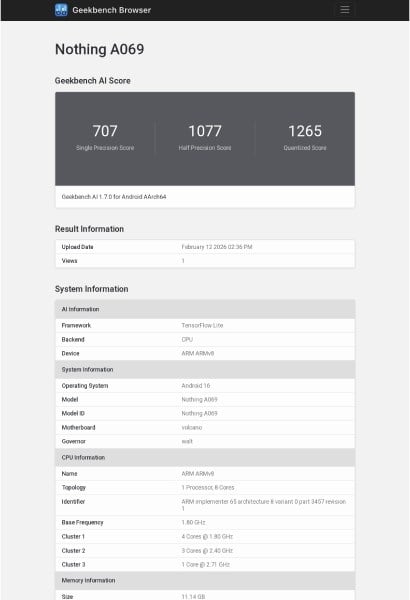
Nothing Phone (4a) Geekbench

The benchmark reveals that the Phone (4a) will run on Qualcomm’s Snapdragon 7s Gen 4, just a step up from the Snapdragon 7s Gen 3 on its predecessor. 

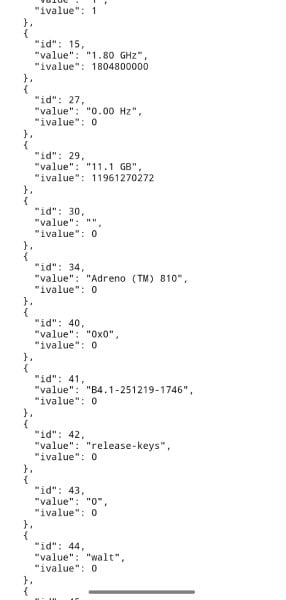
The chip features an octa-core CPU setup with one core clocked at 2.71GHz, three cores at 2.40GHz, and four efficiency cores running at 1.80GHz. Meanwhile, graphics duties are handled by the Adreno 810 GPU. 

Moreover, the tested unit on Geekbench comes with 12GB of RAM. But of course, Nothing may offer lower RAM variants at launch. Software-side is handled by Android 16 out of the box. 

As for the benchmark score, the Phone (4a) ran the AI benchmark with a single-precision score of 707, a high-precision score of 1077, and a 1265 quantized score. 

At this point, Geekbench results don’t tell the whole story. They don’t reveal anything about the display, camera system, battery size, or charging speeds. But they do confirm that Nothing is sticking with a capable midrange chip and pairing it with a relatively high amount of RAM.

The Phone (4a) will launch with the (4a) Pro and even an affordable pair of headphones, called the Headphone (a)

Unfortunately, though, there’s talk of a price increase this time around. Previous reports suggest upcoming Nothing phones could be 30% more expensive due to the ongoing DRAM shortage. 

We will know more when the device launches. Speaking of which, the new products are expected to launch in March, though Nothing hasn’t officially confirmed the date yet.

Don’t miss a thing! Join our Telegram community for instant updates and grab our free daily newsletter for the best tech stories!

For more daily updates, please visit our News Section.

(Via)

The post Nothing Phone (4a) runs Geekbench with Snapdragon chip and 12GB RAM appeared first on Gizmochina.

Lenovo announces Xiaoxin Pro GT 13, its largest 3.5K tablet display yet

12 February 2026 at 11:37
Lenovo-Xiaoxin-Pro-GT-13-tablet-display

Lenovo has officially announced the Xiaoxin Pro GT 13 as the biggest screen tablet in the Xiaoxin series.

As the name suggests, the headline feature is the 13-inch panel with a 3504 × 2190 resolution and a 16:10 aspect ratio. That works out to a 3.5K resolution and a pixel density of 319 PPI, making it also the highest-resolution screen on a Xiaoxin tablet. The screen refreshes at 144Hz. 

Moreover, Lenovo says the tablet has a typical brightness of 600 nits and a peak brightness of up to 800 nits. It also offers 12-bit color depth, covers 99 percent of the DCI-P3 color gamut, and supports Dolby Vision for HDR content.

Lenovo says the panel carries its PureSight Pro certification and has TÜV Rheinland certifications for low blue light and flicker-free performance. It has also passed testing by the National Eye Engineering Center, which the company highlights as a sign of eye comfort and display quality.

Lenovo Xiaoxin Pro GT 13 has an understated design

Design-wise, the Xiaoxin Pro GT 13 looks familiar. Teaser images show a back panel that closely resembles the Xiaoxin Pro GT tablet Lenovo released in 2025. One noticeable change is the camera setup. Instead of a dual-camera system, this model uses a single rear camera. Lenovo has confirmed it’s a 13-megapixel sensor.

The tablet will be available in two color options: pink and silver. Both versions feature a matte metallic finish.

What Lenovo hasn’t confirmed yet is the processor. Last year’s model came with the Snapdragon 8 Gen 3, so it’s reasonable to expect something in that range again. There’s speculation that it could feature a newer Snapdragon 8 Elite or even the Snapdragon 8 Gen 5, but for now, that remains unannounced.

Lenovo is expected to share more details in the coming days. And as always, we will keep you posted on that. 

For more daily updates, please visit our News Section.

Stay ahead in tech! Join our Telegram community and sign up for our daily newsletter of top stories.

The post Lenovo announces Xiaoxin Pro GT 13, its largest 3.5K tablet display yet appeared first on Gizmochina.

Xiaomi announces Xiaomi-Robotics-0, its first-generation robot large-scale model

12 February 2026 at 09:18
Xiaomi Cyberone robot

Xiaomi is best known for smartphones, smart home gear, and the occasional electric vehicle update. Now it wants a place in robotics research too.

The company has announced Xiaomi-Robotics-0, an open-source vision-language-action (VLA) model with 4.7 billion parameters. It’s designed to combine visual understanding, language comprehension, and real-time action execution, which Xiaomi says are the core of “physical intelligence.” And according to the company, it’s already setting multiple state-of-the-art records in both simulations and real-world tests.

At a high level, robotics models like this solve a closed loop: perception, decision, and execution. A robot needs to see the world, understand what it’s being asked to do, decide on a plan, and then carry it out smoothly. Xiaomi says Robotics-0 was built specifically to balance broad understanding with fine motor control.

The Xiaomi-Robotics-0 model is built on two main components

To do that, the model uses what’s known as a Mixture-of-Transformers (MoT) architecture. It splits responsibilities between two main components.

The first is a Visual Language Model (VLM), which acts as the “brain.” It’s trained to interpret human instructions — including vague ones like “Please fold the towel” — and understand spatial relationships from high-resolution visual input. This part handles object detection, visual question answering, and logical reasoning.

The second component is what Xiaomi calls the Action Expert. This is built around a multi-layer Diffusion Transformer (DiT). Instead of producing a single action at a time, it generates something called an “Action Chunk,” — understand it as a sequence of movements — using flow-matching techniques to keep motion accurate and smooth.

One common issue with VLA models is that when they learn to perform physical actions, they tend to lose some of their original understanding capabilities. Xiaomi says it avoided that by co-training the model on both multimodal data and action data. The result, at least in theory, is a system that can still reason about the world while learning how to move within it.

How is it trained?

The training process happens in stages. First, an “Action Proposal” mechanism forces the VLM to predict possible action distributions while interpreting images. This aligns its internal representation of what it sees with how actions are performed. After that, the VLM is frozen, and the DiT is trained separately to generate accurate action sequences from noise, relying on key-value features rather than discrete language tokens.

Xiaomi also tackled another practical problem called inference latency. It is when delays between model predictions and physical movement can create awkward pauses or unstable behavior. 

Xiaomi says it implemented an asynchronous inference, decoupling model computation from robot operation, so movements remain continuous even if the model takes extra time to think.

To improve stability, Xiaomi is using a “Clean Action Prefix” technique, which feeds the previously predicted action back into the model to ensure smooth, jitter-free motion over time. 

Meanwhile, a Λ-shaped attention mask biases the model toward current visual input instead of relying too heavily on past states. The goal is to make the robot more responsive to sudden environmental changes.

Xiaomi-Robotics-0 Benchmark

In benchmark testing, Xiaomi-Robotics-0 reportedly achieved state-of-the-art results in LIBERO, CALVIN, and SimplerEnv simulations, outperforming around 30 other models. 

More interestingly, Xiaomi deployed it on a dual-arm robot platform in real-world experiments. In long-horizon tasks like folding towels and disassembling building blocks, Xiaomi says the robot demonstrated steady hand-eye coordination and handled both rigid and flexible objects without obvious breakdowns.

Unlike earlier VLA systems that often sacrificed multimodal reasoning once action training began, the Robotics-0 model retains strong visual and language capabilities, especially in tasks that blend perception with physical interaction.

For more daily updates, please visit our News Section.

Stay ahead in tech! Join our Telegram community and sign up for our daily newsletter of top stories.

(Source)

The post Xiaomi announces Xiaomi-Robotics-0, its first-generation robot large-scale model appeared first on Gizmochina.

Yesterday — 12 February 2026Main stream

Aohi launches 310W Starship Pro powerbank with 20000mAh battery for just $70

11 February 2026 at 07:02
Aohi-Starship-Pro-powerbank-charging

Aohi has introduced a new high-capacity power bank for people who carry more than just a phone. The Future Starship Pro 310W packs a 20,000mAh battery and, at least on paper, enough power to replace multiple chargers in your bag. It’s priced at 499 yuan and comes in a silver-gray and black finish with a small display on the front.

The device measures 45.6 x 57.6 x 158mm and weighs around 630g, so it’s not exactly pocket-sized. But considering what it promises, the size feels expected. On the front, there’s a 1.14-inch TFT color screen that shows battery level and real-time output information. So instead of guessing how fast your laptop is charging, you can see the numbers directly.

Aohi 310W Starship Pro Specifications

The headline feature here is power output. The Starship Pro uses a 2C + 1A port configuration: two USB-C ports and one USB-A port. Both USB-C1 and USB-C2 support up to 140W input and output individually. The USB-A port tops out at 30W. When all three ports are used at once, the combined maximum output reaches 310W (140W + 140W + 30W), with what Aohi calls “smart power distribution” to manage charging across devices.

That means it’s technically capable of charging two high-power laptops at the same time, while still topping up a phone or accessory. It supports common fast-charging protocols including PD, QC, PPS (up to 100W), and UFCS (63W), which should make it compatible with a wide range of devices.

Aohi claims the 20,000mAh capacity can charge an iPhone 16 up to 4.1 times and a 12.9-inch iPad Pro about 1.4 times. The rated energy is 72Wh, using eight 2,500mAh lithium-ion cells from DMC.

What may matter even more for frequent travelers is recharge speed. The Starship Pro supports up to 180W self-charging input. In theory, that allows the power bank to go from 0 to 100 percent in around 60 minutes. 

It’s still a relatively heavy device at 630g, but for users who carry power-hungry laptops, tablets, and phones, the trade-off might make sense.

For more daily updates, please visit our News Section.

Stay ahead in tech! Join our Telegram community and sign up for our daily newsletter of top stories!

The post Aohi launches 310W Starship Pro powerbank with 20000mAh battery for just $70 appeared first on Gizmochina.

❌
❌