Normal view

Today — 19 February 2026Main stream

One UI 8.5: What to expect from Samsung’s next big upgrade?

18 February 2026 at 17:17
Samsung One UI 8.5 update

Next week is going to be an exciting one for Samsung fans, as the brand is preparing to launch the Galaxy S26 series. These upcoming devices will debut with One UI 8.5, which brings exciting visual changes, along with several new features and plenty of improvements throughout the system.

Unlike most incremental One UI upgrades, One UI 8.5 will be released to a wide array of Galaxy devices, including budget and entry-level smartphones. Now, with just a week remaining until its debut, it’s a good time to review what we already know so far, including details on eligible devices, the release timeline, and major changes.

Samsung devices eligible for the One UI 8.5 update

While One UI 8.5 is confirmed to debut with the Galaxy S26 series, Samsung hasn’t yet revealed the list of eligible devices. We might see that at the launch event.

However, based on the test builds spotted so far, it’s safe to say the One UI 8.5 update is coming to every Galaxy device that has received the One UI 8.0 update or launched with it.

  • Galaxy S series: Galaxy S25, S25+, S25 Ultra, S25 FE, S25 Edge, S24, S24+, S24 Ultra, S24 FE, S23, S23+, S23 Ultra, S23 FE, S22, S22+, S22 Ultra, S21 FE
  • Galaxy Z series: Galaxy Z TriFold, Z Fold 7, Z Flip 7, Z Fold SE, Z Fold 6, Z Flip 6, Z Fold 5, Z Flip 5, Z Fold 4, Z Flip 4
  • Galaxy Tab series: Galaxy Tab S11, Tab S11 Ultra, Tab S10+, Tab S10 Ultra, Tab S10 Lite, Tab S10 FE, Tab S10 FE+, Tab S9, Tab S9+, Tab S9 Ultra, Tab S9 FE, S9 FE+, Tab S8, Tab S8+, Tab S8 Ultra, Tab S6 Lite (2024), Tab A11, Tab A11+, Tab A9, Tab A9+, Tab Active 5, Tab Active 5 Pro
  • Galaxy A series: Galaxy A73, A56, A55, A54, A53, A36, A35, A34, A33, A26, A25, A24, A17 (LTE & 5G), A16 (LTE & 5G), A15 (LTE & 5G), A07 (LTE & 5G), A06 (LTE & 5G)
  • Galaxy F series: F56, F55, F54, F36, F34, F17, F16, F15, F07, F06
  • Galaxy M series: Galaxy M56, M55, M55s, M54, M53, M36, M35, M34, M33, M17, M16, M15, M07, M06
  • Galaxy XCover series: Galaxy XCover 7, XCover 7 Pro

When will your Samsung device receive the One UI 8.5 update?

Samsung typically starts rolling out the latest One UI software to older Galaxy devices a few weeks after its initial release. For One UI 8.5, reports say the rollout could begin in the second half of March 2026, starting with premium models like the Galaxy S25.

As for the One UI 8.5 beta program, it’s been live since December, but only for the Galaxy S25 series. Unfortunately, the company isn’t looking to expand it to more devices. This could mean a direct stable release for other Galaxy devices.

Samsung would hope to complete the One UI 8.5 rollout by Q2 2026, as the company reportedly plans to debut One UI 9.0 (based on Android 17) on upcoming foldables, the Galaxy Z Fold 8 and Galaxy Z Flip 8, in July 2026.

What are the major upgrades to One UI 8.5?

One UI 8.5 is still based on Android 16, but uses a newer build (QPR2), allowing Samsung to include deeper system-level features. Here are some of the major upgrades spotted in the beta builds released so far:

  • More customizable Quick Settings: The improved Quick Settings panel in One UI 8.5 allows users to adjust the layout of every toggle and slider.
  • Improved app icons: Samsung has updated app icons (at least Samsung’s apps) to feature a bit of 3D effect. Some first-party apps also show a similar effect.
  • Smarter lock screen: The lock screen now automatically adjusts the clock and date so they don’t cover the main subject of your lock screen wallpaper. It can display weather visuals based on current conditions.
  • Floating tab bar: Many Samsung apps feature a modern floating tab bar UI, replacing the traditional plain tab bar at the bottom. It’s a pill-shaped UI element with a frosted color scheme that improves the software experience.
  • Partial screen recording: This new feature captures a specific area of your phone rather than the entire screen.
  • Improved Photo Assist: With the latest improvements, Photo Assist allows interrupted image generations without needing users to save each iteration.
  • Storage Share: It lets you access files from other Galaxy devices, such as Galaxy tablets and PCs, directly within the My Files app on your smartphone.
  • Audio Broadcast: This feature enables your Galaxy phone to function as a microphone and broadcast your voice to nearby Bluetooth LE audio devices using Auracast technology.
  • Failed authentication lock: It automatically locks the device after multiple failed unlock attempts.
  • Block apps with excessive ads: This feature puts apps that send frequent ad notifications in deep sleep.

We’ll continue to update you with the latest developments around One UI 8.5 in the Samsung section on this website. Remember to visit that regularly. Also, join our Telegram channel to get instant notifications about the breaking news and software rollouts.

The post One UI 8.5: What to expect from Samsung’s next big upgrade? appeared first on Gizmochina.
Snapdragon 7s Gen 4 vs 7 Gen 3: Which is actually faster?

18 February 2026 at 12:11
Snapdragon 7s Gen 4 vs 7 Gen 3

The Snapdragon 7s Gen 4 is positioned as an affordable version of the 7 Gen 4 chipset, while still offering excellent performance and efficiency. However, it’s not a clear upgrade over the 7 Gen 3. The latter still dominates some key aspects, such as connectivity, whereas the 7s Gen 4 leverages the newer CPU and newer GPU. So, the real question is: which one delivers the better value?

In this post, we’ll dive deep into benchmark figures and crucial differences to find out if the newer Snapdragon 7s Gen 4 can actually outperform the 2023’s Snapdragon 7 Gen 3.

Snapdragon 7s Gen 4 vs 7 Gen 3: Spec sheet

Snapdragon 7s Gen 4Snapdragon 7 Gen 3
AnnouncedAugust 2025November 2023
Process node4nm (TSMC)4nm (TSMC)
CPU1 x 2.7GHz — Cortex-A720
3 x 2.4GHz — Cortex-A720
4 x 1.8GHz — Cortex-A520
1 x 2.63GHz — Cortex-A715
3 x 2.4GHz — Cortex-A715
4 x 1.8GHz — Cortex-A510
GPUAdreno 810
Snapdragon Elite Gaming features
Adreno 720
Snapdragon Elite Gaming features
NPUQualcomm Hexagon NPUQualcomm Hexagon NPU
MemoryLPDDR5, up to 3.0GHzLPDDR5, up to 3.2GHz
StorageUFS 3.1UFS 3.1
CameraQualcomm Spectra ISP (Triple ISPs, 12-bit)
up to 200MP single camera
up to 64MP single camera with zero shutter lag
up to 32+21MP dual cameras with zero shutter lag
up to 21MP triple cameras with zero shutter lag
up to 4K/30fps video recording
Qualcomm Spectra ISP (Triple ISPs, 12-bit)
up to 200MP single camera
up to 64MP single camera with zero shutter lag
up to 32+21MP dual cameras with zero shutter lag
up to 21MP triple cameras with zero shutter lag
up to 4K/60fps video recording
ConnectivitySnapdragon 5G modem (sub‑6GHz)
download speed: 2.9Gbps (peak speed)
Wi-Fi 6E (peak speed: 2.9Gbps)
Bluetooth 5.4
Snapdragon X63 5G modem (sub‑6GHz)
download speed: 5Gbps (peak speed)
Wi-Fi 6E (peak speed: 2.9Gbps)
Bluetooth 5.4

Snapdragon 7s Gen 4 vs 7 Gen 3: Benchmark scores

[Note: For the benchmark results, the tests were performed on the POCO M8 Pro (powered by Snapdragon 7s Gen 4) and OnePlus Nord CE 4 5G (powered by Snapdragon 7 Gen 3).]

Geekbench performance

Snapdragon 7s Gen 4 vs 7 Gen 3 - Geekbench score

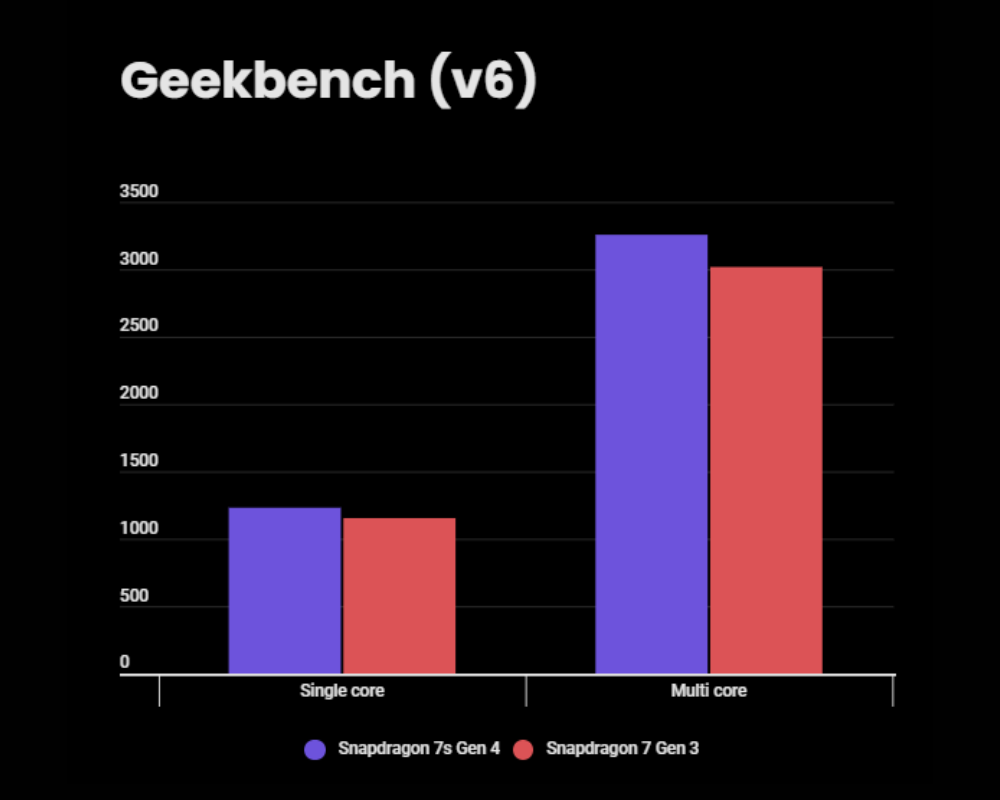
In the Geekbench test, the Snapdragon 7s Gen 4-driven POCO M8 Pro pulls ahead with 1,231 points in the single-core test and 3,257 points in the multi-core test. In contrast, the OnePlus Nord CE 4, powered by the Snapdragon 7 Gen 3, achieves 1,154 and 3,018 points in the single-core and multi-core tests, respectively.

While the difference isn’t significant, devices powered by the Snapdragon 7s Gen 4 should see noticeable improvements in demanding tasks. However, in everyday tasks such as browsing the internet, scrolling through social media feeds, and watching videos, there shouldn’t be any noticeable performance gap.

Snapdragon 7s Gen 4Snapdragon 7 Gen 3
Single core1,2311,154
Multi core3,2573,018
Geekbench score (v6)

AnTuTu performance

Snapdragon 7s Gen 4 vs 7 Gen 3 - AnTuTu score

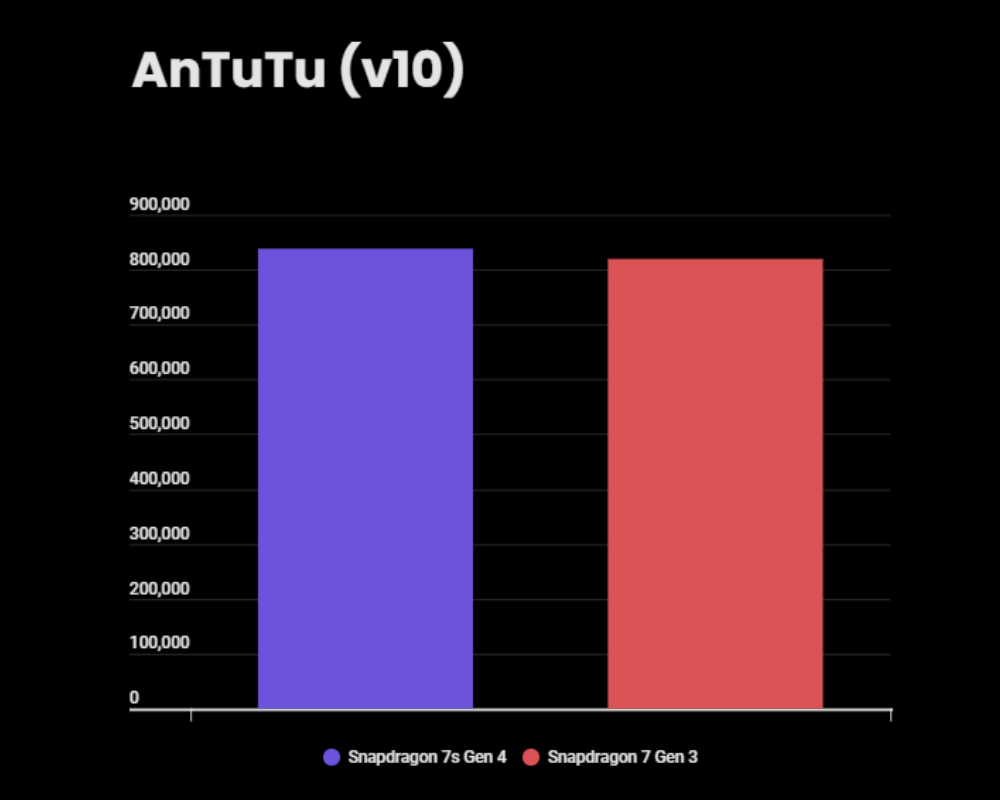
The Snapdragon 7s Gen 4 achieves a higher AnTuTu score, but the difference isn’t significant. The CPU score is also just above that of the 7 Gen 3 chip, posting a difference of just 2.8%. However, the 7 Gen 3 bounces back strongly in the GPU performance with a 21% higher score. We’ll tell you the reason in the following section.

Snapdragon 7s Gen 4Snapdragon 7 Gen 3
AnTuTu score838,402819,655
CPU276,892269,334
GPU211,590256,584
Memory162,373129,961
UX187,547163,776
AnTuTu score (v10)

As the benchmarks show, the newer Snapdragon 7s Gen 4 offers better CPU performance, but the 7 Gen 3 is still ahead in GPU performance. However, they don’t say anything about the camera’s performance or connectivity. So, let’s now look at the key differences to get a better picture.

Snapdragon 7s Gen 4 vs 7 Gen 3: Key differences that matter

CPU, GPU & NPU

Both Snapdragon chipsets use the same 1+3+4 core configuration, but the 7s Gen 4 features newer CPU cores that offer better performance and power efficiency. Plus, they run at higher speeds, further improving performance.

For gaming and graphics-related tasks, the Snapdragon 7s Gen 4 mainly relies on the Adreno 810 GPU, while the 7 Gen 3 features an Adreno 700-series GPU, the Adreno 720. Despite that, the latter is able to offer better GPU performance because it has a higher GPU frequency, more shading units, and faster computational capabilities.

Both chips feature Qualcomm Hexagon NPUs with a fused AI accelerator design. They can generate text, photos, and other content on-device. Plus, it helps with noise cancellation and improves the overall camera output.

Camera & Imaging

The camera specs are mostly the same, except that the 7 Gen 3 supports 4K video recording at 60 fps, while the 7s Gen 4 is limited to 30 fps. Note that the final output also depends on the camera sensor and OEM optimizations.

Connectivity

The Snapdragon 7s Gen 4 and 7 Gen 3 are identical in most connectivity areas, except that the 7 Gen 3 offers up to 5Gbps download speed over 5G, while the 7s Gen 4 peaks at 2.9Gbps. The rest of the connectivity specs are the same, as both offer sub-6GHz, mmWave 5G, Wi-Fi 6E, and Bluetooth v5.4.

Snapdragon 7s Gen 4 vs 7 Gen 3: Which is a better choice?

The Snapdragon 7 Gen 3 is a better choice, even though the 7s Gen 4 offers better CPU performance. That alone can’t justify the advantages provided by the Snapdragon 7 Gen 3, including a much better gaming performance, faster memory, and better video recording capabilities. The 7 Gen 3 also offers faster download speed over 5G.

If gaming isn’t your thing, the Snapdragon 7s Gen 4 might make more sense if you can get a device at a lower price than one powered by the Snapdragon 7 Gen 3.

The post Snapdragon 7s Gen 4 vs 7 Gen 3: Which is actually faster? appeared first on Gizmochina.

❌
❌