Login
Login

Exynos 2600 vs Snapdragon 8 Elite Gen 5: The battle gets more intense

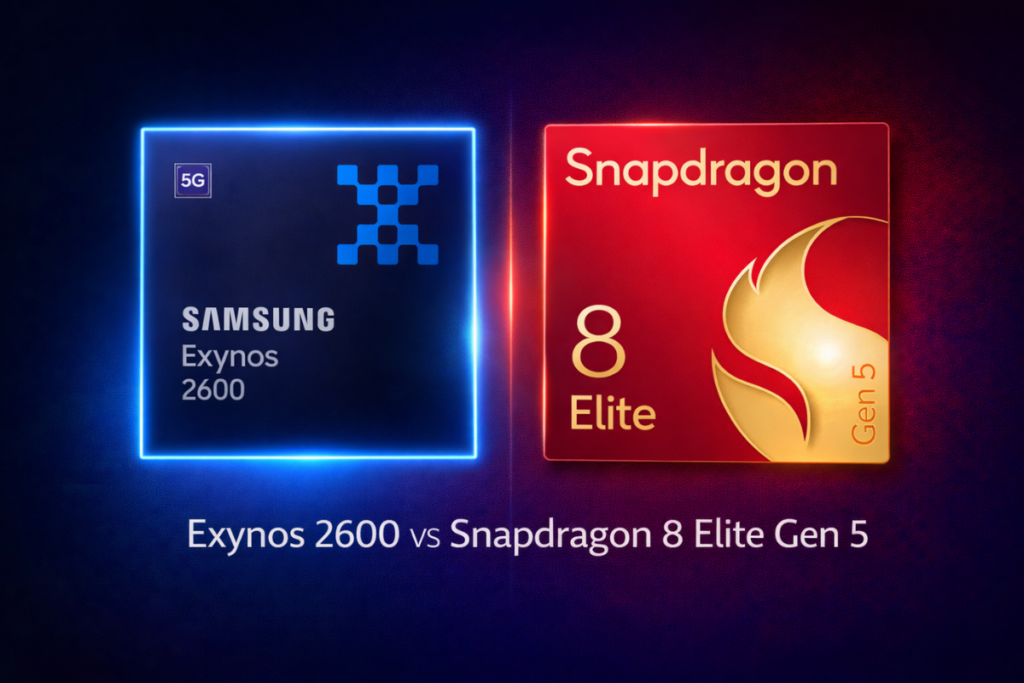
Samsung’s Exynos chipsets have historically been less powerful than Qualcomm’s Snapdragon chipsets. The latter has always dominated key aspects, including CPU, GPU, and connectivity. However, the newly-released Exynos 2600 narrows the gap significantly. In fact, it outperforms the Snapdragon 8 Elite Gen 5 on several benchmarks.
In this detailed comparison, we’ll make sense of the benchmark scores and dive into the key differences to understand how the Exynos 2600 and Snapdragon 8 Elite Gen 5 stack up against each other.
Let’s begin with a quick look at the spec sheet:
| Exynos 2600 | Snapdragon 8 Elite Gen 5 | |
|---|---|---|
| Announced | December 2025 | September 2025 |
| Process node | 2nm (TSMC) | 3nm (TSMC) |
| CPU cores | 10-core | 8-core |
| CPU cores | 1 x 3.8GHz — C1-Ultra 3 x 3.25GHz — C1-Pro 6 x 2.75GHz — C1-Pro | 2 x 4.61GHz — Oryon (3rd gen) 6 x 3.63GHz — Oryon (3rd gen) |
| GPU | Exynos Xclipse 960 GPU Ray tracing support Exynos Neural Super Sampling | Adreno 840 Ray tracing support Snapdragon Elite Gaming features |
| NPU | AI engine with 32K MAC NPU | Qualcomm Hexagon NPU Agentic AI support |
| Memory | LPDDR5X | LPDDR5X, up to 5.3 GHz |
| Storage | UFS 4.1 | UFS 4.1 |
| Camera | up to 320MP single camera up to 108MP single camera (30fps) up to 64MP+32MP dual cameras (30fps) up to 8K video recording real-time semantic segmentation | Qualcomm Spectra Triple ISP (20-bit) up to 320MP single camera up to 108MP single camera (MFNR, ZSL, 30fps) up to 48MP triple camera (MFNR, ZSL, 30fps) up to 8K video recording real-time semantic segmentation (limitless) Advanced Professional Video (APV) codec |
| Connectivity | Exynos 5410 modem download speed: 14.79Gbps (maximum) upload speed: 4.9Gbps (maximum) Wi-Fi 7 Bluetooth 6.0 | Snapdragon X85 5G modem download speed: 12.5Gbps (peak) upload speed: 3.7Gbps (peak) Wi-Fi 7 (peak speed: 5.8Gbps) Bluetooth 6.0 |
Exynos 2600 vs Snapdragon 8 Elite Gen 5: Benchmark scores
Since the Galaxy S26 trio has yet to reach Gizmochina’s house, we used NL Tech’s benchmark data. The Galaxy S26+ (Exynos 2600) and Galaxy S26 Ultra (Snapdragon 8 Elite Gen 5) were used in the testing.
Geekbench score (v6)
| Exynos 2600 | Snapdragon 8 Elite Gen 5 | |
| Single core | 3,126 | 3,690 |
| Multi core | 10,684 | 11,148 |
On Geekbench, the Exynos 2600 posts lower scores than the Snapdragon 8 Elite Gen 5. In the single-core test, the Snapdragon gets about 18% higher score, while the difference in multi-core scores is just 4%.
AnTuTu score (v11)
| Exynos 2600 | Snapdragon 8 Elite Gen 5 | |
| AnTuTu score | 2,663,898 | 3,396,880 |
| CPU | 788,803 | 1,014,266 |
| GPU | 1,091,141 | 1,388,476 |
| Memory | 359,328 | 346,871 |
| UX | 424,626 | 647,267 |
The Snapdragon 8 Elite Gen 5 shines on AnTuTu too, posting a total score close to 3.4 million (vs. 2.66 million on Exynos 2600). That 27% uplift in total score for the Snapdragon chip is also reflected in the CPU and GPU scores.
The Snapdragon 8 Elite Gen 5 also achieves a significantly higher score in the memory test, while the Exynos 2600 scores 3% higher in the user experience test.
3DMark score
Wild Life Extreme Stress Test
| Exynos 2600 | Snapdragon 8 Elite Gen 5 | |
| Best loop score | 7,077 | 7,084 |
| Lowest loop score | 2,988 | 3,067 |
| Stability | 42.2% | 43.3% |
Benchmark results from the 3DMark Wild Life Extreme Stress Test show that the Dimensity 2600 performs on par with the Snapdragon 8 Elite Gen 5. There isn’t a big gap in stability either.
Solar Bay Extreme Stress Test
| Exynos 2600 | Snapdragon 8 Elite Gen 5 | |
| Best loop score | 2,037 | 1,247 |
| Lowest loop score | 878 | 709 |
| Stability | 43.1% | 56.9% |
The Exynos 2600 surprisingly outperforms the Snapdragon 8 Elite Gen 5 in the Solar Bay Extreme Stress Test, which means that the latest phones have excellent ray tracing performance.
Now that we’re aware of the benchmark data, let’s dig further into the key differences to get a clearer picture.
Exynos 2600 vs Snapdragon 8 Elite Gen 5: Key differences
The Exynos 2600 was announced just three months after the Snapdragon 8 Elite Gen 5, as the world’s first smartphone chipset to use a 2nm process. In February 2026, it debuted with the Galaxy S26 series.
CPU, GPU, and NPU
The Exynos 2600 features a 10-core CPU, which includes one C1-Ultra prime core, three C1-Pro high-performance cores, and six C1-Pro high-efficiency cores. The Snapdragon 8 Elite uses a custom-designed Oryon CPU, featuring two Oryon prime cores (third-gen) and six Oryon performance cores (third-gen).
The Snapdragon 8 Elite benefits from a higher peak CPU speed, which is one of the reasons it scored higher in the single-core test on Geekbench. For graphics-intensive tasks, the Exynos 2600 relies on the Xclipse 960 GPU, while the Snapdragon chip uses the Adreno 840 GPU.
Both chipsets have highly capable GPUs with strong ray tracing capabilities. However, the Exynos 2600 may have an edge, as seen in 3DMark tests.
The Exynos 2600 and Snapdragon 8 Elite Gen 5 feature advanced NPUs optimized for on-device generative AI. They also use AI to optimize connectivity, camera, and many other aspects.
Camera
The Exynos 2600 introduces an AI-powered Visual Perception System (VPS), which replaces the traditional ISP with a dedicated AI subsystem for real-time scene analysis, object recognition, and noise reduction. This enables ultra-high-res processing at 60fps with over 50% better power efficiency than the Exynos 2400.
The Exynos chip features Deep Learning Video Noise Reduction (DVNR) for noise reduction in low-light conditions and supports hybrid OIS + AI-EIS for better stabilization.
On the other hand, the Snapdragon 8 Elite offers 20-bit triple AI-ISPs, delivering 4x dynamic range, real-time semantic segmentation with up to 250 layers, and direct NPU access to raw sensor data for on-device AI processing. Additionally, the chip offers a range of features to further improve the camera output, including object eraser, skin/sky tone enhancements, Night Vision 3.0, video object eraser, and Snapdragon Audio Sense.
Connectivity
The Exynos 2600 features a redesigned connectivity setup with an external modem (Exynos Modem 5410), offloading cellular, Wi-Fi, and Bluetooth from the main 2nm die to improve the thermal efficiency and space for CPU/GPU.
The Exynos chip supports a higher peak download speed of 14.79Gbps (vs. 12.5Gbps) and a higher peak upload speed of 4.9Gbps (vs. 3.7Gbps) on a cellular connection compared to the Snapdragon 8 Elite Gen 5.
The Snapdragon chip features an integrated Snapdragon X85 5G modem with FastConnect 7900 for robust connectivity. Wi-Fi 7 supports a peak speed of 5.8Gbps. Furthermore, the chip includes AI-powered optimizations for traffic prioritization, seamless Wi-Fi/cellular switching, and enhanced satellite support.
Exynos 2600 vs Snapdragon 8 Elite Gen 5: Which is a better choice?
Since we haven’t yet tested an Exynos 2600-powered Samsung phone, it’s difficult to say whether it’s the same story this year or if the Exynos 2600 completely outperforms the Snapdragon 8 Elite Gen 5. However, based on the benchmark data and spec sheet, the Exynos 2500 appears to be significantly better than its predecessor, particularly in gaming performance.
The Exynos chip also introduces major camera upgrades, including Deep Learning Video Noise Reduction. It now features a redesigned connectivity system with an external modem, which claims to improve thermal efficiency.
That said, the Snapdragon 8 Elite Gen 5 still delivers strong CPU performance and features a mature ISP with excellent imaging capabilities. Its robust connectivity system with better carrier support also makes a notable difference.
The post Exynos 2600 vs Snapdragon 8 Elite Gen 5: The battle gets more intense appeared first on Gizmochina.