Reading view

Top Five Altcoins To Stack Ahead of CLARITY Act Meeting Today

tardeview-top-altcoin

The post Top Five Altcoins To Stack Ahead of CLARITY Act Meeting Today appeared first on Coinpedia Fintech News

The CLARITY Act just moved one step closer to becoming law in the U.S., and crypto analysts are already pointing to a handful of altcoins that could benefit the most if the bill eventually reaches President Trump’s desk.

In a recent video analysis, an analyst broke down the newly released 309-page version of the legislation, arguing that the latest draft could quietly create major opportunities for several altcoins beyond Bitcoin and Ethereum.

The bill recently passed through the Senate Banking Committee and is designed to finally clarify which digital assets fall under SEC oversight and which qualify as commodities regulated by the CFTC.

XRP

XRP remains one of the biggest altcoins tied to the regulatory clarity narrative.

  • XRP is currently trading inside a triangle pattern.
  • Major support is near $1.39 while resistance sits around $1.59.
  • The price is stuck between its 50-day and 100-day moving averages.
  • The 4-hour RSI still looks weak.
  • Analysts say XRP could dip lower before attempting another breakout higher.

Solana (SOL)

Solana is seeing growing institutional attention ahead of possible crypto regulation progress.

  • Analyst pointed to growing ETF-related inflows into SOL.
  • Wall Street appears to already be positioning around Solana.
  • SOL recently faced rejection at a major resistance zone.
  • Technically, Solana could revisit support near $85 before another short-term rally.

Hyperliquid (HYPE)

Hyperliquid could benefit from the BRCA protections included inside the CLARITY Act.

  • The bill protects DeFi developers and blockchain infrastructure providers from money transmitter classification.
  • HYPE recently held strong support near $40.
  • Major resistance currently sits around $45.
  • Analyst say another bounce could happen after a possible retest near $38.

Chainlink (LINK)

Chainlink remains one of the biggest infrastructure plays tied to institutional crypto adoption.

  • With regulations on tipping, LINK could benefit as tokenization and institutional blockchain use continue growing.
  • LINK’s daily chart is currently showing bearish divergence signals.
  • Similar signals have previously marked major tops for Chainlink.
  • On the technical part, say LINK could revisit the $10 area before another larger rally develops.

Coinbase (COIN)

Interestingly, Valdez’s final “dark horse” pick was not an altcoin but Coinbase stock.

  • While not technically an altcoin, Coinbase was listed as a major beneficiary of the CLARITY Act.
  • Analyst pointed to Section 402 involving “qualified digital asset custodians.”
  • Having said that, Coinbase already acts as a custodian for several major ETF issuers.
  • BlackRock continues using Coinbase for Bitcoin custody services.
  • Analyst say growing institutional demand could place Coinbase among the biggest winners if the legislation advances further.

CLARITY Act Negotiations Stall Overnight As Senate Markup Looms This Morning

Crypto Market Structure Draft Bill

The post CLARITY Act Negotiations Stall Overnight As Senate Markup Looms This Morning appeared first on Coinpedia Fintech News

Negotiations over the CLARITY Act broke down late Tuesday night, hours before the Senate Banking Committee was due to mark up the crypto market structure bill.

A small bipartisan group of senators spent the evening trying to close the remaining gaps but ended without agreement, according to journalist Eleanor Terrett.

Senator Cynthia Lummis said the bill is 99% agreed upon and urged colleagues across the aisle to resolve the outstanding issues after the committee vote. She warned that failure to pass the legislation leaves the industry exposed to another FTX-style collapse with no regulatory framework in place.

“I hope my colleagues across the aisle will work with me to get the remaining 1% resolved after we pass this bill out of committee. Otherwise, when or if another FTX happens, we will have no one to blame but ourselves,” she said.

What’s Holding Up the Deal?

The latest version of the CLARITY Act spans more than 309 pages and is considered the most advanced crypto market structure bill the Senate has handled so far.

The legislation is designed to clearly separate which digital assets fall under SEC oversight and which are regulated by the CFTC. It also creates rules for crypto exchanges, brokers, stablecoins, self-custody protections, and blockchain developers.

However, two major issues reportedly caused negotiations to break down overnight.

The first involves ethics and conflict-of-interest provisions tied to the First Family and political figures involved in crypto-related businesses. Democrats, including Adam Schiff and Ruben Gallego, were pushing for stronger compromise language before supporting the bill.

According to Terrett, progress was reportedly made on the ethics side during negotiations.

The second and bigger issue involved concerns around the Blockchain Regulatory Certainty Act (BRCA). The BRCA provisions are meant to stop non-custodial software developers and blockchain infrastructure providers from being prosecuted under money transmitter laws.

Some Democrats raised last-minute concerns that parts of the language could weaken anti-money laundering enforcement protections.

Senate Vote Could Turn Partisan

At this stage, uncertainty still remains around how the five pro-crypto Democrats on the Banking Committee will vote during today’s markup session.

For now, expectations inside Washington are increasingly shifting toward a largely partisan committee vote instead of a bipartisan breakthrough.

Despite the overnight setback, industry leaders still see the legislation as the closest the U.S. has ever come to establishing comprehensive crypto regulation after years of legal uncertainty.

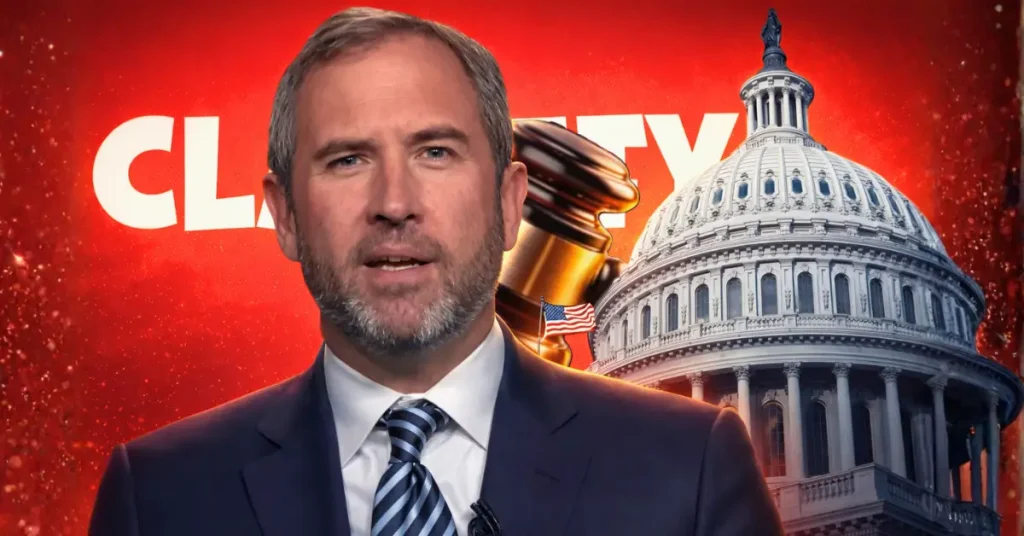
Brad Garlinghouse Says Crypto Regulation Is “Closer Than Ever” as Senate Votes on CLARITY Act

Ripple CEO Brad Garlinghouse Says Clarity Act Window is ‘Open’

The post Brad Garlinghouse Says Crypto Regulation Is “Closer Than Ever” as Senate Votes on CLARITY Act appeared first on Coinpedia Fintech News

The U.S. crypto industry is heading into one of its biggest regulatory moments yet as the Senate Banking Committee prepares to vote Thursday on the CLARITY Act, a major crypto market structure bill designed to finally bring clear rules to digital assets after years of uncertainty between the SEC and CFTC.

The legislation would define which crypto assets qualify as securities and which fall under commodities regulation, while also setting compliance rules for exchanges, brokers, dealers, stablecoins, and self-custody protections. The bill also includes anti-money laundering requirements and new oversight for Bitcoin ATMs.

Amid the growing momentum, Brad Garlinghouse said the industry is now “as close to the finish line as we’ve ever been.”

Brad Garlinghouse on how close the US may finally be to crypto regulatory clarity.

“𝘞𝘦’𝘳𝘦 𝘢𝘴 𝘤𝘭𝘰𝘴𝘦 𝘵𝘰 𝘵𝘩𝘦 𝘧𝘪𝘯𝘪𝘴𝘩 𝘭𝘪𝘯𝘦 𝘢𝘴 𝘸𝘦’𝘷𝘦 𝘦𝘷𝘦𝘳 𝘣𝘦𝘦𝘯.” pic.twitter.com/wU2KHdygFI

— Binance (@binance) May 13, 2026

“There’s actually a markup scheduled out of the Senate Banking Committee tomorrow morning,” Garlinghouse explained. “That is something we really haven’t been this far along.”

Ripple CEO Sees Major Shift in Washington

For many in crypto, Garlinghouse’s comments carry weight after Ripple spent nearly four years fighting the SEC in one of the industry’s most closely watched legal battles.

According to him, the political environment around crypto has changed dramatically compared to previous years.

“The shift from the Biden administration to the current administration has been a dramatic positive shift for the industry,” he said.

Garlinghouse also revealed the industry nearly reached a breakthrough earlier this year before negotiations reportedly stalled after Coinbase raised concerns and stepped away from talks publicly.

“When you create a vacuum in Washington, it gets filled,” he said, noting that banking groups and other industries quickly pushed their own concerns into the discussion afterward.

Industry Heavyweights Rally Behind the Bill

Despite political debates continuing around conflict-of-interest amendments tied to crypto businesses and government officials, support for the bill across the industry remains strong.

White House crypto advisor David Sacks called the markup “a monumental step in making the U.S. the Crypto Capital of the World.”

Meanwhile, Brian Armstrong described the bill as “strong,” saying it could make the U.S. financial system “faster, cheaper and more accessible.”

Marc Andreessen also backed the legislation publicly, while Charles Hoskinson called the latest draft a “massive improvement” compared to earlier versions.

Trump Signature Could Arrive Before Summer Ends

The bill will still need 60 Senate votes before advancing further, meaning bipartisan support remains critical.

Still, Garlinghouse feels that there is some positive movement and it’s finally building after years of delays.

“I think these prediction markets have the likelihood of around 70% of this passing this year,” he said.

Most importantly, he hinted that President Donald Trump could potentially sign major crypto legislation before the end of summer if progress continues.

Ripple News: XRP Whale Wallets Hit Record High as ETF Holdings Climb to $1.44 Billion

Ripple News $50B XRP Losses Grow as Analyst Points to $6.8 Capitulation Level

The post Ripple News: XRP Whale Wallets Hit Record High as ETF Holdings Climb to $1.44 Billion appeared first on Coinpedia Fintech News

XRP may still look stuck on the charts, but bigger holders clearly haven’t stopped accumulating. According to on-chain data shared by Santiment, the XRP Ledger has now reached an all-time high of 332,230 wallets holding at least 10,000 XRP.

The findings show that it has been steadily growing since June 2024, even through all the sideways price action and volatility this year. Though the numbers aren’t great, out of more than 7.7 million activated XRP addresses, wallets holding 10,000 XRP or more are considered part of a pretty exclusive bracket. Based on XRP rich list data, that amount puts a holder roughly in the top 5% globally.

Santiment says this kind of wallet growth usually points to long-term conviction rather than short-term trading. In simple terms, larger holders seem more interested in positioning early instead of waiting for hype and momentum later.

But here’s the catch: the accumulation keeps growing even though XRP is still trading below previous highs. Instead of chasing breakouts, many holders appear more comfortable buying during uncertainty.

ETF Exposure Keeps Expanding

On the other hand, big firms are showing interest in XRP products. According to Whale Insider, ETF clients recently bought another $5.31 million worth of XRP, pushing total XRP ETF-held assets to around $1.44 billion. While Bitcoin and ETH ETFs saw a routine outflow in comparison, XRP stayed positive on the trend.

JUST IN: ETF clients buy $5.31 million worth of $XRP, bringing total ETF-held net assets to $1.44 billion. pic.twitter.com/MlFWceZYkS

— Whale Insider (@WhaleInsider) May 13, 2026

That’s adding to the idea that institutions are still quietly building exposure even while retail traders grow frustrated with XRP’s slow movement.

February Panic Didn’t Last

Santiment also highlighted that more than 4,500 large XRP wallets disappeared between February 6 and 8 earlier this year.

However, the firm says that the drop was likely tied to the broader crypto market liquidation event on February 5 rather than anything directly related to XRP itself.

Since then, the number of large wallets has fully recovered and pushed to fresh all-time highs again.

XRP Still Needs a Breakout

Moving on to XRP, price action remains stuck inside a tight consolidation range along with much of the crypto market.

Macro analyst Neel said XRP still needs a clean break above the $1.60 level before any meaningful short-term rally can begin. According to him, a move above $2.00 would likely trigger stronger momentum and shift sentiment more aggressively bullish again.

$XRP remains stuck in a tight range along with the broader crypto market.

It needs a clear break above $1.60 for any meaningful short-term rally.

A move above $2.00 would generate fresh momentum.

CTs are clearly not happy with this sideways price action. pic.twitter.com/GprmtU2EFP

— Neel (@NeelMacro) May 12, 2026

For now, though, many traders across crypto social media remain frustrated with XRP’s sideways movement even as accumulation quietly continues in the background.

CFTC Chair Says Bitcoin Ban Has Slim to None Odds as Strategic Reserve Announcement Nears

A Commodity Futures Trading Commission (CFTC) seal next to a gold Bitcoin coin and rising gold candlestick charts on a green grid background.

The post CFTC Chair Says Bitcoin Ban Has Slim to None Odds as Strategic Reserve Announcement Nears appeared first on Coinpedia Fintech News

The Trump administration is continuing to double down on its pro-crypto stance, and recent comments from CFTC Chair Mike Selig gave one of the clearest signals yet about how Washington now views Bitcoin and digital assets.

Speaking during a conversation on the Market Disruptors Podcast with Mark Moss, Selig said the chances of the United States banning Bitcoin are now “slim to none.

“I think we must create a space for Bitcoin and crypto assets to flourish here,” Selig explained. “A space that’s future-proof, right? A space that we can’t have government coming in and seizing people’s crypto assets and Bitcoin.”

He argued that private property rights remain a core American principle and said those protections should extend to self-custody wallets and digital assets as well.

“This country was founded on the premise of private property,” he said. “All of our rights are derived from the right to own our own stuff.”

Trump Administration Pushes Crypto Roadmap

Selig repeatedly described Donald Trump as a “crypto president,” saying the White House is actively involved in shaping a long-term crypto roadmap for the country.

“We put out a report that really lays out what I believe is the blueprint to make the United States the absolute leader in crypto,” Selig said.

He pointed to the launch of regulated Bitcoin futures during Trump’s earlier administration as a major turning point for institutional adoption. Now, the White House is backing legislation like the Genius Act for stablecoins and the Clarity Act for broader crypto regulation.

Selig said the goal is to protect developers, exchanges, and self-custody users while preventing another version of “Operation Choke Point” or large-scale debanking of crypto businesses.

Strategic Bitcoin Reserve Narrative Grows

The conversation also touched on the growing Strategic Bitcoin Reserve narrative inside Washington.

Recently, White House crypto advisor Patrick Witt revealed that new announcements tied to the reserve and a broader digital asset stockpile could arrive “in the coming weeks.”

WHITE HOUSE DOUBLES DOWN ON THE STRATEGIC BITCOIN RESERVE 🇺🇸

Crypto Advisor Patrick Witt says $BTC is part of the “financial infrastructure of the future”.

New reserve announcements coming soon. 👀 https://t.co/WdcNwnvMQa pic.twitter.com/4msYVpWfjp

— CryptosRus (@CryptosR_Us) May 13, 2026

“We will be making announcements around the strategic Bitcoin reserve digital asset stockpile,” Witt said. “These assets are the new infrastructure, the new architecture of the financial future.”

He added that the administration now views Bitcoin similarly to gold and sees digital assets as increasingly important to America’s economic and national security strategy.

“We need to be leading on these,” Witt added, “and thinking very, very forward in terms of how we are approaching these assets.”

Pi Network News Today: Why Is Pi Network Rejecting Some KYC Applications?

pi-network-price-prediction-token-value-market-analysis.jpg

The post Pi Network News Today: Why Is Pi Network Rejecting Some KYC Applications? appeared first on Coinpedia Fintech News

Pi Network has addressed one of the biggest concerns inside the community lately, the “Tentative KYC” status. As the network keeps expanding, Pi revealed that more than 18.1 million users have now passed KYC verification, while over 16.7 million users have already migrated to Mainnet.

According to Pi, KYC remains one of the most important parts of the ecosystem because the entire network runs on a strict “one person, one account” system. The idea is to keep bots, fake accounts, and duplicate users out while protecting real Pioneers and keeping mining rewards fair.

So, What Does “Tentative KYC” Actually Mean?

Pi clarified that Tentative KYC does not mean your application was rejected.

Instead, it simply means the system needs a few extra checks before giving final approval. Some users may be asked to complete liveness checks, while others could go through additional reviews depending on their case.

Pi says these extra steps are important because allowing fake or duplicate accounts onto Mainnet could hurt the ecosystem long term.

To make things faster, the network has now rolled out new AI-powered upgrades behind the scenes. According to Pi, the updated system combines AI models, liveness verification, and application analysis to process applications more efficiently.

The company says millions of Tentative accounts have already been moved into eligible status, while the overall KYC backlog has also been reduced significantly.

Community Starts Discussing “Step 8” Again

The update also sparked renewed discussion about the mysterious “Step 8” issue many users still face.

I recall PiCoreTeam mentioning the KYC categorization to include palm authentication. Those who are currently on step 8 haven't received palm authentication yet. So, what's the next step? pic.twitter.com/4h7mV9N3PG

— 𝕏 FireSide | Pi π (@fireside_pi) May 13, 2026

A Pi-focused community account pointed out that the Pi Core Team had previously mentioned palm authentication as part of future KYC verification upgrades.

The account questioned what the next step could be for users currently stuck on Step 8 who still haven’t received any palm authentication requests yet.

Why Pi Says Strict KYC Matters

Pi says stricter verification is necessary to protect the ecosystem as the network grows.

Without proper KYC checks, duplicate accounts could enter Mainnet, mining rewards could become unfair, and apps built on Pi would struggle to trust user authenticity.

According to the team, verified participation will ultimately support future payments, digital services, commerce apps, and other real-world utilities built on the network.

TRON Defies Crowd Doubt as TRX Climbs Back Above $0.35

Tron (TRX) Price Prediction 2026 Can TRX Reach $0.37 Next

The post TRON Defies Crowd Doubt as TRX Climbs Back Above $0.35 appeared first on Coinpedia Fintech News

TRON (TRX) has been quietly gaining strength again while much of the crypto market remains focused on meme coins, AI projects, and newer Layer-2 networks. Despite the criticism that has followed the project for years, TRX has managed to climb nearly 26% over the last three months and is now trading back above $0.35 for the first time since September 2025.

At the time of writing, TRON is trading around $0.3494 with daily trading volume close to $738 million. The network currently has a circulating supply of nearly 94.8 billion TRX.

What makes the move interesting is that the broader sentiment around TRON remains divided.

Why TRON Still Faces Heavy Criticism

According to analytics platform Santiment, much of the skepticism tied to TRON still traces back to Justin Sun’s long-standing reputation within crypto.

Over the years, Sun has regularly faced accusations involving aggressive promotion tactics, market manipulation claims, lawsuits, and broader regulatory scrutiny. Even now, many retail traders continue viewing TRON as “too controversial” or “too risky” compared to newer ecosystems gaining momentum across the market.

The analytics firm also noted that despite TRX performing strongly throughout 2026, a large part of the crypto crowd still distrusts the project because of associations with earlier hype-driven market cycles.

Stablecoins Have Become Both TRON’s Strength and Weakness

Another major source of criticism has been TRON’s massive role in global stablecoin transfers. The network processes enormous USDT volumes because of its fast settlement speeds and low transaction fees.

However, critics argue that the same efficiency has also made TRON a preferred network for suspicious wallet activity and illicit transfers. Headlines involving Tether freezes linked to TRON wallets have repeatedly added to negative sentiment around the chain this year.

At the same time, some traders remain unconvinced by TRON’s ecosystem growth because much of the expansion has been driven by stablecoin activity and yield products rather than consumer-facing applications or flashy innovation narratives.

Why The Doubt May Actually Be Helping TRX

Ironically, Santiment says the constant skepticism surrounding TRON may actually be supporting the rally instead of hurting it.

Markets often struggle most when retail sentiment becomes overly euphoric. TRON, however, has spent much of 2026 climbing while hesitation, fear, and doubt remained dominant across social discussions.

In Santiment’s view, that lack of crowd conviction may still be leaving room for TRX to continue moving higher while much of the market looks elsewhere.

❌