Reading view

Developer successfully ports Linux to 1994 Sega 32X — Genesis and MegaDrive expansion runs open-source OS on paltry 23MHz processors and 256KB of RAM

The adventurous developer who recently released Linux for the Atari Jaguar (1993) has brewed up a version of the open-source OS for the Sega 32X (1994). If you can’t remember the 32X, it was Sega’s mid-gen answer to early fifth-generation challengers like the Jaguar, 3DO, and Amiga CD32. Sega’s solution added some potent processing power to a mushroom-like slot in an expansion to its popular Mega Drive/Genesis. Now cakehonolulu has got it running Linux, despite facing several major hurdles.

Compared to its Genesis host, the Sega 32X was incredibly muscular. The Genesis had relied on the capable but long-in-the-tooth Motorola 68000 (7 MHz) for years, but the 32X add-on boosted that with a pair of Hitachi SuperH SH2s (SH7604) CPUs (23 MHz). It also ramped up system RAM from the base 64KB by adding 256KB of its own. Sega’s expansion offered more than just speed; the console’s color palette was ramped up from 64 to 32,000 simultaneous colors on screen, and it was powerful enough to introduce hitherto unachievable 3D graphics elements to mainstream console gaming.

As with cakehonolulu’s tale of Linux wrangling on the old Jag, the above-linked blog talks through a long list of hurdles that needed to be leapt to get the Linux kernel booted and running BusyBox. This time around, particularly steely roadblocks included: the even more constrained RAM situation, the lack of hardware synchronization primitives, the desire to get SMP working across the pair of SH2 CPUs, no direct UART access from the 32X, and scheduler bugs, among other things.

On the positive side, smoothing the development process along were access to Chilly Willy’s 32X devkit, the linuxmd project, the Krikzz FPGA-based flash cart with ROM – RAM mapping tools, and existing SH2 documentation and sample projects. Please check through the linked blog for far more technical details from cakehonolulu.
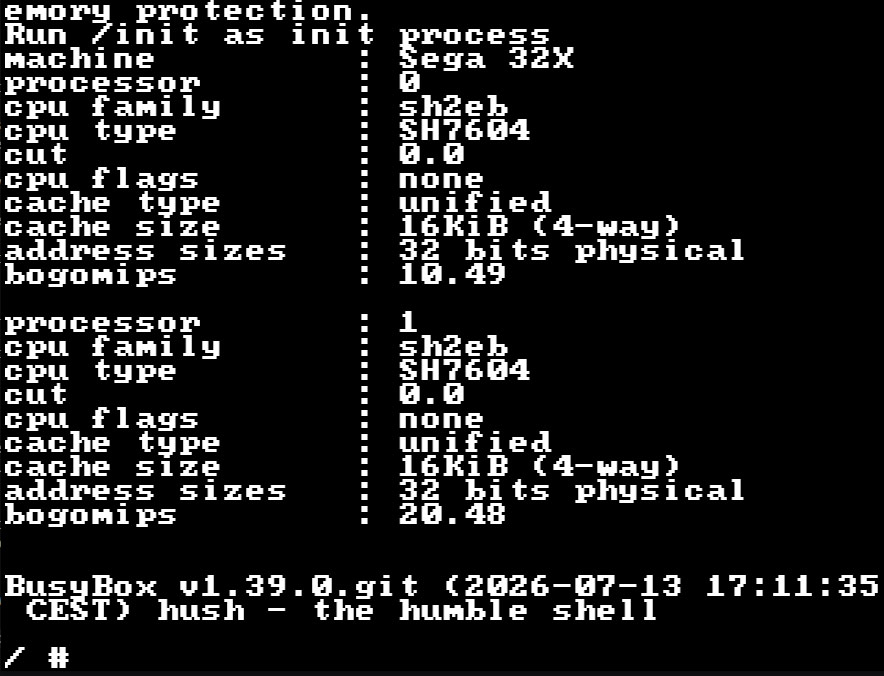
Linux now available for the Sega 32X

Linux booted with BusyBox prompt on the Sega 32X (Image credit: cakehonolulu)

As you can see, cakehonolulu was successful again. So, what’s the next stop for this adventurous dev – the Sega Saturn? Whatever the project may be, it was interesting to read that works like this are basically forming a portfolio for the Spanish dev, which they hope will help them with job hunting.
Sega Dreamcast driver fixes appear in Linux 7.2-rc3 — fabled console remains in favor while iconic computing architectures like i486 fall by the wayside

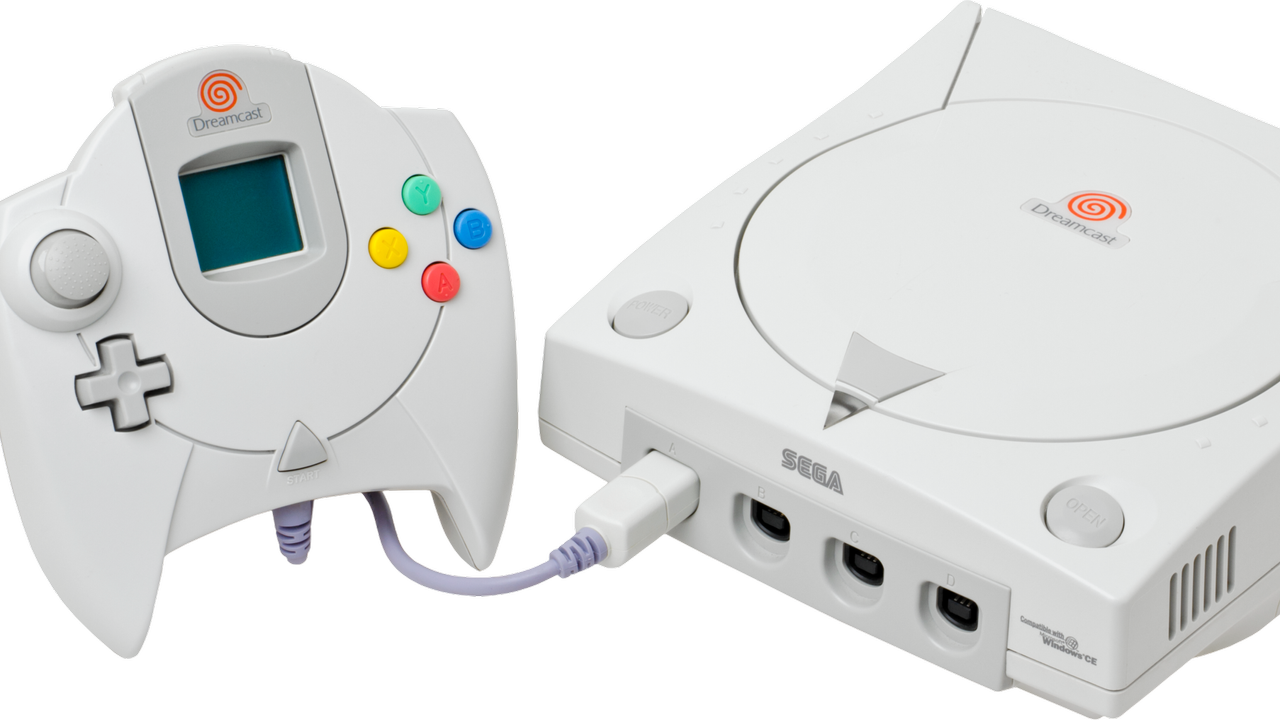
A set of updates for Sega Dreamcast hardware has been merged into the Linux 7.2-rc3 kernel this weekend. Dmitry Torokhov submitted updates addressing the legendary console’s input subsystem and Linus Torvalds merged them on Saturday. The updates even surprised Linux-focused site Phoronix, That’s probably due to context: the Dreamcast continues to enjoy support while admittedly older but real computing hardware like the i486, PowerPC 40x chips, DEC Alpha, and Itanium / IA‑64, have all been sidelined in recent times.

In brief, the updates should mean new versions of Linux will come with more stable mouse, keyboard, and joystick drivers for Dreamcast stalwarts. If you are one of the Dreamcast faithful, still satisfying your computing (and gaming) needs on the final original consumer gaming hardware from Sega, this is good news.

Reading the pull request we can see some details about the new drivers for the Dreamcast’s Maple‑bus peripherals (mouse, keyboard, controller). Specifically, there’s a “fix for a crash in Sega Dreamcast (Maple) mouse driver when opening the device, caused by missing driver data,” as well as “Fixes for Maple drivers (keyboard, mouse, joystick) to properly order setting driver data and device registration to avoid races.” In this context races refers to things happening in the wrong order to result in crashes: it’s a timing bug that’s now been quashed.

Dreamcast hangers-on will now be able to craft specialized Linux builds on CD-R for their machines. The maplemouse driver has had the now-fixed crash-inducing bug since 2017.

Phoronix also comments that Linux kernel fixes for the GD-ROM driver used by the Dreamcast and a proposal for the VMUFAT file-system driver were also seen this year.

The Sega Dreamcast launched at the end of 1998 (in Japan, and the following year in the U.S.). So, in some ways it isn’t that surprising that it is still getting Linux kernel updates when the Intel i486 (1989) has been retired from mainline support. But one might have expected stronger demand for supported Linux distributions among i486 desktop and laptop users.

Microsoft loses Brazilian court case after telling hacked Xbox user to re-purchase games — tech giant ordered to restore Xbox account with all games and pay $400 in damages

A Brazilian gamer who lost his Microsoft account and all his digital games has won a court order forcing the company to hand it all back, after support staff told him to simply repurchase his library. The user, who posts as Ordo_Liberal on Reddit, shared a screenshot of a small-claims ruling in the Xbox subreddit that gives Microsoft 15 days to restore access or face fines and roughly $400 (R$2,000) in damages. He said the account had two-factor authentication enabled when it was flagged and permanently suspended, and that none of Microsoft's recovery options allowed him to regain access before he filed his lawsuit.

According to the support emails he posted, Microsoft suspended the account after detecting what it described as unauthorized access, and said an investigation found the account's security information had been changed. The company treated the suspension as permanent and directed him to buy his games again rather than reinstating the ones already tied to the account.

Anyone with a large Microsoft account might want to take note here, because the suspension didn’t target a single game or console but the user’s entire account. Microsoft accounts can carry Xbox purchases, Windows licenses, store apps, 365, and OneDrive data, and a permanent suspension blocks all of it, even, as in this case, when you’ve got strong security and two-factor authentication set up.

Brazil's Consumer Defense Code and its small-claims track allow individuals to bring cases without a lawyer and without paying court costs, meaning Ordo_Liberal was able to take Microsoft to court without incurring any costs. If Microsoft misses the payment deadline, an additional 10% penalty will be imposed. While the damages awarded in this case are minor, it's notable that Microsoft has been compelled to restore the account and its contents, which runs counter to the standard platform position that customers license digital games rather than own them.

This, of course, is a first-instance small-claims judgment, not binding precedent, and it covers one account in one jurisdiction. Courts elsewhere have gone the other way. Chinese courts have recognized game accounts as inheritable property, while U.S. rulings generally treat games as revocable licenses. The case comes as both Microsoft and Sony push players away from physical media, with Xbox testing a way to convert discs into digital entitlements and Sony ending new PlayStation disc production in 2028. Microsoft hasn’t publicly commented on the ruling.

❌