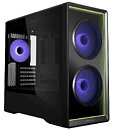
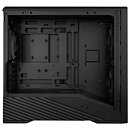
LIAN LI Industrial Co. Ltd., a leading manufacturer of chassis and PC accessories, announces the VECTOR V150 INF, a compact microATX chassis featuring a tempered glass infinity-mirror front panel, two pre-installed 140 mm ARGB PWM front fans, and a 120 mm rear fan. The V150 INF delivers both visual impact and effective cooling out of the box. A built-in hub enables fan and lighting control via standard motherboard software or Wireless mode, which, when paired with an L-Wireless controller (sold separately), allows full customization through L-Connect 3. Inside, a customizable side bracket offers a choice between additional cooling or expanded storage, while a pre-installed adjustable GPU anti-sag bracket ensures stable support for modern graphics cards. With support for standard and back-connect microATX motherboards, 400 mm of GPU clearance, and clean cable management, the V150 INF provides a refined and visually striking platform for compact gaming builds.
Infinity Mirror Design with Precision Airflow
The VECTOR V150 INF features a tempered glass front panel with a built-in infinity mirror, creating a strong, immersive visual effect. The panel includes precision-cutouts for the two pre-installed 140 mm front fans, ensuring direct airflow intake. These intakes are protected by removable mesh filters that can be easily detached by turning them left and pulling away, making maintenance simple and tool-free
StarTech.com, a global provider of performance connectivity solutions for IT professionals, announces the launch of its Driverless Dual 4K USB4 Universal Docking Station (208N-USB4-DOCK), an industry-first solution designed to deliver driverless dual-display support for MacBook users while enabling seamless compatibility across Windows and Linux laptops.
The new dock gives IT teams a single solution to standardize across their entire fleet. Native driverless compatibility removes the need for software installation, eliminating common deployment challenges and ensuring consistent performance across Mac, Windows, and Linux environments.
Star Wars: Galactic Racer, the high-stakes, runs-based Star Wars racing adventure, will be inviting budding pilots to shunt, slam, and takedown their rivals when the game launches on October 6th, 2026. Pre-orders open today, with digital Standard and Deluxe Editions, as well as a physical Collector's Edition, available across PlayStation 5 (PS5), Xbox Series X|S, and PC. Physical Standard and Deluxe Editions will also be available on PS5 and Xbox Series X|S. Pricing begins at an SRP of $59.99/£49.99/€59.99 for the Standard Edition.
Star Wars: Galactic Racer invites race fans to join the Galactic League, an unsanctioned racing circuit born in the lawless Outer Rim of the Star Wars galaxy. Step into the cockpit as mysterious pilot Shade in a thrilling singleplayer campaign where alliances will be forged, rivalries reignited, and old grudges will be settled. Experiment with your build strategies across three distinct styles of repulsorcraft to create your ultimate vehicle. Get behind the controls of podracers and put your skills to the test in this iconic vehicle class. Take your talents online in exciting multiplayer races to prove yourself as an elite racing pilot. No Force. No prophecy. Just skill, strategy, and the will to rise.
Hooded Horse, Unfrozen Studio, and Ubisoft are excited to share that the highly anticipated turn-based strategy game Heroes of Might and Magic: Olden Era is out now in early access for PC via Steam, the Microsoft Store (via Game Preview), and PC Game Pass.
The first new Heroes of Might and Magic game in over ten years, this next entry is made for series veterans and newcomers alike, built on the familiar foundations of one of the most critically acclaimed strategy series of all time. Engage in strategic empire building, epic turn-based tactical battles, and in-depth RPG mechanics, all while exploring a vibrant land brimming with secrets and dangers.
The trumpets of war ring out with praise for the latest instalment of the WWII real-time strategy game, Sudden Strike 5. Following the global release on April 23, the first wave of critics has hailed the game as a worthy successor, commending the development team at Kite Games for faithfully carrying forward the spirit of the series. Publisher Kalypso Media and Kite Games are proud to share these early reactions as players across the globe experience the game firsthand.
DualShockers commends the newest iteration of the franchise for preserving the Sudden Strike experience and carrying forward its long-standing tradition - "the Sudden Strike series has established itself as one of the best real-time strategy titles available, and Sudden Strike 5 keeps this legacy alive and well."
AV Access, a global leader in Pro AV and conferencing devices, proudly unveils the iDock B23, the newest flagship model in its iDock series. Engineered for competitive gamers and streamers who demand uncompromising visual performance, the iDock B23 delivers 8K @ 60 Hz output, triple-monitor support, and a 12-in-1 docking design—making it an all-in-one solution for high-refresh-rate gaming, live streaming, and seamless switching between devices.
"Professional gamers and creators often struggle with complex setups, cable clutter, and the need to switch between multiple systems," said Bill Liao, CTO of AV Access. "The iDock B23 solves these challenges by combining triple-monitor output, 8K clarity, and a full docking station into one streamlined device."
Today, HP Inc. announced new additions to its HyperX portfolio, designed to give players control, personalization, and comfort. Built for how you play, the new lineup introduces the HyperX Clutch Talon Controller, the HyperX Cloud Stinger 3 headset family, and enhanced HyperX NGENUITY software -empowering gamers to fine-tune their setup and perform their best across platforms.
HyperX solutions prioritize combining player experience and machine performance to unlock maximum potential. With a continued focus on performance, personalization and play, NGENUITY software and the latest peripherals deliver precision, flexibility, and reliability players need to stay competitive and connected.
LG Electronics USA today announced U.S. availability for its 2026 LG gram laptop lineup. All four new series of laptops—LG gram Pro, LG gram Pro 2-in-1, LG gram and LG gram Book—are now available at LG.com and LG-authorized retailers. To celebrate the 2026 lineup launch, LG is offering a 1-year Premium Care service plan on select LG gram laptops for only $1 until May 10, 2026.
Powered by next-generation Intel Core Ultra and AMD Ryzen AI processors, the 2026 gram lineup combines ultra-light portability, military-grade durability and Dual AI capabilities for professionals, creators, students and everyday users.
Samsung Electronics today introduced Galaxy Book6 Enterprise Edition, the first Galaxy Book designed specifically for an enterprise environment. Powered by the latest Intel Core Ultra Series 3 processors with Intel vPro, Galaxy Book6 Enterprise Edition combines the reliable performance, security and manageability required for modern enterprise environments.
"Galaxy Book6 Enterprise Edition marks an important step in expanding the Galaxy Book series into enterprise computing," said Andrew Chun, CVP & Head of B2B NPC Group, Mobile eXperience (MX) Business at Samsung Electronics. "We're excited to bring the connected Galaxy experience to enterprise IT environments to help enable seamless workflows across devices and businesses."
Samsung has reported a record quarterly profit for Q1 2026, with chip division operating income jumping to 53.7 trillion won ($36.15 billion), a 49% increase from the 1.1 trillion won ($745 million) posted in the same quarter last year. That figure accounted for 94% of the company's total operating profit of 57.2 trillion won ($38.7 billion), which itself was up from 6.69 trillion won a year prior. Overall revenue rose 69% year over year to 133.9 trillion won ($90.6 billion). Its record profit came mostly from the AI data center sector that pushed demand for advanced memory well beyond what Samsung and its peers can supply. The company has signed multi-year binding supply contracts with customers looking to lock in capacity, though it hasn't disclosed names or terms. Samsung's memory chief Kim Jaejune told analysts that supply is already falling well short of demand, and that based on orders already received, the gap in 2027 is expected to be even wider than in 2026.
On HBM specifically, Samsung said it began mass-production sales of HBM4 for NVIDIA's Vera Rubin platform in February and is on track to more than triple HBM revenue this year versus last. However, rising memory prices are affecting the profit of other Samsung businesses. Mobile and network division profit fell 35% to 2.8 trillion won, due to higher component costs, and the display division saw operating profit drop 20% to 400 billion won ($270 million). Reuters also reports the risk of a strike, with unions representing a large portion of Samsung's South Korean chip workforce considering work stoppages over pay disputes. For the rest of 2026, Samsung expects that increasing demand will keep pushing memory, foundry, and display businesses.
As data sovereignty and compute performance become strategic differentiators for enterprises adopting AI, the demand for private, on-premises AI infrastructure continues to grow. In response to this shift, QNAP Systems, Inc., a leading innovator in computing, networking, and storage solutions, today introduced the QAI-h1290FX, a next-generation Edge AI storage server designed to empower private deployment of large language models (LLMs), Retrieval-Augmented Generation (RAG) search engines, and generative AI applications.
Built with server-grade AMD EPYC processing, with support for NVIDIA RTX GPU acceleration, and twelve U.2 NVMe/SATA SSD slots, the QAI-h1290FX delivers a high-performance, on-prem AI infrastructure for organizations that demand low-latency inference, full data privacy, and operational control—without relying on the cloud.
Alphacool International GmbH from Braunschweig is a pioneer in PC water-cooling technology. With one of the most comprehensive product portfolios in the industry and over 20 years of experience, Alphacool is once again expanding its portfolio with the new Apex Grip Fittings & Adapter. The new Alphacool Apex Grip Fittings are based on a modular system that enables flexible and customized connection solutions for modern custom water-cooling setups. Combined with the refined Apex design, high-quality workmanship, and user-friendly handling, the series is ideal for demanding systems.
A key feature is the integrated silicone surface on the outer grip area of each fitting. It provides improved grip when tightening by hand and makes installation easier, especially in confined spaces. This gives users greater comfort and control during assembly. Made from high-quality brass, the fittings offer excellent stability and long-term durability. A premium coating helps prevent paint chipping while emphasizing the elegant appearance of the series.
Clean lines, powerful cooling, uncompromising looks: With the Steel Shark, Sharkoon presents a stylish dual-chamber ATX case that combines modern design with an especially clean interior layout. Tempered glass on the front and side panel, four pre-installed ARGB PWM fans, extensive cooling options, and BTF support make the Steel Shark the ideal foundation for powerful and visually impressive gaming systems.
Neat Dual-Chamber Design
Thanks to its well-thought-out dual-chamber design, the Steel Shark clearly separates the hardware area from the power supply and cable management. This results in an extra tidy look in the main chamber, while cables, drives, and the power supply can be discreetly housed at the rear.
Gigabyte Technology Co. Ltd, a leading manufacturer of motherboards, graphics cards, and hardware solutions, today announced an unprecedented achievement: the X870 AORUS STEALTH ICE, X870E AORUS XTREME X3D AI TOP, X870E AORUS MASTER X3D ICE, and X870E AERO X3D WOOD winning Red Dot Design Awards 2026 in Product Design—one of the most coveted international distinctions in design excellence—across its major motherboard lineup. This milestone underscores Gigabyte's unwavering commitment to innovation and design excellence, further cementing its distinguished legacy in product design.
These four award recipients each received recognition for their unique fusion of bold aesthetics, precision engineering, and user-centric innovation. From the connector-reverse minimalism of the STEALTH ICE to the organic warmth of the AERO X3D WOOD, these four boards demonstrate that performance hardware and inspired design are not a compromise—they are one and the same.
LG Electronics (LG) is rolling out its new UltraGear evo GM9 5K gaming monitor (model 27GM950B) powered by Hyper Mini LED technology. First unveiled at CES 2026, the 27GM950B reinforces LG's commitment to delivering high-performance gaming monitors combining next-gen display technology with advanced gaming features.
LG's latest UltraGear evo model meets growing demand for 5K gaming monitors offering precise, dynamic visuals. The 5K resolution (5,120 x 2,880) comes together with the company's Hyper Mini LED technology to supply greater clarity, depth and realism, making gameplay more immersive and lifelike.
Gigabyte Technology Co. Ltd, a leading manufacturer of motherboards, graphics cards, and hardware solutions, today announced a comprehensive BIOS update rollout for its Intel 800, 700, and 600 series motherboards, adding full support for the newly introduced HUDIMM (One Sub-channel DDR5) memory standard. The move reflects Gigabyte's ongoing commitment to empowering users at every budget level, particularly as global DDR5 memory prices remain elevated amid continued supply constraints.
Lowering the Cost of Building on DDR5
One Sub-Channel is a new DDR5 memory specification that utilizes a single 32-bit sub-channel instead of the dual 32-bit sub-channels found in standard UDIMM modules. By adjusting the DRAM chip count per module, HUDIMM (One Sub-channel DDR5) enables memory manufacturers to provide DDR5 sticks at significantly lower price—making modern DDR5 platforms more accessible to mainstream users, system integrators, and entry-level builders who have previously been priced out of the DDR5 ecosystem.
MSI IPC announces the launch of the MS-CF27, a compact 3.5" single board computer designed to deliver reliable computing performance, wide voltage power input, and versatile connectivity for industrial and embedded solutions.
The MS-CF27 is a newly introduced 3.5" single board computer from MSI IPC that integrates Intel Alder Lake N, Twin Lake N, and Amston Lake processors to deliver efficient performance for industrial computing. Designed for fanless and ultra low power environments, the platform supports processors such as Intel Alder Lake N97, Intel Alder Lake N305, Intel Twin Lake N150, and Intel Amston Lake x7433RE, offering performance levels suitable for both PC client and embedded applications.
ASRock, the global leading manufacturer of motherboards, graphics cards, mini PCs, gaming monitors, power supply units and AIOs, today announced the launch of the X870E Taichi White, the first pure-white motherboard in its flagship Taichi series. Featuring a futuristic, digital-inspired white design, the X870E Taichi White introduces a bold new look to the Taichi family. In addition to its eye-catching appearance, it is built with flagship-level hardware to deliver both refined aesthetics and outstanding performance. Designed to pair perfectly with the newly launched AMD Ryzen 9 9950X3D2 Dual Edition processor, the X870E Taichi White reflects the growing popularity of white PC builds while redefining flagship style and performance in a pure-white form.
The X870E Taichi White introduces a futuristic, all-white design inspired by a digital sci-fi aesthetic. While staying true to the Taichi series' philosophy of balance, it reinterprets that identity through a more modern and refined visual language. Blending premium craftsmanship with an elegant new look, it brings a fresh dimension to the Taichi flagship.
Following a rather successful launch in mid-April, the development studio behind Windrose, the co-op pirate survival game, has announced an early roadmap to give players some sense of what to expect from the game in the next few months. The first order of business, and likely the most important for most players, is the announcement that Kraken Express will be focusing on improving the experience and delivering quality of life updates for the foreseeable future. Specifically, the developer has an update planned for sometime in early May that will improve connectivity issues, reduce CPU usage on idle clients and servers, address SSD load during gameplay, and improve performance and stability. The update will also introduce over 40 new building pieces and over 50 other fixes and quality of life changes.
In addition to the announcement of the bug fixes and minor changes, Kraken Express also revealed that it will start actively working on the game's first major content update as soon as the aforementioned fixes have shipped, but it also asked the community for patience because it will take "at least six months to deliver" the new content update. The upcoming update will introduce the game's first additional biome, called Ashlands, which will likely feature new enemies and crafting opportunities, but other than that, not much is known about the new content planned. Regarding the update, the developer says that "Our philosophy now is to enrich the current gameplay systems, instead of only adding new biomes with the respective content, so even before we have the full details, it's safe to say the game will not just grow in size - it will also evolve." Kraken Express was also careful to reiterate on the game's official Discord server that it does not plan to do wipes at any point in time, so no progress will be lost with the introduction of major content updates, like Ashlands.
The Linux community's response to the advent of LLMs and generative AI has been very mixed, but Ubuntu has more or less made its stance clear in a recent project discussion thread about the future of AI in Ubuntu. The gist of it is that, starting with Ubuntu 26.10 Stonking Stingray in October 2026—the next major release after 26.04—Ubuntu will start to get new AI features scattered throughout the operating system. The project's technical lead, Jon Seager, states that in 2026, Ubuntu has started encouraging its developers to use AI internally, incentivizing engineers to "go deep" and effectively figure out what works and what doesn't by measuring output. As internal adoption increases, Canonical will be integrating AI into the OS, but he notes that "responsibility and transparency are at the core of our approach."
This approach means that, instead of stuffing ChatGPT into every nook and cranny of Ubuntu, Canonical will prioritize open source models and offline, local inference wherever possible. Canonical will also pay special attention to the terms of the model, as opposed to simply considering whether the weights are open. The AI implementations will come in the form of what Seager describes as implicit and explicit features—implicit being features that integrate directly into the OS and enhance its standard operation, like speech-to-text and OCR, while explicit features are AI-centric features, like agentic and AI-automated workflows. "Implicit AI features will improve what Ubuntu already does; explicit AI will be introduced as new features." The full statement on how Canonical will implement AI in Ubuntu follows.
Thick as Thieves, an upcoming stealth co-op game from Deus Ex creator, Warren Spector, has been out in the open for a while now, with a release date set for May 20, and it was revealed long ago that it would be a stealth PvE co-op experience, but OtherSide Entertainment and Megabit Publishing, the studios behind the game, have just divulged more information about the game. First off, the price has been set at a very inoffensive $4.99/£4.99/€4.99, although it's likely that there will be regional pricing at play in other markets. Secondly, a gameplay walkthrough has been published to Megabit Publishing's YouTube channel, giving players a fairly in-depth look at the stealth, traversal, and progression mechanics, among others. Thick as Thieves is designed to be played as a single-player game or in a team of two players, and the game is set in an alternate history version of the early 20th century that features everything from magic and early technological innovation to eldritch horrors. The game will launch on Steam on May 20, 2026.
Thick as Thieves will drop players into Kilcairn as a stranger just joining the thieves' guild and looking to make a name for themselves. There are two playable characters, each with their own specific abilities, strengths, and weaknesses, although only one will be available to players with the other hidden behind an in-game unlock. The core gameplay, as you may have already guessed, revolves around players taking on and completing heists in the town of Kilcairn. In order to complete these heists, players will need to sneak through highly patrolled areas, solve environmental puzzles, and pick locks to gain access to forbidden areas. The gameplay walkthrough showed off a number of interesting mechanics, like the dynamic stealth and detection systems that force players to think on their feet and avoid making too much noise, and the various ways players can manipulate their surroundings and enemy NPCs to misdirect and trick them in order to get past—including distracting guards and shrouding the room in darkness by turning off lights, or using gear to lure the guards away entirely. The gameplay is designed to be highly replayable, with each heist offering players different choices and routes to explore. The Thick as Thieves gameplay walkthrough follows.
Unless you've been living under a rock, you've seen the numerous issues Windows users have faced, from poor performance to experience-breaking bugs and updates, and AI oversaturation in the OS. While Microsoft has previously announced that it intends to address many of these complaints levelled by Windows users, a new report out of Windows Central purports to have insider information about what the publication calls "Windows K2." K2 isn't a specific version of Windows or a new update that's on the horizon; instead, it's a new initiative within Microsoft that fundamentally changes how the software giant develops Windows and its features.
According to inside sources, Windows K2 is based on three core tenets: performance, craft, and reliability, and it will effectively serve as a reboot for the user experience and the development standard operating procedures. Going forward, Microsoft will be using Insider feedback, user telemetry analytics, and customer focus groups to ensure that Windows 11 is performant, thoughtfully designed, and stable. The biggest shift, however, is away from a focus on agility, which used to be a top priority for Windows development, to an emphasis on quality. Effectively, this means users may see fewer updates and fewer features in those updates, but also fewer bugs. One of the other main driving forces behind K2 is chasing the performance of SteamOS, and the K2 team believes that "foundational changes" that are being made to Windows in the coming months will be able to put Windows on par with SteamOS within the next year or two. File explorer is another major focal point where Windows K2 seeks to improve navigation, search, and file processing performance.
Qualcomm Incorporated (NASDAQ: QCOM) today announced results for its fiscal second quarter ended March 29, 2026.
"We are pleased to deliver results in line with our guidance, reflecting solid execution as we navigate a challenging memory environment," said Cristiano Amon, President and CEO of Qualcomm Incorporated. "We are in a period of profound industry transformation—the rise of AI agents is reshaping our roadmap across every platform we develop. We are equally excited by our entry into the data center, where a leading hyperscaler custom silicon engagement is on track for initial shipments later this calendar year. We look forward to providing an update on our growth initiatives, including opportunities in Data Center and Physical AI, at our Investor Day on June 24."
Microsoft Corp. today announced the following results for the quarter ended March 31, 2026, as compared to the corresponding period of last fiscal year:
Revenue was $82.9 billion and increased 18% (up 15% in constant currency)
Operating income was $38.4 billion and increased 20% (up 16% in constant currency)
Net income was $31.8 billion and increased 23% on a GAAP basis, and increased 20% (up 18% in constant currency) on a non-GAAP basis
Diluted earnings per share was $4.27 and increased 23% on a GAAP basis, and increased 21% (up 18% in constant currency) on a non-GAAP basis
Non-GAAP results exclude the impact from investments in OpenAI, explained in the Non-GAAP Definition section below
"We are focused on delivering cloud and AI infrastructure and solutions that empower every business to eval-max their outcomes in the agentic computing era," said Satya Nadella, chairman and chief executive officer of Microsoft. "Our AI business surpassed an annual revenue run rate of $37 billion, up 123% year-over-year."
Microsoft PowerToys is an oft-recommended utility that makes Windows 11 much more user-friendly by adding new features and UI tweaks to Microsoft's desktop OS. In an update not too long ago, PowerToys got a nifty dock, and before that a Command Palette, just like KDE's Krunner and macOS's Spotlight. Now, in an April update, version 0.99, Power Toys is getting a handful of new features that make Windows a little more like Linux and macOS. The first notable feature is Grab and Move, which allows you to hold Alt and left click to grab and move a window without having to aim for the border. Holding Alt and right click lets you resize a window from the nearest edge. If you're not familiar with Linux, this is exactly how most Linux desktop environments, like KDE Plasma and Gnome, work, except they generally use the System or Windows key as a modifier.
The other new addition to PowerToys 0.99 is Power Display, which allows you to change external display settings, like the source, power state, brightness, and contrast, from a taskbar fly-out menu. Users can also create specific display profiles that can be displayed and selected from the task bar menu. There are also minor changes to the keyboard layout editor, which now has support for selecting keys that are not physically available on your keyboard when setting up shortcuts and chords. The Command Palette also now features a compact dock option for those with limited screen space, and it has received several new features, including persistent calculator history and options for how applets pin to the dock and how the dock interacts with windows—you can choose to keep the dock above all windows, and there is a new dialogue to choose where apps pin to the dock.
Not long after EA announced that it was being acquired by a group of private investors, the company's new management announced an AI pivot that would see the company cut operating costs significantly. As it turned out, though, workers at EA would later reveal that the company had been pushing AI hard internally long before the takeover, and that the AI push was causing more harm than good and ultimately costing them time. Now, EA CEO, Andrew Wilson, has pushed back on this notion during a recent talk at the Iicon gaming event in Las Vegas.
According to Wilson, "almost all, like 85%, of our quality assurance is done with some kind of machine learning or AI-driven algorithm." However, he also adds that EA's QA hiring is at an all-time high. His argument is that AI has been "almost entirely augmentation," and not a replacement for human workers. According to the CEO, AI is doing mundane checks, like "turn the box on, turn the box off, boot it up, shut it down, does it crash, all these things." Despite these claims, there is evidence of AI-generated assets in Battlefield, and the company has partnered with Stability AI to work on generative AI tools.
According to sources close to MacRumors, Apple is abandoning the development of the next-generation Vision Pro headset after the product failed to capture significant market share. With sales of "only" 600,000 units, Apple has not seen this product line take off as its other products have. Launched in February 2024, the Vision Pro headset debuted with a steep $3,499 price tag. In October 2025, about a year and a half later, Apple updated the Vision Pro with its latest 3 nm M5 SoC, typically used in MacBooks, but even this refresh failed to generate significant interest and orders from users. Although the system offers a technically impressive solution, the market has reacted poorly, particularly due to the high price point Apple set.
Technically, the headset features a micro-OLED 3D display system with 23 million pixels and weighs between 750-800 grams, depending on the headband choice. However, users have complained about the device's weight and distribution, especially around the nose area, which often feels heavy on a single pressure point. No headband choice has been able to completely alleviate this issue. Additionally, the price point is too high for consumers, especially for a technology that is relatively new to the Apple ecosystem. As a result, MacRumors tipsters suggest that Apple is close to completely abandoning the project.
Intel and SoftBank, through their subsidiary Saimemory, have been developing an alternative technology to the popular high-bandwidth memory (HBM) to provide more bandwidth and capacity for memory modules used with powerful AI accelerators. At VLSI 2026 in June, Saimemory is scheduled to present a paper on the newly developed HB3DM memory, which is based on Z-Angle Memory (ZAM) technology. This name refers to the vertical (Z-axis) stacking of dies, similar to traditional HBM. However, Intel aims to achieve impressive results using state-of-the-art manufacturing technology. The first generation of HB3DM will feature a total of nine layers, stacked using a hybrid bonding technique for 3D chip placement. At the base will be a logic layer that manages data movement within the chip, with eight DRAM layers on top for data storage. Each layer will include about 13,700 TSVs for hybrid bonding.
In terms of capacity, HB3DM will offer about 1.125 GB per layer, translating to 10 GB per memory module. Intel can achieve approximately 0.25 Tb/s of memory bandwidth per mm², and for a 10 GB module with a 171 mm² die area, we can expect around 5.3 TB/s per module. These impressive figures could quickly overshadow competing HBM4 memory, as HB3DM offers much higher bandwidth. HBM4 provides speeds of around 2 TB/s per stack, less than half of what HB3DM will deliver. However, HB3DM is limited by capacity, with only 10 GB available, whereas HBM4 can reach up to 48 GB per stack. Intel may increase the number of layers in production as HB3DM progresses, but for now, it is emerging as a bandwidth leader.
Motorola is expanding its connected ecosystem in North America with the launch of the moto buds 2 plus: premium earbuds designed for consumers who expect more from their audio experience. With Sound by Bose technology, Dynamic Active Noise Cancellation (ANC), long-lasting battery life and smart audio functions, every note, beat and voice comes alive.
The moto buds 2 plus produce pure sound and zero distractions
Built for users who are constantly pivoting between their personal and professional lives, taking work calls on the go, exercising at a moment's notice or unwinding at home, the moto buds 2 plus have what they need to maximize every activity. These earbuds keep users engaged through Sound by Bose technology and tuned into their environments with Dynamic ANC and smart audio functions.
Intel's next-generation 18A node is ready, and the company has tested it, showcasing some impressive results. At the VLSI 2026 Symposium in Honolulu, Hawaii, Intel will present its new research on the capabilities of the upcoming 18A-P node. According to the paper, the 18A-P node can deliver a 9% performance increase at the same power level or achieve 18% power savings at the same performance level compared to the standard 18A. However, there is more to this than meets the eye. Typically, node generations show similar performance and power improvements across generations. What would be expected in terms of power and performance improvements when transitioning from 18A to 14A is now already available with the 18A-P node, but without any density improvements. This makes the 18A-P node a very attractive option for external customers who expect the transistor density of the 18A node found in "Panther Lake," but with significantly better characteristics.
For reference designs, Intel uses an Arm core sub-block to test frequency and power scaling. The new 18A-P node can yield much better results on paper, but one of the most interesting improvements is in manufacturing, specifically in something called skew corners. When a node is manufactured, no two transistors are identical due to the inherent physics of the manufacturing process, especially at today's scale. These variations are measured between fast and slow "corners," meaning faster and slower transistors. The skew refers to how wide the performance and power gap is between these transistors. Intel has managed to improve the skew corners on the 18A-P node by 30% compared to the standard 18A, meaning that power and performance characteristics are now more predictable, especially for parametric yields. This means that chip functions are now more predictable, and Intel has to deal with far fewer variations with the new node.
Below is Intel's paper abstract about the 18A-P node.
Intel's stock is one of the best-performing semiconductor-related names in 2026, with the company's share price reaching a new all-time high of $94.10 per share at the time of writing. This is remarkable news, considering that about a year ago, Intel's stock hit a decade-low of $17.67 per share. This marks a growth of more than 400% in a single year for a company that is one of the most strategically important in the United States' sovereign semiconductor manufacturing. Intel's rise began with investment from the United States government, aimed at supporting the only company left in the U.S. conducting R&D and advanced silicon manufacturing. Since then, Intel has been on an upward trajectory, and the share price shows no signs of slowing down.
Contributing to this success is the revival of Intel's Foundry business, which is on track to attract many external customers. Intel Foundry recently achieved a significant milestone by improving yields across all major foundry nodes currently in high-volume manufacturing. This includes the Intel 4, Intel 3, and 18A nodes, which power the majority of Intel's product portfolio. In the latest Q1 2026 earnings call, Intel CFO David Zinsner noted that the company continues to improve yields on its older nodes, such as Intel 4 and Intel 3, while refining the yield of the current top-performing 18A node to reduce waste and increase the number of functional chips, even in larger dies. Additionally, Tesla signed on as Intel's first major 14A customer for Elon Musk's Terafab AI chip complex in Austin, indicating that the foundry's success in attracting external clients is just beginning.
Following the official release of Fedora 44, Bazzite's lead developer Kyle Gospodnetich has announced the release of Bazzite 44, the atomic gaming-focused distribution based on Fedora, which brings Gnome 50 and KDE Plasma 6.6, as well as many of the same improvements as the workstation OS. However, there are some notable differences for the atomic distribution—namely, the Linux kernel is still on version 6.19.x. Other notable changes and updates to Bazzite 44 include an update to the KDE Plasma Login Manager for KDE versions, a new version of the Bazaar app store, improved image security for ISOs, built-in support for Elgato 4K capture cards, and the removal of QEMU and ROCM, Bazzite 44 also includes the latest ASUS Linux patches for ASUSCtl, which provides access to LED customization, fan control, and various BIOS, boot, and power settings.
While the desktop images of Bazzite 44 are already available, the handheld versions have been delayed, with the developer stating that "we are slow-rolling this update due to the nature and amount of changes present in it to ensure that the vast majority of our existing users have a good experience." He also indicates that there will be more news about Bazzite 44's handheld images "in the coming weeks," so it seems like the delay will be more than just a few days. While this may be somewhat disappointing to hear, it also means that the developers will have more time to test and validate Bazzite 44 ahead of release, hopefully delivering a more stable OS as a result. Bazzite's development team has also promised to ship the new VRAM management patch that recently made a buzz in the Linux gaming world when it releases kernel version 7.
The SEMI Silicon Manufacturers Group (SMG) reported today, in its quarterly analysis of the silicon wafer industry, that worldwide silicon wafer shipments increased 13.1% year-on-year to 3,275 million square inches (MSI) from the 2,896 MSI recorded during the same quarter of 2025. Sequentially, shipments declined 4.7% quarter-over-quarter from the 3,437 MSI recorded during the fourth quarter of 2025 in line with typical seasonality.
"Silicon wafer demand related to AI data centers continues to be strong, including advanced logic and memory, and also now extending to power management devices," said Ginji Yada, Chairman of SEMI SMG and Managing Executive Officer, General Manager, Sales and Marketing Division at SUMCO Corporation. "Overall, silicon wafer demand has improved, but the recovery is not uniform. Many device companies have noted improvements in the industrial semiconductor segment, and this is creating a more broad-based recovery as wafer inventory is absorbed. Weaker smartphone and PC shipments in the first quarter of this year may show the impact of tighter supply of memory due to AI high bandwidth memory (HBM) allocation decisions."
Announcing Pop 2 Vision, a new addition to the Pop 2 series, combining panoramic design with a sleek dual-chamber layout. Pop 2 Vision is crafted to provide a clean, uncluttered view into its refined interior. With support for graphics cards up to 412 mm, top-mounted radiators up to 360 mm, and compatibility with reverse connector motherboards, it offers flexibility for modern gaming components. Out of the box, it features four pre-installed reverse-blade fans, integrated with hidden cables and frames to make achieving a clean build effortless.
On the outside, Pop 2 Vision offers easy access through removable glass panels, together with a ventilated right-side panel and magnetically attached top mesh filter. Inside, dedicated cable routing space, a large cable grommet, and modular power supply mounting help create a smooth building experience. A top-mounted I/O provides quick connectivity with two USB ports and an audio jack, while RGB versions also include integrated controls for effortless lighting adjustments.
Philips Evnia is expanding its ambient lighting ecosystem for gamers who use lighting to enhance atmosphere, pace, and immersion beyond the screen. Building on its established AI-Enhanced Ambiglow technology and Windows Dynamic Lighting support, Evnia now introduces AmbiScape; a new feature designed to extend synchronized lighting from the display into the surrounding room.
Together, Ambiglow, AmbiScape, and Dynamic Lighting integration enable a more unified setup where on-screen action can influence both the monitor's ambient lighting and compatible devices across the gaming environment. The experience is enabled via USB upstream and configured through the Philips Evnia Precision Center.
Back in February, ComputerBase conducted a large blind test comparing in-game screenshots generated using the latest upscaling technologies: AMD's FSR 4.0 and NVIDIA's Deep Learning Super Sampling 4.5. The testing has since been updated, and community votes have been processed, revealing that AMD's updated upscaling technology, FSR 4.1, shows significant improvement over FSR 4.0. However, it still trails behind NVIDIA's DLSS 4.5 in visual quality. In the latest ComputerBase testing, the following games were upscaled using FSR 4.0, FSR 4.1, and DLSS 4.5: Year 117 - Pax Romana, ARC Raiders, Assassin's Creed Shadows, Call of Duty: Black Ops 7, Kingdom Come 2: Deliverance, Resident Evil Requiem, and The Last of Us Part I. In all of these games, the ComputerBase review concluded that DLSS 4.5 was the top performer, a view confirmed by the community in a separate blind test vote.
Similar to the previous test, the ComputerBase team conducted the comparison using videos labeled with three options, without revealing which rendering method was used, to ensure a fully blind test. This resulted in a community verdict with two notable outcomes. First, NVIDIA's DLSS 4.5 remains the leader in image quality, with 6 out of 7 games showing the best results using DLSS 4.5. The only game where AMD's FSR upscaling came out on top was Resident Evil Requiem, where DLSS 4.5 placed second behind FSR 4.1. Overall, DLSS 4.5 is seen as providing sharper visual details and more consistent frame generation compared to AMD's FSR upscaling.
Today, we reported that GALAX is ending its operations as an independent company and integrating into its parent company, Palit. However, users were left wondering whether Palit would stop offering GALAX-branded products, which have significant recognition among gamers. The official company response is that the branding will continue to be active. This means that GALAX-branded Hall-of-Fame (HOF) GPUs for extreme overclocking, the KFA2 brand for Europe, and other GALAX-branded products will remain available on the market. In simple terms, this is just a corporate structure change, with Palit consolidating its ventures under one roof as the parent company. Ongoing customer commitments, including RMA, warranty claims, and general support, will now be handled by Palit, while the design and development of new GPUs under the GALAX brand will continue.
Below is a complete statement from Palit, followed by a statement from GALAX.
Milestone and MotoGP Sports Entertainment Group today announce the release of MotoGP 26, the latest instalment in the official MotoGP videogame franchise. Featuring the full official 2026 season, it combines reworked physics with Dynamic Rider ratings and deeper career management mechanics to deliver a more immersive and authentic gaming experience.
MotoGP 26 refines its physics through a rider-based handling system where control is more closely tied to how players move and position the rider on the bike. Body shifts and weight transfer now have a tangible impact on stability, cornering, and braking, resulting in a more natural and responsive riding experience. Supported by new rider animations, this model significantly changes the overall gameplay feel, offering finer control and a wider range of motion in both Pro and Arcade modes.
Ready to rekindle the fire? With the FIREGLIDER One, a classic returns - but this time, faster, lighter, and more precise than ever before! The dual-mode gaming mouse combines uncompromising technology with a minimalized design that is totally committed to good performance. Whether in competitions or for everyday gaming, the FIREGLIDER One delivers lightning-fast reactions and maximum control for heating up any game to exactly the right temperature.
Two Modes, One Goal: Victory
The FIREGLIDER One can be operated both wired and wirelessly and is always ready for use, whether you need a stable connection for a tournament or if you prefer wireless freedom for everyday gaming.
The legendary maker of Hall of Fame (HOF) GeForce GPUs, known for their exceptional overclocking capabilities, GALAX, is officially closing its operations after 30 years in business. GALAX, along with its KFA2 brand for the European market, will now be closed, with existing product inquiries managed by Palit—one of the largest GPU add-in card (AIC) manufacturers and a significant NVIDIA partner. Founded in Hong Kong in 1994, GALAX distinguished itself by creating high-performance designs with NVIDIA GeForce GPUs, particularly known for its HOF series. These iconic white-themed designs feature massive VRM circuitry for overclocking and higher-binned dies suitable for LN2 extreme overclocking scenarios. Over the past few generations, multiple world overclocking GPU records were achieved with GALAX HOF cards, and the brand has maintained that design language throughout the years.
After more than 30 years in business, GALAX is closing its operations, and these will be transferred to Palit, which will take full responsibility for "all activities and commitments related to the brand." This includes RMA services, warranty claims, product launches, and more. Interestingly, the announcement does not mention that the GALAX branding will be phased out. Only the actual company operations will be integrated into Palit. It's possible that Palit will retain the GALAX branding and its HOF name, which is well-known for high-performance overclocking among enthusiasts. It's worth noting that GALAX and its sister brand KFA2 have been operating for years with Palit's support as the parent company, so it's uncertain if the brand will continue its market presence under different management. GALAX and KFA2 have been sub-companies of Palit, and management claims that now is the time to unite all of Palit's brands under one roof.
Update 11:05 UTC: Palit confirmed that the current GALAX branding will continue to be present on the market.
Epomaker's voyage into the world of Hall effect keyboards has been ongoing for a little over two years, now, and, while the peripheral maker oft manages to hit a reasonable price point, the results can be a little mixed. Now, it has shown off a revised version of the HE75 Mag that launched in 2025, bringing some new enthusiast-grade design touches to the affordable Hall effect gaming keyboard. The HE75 V2 has not yet officially launched, but Epomaker has shown it off in a recent livestream on YouTube and published the product page with all the specifications ahead of the official launch. From that product page, we can see that the HE75 V2 has an ABS plastic case with a gasket mount and an FR4 plate. Curiously, neither the PCB nor the FR4 plate have flex cuts, which is generally valued by the enthusiast community, since it prioritizes sound. Pricing has not yet been divulged, but if it is anywhere close to the original HE75 Mag, it should come in at around $100.
As the name suggests, the HE75 V2 follows a 75% layout, keeping both the num row and F row, although it makes use of a reduced, three-key navigation column on the far right edge, making it a solid, if somewhat compromised, all-round option. There is also modular programmable volume knob that can be removed and replaced with two key switches, much like on the original HE75 Mag. Unlike the original, the HE75 V2 comes in either an all-white or all-black aesthetic, both with color-matched translucent PC keycaps—smokey on the black version and frosted on the white keyboard. The translucent keycaps obviously allow a lot of RGB shine-through, and Epomaker has accented that with edge lighting that shines through a faceted diffuser seemingly meant to look like crystals. If the Epomaker livestream is any indication, the HE75 V2 and its Creamy Jade Magnetic switches will have a poppy sound signature typical of an FR4 plate and POM switches. The HE75 V2 will feature tri-mode connectivity, with Bluetooth, 2.4 GHz, and USB-C, and 8 kHz polling over 2.4 GHz and wired connections.
News recently broke about a new DRM system Sony had seemingly silently implemented in the PS5 that would make buyers of digital games go online every 30 days to validate a license or potentially be locked out of their games until they could access an internet connection. Now, according to some research done by andshrew on the ResetEra forums, it seems as though it's not quite as simple as that. As it turns out, going online to validate the DRM license may only be a requirement for the first 14 days as an attempt to avoid users buying a game and then refunding the game and playing it anyway in offline mode using some exploit—at least that is the current speculative explanation, since Sony is yet to address this debacle publicly.
The explanation in the ResetEra forum post details the full methodology, but essentially, what the user found by comparing two copies of the same game purchased on two separate PSN accounts, once before the new requirement and once after, is that Sony is now issuing a 30-day license for the first 14 days and swapping that license out for a perpetual license after the refund period has lapsed. This would mean that, after Sony's DRM server has been able to validate the license once after the 14-day refund period is over, there will be no restrictions on offline play, as is usually the case with console games. This somewhat resolves some of the issues that have been brought up surrounding this DRM feature, but it still may present issues for those who are not able to connect to the internet more than 14 days after purchasing a game—this is especially true, since there is no clearly visible notice about this DRM feature on Sony's site at the time of writing.
Hot on the heels of the news of Sony's new DRM that earned significant community backlash, Andy Nguyen, the developer who previously showed off running a full Linux installation on a PlayStation 5, has officially published their methodology and necessary steps to get the open-source operating system running on Sony's console. The hack requires a PS5 disc version running firmware version 3.00, 3.10, 3.20, 3.21, and 4.00, 4.02, 4.03, 4.50, 4.51, and there is only support for the M.2 drive in the 4.XX versions at the time of writing. There are supposedly ways to downgrade the PS5 firmware to one of the versions that still supports the hack, but those may not always work reliably. If you've followed the jailbreak steps, injected the payload and rebooted back into Linux, you should be greeted by a full Ubuntu 26.04 Resolute Raccoon installation, replete with the Linux kernel 7.
Interestingly, the PS5 Linux installation is quite full-featured, replete with custom VRAM allocation, fan control, and a boost mode toggling—all from within the terminal or a text file, of course. There are some caveats, and driver development is still ongoing—wireless networking, for example, may require you to manually restart the WLAN adaptor to work. The Sony DualSense controllers also don't currently work via the built-in dongle, although they do with an external dongle. The output refresh rate is also limited to 60 Hz across 1080p, 1440p, and 4K resolutions, although 120 Hz may be added later. The biggest limitation, however, is that it is a soft mod, meaning that if you restart the PS5 while in the Linux desktop, it will not boot back into the environment unless you apply the same jailbreak again. The upside of that is that the PlayStation 5's base OS isn't affected by the Linux installation, so if you want to go back to using it as a regular PS5, you can just reboot.
Since the launch of the Steam Deck, Valve has poured a lot of effort into not only developing SteamOS but also making the Steam Store and client more user-friendly on handheld devices. Valve's latest Steam Deck Client update builds on this, introducing a number of small changes that make the Steam Deck all the more useful as a console-like gaming experience. Some of the highlights in this latest update include a new optional "Switch to Desktop" button on the login screen—a change that should make the Steam Deck that much easier to user as a docked workstation when necessary. The update also adds a wireless gamepad battery indicator and a low battery level toast notification.
In addition to the aforementioned new UI features, the Steam quick access menu now also houses Steam chat, making in-game socials easier, and there is now a new quick chat feature in Steam Deck and Big Picture mode. Users can access user-configurable quick chats by holding down the view button and selecting the appropriate response. The Steam Deck also now supports Remote Downloads management, allowing you to manage, for example, the downloads on your gaming desktop from the comfort of a couch across the room or the discomfort of an airport across the country. The update also includes a number of bug fixes and UI changes to features like the Steam Input controller customization settings, which can all be viewed in the full update changelog.
Capcom has been fairly open about the fact that there is a Resident Evil Requiem DLC coming at some point this year, but an exact launch date was unclear. Now, according to a hint from the game's director, Koshi Nakanishi, and producer, Masato Kumazawa, in an interview with Denfaminico Gamer, that DLC is still under development. The pair did not outright confirm the release date, but they confirmed that there is a combat-based mini-game DLC coming in May, following up that statement by suggesting that players interested in playing the mini-game DLC complete the game's main quest during Japan's Golden Week holidays.
"So, if you're planning to play it, clearing the main story during Golden Week would be just right for you to be able to play it," said Kumazawa. Golden Week is one of Japan's largest holiday periods and runs between April 29 and May 6, so the implication here is that the Resident Evil mini-game DLC will launch sometime shortly after May 6. The comment to Denfaminico also confirms that the mini-game will only be accessible once players have completed the main quest in the Resident Evil Requiem base game.
While Gnome 50 and KDE 6.6 both feature neat UI tweaks, bug fixes, and accessibility and performance improvements, Fedora Linux itself also saw a few notable changes. For starters, Fedora 44 now includes the NTSync driver, and it is enabled by default, enabling some impressive performance and stability improvements in certain games and with the most recent Proton and Wine versions, as we covered previously. All Fedora KDE versions will now all use the same out-of-the-box experience, making initial setup feel more familiar and enabling hardware vendors to sell hardware with Fedora KDE pre-installed with a proper user greeting and setup wizard. Fedora Atomic Desktops have also dropped FUSE2 library support, which may be of import to some users using AppImage applications. Both Fedora Workstation and Fedora KDE Plasma Desktop use Wayland by default, but in the case of Fedora Workstation, Gnome 50 no longer includes any code for X11 compatibility. X11 can still be installed, but it is not officially supported and may result in issues. Fedora KDE Plasma Desktop 44 also switches to KDE Plasma Login Manager by default, which may be unfamiliar to some users and may actually have fewer features.
Mouse comparison website, EloShapes has long been an indispensable tool for gamers—and productivity users—to compare shapes when shopping for a new mouse, but it has previously only worked with the outlines of the mice in its database. This was a good solution, but as of a recent announcement, the developer behind EloShapes has started providing 3D models for shape comparison, making it far easier to spot small differences in contours and complex geometry that would have otherwise been hidden in the silhouette view. In the EloShapes search drop-down, you can see which mice models have 3D models available with a simple little icon that appears next to the mouse's name. At the time of writing, there does not seem to be a way to download the 3D models to 3D print a mock-up shape to test ergonomics and fit, but there is a lot of demand for it in the responses to the announcement of the feature.
The new 3D model comparison feature in EloShapes is based on 3D scans of real production units of gaming mice, and it allows you to very quickly compare two or more mouse shapes by overlaying the models over one another. It's a surprisingly complete tool for comparison. It allows you to switch between solid and shaded views to see how the shapes compare when superimposed over one another; there's a built-in ruler to measure features; and it allows you to change the alignment, position, and rotation of the mice to compare based on different datums or reference points. The model even indicates the sensor location, so that you can see if there is going to be any weirdness in the way the mouse feels to aim. The creator of EloShapes said in the announcement on X that there are a number of mice available on the comparison site, and that the collection would grow consistently over time.
Seagate Technology Holdings plc (NASDAQ: STX) (the "Company" or "Seagate"), a leading innovator of mass-capacity data storage, today reported financial results for its fiscal third quarter ended April 3, 2026.
"Seagate delivered outstanding March quarter results, exceeding the high end of our revenue and EPS guidance, achieving record margin performance, and generating close to $1 billion in free cash flow," said Dave Mosley, Seagate's chair and chief executive officer.
Framework, known for its repairable and upgradeable gaming and productivity laptops, has officially released a Laptop 16 graphics upgrade module with the new NVIDIA GeForce RTX 5070 12 GB. Framework's original Laptop 16 graphics expansion module, which upgrades the original $350 AMD Radeon RX 7700S, is based on the NVIDIA GeForce RTX 5070 8 GB and costs $699. Now, the RTX 5070 12 GB upgrade comes in at a whopping $1,199—a 72% price increase for a 50% increase in VRAM. It's unclear where the drastic price increase comes from, but some of it can likely be explained by the low volume Framework has to contend with, and some of it can be attributed to the ongoing DRAM crisis wracking the PC hardware market.
A Hypervisor bypass recently appeared giving game crackers an alternative way to circumvent protections like Denuvo DRM. The bypass is so effective that popular game repacker, FitGirl, has declared that "all single-player/non-VR Denuvo games are now cracked/bypassed." The announcement comes after four Hypervisor bypasses were released for EA Sports games. The Hypervisor bypass appears to rely on installing a new Hypervisor driver in Ring -1, granting it very low-level access, which present significant security concerns, as acknowledged by FitGirl themself.
The announcement of this universal Denuvo bypass has prompted Denuvo to implement a new workaround: require a regular DRM check with an online server every two weeks, according to recent reports from players online. This updated check has seemingly been applied to games published by 2K, namely NBA 2K25 and 2K26 and Marvel's Midnight Suns. Irdeto, the company behind Denuvo, has also spoken out about the issue, stating that "We're already working on updated security versions for games impacted by hypervisor bypasses. For players, performance will not be compromised by these strengthened security measures." Notably, Denuvo also said that whatever workaround is released will not operate in Ring -1, as has been theorized.
Bandai Namco and Rebel Wolves have officially released full system requirements, new story trailer, and the release date for the upcoming The Blood of Dawnwalker. Built in Unreal Engine 5, The Blood of Dawnwalker is a single-player open-world action RPG game developed by studio which is co-founded by Konrad Tomaszkiewicz, director of The Witcher 3: Wild Hunt. The game is set in an alternative 14th century, where feudal lords have been overthrown by a clique of powerful vampires, and follows Coen, a young man turned into a Dawnwalker.
In addition to the story trailer, which reveals a bit more details about the game, Rebel Wolves have also released full PC system requirements for the game, and you will need at least an Intel Core i5-10400F or AMD Ryzen 7 3700X CPU, 16 GB of RAM and an NVIDIA GeForce RTX 3050, an AMD Radeon RX Vega 56, or Intel Arc A580 graphics card with at least 6 GB of VRAM. This will run the game at 1080p resolution at 30 FPS with low quality preset. The recommended PC system requirements, which target 1080p at 60 FPS or 1440p at 60 FPS with high quality preset, include an Intel Core i5-13600 or an AMD Ryzen 9 7900X CPU, 16 GB of RAM, and NVIDIA RTX 5060 or AMD RX 6800 XT for 1080p and NVIDIA RTX 4070 Ti or AMD RX 7800 XT for 1440p resolution.
NVIDIA has released the GeForce 596.36 WHQL Game Ready driver for Conan Exiles Enhanced game, launching on May 5th with support for DLSS Multi Frame Generation, DLSS Super Resolution, and NVIDIA Reflex. The new driver also adds support for the recently announced GeForce RTX 5070 12 GB Laptop GPU, as well as fix some gaming and general bugs.
As detailed by NVIDIA, Conan Exiles Enhanced is built in Unreal Engine 5 and packs eight years of post-launch content, as well as brings improved visuals, enhanced performance, and modern rendering technology. In addition to the game launch support from day one, the new GeForce 596.36 WHQL Game Ready driver also adds support for the recently introduced GeForce RTX 5070 12 GB Laptop GPU that will feature 24 Gb GDDR7 memory. According to the release notes, the new driver also fixes issues in God of War: Ragnarok, Assassin's Creed Shadows, and The Crew Motorfest games, as well as blocky artifacts issue seen in when playing H.264 content with DXVA 3.0 and issue with Blender 5.0.1 EEVEE.
Fanatec, a brand of Corsair (NASDAQ: CRSR) and global leader in sim racing hardware, presented a series of product announcements and platform updates during its Spring Showcase event, introducing new hardware and software updates designed to expand flexibility across its ecosystem.
ClubSport Formula V3 launched
Fanatec introduced the ClubSport Formula V3, a reworked version of its iconic Formula-style steering wheel. The new model is a direct replacement for the Formula V2.5 and features a larger display with Intelligent Telemetry Mode, allowing drivers to switch between layouts such as lap times and deltas, tire temperatures, and other telemetry. The diameter increases to 290 mm, with revised ergonomics suited to a wider range of race cars.
Logitech G today announced the new Logitech G512 X TMR Analog/Mechanical Gaming Keyboard. Designed for players who view their setups as living, breathing ecosystems, the G512 X marks a shift from static hardware to a modular, performance-driven system built to be tuned, tweaked, and mastered. The G512 X is the first keyboard engineered to adapt to the nuance of your unique playstyle, rather than forcing you to adapt to your hardware.
"At Logitech G, we see a player's setup as something that grows with them as they improve," said Robin Piispanen, Vice President and General Manager of Logitech G. "With the G512 X, we combine craftsmanship with performance. This keyboard isn't just a tool—it's an extension of the gamer, giving you the control and precision to play at your best."
The European Union has officially imposed a new rule for selling laptops with a power rating of 100 W or less, requiring them to use a USB-C port for charging. This rule takes effect today, April 28, Tuesday, as the European Commission has been exploring ways to reduce electronic waste and has been planning this since imposing a similar rule on smartphones in 2024. As readers may recall, modern smartphones have largely been shipping with USB-C ports since the European Commission mandated that all newly sold smartphones must have a unified connection, instead of multiple connectors that create a significant amount of e-waste across Europe. With laptops, the EU legislation now aims to address this issue in the laptop sector, as they contribute significantly to the problem.
However, there are exceptions to this rule. The traditional USB-C power delivery mechanism can deliver 240 W through a single port, but gaming laptops sometimes require more power. Gaming laptops can continue to use the typical barrel power connector on models that exceed 100 W of power, whereas any laptop model with a power rating of 100 W or less must adopt USB-C as its primary charging connector. From today, it is illegal to sell laptops that do not meet the European Commission's standards across the European Union. However, this rule does not apply to computers sold on the second-hand market; only new devices entering the EU zone must comply.
Your desk has evolved. Sharper displays, better keyboards, devices designed to work together across a full Apple ecosystem—your workspace already looks like the future. Now picture a charger built to match. Meet the Satechi ChargeView 140 W Desktop Charger: a charging station with a live digital display, four USB-C ports, and 140 W of GaN-powered output, engineered to be a working part of your desk setup.
Power You Can See
Charging used to be a guessing game. ChargeView ends the guessing, in real time. Each port shows its current wattage at a glance, so you know exactly what's flowing where. No more cable-swapping just to figure out what's charging. No more wondering whether your MacBook Pro is at full speed or barely sipping. No more guessing whether the cable is the problem, or the port.
French developer and publisher DON'T NOD has today released Aphelion on PC (Steam), Xbox Series X|S, and PlayStation 5. It is an Xbox Play Anywhere title and is available on Game Pass. Aphelion is a cinematic sci-fi adventure game at the edge of our solar system.
Standard, Deluxe, & Day One Editions
The Standard Edition, containing the game alone, is 29.99€/$ on Steam and 34.99€/$ on consoles. There is a 10% launch discount for Steam and Xbox users. Xbox and PlayStation players can get the Day One Edition at 10% off on both platforms (only for PS+ users on PlayStation), exclusively within the first day of sale. The Day One Edition contains the game and a cosmetics pack with 2 spacesuit variants and 6 backpack accessories: 3 stickers and 3 keychains. The stickers and keychains reference the ESA collaboration and fan-favorite DON'T NOD games, Jusant and Lost Records: Bloom & Rage.
Microsoft has released the Shader Model 6.10 preview, included in the new AgilitySDK 1.720-preview build. This preview introduces a compelling feature related to GPU-dedicated AI engine control. According to the developer blog, Shader Model 6.10 features a new, streamlined algebra matrix API that reveals all known matrix operations for popular gaming GPUs from AMD, Intel, and NVIDIA. This means that modern GPUs have dedicated hardware for processing AI workloads, typically involving matrix multiplication and accumulation. Modern machine learning-based upscaling relies on this hardware, whether it's Tensor cores from NVIDIA, XMX cores from Intel, or AI accelerators in AMD GPUs, each with its own communication method. To unify access, Microsoft is introducing a new API from the class linalg::Matrix, which will expose all matrix operations to the shader language. This allows neural rendering operations to be executed across multiple GPUs with a single programming effort.
As the developer behind the DirectX 12 API, Microsoft is observing a significant increase in graphics features utilizing neural network-based rendering techniques to enhance user graphics. This will require more matrix units in modern gaming GPUs. To provide a unified layer of abstraction for programming and executing neural rendering operations, Microsoft hopes that Shader Model 6.10 will become the standard for every GPU maker. Interestingly, this feature is supported across all NVIDIA RTX hardware, as it includes Tensor cores. Intel support is planned for an upcoming release, with B-series GPUs expected to be compatible. Only AMD's RDNA 4-based Radeon RX 9000 series GPUs support this feature, with no support planned for older models like the RX 7000 series and below.
Developer Impeller Studios is thrilled to announce that In The Black, an intense, skill-driven space combat simulator that has been in development for ten years by an extraordinarily passionate team, will officially launch on May 5th in Early Access on Steam.
Set 200 years in the future within our own solar system, In The Black puts players in the role of private military contractors navigating the shadow wars of ruthless megacorporations featuring realistic space combat with a serious respect for science.
SAPPHIRE Technology unveils the revolutionary PhantomLink connectivity feature in the distinctively special Polar edition on the SAPPHIRE NITRO+ AMD Radeon RX 9070 XT PhantomLink Edition Graphics Card and SAPPHIRE NITRO+ X870EA PhantomLink Edition Motherboard for the ultimate SAPPHIRE NITRO+ ecosystem in a glacial white-color themed pairing.
The SAPPHIRE NITRO+ AMD Radeon RX 9070 XT PhantomLink Polar Edition Graphics Card and the SAPPHIRE NITRO+ X870EA PhantomLink Polar Edition Motherboard were designed conjunctively to be used together for a premium SAPPHIRE NITRO+ ecosystem. For the first time, this ecosystem has been created in a silver-white aesthetic for powerful systems where innovative cooling meets enthusiast performance on an icy-metallic and elegant backdrop.
Acemagic has launched the F5A, a mini PC built around AMD's Ryzen AI 9 HX 470, a 12-core, 24-thread chip combining Zen 5 and Zen 5c cores with boost clocks up to 5.2 GHz. Graphics come from the integrated Radeon 890M (RDNA 3.5, 16 compute units), and the XDNA2 NPU is rated at 55 TOPS, pushing total platform AI performance to up to 86 TOPS. Memory is fixed at 32 GB of LPDDR5X-8000, paired with a PCIe 4.0 NVMe SSD. Storage expansion is a strong point since Acemagic F5A mini PC features three M.2 2280 slots giving you up to 12 TB of total capacity. Networking covers Wi-Fi 7, Bluetooth 5.4, and dual 2.5 GbE LAN ports.
For a system this compact (130 x 132 x 62 mm) the connectivity is solid. You get HDMI 2.1, DisplayPort 2.1, and dual USB4 ports with DisplayPort output and 40 Gbps transfer speeds, plus an OCuLink port for eGPU or high-speed storage expansion. Multiple 8K display outputs are supported. Cooling is handled by a dual-fan setup with a vapor chamber, rated up to 65 W. The F5A is available as a barebones configuration at $759 or as a preconfigured 32 GB / 1 TB model at $1,299, however, availability seems limited at launch.
NVIDIA has officially launched its new GeForce RTX 5070 12 GB laptop edition GPU, featuring higher-capacity GDDR7 memory. This confirms earlier rumors about an upgraded memory configuration. In a quiet release, NVIDIA announced its decision to use 24 Gb (3 GB) GDDR7 memory modules, which offer a 50% increase in memory capacity compared to the current 16 Gb (2 GB) GDDR7 configurations. As demand for GPU memory remains high, NVIDIA can balance the supply of 16 Gb GDDR7 modules by utilizing a new batch of 24 Gb GDDR7 modules from partners like SK hynix, Samsung, and Micron. The company describes this move as a way to ensure a sufficient supply of 16 Gb GDDR7 memory for the remaining GeForce RTX 50-Series "Blackwell" GPUs, maintaining healthy supply levels. The new GPU SKU complements the existing RTX 5070 8 GB Laptop Edition model, providing gamers with more laptop configurations to choose from.
NVIDIADemand for GeForce RTX GPUs remains strong, and memory supply is constrained. In order to maximize memory availability, we are releasing the GeForce RTX 5070 Laptop GPU 12 GB configuration with 24 Gb G7 memory. This gives our partners access to an additional pool of memory to complement the 16 Gb G7 supply that currently ships with most GeForce GPUs. The 12 GB configuration will exist alongside the current 8 GB configuration, and allows our partners to bring a broader range of GeForce RTX 5070 laptops to consumers.
ASUS Republic of Gamers (ROG) today opens pre-orders for the all-new ROG Zephyrus Duo, the world's first 16-inch dual-screen OLED gaming laptop. Powered by the latest Intel Core Ultra 9 386H processor and paired with up to an NVIDIA GeForce RTX 5090 Laptop GPU running at 135 W TGP, enabling flagship gaming and content creation. This ultra-premium machine is housed in a CNC-milled aluminium chassis with a stunning Stellar Grey colorway and comes complete with a detachable magnetic keyboard to keep users gaming and creating wherever life takes them.
The world's first 16" dual-screen gaming laptop
The Zephyrus Duo is the world's first 16-inch dual-screen gaming laptop. Boasting two 3K ROG Nebula HDR OLED touchscreens, with over 21 inches of total diagonal screen space available on one laptop, the Duo reimagines what a portable personal workstation is capable of. Both panels offer a 0.2 ms response time, paired with a 120 Hz refresh rate, and the main screen supports NVIDIA G-SYNC, bringing crisp motion and nearly zero ghosting in games. With 1100 nits of peak HDR brightness and a VESA DisplayHDR True Black 1000 certification, HDR games and content looks spectacular. For the creators out there, a color accuracy of Delta E < 1i and 100% coverage of the DCI-P3 color space offers twin professional-grade screens right out of the box.
Super Micro Computer, Inc. , an AI, Enterprise, Storage, 5G/Edge Total Solution provider, today expanded its Data Center Building Block Solutions (DCBBS) portfolio with new Arm -based server platforms powered by the new Arm AGI CPU, and new Open Compute Project (OCP) ORv3-compliant rack offerings. Supermicro leads the industry with over 20 OCP Inspired systems, which incorporate various OCP technologies and form factors, to simplify open data center deployments.
"Supermicro continues to advance its DCBBS with an expanded portfolio of Arm-based platforms and OCP systems for next-gen AI and HPC," said Charles Liang, president and CEO of Supermicro. "With high-density, liquid-cooled systems and energy-efficient Arm architectures, we enable scalable, flexible data centers that maximize performance-per-watt and accelerate AI adoption across cloud and enterprise environments."
FinalWire Ltd. today announced the immediate availability of AIDA64 Extreme 8.30 software, a streamlined diagnostic and benchmarking tool for home users; the immediate availability of AIDA64 Engineer 8.30 software, a professional diagnostic and benchmarking solution for corporate IT technicians and engineers; the immediate availability of AIDA64 Business 8.30 software, an essential network management solution for small and medium scale enterprises; and the immediate availability of AIDA64 Network Audit 8.20 software, a dedicated network audit toolset to collect and manage corporate network inventories.
The latest AIDA64 update introduces AIDA FPS, a new module that captures real-time frame rate data in DirectX 11 and 12 games. It also adds support for Adaptec RAID controllers and the latest Turing-based external displays, along with expanded support for the newest graphics and GPGPU technologies from AMD, Intel, and NVIDIA.
Corsair (Nasdaq: CRSR) is proud to announce the launch of ThermalProtect, a 12V-2x6 GPU power cable featuring innovative technology that monitors the temperature of a GPU's power cable in real time to help prevent damage to the GPU.
Corsair ThermalProtect
ThermalProtect enables additional Over Temperature Protection (OTP) for GPUs by actively monitoring the 12V-2x6 cable. Housed discreetly inside a cable comb 30 mm from the connection point, the hardware offers a clean, unobtrusive appearance. If the sensor detects extreme temperatures, ThermalProtect activates, causing the GPU to shut down to prevent potential damage.
ASUS today announced the TUF Gaming Platinum series of power supplies, available in 850-watt, 1000-watt and 1200-watt versions. These PSUs feature a next-generation GaN MOSFET, military-grade durability, flagship fan design, and PCB protection for efficient and consistent power delivery. Compared to traditional silicon-based MOSFETs, the GaN variety delivers advanced energy efficiency, faster switching speeds, lower heat generation, and higher voltage resistance, positioning it as a server-grade material for demanding applications such as AI development, high-end gaming, and video editing. This MOSFET's compact size also enables a streamlined layout with larger heatsinks and enhanced airflow for additional heat dissipation.
GaN MOSFETs for maximum efficiency and cooler operation
Gallium Nitride MOSFET technology has been instrumental in making premium ROG Strix Platinum PSUs and ROG Thor III PSUs efficient powerhouses, so ASUS is excited to bring this tech to a range of TUF Gaming Platinum PSUs.
LincPlus has officially unveiled LincStation E1, a compact and versatile 4-bay network-attached storage (NAS) solution designed for creators, home labs, and modern households. The device will launch soon on Kickstarter, giving early supporters access to exclusive early-bird offers.
As subscription fatigue grows and concerns around data privacy increase, more users are reconsidering traditional cloud storage services. LincStation E1 aims to provide a compelling alternative by allowing users to build their own private cloud while maintaining full ownership of their data. "LincStation E1 is built to give users the freedom of the cloud with the control of local storage."
ASRock, the global leading manufacturer of motherboards, graphics cards, mini PCs, gaming monitors, power supply units, and AIO liquid coolers, today officially announced the launch of its latest gaming monitor, the PG27QFW2A, featuring a combination of 400 Hz ultra-high refresh rate and a 2K QHD IPS panel. Designed to strike an optimal balance between speed and visual fidelity, it delivers a distinct experience beyond conventional gaming displays.
In the high refresh rate segment, many monitors continue to rely on TN panels. By adopting Fast IPS technology, the PG27QFW2A maintains 400 Hz fluidity while delivering accurate color reproduction and wide viewing angles, ensuring consistent and clear visuals even during fast-paced gameplay.
EarFun, a leading innovator in wireless audio technology, today announced the launch of its groundbreaking EarFun Clip 2 earbuds, setting a new standard for comfort, performance, and affordability. Packed with cutting-edge features including AI translation, Hi-Res audio, and a groundbreaking ergonomic design, the EarFun Clip 2 earbuds redefine the wireless listening experience.
Unlocking Language Barriers with Instant AI Translation
Breaking down language barriers has never been easier with the EarFun Clip 2 earbuds' groundbreaking AI translation feature. According to EarFun, the innovative Clip 2 by EarFun isn't just about passive listening but about engaging the world around you. Supporting over 100 languages, these earbuds empower users to connect with individuals from other places and cultures with seamless real-time translation. EarFun offers this feature in their companion EarFun Audio app, where you can also select a host of other customization features for how you use the Clip 2.
One of the often-touted benefits of console gaming is how physical media enables access to games, even when there is no internet connection for the DRM to verify the game's license. Now, it seems as though the Sony's PS5 will start locking players out of digital-only games if the console has been unable to connect to PSN servers within the last 30 days. This is according to testing done by Hikikomori Media, who found the issue with Wild Arms 4 and Vampire Crawlers, both of which were purchased as digital-only titles in April 2026.
The content creator simulated an offline PS5 by disconnecting it from the internet, resetting the internal clock by removing the CMOS battery, and then booting up the PS5 without an internet connection. Effectively, he tricked the PS5 into thinking that it had been offline for an extended period of time. The end result is that both Wild Arms 4 and Vampire Crawlers were unable to launch after the reboot. It's notable that games purchased before March 2026 would still launch without a hitch. Based on this testing and further testing with a PS4, which revealed a timer showing how long it had been since the console could call home, it seems as though games purchased after March 2026 will need to connect to PSN servers at least once every 30 days in order to be playable.
Valve confirmed not too long ago that it had delayed announcing the pricing of the Steam Machine, Steam Frame, and Steam Controller because of the ongoing DRAM shortage and price volatility crisis that has plagued the PC hardware industry in recent months. Eventually, the gaming giant caved and announced the Steam Controller ahead of the rest of the hardware that was meant to ship alongside it, and in a recent interview with Polygon, Valve confirmed what we all suspected: The Steam Machine and Steam Frame are still being held back by the DRAM crisis. As Valve hardware engineer, Steve Cardinali, explained about the early launch of the controller: "This doesn't have RAM in it, and it's not as complicated to start getting out the door for us. We're ready for it. We wanted to build up quantity so that we could try to address everybody who wants one at launch, but it's possible that the demand for it far exceeds our expectations."
He goes on to explain that there was never a hard-and-fast rule that the Controller, Frame, and Machine had to launch together, although he confirmed that Valve would not launch the Machine ahead of the Controller. It's safe to assume, then, that the Steam Machine and Steam Frame were originally meant to launch around May as well—Cardinali says that the Controller and Machine are "a pair made in heaven," so it only makes sense to try to launch them around the same time, even if "there's no point in holding it back while we work through the other stuff." According to VR industry insider, Brad Lynch on X, the Steam Machine is more severely affected by the memory supply issues than the Steam Frame, since it relies on on-package RAM and on mobile RAM, which doesn't appear to be as severely impacted by the shortages. Reading between the lines, it seems entirely possible that the Steam Frame may launch ahead of the Steam Machine as long as RAM prices remain elevated and unstable.
Keychron has been steadily updating its mechanical keyboard line-up with ZMK firmware and its new Silk POM mechanical switches. One of the more recent updates is the Keychron P6 Ultra, which features a full-size layout, 8 kHz polling, and an understated design with a neat party trick. The hallmark feature of the P6 Ultra is its quick-disassembly ball-catch closure mechanism, which allows for toolless disassembly of the aluminium case. This is becoming more common in mechanical keyboards, because it allows you to more easily get at the internals for modifications, although it does introduce a drawback in that it makes the front height slightly taller—the P2 Ultra measures in at 22.25 mm as a result. Aside from the quick-release closure, the P6 Ultra also features a programmable knob, and the entire keyboard is customizable and programmable in Keychron Launcher, the brand's VIA-like web driver.
The P6 Ultra is available on Keychron's online store for $199.99 and on Amazon for $179.99, and it can be purchased with the Silk POM Red (linear), Brown (tactile), and Banana (early-bump tactile) switches. It is only available in black, and it comes with black Cherry profile double-shot PBT keycaps with gray and orange accent keys. Keychron says the 4,000 mAh battery in the P6 Ultra is capable of keeping it going for 660 hours on a single charge, at least without the backlighting disabled. With the backlighting on its lowest brightness, that drops to 200 hours per Keychron. It features both 2.4 GHz and Bluetooth 5.3 connectivity for convenience and broad compatibility. Unlike many of Keychron's other mechanical keyboards, this seems to be based on a design similar to that of the Lemokey P2 HE, which also features the same silicone bean gasket mount and quick-disassembly feature.
Colorful Technology Company Limited, a leading brand in gaming PC components, gaming laptops, and HiFi audio products, today announces the launch of its refreshed BATTLE-AX motherboard series, now updated with Wi-Fi 7 connectivity and a range of enhancements over previous generations. The new lineup includes the BATTLE-AX B860M-PLUS S WIFI7 and B760M-PLUS S WIFI7, giving users the choice between next-generation DDR5 performance and cost-effective DDR4 compatibility.
The BATTLE-AX B860M-PLUS S WIFI7 is built to support the latest Intel Core Ultra 200S series processors, positioning it as a forward-looking option for new builds, while both models introduce improved power delivery, enhanced connectivity including Wi-Fi 7, and more user-friendly installation features compared to their predecessors.
With Valve today officially announcing pricing and availability for the Steam Controller, it was only a matter of time before people started asking questions about the Steam Machine and even the Steam Deck 2. Fortunately, in a recent comment to IGN, Valve developer, Pierre-Loup Griffais, has addressed the latter right off the bat. Griffais commented that the Steam Deck 2 is actively being worked on at Valve, although neither he nor the gaming giant can divulge any more concrete information about the upcoming gaming handheld, let alone a potential release window. He does note that the Steam Deck 2 will be a culmination of the lesson Valve learned during the development of its previous hardware projects.
Given prior comments that the Steam Deck 2 would need to be a sizeable performance leap over the current Steam Deck, it would not be surprising to see Valve wait until something like RDNA 4 or 5 reaches sufficient efficiency, performance, and pricing figures to be stuffed into a handheld APU without severely impacting the battery life. At that point, the Steam Deck 2 may have more serious competition to contend with, specifically from the likes of Sony. It has recently been rumored that the Steam Deck 2 would not use a semi-custom AMD APU but would launch in 2028 like the original Steam Deck, instead being powered by an off-the-shelf unit—a move that may offer Valve more flexibility to react to different market conditions and new mid-cycle CPU refreshes.
To call Noctua popular in PC building enthusiast circles would be an understatement, but the company may have just scored even more points among its fans by publishing free 3D models of all its fans. According to the post on X announcing the 3D models, Noctua intends for makers, designers, and engineers to use these models for "mechanical design, renderings, or animations," and the actual license on the Noctua page states that the models "may not be used, in whole or in part, for the manufacture, reproduction, or commercialization of the products they represent or any substantially similar products." At the time of writing, a number of fans are not available on the 3D downloads site, but a substantial number are available as STEP files, which makes them almost universally compatible with CAD software.
Aside from using the models themselves as visual references, the CAD files should make it significantly easier for case designers to accurately design mounting points and plan cooling routes using Noctua fans. From poking around in the CAD models, it's notable that Noctua has published the products with separate bodies, which is useful if you want to, for instance, print a missing rubber corner for noise damping. Noctua notes that certain geometry, like the fan blade curvature, has been adjusted to protect the company's IP and to avoid users doing airflow simulation with the 3D models. Publishing 3D models for end-user use is becoming more and more popular, with companies like Keychron and ZSA doing the same for their keyboards. Cooler Master also famously has several case series for which it has released 3D models for users to design and print their own accessories.
GPD has officially announced its Box mini PC and its G-series eGPUs, which both now feature faster external PCIe interfaces for gaming and AI use cases. The GPD Box itself is a fairly standard Panther Lake mini PC, although not too much has been revealed about the Box aside from its new eGPU interface. The GPD Box swaps out the traditional USB4 or Thunderbolt 5 port with an MCIO 8i (Mini Cool Edge IO) port, which is capable of full PCIe 5.0 ×8 bandwidth. MCIO 8i aside, the Box looks to have a healthy assortment of ports, with dual USB Type-A and Type-C ports, alongside a 3.5 mm audio jack on the front and two USB Type-A ports, DP and HDMI for display, and dual Ethernet ports on the back of the mini PC. That MCIO ×8 port is theoretically capable of bidirectional bandwidth of up to 512 Gbps, although there are legitimate concerns about rated insertion cycles and wear on the ports, given that MCIO was initially designed for server applications, where hardware would be plugged and unplugged far less frequently than in consumer applications. It should also be noted that it is limited to PCIe ×8, even on PCIe Gen 5, meaning it will be limited to 256 Gbps bidirectional bandwidth on PCIe Gen 5.
The GPD G2 itself is the eGPU enclosure launching alongside the Box mini PC, and it is capable of connecting either over USB4 v2.0 or MCIO 8i, making it useful for more than just the GPD mini PC. GPD claims that the G2 can run an NVIDIA RTX 4090 with only 2% performance loss, which is a level of throughput that neither Thunderbolt 5 nor OCuLink can achieve. The G2 eGPU dock itself has dual USB Type-A ports for peripherals and a USB4 port with 100 W PD charging, and there's a built-in PCIe SSD expansion slot in the eGPU dock for extra storage. The G2 also has its own on-board PSU that connects to the GPU with an externally routed 12v-2×6 cable—GPD has not yet revealed the output of that unit, but presumably, it will at least be enough to power an RTX 4090 if that's what the company is staking its performance claim on. Availability and pricing have not yet been announced, but the Weibo announcement post lists 2026 as the release date, so we will likely find out more, including more specifications, later this year.
Kyocera Corporation (President: Shiro Sakushima; "Kyocera") today announced that it is commercializing a new multilayer ceramic core substrate for advanced semiconductor packages, such as xPUs and switch ASICs, which are rapidly scaling in complexity as AI data center architectures evolve. The new product will be unveiled at ECTC 2026, an international conference on semiconductor packaging technologies, in Orlando, Florida, USA, May 26-29, 2026.
Built from Kyocera's proprietary Fine Ceramic materials, the new core substrate is engineered for high‑density wiring and exceptional rigidity. According to the company, these characteristics dramatically reduce deformation (warpage) in high-performance semiconductor packages, a key challenge as demand for greater device integration and higher processing speed continues to rise.
Battlestar Galactica: Scattered Hopes, an innovative tactical video game inspired by one of the most beloved sci-fi franchises of all time, will immerse you in a tense, ever-changing roguelite-style fight for their fleet's survival when the game launches May 11. Publisher Dotemu (Absolum, MARVEL Cosmic Invasion) and developer Alt Shift (Crying Suns) in collaboration with Universal Products & Experiences announced the launch date today, via an all-new gameplay trailer featuring a fresh look at the Cylons, Battlestar Galactica's iconic sentient robot antagonists and the fearsome force striving to hunt you down in Battlestar Galactica: Scattered Hopes.
In Battlestar Galactica: Scattered Hopes, every decision matters as you manage your fleet in the shadow of relentless Cylon pursuit. Allocate your crew's time wisely between critical repairs, internal conflicts and exploration, where new resources, items, and survivors may tip the balance. But danger is never far—hidden Cylons and mounting crises threaten your fleet from within.
The Orbital Pathfinder is one of the more unique gaming mice out there, owing to its modular, highly configurable design and high-performance internals. Now, more than a year after the mouse first launched, Orbital has announced an updated version of the Pathfinder with refreshed internals, additional modularity and shapes, and an updated scroll wheel in a new special edition clear shell. The new Pathfinder: Ghost also gets a lower starting price, retailing for $149 instead of $189 for the base mouse and exploration kit, with a $29 expansion kit, starting on April 30—however, it will be a made-to-order one-time production run. The brand has also confirmed that the expansion set will be available separately for the black version, suggesting that the improvements will be brought forward into the mainline Pathfinder base kit as well.
The new Pathfinder operates on the same modular philosophy as the original version but with new materials and additional options. Orbital has introduced four new shapes—the interchangeable attachments that allow you to change the shape of the Pathfinder—thereby expanding the number of configurations to over 5,000. The brand has also updated the PCB, which now supports modular switches and is based on the Nordic nRF54L15 MCU, and the mag-alloy scroll wheel has also been redesigned, although it's unclear what exactly the changes there are. To celebrate the launch, Orbital has also created a Special Edition version of the Pathfinder that's made from a "clear plastic alloy," likely composed of some mixture of polycarbonate.
Valve has officially confirmed that its highly-anticipated Steam Controller will go on sale globally on May 4. It will be priced at $99 in the United States, €99 in European Union countries, £85 in the UK, $149 CAD in Canada, and $149 AUD in Australia, marking a truly global launch. Designed as a universal control device, the Steam Controller aims to be a versatile gamepad for the broader Steam ecosystem, supporting PCs, laptops, Steam Deck, Steam Machine, and even the Steam Frame VR headset. While maintaining familiar core controls, Valve is clearly focusing on additional inputs, including dual trackpads, a gyro, Grip Sense, and four rear grip buttons, all of which can be customized through Steam Input.
Interestingly, Valve has revealed more details about some of the core technology behind the Steam Controller, with perhaps the most intriguing being magnetic thumbsticks built around TMR technology. Valve claims they offer a better feel, improved responsiveness, and much greater durability. They also add capacitive touch support for motion-based controls, meaning your commands can now be expressed in multiple ways. There is also a new puck accessory that handles both wireless connectivity and charging, snapping onto the controller magnetically to serve as a dock and transmitter in one.
We have been reporting on the intense demand in the CPU sector currently sweeping the industry. AMD and Intel have sold out their inventories, and lead times are now weeks long. However, Intel, which manufactures a large part of its CPU portfolio, has been handling the situation differently. According to Intel and confirmed by industry analyst Ben Bajarin, the company is repurposing some of the dies found on the very edge of the silicon wafer, which would have otherwise become silicon scrap, into products that customers are eager to buy. This approach allows even some SKUs, which may have been flawed due to various effects like silicon node yield, to find new life through repurposing. Intel's customers are so eager for CPUs that higher-end parts, which would typically be discarded, are now being sold as independent SKUs. No silicon is left behind.
For example, when Intel produces a Xeon 6 "Granite Rapids" CPU on the Intel 3 node, the CPU compute die can accommodate up to 44 cores per die, but some are disabled for yield and power reasons. When the yield fails, these compute dies are repurposed into SKUs with lower core counts, as it costs Intel money to manufacture the die, and wasting it would be a significant loss of resources. However, when the die doesn't achieve satisfactory yield on the Intel 3 production line, the company would usually discard it if it can't extract a reasonable number of working cores. Amidst one of the highest-ever recorded CPU shortages, Intel is doing the opposite. The company is using these defective or scrap dies and packaging them into lower-class SKUs to sell to its customers, as any CPU availability is crucial, and customers are eagerly purchasing them. Imagine a wafer edge, which is round, having only a few working P-Cores, and that being packaged into a CPU that a hyperscaler would integrate into their offering.
Fedora 44 was meant to be launched today, April 14, 2026, but a gander at the Fedora developer mailing list reveals that the workstation Linux distribution will be delayed to April 21 at the earliest. Adam Williamson, the Fedora QA developer who made the announcement clarified in the email that the reason for the delay is a long list of outstanding blockers—bugs or broken features that are big enough to break the experience or prevent the launch of the OS—that nobody is willing to waive. These bugs include issues with KDE's plasma-setup network setup, the NVIDIA Mesa driver setup, KDE keyboard layout selection, the systemd-oomd.service, and Grub breaking booting to Windows systems with BitLocker enabled.
On the one hand, this means that gamers and workstation users on Fedora, and all of its various iterations, like Bazzite, Nobara, and Rocky Linux, will have to wait a longer for the new version, along with all of its bug fixes, the new kernel version 6.19, and promised new features. On the other hand, the delay will give the project's developers extra time to iron out those experience-breaking bugs and deliver a working operating system. Some of the highlights of Fedora 44 are a move to Gnome 50 and KDE Plasma 6.6, a streamlined install process, finalizing the move to Plasma Login Manager on KDE spins, and adding support for Budgie 10.10.
The last time Assassin's Creed Hexe made news, it was revealed that the combat had been scaled back significantly—after nearly four years in development, at that. Now, an Insider Gaming report, citing internal sources, claims that Ubisoft has removed as many as 50 developers from the project. The developers who have been removed from Hexe have supposedly been assigned to what is known internally as the "Interproject team," where they have up to three months to find a new project to work on or potentially be laid off. It's currently unknown whether this will have an impact on the eventual state of the game, but the move appears to be just the latest in Ubisoft's efforts to cut costs, although less forcefully than previously.
It seems as though the development of Assassin's Creed Hexe may not be going as smoothly as Ubisoft would like, which may be problematic given the expected 2027 launch date. It may also be Ubisoft taking a cautious approach, which would echo what has been reported about the future of Assassin's Creed remake projects. The rumor of a smaller dev team on Hexe comes shortly after Ubisoft officially confirmed that Assassin's Creed: Black Flag Resynced would launch in July of 2026, and leaks revealed that an Assassin's Creed 1 remake is likely also in the works. It was also revealed that the as-yet unannounced cozy life sim, Alterra, was cancelled in a recent cost-cutting measure, which is what the Hexe downsizing seems to be as well.
Although originally announced back in January, Gigabytes GO27Q24G is now available in retail, at least in Europe for around €400. It's built around a 27-inch, 2560 x 1440 resolution WOLED panel from LG Display and it comes with LG Display's MLA+ technology, as well as a RealBlack glossy coating. MLA+ is said to boost the typical brightness to 275 nits, with peak brightness hitting 1300 nits. The RealBlack glossy coating is said to minimise reflections for enhanced visibility.
Other features include a 240 Hz refresh rate, a 0.03 ms response time and VESA DisplayHDR True Black 400 certification, as well as support for AMD FreeSync Premium and NVIDIA G-Sync Compatible. Connectivity consists of two HDMI 2.1 ports, one DP 1.4, one USB Type-C with DP Alt mode and one 3.5 mm headphone jack. The stand supports height, tilt, pivot and swivel adjustments and comes with a 2 mm thick metal base. Gigabyte also throws in a three year warranty that includes burn-in coverage.
Super Micro Computer, Inc. (NASDAQ: SMCI), an AI, Enterprise, Storage, 5G/Edge Total Solution Provider with optimized Data Center Building Block Solutions (DCBBS), today announced its largest US location with the advanced DCBBS campus and a significant expansion of its Silicon Valley operations with a new state-of-the-art business complex near its headquarters in San Jose, California.
The latest addition—spanning approximately 32.8 acres and more than 714,000 square feet—marks Supermicro's fourth Bay Area site and brings its regional footprint to nearly 4 million square feet. The facilities will support a full range of domestic operations, including advanced system design, manufacturing, testing, and service, as well as global distribution of the company's DCBBS for AI infrastructure.
Lenovo Group Limited (HKSE: 992) (ADR: LNVGY) (together with its subsidiary, "Lenovo" or the "Group") today announced it has completed the acquisition of Phoenix Technologies' firmware (BIOS) technology business registered in Dublin, Ireland, including its related intellectual property and expertise. The acquisition brings firmware development and additional core software expertise in‑house, enhancing Lenovo's ability to manage critical firmware across its entire PC portfolio and, over time, across other AI‑enabled devices.
"This transaction is a strategic step forward for Lenovo," said Luca Rossi, President of Intelligent Devices Group, Lenovo. "By bringing firmware development in-house, we are strengthening our core engineering capabilities and gaining greater control over one of the most critical layers of the computing experience. This will enable us to accelerate innovation, enhance security, and deepen our vertical integration, while also unlocking meaningful cost efficiencies. With its strong heritage and leadership in firmware, Phoenix Technologies brings differentiated expertise that will further strengthen our portfolio."
Tronsmart, a brand dedicated to delivering premium audio, today announced the launch of the OpenFly Clip 2, a new pair of open ear clip-on earbuds designed for sports lovers and everyday listeners who value both comfort and stability. Featuring an innovative ear-bridge design that attaches securely to the ear, the OpenFly Clip 2 offers a comfortable, lightweight fit.
Never Compromise, Even with an Open-Ear Design
The OpenFly Clip 2 bridges the gap between situational awareness and high-fidelity audio. Unlike standard open-ear models, the earbuds are Hi-Res Wireless Audio Certified and support the LDAC codec, presenting richer detail and near-lossless sound reproduction that captures every detail of the music. Powered by an 11 mm dual-magnetic dynamic driver and Tronsmart's proprietary SoundPulse technology, the earbuds produce deep, resonant bass, bringing balanced sound to open-ear listening.
The Professional storage brand TerraMaster today officially introduces the all-new rugged portable SSD enclosure—D1 SSD. Designed for users who demand both data security and high-speed performance, the D1 SSD features an aircraft-grade all-metal chassis, IP67 water and dust resistance, and 1.2-ton crush resistance. Combined with high-speed data transfer, silent cooling, and broad platform compatibility, it becomes an ideal storage companion for photographers, outdoor professionals, and mobile workers.
Three Layers of Protection Build an Unbreakable Data Shield: 1. Solid All-Metal Chassis for High-Intensity Work Environments
The D1 SSD adopts a unibody aircraft-grade aluminium alloy construction. The full-metal enclosure offers excellent scratch resistance and corrosion protection, making it well-suited for long-term, heavy-duty usage. Whether facing extreme temperature differences outdoors or constant wear from mobile work, the enclosure ensures stable operation, extended lifespan, and reliable storage performance for professional users.
Kingston Digital, Inc., the Flash memory affiliate of Kingston Technology Company, Inc., a world leader in memory products and technology solutions, today announced the launch of the Kingston DC3000ME Gen 5 U.2 NVMe SSD with a new high-capacity 30.72TB1 option, expanding the DC3000ME family to address the growing storage density and performance demands of modern data centers.
The DC3000ME leverages a high-speed PCIe 5.0 NVMe interface, delivering sequential read speeds of up to 14 GB/s and random read performance of up to 2.8 million IOPS, enabling faster data access for compute intensive applications. Full backward compatibility with PCIe 4.0 allows organizations to deploy DC3000ME across mixed server environments while preparing for future platform upgrades. Designed with enterprise class reliability in mind, DC3000ME utilizes 3D eTLC NAND and includes on-board power loss protection (PLP) to safeguard data in the event of unexpected power loss. The drive also supports AES 256-bit encryption and TCG Opal 2.0 self-encrypting drive (SED) capabilities to help organizations meet stringent security and compliance requirements.
Intel recently unveiled its "Wildcat Lake" Core 300 series of laptop processors, designed for the entry-level market with excellent CPU and GPU capabilities to meet basic needs. By combining two "Cougar Cove" P-cores with four LPE "Darkmont" cores, these processors should provide sufficient CPU power for basic tasks in the entry-level segment. Especially when paired with the NPU 5, Xe display and media engine, and a GPU featuring up to two Xe3 cores, this SoC should handle tasks with ease, including some very light entry-level gaming. Today, the first benchmarks appeared, showcasing what this CPU is capable of and how it compares to industry-leading solutions in this price range, such as Apple's newest MacBook Neo, thanks to the initial PassMark benchmark results.
In the latest benchmark, PassMark recorded the Intel Core 5 320 "Wildcat Lake" with two P-cores running at up to 4.6 GHz and LPE cores with a maximum turbo frequency of 3.4 GHz. This SoC scored about 4,047 points in the single-threaded rating and approximately 15,222 in the multithreaded rating in the PassMark evaluation benchmark. This places its rating just above Apple's first-generation M1 SoC in both single and multithreaded results. Additionally, the design surpasses Apple's A18 Pro SoC in the current MacBook Neo and the A19 Pro SoC that is expected to be included in the second-generation MacBook Neo design scheduled for 2027. Technically, both are based on different architectures, but they serve the same purpose: providing customers with an affordable SoC/laptop design that delivers solid computing power for all basic tasks.
JBL Tour ONE M3 headphones and JBL Tour PRO 3 earbuds, delivering improvements in audio performance and user experience to new and existing listeners, as well as a fresh new color drop.
The combination of premium design, high-quality sound and class-leading features has made the flagship Tour over-ear headphones and TWS standout performers since their introduction. But JBL isn't standing still. Subtle yet meaningful changes reimagine the JBL sound curve for clearer, more accurate audio than ever before. This joins a powerful user-interface update transforming how you interact with the Smart Charging Case and JBL SMART Tx.
Valve's Steam Controller is reportedly just a few days away from launch, as the company is preparing for a May 4 release in Japan. According to a now-deleted post by 4Gamer, the Japanese launch is expected on May 4, with a price of $99. This price includes the controller, a charging cable, and a 2.4 GHz dongle for wireless connectivity to a PC. The removed 4Gamer post mentioned the exact launch time as May 4 at 15:00 local time in Japan, which means the launch timing will differ for the Western hemisphere. This effectively sets the launch date exactly a week from the time of writing, confirming rumors of an imminent release. As a reminder, Valve's Steam Controller will feature elements that justify its $99 price point, including four programmable buttons, dual touchpads, a hall effect sensor, HD rumble for haptic feedback, decent battery life, and connectivity options that include Bluetooth and a separate 2.4 GHz dongle.
Below are some pictures from the 4Gamer article, which has now been taken down.
Intel's Arc gaming GPU roadmap is in a weird state, as the company has reportedly been reshuffling a significant portion of its dedicated Arc desktop GPU launches for the upcoming quarters. Currently, Intel offers its second-generation "Battlemage" architecture, based on the Xe2 IP, as a dedicated desktop gaming GPU in the form of the B580 mid-range graphics card. For those interested in Xe3-based "Celestial" or Xe3P-based "Crescent Island" dedicated GPU variants, Intel leaker Jaykihn has confirmed that there won't be an update anytime soon. Even the next-generation Xe4 "Druid" is being reconsidered for dedicated gaming GPUs. Intel has previously confirmed that it will continue GPU development, but desktop gamers might not be the primary focus, leaving notebook users in a better position.
Intel currently offers new GPU IP through integrated graphics, such as the Arc B390 iGPU found in "Panther Lake" processors, which use Xe3 IP. However, desktop dedicated GPUs are still using Xe2, and even for a maxed-out "Battlemage" configuration, Intel only offers the Arc Pro B70 and Arc Pro B65 graphics cards. These cards maximize the BMG-G31 Xe2 silicon but are intended for professional users. A recent driver update added the ability to play games on these cards, but they are still primarily designed for AI workloads and professional visualization, and they are priced higher than what the average gamer would want. Gamers are still seeking clarity about future updates, and the lack of recent rumors regarding an additional Arc gaming discrete GPU is concerning. Below are older roadmaps, and we expect to see an updated version sometimes in the near future as Intel confirms changes.
Microsoft is... giving users exactly what they want? In the latest Windows Insider preview for Windows 11, Microsoft is rolling out an updated Windows Update experience that gives users more control over their update process. This includes the option to skip updates entirely during the out-of-box experience (OOBE) menu, allowing you to set up a PC without applying updates first. Previously, new PC configurations and installations might have been several months behind on Windows 11 updates, and Microsoft would force users to apply these updates immediately. This led to prolonged OS setup times and user frustration. Now, for those who need to move to a new desktop quickly and apply updates at a later date, Microsoft is finally offering an option during OOBE to install the OS first and apply updates later.
Additionally, Microsoft is now allowing users to pause Windows 11 updates in the settings with a dedicated calendar that extends up to 35 days. This ensures you have ample time to schedule an update session without disrupting your workflow. However, the 35-day mark is not a hard stop, as users can re-pause updates for another 35 days even after the original period has expired, essentially allowing updates to be paused indefinitely. There are no limits on how many times you can reset this pause date, giving you full control over the entire update process. This could be especially useful when a new update series arrives, and you want to wait and see if there are any OS issues or known problems before applying the update. For example, in the latest Windows 11 April update, some PCs might experience a BitLocker trigger, but this will be resolved in a future fix. Users can wait a few days for a fix to arrive and then install updates all at once without being forced to do so immediately.
With Assassin's Creed: Black Flag Resynced now officially confirmed and virtually around the corner, a new leak from @xjØnathan on X, Ubisoft is also working on a remake of Assassin's Creed 1. The leak allegedly stems from someone within Ubisoft, although not much else is known about the AC1 remake. The Black Flag remake was a collaborative effort between Ubisoft Singapore, Barcelona, Bordeaux, Belgrade, Chengdu, India, Kyiv, Montpellier, Philippines, Quebec, and Shanghai.
This recent leak corroborates a recent rumor that Ubisoft already had at least one Assassin's Creed remake in the works, however, future remakes will hinge on the success of Black Flag Resynced. It remains to be seen what approach Ubisoft takes with the Assassin's Creed 1 remake, but, given the way the gaming giant has handled Black Flag Resynced when it comes to features like DLC and multiplayer gameplay, or the absence of those features, it's safe to assume Ubisoft will be taking the same cautious approach with the Assassin's Creed 1 remake. There seems to be a decent amount of interest in Assassin's Creed: Black Flag Resynced, which has garnered nearly 30,000 followers on Steam since its announcement just two days before the most recent leak.
Rosewill, a trusted brand in PC components and server hardware since 2004, today announced the launch of the HEARTH NAS and the HEARTH NAS PRO, two new server chassis designed to bring enterprise-level storage density and thermal performance to home users, enthusiasts, and small business builders. Both chassis are built from SECC steel and support E-ATX motherboards up to 12" x 13", as well as standard ATX and Mini-ATX configurations. Each offers 10 expansion slots, front-panel USB 3.2 Type-C connectivity, and a robust cooling system featuring five 120 mm PWM fans with support for 360 mm AIO liquid coolers—giving builders the thermal headroom needed for demanding always-on workloads.
Apple is reportedly set to become the third-largest laptop vendor by the end of 2026, according to market research firm Sigmaintell. Their projections indicate that Apple-made laptops will surpass the industry staple Dell, securing the third spot. This is a remarkable achievement for Apple, which will capture significant unit sales with its newly released, affordable MacBook Neo. According to the market research, the largest vendor by unit sales in 2026 is expected to be Lenovo with 43 million units, followed by HP with 39 million units. Apple is anticipated to sell 28 million MacBooks that year, an impressive number considering the firm sold about 23 million MacBooks in 2025.
The latest MacBook Neo is projected to sell around 10 million units, while the remaining 18 million units are expected to come from the MacBook Air and MacBook Pro 14/16 variants. With its current product portfolio, Apple covers a wide range of market segments, from the entry-level $599 MacBook Neo (or $499 with a student discount) to mid-range offerings like the thin and light MacBook Air, and high-end options for professionals with the MacBook Pro lineup. By catering to every segment from entry-level to high-end, Apple enhances its market visibility and provides users with options to fit their budgets.
Valve's upcoming Steam Controller is one of the most anticipated hardware releases the company plans to unveil soon. In a leaked video review that has since been taken down, we learned that Valve has reportedly priced this product at $99. This price point may leave enthusiasts weighing the potential higher cost against its features. While it is on the pricier side for a wireless controller, Valve positions the Steam Controller as having an ergonomic, programmable, and immersive design. What makes it special are its features, including four programmable buttons, dual touchpads, a hall effect sensor, HD rumble for haptic feedback, decent battery life, and connectivity options that include Bluetooth and a separate 2.4 GHz dongle. All of this may justify the asking price, but given the recent influx of high-quality third-party controllers, we should wait for official reviews before drawing any conclusions.
Just a few days ago, Valve quietly uploaded a Steam Controller unboxing video on its Steam platform. However, the video has not been made available for viewing, as attempting to play it results in a "This video has not been processed for streaming" message. This indicates that the launch of the controller is imminent, but since a review was released early, we are likely just a week or two away from the official unveiling. Below is a screenshot from the leaked video review, which has now been taken down.
Welcome to the last week of April and this week's major release is based on a popular comic and animated series, but we'll let you figure out which one. The week kicks off with some big white trolls, followed by what is said to be a spiritual successor of Garry's Mod—for those of you that are old enough to remember that one—and a rat project that seems to involve magic. Next up we have a huge turn-based grand strategy game and we end the week with a new take on chess that somehow is a rougelike. Don't forget to check out the additional new release this week as well.
Invincible VS / This week's major release / Thursday 30 April
Invincible VS is a brutal superhero 3v3 tag fighting game set in the Invincible universe, where you can battle to the death as a team of fan-favorite characters in iconic locations. Unleash bone-breaking combos through fast combat and smart defensive tactics to leave a trail of blood and destruction. Land vicious Super moves and Ultimates to leave your opponents in a mess of blood. Steam link
Back in January, we checked out the ASUS Zenbook Duo at the ASUS booth at CES 2026, where ASUS confirmed that the new dual-screen productivity laptop would feature Intel's Panther Lake CPUs, a new Ceraluminum coating, and redesigned hinges that bring the device's top and bottom displays closer together. Now, following the launch of the ASUS Zephyrus Duo, ASUS has officially launched the Zenbook Duo 2026 with two distinct models available for purchase at the time of writing. The biggest difference between the Zenbook Duo US8407AA-DS99T and the UX8407AA-PSXT is that the former uses the less powerful Intel Core Ultra 9 386H CPU, while the latter comes with the Core Ultra X9 388H. The two CPUs share similar CPU performance, but the 388H gains a significant lead when it comes to iGPU performance, thanks to the inclusion of the Intel Arc B390 iGPU compared to the more standard Xe3 graphics in the 386H.
Both models share the same dual touch-enabled, 14-inch, 2880×1800p, 16:10, 144 Hz OLED displays with 1,000 nits HDR brightness and 500 nits of SDR brightness. Similarly, both laptops come with 32 GB of LPDDR5X memory and a 1 TB NVMe PCIe 4.0 SSD by default. While ASUS positions the Zenbook as a sort of catch-all laptop capable of doing everything from creative work to general productivity, and even a little gaming, the ports tell somewhat of a different story. Both have a single USB 3.2 Gen 2 Type-A port, dual Thunderbolt 4 ports with both USB Power Delivery and support for external displays, a single HDMI 2.1 FRL port, and a 3.5 mm audio combo jack. The Zenbook Duo comes with the ASUS Pen 3.0 with wireless charging as well as a Zenbook laptop sleeve, and the bottom display has a detachable wireless keyboard. The Zenbook Duo is available directly from the ASUS store, with the Core Ultra 9 386H variant starting at $2,499.99 and the Core Ultra X9 version starting at $2,699.99. The Core Ultra 9 version is expected to start shipping on May 11, while the Core X9 version will only be available in "late Q2."
Digital Extremes has long teased an upcoming update for mid-2026, and the game studio has finally put a name on the update and given gamers an idea of what to expect when it rolls out in June. The details about the upcoming update are still scant, but Digital Extremes did reveal that the Jade Shadows: Constellations quest would be a follow-up to the Jade Shadows quest that saw players delve into the backstory and relationships that motivate the enigmatic Stalker. Jade Shadows: Constellations will see players return to Stalker's lair, although this time, the action seems to center on Stalker's children, Orion and Sirius. Digital Extremes released an animated short for Jade Shadows: Constellations, showing off Orion and Sirius battling it out on a desolate world, with the Protoframes of Garuda and Ash, Vena and Ryoku, respectively, also making an appearance in the trailer. By the way Digital Extremes is framing the introduction, it seems as though players will be offered a choice of which of Stalker's children to side with during the quest.
The update will also introduce two new Railjack missions in the Uranus Proxima sector, and both of these Railjack missions will be tied to Vena and Ryoku. Nidus, a stalwart Warframe tied to the game's Infected faction lore, will also receive a minor rework in Jade Shadows: Constellations, in which he will get increased health and an overall buff to his abilities. Finally, DE also confirmed that, starting on May 4, Operation: Belly of the Beast will be returning until June 1, giving players a chance to access new and returning rewards. More details about Belly of the Beast are available here, but players wishing to participate—at least those who have completed The New War quest—will be able to play through two operation missions on Uranus, one of which will be in the new Brutus node and feature classic Ascension-style defense mission types, but with special Jade Light Eximus units spawning in for an extra challenge. The animated Jade Shadows: Constellations trailer follows.
Xbox executives, Asha Sharma and Matt Booty, recently publicly released an internal memo in which they detailed the upcoming changes to the Xbox Games strategy, revealing that Microsoft would be reevaluating its approach to Xbox exclusive games and further addressing the viability and value proposition of Game Pass. The memo also addressed the future of Xbox hardware, stating that Project Helix would lead in performance and that the short-term goal was to work on the shortcomings of the Xbox Series X|S consoles to make them more attractive for gamers. Sharma and Booty also recently spoke to The Game File in an interview and divulged more of what those plans meant for the future of Xbox.
Addressing Game Pass first, Sharma said that the recent price cut applied to Xbox Game Pass Ultimate and PC Game Pass were the first steps toward attracting more players who will stick around long-term. The CEO went on to say that the executives have been rethinking the Game Pass approach, commenting that, aside from making it more affordable, they are evaluating how value looks in the context of the modern gaming landscape and the rapidly changing world. Matt Booty, Chief Content Officer, commented that Microsoft would be working on the games coming out of Xbox Game Studios, so that it could deliver a predictable cadence with a robust roadmap, and that it would "aim for quality."
ASUS today announced the availability of the ROG Strix XG27UCG Gen 2 (XG27UCGR), the ROG Strix XG27UCS Gen 2 (XG27UCSR), and the TUF Gaming VG27UQEL5A gaming monitors.
These gaming monitors feature 27-inch 4K Fast IPS panels with a 0.3 ms response time (minimum) for crisp visuals and smooth high-frame-rate gameplay. Each monitor offers a Dual Mode feature that enables gamers to easily switch between high-resolution visuals and high refresh rates. When set to the high-refresh-rate mode, Smart Pixel technology intelligently enhances every frame with advanced 4K upscaling, enabling gamers to experience ultrasmooth gameplay and sharper, more vibrant visuals with greater levels of detail, even at lower resolutions. ASUS Extreme Low Motion Blur Sync (ELMB Sync) enables the integrated ELMB to work simultaneously with variable refresh rates to eliminate ghosting and tearing for exceptionally-clear motion. The monitors are VESA DisplayHDR 400-certified for enhanced contrast and brightness.
Clair Obscur: Expedition 33 made waves when it launched in early 2025, going on to earn numerous Game of the Year awards later on in the year. Now, in a recent announcement, Sandfall Interactive has officially announced that Clair Obscur: Expedition 33 has sold over 8 million copies since it launched, which is an impressive milestone for a relatively small indie studio, especially for a genre that generally appeals to a smaller subset of the overall gaming audience.
This is yet another indication of the comeback of original single-player games that has been ongoing in the last few years, with other single-player games, like Crimson Desert and Pragmata also hitting it big in the first half of 2026. Sandfall Interactive has also announced a new update for Clair Obscur: Expedition 33 that adds fun new cosmetics in celebration of the milestone and of the game's one-year anniversary.
NACON, a major player in gaming accessories and parent company of the premium audio brand RIG, today announced the launch of the R8 SPECTRE PRO HS dual-wireless gaming headset, officially licensed by PlayStation. The latest addition to the critically acclaimed R-Series lineup combines studio-grade sound with dual-wireless audio mixing, delivering competitive players a wireless headset that's Built Different.
"The R8 PRO HS is the technical evolution of one of our most celebrated headsets - the 800 PRO," explained Michael Jessup, Head of Audio Product. "With the return of the iconic base station and the addition of graphene drivers plus dual-wireless audio, the R8 PRO HS delivers ultra-low latency performance, enhanced acoustic precision, and the convenience competitive players demand."
More often than not, finding a pre-built mechanical keyboard with any layout other than US ANSI can be challenging—broad layout support is one of the reasons Keychron became popular in the first place—and finding a true 100% mechanical keyboard in ISO or JIS layouts can be even more challenging, given the keyboard market's tendency to prefer more compact designs, like the Wooting 60HE v2. Fortunately, NuPhy has just updated its somewhat affordable Node100 and Node75 wireless mechanical keyboards with support for both ISO and JIS.
The ISO versions include UK, DE, and FR layouts, with JIS only supporting Japanese, although the keycaps are still in the regular Latin alphabet. Interestingly, the JIS layout features a fully split space bar with 2.25 U and 2.75 U keycaps, likely in order to fit the denser bottom row of the JIS layout more than anything. The ISO and JIS layouts are also available in both the full-height and low-profile versions of the Node keyboards. At the time of writing, ISO and JIS are only available in Lunar White and Ink Grey colorways. ISO and JIS layouts also come at a $10 premium over the ANSI versions for both the Node75 and Node100, with both the high- and low-profile Node75 starting at $99.95 in ANSI but $109.95 in ISO. Likewise, the Node100 starts at $109.95 in ANSI-US but $119.95 in ISO and JIS.
Pulsar Gaming Gears (AplusX Inc.), a leading developer of high-performance esports peripherals, today announced the official launch of the Pulsar X2H CrazyLight BadSeed Tech Edition, in collaboration with renowned tech reviewer Brian Phillips. This collaboration is rooted in a shared commitment to uncompromising peripheral quality. Brian Phillips, the force behind the BadSeed Tech brand and YouTube channel, is a highly respected reviewer known for his straightforward, no-nonsense approach to PC gaming peripherals. He has built a reputation for brutal honesty and high production standards, driven by his philosophy: "everything you need to know, and nothing you don't". This limited-edition mouse is engineered to meet the stringent standards of one of the industry's most critical voices.
The X2H CrazyLight features a symmetrical shape with a high hump and narrow waist, making it an ideal choice for relaxed claw and claw grip users. Weighing in at a staggering 37 g for the Mini (Size 1) and just 43 g for the Medium (Size 2), the "CrazyLight" Advantage reduces wrist strain and allows for the speed required for high-level play.
Meta has signed an agreement to deploy AWS Graviton processors at scale. The deal marks a significant expansion of a long-standing partnership between the two companies as Meta builds its next generation of AI.
The deployment starts with tens of millions of Graviton cores, with the flexibility to expand as Meta's AI capabilities grow. The deal reflects a shift in how AI infrastructure gets built: while GPUs remain essential for training large models, the rise of agentic AI is creating massive demand for CPU-intensive workloads—real-time reasoning, code generation, search, and orchestrating multi-step tasks. Graviton5 is purpose-built for these workloads, giving Meta the processing power to run them efficiently at scale.
Yunzii has added two wood-bodied keyboards to its lineup, the Wood 68 and Wood 84, both built around a walnut wood frame with tri-mode wireless connectivity.
The Wood 68 is a 65% board with 68 keys, while the Wood 84 steps up to a 75% layout with 84 keys. Both keyboards share the same core feature set: double-shot PBT Cherry profile keycaps, Yunzii Candy Linear switches, full hot-swap support for 3-pin and 5-pin switches, south-facing RGB, and a 4000 mAh battery. Connectivity covers Bluetooth, 2.4 GHz wireless, and wired USB-C. N-key rollover is supported, and customization is handled through Yunzii's software on Windows and macOS or via their online configurator.
The Wood 68 measures 325.4 x 116.4 x 41.77 mm and weighs 767 g. The Wood 84 shares the same width but is taller at 325.4 x 135.4 x 45.42 mm and heavier at 979 g. Both use a tray mount design with internal sound dampening, and the frame features decorative engravings. The Wood 68 is priced at $89.99 and the Wood 84 at $92.99 on the Yunzii website.
AMD has officially launched its Extended Profiles for Overclocking (EXPO) version 1.2, which expands support for more memory profiles, CUDIMM, and additional features. With this release, AMD aims to introduce more advanced memory tuning profiles to the "Zen 5" platform and its DDR5 memory types, while full support for EXPO 1.2 features is anticipated with the "Zen 6" processor generation. This means that full CUDIMM support for "Zen 5" tuning is still limited, and only "Zen 6" will offer complete CUDIMM support. EXPO 1.2 works with AMD's AGESA, but since AGESA 1.3.0.1 lacks full CUDIMM DDR5 support, this feature is postponed until the next-generation "Zen 6." Current-generation "Zen 5" CPUs on the AM5 socket may be able to use EXPO 1.2, but they won't fully support the new DDR5 memory with an onboard clock driver, instead relying on traditional memory to perform the task. Notably, popular AMD developer 1usmus mentioned that AMD EXPO 1.2 brings the following changes.
Support for module geometry.
Added support for MRDIMM (CUDIMM and CSODIMM are already supported). AGESA 1.3.0.1 still lacks full CUDIMM support; AMD is preparing this for Zen 6.
New! tREFI, tRRDS, tWR, ULL Enable—Unified Latency Lock and VDDP(V).
ASRock, the global leading manufacturer of motherboards, graphics cards, mini PCs, gaming monitors, power supply units, and AIOs, proudly announces outstanding overclocking achievements with its flagship ASRock X870E Taichi OCF motherboard, paired with the powerful AMD Ryzen 9 9950X3D2 Dual Edition processor.
Professional overclockers AKM and l0ud_sil3nc3 have successfully pushed system performance to new heights across multiple benchmark platforms, securing several Global 1st Place records and top global rankings. These results once again demonstrate the extreme overclocking capability and rock-solid stability of the X870E Taichi OCF.
Intel's upcoming "Nova Lake" Core Ultra 400 series processors will introduce not only a new CPU platform and socket but also a new motherboard chipset segmentation, unlike anything we have seen from Team Blue. According to a well-known leaker, Jaykihn, the new Z970 chipset platform is set to take over much of the space currently reserved for B860 motherboards. Meanwhile, B960 is expected to be positioned lower in the lineup as a value-focused option, often used by Intel's OEM partners for all-in-one builds or mini-PCs. This makes the Z970 the primary choice for a large share of "Nova Lake" builders, not just enthusiasts. Intel's higher-end Z990 boards are still expected to target the most demanding systems, while Z970 seems to bridge the gap between premium and mainstream desktop segments, incorporating many features that the Zx70 chipsets typically reserved from the Bx60 chipset ranges over the past few years.
The most likely scenario is that the Z970 will offer overclocking and wider I/O selection, while the Z990 will focus on more diverse expansion capabilities. The third entry-level B960 boards are expected to be starter NVL platform designs without overclocking support, intended to get the platform up and running with minimal I/O and SSD expansion. One of the biggest attractions of the Z970 would be CPU overclocking support, a key advantage over the B960, which is anticipated to be the more affordable option but without the same tuning flexibility. While the two chipsets may share similar baseline I/O features, motherboard manufacturers are likely to differentiate them through board design, port count, storage support, and overall feature set.
Intel posted strong Q1 2026 earnings results, indicating improvements across multiple verticals, from Intel Products to Intel Foundry divisions. Both groups experienced operational enhancements, but Intel Foundry achieved a significant milestone: yield improvement across all major foundry nodes currently in high-volume manufacturing. This includes Intel 4, Intel 3, and 18A nodes, which power the majority of Intel's product portfolio. In the latest Q1 2026 earnings call, Intel CFO David Zinsner noted that the company continues to improve yields on its older nodes, such as Intel 4 and Intel 3, while refining the yield of the current top-performing 18A node to reduce waste and increase the number of functional chips, even in larger dies.
David Zinsner, Intel CFOIntel Foundry operating loss in Q1 was $2.4 billion, improved $72 million quarter-over-quarter as better yields across Intel 4, Intel 3, and 18A drove higher gross margins. This was mostly offset by increased operating expenses associated with an intentional step-up in Intel 14A investments to support both internal and external customer evaluations. As a reminder, Intel Foundry carries the bulk of the cost associated with the early ramp of Intel 18A, and we expect Intel Foundry's operating loss to improve through the year as 18A continues to ramp into volume and yields improve further. Within the quarter, Intel Foundry delivered output above our expectations, drove steady improvements in yields, and met key 14A milestones.
Canonical has today released Ubuntu 26.04 LTS as the company's latest update to the mainstream Linux distro. As we reported previously, Canonical has upgraded the minimum system requirements to 6 GB of RAM, but that change comes alongside a number of upgrades to the distro itself, some of which will be immediately noticeable, while others will silently improve the user experience in the background. Ubuntu users can download Ubuntu 26.04 directly from Canonical, or users of previous Ubuntu versions can simply run "do-release-upgrade -p" in their terminal.
The biggest user-facing change is the move to Gnome 50, which now mandates Wayland and has improved, non-experimental support for both VRR and fractional scaling. Gnome 50 also implements a new feature that allows the cursor to render at the monitor's full refresh rate, even if the foreground app is running at a lower frame rate. The Gnome 50 update also sees the Yaru theme get some nifty visual tweaks that bring it closer to the standard Gnome theme and a new icon pack. Resolute Raccoon also moves Ubuntu up to the Linux kernel 7.0, adding better memory management, removing the "experimental" tag from Rust, and updating various drivers and services, like ZFS, and adding security features, like TPM-backed full-disk encryption. Ubuntu 26.04 is also the first Ubuntu version to ship NVIDIA CUDA out of the box, and AMD's ROCm platform is available in the Ubuntu repos for those looking to run local AI.
Announced during this year's FINAL FANTASY XIV Fan Festival, HYTE, a leading manufacturer of premium PC components, is teaming up with SQUARE ENIX to produce a limited-edition Y70 collaboration PC case based on the beloved MMORPG FINAL FANTASY XIV Online. To learn more, please visit: https://hyte.co/FFXIV-pr
Starting today, the Official FINAL FANTASY XIV Y70 case invites players to bring Eorzea to their gaming set-up and it is now available for pre-order. This limited-edition chassis showcases the MMORPG's central cast in immaculate detail across its panoramic tempered-glass panels. With a uniquely numbered "WARRIOR OF LIGHT" serialized plate on its back and the game's logo proudly displayed on the case's back panel, the Y70 is perfect as both premium hardware, and as a true collectible display piece that honors the game's legacy and devotion from its passionate community.
According to an update on the Virtuos Games website—a game studio that helped Playground Games bring Forza Horizon 5 to the PS5—Forza Horizon 5 has sold more than 5 million copies on Sony's console alone. This nearly matches some of the estimated sales figures for the game's Steam release, which sits anywhere between 7.24 million and 8.36 million, depending on which analytics figures you're referencing. This is despite Forza Horizon 5 only releasing on PlayStation 5 in 2025, nearly four years after the original PC and Xbox launch. This sort of timed exclusivity is very similar to the model that Sony has been following with many of its games and largely one that Microsoft has been moving away from, and will possibly return to in the future. As it stands, Forza Horizon 6 is launching on May 19, with a PS5 release date promised for later in 2026.
Microsoft Visual Studio Professional 2026 is currently available for $34.97 (MSRP $499.99), but only through May 17. The release continues Microsoft's focus on improving performance, collaboration, and AI-assisted development within its flagship integrated development environment (IDE). Visual Studio 2026 is built on a 64-bit architecture, allowing it to handle larger codebases and more complex projects more efficiently than earlier versions. This is particularly relevant for developers working with enterprise-scale applications or multi-project solutions.
The platform supports development across multiple environments, including Windows, Linux, and container-based systems. Developers can build mobile and desktop applications using.NET MAUI, as well as web interfaces with frameworks like Blazor. Integrated debugging and testing tools are included for both.NET and C++ applications.
Intel has posted better-than-expected Q1 2026 results, with $13.58 billion in revenue, up 7.2% year over year and well ahead of the $12.42 billion analysts had forecast. Adjusted earnings per share hit 29 cents against an expectation of just one cent, sending the stock up more than 15% in after-hours trading. Data center and AI were strong performers, bringing in $5.1 billion against estimates of $4.41 billion. The foundry division revenue generated $5.4 billion, though the vast majority of that was Intel's own internal business. External customer revenue was less than $200 million, mostly legacy wafer work. Also, Intel ASIC business is on track for more than $1 billion in revenue this year. Part of the Q1 surprising results came from Intel clearing out finished goods inventory it hadn't expected to move, according to CFO David Zinsner. The company is also raising chip prices to offset rising production costs, which is reflected in its Q2 guidance of $13.8 to $14.8 billion, a bit more than the $13 billion Wall Street had estimated.
Going back to the foundry side, Intel scored two notable wins on this front. Tesla signed on as Intel's first major 14A customer for Elon Musk's Terafab AI chip complex in Austin, however, the details of this deal are still unknown. The most logical scenario is that Terafab will license the Intel 14A process, but neither side has confirmed it. The second win came earlier this month when Intel expanded its AI CPU deal with Google, the two companies extending their co-development of custom ASIC-based IPUs.
Hot on the heels of a sizeable update to how Wooting keyboards handle on-board keyboard profile switching, Wooting has announced a new round of cases to add some custom flair to its 60HE v2 HE keyboard. The new silicone Wooting 60HE v2 cases are slightly translucent, and come in aquamarine or white colorways. Wooting also says that the translucent nature of the silicone case allows the keyboard's RGB to shine through the case, sort of like a pudding keycap.
Wooting designed the silicone case for the 60HE v2, but it is also compatible with the friction fit mounting system of the original Wooting 60HE+. It is meant to serve as a lighter, easy to install alternative to the original aluminium case that comes with the 60HE v2. The silicone case, which has a 70 A hardness rating—making it about as stiff as the rubber on the outsole of a shoe—measures just 19.3 mm tall at its tallest and has a 4° typing angle. Currently, it retails for $39.99, making it the cheapest aftermarket case Wooting sells aside from the brass UwU case. If you build out a Wooting 60HE v2 module with a silicone case and the cheapest options available, the case is discounted to $19.99, bringing the build down to $179.99, making it just $5 more than the original Wooting 60HE+ at the time of the 60HE v2's launch.
Since Asha Sharma took over as CEO of Xbox Gaming, she seems to be trying to tackle a number of complaints regularly levelled at Microsoft's gaming division. The most recent material change to be announced to Microsoft's gaming stack is a price cut for Xbox and PC Game Pass. More recently, however, Sharma and Matt Booty, the new Chief Content Officer at Xbox Gaming, published an internal memo detailing a strategy shift, which could result in significant changes to how gamers interact with Microsoft's gaming IPs and divisions.
The full memo is available after the break, but the gist of it appears to be that Microsoft wants to strengthen Xbox Gaming's position as a hardware supplier and build the Xbox ecosystem, starting with Gen 9 (Xbox Series X|S consoles), make Game Pass more sustainable, increase the viability of cloud gaming, and address game discoverability, discoverability, and social features, including live service gaming and UGC games. Sharma and Booty say that they want to make Xbox "the best place for developers and creators to build and grow," and they specifically mention that Xbox will "reevaluate our approach to exclusivity, windowing, and AI, and share more as we learn and decide." The memorandum also mentions making Xbox "affordable, personal, and open," with "flexible" pricing to lower the barrier to entry.
It was recently rumored that Gears of War: E-Day would be shown off at a June Xbox Summer Games showcase in 2026, and we have already seen drips and drabs of information about the upcoming game's plot, setting, and characters. Now, according to a purported leak by GhostOfHope on X, Microsoft is planning to launch Gears of War: E-Day sometime in September 2026. GhostOfHope is a known leaker, generally focusing on games like Call of Duty, lending some credence to the rumor. It should be noted that, while E-Day has an official Steam Store page, and Xbox Game Studios has previously acknowledged the game's existence, neither Microsoft nor Xbox Game Studios has actually commented on the release date or a release window. That said, it would not be surprising to see a September launch, since it has been said to be releasing in 2026, and September is usually a busy time for video game launches, since it's right before the holiday season.
Samsung Electronics and POSTECH have published a research paper titled "Switchable 2D-3D display through a metasurface lenticular lens" in the prestigious journal Nature, marking notable progress in next-generation display technology through industry-academia collaboration.
Rethinking 3D Displays With Metasurfaces
A metasurface lenticular lens-based switchable 2D/3D display uses an ultra-thin metalens composed of nanoscale structures to transition seamlessly between flat (2D) and stereoscopic (3D) images. A metasurface is significantly thinner while enabling complex optical functions—making it key to next-generation displays and camera systems.
Since the launch of the Steam Deck, Valve has been steadily updating SteamOS with new features in order to improve the gaming experience on its gaming handheld, all the while working with developers and providing them with tools to make it easier to support the Steam Deck. The latest beta update to the Steamworks dashboard for partners—developers and publishers—comes in the form of frame rate reporting for SteamOS users. With the new feature, game developers whose games have received Steam Deck Verified status will be able to access data gathered from Steam Deck users who opted into frame rate reporting.
Currently, the feature will provide game developers with a graph of average frame rate data for the 30 days, but Valve says that it will later add additional information about frame rate fluctuations, giving developers even more information to use to optimize the game. Valve says that it has added frame rate reporting to the Steamworks platform in order to help developers address user feedback from gamers who disagree with Steam Deck Verified ratings, stating that this data "can be valuable for developers to better understand the experiences of customers who disagree, especially in the context of a specific title or update." In the future, it will also expand this frame rate data to include games rated as "Steam Deck Playable," and it will add frame rate variance to the graph to indicate frame rate stability. Valve also provides developers with other Deck Verified data gathered by surveying users who have spent more than 10 minutes in a game. Presumably, features like these will eventually be available for the upcoming Steam Machine and Steam Frame, too.
GeForce NOW is doubling down on what matters most: gamers. This week's upgrades bring smarter libraries, making it easier than ever for gamers to turn a PC collection into a cloud-powered flex. It starts with giving existing libraries time to shine. Gamers can bring the games they love to the cloud, stream them with high performance and see the value of a GeForce NOW membership grow with new games, rewards and features.
First up, finding something to play gets an upgrade. The new in-app labels, first announced at GDC, are now live - making it simple to spot titles and new releases from connected subscription services like Xbox Game Pass and Ubisoft+. All that sets the stage for six new games rolling onto the cloud this week. Leading the charge is Vampire Crawlers: The Turbo Wildcard, a chaotic new spin on the fast, unpredictable and packed-with-personality Vampire Survivors universe. Even the vampires can't avoid the spotlight this time. Round it out with a thunderous new Marvel Rivals skin for Thor, and it's a lineup fitted to perfection.
Ubisoft has officially announced that the Assassin's Creed Black Flag Resynced, a refreshed version of the 2013 title, is set to launch on July 9. Developed by Ubisoft Singapore with involvement from original team members, the release brings the game to modern platforms using an updated version of the proprietary Anvil engine. The new version revisits Edward Kenway's story with updated visuals, improved lighting, and a reworked combat system. Ubisoft says that the game will feature reworked action-adventure combat, new and enhanced stealth gameplay, reworked naval combat, enhanced parkour moves, dynamic weather and objects. On the graphics side, Black Flag Resynced comes with ray-traced lighting with global illumination (RTGI) and reflections, completely reworked graphics assets, fully modernized water rendering and simulation. The PlayStation 5 and PlayStation 5 Pro versions get their share of attention with optimized performance options: 60 FPS Performance mode, 30 FPS Fidelity mode, 40 FPS Balanced mode (requires 120 Hz display).
Ubisoft also provided details regarding PC requirements that start with 65 GB of storage on a "must-have" SSD and 16 GB of RAM listed across all tiers. Then, the minimum requirements target 1080p at 30 FPS on low settings, with a Core i7-8700K or Ryzen 5 3600 paired with a GeForce GTX 1660 or Radeon RX 5500 XT. For 1080p at 60 FPS on medium settings, Ubisoft recommends a Core i5-10600K or Ryzen 5 3600 with an RTX 3060 or RX 6600 XT. For 1440p gaming at 60 FPS on high settings gamers will need an RTX 3080 or RX 6800 XT, while 4K at 60 FPS on ultra settings requires GPUs such as the RTX 4090 or RX 7900 XTX, paired with CPUs like the Core i7-12700K or Ryzen 7 5700X3D.
The Vampire Survivors "turboturn" spinoff, Vampire Crawlers, has officially launched on Steam in Early Access, serving as yet another reminder that what seems to really matter in gaming is fun factor. Despite the bizarre combination of turn-based deck-builder, dungeon crawler, and roguelite, Vampire Crawlers has peaked at 40,802 players within 48 hours of launch, according to SteamDB. It has also managed to hit fifth place in Steam's top sellers chart and shore up nigh-universal praise, with an "Overwhelmingly Positive" 98% positive review rating on Steam. Even in the first 48 hours, Vampire Crawlers has already come close to the 77,061 peak concurrent player count of Vampire Survivors. It should also be noted that these numbers are for Steam alone, and Vampire Crawlers also released on Nintendo Switch 2, PS5, and Xbox Series.
The Steam reviews praise the game for its addictive, original mix of gameplay mechanics and satisfying gameplay loop, but a number of reviews also commend it for how well it keeps gameplay feeling fresh with new mechanics and interesting encounters. One minor complaint that pops up in a few reviews is the overall length, at just 15-20 hours, according to a few reviews, given the long legs that Vampire Survivors has had, it would not be surprising to see plenty of additional content come to Vampire Crawlers in the coming months and years. The Vampire Crawlers launch trailer follows.
Getac Technology Corporation (Getac), a leading provider of rugged computing and mobile video solutions and a manufacturer with advanced in-house capabilities, today announced the launch of the new G140 tablet, a fully rugged Copilot+ PC.
Powered by AMD Ryzen technology, the G140 is designed for professionals working in industries such as public safety, automotive, and manufacturing, who require versatile field-ready devices that can run demanding edge AI applications in a wide range of operational environments.
One of the first Intel "Wildcat Lake" laptops has been revealed, showcasing a design language that closely resembles Apple's highly popular $599 MacBook Neo model. Intel's own reference design model features a standard 6-core "Wildcat Lake" configuration with two Xe3 cores and a 17 TOPS NPU, all housed in an aluminium chassis with a bright color theme, similar to Apple's MacBook Neo. The Intel reference design "Wildcat Lake" laptop operates with a 17 W PL1 mode, which measures the base TDP, and a 35 W PL2 for running the new WCL chip at maximum turbo frequency. There is also a high-performance mode for maximizing core performance with a 22 W PL1 base TDP, as well as a mode for fanless operation. In the PL1 power mode at 11 W, WCL chips can function in fanless environments, making them very versatile.
When Intel launched the "Wildcat Lake" Core 300 series of processors, the company aimed to satisfy value-oriented buyers seeking good CPU performance and basic GPU output in small form-factor commercial and edge AI PCs. The platform's hybrid core configuration, combining two "Cougar Cove" P-cores with four LPE "Darkmont" cores, should provide sufficient CPU power for basic tasks in the entry-level segment. Especially when paired with the NPU 5, Xe display and media engine, and a GPU that includes up to two Xe3 cores, this SoC should handle tasks with ease, along with some very light entry-level gaming.
Retro Games Ltd (RGL) today announces that The Spectrum White Edition is available now, marking exactly 44 years to the day since the original rubber-keyed ZX Spectrum 48k first launched on 23rd April 1982. Developed in collaboration with PLAION REPLAI, The Spectrum White Edition reimagines one of gaming's most iconic and influential home computers through a striking new all-white design inspired by decades of community folklore.
For years, stories have circulated of a white ZX Spectrum created to mark the milestone of one million units sold. While never commercially released, it became a symbol of possibility within the retro gaming community. Today, that story becomes reality.
Compact design meets workstation performance: With the new XB860G2, Shuttle is expanding its portfolio with a high-performance solution that bridges the gap between ultra-compact mini-PCs and bulky tower systems. Thanks to the Intel B860 chipset, support for 'Arrow Lake-S' and a PCIe 5.0 slot for dual-slot graphics cards, the system offers maximum flexibility for demanding professional applications.
Hardware requirements in professional environments are diverse: whilst ultra-compact 1-liter systems are the ideal choice for efficient office applications and space-critical installations, computationally intensive projects often require additional hardware resources. The new Shuttle XPC Barebone XB860G2 fills precisely this market niche. With a chassis volume of around 4.7 liters, it offers space for dedicated components and optimized cooling performance that was previously reserved for significantly larger systems, without sacrificing the advantages of a compact form factor.
Seagate has refreshed its consumer and prosumer storage lineup across three brands, with new options under the Seagate, FireCuda, and LaCie names targeting everything from everyday backup to high-end creative production. The most straightforward of the three is the Seagate One Touch desktop drive, available in 8 TB, 20 TB, and 24 TB. It uses a single USB-C cable for both power and data, no external power brick needed, and it works with Windows and Mac out of the box. Seagate included its Toolkit backup software and Rescue Data Recovery Services. For gamers and streamers, Seagate brings the FireCuda X Vault featuring 8 TB and 20 TB variants. It's also bus-powered over USB-C and adds customizable RGB lighting with Windows Dynamic Lighting support. Xbox on PC certification and an Xbox Game Pass trial are bundled in. Both the One Touch and FireCuda X Vault are positioned as companions to fast internal NVMe drives rather than replacements.
At the high end is the LaCie 8big Pro5, a Thunderbolt 5 multi-bay RAID enclosure designed for video editors and production teams working with 4K/8K footage and large RAW image libraries. It supports Thunderbolt 5 at up to 120 Gbps, can reach speeds up to 2,800 MB/s in RAID 0, and can deliver up to 140 W of power for connected laptops. Capacities run from 32 TB all the way up to 256 TB, with a 5-year warranty and Rescue Data Recovery Services included. All three are available now. The One Touch 8 TB starts at $259.99, the FireCuda X Vault at $269.99, and the LaCie 8big Pro5 starts at a whopping $5,979 for the 32 TB.
Today, System76, the leading Linux-first computing platform, introduced significant updates to its Thelio product family with the new Thelio Mira desktop and Thelio Major workstation. The two systems - designed, engineered, and manufactured in Denver - deliver a complete range of professional and mission-critical capabilities for organizations that demand sustained performance, open architecture, and hardware built to last.
Engineered for Linux from the hardware up, both systems ship with Pop!_OS 24.04 LTS or Ubuntu. This full-stack approach distinguishes System76 from any other desktop manufacturer in the market.
NEO Semiconductor, a leading innovator in advanced AI and memory technologies, today announced successful proof-of-concept (POC) results for its 3D X-DRAM technology, marking a major milestone toward next-generation, high-density memory solutions for AI and data-centric systems.
The company also announced a new strategic investment led by Stan Shih, Founder and former Chairman and CEO of Acer, and former Board Director of TSMC for over 20 years. As a globally respected technology pioneer and entrepreneur, Mr. Shih's participation reflects strong confidence in NEO's technology and vision, and will support the company's next phase of development.
LG Display today reported unaudited earnings results based on consolidated K-IFRS (International Financial Reporting Standards) for the three-month period ending March 31, 2026.
Revenues in the first quarter of 2026 decreased by 23% to KRW 5,534 billion from KRW 7,201 billion in the fourth quarter of 2025 and decreased by 9% from KRW 6,065 billion in the first quarter of 2025.
Operating profit in the first quarter of 2026 decreased by 13% to KRW 146.7 billion from KRW 168.5 billion in the fourth quarter of 2025 and increased by 338% from KRW 33.5 billion in the first quarter of 2025.
EBITDA in the first quarter of 2026 was KRW 1,141 billion, compared with EBITDA of KRW 1,162 billion in the fourth quarter of 2025 and KRW 1,231 billion in the first quarter of 2025.
Net loss in the first quarter of 2026 was KRW 576 billion, compared with the net loss of KRW 351 billion in the fourth quarter of 2025 and with the net loss of KRW 237 billion in the first quarter of 2025.
Kioxia Corporation today announced the KIOXIA BG8 Series solid state drives (SSDs), the next evolution of its client SSD lineup designed for PC OEM customers. Delivering PCIe 5.0 speed to the mainstream segment, the KIOXIA BG8 Series combines next-generation capability with efficient operation and broad design flexibility for slim laptops, commercial and consumer notebooks, and desktop systems.
Built with Kioxia's BiCS FLASH generation 8 TLC-based 3D flash memory, the KIOXIA BG8 Series advances both performance and power efficiency. Compared to the previous generation, the KIOXIA BG8 Series achieves up to 47 % higher sequential read, 67 % higher sequential write, 44 % higher random read, and 30 % higher random write performance.b
Axiomtek, a world-renowned leader relentlessly devoted to the research, development, and manufacture of innovative, highly efficient, and reliable industrial computer products, proudly introduces its latest Pico-ITX single board computer, the PICO570. Powered by the Intel Core Ultra processors (Series 1), this ultra-compact solution is designed to meet the evolving demands of edge AI computing. It integrates an 11 TOPS NPU to enable efficient on-device AI inference without requiring discrete accelerators, offering developers a faster time-to-market for space-constrained systems.
AI-Ready Performance with Integrated NPU
Built with Intel Core Ultra processors, the PICO570 features an integrated NPU to accelerate AI workloads directly at the edge. This enables real-time data processing with reduced latency while maintaining power efficiency. With these AI-on-device capabilities, users can simplify system architecture for applications such as edge AI gateways and inference nodes.
Today, Turtle Beach Corporation, a leading gaming accessories brand, announced its expansion of PC peripherals with the launch of the all-new Turtle Beach Command Series of keyboards and mice. Designed across a range of price points, the Command Series products deliver a new standard of value, combining high-speed performance, precision, and versatility to power - gaming, content creation, and everyday productivity.
"The all-new Command Series marks a major moment for Turtle Beach - our most advanced lineup of keyboards and mice yet, built for the speed, precision, and flexibility that Today's gamers, creators, and multitaskers demand," said Cris Keirn, Chief Executive Officer, Turtle Beach Corporation.
Leading provider of industrial PC solutions AAEON (Stock Code: 6579) today announced the BOXER-6407-TWL, an ultra-slim compact embedded PC available with either the Intel Processor N250 or N150 CPU SKU from the Intel Processor N-series (formerly Twin Lake). Central to the product's value proposition is its compact 153 mm x 101 mm x 30 mm size, with its height being particularly notable, given it is 35% slimmer than previous models from AAEON's Ultra-slim Box PC portfolio. AAEON has said this design decision was made to satisfy market demand for more advanced, fanless platforms that can be integrated into existing systems with minimal space, such as semiconductor manufacturing equipment and digital signage installations.
Highlighting its suitability for retrofitting and modernizing industrial setups, the BOXER-6407-TWL offers both VGA and HDMI display outputs to ensure compatibility with existing display panels. Meanwhile, the PC features a robust industrial I/O comprised of three USB ports (USB 3.2 Gen 2 x 1, USB 2.0 x 3), dual Gigabit Ethernet LAN, and two DB-9 ports for RS-232/422/485. This positioning of the product as one for industrial environments is consistent with its mechanical specifications, which boast a fanless, ventless chassis with a single-mold top cover, allowing it to operate in temperatures as high as 60°C while preventing dust ingress.
AMD's stock has been experiencing a significant rise over the past few months, with the company's share price reaching a record $303.46 at the time of writing and a market capitalization of nearly half a trillion USD, precisely $494.74 billion. Historically, AMD's stock has struggled to match the levels of NVIDIA and, to some extent, Intel. However, the company has seen a massive turnaround with the expansion of AI data centers. AMD has been performing well in the data center space with its EPYC processors and Instinct MI accelerators, and the stock price has followed this upward trajectory. This is AMD's best stock performance yet, supported by a strong current and upcoming product portfolio that has major investors confident in the company's operations, financials, and execution of plans.
AMD is on track to ship its EPYC "Venice" server CPUs with "Zen 6" architecture, the Instinct MI400 series of accelerators for AI training, inference, and HPC workloads, and Pensando "Vulcano" AI NICs, all housed within a rack-scale system called "Helios." Expected to match and exceed NVIDIA's "Vera Rubin" in some areas, AMD will be competitive in the world's largest industry today—AI data centers. However, the company is not resting on its laurels and has already prepared a 2027 update of this product portfolio for the next-generation AI rack. This execution has instilled confidence in AMD's investors, driving the stock price significantly higher.
Yesterday, TSMC unveiled its latest A13 node preview at the North America Technology Symposium, highlighting the company's ongoing developments. However, the most significant news isn't about a new node but the technology behind it. TSMC announced it would rely on older ASML Low-NA EUV tools instead of the more expensive High-NA EUV scanners. With the High-NA EUV scanner priced at about €350 million ($410 million), the capital expenditure required to equip a modern facility is substantial. TSMC claims it can maintain a competitive advantage using the existing Low-NA EUV technology, which costs roughly half as much per machine. Kevin Zhang, TSMC's deputy Co-COO and SVP, noted to Reuters, "This is where I think our R&D has done exceptionally well in terms of leveraging existing EUV technology while setting an aggressive technology scaling roadmap. This is definitely a strength."
TSMC's use of Low-NA EUV lithography involves a technique called multi-patterning, where the EUV machine takes multiple passes to etch a design on a single layer. By performing two Low-NA etching runs, TSMC can achieve benefits similar to High-NA exposure, effectively reducing the need for new tools. However, there are limitations to the Low-NA multi-patterning technique, which will be addressed later by introducing High-NA systems, but only for nodes at 1 nm and below. For now, and for recent nodes, TSMC sees a way to maximize performance from the existing Low-NA systems at a much lower capital expenditure than would be required for High-NA systems.
Alphacool International GmbH from Braunschweig is a pioneer in PC water-cooling technology. With one of the most comprehensive product portfolios in the industry and over 20 years of experience, Alphacool is once again expanding its portfolio with the new Apex Manifold 360 mm.
The Apex Manifold 360 mm is designed for visually striking custom water-cooling builds and enables especially clean tubing runs for a neat and organized system layout. Four chambers and eight G1/4" inlet and outlet ports provide flexible integration of multiple components, while allowing hard tubes and soft tubes to be routed particularly straight and easily.
It was recently rumored that PlayStation would be moving away from publishing PC ports of its mainline first-party single-player games, which came with the implication that Sony would not port the upcoming Marvel's Wolverine game to PC. Speaking at a recent ALT Games Festival event in Australia, Shuhei Yoshida, Sony's former president of Sony Interactive Entertainment, commented on the PlayStation exclusive situation and how PC ports impact Sony's gaming portfolio and financials in his view. Yoshida is of the opinion that PC ports are largely a positive move for Sony, and that they don't meaningfully detract from console hardware sales or game sales on consoles.
Instead, Yoshida says that Sony's PC ports could help recoup some of the initial game design and development costs—presumably because games usually get a bump in sales when they launch on other platforms, and because developing a new game is far more costly than porting an existing game to a new platform. The latter is especially true with modern hardware, which all share similar x86 platform specifications, with the exception of systems like the Nintendo Switch 2 and Valve's upcoming Steam Frame. He also goes on to say that he is "not seeing any proof of them (Sony) changing their strategy this generation, but if they are changing, it's going to be interesting how they are able to maintain the investment on big budget games." On the topic of AAA game budgets, Yoshida comments that the ever-increasing budgets in the AAA industry don't seem sustainable. The full interview with Shuhei Yoshida on YouTube follows.
Rambus Inc. (NASDAQ: RMBS), a premier chip and silicon IP provider making data faster and safer, today announced a SOCAMM2 (Small Outline Compression Attached Memory Module) chipset designed to enable low-power, high-performance LPDDR5X-based memory modules for AI server platforms. The SOCAMM2 chipset represents the first step in a broader Rambus roadmap of LPDDR-based server module solutions, reflecting the company's ongoing collaboration with industry partners to support new memory architectures optimized for evolving workloads in AI data center infrastructure. This new product family extends the comprehensive Rambus offering of complete memory interface chipsets for all JEDEC-standard DDR5 and LPDDR5 memory modules.
The rapid diversification and expansion of data center workloads driven by AI is reshaping system requirements, heightening the need for purpose-built solutions that optimize for power, efficiency, form factor and memory scalability. SOCAMM2 memory modules, based on LPDDR technology, are emerging as an innovative architectural approach to address these challenges by delivering high performance with lower power consumption in a modular, serviceable, board area efficient form factor.
SK hynix Inc. (or "the company", www.skhynix.com) announced today that it has recorded 52.5763 trillion won in revenues, 37.6103 trillion won in operating profit (with an operating margin of 72%), and 40.3459 trillion won in net profit (with a net margin of 77%) in the first quarter.
Revenue surpassed 50 trillion won for the first time on a quarterly basis, while operating profit and operating margin reached record highs at 37.6 trillion won and 72%, respectively. Operating profit has nearly doubled compared to the previous quarter, clearly demonstrating an improving profitability.
Wooting is one of the rare keyboard manufacturers that meets gamers in the middle, providing gamers with both a web app and an installable program to customize their gaming keyboards. Now, the keyboard maker has announced App Linking, which enables per-app profiles in a new beta version of Wootility. Now, Wooting users who have the Wootility Background Service enabled can switch keyboard profiles on the fly, depending on which window is in focus in their operating system. It supports up to eight linked apps per profile on the keyboard, and the 80HE and 60HE V2 can support up to four on-board profiles. The update also refines the RGB sleep timer control UI and allows editing profiles directly from the icon tray.
Wooting's profiles control everything from actuation points, features like RT, SOCD, and analogue input, to key mapping and RGB lighting. This means you could set up a Wooting 80HE or 60HE to act like a macro pad while something like a video editor or CAD suite is focussed, a regular office keyboard with a lower polling rate and reasonable actuation point when word processors or web browsers are open, and a high-performance gaming keyboard with 8 kHz polling, RT, and a 0.1 mm actuation point when in games. One caveat with this background service functionality is that it currently does not work with Wayland on Linux, since that display server, since apps are generally isolated under Wayland, and support for features like this is spotty at best on Wayland. The Wooting support team is engaging with the community about Wayland support on Linux, and it seems as though the development team will look into supporting certain desktop environments, like KDE.
Recent rumors revealed that Microsoft may be ditching APU customization for Xbox Project Helix, its upcoming PC-console hybrid that is expected to launch around the $1,000 mark, opting instead for an off-the-shelf AMD APU that will seemingly be available to other manufacturers as well. Now, per a new rumor by ubiquitous leaker Moore's Law Is Dead on the Broken Silicon podcast, it seems as though that high price may come with a significant performance boost.
Moore's Law Is DeadWhat's even more of a cause for optimism, though, is how much better PS6 and Helix will be. Helix is basically a high-end PC, even using the same silicon as AMD's 70-class or maybe 80-class RDNA 5 GPUs. It isn't an ultra-level of PC hardware, but still far more powerful than consoles usually have. It will have the biggest APU in console history... Yes it will be expensive, but guys, if it's even $1,200, it's like a $2-3,000 gaming PC. That's disruptive.
It has long been predicted that 2026 would be a year for expensive PC hardware launches, especially on the gaming and enthusiast side of things, and that is turning out to be true for ASUS's latest gaming laptops in the ROG Zephyrus line-up. As per a recent announcement by ASUS Taiwan, the ASUS ROG Zephyrus Duo, Zephyrus G14, and Zephyrus G16 have officially been made available for pre-order in the East Asian nation. All three laptops feature color-accurate, high-resolution OLED displays, lightweight aluminium chassis, Intel Core Ultra 9 386H CPU, and NVIDIA's GeForce RTX 50-series graphics, making them powerhouses for both gaming and creative workflows. As we shared in our coverage of CES 2026, however, it seems as though there are more SKUs coming later down the line with different GPU configurations.
The ASUS Zephyrus Duo, largely the flagship device of the three launching today, packs an NVIDIA GeForce RTX 5090 Laptop GPU with 24 GB of GDDR7 alongside that 16-core Intel Core Ultra 9 CPU and up to 64 GB of LPDDR5X. Despite the dual 16-inch, 120 Hz, 1,100-nit, 3K OLED displays—which incidentally have 100% DCI-P3 Wide color gamut coverage, Pantone validation, and stylus support—and dual USB 3.2 Gen 2 Type-A ports, a 3.5 mm audio combo jack, a full-size HDMI 2.1 port, a full size UHS-II SD card reader, and dual Thunderbolt 4 ports, the laptop measures in at a reasonable 24.9 mm thick at its thickest and weighs in at 2.82 kg. In Taiwan, the Zephyrus Duo will retail for NT$269,999 or $8,570.31.
TSMC (TWSE: 2330, NYSE: TSM) today debuted its latest innovation in its most advanced process technology at the Company's 2026 North America Technology Symposium. TSMC's new A13 process is a direct shrink of its industry-leading A14 node announced in 2025, enabling even more compact and efficient designs to address insatiable customer demand in computational requirements for next-generation artificial intelligence, high performance computing (HPC), and mobile applications.
Representing TSMC's commitment to continuous improvement, A13 provides 6% area savings from A14. Design rules are fully backward compatible with A14, enabling customers to quickly migrate their designs to TSMC's latest nanosheet transistor technology. In addition, A13 delivers increased power efficiency and performance gains through design-technology co-optimization, and is scheduled to enter production in 2029, one year after A14.
JEDEC Solid State Technology Association, the global leader in the development of standards for the microelectronics industry, today previewed a set of new features planned for incorporation into the next version of its JESD209‑6 LPDDR6 standard. Building on the foundational JESD209‑6 published in July 2025, JEDEC's JC‑42.6 Subcommittee has been working to enhance the next version of the standard to extend LPDDR6 beyond mobile platforms to support selected data center and accelerated computing workloads seeking a power‑efficient, high‑capacity memory platform.
Planned features for the upcoming LPDDR6 update include:
Narrower per-die interface (x6) enables higher capacities: With the move to a non-binary interface width - from x16 to x24, the inclusion of x12 and an additional x6 sub-channel mode, allows more die per package and higher memory capacities per component and per channel, a critical enabler for AI-scale memory footprints.
Flexible metadata carve‑out intended to minimize impact to peak data throughput, giving data center customers the option to balance user capacity and metadata needs according to their specific reliability requirements.
512 GB density on the horizon: LPDDR6 is expected to unlock densities beyond the current LPDDR5/5X maximum, a capability designed to address the ever-growing memory capacity requirements of AI training and inference workloads.
LPDDR6 SOCAMM2 module standard in development: JEDEC is actively working on an LPDDR6-based SOCAMM2 module standard, which is being designed to carry the compact, serviceable module form factor forward and offer a clear upgrade path from today's LPDDR5X SOCAMM2 modules.
Polish game studio, 11 Bit Studios, has just released its 2025 earnings and revenue report, indicating a rather positive year for the company, which earned 21.9 million PLN ($6.05 million) in profit, which it attributes to the sales of Frostpunk 2 (880,000 copies) and The Alters (545,000 copies). More excitingly, the studio announced that it will be focusing on a new strategy between 2027 and 2031, which includes a "reimagining" of This War of Mine and a new game set in the Frostpunk universe, which the studio says is its most valuable franchise.
Of course, Frostpunk 1866 has already been announced for a 2027 release, and that is mentioned separately from the other Frostpunk project, which 11 Bit Studios says will be in a completely different genre to the usual city builder franchise. Nothing else appears to have been published about the other upcoming games or the This Was of Mine remake, but it could easily be the same or a similar story from a different perspective or a straight remake of the side-scrolling POV game. 11 Bit also confirmed that it was working on at least two new IPs, and that it would see an "increase in the regularity of releases," and it made references to both its development and publishing divisions, suggesting that we will see more indie games, like Death Howl, Creatures of Ava, The Thaumaturge, and The Invincible.
Bolt Graphics today announced the successful tape-out of its test chip, marking a key milestone in the development of its Zeus GPU. Zeus is a next-generation compute platform designed to reduce the total cost of compute by up to 17 times across high-performance computing (HPC), rendering, and emerging compute-intensive applications.
Global demand for compute capacity continues to accelerate to support capabilities such as simulations, real-time graphics, and artificial intelligence across a wide range of industries. To address the need, companies optimized existing compute architectures for peak performance rather than cost efficiency, causing infrastructure cost to become a primary constraint. As the majority of workloads remain dependent on these architectures, large segments of the available market remain economically unviable.
Today, AMD released the AMD Ryzen 9 9950X3D2 Dual Edition processor, the first processor that brings dual AMD 3D V-Cache technology to the desktop, unlocking a new level of performance for developers, creators and gamers.
Built for demanding developers, the AMD Ryzen 9 9950X3D2 Dual Edition processor combines high-performance "Zen 5" core technology with dual 2nd Gen AMD 3D V-Cache technology across all 16 cores, delivering 208 MB of total cache for expanded cache capacity and low latency. The result is exceptional responsiveness, increased throughput and flexibility to power next-generation development and creation workflows.
Today at Google Cloud Next, we are introducing the eighth generation of Google's custom Tensor Processor Unit (TPU), coming soon with two distinct, purpose-built architectures for training and inference: TPU 8t and TPU 8i. These two chips are designed to power our custom-built supercomputers, to drive everything from cutting-edge model training and agent development, to massive inference workloads. TPUs have been powering leading foundation models, including Gemini, for years. These 8th generation TPUs together will deliver scale, efficiency and capabilities across training, serving and agentic workloads.
In this age of AI agents, models must reason through problems, execute multistep workflows and learn from their own actions in continuous loops. This places a new set of demands on infrastructure, and TPU 8t and TPU 8i were designed in partnership with Google DeepMind to take on the most demanding AI workloads and adapt to evolving model architectures at scale.
Gigabyte, the world's leading computer brand, announces the collaboration with NVIDIA for the PRAGMATA GeForce RTX 50 Series game bundle across eligible graphics cards, desktops, and laptops powered by NVIDIA GeForce RTX 5070 or above GPUs and Laptop GPUs. Powered by NVIDIA Blackwell architecture, the GeForce RTX 50 Series GPUs bring game-changing capabilities to gamers. Equipped with a massive level of AI horsepower, the RTX 50 Series enables new experiences and next-level graphics fidelity. Combined with Gigabyte's cutting-edge cooling designs, the bundle aims to unleash smoother gameplay and a more immersive PRAGMATA gaming experience.
The GeForce RTX 50 Series GPUs leverage a trio of key technologies to elevate gameplay. Path tracing simulates the physical behavior of light to deliver photorealistic and real-time 3D graphics. Alongside NVIDIA's suite of neural rendering technologies, NVIDIA DLSS 4 leverages AI technologies to boost FPS, reduce latency, and enhance image quality, while NVIDIA Reflex further reduces system latency for more responsive control.
GMKtec has officially launched the NucBox G11, a compact mini PC powered by AMD's embedded Ryzen platform, targeting users looking for an affordable solution for home computing, edge AI workloads, and business deployment.
Starting at just $169, the G11 stands out in the entry-level mini PC segment by offering dual 2.5GbE ports, Wi-Fi 6E, and support for up to 16 TB of storage, making it suitable for networking, local servers, and lightweight AI inference tasks.
In Win Development Inc. (InWin) announces the COVALENT full-tower chassis, engineered for high-performance computing, AI applications, and professional workstation environments. Built on a modular architecture with expansive internal capacity, COVALENT combines efficient thermal engineering with a refined industrial aesthetic to support sustained, high-demand workloads.
Balanced Design for Performance and Versatility
COVALENT is available with either tempered glass or solid metal side panel options. The tempered glass edition highlights internal components and ARGB lighting, while the metal panels offer a more understated appearance with enhanced structural strength and thermal performance. A vertically slotted front panel improves airflow intake, helping maintain consistent cooling during extended workloads.
With the HD 480 PRO, Sennheiser today launches its top-of-the-range closed-back headphones for studio and live environments. Designed with the utmost care and precision, they eliminate the two most-cited pain points of closed-back headphones by delivering a tight, accurate bass reproduction and ensuring supreme comfort for audio professionals tasked with recording, tracking, or monitoring in the studio, in live audio environments or on the move.
Delivering where other closed-backs fail
With closed-back headphones, a good reproduction of the low-end is usually difficult to achieve. "This is where the HD 480 PRO excel. Compared to other closed-back headphones, they are a lot tighter on the bass, their low-end is super-accurate and realistic," notes Jimmy R. Landry, Category Market Manager, Music Industry at Sennheiser.
Samsung Display announced today that its QD-OLED panels for TVs and monitors have received verification from UL Solutions, a global leader in applied safety science, for their viewing angle performance under the 'Quantum View' standard.
'Quantum View' is a verification program that evaluates changes in luminance and color coordinates as the viewing angle shifts from the front in 10-degree increments up to 60 degrees. According to the assessment results, Samsung Display's QD-OLED panels maintained above 60% of front-facing luminance even at a 60-degree angle, while color shift remained below 0.012, indicating minimal change.
PDF software does not have to be overly complex to be capable. Adobe Acrobat is still the most widely recognized name in space. Many people also feel that the daily document work demands are more expensive and cumbersome than they are. In practice, what matters more is a reliable editor that can handle the full PDF workflow efficiently.
UPDF positions itself as exactly that kind of alternative. Available on Windows, Mac, iOS, and Android, it offers a cross-platform workflow that fits naturally into both desktop and mobile use. It also brings in AI-assisted tools for editing and document interaction for convenience without pushing the product into unnecessary complexity.
Alterra, a cozy game inspired by Animal Crossing and Minecraft in development at Ubisoft, has officially been cancelled, according to a recent Insider Gaming report. The news broke by way of insiders at Ubisoft, who claim that the news was broken to them on the morning of April 21, after which the team working on the game was sent home. Following the news of the cancellation, IGN published a statement by an Ubisoft representative, who said that "As part of our portfolio management approach and evolving creative house-led model, we continuously assess projects at every stage of development to ensure alignment with our strategic priorities, quality ambitions, and long-term market potential," continuing to explain that "projects that no longer meet these expectations may be discontinued."
It should also be noted that there have been no layoffs as a result of the cancellation of Alterra, and the team working on the cozy game will simply be made available to other development projects. The comments by the Ubisoft representative suggest that the company doesn't think the game would have been successful in the current gaming climate, and they echo recent rumors about Ubisoft carefully assessing the value of future Assassin's Creed game ports with the upcoming Black Flag Resynced launch. This move is only the latest in a series of decisions at Ubisoft aimed at cutting costs and making the company more efficient, and it follows a March round of layoffs that saw 105 people lose their jobs.
We've known for a while now that the upcoming Xbox Project Helix game console will be a hybrid game console, able to play both PC and Xbox games, but recently news broke that the Xbox Helix would be using an off-the-shelf AMD APU, followed by a leak from KeplerL2 on the NeoGAF forums that it would be a third-party console. The latter rumor claimed that the Xbox Helix would not be available directly to consumers from Microsoft itself, instead adopting something of a Steam Machine model—the original Steam Machine, not the 2026 reboot—and making the hardware design available to hardware partners similarly to how AMD and NVIDIA sell their GPUs to board partners who package them in their own way.
Xbox Vice President, Jason Ronald, chimed in with a response on X, saying simply that "Project Helix will be available as a 1st party Xbox console," and nothing more. While this somewhat debunks the rumor started by KeplerL2, it also leaves the door open to the possibility of third-party Helix consoles. This idea somewhat holds water, given the context of the previous rumor about the off-the-shelf APU. If Microsoft did not license the Xbox Helix design, and brands could simply buy the APU directly from AMD to make their own hardware platforms, similarly to what's been happening with other Radeon 780M-powered APUs that have been popping up in Windows gaming handheld devices since the Ryzen Z1 Extreme handhelds launched.
Alongside the Framework 13 Pro that was just announced, Framework also released the OCuLink Dev Kit, which is a new modular adaptor that replaces the Framework Laptop 16's Graphics Module with an external OCuLink port, allowing you to connect high-performance peripherals and hardware across a PCIe 5.0×8 interface and offering a theoretical maximum bandwidth of 128 GT/s. Framework suggests that users could use the OCuLink port to build out their Framework Laptop 16 as a lightweight on-the-go laptop, removing the dGPU and using that in an eGPU setup while docked at a desk and relying on the iGPU in the laptop for work away from the desk.
The Framework OCuLink Dev Kit includes the hardware that goes into the laptop itself, an OCuLink Expansion Bay adaptor, as well as the external bits, including a Graphics Module OCuLink Dock, for mounting your Framework Graphics Module externally, a PCIe OCuLink Dock with a full-size PCIe slot for hardware like GPUs, networking cards, capture cards, and whatever else goes into a PCIe slot; and an OCuLink 8i cable to connect the dock to the laptop itself. In order to use the external graphics module, you'll need to supply your own desktop PSU, since Framework does not include one in the package, and it should also be noted that the OCuLink port does not support the same charging capabilities as USB4 or Thunderbolt, so you'll still need to run at least two cables when using the Dev Kit.
Xbox CEO, Asha Sharma was recently quoted in a leaked internal memo stating that Game Pass was too expensive and that it didn't provide adequate value to its consumers, and it seems as though she has now followed through on the implied promise in that internal memo. As announced on Xbox Wire, Xbox Game Pass Ultimate and PC Game Pass are both receiving price cuts, with Xbox Game Pass Ultimate coming down from $29.99 to $22.99/month and PC Game Pass dropping from $16.49 to $13.99.
At the same time, though, starting in 2026, Xbox Game Pass and PC Game Pass users will lose launch-day access to Call of Duty games. Starting with the next Call of Duty game, Game Pass players will need to wait "about a year" for Call of Duty to hit Game Pass. Fortunately, current Call of Duty games will remain playable on both PC Game Pass and Xbox Game Pass Ultimate, and other major releases will still hit Game Pass on launch day. It was previously reported that Microsoft lost $300 million in Call of Duty sales by including the popular shooter series in Game Pass, despite Game Pass being an overall profitable endeavor.
NC America officially confirmed today that AION 2, the action-packed, open-world MMORPG, will arrive later this year on Steam and PURPLE platforms. Featuring flight as a signature experience, players can fly freely across a world 36 times larger than the original AION, dive underwater, and engage in aerial combat in PvE and PvP gameplay.
The AION 2 development team has invested deeply in building a version suited for global PC players and will be actively engaging with Western players and media throughout the year. The AION 2 development team will introduce more news for AION 2 in May, and looks forward to answering questions from the community.
Today, we're happy to introduce Framework Laptop 13 Pro, a complete ground up redesign that brings a massive leap in battery life with Intel's Core Ultra Series 3 Processors, a 74 Wh battery, and LPCAMM2 memory, a new full CNC aluminium chassis, our first purpose-built power-optimized display with touch support, an excellent feeling haptic touchpad, an option for pre-loaded Ubuntu, and much more.
In many ways, this product has been six years in the making. We've taken all of the feedback you've given us on the first seven generations of Framework Laptop 13 to make this the ultimate portable developer and power user machine. With all of this, it's still a Framework Laptop, meaning it's repairable, upgradeable, customizable, and entirely yours to do what you want with. Framework Laptop 13 Pro is available to pre-order today, starting at $1,199 USD for DIY Edition and $1,499 USD for pre-built configurations, with first shipments in June.
Apple is making its latest macOS 26 release the last official operating system that will run on Intel-powered Macs. This means that starting with next year's macOS 27 release, new operating system updates will be available only on the M-Series of Apple Silicon. For macOS 26, codenamed "Tahoe," several Intel-based Macs will still support this latest release. These include the 2019 Mac Pro, 2019 MacBook Pro 16-inch, 2020 MacBook Pro 13-inch, and the 2020 release of the 27-inch iMac. These models will receive the latest macOS "Tahoe" operating system support this year, while next year's macOS 27 will officially end the rollout for Intel-based Macs. This marks the end of an era for Intel-based Macs and represents the Hackintosh community's final efforts to get this operating system on non-Apple PCs.
The transition to Apple Silicon officially began in late 2020 with the introduction of the M1 SoC—Apple's first custom silicon processor that features an in-house developed CPU, GPU, and much of the surrounding IP that make up an SoC. This initiated a series of M-Series designs over the years, with the current latest being the M5 generation, led by the M5 Pro and M5 Max. The Cupertino giant has been creating custom silicon for years with its A-Series of smartphone SoCs, but only recently started a special line for Macs. The company even offers the A18 Pro-based MacBook Neo, incorporating some smartphone silicon into a $599 Mac computer for basic PC work.
Razer, the leading global lifestyle brand for gamers, today announced the Razer Atlas Pro, the world's thinnest glass gaming mouse mat, setting a new benchmark in thinness, performance, and modern set-up aesthetics.
Ultra-Thin Engineering, Without Compromise
Featuring an ultra-thin 1.9 mm low-profile design, the Atlas Pro brings the mouse surface closer to the desk for a more seamless, ergonomic experience. By crossing the sub-2 mm threshold for the first time, the Atlas Pro is the world's thinnest glass gaming mouse mat, measured across its entire construction - including the rubber base, with the glass layer measuring just 1.1 mm.
Akasa, a leading provider of computer hardware and PC accessories, has launched a 10 Gigabit PCIe Network Interface Card (NIC), designed to upgrade desktops, workstations, servers and embedded systems to multi-gigabit Ethernet connectivity. Powered by the Realtek RTL8127AT chipset and featuring a PCIe 3.0 x2 interface, the card supports six auto-negotiating speed tiers from 10 Gbps, 5 Gbps, 2.5 Gbps, 1 Gbps, 100 Mbps to 10 Mbps, while fitting PCIe x4, x8 and x16 slots and remaining compatible with x2 slots where present on server and workstation boards.
Compliant with IEEE 802.3bz (2.5GBASE-T/5GBASE-T) and IEEE 802.3an (10GBASE-T), the card incorporates built-in IEEE 802.3az (Energy Efficient Ethernet) support, which reduces power consumption during low-traffic periods without interrupting network availability. Additional features including Wake-on-LAN (WoL) and jumbo frame support up to 16K further extend operational efficiency, enabling remote power management and reducing CPU overhead on large data transfers.
The leak also purports that Ubisoft has at least one more Assassin's Creed remake in the works, although it seems as though Ubisoft is taking an overly cautious approach to the commercial performance of its remakes. Source have claimed that future remakes would hinge on the success of Black Flag and the upcoming second Assassin's Creed remake project. While it's unknown which Assassin's Creed game will follow Black Flag down the remake path, it seems as though Black Flag itself will do reasonably well, given the game's reputation and the hype surrounding the launch.
AMD, with its latest FSR "Redstone" graphics technology pack, is currently the only major GPU maker without multi-frame generation (MFG) in its suite of advanced graphics technologies. However, this might be changing soon as AMD is pushing new updates to its FSR SDK, as discovered by a Redditor. In the AMD Device Library eXtra (ADLX) SDK update, AMD is implementing a new function called IADLX3DFidelityFXFrameGenUpgradeRatioOption. While this lengthy name might not mean much at first glance, the ADLX SDK describes it as a feature that will allow users to choose the most optimal frame generation multiplier for performance and visual quality, essentially matching what multi-frame generation means in modern stacks like DLSS from NVIDIA and XeSS from Intel.
For instance, AMD currently supports frame generation with up to a 2x mode with its FSR 4 technology, but it lags behind the modern 6x mode that NVIDIA offers in its DLSS 4.5 pack and the 4x mode that Intel provides in XeSS 3.0, which can significantly boost FPS. AMD's current solution uses a custom ML-based algorithm to generate intermediate frames using optical flow estimation and motion vectors. FSR 4 uses per-pixel motion and appearance, combined with motion vectors, to generate a new frame between two frames, resulting in a high-quality frame. This leads to a significant FPS increase, but it is only a third of what NVIDIA can achieve and half of what Intel offers. Therefore, AMD is scaling this technology for a new FSR release, and we might see a 4x mode or even a 6x mode to match NVIDIA.
If you've been refreshing our front page today looking for the Ryzen 9 9950X3D2 "Dual Edition" review, I don't have good news for you: we won't be publishing a review, because we had no access to a review sample. AMD typically reaches out to us, offering to be part of the reviews, but not this time. So, after waiting for a few days, I reached out to them, because I would have loved to test this really interesting SKU, but I was told no samples were available for TechPowerUp.
We're not alone. As VideoCardz noted in their review roundup, Gamers Nexus reacted strongly after being denied a sample, ComputerBase, one of the top publications, was also denied, just like many others that you know for their deep, methodical testing—exactly the kind of reviews that dig into cache behavior, inter-CCD latency, power scaling, and per-game CCD parking quirks, which on a part like this are arguably the whole story.
Nintendo seems to be revisiting Splatoon, the traditionally multiplayer game for the Switch and Wii U, with Splatoon Raiders, a new single-player action shooter. Splatoon Raiders will officially be available on July 23 for the Nintendo Switch 2 from Nintendo for $49.99 for the digital version and $59.99 for the physical version, and it is currently available for pre-order. The Splatoon Raiders launch date announcement comes with a launch date trailer that reveals some of the gameplay.
Based on the gameplay trailer and the game description, Splatoon Raiders will see players take up residence as a mechanic aboard a floating raft alongside the musical trio Deep Cut—making their return from Splatoon 3—where they will have to survive by exploring and raiding nearby islands, facing off against en enemy known as Salmonids in outlandish combat encounters. Splatoon Raiders will also allow players to customize the raft they call home and seems to offer comprehensive weapons and loadout customization options for players to experiment with. The game's graphics, however, follow the same cartoonish aesthetic as prior Splatoon games, but Nintendo hasn't provided any information about expected frame rates or image quality just yet. The Splatoon Raiders trailer follows.
The Toei Company, the Japanese media giant behind some of the most popular anime around, like One Piece, the Dragon Ball franchise, and Sailor Moon, has officially announced "Toei Games" as a new video game company entering the scene. At the time of writing, it's unclear what part of the game production pipeline Toei Games will be responsible for, but it's not the first time that The Toei Company will be involved in game development in some capacity. Currently, Toei licenses many of its IPs to other game development and publishing companies, like Bandai Namco, who publishes many of the Dragon Ball games. Toei was briefly involved in the gaming industry in the 1990s, but seems to have lost interest in 1998 with Chameleon Twist 2. Based on the blurb on the Toei Games website, it seems as though Toei Games will work with other developers or studios in some capacity, suggesting a publishing role rather than a development role.
Toei GamesEven as times and media evolve, our DNA remains unchanged.
Our unwavering desire: "deliver beloved stories to the world."
Having continuously created countless stories, Toei will now deliver them through games.
Toei Games will be an accomplice.
One who believes more than anyone in the unique, profound passion of creators who love and strive to create games.
Their driving force: "I love this," "I want to make this."
We want to deliver that to the world.
Intel's Robert Hallock, a vice president and general manager of the enthusiast section at the company, has announced plans to expand overclocking support to a much wider range of processors in the future. This is a significant move for Intel's product business, which has been producing CPUs unlocked for overclocking for years but typically reserved this capability for its K and KF SKUs. Robert Hallock argues that enabling this feature across a broader range of CPUs will allow enthusiasts at different price points to access one of the most appealing features of the K/KF SKUs. Just because a PC enthusiast buys at a different price point doesn't mean their enthusiasm is any less, and Intel aims to support that going forward. In an exclusive interview with PC Games Hardware, we learn more about this initiative and get a quote below.
Robert HallockWhat you will see is more and more unlocked SKUs over time. That is the goal. That should not be a feature that is exclusively reserved for the people paying the most amount of money. Not everyone can afford the most amount of money...and that doesn't make them any less an enthusiastic than the person who can spend 500 USD on a CPU. They are still PC enthusiasts, and they deserve the same level of features, and that is what we intend to deliver in our roadmap.
SOLAI Limited ("SOLAI" or the "Company"), a technology-driven personal AI and digital infrastructure provider, today announced the launch of Solode Neo, a personal AI device designed to run and host autonomous AI agents at home or in the office. This launch marks a key milestone in executing the Company's multi-layer personal AI infrastructure blueprint.
Solode Neo sits at the center of SOLAI's personal AI infrastructure strategy. Packaged in a sleek, compact design that blends seamlessly into any home, office or living space, the device only requires a power outlet and a Wi-Fi connection to start working.
Zondision, a leader in light-field 3D display tech, announced its flagship ZIMO1, a 27-inch glasses-free 3D display for consumers and creators. It will launch on Kickstarter on April 21, offering an immersive display that combines high-performance 3D visualization, real-time interaction, and an open ecosystem.
ZIMO1 offers high-definition stereoscopic visuals without headsets or glasses. Backed by over a decade of optical engineering and AI eye tracking, it switches between 2D and 3D modes while maintaining image quality.
Manufacturers are under increasing pressure to improve efficiency, resilience, and responsiveness in the face of ongoing supply chain volatility and rising operational complexity. In this environment, AI is no longer a future ambition but an operational necessity. With 94% planning to increase AI investment in 2026 and an expected $2.86 return for every dollar spent, the priority has shifted from experimentation to execution.
At Hannover Messe 2026, Lenovo in partnership with NVIDIA are demonstrating how manufacturers can close that gap by deploying AI solutions already proven at scale across its own global operations, delivering measurable improvements in lead time, cost, quality, and productivity.
"Manufacturers don't need more AI pilots. They need AI that runs at scale in production," said Jonathan Wu, Chief Technology Officer of Smart Manufacturing at Lenovo. "At Lenovo, we've already done this across our own global manufacturing operations, achieving significant improvements in lead time, cost, and productivity. At our largest site in North America, lead time was reduced by 85%, logistics costs by 42%, and productivity was boosted by 58% by deploying AI and Gen-AI enabled solutions. That experience is what we bring to our customers."
MSI proudly announces the VERSA 300 WIRELESS 8K, MSI's first 8K gaming mouse, designed to deliver ultra-fast responsiveness, precision control, and long-lasting performance for competitive gamers. Combining an advanced PixArt PAW3395 optical sensor, an 8000 Hz polling rate, and an ultra-lightweight 66 g design, the VERSA 300 WIRELESS 8K empowers players with exceptional speed and accuracy in every movement.
As the latest addition to the VERSA 300 series, the VERSA 300 WIRELESS 8K expands on the success of earlier models, including the VERSA 300 WIRELESS and VERSA 300 ELITE WIRELESS. Built around the core strengths of precision, comfort, and versatility, the series features lightweight symmetrical designs and advanced sensors to support a wide range of gaming styles and hand sizes. Available in both classic black and white color options, the VERSA 300 WIRELESS 8K gives users greater freedom to match their setup and express their personal style.
AGON by AOC, the world's leading gaming monitor brand, announces the AGON PRO AG326UZD2, the brand's most advanced 32" (31.5" - 80 cm) 4K display to date. Built around a 4th generation QD-OLED panel, the AG326UZD2 pushes the boundaries of what a single monitor can deliver, whether for competitive gaming, console play, content creation or cinematic entertainment.
A Generational Leap in QD-OLED
Where the original AG326UD introduced gamers to a 31.5" QD-OLED at UHD resolution with exceptional color accuracy and a 165 Hz refresh rate, the AG326UZD2 represents a significant step forward. The move to 4th generation QD-OLED technology brings a brighter, more refined panel with a peak brightness of 1,000 nits (3% APL) and an upgraded VESA DisplayHDR True Black 500 certification, up from True Black 400 on its predecessor. Combined with a practically infinite contrast ratio and perfect black levels thanks to QD-OLED technology, the result is a breathtaking HDR experience with noticeably more highlight detail and punch.
Kioxia Corporation today announced KIOXIA EG7 Series solid state drives (SSDs), the first client solution to adopt Kioxia's BiCS FLASH generation 8 4-bit-per-cell, quadruple-level cell (QLC) technology. The QLC-based KIOXIA EG7 Series delivers equivalent performance as TLC-based solutions, enabling better total cost of ownership (TCO) for value-oriented slim laptops, as well as commercial and consumer notebooks and desktops.
KIOXIA EG7 Series SSDs bring the performance and power efficiency advantages of KIOXIA BiCS FLASH generation 8 QLC 3D flash memory to common computing workloads for PC OEMs. The new drives deliver random read and write performance of up to 1,000 KIOPS, sequential read speed of up to 7,000 MB/s, and sequential write speed of up to 6,200 MB/s.
ASUS today announced ProArt PA40SU, a premium external SSD enclosure designed for creators who require fast, stable storage in a refined, portable form factor. USB4 technology enables transfer speeds of up to 40 Gbps for efficient handling of large media files and backups.
The enclosure features a four-level smart cooling fan that keeps temperatures in check for sustained performance during extended workloads, and its Stealth Black chassis has an ultraslim profile that measures a mere 13.5 mm—ideal for in-studio or on-location use. In addition, the PA40SU includes the exclusive ProArt SSD Dashboard for real-time monitoring.
Valve has quietly uploaded a Steam Controller unboxing video to the Steam platform. However, the video is currently unavailable for viewing, as attempting to play it results in a "This video has not been processed for streaming" message. This occurred late last night when one of the Valve watchers noticed, via a SteamDB entry, that Valve had uploaded a video titled "steam_controller_unboxing_2026" on April 20. It makes it seem as one of the clearest indications that the launch of this new hardware from Steam is imminent, possibly just days away.
This follows another confirmation from the same industry insider, @SadlyItsBradley on X, who noted recent shipping documents indicating that Valve has received its first large volume imports of a new wireless controller. The company may be stocking up warehouses in preparation for the Steam Controller's launch. Since this happened early last week, Valve's stockpiling of the new Steam Controller may be complete, and the first unboxing materials are about to be released for streaming. Additionally, this might coincide with the launch and pricing update, as we currently have no information about the Steam Controller's price. For now, all we know is that the launch is imminent, and we expect to hear the news any day now.
It seems as though 2026 will be the year of age verification for online communication platforms. Following the prior news about Discord starting to require age verification for all accounts—a move that the company later walked back after backlash—it has now been revealed that Sony will soon start to mandate age verification for PSN online communication features. This is according to a report by Push Square, which shared a screenshot of an age verification prompt from the PlayStation Store.
The screenshot shows a QR code that redirects users to start an age verification process on their smartphones, which would prompt users to provide a copy of their ID, perform a facial scan, or receive a text message on their mobile phone that uses information stored by the mobile network provider to ascertain their age. Sony has more details about the age verification options on a FAQ page. At the time of writing, age verification seems to be limited to the UK and Ireland, but this seems to be a move to comply with recent age verification requirements, and there are currently age verification laws being implemented or talked about everywhere from the US to the EU, and Australia, and all of those laws restrict teens and children from accessing similarly risky or potentially harmful content online, meaning similar processes may be implemented across the board.
Natalie Vock, a well-known Valve contractor and Linux graphics driver developer, recently debuted a new patch that enabled better VRAM management on Linux for GPUs with low VRAM. When we originally covered the set of kernel patches, we noted that it could cut VRAM usage in half in some applications, potentially making certain aging graphics hardware viable for gaming where it may not have been before the patches. Aside from some early tests by Vock herself, not much other data was available at the time to draw any conclusions about the potential performance improvements. Now, thanks to NJ Tech on YouTube, we have some idea of how the patch could improve performance on a GPU like the AMD Radeon RX 6500 XT, which has a mere 4 GB of VRAM. The YouTuber tested the GPU across nine games, including some heavy hitters, like Crimson Desert, Hogwarts Legacy, and Cyberpunk 2077 in CachyOS, which was the first Linux distribution to package and release Vock's kernel patches in what it calls GPU Booster. In the current GPU market, it would be nice to have a silver bullet to make low VRAM GPUs viable, but the results are far more varied than that, with some games seeing no improvement and others seeing up to 100% increases in FPS.
In Alan Wake II, VRAM use is actually increased, but there's a more than 2× increase in FPS, going from 14 FPS to a very playable 42 FPS average. In Resident Evil: Requiem, VRAM use is identical, but there's a 16% FPS increase, and in Silent Hill f, the story is similar, with identical VRAM utilization but marginal performance increases. Crimson Desert saw a decrease in VRAM usage, but there was no measurable performance increase as a result, as was the case with Hogwarts Legacy and Cyberpunk 2077, both of which saw reduced VRAM usage but an increase of 1 FPS average in the former and identical performance in the latter. The Last of Us Part 2 actually saw a 1 FPS drop in both average and 1% low FPS, but it seems as though there was just too much graphics memory pressure for Vock's VRAM patches to mitigate the issue. Death Stranding 2 and Marvel's Spider-Man 2 also saw little to no improvement despite reduced VRAM utilization in the former. The full video by NJ Tech follows.

 Login
Login