
 Login
Login
Apple Eyes Intel and Samsung Foundries for Chip Production in the U.S.
Companies like Apple are always seeking top-tier manufacturing for their Apple Silicon products, which range from the A-Series chips in iPhones and low-power MacBooks to the more powerful M-Series SoCs that power iPads and higher-end Macs. Manufacturing these custom processors has traditionally been handled by TSMC, but Bloomberg now reports that Apple has been in talks with both Intel Foundry and Samsung Foundry to manufacture some of its chips in the coming months. It has been known for some time that Apple is exploring Intel's 18A-P process design kits (PDKs). Apple has used version 0.9.1 of the PDK designed for Intel's 18A-P node. With performance, density, power, and other metrics meeting expectations, Intel could become Apple's source for advanced node production by 2027.
Additionally, Apple is reportedly waiting for Intel to release the 18A-P PDK version 1.0, which is on track to launch in the first half of 2026 or may have already been released to partners. Once available, Apple plans to start with the lowest-end M-series chip, used in MacBook Air and iPad Pro devices, as previously mentioned. This node is particularly interesting due to its performance characteristics, as the 18A-P can deliver a 9% performance increase at the same power level or achieve 18% power savings at the same performance level compared to the standard 18A. This is exactly what Apple is looking for. Coupled with better thermal conductivity, these designs should offer improved heat dissipation and performance compared to what Apple currently achieves with TSMC's 3 nm process in the M5 SoC.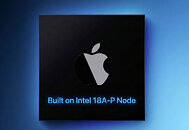
Additionally, Apple is reportedly waiting for Intel to release the 18A-P PDK version 1.0, which is on track to launch in the first half of 2026 or may have already been released to partners. Once available, Apple plans to start with the lowest-end M-series chip, used in MacBook Air and iPad Pro devices, as previously mentioned. This node is particularly interesting due to its performance characteristics, as the 18A-P can deliver a 9% performance increase at the same power level or achieve 18% power savings at the same performance level compared to the standard 18A. This is exactly what Apple is looking for. Coupled with better thermal conductivity, these designs should offer improved heat dissipation and performance compared to what Apple currently achieves with TSMC's 3 nm process in the M5 SoC.


