Reading view

Spotify parents rejoice! KPop Demon Hunters need never cloud your Wrapped results again, thanks to Managed accounts launching on Spotify Free

  • 'Managed' accounts let parents create a Spotify experience for their child
  • Once reserved for Premium Family accounts, it is now rolling out to all
  • Managed accounts are music-only with no messages, but do get Wrapped

Fed up with waiting for your Wrapped roundup only to find KPop Demon Hunters is claiming the top spot again — and it most certainly would not be down to you?

Great news: Spotify is expanding its Managed account service (which the big green streaming machine launched around two years ago, within its paid-for Family subscriptions) to the Free, ad-supported service.

This gives young listeners a chance to have their own personalized Spotify experience (including their own Wrapped summary), but within what Spotify calls a "focused, music-only experience".

With Managed accounts (which must be set up by an adult 'Account manager', usually a parent or guardian), young listeners can create their own playlists and receive tailored recommendations for new music. Yes, our favorite Daylist feature, plus a Wrapped summary at the end of each year, are both onboard.

The company tells me that while 90% of parents using Spotify agree that listening to music on the platform is a good use of their children's time (versus only a third of parents when asked the same question about gaming), parents don't really want their Wrapped playlists influenced by their nine-year-old.

Spotify also reports that more than 70% of kids now listen to music every week, but that children asking their parents to play a favorite track (often a lot) can cause family friction — especially when children might be fighting for airtime with a sibling, or just completely ignoring what mom might want to listen to in the car.

Managed accounts on Spotify: what you need to know (and why they're Golden)
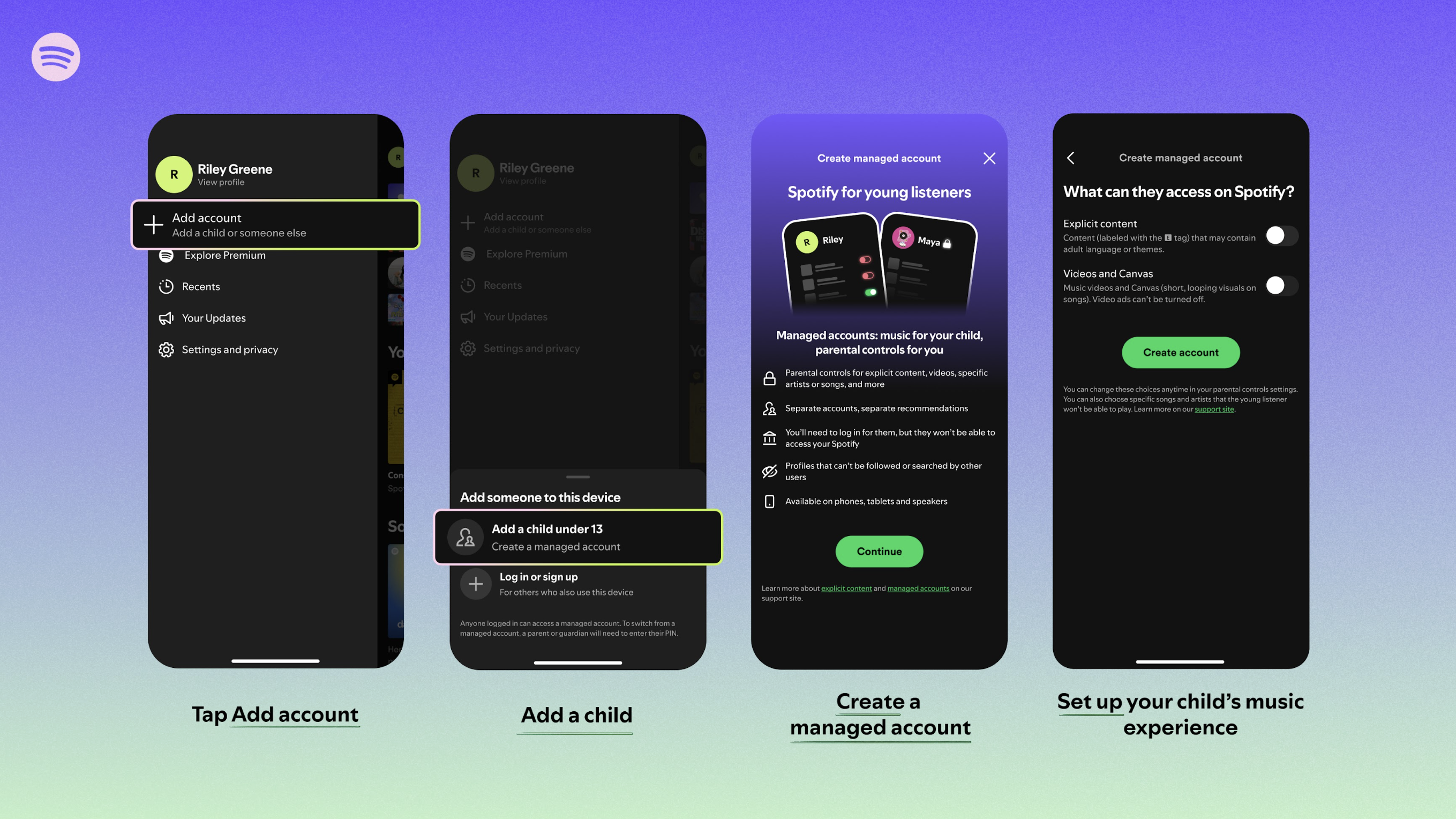
Spotify managed accounts screengrabs on blue background

(Image credit: Spotify)

As the image above shows, the process for creating a Managed account is straightforward using the 'Add account' tab. As any parent in the UK knows, plans are well underway for a social media ban for under-16s, so this can only be seen as a wise and welcome move from Spotify.

The basics are this: as well as Spotify's filters for explicit lyrics or content, parents and guardians can manually filter out content, and manage playback for specific artists or tracks.

Video and Canvas looping visuals are also always off by default for managed accounts. During its initial rollout, Spotify says 60% of parents chose to keep video content switched off, which is why in this wider rollout — it is coming to 17 markets globally today — it's off by default.

Additionally, the default features of Managed accounts mean that they are automatically set to private and are unsearchable, with no profile photos (just avatars), and young listeners will not have access to messages.

Spotify tells me that Managed accounts are typically for children aged 7-12, who are not yet ready for a full account but who want to establish their identity and explore a love of music themselves, via their own managed account.

Again, Managed accounts are music only right now, i.e., no podcasts, video or audiobooks. But Spotify says the experience will evolve as the company continues to work closely with parents as well as Spotify's team of six external partners, including the Spotify Safety Advisory Council.

Does your child need their own phone? No, there’s a device switching option, which locks the account holder’s content with a PIN, so the holder of the Managed account can start to stream away with both the default and added controls and filters deployed.

And when your children grow up (it happens so fast!), what then? Once a child reaches the minimum age for their respective market, they can put in a 'request’ to the main account holder to be upgraded to a full account. Once the owner of a Managed account turns 18, that young person can change their own account to a regular one — so no playlist gets left behind.

Volkswagen unveils its innovative eBike with the world's first integrated rear-view camera and smart glasses

  • Volkswagen and n+ have unveiled a premium new eBike range
  • It features a rear-view camera and radar-based blind-spot warnings
  • Smart glasses and a connected helmet complete the safety ecosystem

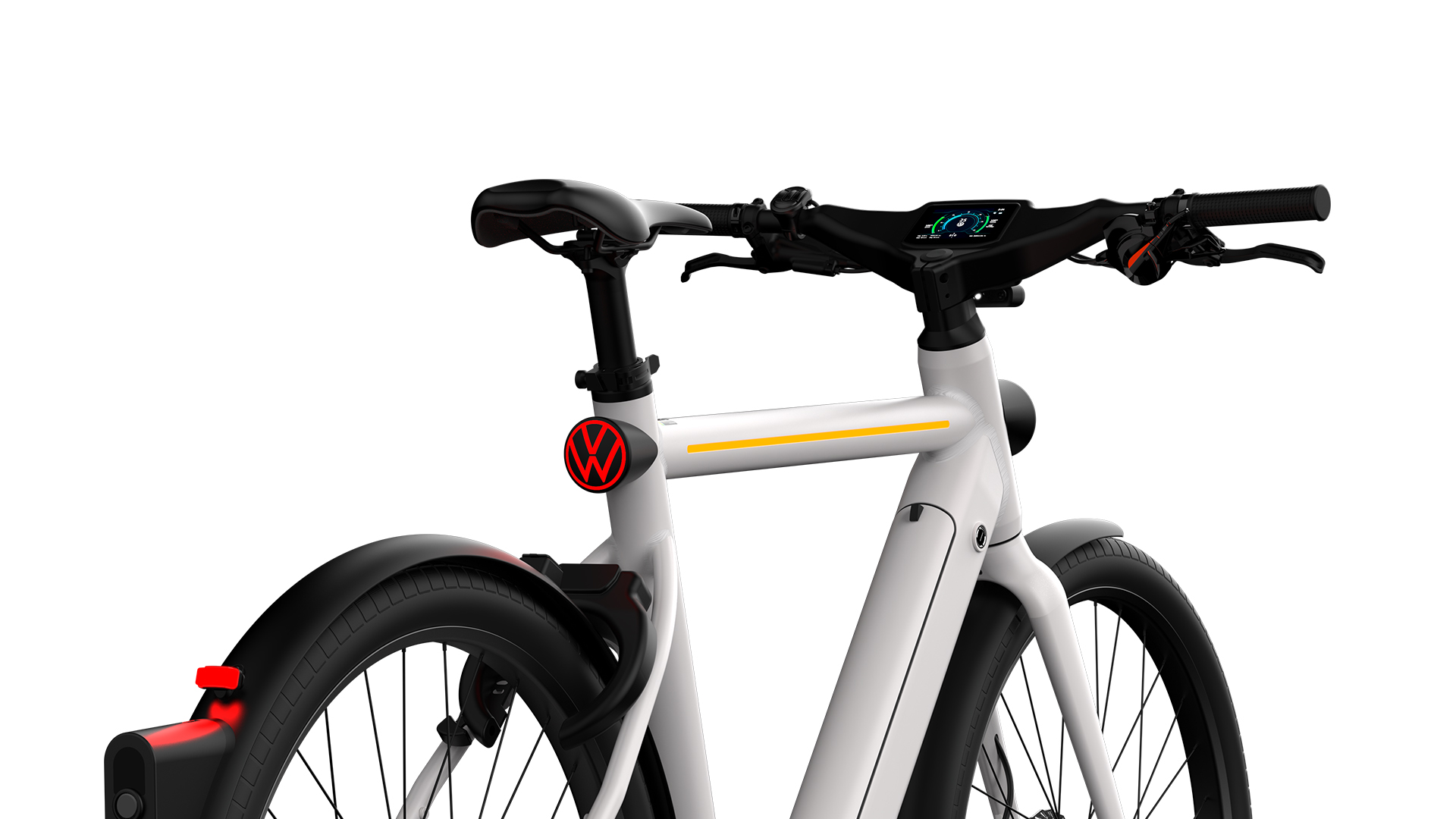
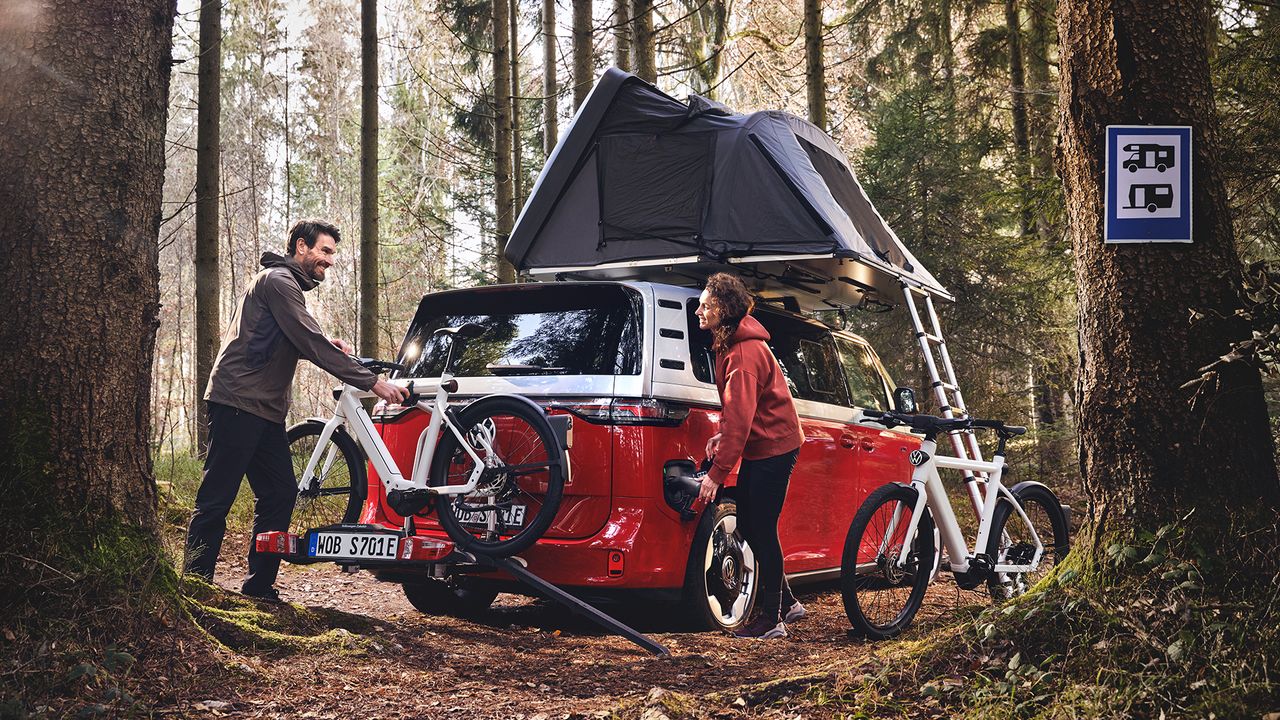
Volkswagen has taken some of the most advanced safety features from its passenger cars and squeezed them onto an electric bicycle, unveiling what is claimed to be the world's first eBike with an integrated rear-view camera and dashboard display.

Developed in partnership with premium eBike manufacturer n+, the new Volkswagen-licensed electric bicycles are designed around the same "safety-first" philosophy that has informed the German automaker's road cars for decades.

Rather than focusing solely on bigger batteries and more powerful motors, Volkswagen says the new range is engineered to make cyclists more visible to motorists and more aware of their surroundings.

At the heart of the system is Smart View, which combines an integrated high-definition rear-view camera with radar-assisted traffic monitoring.

Neatly integrated into the handlebars, the display takes a real-time feed from a high-definition camera mounted on the rear mudguard that allows riders to see what is happening behind them without having to turn their heads. At the same time, radar sensors, similar to those offered by Garmin, can also warn of approaching vehicles in a cyclist's blind spot.

The technology resembles the camera mirror systems increasingly found in modern passenger vehicles, and the company says it could represent one of the most significant safety advances to hit the eBike market in recent years.

Volkswagen and n+ have also developed a full-length illuminated LED strip that runs through the bike's top tube. The system acts like an automotive daytime running light but can also illuminate red when braking and amber when turning, signaling a rider's intentions to other road users.

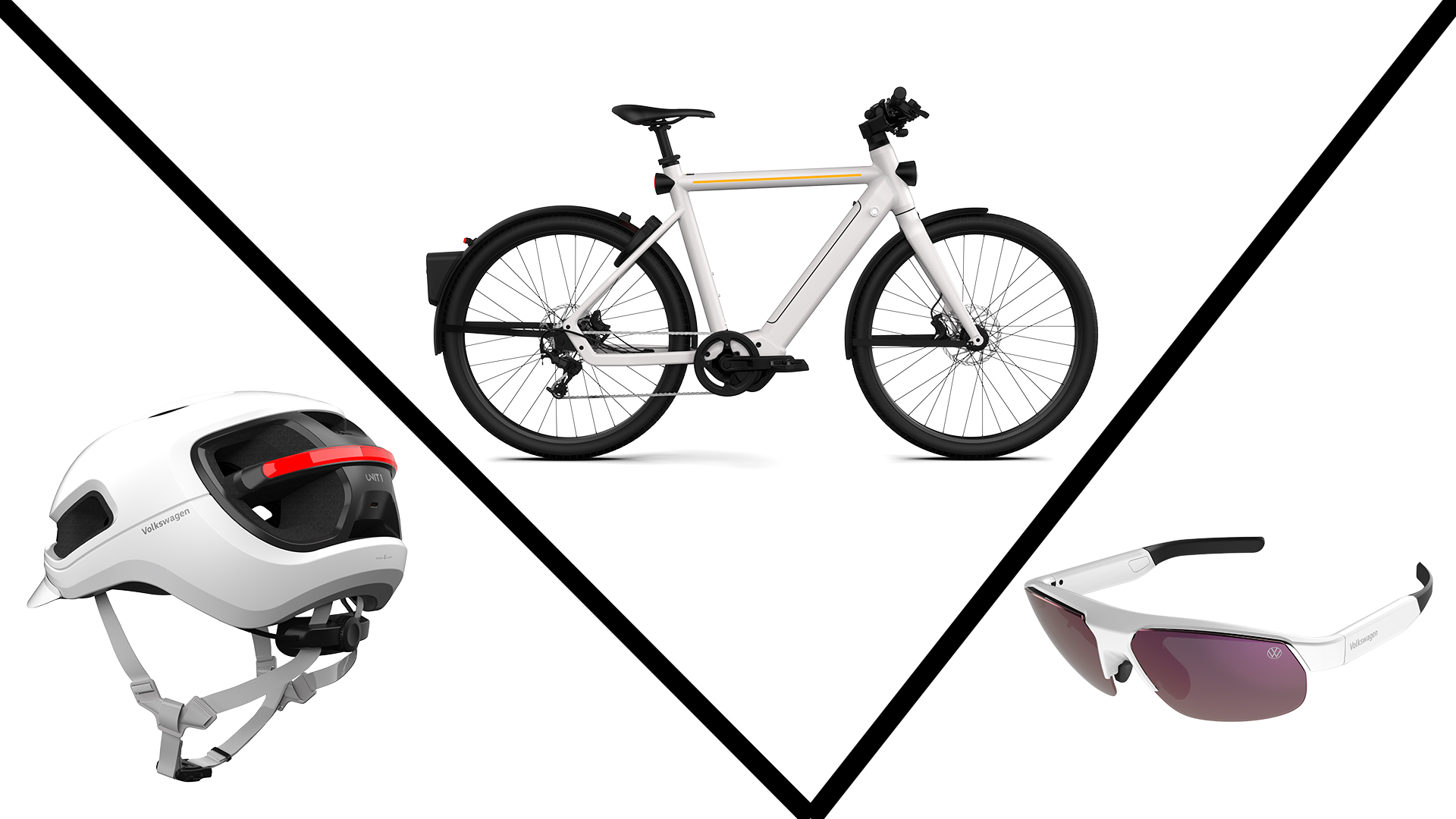
Volkswagen Smart eBike

(Image credit: Volkswagen/n+)

An optional Smart Helmet can synchronize with the eBike via Bluetooth, mirroring the bicycle's lighting signals and incorporating a built-in accelerometer that can detect crashes and automatically send text messages to loved ones in the event of an emergency.

Then there are the Smart Glasses, which are perhaps the most futuristic of all. Inspired by automotive head-up displays and developed by engineers who previously worked on fighter pilot helmet displays, the glasses can project navigation instructions, blind-spot warnings and ride information directly into a rider's field of vision.

Peter Jost, CEO of Volkswagen Accessories, Lifestyle and Licensing Business, said that technologies like these are "most commonly known from the automotive world" and that seeing them arrive on an eBike demonstrates how safety systems can "evolve and be adapted in meaningful ways".

Despite the plethora of new technologies onboard, the innovative eBikes are priced to rival premium competitors, with Sport models starting at £3,999 in the UK (around $5,300/AU$7,700), which includes the Smart View rear-view monitor. The Smart Helmet and Smart Glasses cost an additional £499 (around $670AU$960) each.

Analysis: are automotive safety systems the next big thing in eBikes?

Volkswagen Smart eBike

(Image credit: Volkswagen/n+)

As cities become increasingly congested and more people turn to electric bicycles as an alternative to driving, safety is rapidly becoming one of the biggest battlegrounds in micromobility.

While innovations in recent years have largely centered on extending range and increasing power, there has been comparatively little focus on helping cyclists avoid accidents in the first place.

Many companies that specialize in cycling accessories have come up with safety solutions that help increase visibility and awareness of other vehicles, but this often requires cyclists to bolt on awkward pieces of technology.

Having it neatly integrated into the bicycle itself feels like a logical solution, and with commuters looking for ever-cheaper ways to get from A to B, these could very well be the sort of innovations that persuade motorists to ditch their cars in favor of something leaner and greener.

LAPD hits pause on Flock surveillance cameras due to 'serious concerns around civil liberties and privacy' — as the backlash continues to grow

  • Three-year contract won't be renewed, police officials claim
  • Data and privacy concerns have been cited
  • Flock cameras have faced a backlash from a privacy-concerned public

Officials from the Los Angeles Police Department have told the Los Angeles Times that its contract with surveillance camera company Flock will not be renewed due to "serious concerns" around privacy and the data they gather.

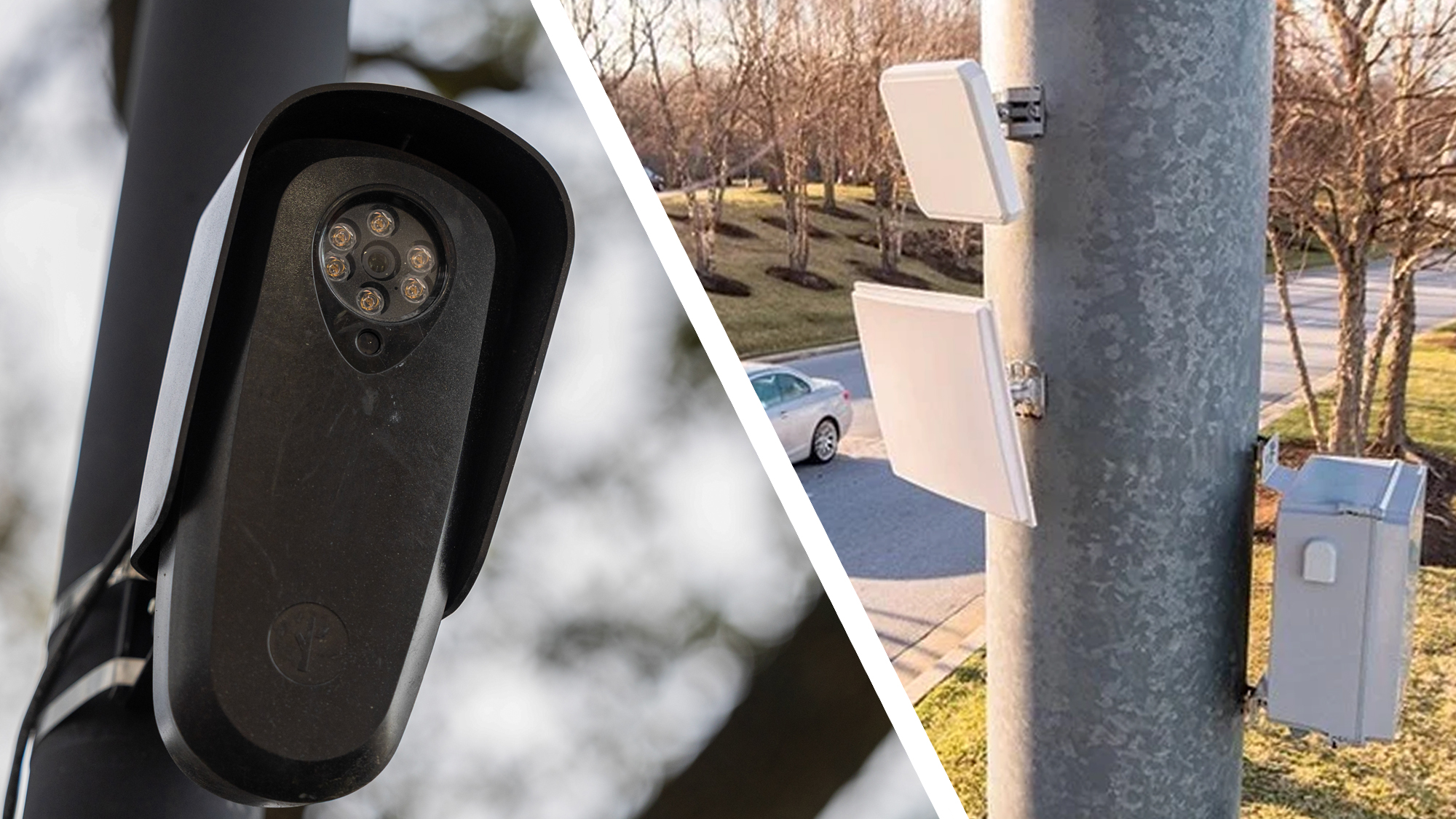
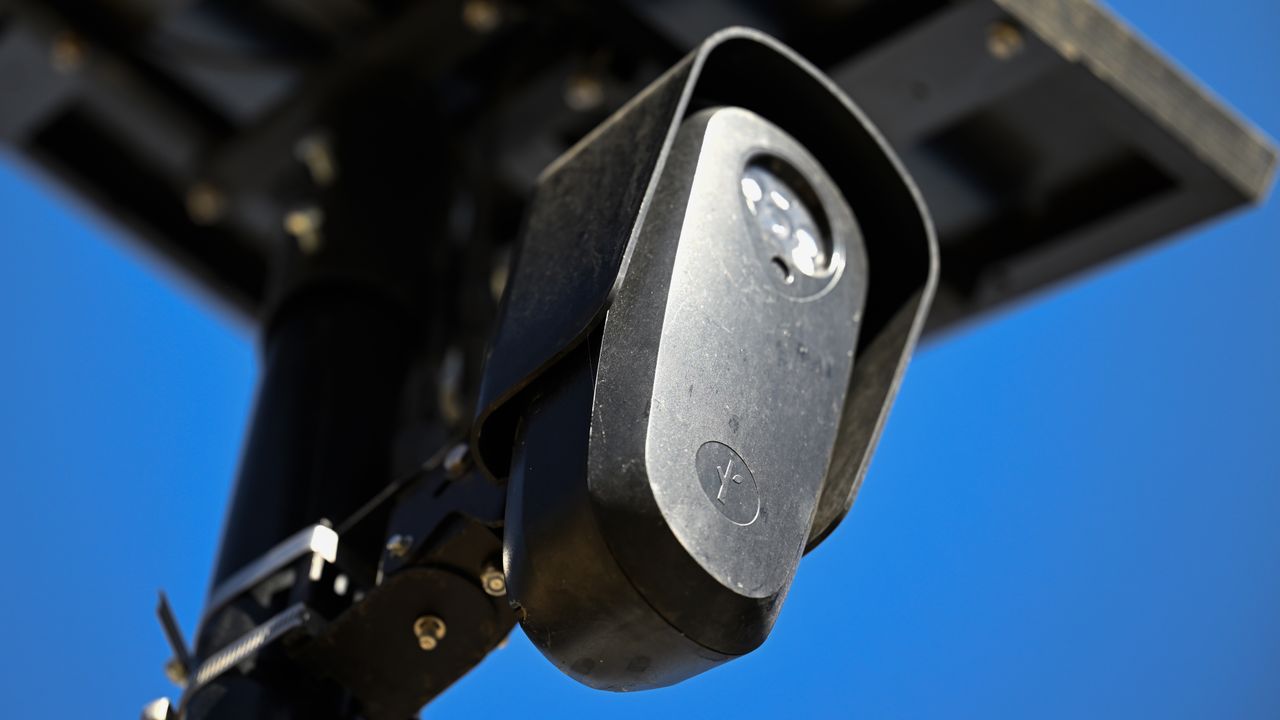
The cameras, which are owned by Flock and used by more than 5,000 law enforcement agencies across the US, scan and track billions of vehicle license plates every month, with the resulting data used by police departments to help make arrests and build cases.

However, there has been widespread public backlash due to privacy concerns, with some residents taking matters into their own hands. Recently, an Air Force engineer from Virginia has been accused of cutting down 13 Flock cameras over a six-month period.

According to Military.com, privacy advocates across the country have donated more than $15,000 (about £11,220 / AU$21,660) to the accused's legal defense.

What's more, developers have created a free online mapping tool that allows US drivers to plot routes that actively avoid areas with a dense population of Flock cameras.

The LAPD's chief information officer, Dean Gialamas, told reporters that the contract was not being renewed due to "serious concerns around civil liberties and civil rights issues, particularly around privacy and the data that is being collected from these cameras."

Gialamas added that he hoped the data, privacy, security, and sharing concerns would eventually be "ironed out through a contractual relationship." There is currently no word on whether Flock's cameras will continue to record and distribute data in the meantime.

Analysis: The public fights back

A flock camera next to SignalTrace cameras on a post

(Image credit: Getty Images / Leonardo)

Flock's network of some 80,000 cameras in the US has been chastised by data privacy advocates, with the likes of 404 Media carrying out numerous investigations that highlight how easy it is for this surveillance data to fall into the wrong hands.

According to TechCrunch, researchers have also identified an increase in the number of documented cases where motorists have been pulled over, detained, and even jailed due to false positives and errors with license plate readers.

We also recently reported that an investigation by the Electronic Frontier Foundation found that more than 50 federal, state, and local agencies ran hundreds of searches through Flock's national network of surveillance data in connection with protest activity.

One motoring journalist in the US was even tracked for days and eventually 'boxed in' by police over a Flock-based mix-up with the license plates attached to the press loan vehicle he was driving.

As public distrust in Flock's safety cameras mounts, we could see more agencies follow LAPD's lead in pushing back on the technology.

Xiaomi unveils its first range-extender SUV and it looks like a private jet on wheels

  • Xiaomi reveals its first extended-range electric vehicle
  • SkyNomad will sit separately from its pure EV Xiaomi Auto company
  • The 1.5-liter engine is manufactured by Changan's subsidiary Harbin Dongang

Xiaomi is set to enter the hotly contested luxury SUV sector with an all-new business that it has dubbed SkyNomad.

Fresh off the success of both the SU7 and YU7, the former of which has outsold the Tesla Model 3 in the Chinese market, smartphone-maker Xiaomi sees a gap in the market for its first extended-range electric vehicle (EREV), which sees a gasoline engine act as a generator to charge battery packs on the move.

While the powertrain is still in its infancy in Europe, with just the Leapmotor C10 REEV and Mazda MX-30 R-EV currently on sale in many markets, it has experienced sales success in much of China.

Li Auto is the current market leader, with six models offering a mix of combustion engines and battery packs, while AITO, Deepal, Avatar and Leapmotor also offer similar solutions.

Unlike traditional plug-in hybrids, which use a gas engine to drive the wheels or charge the batteries, EREVs rely solely on a fully electric powertrain for propulsion, with the combustion engine serving as a generator to charge the batteries.

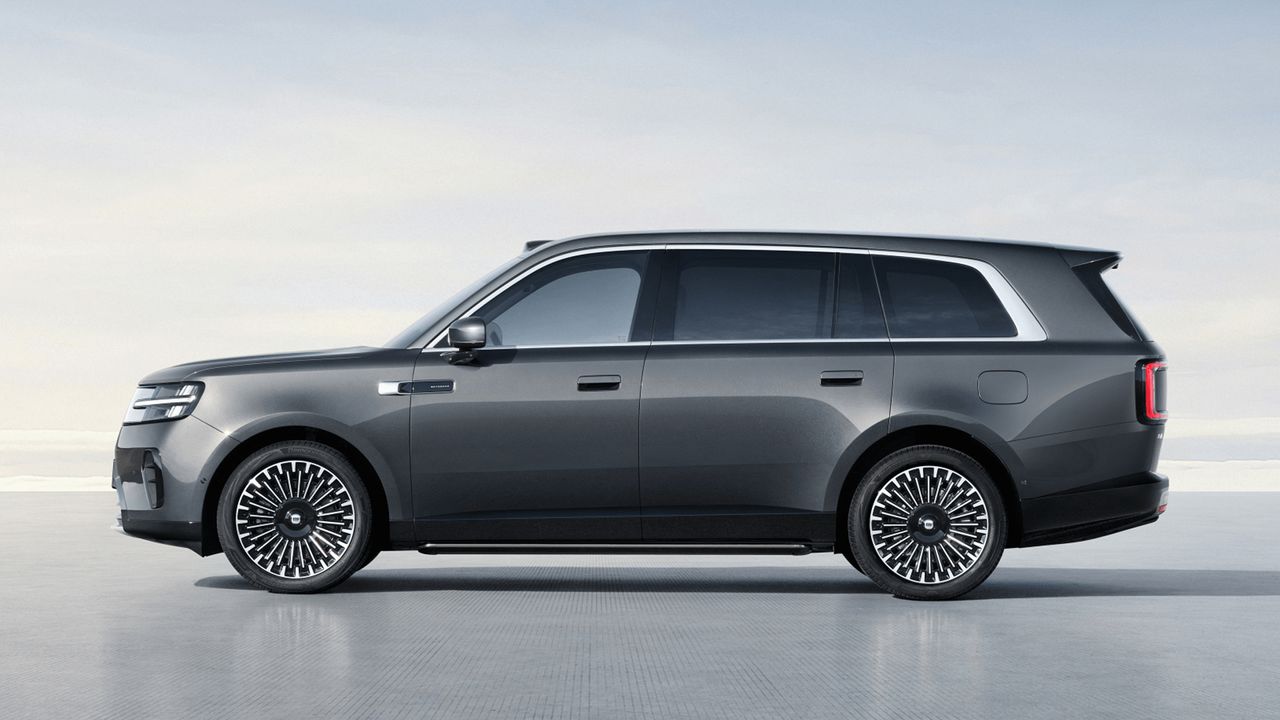
According to Car News China, Xiaomi's SkyNomad brand will offer the N70 and N90, the latter coming as a full-size, three-row SUV with rotating front seats, a full leather premium interior, and an N90 Max Camping Edition that adds a pop-up roof and a built-in side awning for upmarket camping trips.

SkyNomad is also selling the idea of modularity, stating in its promotional material that the cabin can transform into a studio for one, a cafe for two, a meeting room for three, or a play area for the whole family.

Under the skin, a 1.5-liter gasoline engine from Changan's subsidiary, Harbin Dongang, sends power to a 76 kWh ternary NMC battery pack in the N90, while a pair of electric motors team up to deliver 310 kW (416 hp) of power.

Analysis: unnecessarily enormous

Xiaomi SkyNomad N90

(Image credit: Xiaomi/SkyNomad)

Xiaomi's decision to launch an EREV-focused brand, SkyNomad, is a clear shot at market leader Li Auto, which is experiencing a 74% year-over-year sales decline in the first four months of 2026, according to Electrek.

The introduction of EREVs to Xiaomi's stable will undoubtedly help it boost sales in China, but it's difficult to get away from the fact that the N90 is absolutely enormous. It measures over five meters in length and weighs 3,361 kg, which makes the 416 hp feel slightly underpowered.

Car News China says the N90 can manage around 230 miles before the batteries are depleted, by which point the 1.5-liter engine is called upon. Overall range is in excess of 1,500 km — or around 930 miles.

It's also interesting that Xiaomi, a company that found great success with pure EVs, is pivoting back to fossil fuels.

All of the PR coming out of China suggests that its public EV charging network is both faster and more widespread than most other markets, which raises the question of why the market needs big, heavy range extenders like this in the first place.

The American Dream is killing me — until I see Billie Joe Armstrong's new Marshall guitar amp (and then I'm as consumerist as they come)

  • Marshall's 1959BJA Signature amp was first seen at the Super Bowl
  • Built on Marshall’s handwired 1959HW platform, with a custom 'Dookie Mod'
  • The color? A nod to Billie Joe Armstrong's first guitar, Blue (are you even an Idiot?)

When Billie Joe Armstrong et al took to the stage for Green Day's Super Bowl performance earlier in the year, I'm pretty sure most guitarists stopped listening for the "MAGA agenda" lyric switcheroo that never came and instead simply breathed "That amp though…"

And now, shredders can buy their own striking baby-blue Marshall head, just like the one that was set up behind Billie Joe Armstrong — for a not insignificant sum of $3,999.99 / £3,099.99 (which is around AU$5,779, where sold).

It is Marshall's first artist signature amp in 14 years, and its full name is the Billie Joe Armstrong 1959BJA Artist Signature. Yes, it's inspired by one of punk rock’s most recognizable guitar tones, and yes, that means it has a special "Dookie mod".

Basket Case? No, just the amp please

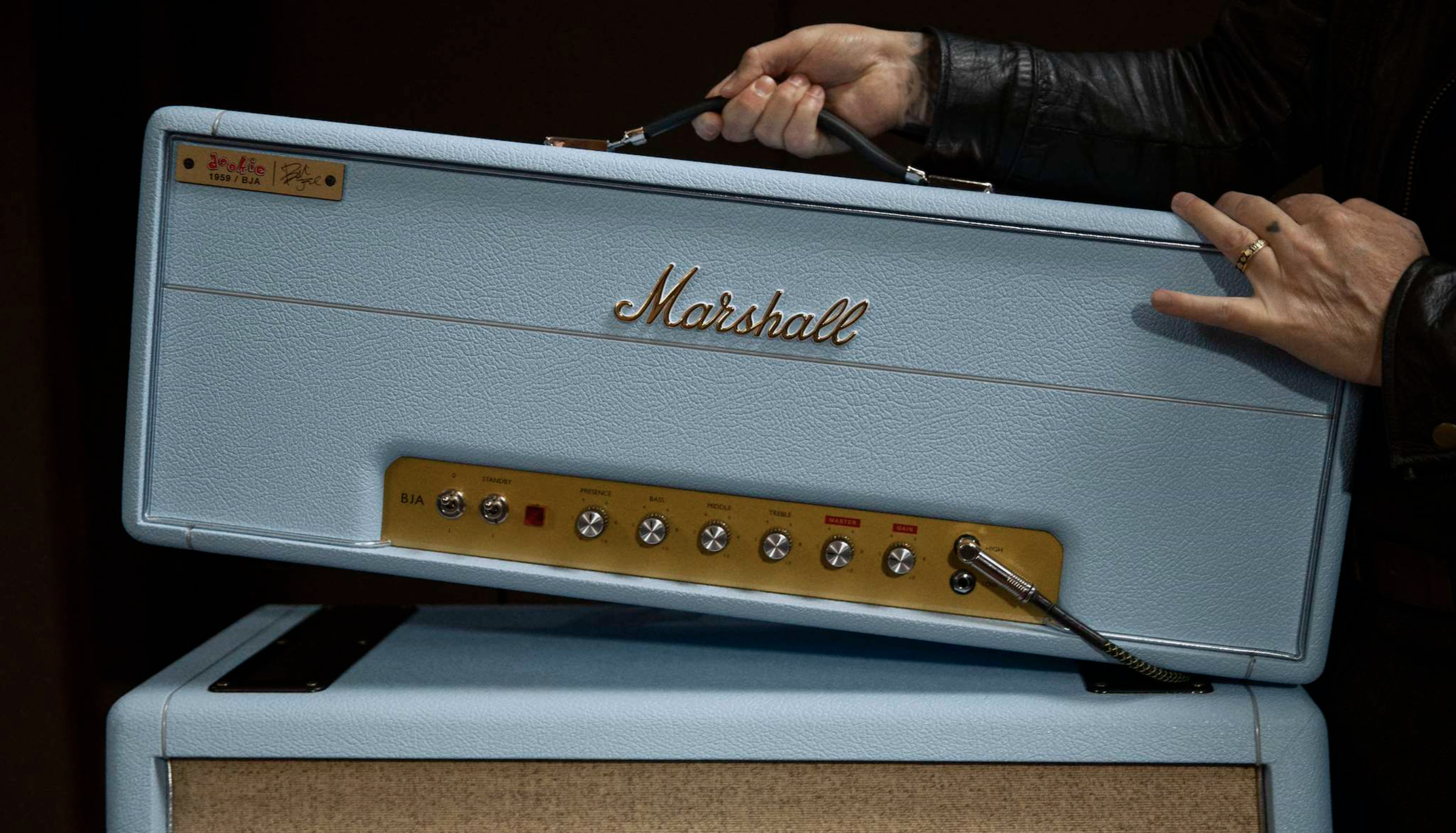
Marshall x Billie Joe Armstrong's baby blue guitar amp head, held by the star, whose arms are just visible

(Image credit: Marshall)

The amp was developed with Billie Joe Armstrong (it even bears his signature on the front and back) and is built on Marshall’s hand-wired 1959HW platform, refined with a custom “Dookie Mod”. This, says Marshall, is "inspired by the tone shaped alongside producer Rob Cavallo during Green Day’s breakthrough era".

The promise? A classic plexi but with modern performance flexibility, "increased gain, tighter lows and the saturated punch that brings Billie’s signature sound into a modern stage-ready format."

The design, of course, is a nod to Billie’s first guitar, Blue (seen in the main image), combining baby-blue with brass and silver panel details, all hand-wired in the UK.

It is released as a head-only unit, so axe men (and women, and in fact all humans who play guitar, I salute you) can pair it with the cabinet of their choice — but I'm sure a blue cabinet is possible to purchase as well…

And this isn't Billie Joe Armstrong's first rodeo with Marshall. Back in 2024, he actually appeared in the Monitor III ANC headphones campaign. So, the 1959BJA simply marks the natural progression of that relationship? It certainly looks that way.

Armstrong himself is quoted as saying, “I’m so overjoyed to have my own signature Marshall amp", adding "These amps have been a part of my musical life, from my heroes down to little old me. Turn it the f**k up!!”

You'll be able to buy the 1959BJA Billie Joe Armstrong Artist Signature from July 21, and again, you'll need to part with $3,999.99 / £3,099.99 (or around AU$5,779) to get yours when they become available.

Sometimes you don't find the amp; it finds you. It's something unpredictable, but in the end, it's right…

❌