For most blockchains, a sustained DDoS attack at internet-scale would mean stalled transactions, missed blocks, and visible network stress. That didn’t happen this time.
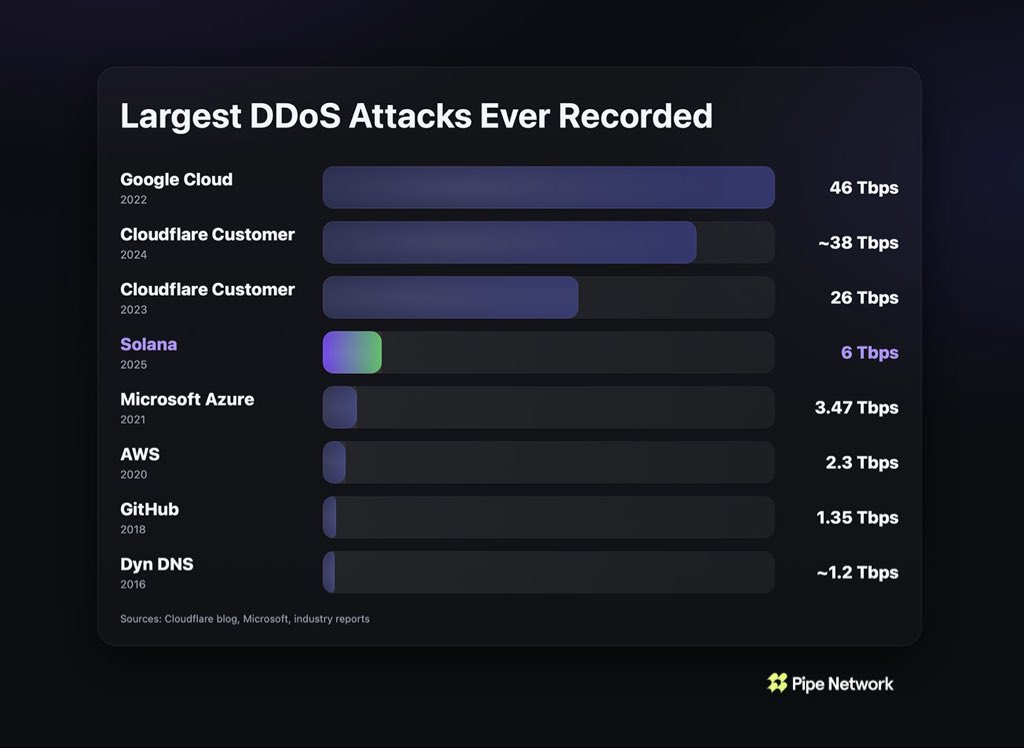
Over the past week, the Solana network has been operating under a massive distributed denial-of-service (DDoS) attack that peaked near 6 terabits per second, ranking it as the fourth-largest DDoS attack ever recorded on any distributed system.
Despite the scale, on-chain data shows the network continued to function normally.
A Week Under Attack With No Network Slowdown
A DDoS attack is designed to overwhelm a network by flooding it with traffic, usually causing slowdowns or outages.
SolanaFloor reported that the Solana network had been facing a “sustained DDoS attack for the past week, peaking near 6 Tbps,” while noting that data showed “no impact, with sub-second confirmations and stable slot latency.”
Pipe Network described the scale as unusual even by internet standards.
“6 Tbps volumetric attack translates to billions of packets per second,” the firm said.“Under that kind of load, you’d normally expect rising latency, missed slots, or confirmation delays.”
Transaction Speeds Remain Steady Under Pressure
Data shared showed that transactions continued to confirm in under a second, with block production staying on schedule throughout the attack. In simple terms, users were able to send and confirm transactions as usual, even while the network was being flooded with attack traffic.
DDoS attacks of this scale have historically targeted cloud providers such as Google Cloud and Cloudflare, making Solana’s ability to stay online stand out.
A Clear Contrast With Other Blockchain Disruptions
According to reports, the episode also contrasts with a recent DDoS attack on the Sui network, which resulted in block production delays and degraded performance.
As details of the attack spread, the crypto community took to X to point out the scale of the event and the lack of visible impact on the network.
This is your daily reminder that Solana is the best.
As TON continues to scale inside Telegram, the foundation behind the blockchain is fixing a less visible, but critical, piece of the puzzle: how money moves.
TON Foundation has chosen OpenPayd to power its global fiat operations, giving the organization a unified way to manage payments, currencies, and treasury activity across regions. The move comes as TON’s role inside Telegram’s Mini App ecosystem grows, now touching more than 1 billion monthly users.
Why TON Needed Stronger Fiat Infrastructure
TON powers Telegram’s Mini Apps, a fast-growing ecosystem used by developers, creators, and businesses worldwide. But global reach brings global complexity especially when it comes to moving real-world money.
With OpenPayd, TON Foundation can now connect international fiat rails through a single API. That allows the foundation to fund ecosystem grants faster, manage multiple currencies more efficiently, and reduce friction when operating across borders.
In short, it makes everyday operations easier to run at scale.
What OpenPayd Brings to the Table
OpenPayd provides enterprise-grade financial infrastructure used by major crypto firms, including Kraken, OKX, and eToro. Its platform supports global payments, FX, treasury management, and interoperability between traditional finance and digital assets.
OpenPayd CEO Iana Dimitrova said TON’s positioning stood out, calling it “one of the most strategically positioned blockchain ecosystems in the world,” especially given its deep integration with Telegram.
How This Supports TON’s Growth
For TON Foundation, the focus is speed and flexibility. President and CEO Max Crown said the partnership gives the foundation “a far more agile and globally connected financial backbone,” helping it move funds faster and support builders more effectively.
While users won’t see this change directly, it strengthens the foundation beneath the ecosystem, making TON better prepared for continued growth inside Telegram’s massive global network.
As early as January, the Bank of Japan (BOJ) is expected to begin selling its massive ETF holdings, a portfolio valued at ¥83 trillion ($534 billion). The plan is to move slowly and avoid market shock. But even a gradual exit from ETFs by one of the world’s biggest central banks carries weight, especially at a time when global liquidity is tightening.
See how this could affect the markets.
Bank of Japan Prepares to Start Selling ETFs
According to Bloomberg, BOJ officials plan to offload ETFs gradually following a decision made at the September policy board meeting. The central bank has set a pace of ¥330 billion per year based on book value, a timeline that could stretch for decades.
The goal is to keep the impact minimal. Officials want the market response to be barely noticeable,similar to how Japan sold bank stocks in the 2000s without disrupting markets.
Still, the scale is hard to ignore. The ETF holdings have grown sharply in value as Japan’s stock market rallied over the past two years, leaving the BOJ with massive unrealized gains.
That shift matters because Japan has long been the world’s cheapest source of leverage.
“For decades, the Yen has been the #1 currency people would borrow & convert into other currencies & assets… That carry trade is diminishing now, as Japanese bond yields are rising rapidly,” wrote analyst Mister Crypto.
The Bank of Japan is about to do a rate hike on Friday the 19th, creating massive fear surrounding the Yen carry trade.
Bitcoin dumped hard the last time they hiked rates:
That said, the market response has been relatively controlled. Many analysts note that expectations around a Bank of Japan rate hike have been circulating for weeks, giving traders time to adjust positioning. In that sense, part of the impact may already be reflected in current prices.
While markets are clearly paying attention, there is no sign of disorderly selling so far, suggesting investors are treating this as a macro adjustment rather than a sudden risk event.’
Never Miss a Beat in the Crypto World!
Stay ahead with breaking news, expert analysis, and real-time updates on the latest trends in Bitcoin, altcoins, DeFi, NFTs, and more.
FAQs
Why is the Bank of Japan selling its ETFs, and will it crash the market?
The BOJ is selling its ETFs to normalize monetary policy after years of stimulus, but it plans to sell so gradually that the market impact is designed to be “almost unnoticeable”.
How could the BOJ’s policies affect Bitcoin and cryptocurrency prices?
A BOJ interest rate hike and ETF sales could pressure Bitcoin by reducing global market liquidity. This could weaken the popular “yen carry trade,” where investors borrow cheap yen to buy riskier assets like crypto.
When will the Bank of Japan start selling ETFs?
BOJ is expected to begin its ETF sales in January, moving slowly over the years to avoid sudden market reactions.
JPMorgan is making another meaningful move into crypto – this time with one of Wall Street’s most traditional products.
According to a Wall Street Journal exclusive, the banking giant’s asset-management arm has launched its first tokenized money-market fund, built on the Ethereum blockchain and backed by $100 million of JPMorgan’s own capital. The fund is expected to open to outside investors this week.
For a firm that manages nearly $4 trillion in assets, this is a major signal.
It was a pivotal but uneasy week for crypto, with regulators making tangible moves even as markets stayed cautious. A priced-in Fed cut failed to move prices, while new U.S. policy signals and global rate shifts reshaped how investors are thinking about risk.
Here are the top headlines to catch up on!
Third Fed Rate Cut Lands, But Markets Shrug
The Federal Reserve delivered its third rate cut of the year, trimming rates by 25 basis points to a 3.50%-3.75% range, which is a move analysts say the markets had fully priced in. Chair Jerome Powell struck a cautious tone, calling the outlook “challenging” with no “risk-free path” ahead. Bitcoin jumped before the decision, then reversed sharply as reality set in.
Ripple and Circle Win Federal Bank Charters
U.S. regulators crossed a major line this week. The OCC granted conditional national trust bank charters to Ripple, Circle, Paxos, BitGo, and Fidelity Digital Assets, plugging them directly into the Federal Reserve’s payment system.
HUGE news! @Ripple just received conditional approval from the @USOCC to charter Ripple National Trust Bank. This is a massive step forward – first for $RLUSD, setting the highest standard for stablecoin compliance with both federal (OCC) & state (NYDFS) oversight.
Backed by the GENIUS Act, the move enables 24/7 stablecoin settlement and cuts bank counterparty risk. Critics, including the ABA, warn it “could blur the lines of what it means to be a bank.”
Terra Founder Do Kwon Sentenced to 15 Years
Do Kwon, the architect of the TerraUSD and Luna collapse, was sentenced to 15 years in U.S. prison for fraud – more than prosecutors sought. Judge Paul Engelmayer called it “a fraud of epic generational scale,” citing massive investor harm that helped trigger the 2022 crypto winter.
Kwon admitted responsibility, agreeing to forfeit $19.3 million as part of his plea.
CFTC Launches Digital Assets Pilot
The CFTC has launched a Digital Assets Pilot Program allowing Bitcoin, Ether, and USDC to be used as margin collateral in regulated derivatives markets for the first time. Announced December 8, the pilot creates a tightly monitored framework for tokenized collateral without expanding trading activity.
The shift changes how margin efficiency and risk are managed, integrating crypto deeper into the U.S. market.
Economists See BOJ Rates Reaching 1% by 2026
A strong majority of economists now expect the Bank of Japan to raise rates to 0.75% at its December meeting, with borrowing costs reaching at least 1% by next September, according to a Reuters poll.
Expectations have firmed rapidly as inflation persists and the yen remains weak, reinforcing views that Japan’s long era of ultra-loose monetary policy is steadily ending.
“The beauty of what we’ve built is that YouTube doesn’t have to touch crypto,” said PayPal crypto chief May Zabaneh. The move shows how big platforms are testing stablecoins as payment rails without handling digital assets directly.
Tether Moves to Buy Juventus Club in Cash Deal
Tether has proposed a cash-only deal to acquire full control of Juventus, offering to buy out all remaining shares after already securing a 10% stake. The club’s holding structure controls 65.4% of share capital.
If completed, Tether plans to invest €1 billion into Juventus, citing strong finances after posting over $10 billion in profit in the first nine months of 2025.
XRP Becomes Fastest ETF to $1B Since ETH
XRP spot ETFs have crossed $1 billion in assets under management, becoming the fastest crypto ETF to hit the mark since Ethereum. Canary, Grayscale, Bitwise, and Franklin are driving inflows, largely from institutional desks. Ripple CEO Brad Garlinghouse said the surge reflects “pent up demand” for regulated exposure, especially as platforms like Vanguard open crypto ETFs to mainstream retirement accounts.
Coinbase to Launch Prediction Markets on Dec. 17
Coinbase is preparing to launch prediction markets powered by Kalshi at its Dec. 17 “Coinbase System Update” event, alongside plans for tokenized stock trading. The move advances CEO Brian Armstrong’s push to turn Coinbase into an “everything exchange” as crypto sentiment cools.
The partnership signals Coinbase’s bid to compete with Robinhood and Kraken beyond tokens.
New York Adopts UCC Rules for Digital Assets
New York has enacted the 2022 UCC amendments, creating a new legal framework for digital assets like cryptocurrencies, NFTs, and tokenized instruments. Effective June 3, 2026, the changes define how ownership, transfers, and security interests work for “controllable electronic records.”
The update doesn’t regulate crypto directly but lays critical groundwork for tokenization and real-world asset structuring under state law.
Bhutan Launches Gold-Backed Token on Solana
Bhutan has launched TER, a gold-backed digital token built on Solana, linking physical gold with blockchain rails. Announced December 10, the token goes live December 17 and is backed 1:1 by audited gold held at DK Bank. Officials say TER reflects Bhutan’s push to blend traditional value with transparent, low-cost digital infrastructure as part of its broader blockchain strategy.
Gelephu Mindfulness City is launching TER, the world’s first sovereign-backed, physical gold-backed digital token, on Dec 17, 2025. Built on Solana, issued via DK Bank, and powered by Matrixdock tech, TER brings Bhutan’s “Treasure” on-chain with full transparency.… pic.twitter.com/HmJVGh4qPB
Crypto enters the week in a watchful mood. The Fed’s latest rate cut failed to spark a rally, while Japan’s path toward higher rates is quietly tightening global conditions. At the same time, U.S. policy signals are turning more constructive for crypto.
If Bitcoin finds its footing, markets may calm, but macro uncertainty still leaves room for sudden moves.
The standoff between OKX and Mantra just took a sharper turn.
Today, OKX broke its silence with a public statement accusing the Mantra team of spreading a “misleading narrative” around OM and confirmed that law enforcement is now involved.
What started as a disagreement over a token migration timeline is quickly turning into something much bigger.
OKX Alleges Collusion Behind OM’s Price Surge and Crash
In its statement, OKX said it uncovered evidence that “multiple connected and colluding accounts used large quantities of OM as collateral to borrow significant amounts of USDT, artificially pushing OM’s price up.”
The exchange said its risk team flagged the activity early, contacted the account holders, and asked them to correct the issue. “They refused to cooperate,” OKX said.
To limit exposure, OKX took control of the related accounts. Soon after, OM’s price collapsed.
OKX stressed that it liquidated only a very small portion of OM and that losses from the crash were fully absorbed by the OKX Security Fund. The exchange also pointed to third-party analysis suggesting the sharp drop was largely driven by perpetual trading activity that happened outside OKX.
“There has been no explanation of where those unusually large quantities of OM originated,” OKX added, raising questions about supply concentration.
The OM Migration Dispute
The latest response follows repeated warnings from Mantra CEO JP Mullin, who urged OM holders to withdraw tokens from OKX.
Mullin accused the exchange of publishing incorrect and misleading migration dates and said a December 2025 migration is not possible. According to him, ERC-20 OM cannot be migrated before it is fully deprecated on January 15, 2026, making OKX’s proposed timeline unworkable.
He also claimed the exchange reversed the order outlined in governance proposals and said the lack of coordination has caused confusion for holders.
OKX’s December 10 Letter
In a December 10 letter to the Mantra team, OKX pushed back against public comments from CEO JP Mullin and warned that those statements could cause serious harm to the exchange and its users. OKX said it supported the OM migration and asked Mantra to clarify Proposal 26.
The exchange also rejected Mullin’s claim that legal risks prevented cooperation and warned that blocking migration could unfairly penalize OKX users.
Mullin Went Public Again
Mullin published his response on X.
He said ERC-20 OM will be deprecated on January 15, 2026, and that the chain upgrade and 1:4 split would happen afterward. He confirmed the redenomination would occur at the protocol level and require no user action.
Mullin also renewed his request for OKX to disclose how many OM tokens it holds for users and on its own balance sheet, saying this was necessary for compliance. He defended making the dispute public, arguing transparency was in the community’s best interest.
Legal Pressure Builds
OKX confirmed it has submitted full evidence and documentation to regulators and multiple litigations and legal proceedings are currently underway.
For OM holders, clarity remains elusive. With migration details disputed and legal pressure mounting, the dispute highlights how quickly trust can fracture when exchanges, token issuers, and timelines fall out of sync.

 Login
Login

 Bank of Japan is about to do a rate hike on Friday the 19th, creating massive fear surrounding the Yen carry trade.