Reading view

OpenSea Enables NFT Purchases Using Power Protocol’s $POWER Token
opensea-power-protocol

The post OpenSea Enables NFT Purchases Using Power Protocol’s $POWER Token appeared first on Coinpedia Fintech News

Gameplay-earned tokens from Fableborne can now be used directly across OpenSea’s marketplace.

London, England, [16 December 2025] Power Protocol announced that its $POWER token,  a gameplay-earned reward, is now supported as a payment option for NFT purchases on  OpenSea.

The integration lets players use $POWER without first converting it into another asset, connecting in-game activity with one of the largest NFT marketplaces in the world. The update expands the utility of $POWER beyond gaming and into broader NFT commerce.

$POWER is earned through participation in the Power ecosystem, with Fableborne serving as its flagship title. Until now, OpenSea payments have primarily relied on assets such as ETH, WETH, and USDC. Adding $POWER introduces a gameplay-earned token as a marketplace-wide payment method, enabling value generated in games to flow directly into NFT transactions.

Kam Punia, Founder and CEO of Pixion Games, said:

“Our objective with Power Protocol has been to create a framework in which game-earned value can participate in the wider digital economy. OpenSea’s integration of POWER allows a token earned through gameplay to be used natively across one of the world’s largest NFT and token marketplaces.”

Power Protocol is designed as a shared infrastructure layer connecting games, applications, and digital products through common token mechanics. While Fableborne is the first major driver of activity, the protocol is built to support additional integrations over time.

Oliver Maroney, Head of Business Development and Partnerships at OpenSea, said:

“This integration reflects growing demand for more flexible payment options and our vision of everything onchain, all in one place. POWER represents a great use case for our space, originating from a game ecosystem yet designed to participate in wider digital markets. Enabling POWER as a platform-wide payment method gives creators and collectors on OpenSea a new way to transact, and we’re pleased to support this integration.”

The move positions $POWER as a token with utility beyond a single game, reflecting a broader shift toward making in-game rewards portable across open marketplaces.
Canopy Introduces ‘Progressive Autonomy’: A New Framework That Makes Launching a Blockchain Easy

canopy

The post Canopy Introduces ‘Progressive Autonomy’: A New Framework That Makes Launching a Blockchain Easy appeared first on Coinpedia Fintech News

Canopy’s “Progressive Autonomy” model lets teams spin up sub-chains under shared validator security, then transition to full sovereign L1s without rebuilding infrastructure or raising a separate security budget.

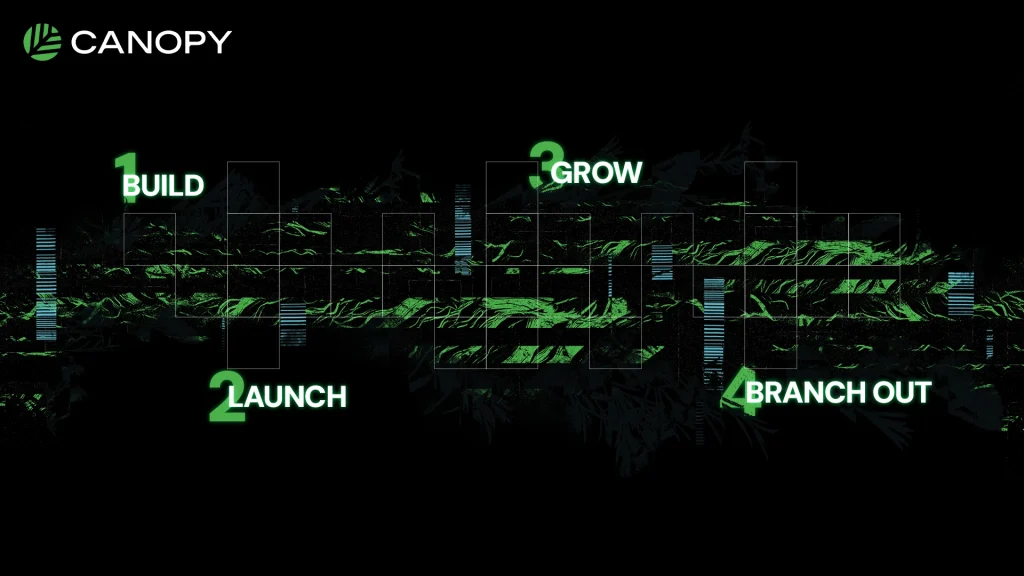
Canopy, the company building a next-gen Layer 1 (L1) framework with the simplicity of a Layer 2 (L2), introduces Progressive Autonomy, a new deployment model built to make launching a blockchain dramatically easier while preserving full long-term sovereignty and value capture. The framework provides developers with a complete lifecycle: teams can launch as a sub-chain secured by Canopy’s validator network, customize their chain as it matures, and graduate to an independent L1 without rewriting core infrastructure or assembling a costly security budget.

Progressive Autonomy debuts at a time when the limitations of both L2 rollups and traditional L1 development increasingly constrain teams. Rollups have made deployment simple, but at the cost of centralized sequencers, governance-only tokens, fragmentation, and ecosystems that struggle to retain value. 

Sovereign L1s remain the only architecture that consistently captures long-term economics, but building one typically requires over a year of engineering, substantial upfront capital, and custom consensus development. Overall, this clunky and expensive process forces builders to make early trade-offs: either prioritize ease and sacrifice ownership, or pursue sovereignty at prohibitive cost.

Adam Liposky, CEO of Canopy, said:

“Teams were forced into a false choice between simplicity and sovereignty, so we built Canopy to remove that trade off. Sovereignty should mean developers control their network economics and capture value on their own rails. Progressive Autonomy lets teams launch fast, retain long term ownership of their chain, and build toward a future of hundreds of specialized sovereign sub chains owned by the communities behind them.”

The Progressive Autonomy model eliminates the compromises, ensuring that all chains launched on Canopy inherit shared restaked security from a growing network of professional validators, including more than 20 top-tier operators who already joined the platform’s Betanet. This gives new chains protection from day one, without relying on token inflation or external security markets. 

Validator sharing removes the need for early-stage projects to assemble and incentivize their own validator sets. This reduces both the time it takes to launch and the operational complexity that’s associated with the process. Canopy’s VM-less architecture enables developers to build in any language and tailor their execution environment as their application scales, without touching consensus or modifying the underlying network. 

diagram-canopy

When a project is ready, it can detach from Canopy’s shared security and transition into a full sovereign L1, carrying its history, state, community, and economics with it. The upgrade path preserves continuity for users and developers while granting teams complete control over governance, performance, and value capture. Canopy positions this as a structural shift for the industry. Rather than choosing between an L1 or an L2 at the start, teams can now naturally evolve from incubation to independence as their needs grow.

Andrew Nguyen, Co-Founder and CTO of Canopy, said:

“Progressive Autonomy allows developers to focus entirely on building useful, high-performing applications instead of wrestling with infrastructure. Our goal was to take the security and operational burdens away from the traditional L1 creation and make them completely invisible. When sovereignty becomes accessible, the entire ecosystem will expand and benefit mutually.”

Canopy’s Betanet is already live and supported by leading validators including PierTwo, Stakely, Rhino, Lavender Five, Nodes.Guru, Kingnode, Easy2Stake, and others, signalling early momentum for the shared security approach. The full mainnet launch is planned for 2026, following more than 18 months of development across the core protocol and supporting infrastructure.

build-launch

About Canopy Network

Canopy makes launching a sovereign blockchain as simple as spinning up an app. Teams can deploy in days, own their network economics, and connect across chains without bridges or wrapped assets. Powered by NestBFT and layerless mesh security, Canopy provides shared protection and built-in atomic swaps for every chain on the network. Developers get predictable costs, fast deployment templates, and interoperability from day one.

Website | Twitter/X | Discord | Github

❌