
 Login
Login
London Beats Birmingham, Belfast, Manchester, Liverpool, Bradford and Other UK Cities That Make It Harder to Sleep Well: Full Research Here

London, the city that never sleeps, has officially claimed the title as the hardest city in the UK to get a proper night’s rest. Not only does it beat Birmingham, Belfast, Manchester, Liverpool, Bradford, and several other UK cities, but it also reveals just how severe the sleep deprivation crisis really is. In a full research study, we uncover shocking findings that show London’s struggle with sleep goes beyond noisy streets and long working hours. Despite being the heart of the UK, it’s now officially the worst place to rest. The study ranks London, leaving Birmingham, Manchester, Liverpool, and Bradford trailing behind as they also face significant sleep challenges.
From night shifts to overwhelming noise pollution, the factors that make it harder to sleep in London, Birmingham, and Belfast are real, and they’re affecting the well-being of thousands. If you think Birmingham is the noisiest or Manchester is the worst for night workers, think again. London, with its infamous commute times and overcrowded housing, is putting its residents at risk for severe sleep deprivation.
Want to know more? Read the full research here to see how London, Belfast, Liverpool, and others stack up in the sleep struggle.
Londoners Endure the Longest Sleepless Nights in the UK: Shocking Revelations of a Sleep-Deprived City
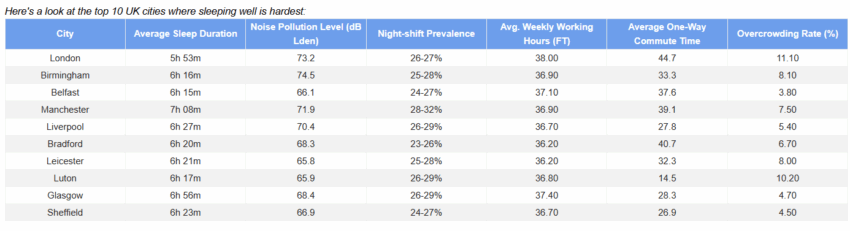
Londoners sleep less than 6 hours a night, significantly below the recommended amount. Can you believe it? The bustling city of London, once a symbol of excitement, now stands as the most challenging place to sleep in all of Britain. The research conducted by Roomes paints a disturbing picture, revealing that residents barely manage 5 hours and 53 minutes of sleep on average each night. This shocking statistic highlights the severe toll the capital’s daily grind takes on its residents’ health and well-being.
But why is it so hard to sleep in the city that never sleeps? Is it the relentless noise, the long commute times, or maybe overcrowding? As one of the world’s busiest and most densely populated cities, London faces a unique combination of issues that prevent its citizens from catching the restorative sleep they so desperately need. The average commute time alone, a staggering 44.7 minutes, slashes precious hours of rest, and the noise pollution levels reaching 73.2 decibels don’t help either. That’s louder than a busy restaurant, making it nearly impossible to rest peacefully.
If you live in London, you’re not alone. 26-27% of the workforce work night shifts, further disrupting their sleep cycle. If London’s staggering statistics don’t alarm you, then what will?
Birmingham’s Battle with Noise Pollution: The City That Never Lets You Sleep
The UK’s second-largest city, Birmingham, follows close behind in the race for sleepless nights. The night-time noise level here is a shocking 74.5 decibels, the highest in the country. If you thought London was bad, Birmingham’s noise pollution tops the charts with noise levels on par with those of a busy restaurant.
Imagine trying to get some rest amidst this chaos. With nearly a third of the workforce on night shifts, Birmingham’s sleep struggles are compounded by the hustle and bustle of workers coming and going at odd hours. This disturbing trend leaves the city’s residents battling exhaustion, with Birmingham residents averaging just 6 hours and 16 minutes of sleep every night, far below what the body requires for recovery.
This epidemic of sleeplessness isn’t limited to just the workers. Birmingham’s overcrowding rate, which affects 8% of the population, only worsens the issue. Thin walls, shared spaces, and constant noise make it a nightmare for anyone trying to sleep.
Belfast’s Sleep Nightmare: Work Schedules and Long Commutes Are to Blame for Sleepless Nights
Third on the list is Belfast, where despite quieter streets than London or Birmingham, sleep remains elusive. With a 6-hour and 15-minute average sleep duration, Belfast residents struggle primarily due to long commutes, averaging 37.6 minutes each way. These exhausting travel times cut into sleep hours, leaving little time for rest.
Even worse, night-shift work is prevalent in Belfast, affecting up to 27% of the population, making it almost impossible for many to maintain a consistent sleep schedule. Working more than 37 hours per week, Belfast’s workforce is tired, and the impact on sleep is unmistakable.
Manchester: Where 32% of Workers Face Irregular Hours, Disrupting Sleep for Everyone
Manchester, a city known for its music scene and football culture, comes in at number four, with residents averaging 7 hours of sleep each night. While this might sound like more than other cities, it’s still not enough to meet the NHS’s recommended 7 to 9 hours of sleep.
The culprit? The highest percentage of night-shift workers, with 32% of the workforce juggling irregular schedules that prevent them from getting quality sleep. To make matters worse, Manchester’s noise levels reach 71.9 decibels during the night, disrupting the peace and making it harder for residents to sleep through the night.
As if that weren’t enough, Manchester’s average commute of 39 minutes further hampers their chances of getting proper rest. How can anyone stay well-rested with such relentless schedules and distractions?

Liverpool: Noise and Night Shifts Make Sleep a Struggle for City Dwellers
Rounding out the top five cities with the most significant sleep issues is Liverpool, where residents sleep an average of 6 hours and 27 minutes each night. Liverpool’s noise levels, though slightly lower than other cities at 70 decibels, still create a major obstacle for those trying to rest. When combined with night shifts, Liverpool’s workers face disruptions that add to their fatigue.
With around 25-29% of workers in Liverpool on night shifts, the city’s sleep difficulties extend far beyond just the noise. While commutes are shorter, averaging 28 minutes, this doesn’t make up for the challenges posed by irregular work hours and the constant disturbances.
The post London Beats Birmingham, Belfast, Manchester, Liverpool, Bradford and Other UK Cities That Make It Harder to Sleep Well: Full Research Here appeared first on Travel And Tour World.