Reading view

Winter Olympics 2026: Canadian pairs skater realizes her Olympic dream at 42 as Japan, Georgia, Germany claim medals
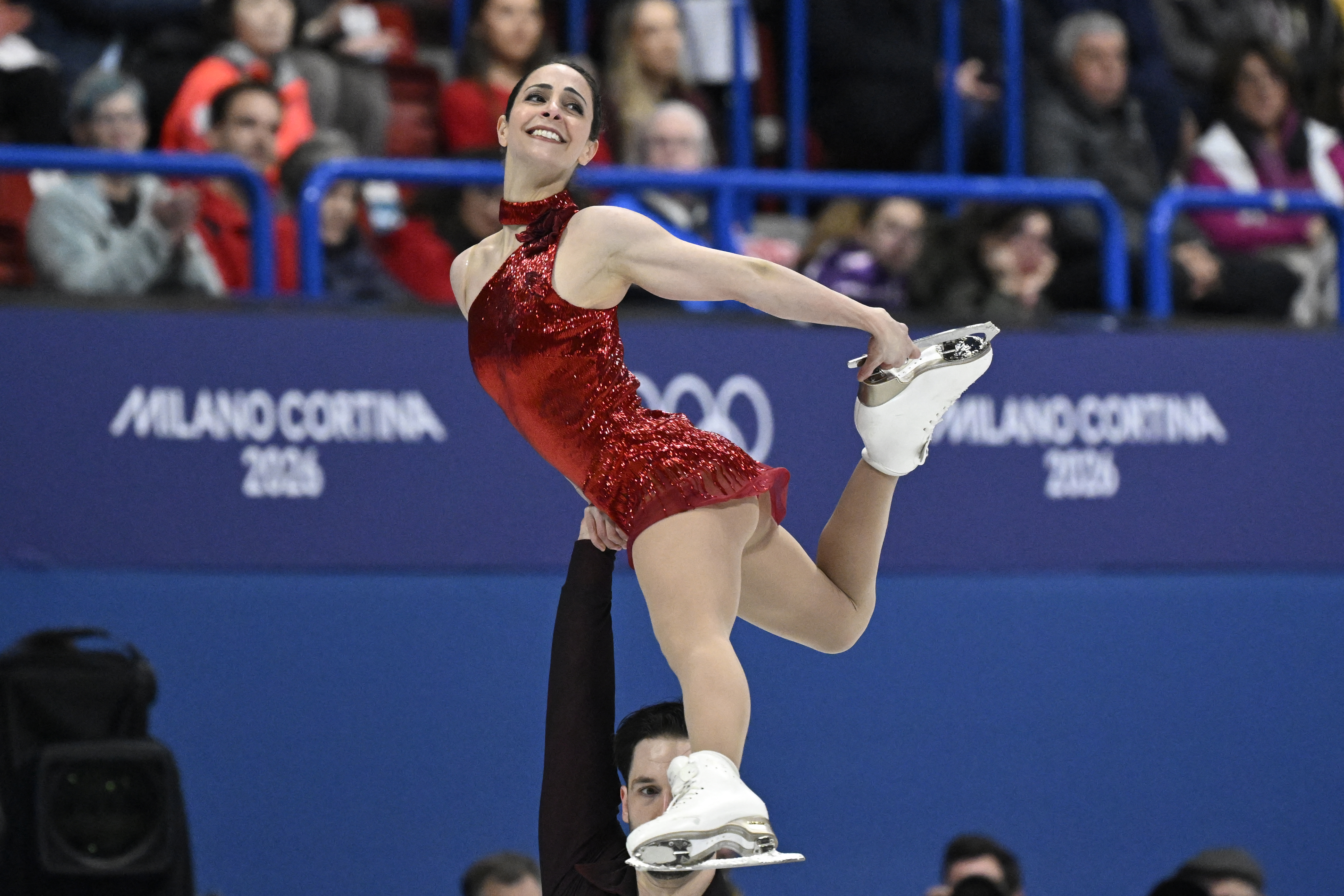
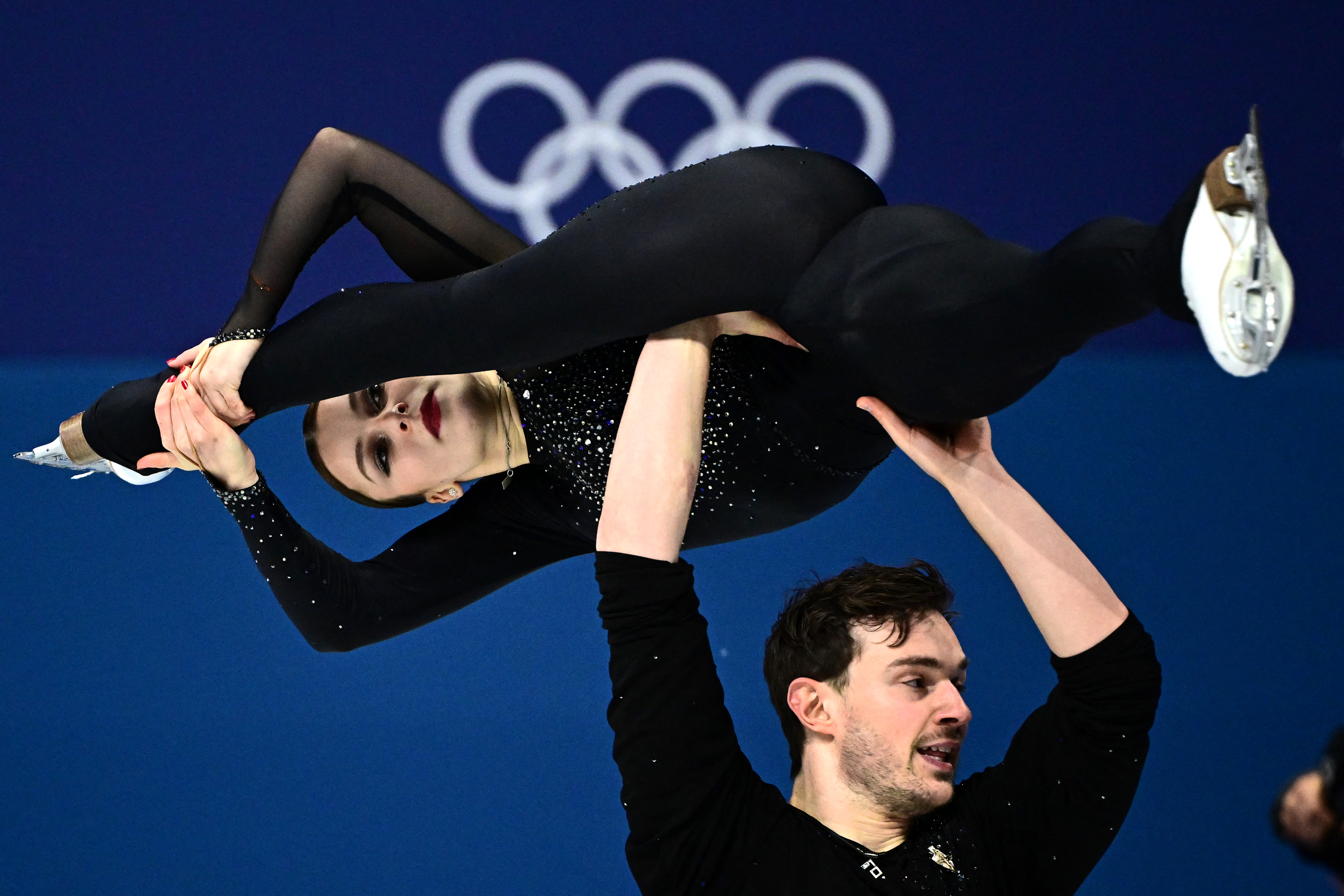
Canada's Maxime Deschamps and Canada's Deanna Stellato-Dudek compete in the figure skating pair skating free skating final during the Milano Cortina 2026 Winter Olympic Games at Milano Ice Skating Arena in Milan on February 16, 2026. (Photo by WANG Zhao / AFP via Getty Images)
WANG ZHAO via Getty Images

MILAN — There are two distinct kinds of happy Olympians in the moments after an event: those who are happy they medaled, and those who are happy to be there. The medalists go home with hardware and fame; the others take satisfaction in the fact they’ve accomplished their dreams. Even if they take, say, an extra 25 years to achieve. 

At the pairs figure skating event on Monday night, Japan’s Riku Miura and Ryuichi Kiahara claimed gold, Georgia’s Anastasiia Metelkina and Luka Berulava won silver and Germany’s Minerva Fabienne Hase and Nikita Volodin earned bronze. Americans Emily Chan and Spencer Howe finished sixth while Ellie Kam and Danny O’Shea finished eighth. They were all happy in their own ways, but none of them were quite happy in the way that Canada’s Deanna Stellato-Dudek was, because none of them have a story that can quite match hers. 

At age 42, Stellato-Dudek embodies persistence, stubbornness, hard-headedness … whatever you’d call the will to stick with your Olympic dreams even after a long retirement. A junior skater with substantial promise, including a silver medal in the 2000 World Junior Championships, she initially targeted the 2002 Salt Lake City Olympics as her goal. But persistent injuries forced her into retirement in 2001, and for 16 years, that seemed like the end of her figure skating story. 

Something nagged at her, though, some unfinished business deep inside. At a team-building exercise in her mid-30s, she surprised herself by answering the question, “What would you do if you knew you couldn’t fail?” with “I would win an Olympic gold medal.” She then decided she wanted to take one more run at the Olympics, she had to overcome doubts from virtually every corner. There aren’t many Olympians who start skating again in their mid-30s, after all.

On the suggestion of a U.S. Figure Skating official, she tried pairs, which better fit her skillset. She paired with 2014 Olympian Nathan Bartholomay until he was forced to retire in 2019 with persistent knee injuries. To keep her career going and her dreams alive, Stellato-Dudek opted to move to Canada and pair with Maxime Deschamps, eight years her junior. The duo decided to skate for Canada, reasoning that it would be easier to get Stellato-Dudek a Canadian passport in time for the 2026 Olympics than for Deschamps to get a U.S. one.

The pair won a surprise gold at the 2024 World Championships, and continued to push forward toward the 2026 Olympics even as the obstacles grew higher and higher, from tougher competition to lingering illness and injury. Still, they persisted, and in January were named to the Canadian Olympic team and slated to skate in the team event. 

But since nothing is ever easy for Stellato-Dudek, disaster again struck. Just days before the pair was scheduled to leave for Milan, days before she would finally achieve her Olympic dream … she hit her head in a training accident. Suddenly, everything she had worked for over the course of decades was in jeopardy. 

Doctors finally cleared her to fly early last week, and the pair landed in Milan well after the Opening Ceremony had started. They had little time to get accustomed to the ice of Assago Ice Skating Arena, and struggled through their short program, finishing 14th of 19 teams after a late fall marred their routine. 

“The potential was still there, but there was nothing I could do. It was an accident,” she said. “Stuff like that happens in life all the time, and I'm not young, so I'm aware of that.”

In one way, being so close to competing for a medal was surely maddening. In another, it didn’t really matter, not when you’ve waited your whole life — a life twice as long as some of your teammates — to be here at the Olympics.

“We've been really busy, busier than normal, so I have not been able to enjoy much,” Stellato-Dudek said. “I look forward to having a great Olympic experience now that the ‘work’ is done. I'll take the photo with Maxim in front of the rings and go get some of the free stuff. We've gotten nothing so far, so we look forward to doing that now.”

And after Milan? Who knows? Could she be a 46-year-old Olympian?

“I'm not certain that I'm done,” she said. “I think the only limits you have are the ones that you set on yourself. Even though everybody loves to try to put limits on me because I'm 42. I don't believe in any of that. Only I can put limits on myself. So I might see you again in four years."
'Something felt right': Daytona 500 winner Tyler Reddick on strategy, guts and Michael Jordan 

Being a Daytona 500 winner is a whole lot like being a Masters champion or an Oscar winner. No matter where you go for the rest of your life, no matter what you do in the rest of your career, you’ll always be known as a Daytona 500 winner. 

Plus, you get a pretty sweet ring and a Rolex, too. 

Tyler Reddick won the Daytona 500 Sunday night in one of the wildest, most chaotic final laps in recent memory. Probably a good dozen drivers had a shot at winning the race as it wound through its final turns, but in the end, 23XI’s Tyler Reddick was the last man driving. (Almost literally; the second through fifth cars crashed behind him, joining the dozens that had wrecked earlier in the race.) 

TYLER REDDICK WINS THE DAYTONA 500! pic.twitter.com/nOAjUM4Buu

— FOX: NASCAR (@NASCARONFOX) February 15, 2026

Going on a couple hours’ sleep — “I’m used to that with an 8-month-old and a 6-year-old” — Reddick spoke to Yahoo Sports Monday morning to discuss that finish, his new jewelry, and what happens when Michael Jordan himself tells you you’re his driver. 

“Something felt right from the beginning of the day, to go the way it did,” Reddick said. “It's surreal. You dream of having the opportunity to cross the finish line first in the Daytona 500. To be able to seize the opportunity was huge, because some drivers go their whole career with only getting one shot. Some drivers never get that opportunity to win that race. So it was super important for me to capitalize on the moment in front of me.”

In front, behind and around him. Reddick combined data, strategy and good old gut instinct in that final lap. “It took a little bit of everything,” he said. “The things we’ve learned, been working on on the Cup side, the strategy to get in that position, leaning on numbers and data decisions about the final laps. And then I leaned on and relied on instincts, the type of things that helped me get to where I am today from dirt racing.” 

A self-professed late bloomer, Reddick first attended the Daytona 500 as a fan, sitting in the backstretch and watching Matt Kenseth’s rain-delayed win in 2012. Back then, he was a dirt track racer just trying to break through the dirt-to-asphalt barrier. He found a seat in Ken Schrader’s ARCA car in 2013, and then caught the attention of Brad Keselowski, who put him in a Camping World Truck in 2014. From there, he moved upward through the ranks of then-Xfinity and Cup series … until the day in 2022 when he received the proverbial summoning before the throne.

Two days after the now 30-year-old Reddick was born, Michael Jordan — then with only three championships to his name — dropped 48 points on the Philadelphia 76ers. So Reddick knows Jordan as a basketball player only from highlight films. Even so, the GOAT’s shadow was long enough to intimidate Reddick … right up to the moment that Jordan and Denny Hamlin — co-owners of 23XI Racing — made him an offer he couldn’t refuse. 

“The first time I met him,” Reddick recalled, “he and Denny both told me, ‘Of all the drivers in the Cup garage, you’re the guy we want the most. You’re our first pick, and we’d love to have you drive our race cars.’” 

That made an impression on Reddick, even if he can only remember Jordan on the Washington Wizards. “When you have someone like [Jordan] that believes in you and what you do, what you're about and how hard you work, and how much you care about racing,” Reddick says, “and then hearing how much he cares about racing too on top of that, it just helps really sell it that 23XI is where I need to be.” 

Jordan and Hamlin’s faith paid off. Reddick has won six races since joining 23XI at the start of the 2023 season, and he’s made the playoffs every year. He won the 2024 regular-season championship and was one of the now-defunct Championship 4 that year. He and his family struggled through personal challenges last year — his infant son Rookie had to have surgery after doctors found a tumor in his chest — but wife Alexa, Rookie and Rookie’s older brother Beau were in victory lane Sunday night. 

“We travel on the road together,” he said. “I feel it's important to share these moments with our children. To celebrate the biggest times together is important, especially coming off of some of the things we went through the last year.”

Reddick is in the midst of a media crush — his voice is already ragged, and he’s got a New York media car wash to go — and then he’ll need to get ready for the Atlanta race this coming weekend. But he’s already getting used to the fact that, yes, he’s a Daytona 500 champion. 

“Looking at the ring, it helps,” he said, laughing. “Looking down at my Daytona Rolex watch, yeah. Every time I look at the time on this thing, I’ll think of this race and that day.”

Train for 4 years, over in 90 seconds: the cruel math of Olympic speed skating

MILAN — Say “speed skating” out loud. There, you just covered the difference between success and failure in the Olympics. Four years of training, four years of work, four years of hopes and dreams … and you might fall short by a third of a second. 

Kristen Santos-Griswold has spent the last four years training for Monday morning. One of the world’s best short-track speed skaters, Santos-Griswold was leading the 1000m race in Beijing when she was taken out on the final lap. She would go on to finish fourth, the most agonizing of all places in the Olympics. 

“The hardest part about this sport,” Santos-Griswold said recently, “is that kind of concept of, you can be the best, you can be the fastest, and things just don't work out for you.”

She spent months after that 2022 heartbreak trying to figure out whether she wanted to commit another four years to training, knowing every minute of every day that it could all end in the literal blink of an eye.

“I had to really sit there and think, if in four years the same thing happens again, would that be worth it?” she said recently. “Obviously, I’m here. So I did decide that it would be.”

Monday morning, Santos-Griswold put that mindset to the test as she stood on the starting line for the 1000m, this time in the quarterfinals. She needed to finish first or second, or notch one of the fastest third-place times in the quarterfinals, to advance to the semis. 

The race began cleanly, a sharp contrast from her four-start 500m race a few days ago. And very quickly, Santos-Griswold climbed into first place … which was exactly where she didn’t want to be. Within a few laps, her pursuers caught her, and she couldn’t make up the ground. 

“I just expected it to start a bit faster, and that I was going to sit in second or something,” she said a few minutes after the finish. “Then when it didn't, it's like, Alright, I've got to make a move and kind of pick it up a bit.”

She couldn’t, finishing in third place by 0.34 seconds. Worse, her time of 1:29.102 wasn’t fast enough to qualify her as a third-place finisher. And thus, her hopes for 1000m redemption ended right there in the quarterfinals. 

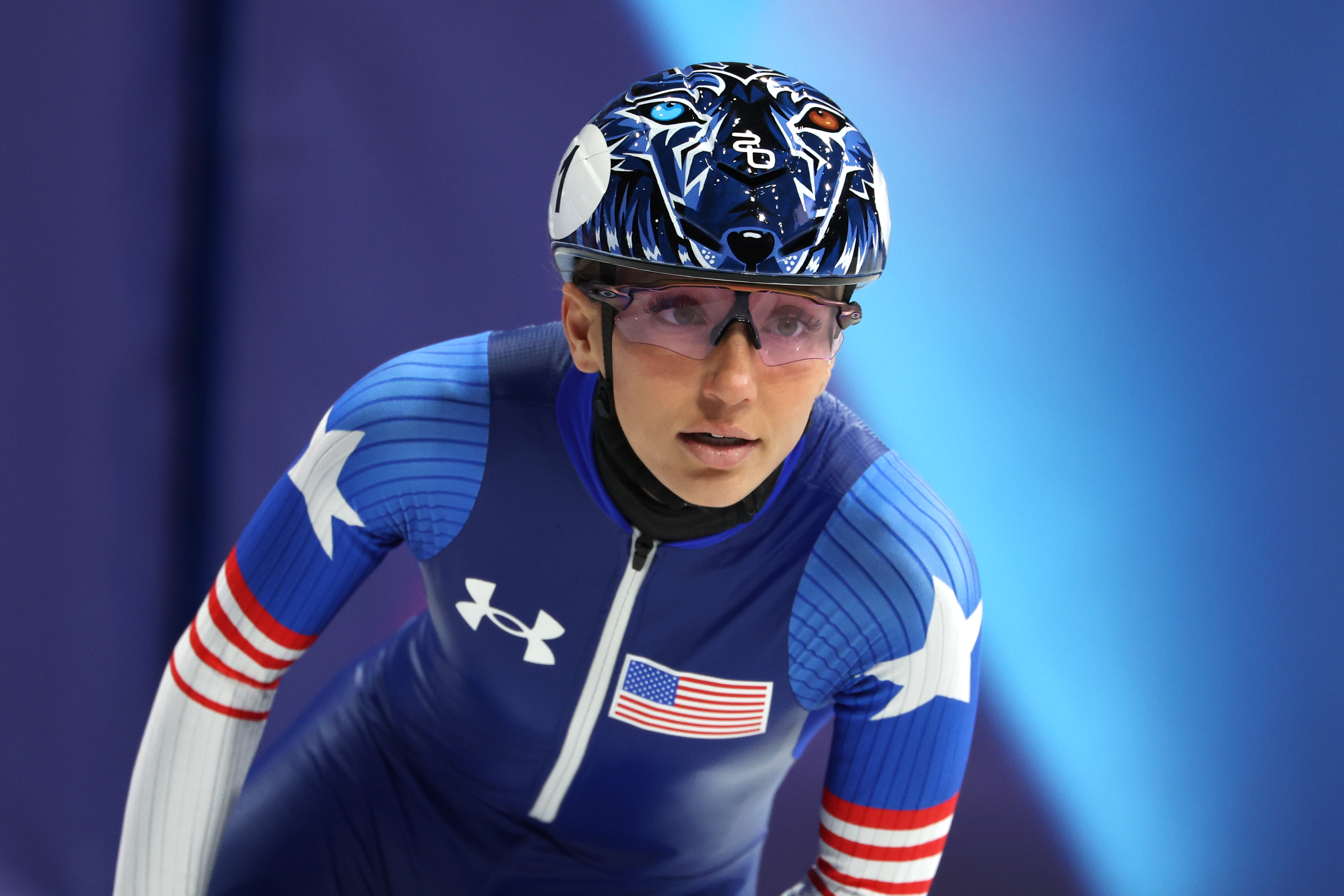
MILAN, ITALY - FEBRUARY 16: Kristen Santos-Griswold of Team United States reacts after competing in quarterfinal 3 of the Short Track Speed Skating Women's 1000m on day ten of the Milano Cortina 2026 Winter Olympic games at Milano Ice Skating Arena on February 16, 2026 in Milan, Italy. (Photo by Jamie Squire/Getty Images)
Kristen Santos-Griswold reacts after competing in quarterfinals of the short track speed skating women's 1000m. (Photo by Jamie Squire/Getty Images)
Jamie Squire via Getty Images

This is the cruelty of short-track speed skating. Other Olympic sports have margins of victory measured in the tenths, hundredths, even thousandths of a second. But none of the athletes in those sports — skiing, biathlon, luge, and so on — have their competition literally entangled with them the way short-track speed skating does. 

Sure, there are rules. You can’t impede a skater while they’re attempting a pass, you can’t “brake-check” a fellow skater, you can’t throw your blades around. But beyond that, collisions can and do happen. And when you’re whipping around a sheet of ice at 30 miles an hour on millimeter-thick blades, well … there’s a reason why short tracks have massive pads encircling the rink. It’s a safe bet someone’s going to fly into them at high speed. 

With all that tension and pressure, it’s a wonder short-track skaters aren’t puddles of anxiety. Even so, Santos-Griswold has been open about her nerves before races, and she spoke of that on Monday following the end of her 1000m event. 

“I get very nervous and anxious before races, but I just try to take it one step at a time,” she said. “I try to go into it knowing that I'm as prepared as possible, but without the thought of, ‘I've sacrificed so much,’ and more like, ‘I'm here because I want to be here.’”

Santos-Griswold has one individual race, the 1500m, remaining in her Milan Olympics … and, probably, her Olympic career as a whole. One more chance to cap off her comeback with a medal, even if she’s already validated it to herself. 

“I think I'll have to talk to my coaches and figure out maybe a different plan, and how I'm going to capitalize on the race at the end more,” she said. “You can never really predict what anyone's going to do, so it's just what it is.”

Maybe she’ll be more at ease with the randomness of this sport and the near-misses of her Olympics in the coming days and years. But in the moment, she sure sounded like she was trying to convince herself.

Winter Olympics 2026: The skaters whose own country didn’t want to send them to Milan 

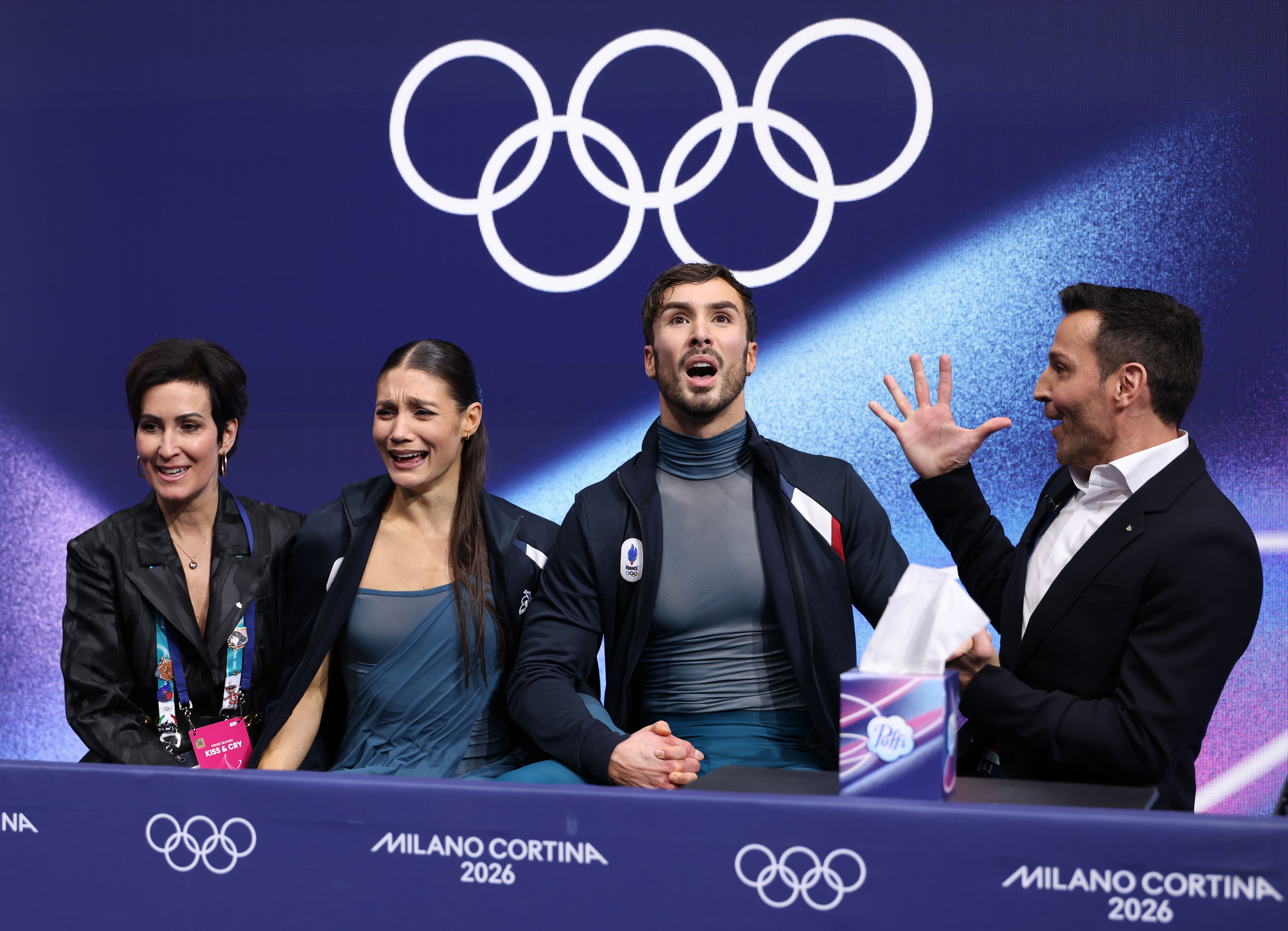
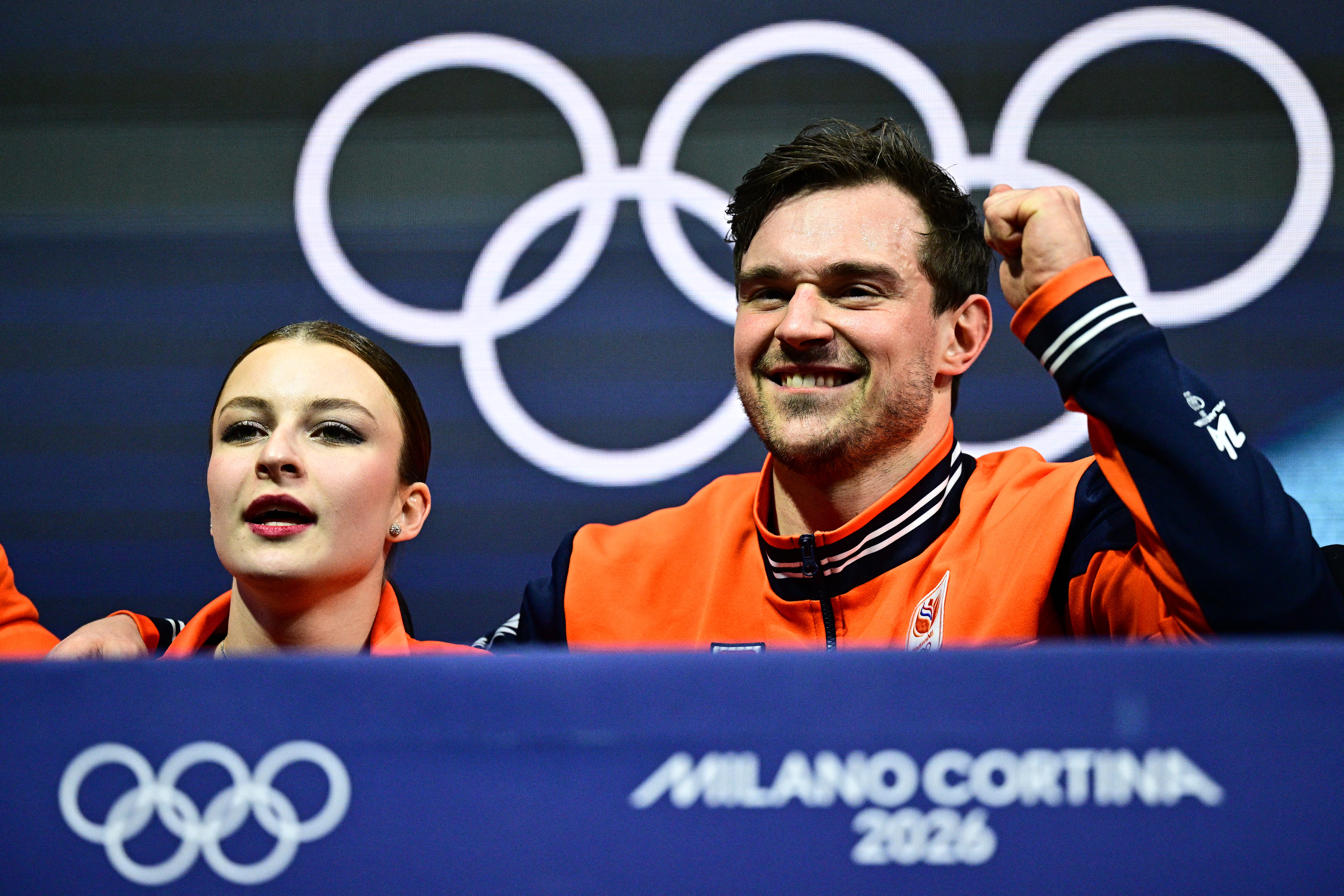
Netherlands' Daria Danilova and Michel Tsiba react in the kiss and cry area after competing in the figure skating pair skating short program during the Milano Cortina 2026 Winter Olympic Games at Milano Ice Skating Arena in Milan on February 15, 2026. (Photo by JULIEN DE ROSA / AFP via Getty Images)
Netherlands' Daria Danilova and Michel Tsiba react after competing in the pair skating short program at the Milano Cortina 2026 Winter Olympic Games. (JULIEN DE ROSA / AFP via Getty Images)
JULIEN DE ROSA via Getty Images

MILAN — There will be other pairs in Milan who score higher than the Netherlands’ Daria Danilova and Michel Tsiba, other pairs who pull off more complex routines, other pairs who will take home medals. But it’s pretty safe to say there is no other pair having quite as much fun in Milan as the Dutch-by-way-of-Russia duo. 

That’s what happens when you make it to the Olympics even after your own country says you can’t go. 

Danilova and Tsiba were among the first pairs to skate in the short-form program on Sunday night. By the end of the evening, the German duo of Minerva FabienneHase and Nikita Volodin posted the short program’s highest score. Two American duos finished the night in the top 10: Ellie Kam and Danny O’Shea in 7th, and Emily Chan and Spencer Howe in 9th. But no one had a better time on the ice than the Dutch duo, the only figure skaters from the Netherlands at the Olympics, and the first pair from their home country ever to reach the Games. 

Danilova, who is Russian, began skating with Tsiba, who is Dutch, in 2018. They found immediate success, medaling in four straight Dutch championships from 2020 to 2023 — two gold, two silver. They enjoyed a series of strong worldwide finishes leading up to the 2025 World Championships in Boston, where they finished 15th, good enough to qualify, in the eyes of the International Skating Union, for the Milan Olympics. 

And then everything went sideways for the pair. 

In the eyes of the Dutch Olympic committee, just “good enough” to make the Olympics isn’t good enough. If you’re going to go to the Olympics wearing Dutch orange, you’d better be good enough to win, not just show up. That’s the directive of the Nederlands Olympisch Comité*Nederlandse Sport Federatie, abbreviated NOC*NSF, and it’s codified in their performance requirements for athletes seeking to attend the Olympics as members of the Netherlands. 

“The ambition of NOC*NSF and the sports federations is to be among the top ten elite sports nations in the world,” the federation says. This is achieved by winning as many medals as possible in as many different sports as possible at the Olympic Games.” 

In order to hit those lofty marks, NOC*NSF says, “an elite athlete must have demonstrated the potential to finish in the top eight at the Olympic Games.” In practice, that means even if an athlete qualifies for the Olympics based on an international governing body’s standards, NOC*NSF can block the athlete from attending if the athlete hasn’t met Dutch standards. 

They’re serious. In 2024, NOC*NSF forbade three Dutch golfers — Joost Luiten, Darius Van Driel and Dewi Weber — from participating in the Paris Olympics, the second straight Olympics that the Netherlands had blocked certain golfers from playing. The International Golf Federation attempted to intervene on the players’ behalf, to no avail. 

Netherlands' Daria Danilova and Netherlands' Michel Tsiba compete in the figure skating pair skating short program during the Milano Cortina 2026 Winter Olympic Games at Milano Ice Skating Arena in Milan on February 15, 2026. (Photo by JULIEN DE ROSA / AFP via Getty Images)
Netherlands' Daria Danilova and Michel Tsiba compete in the pair skating short program at the 2026 Winter Olympic Games. (JULIEN DE ROSA/Getty Images)
JULIEN DE ROSA via Getty Images

In Danilova and Tsiba’s case, NOC*NSF determined that a 14th-place finish in the worlds would satisfy their expectations — one place higher than they’d finished. The federation gave the pair two more opportunities over the course of 2025 to reach the designated Dutch points benchmark, but they couldn’t do so. 

The Royal Dutch Skating Federation (KNSB) appealed to NOC*NSF, arguing that the pair’s 14th-place world ranking, combined with their long string of demonstrated excellence, was enough to warrant an Olympic berth. A Change.org petition organized by fans sought the same reconsideration. 

Tsiba and Danilova, meanwhile, rode the “emotional rollercoaster,” in Tsiba’s words, between exultation and heartbreak. 

“I remember when I was just driving, and I'm happy trying to train, and I think all of a sudden, ‘Olympic Games,’ and I just start crying out of the blue,” Tsiba said. “I'm cooking, I'm with my music on, listening to, I don't know, Eminem or something. And then I think about the Olympic Games, and I'm starting to cry because it's like a knife in your heart, you know?”

Finally, three days before Christmas, they received the greatest present of all: approval to attend the Games after all

“It's rare that a request to use discretionary powers is approved,” André Cats, director of elite sports at NOC*NSF, said in December. “There have to be truly exceptional reasons. After thoroughly examining the situation, we're convinced this is the case, and that's why we've made this exceptional decision.”

With their Olympic future assured, and their pairs skate short program date set for more than a week after the Opening Ceremony, Danilova and Tsiba enjoyed every bit of their Olympic experience. They attended the Opening Ceremony and stayed so long that they were the last Dutch athletes still in the stadium. They visited the pin-trading hub in Milan. They reveled in the glory of the Olympic village. 

“One of the best skaters in the Netherlands, she guided us a little bit and she was like, ‘OK, we're making a plan for you guys,’” Tsiba said. “Because you skate quite late at an event, you come here, first two days you're a tourist … She said that when she went to the Games [for the first time], she was so much in her bubble that afterwards she was like, ‘I didn't enjoy anything.’”

And once they finally reached the ice, how did Danilova and Tsiba perform, given the chance? Well … they had fun, at least. They cycled through a graceful routine set to Raury’s “Take Back the Power,” and when it was done, they embraced and kissed at center ice. They finished 17th out of 19 pairs, missing out on qualifying for the free skate by 0.58 points. But they smiled throughout, and they spent a good long time after their skate laughing with several assembled media members. 

“All the things that happened within the season are behind us,” Tsiba said, “and we got to have a fresh new start. So that's amazing, yeah.”

They may have lost at the Olympics, but they made sure they didn’t lose the party. 

Winter Olympics: U.S. Figure Skating will not appeal controversial judging in ice dance competition

MILAN — Madison Chock and Evan Bates will remain silver medalist ice dancers at the Milan Olympics. U.S. Figure Skating did not appeal the controversial judging that awarded their French competitors the gold medal in last week’s ice dance event

Last Wednesday, Chock and Bates, who are the reigning world and national champions in ice dance, performed an outstanding free skate routine that put them at the top of the medal leaderboard … right up until France’s Laurence Fournier Beaudry and Guillaume Cizeron topped them and skated away with the gold medal.

The American duo were visibly devastated after the medal ceremony, with Chock calling it “bittersweet” to come so far and fall short of gold. The next day, Chock called for “transparent judging” on CBS News. “I think it's also important for the skaters, that the judges be vetted and reviewed to make sure that they are also putting out their best performance,” she added, “because there's a lot on the line for the skaters when they're out there giving it their all, and we deserve to have the judges also giving us their all and for it to be a fair and even playing field.”

A deeper examination of the skating scores indicated that while bias existed all up and down the judges’ panel, the French judge favored Fournier Beaudry and Cizeron by a greater degree than any other judge’s bias in other directions. 

The 2026 Winter Olympics figure skating ⛸️ free dance was scored by 9 judges

The French judge gave Beaudry & Cizeron 🇫🇷 a 137.45 but only gave Chock & Bates 🇺🇸 a 129.74

All other judges were relatively close in their two scores 🤔

Judge No. 4 was just in a bad mood overall pic.twitter.com/1HkDHY5vuo

— Lev Akabas (@LevAkabas) February 12, 2026

However, the International Skating Union contended there was no malfeasance at work. “It is normal for there to be a range of scores given by different judges in any panel and a number of mechanisms are used to mitigate these variations,” the governing body said in a statement. “The ISU has full confidence in the scores given and remains completely committed to fairness.”

U.S. Figure Skating had 24 hours to appeal the result, but opted not to do so. “There has been a lot of thoughtful, and at times emotional, discussion about the ice dance competition in Milan,” USFS CEO Matt Farrell told USA Today Sports in a statement. “Working together with Madi and Evan after the Games, we will have thoughtful and intentional discussions about the best way to support them and the future of the sport. For now, we plan to join them in supporting the success of U.S. Figure Skating in Milan.”

The pairs and women’s events remain to be skated in Milan. Team USA already has a team gold medal, won in part by Chock and Bates.

Winter Olympics 2026: Judges are stealing figure skating's show (and not in a good way)

MILAN — Every four years, we casual Americans become instant experts in a whole array of winter Olympic sports. We decide we know curling strategy, we debate skiers’ lines down precipitous slopes, we instantly judge snowboarders on moves that would leave us in traction. And man, do we have thoughts on figure skating judges. 

Here’s the thing, though: While the Olympians and aficionados can safely ignore pretty much all of our two weeks’ worth of blather, the opinions on figure skating judging stick.

Americans Madison Chock and Evan Bates skated the routine of their lives on Wednesday night in figure skating’s ice dance event … only to watch in horror and heartbreak as judges controversially deemed the routine of France’s  Laurence Fournier Beaudry and Guillaume Cizeron a more worthy one. Chock and Bates ended up with a silver medal — a titanic achievement, of course, but a “bittersweet” one, in Chock’s words, when you think you ought to have won gold. 

On CBS News, Chock called for “transparent judging” to help viewers understand what’s happening. “I think it's also important for the skaters, that the judges be vetted and reviewed to make sure that they are also putting out their best performance,” she added, “because there's a lot on the line for the skaters when they're out there giving it their all, and we deserve to have the judges also giving us their all and for it to be a fair and even playing field.”

The figure skating establishment appears to be shrugging this off as just one of them skating deals, yet another in a long line of what-are-you-gonna-do judging frustrations. It’s not as egregious as the Salt Lake City skating scandal of 2002, when a French judge conceded that she’d been pressured to favor a Russian pairs duo that eventually won gold … right? 

“It is normal for there to be a range of scores given by different judges in any panel and a number of mechanisms are used to mitigate these variations,” the International Skating Union said in a statement. “The ISU has full confidence in the scores given and remains completely committed to fairness.”

Laurence Fournier Beaudry and Guillaume Cizeron of France react as they wait for the scores during the free dance competition of figure skating ice dance at the Milan-Cortina 2026 Olympic Winter Games in Milan, Italy, Feb. 11, 2026. (Photo by Chen Yichen/Xinhua via Getty Images)
Laurence Fournier Beaudry and Guillaume Cizeron of France react as they wait for the scores during the free dance competition of figure skating ice dance at the Milan-Cortina 2026 Olympic Winter Games. (Chen Yichen/Xinhua via Getty Images)
Xinhua News Agency via Getty Images

But the fire continues to smolder outside of figure skating’s traditional territory, and the casual fans who are getting a close look at this are asking, rightfully: Just what the heck is going on with the judging in figure skating?

Granted, Americans come into this with no small anti-judge bias. Judging as a means of determining a victor just doesn’t sit well with most American viewers, whether it’s gymnastics, figure skating or the Westminster Dog Show. 

At the risk of going full Daytona 500, in America, we don’t care much for ties, and we don’t dig on judged sports. If a tie is like kissing your sister, a judgment loss is like kissing a dog, and not even your dog. We like to settle our sporting events on the court, on the field, on the ice … and we don’t like our sports left in the hands of a faceless cabal passing irrevocable judgment. 

(Yes, we have instant replay. But we don’t decide the entire Super Bowl on it.) 

The issue with judging, of course, is that it’s done by judges — flawed, biased, persuadable, even manipulable human judges. The ISU has attempted a range of fixes in the wake of the 2002 scandal, from eliminating the highly imperfect and inconsistent “6.0” system to making judges’ names public to increase transparency. The ISU Judging System drills down to an element-by-element level, eliminating outliers and averaging scores, 

For the most part, the changes work, but if critics want ammunition, well … it’s there if you look at the numbers. Fournier Beaudry and Cizeron finished with 225.82 to Chock and Bates’ 224.39, a difference of 1.43 points. However, in the free dance program, the French duo totaled 135.64, while the Americans finished with 134.67. Again, extremely close, extremely debatable. But keep digging. 

In scores documented by SkatingScores on Twitter, five of nine judges scored the USA duo higher than the French one in free dance. Eight of nine judges gave Chock and Bates at least 130.97 points. The lowest score for the Americans? A 129.74 … from the French judge. Hmmm. 

Now, consider the French scores. All extremely strong, yes, but the strongest score? A stunning 137.45, again from the French judge. HMMMM. 

Put another way: France’s Jézabel Dabois ranked the United States 7.71 points worse than the French duo. This isn’t quite an Indiana-over-Oregon-level differential, but it’s still pretty substantial. Add to that the fact that Spain actually ranked the United States’ routine third, behind France and bronze medal winner Canada, and you can see why many U.S. fans are saying certain judges are full of merde

For another perspective, though, check out this data visualization by Sportico’s Lev Akabas:

The 2026 Winter Olympics figure skating ⛸️ free dance was scored by 9 judges

The French judge gave Beaudry & Cizeron 🇫🇷 a 137.45 but only gave Chock & Bates 🇺🇸 a 129.74

All other judges were relatively close in their two scores 🤔

Judge No. 4 was just in a bad mood overall pic.twitter.com/1HkDHY5vuo

— Lev Akabas (@LevAkabas) February 12, 2026

The immediate point is that the French judge absolutely jobbed the Americans, yes. This sure looks like sandbagging to bring down the Americans’ overall score and help the French team to the gold. Statistically speaking, even if many of the French judge’s individual element scores were thrown out — and they were — there’s still the potential for an artificial manipulation of the final score. And when you’re talking tenths and hundredths of a point, every score matters. 

But the larger point of this graph is equally relevant — bias is rampant across national borders. So much so that SkatingScores’ “Bias-O-Meter” shows that virtually every judge showed bias toward the skaters from their home countries. (Aside: The fact that a “Bias-O-Meter” even exists, and is statistically valid, shows exactly how gnarled the judging situation in figure skating is.) 

What’s the answer? Perhaps AI can handle this, assuming it doesn’t hallucinate a third skater on the ice. Perhaps a more rigid form of judge recusal — kicking out judges when a skater from their home nation is on the ice, for instance, would be a solid start. Or, hell, just go to a worldwide voting system on the phone. No way that could be manipulated, right? 

The maddening aspect of all of this is that it’s welling up just as skating is enjoying a resurgence in the United States. Between the two-time gold medal-winning team, the Quad God and the Big Three, America’s Olympic figure skating looks as good as it has in decades. This isn’t the time for the sport to get mired in familiar, avoidable controversies. 

Viewers deserve better. Chock and Bates deserved better. And figure skating as a sport deserves better. That’s not a judgment, that’s straight fact.

Winter Olympics 2026: Mikaela Shiffrin looks to recapture her Olympic vibe

MILAN — This time last year, the most decorated alpine skier in history was trying to force herself to ski again. Mikaela Shiffrin was attempting to return to the slalom and giant slalom races, and found herself unable to do what she’d been doing all her life.  

“I could barely even finish a run,” she recalled recently, “not because of crashing, but because when I told my body to go, it just wouldn’t.” 

Just a few months before, in November 2024, she was on her second run in Killington, Vermont, and on the cusp of capturing her 100th World Cup victory. No other alpine skier, male or female, has more than 86, and here was Shiffrin, about to break into triple digits. 

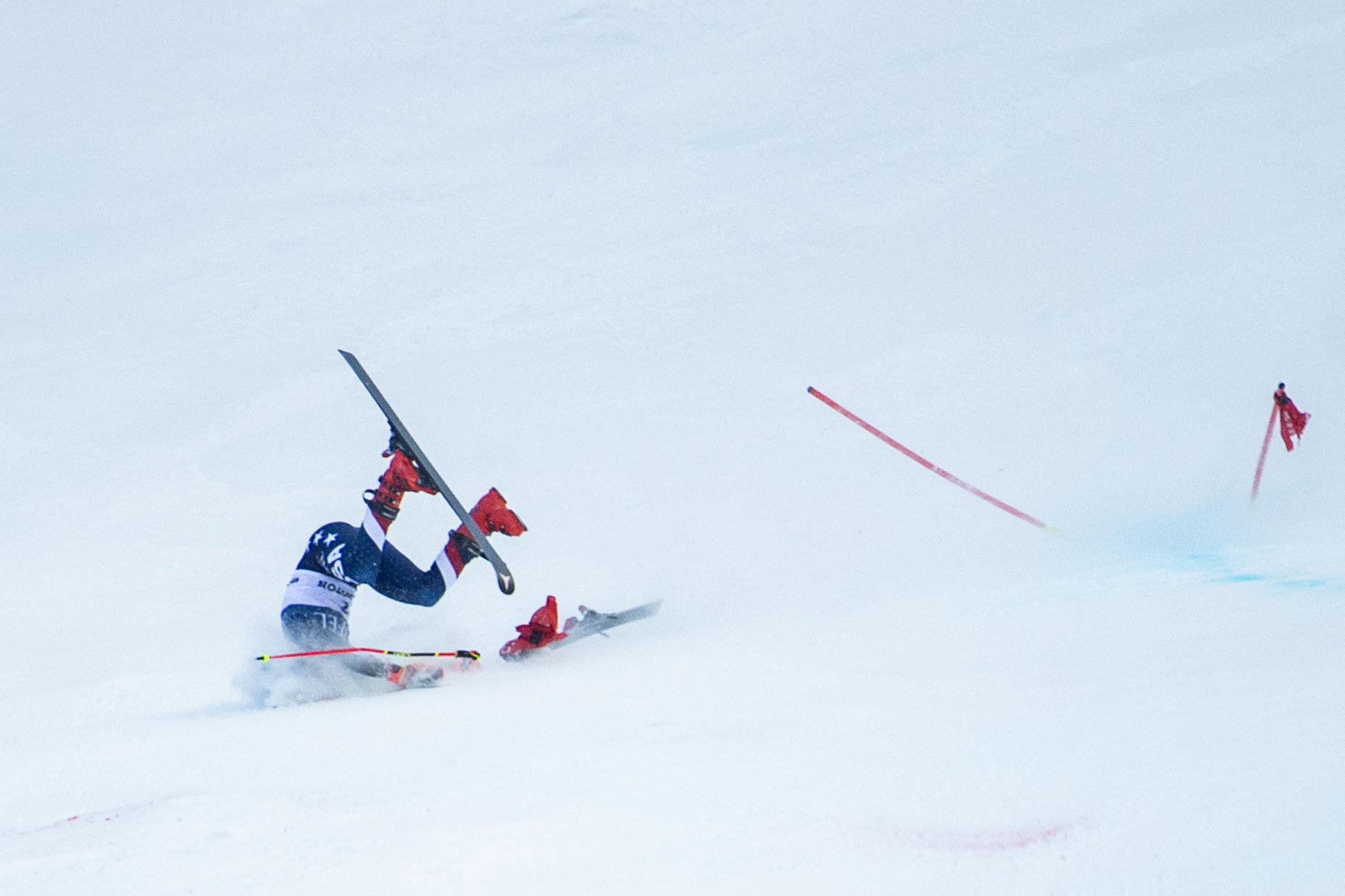
But she clipped a gate midway through her run, setting off a crash that sent her pinwheeling into the slope’s netting. She doubled over in agony, unable to ward off the pain radiating through her abdomen. 

“It’s honestly kind of difficult to explain what the pain felt like,” she later wrote in The Players Tribune. “But the closest I can get would probably be, it was like … not only was there a knife stabbing me, but the knife was actually still inside of me.”

She was extricated from the slope by sled, and later examinations revealed she had suffered significant abdominal injury, nearly puncturing her colon. But while her body healed, her mind continued to struggle. The diagnosed post-traumatic stress disorder from the crash reverberated for months afterward as she attempted to manage the panic and fear that accompanied her return to the slopes.  

TOPSHOT - Mikaela Shiffrin of team USA crashes in the Giant Slalom second run during the 2024/2025 Women's World Cup Giant Slalom in Killington, Vermont, on November 30, 2024. (Photo by Joseph Prezioso / AFP via Getty Images)
Mikaela Shiffrin crashes in the giant slalom during the a Women's World Cup event in Killington, Vermont, last November. (Joseph Prezioso / AFP via Getty Images)
JOSEPH PREZIOSO via Getty Images

“Everybody needs to understand with these struggles that they don't work linearly,” Shiffrin recently said. “They don't work in the way you think they're going to, or expect they're going to. … Time helps. Exposure helps. It doesn’t work to just back away from your fears, but it works to take them on in bite-sized pieces.” 

Killington isn’t the only slope that holds ghosts for Shiffrin. There’s also the Yanqing National Alpine Skiing Centre, host of the alpine events for Beijing’s 2022 Olympics. Shiffrin went into the 2022 Games a two-time gold medalist, victorious both at Sochi (slalom) and Pyeongchang (giant slalom). But at Beijing, she failed to even finish in three of her six events, her best individual finish a 9th in Super G. 

“I don't want Beijing to be the reason that I'm scared of the Olympics. And for the past few years, it has been a little bit,” Shiffrin told Olympics.com last fall. “When Cortina comes along, we’ll just take it day by day, take it as it comes.”

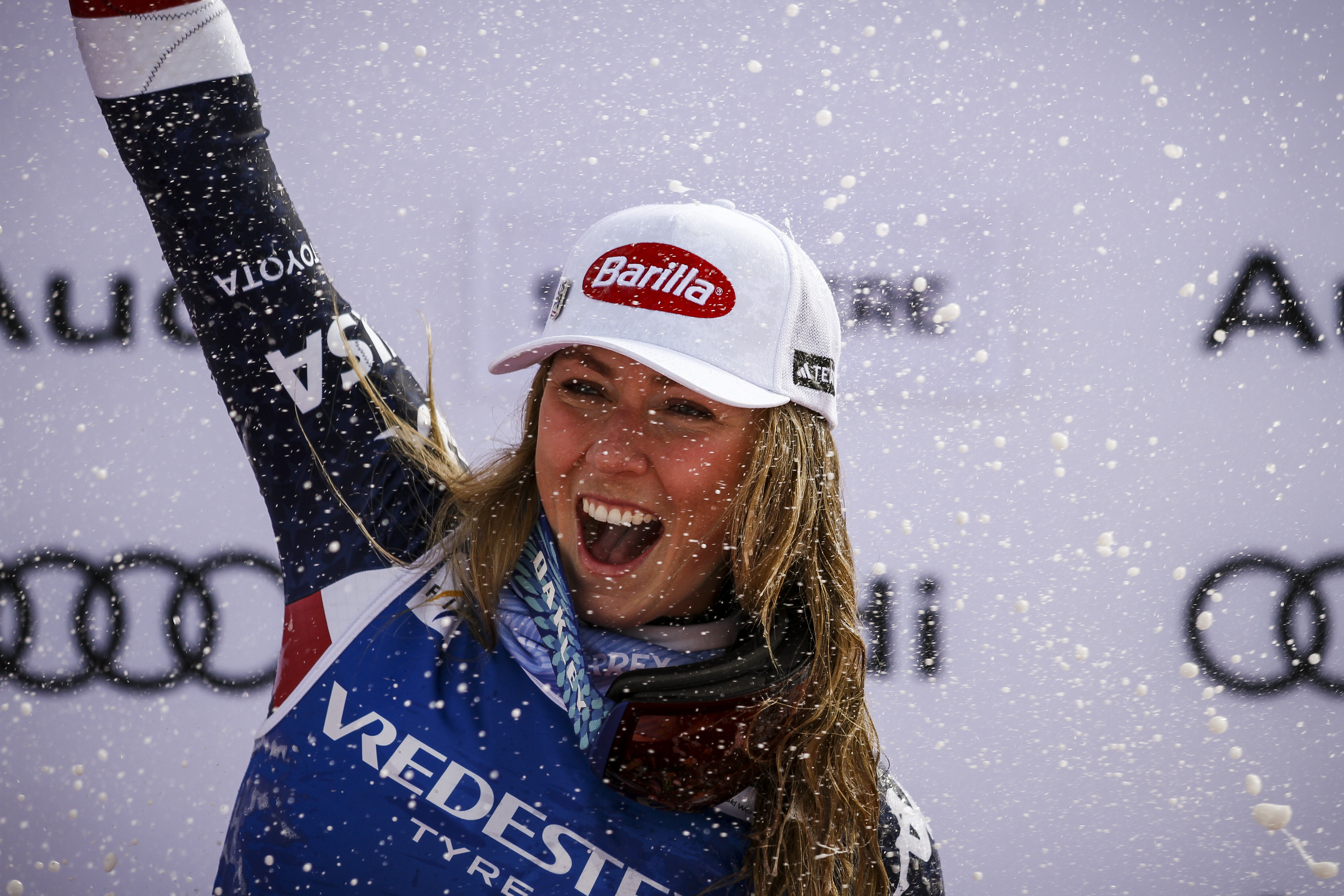
She arrived at the Milan Cortina Games with as much momentum as she’s had in years. She finally managed that 100th World Cup victory in February, and since then she’s added seven more, including a victory in slalom in the Czech Republic just days before the Olympics’ Opening Ceremony. That combined success, that validation of her belief in herself, has given her a new, more optimistic mindset heading into the Games. 

Mikaela Shiffrin of Team USA celebrates during the prize-giving ceremony after the Audi FIS Alpine Ski World Cup Women's Slalom in Sestriere, Italy, on February 23, 2025. US Mikaela Shiffrin wins ahead of Croatia's Zrinca Ljutic, who is second, and US Paula Moltzan, who is third. Mikaela Shiffrin takes her 100th World Cup skiing win with the Sestriere slalom. (Photo by Matteo Bottanelli/NurPhoto via Getty Images)
Mikaela Shiffrin celebrates after winning the slalom in Sestriere, Italy — her 100th World Cup victory — on February 23, 2025. (Matteo Bottanelli/NurPhoto via Getty Images)
NurPhoto via Getty Images

“Especially after the past two seasons, with battling a couple different pretty serious injuries, I've had two fairly incomplete seasons,” Shiffrin said recently. “So, to be at this point right now … heading into the Olympics, but also from the perspective of just having a really successful World Cup season, I'm really excited about that.”

But then came the team combined ski on Feb. 10 where Shiffrin not only lost the lead Breezy Johnson staked her in the downhill but finished 15th overall in her slalom run — nearly a second behind first place. A mediocre ski from Shiffrin would have notched her and Johnson gold. Instead they dropped all the way off the podium to fourth place.

How will she rebound from the rocky start?

She has a few days, as the giant slalom is Sunday. And she also has the lessons of four years ago to fall back on.

“The one thing you can expect from the Olympics is that things are just not really going to go according to your plan,” Shiffrin said. “So you've got to roll with the punches and have a really good open mind.”

❌