
Reading view

Passengers Disrupted In The US as Southwest Airlines, WestJet, Spirit Airlines, and Others Faced 11 Cancelled Flights and 229 Delays at Harry Reid Intl Airport, Disrupting Denver, Los Angeles, Phoenix, San Francisco, and More

Passengers Disrupted In The US as Southwest Airlines, WestJet, Spirit Airlines, and Others Faced 11 Cancelled Flights and 229 Delays at Harry Reid Intl Airport, Disrupting Denver, Los Angeles, Phoenix, San Francisco, and More

Several passengers were affected in the US as 229 delays and 11 cancellations were reported today at Harry Reid International Airport (LAS). The most affected carrier was Southwest Airlines (7 cancellations, 163 delays), followed by WestJet (2 cancellations, 2 delays), Spirit Airlines (1 cancellation, 9 delays), and Air Canada Rouge (1 cancellation, 4 delays).
Other major airlines facing delays included Delta Air Lines (12 delays), United Airlines (12 delays), American Airlines (5 delays), Alaska Airlines (5 delays), Frontier Airlines (5 delays), and JetBlue Airways (2 delays).
Ripple effects were recorded across key hubs including Denver International Airport (2 cancellations, 12 inbound delays; 2 cancellations, 10 outbound delays), Los Angeles International Airport (4 inbound delays; 4 outbound delays), Phoenix Sky Harbor International Airport (4 inbound delays; 4 outbound delays), San Francisco International Airport (5 inbound delays; 3 outbound delays), Seattle–Tacoma International Airport (2 inbound delays; 3 outbound delays), and Reno–Tahoe International Airport (7 inbound delays; 6 outbound delays).
Cross-border routes were also impacted, including Toronto Pearson International Airport, Vancouver International Airport, Montréal–Trudeau International Airport, and Licenciado Benito Juárez International Airport.

  • Update today: 229 delays and 11 cancellations were reported at LAS.
  • Southwest Airlines accounted for 163 delays and 7 cancellations.
  • Denver International recorded 2 cancellations and over 20 total delay movements (inbound and outbound combined).
  • West Coast airports including Los Angeles, Phoenix, San Francisco, Seattle, and Reno saw multiple inbound and outbound delays.
  • Canadian and Mexican routes, including Toronto, Vancouver, Montreal, and Mexico City, registered limited but confirmed disruption.

Airlines Most Affected by Flight Cancellations and Delays

Southwest Airlines

7 cancellations and 163 delays, representing the largest operational impact at LAS today.

WestJet

2 cancellations and 2 delays affecting cross-border services.

Spirit Airlines

1 cancellation and 9 delays.

Air Canada Rouge

1 cancellation and 4 delays on Canada-linked routes.

Delta Air Lines

12 delays recorded with no cancellations.

United Airlines

12 delays impacting domestic connectivity.

American Airlines

5 delays reported.

What Can Affected Passengers Do?

  • Check airline apps and official notifications for real-time status updates.
  • Airlines typically push gate changes, revised departure times, aircraft swaps, and cancellation notices through their mobile apps, SMS alerts, and email systems. Monitoring these channels frequently can help passengers respond quickly to schedule adjustments.
  • Rebook through airline self-service portals where available.
  • Most major carriers provide digital rebooking tools that allow passengers to select alternative flights, standby options, or nearby airport departures without waiting in physical queues. Acting early may provide access to more available seats.
  • Monitor departure and arrival boards at both origin and destination airports.
  • Airport display systems often reflect updates that may not yet appear in third-party travel apps. Checking both departure and inbound aircraft status can provide better visibility into potential cascading delays.
  • Retain boarding passes and receipts related to delay expenses.
  • Keeping documentation for meals, ground transport, or accommodation may be useful if reimbursement options are available under airline policy or applicable regulations. Organized records support faster claim processing.
  • Contact airline customer service for re-accommodation options.
  • In cases of cancellations or significant delays, passengers may request alternative routing, interline transfers, or future travel credits depending on fare conditions and seat availability.
  • Review fare rules regarding refunds or alternate routing.
  • Ticket terms outline eligibility for refunds, travel vouchers, same-day changes, or rerouting through partner airlines. Understanding these conditions helps passengers assess available recovery options.

Overview of Flight Disruptions

Harry Reid International Airport faced 11 cancelled flights and 229 delays, with ripple effects extending across multiple domestic hubs. Airlines most affected included Southwest Airlines, WestJet, Spirit Airlines, Air Canada Rouge, Delta Air Lines, United Airlines, and American Airlines.

Major U.S. cities experiencing associated delays included Las Vegas, Denver, Los Angeles, Phoenix, San Francisco, Seattle, and Reno. Cross-border connectivity with Canada and Mexico also reflected limited disruption, particularly involving Toronto, Vancouver, Montreal, and Mexico City.

The pattern shows concentrated domestic impact within the United States, with secondary effects extending into Canada and Mexico through select routes.

Source: Different airports and FlightAware

The post Passengers Disrupted In The US as Southwest Airlines, WestJet, Spirit Airlines, and Others Faced 11 Cancelled Flights and 229 Delays at Harry Reid Intl Airport, Disrupting Denver, Los Angeles, Phoenix, San Francisco, and More appeared first on Travel And Tour World.

Emirates Deploys Retrofitted A380 and Boeing 777 Aircraft on Asia and Europe Services

Emirates Deploys Retrofitted A380 and Boeing 777 Aircraft on Asia and Europe Services

Long-haul travelers are set to experience broader access to enhanced cabin options as Emirates advances its aircraft refurbishment initiative and adjusts fleet deployment across several international routes. The Dubai-based carrier is progressing toward a significant milestone in its A380 modification programme while introducing aircraft upgrades on select services to Asia and Europe.

A major component of this development involves the airline’s high-density two-class Airbus A380 aircraft. One of these aircraft is scheduled to complete its transformation into a three-class configuration by mid-April. The revised layout will incorporate 76 Business Class seats, 56 Premium Economy seats, and 437 Economy Class seats, reshaping capacity distribution for travelers seeking differentiated cabin experiences.

The first upgraded aircraft is scheduled to operate between Dubai and Amman under flight numbers EK903 and EK904 from 14 April through 31 May. Beginning 1 June, the same aircraft will transition to serve Prague on EK139 and EK140. By November, all 15 of the airline’s two-class A380 aircraft are expected to be converted to the new three-class arrangement, expanding Premium Economy availability across additional routes.

Asia Network Enhancements Target Growing Travel Demand

In Asia, service adjustments will further extend access to upgraded cabin products. From 1 May, flights EK392 and EK393 to Ho Chi Minh City will be operated using a retrofitted Boeing 777-200LR configured in three classes. With this change, more than 600 weekly Premium Economy seats will be offered on the airline’s double daily operations to and from the Vietnamese city.

Additional changes are scheduled for Hong Kong. Beginning 1 October, flights EK382 and EK383 will shift from a Boeing 777-300ER to an Airbus A380. From 1 December, the route will transition again, with a retrofitted A380 equipped with Premium Economy deployed on the service. These adjustments indicate a phased approach to aircraft deployment aligned with product enhancements.

For travelers moving between Dubai and key Asian gateways, the expansion of Premium Economy seating represents an increase in intermediate cabin options positioned between Business and Economy Class.

A More Layered Experience for International Travelers

The introduction of Premium Economy across additional aircraft types reflects a broader effort to create greater segmentation within the long-haul travel experience. For international passengers, the availability of three cabin classes on aircraft previously configured with two introduces more flexibility when selecting fare types.

Travelers planning journeys between Dubai and destinations such as Amman, Prague, Ho Chi Minh City, and Hong Kong will encounter more consistent onboard configurations as retrofitted aircraft enter service. A structured cabin hierarchy may influence booking decisions, particularly on high-demand routes where seat availability and cabin variety are central considerations.

As aircraft configurations evolve, passengers may experience greater continuity across different city pairs served by upgraded A380 and Boeing 777 aircraft.

Tourism Connectivity Strengthened Through Fleet Modernization

The deployment of refurbished widebody aircraft across multiple international routes may support travel flows by aligning seat capacity with varied traveler preferences. The redistribution of seating across Business, Premium Economy, and Economy cabins provides structured choice within a single aircraft type.

Routes linking Dubai with Amman and Prague, alongside Asian markets including Ho Chi Minh City and Hong Kong, will gradually see a harmonized cabin offering. For tourism markets, expanded Premium Economy capacity could influence how travelers plan longer journeys, particularly where comfort considerations intersect with flight duration.

As the retrofit programme progresses toward completion of all 15 two-class A380 aircraft by November, a larger portion of the network will reflect the revised three-class standard. The phased rollout across different cities demonstrates an incremental strategy, with aircraft assignments shifting over time to introduce upgraded cabin products across multiple markets.

The post Emirates Deploys Retrofitted A380 and Boeing 777 Aircraft on Asia and Europe Services appeared first on Travel And Tour World.

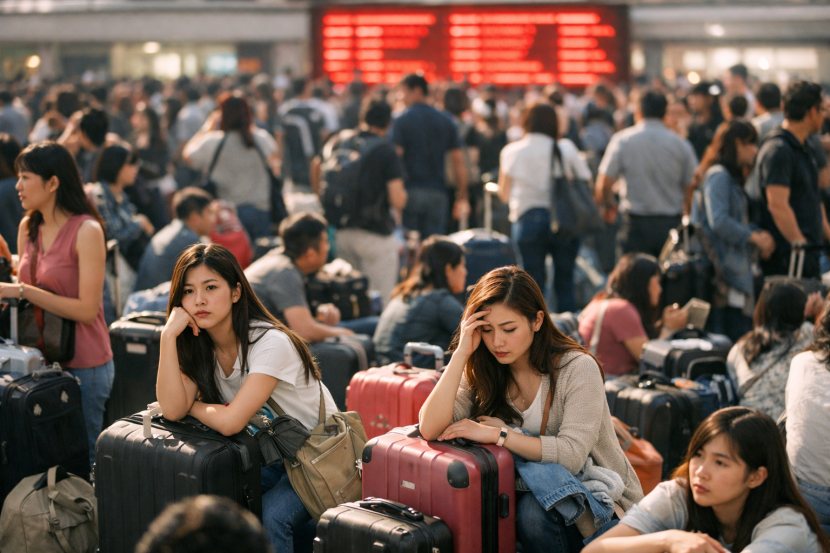
Thousands Of Passengers Stranded In Asia As Japan, Thailand, Singapore, UAE, Indonesia, India, China, And Hong Kong Delay 2,894 And Cancel 52 New Flights, Disrupting Emirates, Japan, Singapore, Cathay Pacific, Lion Air, And Others In Tokyo, Bangkok, Shanghai, Dubai And More

Thousands Of Passengers Stranded In Asia As Japan, Thailand, Singapore, UAE, Indonesia, India, China, And Hong Kong Delay 2,894 And Cancel 52 New Flights, Disrupting Emirates, Japan, Singapore, Cathay Pacific, Lion Air, And Others In Tokyo, Bangkok, Shanghai, Dubai And More
Thousands Of Passengers Stranded In Asia As Japan, Thailand, Singapore, UAE, Indonesia, India, China, And Hong Kong Delay 2,894 And Cancel 52 Flights

Thousands of passengers grounded in Asia today as Japan, Thailand, Singapore, UAE, Indonesia, India, China, and Hong Kong recorded a total of 2,894 delays and 52 cancellations across 15 major Asian airports, including Jakarta (300 delays, 15 cancellations), Mumbai (465 delays, 4 cancellations), Delhi (415 delays, 4 cancellations), Tokyo Haneda (293 delays, 2 cancellations), Bangkok (234 delays, 1 cancellation), Shanghai (210 delays, 2 cancellations), Hong Kong (178 delays, 3 cancellations) and Dubai (172 delays, 2 cancellations).
The most affected airlines by volume included Japan Airlines (168 delays, 4 cancellations), IndiGo (355 delays, 6 cancellations), Air India (294 delays), Cathay Pacific (90 delays, 6 cancellations), China Eastern (98 delays, 1 cancellation), Lion Air (132 delays), Batik Air (105 delays, 19 cancellations), and Thai Airways (55 delays).
Other major carriers such as Emirates, Singapore Airlines, All Nippon Airways, and Flydubai also recorded notable delays.
According to latest flight data, the disruptions impacted Jakarta, Makassar, Mumbai, Delhi, Beijing, Shanghai, Guiyang, Wuhan, Hong Kong, Tokyo, Sapporo (New Chitose), Kagoshima, Bangkok, Singapore and Dubai.

  • Update today: 2,894 delays and 52 cancellations recorded across 15 Asian airports.
  • Mumbai recorded the highest delay volume (465).
  • Jakarta recorded the highest cancellations (15).
  • Japan Airlines recorded 168 delays and 4 cancellations across Japanese airports.
  • IndiGo led Indian carriers with 355 delays and 6 cancellations.
  • Cathay Pacific accounted for 6 cancellations and 90 delays across Hong Kong and Beijing.
  • Tokyo Haneda and Hong Kong recorded the highest U.S.-linked delays (10 and 11 respectively).
  • Most disruptions were delay-driven rather than cancellation-heavy.

Most Affected Asian Airports

Chhatrapati Shivaji Maharaj International Airport

Mumbai recorded 465 delays and 4 cancellations, the highest delay count among all airports assessed.

Indira Gandhi International Airport

Delhi saw 415 delays and 4 cancellations, with heavy impact on domestic carriers.

Soekarno–Hatta International Airport

Jakarta registered 300 delays and 15 cancellations, the highest cancellation figure overall.

Haneda Airport

Tokyo Haneda reported 293 delays and 2 cancellations, including 10 U.S.-linked delays.

Suvarnabhumi Airport

Bangkok recorded 234 delays and 1 cancellation, largely affecting Thai carriers.

Shanghai Pudong International Airport

Shanghai logged 210 delays and 2 cancellations, with 9 delays tied to U.S. routes.

Hong Kong International Airport

Hong Kong reported 178 delays and 3 cancellations, including 11 U.S.-linked delays.

Dubai International Airport

Dubai recorded 172 delays and 2 cancellations, primarily affecting regional and Gulf carriers.

Airlines Most Affected by Asia Flight Cancellations and Delays

Japan Airlines

168 delays and 4 cancellations across Tokyo Haneda and New Chitose.

IndiGo

355 delays and 6 cancellations across Mumbai, Delhi, Bangkok and Dubai.

Air India

294 delays across Mumbai, Delhi and Dubai.

Cathay Pacific

90 delays and 6 cancellations across Hong Kong, Beijing and Bangkok.

Batik Air

105 delays and 19 cancellations across Jakarta and Makassar.

China Eastern

98 delays and 1 cancellation across Shanghai, Beijing, Guiyang and Wuhan.

Lion Air

132 delays across Jakarta and Makassar.

Thai Airways

55 delays across Bangkok and Hong Kong.

What Can Impacted Passengers Do?

  • Contact airlines directly for rebooking options.
  • Monitor SMS and email notifications from carriers.
  • Review compensation eligibility under applicable aviation regulations.
  • Allow extra time for airport transfers and connections.
  • Keep receipts for potential reimbursement claims.

Learn More

Overview of Asia Flight Cancellations And Delays

Across Asia, disruptions remained heavily delay-driven, with major hubs like Mumbai, Delhi, Jakarta, and Tokyo Haneda accounting for a significant portion of the 2,894 delays.

Airlines most affected included Japan Airlines, IndiGo, Air India, Cathay Pacific, China Eastern, and Batik Air, with cumulative delay figures ranging from 90 to 355 per carrier. Jakarta and Mumbai emerged as key disruption hotspots, while Hong Kong and Tokyo Haneda recorded the highest U.S.-linked delay exposure.

While cancellations totaled 52 across Japan, Thailand, Singapore, UAE, Indonesia, India, China, And Hong Kong, they were concentrated among select carriers such as Batik Air, Cathay Pacific, IndiGo, and Japan Airlines. Major international hubs including Shanghai, Dubai, Bangkok, and Singapore experienced sustained delay volumes but limited cancellations, reinforcing a broader regional pattern of schedule congestion rather than widespread flight withdrawal.

Source: Different airports and FlightAware
The post Thousands Of Passengers Stranded In Asia As Japan, Thailand, Singapore, UAE, Indonesia, India, China, And Hong Kong Delay 2,894 And Cancel 52 New Flights, Disrupting Emirates, Japan, Singapore, Cathay Pacific, Lion Air, And Others In Tokyo, Bangkok, Shanghai, Dubai And More appeared first on Travel And Tour World.
❌