Reading view

Why Owning 100 XRP Could Become Increasingly Difficult in a Shrinking Supply Market

XRP price prediction $100

The post Why Owning 100 XRP Could Become Increasingly Difficult in a Shrinking Supply Market appeared first on Coinpedia Fintech News

The claim sounds dramatic at first: one day, owning just 100 XRP might feel like holding something scarce. But that’s the argument gaining attention after a recent breakdown by Edo Farina, and he insists it’s less about moon-talk and more about simple math.

XRP is trading around $1.37 during a broader market cooldown. Nothing explosive on the surface. But Farina says the price today is a distraction. What matters, in his view, is who could end up holding the supply tomorrow.

The Bank Liquidity Theory

Farina’s core argument starts with global banking plumbing.

Banks currently park massive sums of money in what are known as nostro accounts — prefunded pools used to settle cross-border payments. Trillions of dollars sit idle in that system worldwide. If XRP were used as a bridge asset to replace that structure, he argues, financial institutions would need to hold significant reserves.

His rough model goes like this:

If around 150 central banks held 100 million XRP each, that alone would absorb 15 billion tokens. Add roughly 25,000 private banks holding 1 million XRP each, and another 25 billion tokens would be tied up. Combined, that’s about 40 billion XRP — nearly half of the total 100 billion supply.

Whether those numbers are realistic is up for debate. But the point he’s making is simple: institutional reserves could dramatically thin out the liquid supply.

CBDCs, Wallet Reserves, and Retail Demand

Farina doesn’t stop at banks. He layers in consumer adoption through central bank digital currencies and stablecoins potentially operating on the XRP Ledger. If even a fraction of the global population needed XRP to activate wallets or maintain reserve balances, that demand would add up quickly.

For example, if 800 million users held just five XRP each to operate wallets, that would remove 4 billion tokens from active circulation.

It’s not just accumulation, either. Every transaction on the XRP Ledger burns a tiny amount of XRP. Over time, that mechanism slowly reduces total supply. The burn rate is small, but across large-scale usage, it compounds.

Supply Shock or Stretch Scenario?

The bullish case is clear. If institutions lock reserves, retail users hold base balances, and transaction activity continues to chip away at supply, fewer tokens would remain freely tradable. In theory, prices would need to rise to balance shrinking availability with steady or growing demand.

The counterargument is just as straightforward. These projections assume widespread institutional adoption, coordinated accumulation, and heavy retail usage. That’s a tall order. Global banks move cautiously. Governments move slower. And crypto adoption rarely follows a clean, linear path.

Still, the idea sticks because it reframes the conversation. Instead of asking whether XRP can reach a certain price, it asks how much of the supply could realistically stay liquid if large players begin holding it long term.

If that shift ever materializes, 100 XRP might not sound like pocket change.

For now, it remains a theory built on potential structural demand.

Hyperliquid News: HYPE Tops Treasury Rankings as Shorts Pull Back

Altcoin to Watch in February Hyperliquid (HYPE) Primed for a 50% Upswing

The post Hyperliquid News: HYPE Tops Treasury Rankings as Shorts Pull Back appeared first on Coinpedia Fintech News

In the downtrend, HYPE has climbed to 8.2% of circulating supply held by digital asset treasuries, overtaking major crypto assets in just 12 months. At the same time, derivatives data show a sharp reduction in large short positions, signaling a potential shift in market sentiment.

Hyperliquid is rapidly reshaping treasury allocation charts.

According to data shared by CryptoRank, HYPE has moved from near-zero treasury presence to leading all major digital assets in circulating supply held by digital asset treasuries. By February 2026, 8.2% of HYPE’s circulating supply was held in treasury structures, nearly double Bitcoin’s 4.2% and far ahead of BNB’s 0.5%.

While broader markets remain volatile, this metric signals strong ecosystem-level positioning.

From Zero to Treasury Leader

In just one year, HYPE transitioned from minimal strategic allocation to the top spot in treasury concentration. Treasury holdings often represent long-term ecosystem conviction rather than speculative trading flows. That makes this shift notable.

Unlike Bitcoin’s widely distributed supply model, HYPE’s higher treasury share suggests coordinated allocation, potentially tied to ecosystem incentives, liquidity management, or long-term growth planning. The numbers alone show aggressive accumulation relative to peers.

The key question now is whether this represents structural adoption or concentrated positioning during an early growth phase.

Shorts Pull Back as Open Interest Builds

Beyond treasury data, derivatives metrics add another layer. Insights from HyperInsight show that the largest short seller significantly reduced HYPE short exposure by nearly 98,713 contracts, worth roughly $2.94 million.

Total open interest currently sits above $10.4 million, with an average entry price near $30.70. The reported position shows a sizable unrealized profit of over $1.43 million, while the liquidation level is far above current pricing levels. The sharp reduction in short contracts could indicate profit-taking or shifting conviction, potentially easing immediate downside pressure.

Accumulation or Concentration Risk?

HYPE’s rise to the top of treasury accumulation rankings signals strong internal alignment and growing ecosystem strength. At the same time, high treasury concentration and leveraged derivatives activity can amplify volatility in both directions.

For now, HYPE stands at a pivotal moment. Treasury dominance highlights confidence. Short reductions hint at changing sentiment. Whether this momentum evolves into sustained structural growth remains the market’s next big question.

Bitcoin Down 50% From $126K Peter Schiff Warns of $40K Crash

Bitcoin Down 50% From $126K Peter Schiff Warns of $40K Crash

The post Bitcoin Down 50% From $126K Peter Schiff Warns of $40K Crash appeared first on Coinpedia Fintech News

The debate around Bitcoin’s long-term outlook is intensifying once again. While some investors view the recent pullback as a standard cycle correction, longtime critic Peter Schiff believes something far more structural is unfolding.

Bitcoin is currently trading roughly 50% below its October 2025 high of $126,000. After failing to regain sustained upside momentum, the asset has entered a period of consolidation under key resistance levels. Volatility tied to macroeconomic uncertainty and geopolitical stress has further pressured risk assets across the board.

But Schiff’s warning goes beyond charts and technical levels.

The “Bubble Market” Argument

Schiff describes Bitcoin as sentiment-driven and bubble-like, arguing that the multi-year rally was fueled by speculation rather than sustainable fundamentals. In his view, the recent downturn signals that “the air is coming out” of an overextended market.

He has suggested that Bitcoin could fall toward $50,000, or even $40,000, if downside momentum accelerates. Schiff also made headlines by claiming that a single Truth Social post from Donald Trump could significantly impact Bitcoin’s price, underscoring what he sees as the asset’s fragility and dependence on political sentiment.

Schiff has additionally criticized Trump’s pro-crypto stance, calling efforts to position the United States as a global crypto hub misguided and a misallocation of capital.

Gold’s Surge and Institutional Rotation

While Bitcoin struggles, Schiff points to gold’s strong performance as evidence of a broader monetary shift. He argues that rising gold prices reflect de-dollarization trends and renewed central bank accumulation of hard assets.

Institutional flows appear to support a divergence. Hedge fund exposure to Bitcoin ETFs has declined in recent quarters, while gold-backed funds now manage significantly larger total assets. During periods of market stress, capital has increasingly rotated into traditional safe havens.

Two Competing Narratives

Bitcoin supporters maintain that volatility is a normal part of long-term adoption cycles. They argue that network fundamentals and institutional infrastructure remain intact despite the correction.

For now, Bitcoin stands between two sharply contrasting views. One sees a fragile bubble vulnerable to sentiment shocks, even political ones. The other sees a maturing asset navigating another cyclical downturn.

Never Miss a Beat in the Crypto World!

Stay ahead with breaking news, expert analysis, and real-time updates on the latest trends in Bitcoin, altcoins, DeFi, NFTs, and more.

FAQs

Is Bitcoin in a bubble right now?

Some critics call it a bubble due to speculation and volatility. Long-term investors argue it’s a cyclical correction, not a structural collapse.

Are institutions moving from Bitcoin to gold?

Some capital has rotated into gold during market stress. Bitcoin ETF flows have cooled, but long-term institutional interest remains.

Does political news really impact Bitcoin’s price?

Yes. Bitcoin often reacts to political headlines and regulation shifts, but long-term price trends are driven more by adoption and liquidity.

Shiba Inu Price Prediction: Will SHIB Crash After Death Cross?

Shiba Inu Price Prediction Will SHIB Crash After Death Cross

The post Shiba Inu Price Prediction: Will SHIB Crash After Death Cross? appeared first on Coinpedia Fintech News

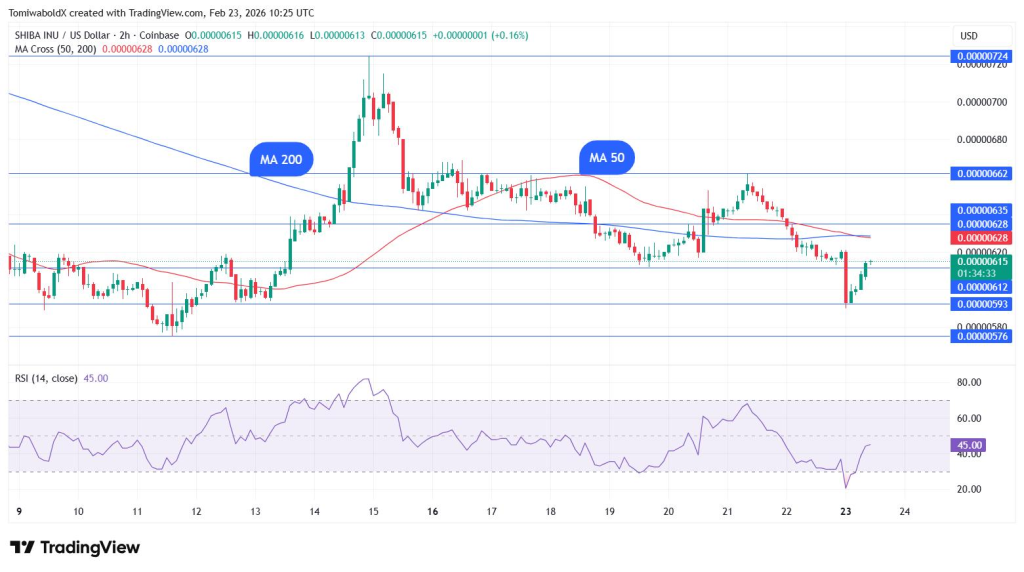
Shiba Inu just flashed a “death cross” on the lower timeframes, and as usual, the chart has split traders into two camps.

Right now, SHIB is trading slightly below $0.0000060 after sliding under several short-term moving averages. On February 23, the 200-period simple moving average crossed above the 50-period moving average on the 2-hour chart. 

In technical analysis, that crossover is widely seen as a bearish signal. It suggests that recent price momentum has weakened enough for longer-term averages to overtake shorter ones.

But here’s the thing: death crosses don’t appear out of nowhere. They usually show up after the damage has already been done.

Why the Signal Matters

SHIB had already formed a similar crossover on the 1-hour chart days earlier. The latest signal on the 2-hour timeframe simply confirms that short-term structure has been leaning bearish for a while. Price has been making lower highs, and each bounce has struggled to build strength.

The important level right now is $0.0000060. That zone previously acted as demand, drawing in buyers during earlier dips. SHIB briefly bounced above $0.0000061, but buying pressure faded quickly. There hasn’t been a strong follow-through.

If this support breaks decisively, the next areas to watch sit around $0.0000057 and then $0.0000050. Those levels have seen reactions in the past, but every time a support level gets tested, it weakens a little more. A clean breakdown could open the door to a faster move lower.

Shiba Inu Price

On the upside, resistance sits near $0.0000066, with heavier supply around $0.0000072 and $0.0000078. For any real recovery to take shape, SHIB would need to reclaim those zones and climb back above its short-term moving averages. Without that, rallies risk turning into short-lived relief bounces.

It is also important to remember that death crosses are lagging indicators. They confirm what has already happened. They do not guarantee that a fresh crash is coming. Sometimes they appear right before a short squeeze or bounce, especially if the market is already stretched to the downside.

At this point, SHIB is at a technical crossroads. The chart looks fragile, but the $0.0000060 level is still in play. Whether it holds or breaks will likely decide the next meaningful move.

FAQs

Will SHIB recover after the recent death cross?

Recovery depends on reclaiming $0.0000066 and holding support. Without that, rallies may remain short-term relief bounces.

Could SHIB drop to $0.0000050 next?

Yes, if $0.0000060 fails decisively, downside momentum could extend toward the $0.0000050 support region.

Is SHIB bullish or bearish right now?

Short-term structure leans bearish due to lower highs and the death cross, but support at $0.0000060 remains critical.

Vitalik Buterin Draws the Line: Ethereum Will Not Back ‘Just Any’ DeFi Project

Ethereum Foundation DeFi principles

The post Vitalik Buterin Draws the Line: Ethereum Will Not Back ‘Just Any’ DeFi Project appeared first on Coinpedia Fintech News

The Ethereum Foundation has made one thing clear this week: it is not backing just any DeFi project with a token and a dashboard.

In a series of posts outlining its direction, the Foundation said it wants to see decentralized finance thrive, but only if it lives up to core principles. As one member put it, DeFi is not just another niche inside crypto.

“DeFi isn’t a speculative bet on the future. It’s the inevitable evolution of finance,” adding that “financial autonomy is a right, not a privilege.”

Ethereum co-founder Vitalik Buterin doubled down on that message.

“DeFi is a central part of the value that Ethereum provides,” Buterin wrote. “Financial empowerment is a central part of what it means to have agency and freedom in our current world.” He said that Ethereum does far more than finance, but stressed that permissionless access to savings, risk management and payments remains one of its strongest contributions.

Not All Onchain Finance Makes the Cut

Buterin was direct about where the line is drawn. The Foundation is not interested in supporting “on-chain finance” indiscriminately. Instead, it wants “permissionless, open-source, private, security-first global finance that maximizes people’s control over their own assets, minimizes centralized chokepoints and trusted third parties.”

One concept he stressed is what he called the “walkaway test.” Protocols should keep functioning even if the founding team disappears or turns hostile. 

Ethereum, he reminded readers, is permissionless. Anyone can deploy anything. But that does not mean the Foundation will stand behind projects that rely on unnecessary centralization or what he described as “dopamine-maximizing gambleslop.”

A Return to DeFi’s Era

Buterin also called for a revival of the early DeFi mindset. “Ethereum’s early DeFi era was great because it dared to dream and innovate,” he said, pointing to breakthroughs like automated market makers.

Instead of simply building “a better stablecoin,” he requested developers to dig deeper into core problems such as risk management and hedging future expenses, and to design solutions that traditional finance cannot replicate.

Hence, Ethereum wants DeFi that could not exist without Ethereum. Not a copy of traditional finance with a blockchain label, but something structurally different.

Never Miss a Beat in the Crypto World!

Stay ahead with breaking news, expert analysis, and real-time updates on the latest trends in Bitcoin, altcoins, DeFi, NFTs, and more.

FAQs

What is the Ethereum Foundation’s stance on DeFi projects?

The Ethereum Foundation backs DeFi that is permissionless, open-source, secure, and minimizes centralized control, not speculative or heavily centralized projects.

Why doesn’t Ethereum support all on-chain finance projects?

Ethereum supports projects that reduce trusted intermediaries and protect users, not those relying on central control or short-term speculative hype.

How does Ethereum want DeFi to evolve?

Ethereum encourages DeFi that solves real financial problems like risk management and hedging, creating systems traditional finance cannot replicate.

Bitcoin and Ethereum ETFs Struggle While XRP ETFs Stay Positive During Market Crash

Bitcoin and Ethereum ETFs

The post Bitcoin and Ethereum ETFs Struggle While XRP ETFs Stay Positive During Market Crash appeared first on Coinpedia Fintech News

Crypto markets are clearly losing steam in early 2026. Bitcoin is trading around $62,900, stuck in a frustrating $60,000 to $70,000 range. Over the past week alone, major cryptocurrencies have dropped between 8% and 11%. This isn’t the kind of fast crash that sparks aggressive dip-buying. Instead, it feels slow and heavy, like the market is gradually deflating.

Altcoins have taken even more pressure. Sell-side activity has reportedly climbed to levels not seen in five years. Sentiment is cautious. Traders are tired. Volatility hasn’t disappeared, but it has changed shape. It’s no longer explosive. It’s structural.

And yet, when you look at ETF flows, a different story begins to emerge.

Bitcoin and Ethereum See Outflows

Last year, spot ETF inflows were one of the main reasons Bitcoin rallied to $126,000. Regulated investment products now account for more than 6% of Bitcoin’s total market capitalization.

But since November, the tide has shifted. Bitcoin ETFs have recorded $7.2 billion in outflows. Ethereum funds have lost another $2.8 billion. Most weeks have ended in the red.

Institutions, at least in BTC and ETH products, appear to be trimming exposure.

XRP and Solana ETFs Stay Positive

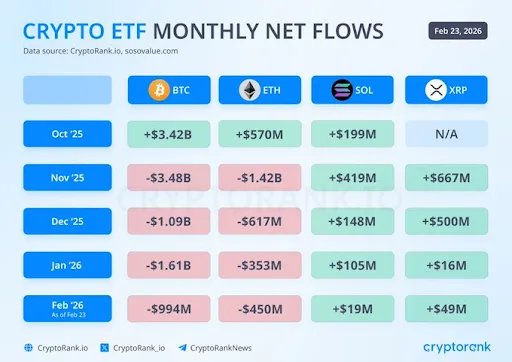
Here’s where it gets interesting. Both Solana and XRP ETFs launched right into this broader market slowdown. Yet neither has recorded a single negative month since its debut.

Crypto ETF Monthly Net Flows

Inflows have slowed significantly. Solana ETF flows fell from $419 million in November to just $19 million in February. XRP dropped from $667 million to $49 million over the same period. But the key point is this: not one red month.

That consistency matters.

According to market analysts, the U.S. spot XRP ETF has seen outflows on only five trading days since launch. That’s a remarkable level of stability during a period when prices have been sliding.

A Different Kind of Downturn

This market feels different from past cycles. Earlier downturns were often driven by retail leverage, leading to sharp collapses followed by violent rebounds. Today’s structure appears more institutionally anchored. Price action is slower. More controlled. More range-bound.

That doesn’t mean weakness is over. Bitcoin’s consolidation near $62,900 shows a balance between buyers and sellers. Altcoins remain under pressure. Liquidity is thinner.

But ETF flows are becoming one of the clearest windows into institutional sentiment. And right now, XRP and Solana are quietly holding their ground.

In a cooling market, staying green every month is not a small detail. It may be one of the more important signals beneath the surface.

Never Miss a Beat in the Crypto World!

Stay ahead with breaking news, expert analysis, and real-time updates on the latest trends in Bitcoin, altcoins, DeFi, NFTs, and more.

FAQs

Why are crypto prices falling in early 2026?

The market is experiencing a structural slowdown rather than a crash, with Bitcoin trading sideways. Selling pressure on altcoins has increased, and institutional outflows from Bitcoin ETFs are contributing to the heavy, range-bound price action.

Are investors pulling money out of Bitcoin ETFs?

Yes, Bitcoin ETFs have seen significant outflows recently, totaling $7.2 billion since November. This shift indicates that institutions are trimming their exposure to Bitcoin, moving away from the aggressive buying seen during the 2025 rally.

What makes this crypto downturn different from past crashes?

Unlike past crashes driven by retail leverage and sharp collapses, this downturn feels institutionally anchored. The price action is slower and more controlled, resulting in a gradual deflation rather than violent, quick rebounds.

What is the most important signal in the market right now?

ETF flows have become the clearest window into institutional sentiment. While Bitcoin and Ethereum see outflows, the fact that XRP and Solana ETFs stay positive every month is a significant signal of underlying strength and stability.

Crypto Crash Today: Bitcoin Drop, Hack Attempt, and ETH Moves Explained

Crypto Crash Today

The post Crypto Crash Today: Bitcoin Drop, Hack Attempt, and ETH Moves Explained appeared first on Coinpedia Fintech News

Crypto markets slipped into the red over the past 24 hours, with traders reacting to a mix of selling pressure, legal headlines, and a failed hack attempt that briefly rattled sentiment.

Bitcoin is hovering in the mid-$60,000 range, but momentum has weakened. 

Bitcoin Under Pressure as Corporate Moves Diverge

One of the biggest storylines today is the split in corporate behavior.

Strategy Inc., formerly known as MicroStrategy, added another 592 BTC worth nearly $40 million. The company now holds 717,722 Bitcoin acquired at a total cost of $54.56 billion. The message from Strategy is clear: long-term conviction remains intact.

But not everyone is doubling down.

Mining firm Bitdeer sold its remaining 943 BTC and reduced its treasury exposure to zero as it pivots toward AI infrastructure. That rotation signals a different view on capital allocation and adds to short-term uncertainty.

Economist Peter Schiff also weighed in with a fresh bearish warning, suggesting Bitcoin could fall below $50,000 and even revisit $20,000. His comments added fuel to an already fragile market mood.

Ethereum Slides After Buterin Sells

Ethereum dropped 5.7% after co-founder Vitalik Buterin sold 1,869 ETH over two days. The sale followed a larger liquidation earlier this month.

While the transactions were reportedly pre-planned to fund ecosystem development and biotech initiatives, traders reacted quickly. In sensitive markets, even routine sales from high-profile figures can trigger defensive selling.

Hack Attempt Adds to Market Nerves

Adding to the chaos, World Liberty Financial (WLFI) reported a coordinated attack targeting its USD1 stablecoin.

According to the team, attackers hacked several cofounder accounts, paid influencers to spread fear, uncertainty, and doubt, and opened large short positions to profit from the disruption.

The attempt failed. USD1 maintained its peg thanks to its 1:1 backing and mint-and-redeem structure. Still, the incident contributed to broader nervousness across digital assets.

Regulation and Legal Shadows

Regulatory headlines are also shaping sentiment.

The SEC introduced a new stablecoin collateral rule allowing institutions to use stablecoins as higher-value collateral. Over time, this could unlock fresh institutional capital.

At the same time, legal issues resurfaced as Jane Street faces accusations linked to the 2022 Terraform Labs collapse. Old wounds in crypto tend to reopen quickly, and legal uncertainty rarely helps short-term confidence.

For now, though, markets are reacting more to risk signals than to growth stories. Until liquidity improves and volatility cools, traders are likely to remain cautious.

Never Miss a Beat in the Crypto World!

Stay ahead with breaking news, expert analysis, and real-time updates on the latest trends in Bitcoin, altcoins, DeFi, NFTs, and more.

FAQs

Why is Bitcoin price under pressure today?

Bitcoin is weakening due to corporate treasury shifts, whale selling, legal headlines, and risk-off sentiment, reducing short-term momentum near $60K–$65K.

Is Bitcoin showing signs of recovery or further downside risk?

Bitcoin is holding key support, but momentum is weak. A true recovery needs stronger volume and liquidity; otherwise, deeper pullbacks remain possible.

Can the crypto market recover after legal and security concerns?

Recovery is possible if volatility cools and liquidity improves. Strong institutional demand and stablecoin stability could help restore confidence.

Firm Allegedly Accused of Bitcoin ‘10AM Manipulation’ Boosts MSTR Holdings Before Terra Court Battle

Jane Street Terra lawsuit

The post Firm Allegedly Accused of Bitcoin ‘10AM Manipulation’ Boosts MSTR Holdings Before Terra Court Battle appeared first on Coinpedia Fintech News

The collapse of the Terra-Luna ecosystem is back in the news and this time, one of Wall Street’s biggest trading firms is at the center of the fight.

According to a report by The Wall Street Journal, the court-appointed liquidator for Terraform Labs has filed a lawsuit in New York federal court against trading giant Jane Street. The firm is accused of using insider information during the 2022 Terra meltdown to profit while the market was unraveling.

Todd Snyder, who is overseeing Terraform’s liquidation process, claims Jane Street had access to non-public information and used it to front-run key trades during the collapse of TerraUSD (UST). The lawsuit argues that this gave the firm an unfair advantage and allowed it to profit while ordinary investors and creditors suffered heavy losses.

The Curve Pool Withdrawal Claim

One of the main allegations centers on events from May 7, 2022. The complaint states that Terraform quietly withdrew 150 million UST from the Curve 3pool. Within minutes, wallets allegedly linked to Jane Street pulled another 85 million UST from the same liquidity pool.

Snyder argues this information was not public at the time and suggests Jane Street acted with advance knowledge of Terraform’s move. The lawsuit describes the activity as an effort to “rig the market” during one of crypto’s most dramatic crashes.

Jane Street has denied any wrongdoing. The firm reportedly maintains that Terra’s collapse was the result of mismanagement and fraud by Terraform’s own leadership, not insider trading.

Communication Channels Under Scrutiny

The complaint also claims that a former Terraform employee who later joined Jane Street maintained contact with Terraform insiders. The lawsuit suggests that sensitive internal discussions may have been shared through private communication channels.

Jump Trading, another major trading firm, is also mentioned. Snyder has previously sued Jump, alleging it had secret agreements to help support UST before its collapse.

Terra’s Fall and the Aftermath

Terraform, founded by Do Kwon, collapsed in May 2022 after UST lost its dollar peg. The crash wiped out more than $40 billion in market value and triggered widespread losses across the crypto industry. Terraform later filed for bankruptcy, and Kwon was sentenced to prison in the United States.

Rising Bitcoin Exposure Raises Eyebrows

Adding to the controversy, Jane Street has sharply increased its exposure to Bitcoin through MicroStrategy shares. The firm reportedly boosted its MSTR holdings by 473% in a single quarter, now holding over 951,000 shares valued at about $124 million.

The timing has drawn attention in crypto circles, especially as some online commentators have previously accused large institutions of influencing Bitcoin price moves around key trading hours.

Never Miss a Beat in the Crypto World!

Stay ahead with breaking news, expert analysis, and real-time updates on the latest trends in Bitcoin, altcoins, DeFi, NFTs, and more.

FAQs

What is the Jane Street lawsuit about?

The liquidator for Terraform Labs is suing Jane Street, alleging the trading firm used insider information to profit during the 2022 TerraUSD collapse before public investors could react.

Pi Network News: Anniversary Marred by 200 Million Pi Deposits as Price Nears All-Time Low

Pi Network News

The post Pi Network News: Anniversary Marred by 200 Million Pi Deposits as Price Nears All-Time Low appeared first on Coinpedia Fintech News

Pi Network has reached its first Open Network anniversary, but instead of fireworks, the mood feels tense.

Over the past week, Pi has dropped more than 6%, followed by another 4% slide on Monday. The token is now trading close to its all-time low near $0.1300. For a project celebrating milestones, the price action tells a very different story.

Right now, the biggest question surrounding Pi is simple: if the ecosystem is growing, why isn’t the price?

Big Numbers, Bigger Claims

In its anniversary update, the Pi Core Team leaned heavily into progress. The focus was not on market performance, but on infrastructure and expansion.

According to the team:

  • Over 16.2 million users have migrated to mainnet, with more than 10 million of those in 2025 alone.
  • Around 17.7 million users have completed KYC verification.
  • The network now hosts 300+ mainnet apps, including over 100 launched this year.
  • More than 421,000 active nodes are securing the network.
  • The Map of Pi shows 148,000 sellers and 2.1 million users transacting locally.
  • Over 111 million Pi have been staked to support app rankings.

On paper, those numbers are impressive. Developer activity appears steady, hackathon submissions continue, and AI-powered tools are being integrated to boost app creation.

But the market has not responded yet.

Supply Pressure Weighs on Price

One reason for the weakness may be liquidity.

Mainnet migration recently resumed, allowing deposits of Pi tokens onto centralized exchanges. Within days, roughly 200 million Pi reportedly flowed into exchange wallets. That kind of supply increase naturally raises concerns about selling pressure.

Adding to the tension, foundation-linked wallets recorded tens of millions of Pi in outflows over a 24-hour period. For traders, visible token movements often signal potential distribution rather than accumulation.

As for now, Pi remains under pressure. The token trades below its 50-day EMA near $0.1758, keeping the short-term trend bearish. The key level to watch is $0.1533. A daily close below that zone could open the door toward the record low near $0.1300.

Never Miss a Beat in the Crypto World!

Stay ahead with breaking news, expert analysis, and real-time updates on the latest trends in Bitcoin, altcoins, DeFi, NFTs, and more.

FAQs

Why is Pi Network price falling despite ecosystem growth?

Pi’s price is under pressure due to rising exchange supply and selling fears, even as user growth and app development continue expanding.

Is Pi Network still growing even with a low price?

Yes, the ecosystem is expanding. The Core Team reports over 16 million mainnet migrations and 300+ apps, but the market price currently reflects liquidity and supply dynamics rather than adoption metrics.

What is causing selling pressure on Pi token?

About 200 million Pi moved to exchanges after migration resumed, increasing liquidity and raising short-term selling pressure.

How Bitcoin Mining in Iran Can Cost Just $1,320 and Sell for $68,000

Bitcoin mining cost in Iran

The post How Bitcoin Mining in Iran Can Cost Just $1,320 and Sell for $68,000 appeared first on Coinpedia Fintech News

As Bitcoin mining gets more expensive around the world, one country stands out for the opposite reason: Iran.

In early 2026, the estimated cost to mine one Bitcoin in Iran is around $1,320. At the same time, Bitcoin is trading near $68,000. That huge gap has sparked talk of a possible 50x return compared to production costs. On paper, it makes Iran one of the most profitable places on Earth to mine Bitcoin.

The Reason Is Simple: Electricity.

Bitcoin mining relies on powerful machines called ASICs that solve complex math problems to secure the network and earn block rewards. Electricity is the biggest expense, often making up 80 to 90 percent of total mining costs. In most countries, power prices have surged. In Iran, however, electricity is heavily subsidized by the government. Industrial rates can reportedly fall as low as $0.005 per kilowatt-hour.

Mining one Bitcoin usually consumes between 2,000 and 3,000 megawatt-hours of energy. At Iran’s low rates, that adds up to roughly $1,320 per coin. In comparison, miners in the United States or Europe may spend anywhere from $40,000 to over $100,000 to produce the same Bitcoin, depending on energy prices and efficiency.

Analysts like Money Ape have pointed out that, at current prices, a single mined Bitcoin in Iran could generate more than $66,000 in profit. Bull Theory has also explained how rare it is to see margins like this in today’s mining industry.

But the Story Is Not That Simple.

Iran officially legalized Bitcoin mining in 2019 as a way to earn foreign currency during international sanctions. Licensed miners can operate legally and access subsidized electricity. However, they are required to sell their mined Bitcoin directly to the Central Bank of Iran, which uses it to help pay for imports and bypass global banking restrictions.

At the same time, experts say that up to 90 percent of mining in Iran may happen underground. Illegal miners often connect to residential power lines or unauthorized grid sources to keep costs even lower. While profits can be huge, crackdowns are common, and authorities frequently seize equipment.

There is also a bigger issue. Large-scale mining has put pressure on Iran’s power grid, contributing to blackouts in some cities. The government has responded with raids and temporary shutdowns to stabilize electricity supplies.

Compared to places like Ethiopia, Kazakhstan, or Texas, Iran still has one of the lowest mining costs in 2026. But the opportunity comes with serious risks. For miners, the question is whether massive potential profits are worth regulatory uncertainty, government oversight, and the constant threat of enforcement.

Never Miss a Beat in the Crypto World!

Stay ahead with breaking news, expert analysis, and real-time updates on the latest trends in Bitcoin, altcoins, DeFi, NFTs, and more.

FAQs

How much does it cost to mine one Bitcoin in Iran?

As of early 2026, the estimated cost to mine one Bitcoin in Iran is approximately $1,320, largely due to subsidized electricity rates as low as $0.005 per kilowatt-hour.

Why is Bitcoin mining so cheap in Iran?

Mining is cheap in Iran primarily because of heavy government subsidies on electricity. Industrial rates are extremely low, making up 80 to 90 percent of operational costs compared to other nations.

Is Bitcoin mining legal in Iran?

Yes, Iran officially legalized Bitcoin mining in 2019. However, licensed miners must sell their coins to the Central Bank of Iran to help the country bypass international banking sanctions.

What are the risks of mining Bitcoin in Iran?

The main risks include regulatory uncertainty, forced sales to the central bank, and potential equipment seizures. Miners also face frequent crackdowns on the large percentage of underground operations that overload the electricity infrastructure.

Ripple News: XRP Could Become a State Reserve Asset as Arizona Advances Crypto Bill

Ripple News

The post Ripple News: XRP Could Become a State Reserve Asset as Arizona Advances Crypto Bill appeared first on Coinpedia Fintech News

XRP is finding itself at the center of a fresh policy discussion in the United States.

Arizona lawmakers have advanced legislation that would allow the state to hold XRP as part of a proposed Digital Assets Strategic Reserve Fund. The bill passed a key committee vote 4–2 and now moves forward in the legislative process.

For XRP, an asset that has spent years navigating regulatory pressure, inclusion in a state-level reserve proposal could mean a shift in tone. It places the token within a public finance framework rather than a courtroom debate.

How the Reserve Would Work

The proposed Digital Assets Strategic Reserve Fund would be overseen by Arizona’s State Treasurer. The fund would include digital assets seized or surrendered to the state, along with funds appropriated by lawmakers.

Under the bill, the Treasurer would be permitted to invest funds held in the reserve during a fiscal year and lend digital assets to generate additional returns, provided such activity does not increase financial risk to the state. Lawmakers have also stated that the measure is not expected to impact Arizona’s General Fund.

XRP Listed Alongside Bitcoin

The legislation outlines broad eligibility criteria. It names Bitcoin, DigiByte and XRP, as well as stablecoins, non-fungible tokens and other digital-only assets that confer economic or proprietary rights.

The bill also introduces a framework for assessing “cryptocurrency fair value,” using metrics such as market capitalization, network activity and decentralization. That language points to a fundamentals-based evaluation rather than a purely speculative view.

For XRP holders, being included in such criteria reinforces the argument that the token is being judged on its utility and network characteristics.

The bill still faces additional debate and votes. Nothing is final. Yet reaching this stage suggests that digital assets, including XRP, are increasingly being treated as components of financial infrastructure rather than niche experiments.

Never Miss a Beat in the Crypto World!

Stay ahead with breaking news, expert analysis, and real-time updates on the latest trends in Bitcoin, altcoins, DeFi, NFTs, and more.

FAQs

How would Arizona’s Digital Assets Strategic Reserve Fund work?

The State Treasurer would manage seized or allocated digital assets, invest them prudently, and lend holdings like XRP without raising risk.

Why is XRP’s inclusion in a state reserve significant?

It signals policy recognition of XRP as financial infrastructure, shifting focus from past regulatory battles to utility and network fundamentals.

Could Arizona’s XRP reserve impact taxpayers or the General Fund?

Lawmakers say the plan won’t affect the General Fund, as the reserve uses seized assets or specific appropriations.

Pro-XRP Lawyer Questions Meme Coin Meltdown as TRUMP and MELANIA Tokens Wipe Out $4.3B

TRUMP and MELANIA meme coin crash

The post Pro-XRP Lawyer Questions Meme Coin Meltdown as TRUMP and MELANIA Tokens Wipe Out $4.3B appeared first on Coinpedia Fintech News

The fallout from the official TRUMP and MELANIA meme tokens has turned into one of the most brutal retail wipeouts in recent crypto memory. Together, the tokens have erased an estimated $4.3 billion in retail wealth, with more than 2 million wallets now underwater. Both assets have collapsed dramatically from their peaks, plunging as much as 92% and 99%, leaving late entrants nursing heavy losses.

Blockchain data reveals a stark imbalance. While everyday investors absorbed billions in losses, roughly 45 early wallets reportedly secured around $1.2 billion in gains. According to market observers, for every $1 insiders made, retail participants lost roughly $20. The numbers have reignited debate over insider advantage, meme coin speculation, and regulatory blind spots.

Retail Losses vs. Insider Gains

Crypto analyst Zach Humphries described the situation as worse than initially believed, citing new data showing billions lost as prices unraveled. He argued that the “official” branding created a powerful perception of legitimacy, drawing in retail liquidity at scale.

The structure followed a familiar meme coin pattern: rapid hype, explosive early gains, and a sharp collapse once liquidity thinned. With insiders exiting early and retail holding depreciating tokens, critics say the episode reflects a classic wealth transfer dynamic common in speculative cycles. The magnitude of the losses has intensified calls for scrutiny, especially given the political branding tied to the tokens.

Should There Be an Investigation?

Lawyer Bill Morgan questioned whether such a high-profile pump-and-dump dynamic should attract regulatory attention. He suggested it feels like the type of situation an agency might investigate, particularly given the scale of losses among everyday investors.

Former SEC regional director Marc Fagel, however, pushed back. He expressed skepticism that securities laws would apply, noting that meme coins often fall outside traditional investment contract definitions. He also questioned whether government resources should be deployed to rescue investors who knowingly speculated on highly volatile assets.

Morgan countered by referencing legal principles that consumer protection laws are designed to safeguard even the uninformed or inexperienced, not merely sophisticated investors.

The debate touches on a deeper issue within crypto regulation. During Gary Gensler’s tenure at the SEC, meme coins were largely treated as outside the agency’s jurisdiction. Some critics now argue that this regulatory gap created room for speculative traps that harmed retail participants.

Never Miss a Beat in the Crypto World!

Stay ahead with breaking news, expert analysis, and real-time updates on the latest trends in Bitcoin, altcoins, DeFi, NFTs, and more.

FAQs

Was the TRUMP meme coin crash a pump-and-dump?

The tokens followed a classic hype cycle: rapid price surge, heavy early selling, and a steep collapse once liquidity dried up, hurting late entrants.

Can the SEC investigate meme coins like TRUMP and MELANIA?

It depends. Meme coins often fall outside traditional securities definitions, which can limit SEC oversight unless clear fraud is proven.

Why did so many investors trust these meme tokens?

The “official” branding created perceived legitimacy, attracting retail liquidity quickly before prices reversed and losses accelerated.

Missouri Pushes Bitcoin Strategic Reserve Plan With 5-Year Cold Storage Rule

Missouri Bitcoin Strategic Reserve Bill

The post Missouri Pushes Bitcoin Strategic Reserve Plan With 5-Year Cold Storage Rule appeared first on Coinpedia Fintech News

Missouri lawmakers are advancing legislation that would allow the state to establish a Bitcoin Strategic Reserve within its treasury. House Bill 2080 (HB 2080), introduced during the 103rd General Assembly, proposes creating a dedicated fund to hold Bitcoin as a long-term reserve asset. The bill has been referred to the House Commerce Committee and represents a big step toward formal state-level Bitcoin adoption.

The initiative is designed to strengthen financial resilience and position Missouri at the forefront of digital asset integration within public finance frameworks.

Defining Bitcoin and Crypto Infrastructure

A central component of HB 2080 is the formal definition of Bitcoin and related crypto concepts under Missouri law. The bill proposes amendments to Chapter 30 of the Revised Statutes of Missouri, adding new sections that clarify key terms such as Bitcoin, cold storage, and cryptocurrency.

Bitcoin is defined as a decentralized digital asset operating on a peer-to-peer network without centralized control. The legislation also outlines cold storage as a method of securing private keys offline in a protected physical environment. Cryptocurrency, more broadly, is described as a digitally recorded virtual currency secured by cryptography and maintained on distributed ledger technology.

By codifying these definitions, Missouri aims to establish a clear regulatory framework to support responsible custody and management of digital assets within the state treasury.

Five-Year Cold Storage Requirement

One of the bill’s most interesting provisions is its strict custody mandate. Any Bitcoin acquired for the reserve must be held in cold storage for a minimum of five years before it can be moved or liquidated. This long-term holding requirement signals that the reserve is intended as a strategic asset rather than a short-term trading instrument.

The fund would grow through gifts, grants, and donations rather than direct taxpayer funding. This structure is designed to ensure that the reserve remains free from state taxation and additional fees tied to traditional transactions. However, other direct crypto-related transactions outside the reserve may still be subject to applicable taxes.

The bill also introduces oversight measures, including custody policies, audits, and biennial reporting requirements to ensure transparency and accountability.

Broader Implications for Bitcoin Adoption

If passed, HB 2080 would position Missouri among the first U.S. states to formally integrate Bitcoin into its treasury strategy. The proposal reflects growing interest among policymakers in treating Bitcoin as a strategic reserve asset, similar to commodities or alternative stores of value.

With an effective date proposed for August 2026, the legislation signals a shift in how state governments may approach digital assets. Should the bill move forward, it could encourage similar initiatives across other states, reinforcing Bitcoin’s legitimacy within public-sector finance.

Never Miss a Beat in the Crypto World!

Stay ahead with breaking news, expert analysis, and real-time updates on the latest trends in Bitcoin, altcoins, DeFi, NFTs, and more.

FAQs

What is the Missouri Bitcoin Strategic Reserve bill?

House Bill 2080 proposes creating a state-held Bitcoin reserve. It defines Bitcoin under state law and requires any acquired Bitcoin to be held in secure cold storage for at least five years as a long-term financial asset.

How would Missouri fund its Bitcoin reserve without taxpayer money?

The reserve is designed to be self-funding. It would grow exclusively through gifts, grants, and private donations rather than direct taxpayer dollars, ensuring the state’s operating budget isn’t used for crypto purchases.

When would the Missouri Bitcoin Strategic Reserve go into effect?

If passed by the legislature, the proposed effective date for the Bitcoin Strategic Reserve is August 28, 2026. This timeline allows the state to establish the necessary custody policies and secure infrastructure for managing digital assets.

❌