The Bitcoin Lightning Network just crossed $1 billion in monthly transaction volume for the first time. That is a 266% year over year surge that happened while Bitcoin’s price dropped 40% from its October peak. When usage grows during a crash, it tells you something the charts cannot. Crypto infrastructure is maturing faster than sentiment suggests, according to Bitcoin Magazine.
At the same time, XRP sentiment hit a five week high. Social activity climbed while the broader market bled. Elliott Wave analysts are calling XRP’s current sideways action a compression phase before a major breakout. Talk of a Nasdaq linked vehicle offering XRP exposure has improved the outlook. But even bullish analysts only target $4 to $9 for XRP. Strong performance for an established asset. Not the kind of return that changes your financial future.
Top 3 Cryptocurrencies to Buy in 2026
Pepeto Outperforms as Meme Infrastructure Demand Surges
Lightning volumes are climbing, which proves people still use crypto infrastructure even when prices swing violently. At the same time, you have seen how fast market mood changes. XRP gets pressure one week, and another large cap runs the next. If you hold one token and hope for the best, you are exposed to every shift in narrative. That is exactly why Pepeto is different. It is not a bet on one coin pumping. It is a bet on building the trading layer that profits no matter which meme coin takes off next. When the meme economy rotates, Pepeto processes the volume.
PepetoSwap is a zero tax cross chain swap announced by the team and close to being ready. The Pepeto Bridge transfers tokens between blockchains. The Pepeto Exchange is a meme coin listing hub approaching launch. These three products were built by a cofounder of the original Pepe token. Dual audits from SolidProof and Coinsult returned zero critical findings.
The presale has raised $7.33 million with 70% of supply filled, as reported by GlobeNewsWire. At $0.000000186, a 150x rally turns $4,000 into $600,000. Staking at 211% APY means a $10,000 hold generates $21,100 in yearly rewards. But the staking is just the holding bonus. The real opportunity is owning infrastructure before a Binance listing arrives.
XRP Price News: Ripple Shows Strength, but Returns Are Limited
In the latest XRP price news, social activity has climbed to a five week high. Traders bought dips and treated the move as consolidation, not collapse. Longer term narratives add support. Reports mention a possible Nasdaq linked vehicle offering exposure to XRP.
Technically, analysts target $4 to $9 if XRP price news turns bullish. For now, XRP needs to hold above $1.44. A break below would favour sellers. The current setup shows resilience. But a move from $1.44 to $9 represents roughly 525% over an extended timeline. Strong for a portfolio anchor, not for exponential wealth creation.
Bitcoin Holds Above $68,000
Bitcoin was trading near $68,100 after recovering from $60,000 lows. On chain data shows whale wallets added 53,000 BTC in one week. Support sits at $67,000 with stronger backing near $65,000. A weekly close above $70,000 could unlock $75,000 to $80,000.
Spot Bitcoin ETFs just posted $560 million in weekly inflows after weeks of redemptions. Institutional demand is returning. But at $1.3 trillion in market cap, Bitcoin’s upside is measured in percentages, not multiples.
Conclusion
Lightning crossing $1 billion barely moved Bitcoin or XRP. That tells you where attention shifts next. Usage grows. Infrastructure matures. And then capital rotates into the projects that serve the next wave. SHIB went from nothing to $40 billion with zero products. DOGE turned a joke into generational wealth. Pepeto has three products approaching launch, a Pepe cofounder, dual audits, and the viral energy of a meme coin with real utility. At $0.000000186, six zeros do not last once the listing day arrives. The window between presale and exchange is where millionaires are made. That window is closing.
What does the XRP price news today mean for investors?
XRP price news today shows resilience with a five week sentiment high. But Pepeto offers far greater upside at six zeros with three products approaching launch.
Why did the Lightning Network crossing $1 billion matter?
It proves crypto usage grows even during price crashes. Infrastructure demand increases regardless of market sentiment, which is exactly the thesis behind Pepeto.
Is Pepeto a better investment than XRP in 2026?
XRP targets $4 to $9 over an extended timeline. Pepeto at $0.000000186 offers 150x potential with real meme economy infrastructure and a Binance listing approaching.
Crypto history keeps proving the same lesson over and over. The coins priced under a penny during fear are the ones that deliver the wildest gains when the market turns. And that turn is happening right now. Bitcoin just surged past $67,900 after Trump’s State of the Union address lifted risk appetite across every market. Over $323 million in shorts got liquidated in 24 hours. Spot ETFs pulled in $257 million in a single day according to CNBC.
The Fear Index hit 5 just days ago, the lowest reading in crypto history, and smart money used that panic to load up. Now the bounce is here. Three tokens under $0.01 are riding this momentum with the kind of early stage positioning that turns $100 into $10,000 when the recovery accelerates. Pepeto ($PEPETO), Pepe Coin ($PEPE), and Floki ($FLOKI) are leading the pack, each carrying fresh energy and a shot at 100x gains that could rewrite portfolios this cycle.
Pepeto ($PEPETO): The Best Crypto Under $0.01 With Real Infrastructure and 100x Upside
Pepeto has quickly emerged as the most talked about low priced crypto in 2026. The presale has already raised over $7.32 million and is 70% filled, with stages closing ahead of schedule. Tokens are going for $0.000000186 each and the buzz around this project is impossible to ignore. What truly sets Pepeto apart is the confirmed Binance listing approaching that will open access to 150 million users who currently have zero way to buy $PEPETO anywhere on earth.
The team behind Pepeto includes a cofounder of the original Pepe token who watched $7 billion in meme coin value disappear because no products existed to hold it together. That lesson became the blueprint for everything Pepeto is building. The team announced three products close to launch: PepetoSwap for cross chain meme trading with zero fees, Pepeto Bridge for multi chain token routing, and Pepeto Exchange as the first dedicated meme coin listing hub.
Dual audits by SolidProof and Coinsult found zero critical vulnerabilities. Zero tax on every transaction. Staking at 211% APY rewards long term holders, but staking is just the cherry on top. The real prize sits in the math. A $100 investment at $0.000000186 at 100x becomes $10,000. At 300x it becomes $30,000. Google search volume for Pepeto exploded this month to levels not seen from a presale since Dogecoin in 2020. Fake tokens impersonating the project launch daily on decentralized exchanges because copycats chase what is about to break out.
Pepe Coin ($PEPE): Bullish Signals But Limited Room to Run
PEPE trades at $0.00000382 today, down 80% from its all time high. Charts show a bounce forming off long term support with the RSI still in oversold territory, leaving room for a recovery move. Forecasts suggest PEPE could push toward $0.00001 in 2026, roughly a 2.6x from here. For a token that already peaked at $7 billion market cap and offers no products or ecosystem, that ceiling feels real. A $100 bet at 2.6x returns $260. Respectable but a far cry from the early days when PEPE was the hottest name in crypto.
Floki ($FLOKI): Meme Branding With Growing Ecosystem
FLOKI sits at $0.000045 with a 12% weekly bounce according to CoinGecko. The Valhalla gaming integration and FlokiFi staking platform give it more substance than most meme coins. Analyst projections suggest FLOKI could push toward $0.0002 in 2026, roughly a 4.4x from current levels. Strong community, real partnerships, and utility beyond hype. But even at 4.4x, a $100 position becomes $440. Decent for a holding play but not the kind of return that changes financial futures.
Why These Sub $0.01 Coins Matter Right Now
Small coins capturing attention during maximum fear is the oldest signal in crypto. While all three projects have momentum and technical setups pointing upward, Pepeto stands alone with unmatched presale demand, a Pepe cofounder at the helm, and three products that the $45 billion meme economy has never had before. PEPE and FLOKI offer solid recovery trades. But the project most likely to deliver a 100x from current pricing is the one still in presale at six zeros with infrastructure no listed meme coin has ever built. The presale is 70% filled and stages close faster every week. Once exchange pricing takes over, this entry point vanishes permanently. The coin that turns $100 into $10,000 is the one you buy before everyone else can. That window is closing fast.
Bitcoin ETF holdings declined by approximately 25,000 BTC in Q4 2025, according to new regulatory filings, reflecting reduced institutional exposure during a period of broader market weakness. While large-cap assets continue to face outflows and positioning adjustments, activity within certain decentralized finance protocols, including Mutuum Finance, has continued to expand, highlighting diverging trends within the digital asset market.
Institutional Bitcoin ETF Exposure Contracts in Q4
Quarterly 13F filings show that U.S. institutions reduced their Bitcoin ETF holdings by roughly 25,000 BTC in Q4 2025, equal to about $1.6 billion at the time. This means large money managers held fewer ETF shares at the end of the quarter compared with Q3. The filings reflect reductions in ETF positions, not direct sales of bitcoin on crypto exchanges.
The biggest sellers were investment advisors and hedge funds. Investment advisors cut about 21,800 BTC worth of exposure, while hedge funds reduced roughly 7,700 BTC. Brokerages and banks also trimmed positions. In contrast, a smaller number of holding companies and government-related entities slightly increased their ETF holdings.
The decline in reported positions matches recent ETF flow data, which show several consecutive weeks of net outflows, including multiple large redemptions in February. Analysts note that some institutions use ETFs for short-term strategies or hedging, but overall positioning weakened during the quarter. Until ETF flows turn consistently positive, bitcoin may remain under pressure as institutional demand plays a key role in price stability.
Mutuum Finance (MUTM)
Mutuum Finance, built on the Ethereum network, is a lending and borrowing protocol designed to allow users to earn passive income by supplying crypto assets into liquidity pools or to borrow against their holdings without selling them. By depositing assets, users can generate yield, while borrowers can use their crypto as collateral to access funds for other expenses. On the token side, the project reports more than 19,000 holders of its native MUTM token, priced at $0.04, and over $20.6 million raised to date.
Mutuum Finance operates through Peer-to-Contract (P2C) and Peer-to-Peer (P2P) markets. In the Peer-to-Contract market, users lend and borrow widely used assets such as ETH or USDT, with APY determined by pool utilization. In the Peer-to-Peer market, users can create custom agreements with more flexibility, including the use of more volatile assets that are not available in pooled markets, such as meme tokens like SHIB or DOGE.
By depositing crypto assets into the protocol, users receive mtTokens in return. These mtTokens act as proof of deposit and represent the user’s share in the liquidity pool, accruing passive income based on the applicable APY percentage. In addition, users can stake their mtTokens. Those who choose to stake, besides earning passive income, can also receive dividends in MUTM tokens. A portion of the fees generated by the protocol is allocated to purchasing MUTM tokens from the open market and distributing them to mtToken stakers.
While lending is simple and clear for most users, many still ask: why should they borrow if they need to deposit collateral? For example, a user holding around $1,500 worth of Ethereum may not want to sell at current prices. Instead of liquidating the position, the user can deposit ETH as collateral and borrow USDT to cover other expenses or investments. In this way, the user retains exposure to potential ETH price growth while accessing liquidity. To unlock the collateral, the borrowed amount plus accrued interest must be repaid. There are no fixed repayment dates as long as the position remains properly collateralized.
Currently, Mutuum Finance is focused on developing its protocol. The first version is live on the Sepolia testnet, where users are testing core lending and borrowing features in a simulated environment. The team reported that the testnet has surpassed $150 million in total value locked (TVL). A recent update also mentioned upcoming feature upgrades, including improvements to the Stability Factor and broader codebase enhancements, with a new feature expected to be released next week.
Total Supply of MUTM tokens
According to tokenomics, the total supply of MUTM is capped at 4 billion tokens. A portion of the allocation is designated for community incentives, including giveaways and leaderboard-based rewards. The project is currently running promotional campaigns tied to these allocations.
The whitepaper also outlines plans to introduce an overcollateralized stablecoin in the future. The proposed stablecoin would be minted against collateral supplied within Mutuum’s lending protocol, with each token backed by on-chain assets above a defined collateral ratio. Its value is intended to track the U.S. dollar through algorithmic and market-based mechanisms. As a decentralized token issued on Ethereum, it would be created when users deposit eligible collateral in excess of required thresholds, following the same risk-managed structure applied to borrowing within the protocol.
Overall, the latest 13F data point to weaker institutional positioning in Bitcoin ETFs during Q4 2025, reinforcing the cautious tone across large-cap crypto markets. At the same time, development and on-chain activity within certain DeFi protocols, including Mutuum Finance, continue alongside broader market adjustments. How institutional flows evolve in the coming quarters, together with protocol-level execution, may shape sentiment across both centralized and decentralized segments of the digital asset market.
Modern financial markets don’t wait for anyone. Bitcoin can drop 15% before your morning coffee gets cold. The euro shifts against the dollar the moment a central bank speaks. Gold prices spike when geopolitical tension rises, and oil reacts to a tweet. For traders, investors, and fintech platforms operating in this environment, gut instinct alone is no longer enough. Real-time data and the ability to make sense of it quickly have become the defining edge, the difference between a well-timed position and a painful loss.
The challenge isn’t access to data, but that markets generate huge volumes of it every single second. Crypto exchanges broadcast price ticks around the clock. Currency pairs update in milliseconds. Gold and oil prices shift with every trade. The real problem is that raw numbers don’t tell you anything on their own. A price without context is just noise. What separates successful market participants from the rest is the ability to transform that constant stream of crypto prices, exchange rates, and commodity valuations into meaningful, actionable insights.
This article breaks down exactly how financial data analytics works across three of the most active and volatile asset classes: cryptocurrency, forex, and commodities. You’ll learn what financial data analytics actually means in plain terms, why real-time market data is critical to every layer of modern finance, and how analytics powers smarter trading, better forecasting, and stronger decision-making. Whether you’re building a fintech product, managing a portfolio, or simply trying to understand how institutional platforms stay ahead, this is where it starts.
What is Financial Data Analytics?
At its core, financial data analytics is the process of collecting, organizing, and examining market data to find patterns, trends, and useful insights. Think of it as the difference between watching a stock ticker scroll by and actually understanding what those numbers mean:
Where prices are heading
Why they moved
What might happen next
It works across several types of data: real-time price feeds showing what an asset is worth right now, historical data revealing how it has behaved over days, months, or years, and volume data showing how much is being traded at any given time. When you combine these data points, you begin to see the bigger market picture, not just isolated numbers.
In practice, financial data analytics is used by traders looking for entry and exit signals, by fintech apps displaying live market data to users, by analysts building economic forecasts, and by financial institutions managing risk across large portfolios. Any platform that analyzes crypto prices, exchange rates, and gold or oil trends is performing financial data analytics continuously and at scale.
Why Financial Data Analytics Matters in Modern Financial Markets
Speed and accuracy are everything in financial markets. When Bitcoin dropped over 30% in a single day in May 2021, traders who had analytics systems tracking momentum, volume spikes, and sentiment indicators responded within minutes. Those relying on manual observation reacted far too late. Analytics doesn’t just help you react faster; it also helps you anticipate market moves.
Risk reduction is another major benefit. Analysts track correlations between assets, such as how gold tends to rise when equity markets fall or how oil prices influence inflation-linked currencies. These relationships, when identified through data, allow investors to hedge more effectively and avoid concentrating risk in assets that move together.
Market trend identification is where analytics shines most visibly. Platforms process live market data from multiple sources, detect patterns across asset classes, and surface trends that would take a human analyst hours to spot manually. Data-driven investing, once the domain of large hedge funds, is now accessible to individual investors through retail trading apps that run analytics in the background.
When forex volatility spikes due to a surprise central bank decision, or when gold prices shift sharply during an inflation report, analytics platforms flag these movements in real time and help users understand their implications not hours later, but as they happen.
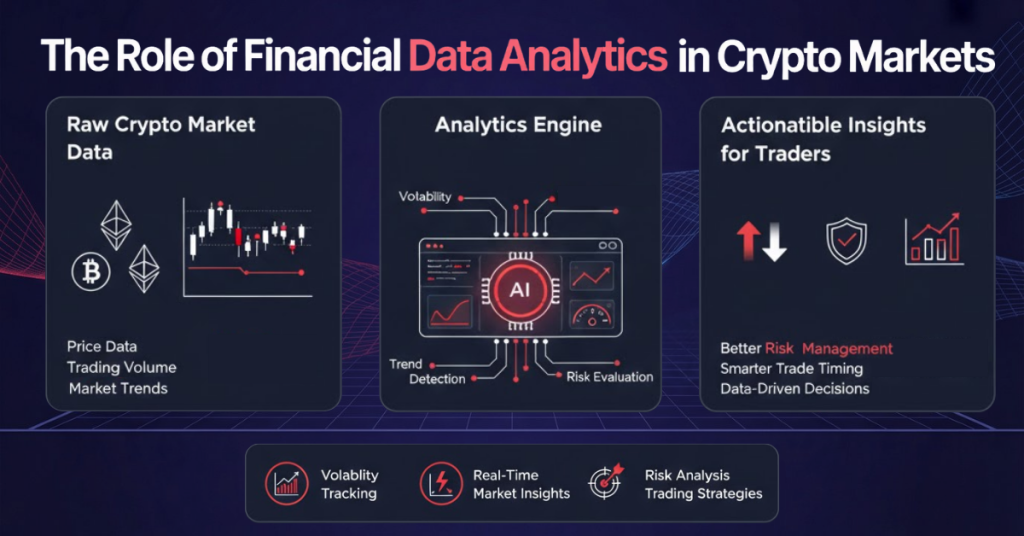
The Role of Financial Data Analytics in Crypto Markets
Crypto markets operate 24 hours a day, seven days a week, with no closing bell. This creates a continuous stream of price data, trading volume, order book activity, and on-chain metrics that never stops. For traders and platforms operating in this space, financial data analytics isn’t optional. It’s the engine that makes the market navigable.
Real-time crypto price tracking allows exchanges and trading dashboards to give users accurate, up-to-the-second valuations across hundreds of tokens. Beyond price, market sentiment analysis pulls signals from social media, search trends, news mentions, and on-chain activity to gauge whether market participants are feeling bullish or bearish, often before that sentiment shows up in price.
Volatility analysis is especially critical in crypto markets because price swings are much sharper than in traditional assets:
Traders monitor how violently a token’s price moves over time.
They compare past volatility with current market behavior.
They adjust position sizes based on risk levels.
They use volatility data to set smarter stop-loss and take-profit levels.
They reduce emotional decisions by relying on structured risk insights.
Trading signals and predictive insights are the downstream output of all this analysis. Portfolio tracking apps surface when a holding is diverging from its typical pattern. Exchange platforms alert users to unusual volume spikes. Trading dashboards generate buy and sell signals based on technical indicators calculated from live data. All of it runs on financial data analytics, working continuously in the background.
How Financial Data Analytics Powers Forex Market Insights
The foreign exchange market is the largest and most liquid financial market in the world, with over $7 trillion traded daily. Exchange rate data sits at the center of forex analytics, as every trade, every hedge, every international transaction depends on accurate, real-time currency valuations. When that data is stale or inaccurate, the consequences ripple across every decision built on top of it.
Currency fluctuation analysis looks at how pairs like EUR/USD, GBP/JPY, or USD/TRY move relative to economic indicators, interest rate decisions, and geopolitical events. Analytics platforms track these correlations and flag when a currency pair is approaching a historically significant level or when volatility is expanding unexpectedly.
Global economic impact on forex trends is one of the most complex areas of financial data analytics. A jobs report in the US, an inflation print in the eurozone, or a rate decision from the Bank of Japan all move currency markets within milliseconds. Fintech platforms rely on accurate exchange rate data sources to ensure their analytics models are working from current, reliable inputs. Using outdated exchange rate data can quickly lead to misleading insights and poor financial decisions.
Real-time currency tracking also matters for businesses beyond pure trading. Multinational companies monitor exchange rates to manage FX risk on international revenue. Payment platforms use live rate data to price cross-border transactions fairly. All of these use cases depend on the same foundation: accurate, low-latency forex data feeding into well-built analytics systems.
Financial Data Analytics in Commodity Markets (Gold, Oil, and Beyond)
Commodity markets carry some of the most important price signals in the global economy. Gold, oil, natural gas, wheat, and copper are not just trading instruments. They’re indicators of economic health, inflation expectations, supply chain stability, and geopolitical risk. Financial data analytics turns commodity price data into a window onto these broader dynamics.
Gold price analytics is a prime example. Gold has historically served as a safe-haven asset when inflation rises, when currencies weaken, or when equity markets fall sharply. Gold tends to attract capital. Analytics models track these correlations, helping investors time gold allocations relative to macroeconomic conditions. During periods of high inflation in 2022, gold analytics helped portfolio managers understand when the metal was pricing in rate expectations versus acting as a pure inflation hedge.
Oil market trend analysis is equally rich with signals. Crude oil prices react to OPEC decisions, geopolitical conflicts in major producing regions, global demand forecasts, and inventory reports from the US Energy Information Administration. Analytics platforms tracking commodity price data from reliable providers allow analysts to overlay these factors and build forward-looking price models rather than simply reacting to yesterday’s close.
Commodity price forecasting combines historical price data, seasonal patterns, supply and demand models, and macroeconomic inputs. The inflation-commodity correlation is one of the most studied relationships in financial analytics. Rising commodity prices, particularly oil and food, are often early indicators of broader inflationary pressure. When analysts track these inputs systematically, they gain a significant lead on markets that are still reacting to lagging data.
How Real-Time Market Data Enhances Financial Data Analytics
There’s a fundamental difference between static data and live data, and in financial markets, that difference is everything. Static data shows where prices were, while real-time data shows where the market stands right now. Analytics built on yesterday’s close is useful for research. Analytics built on live price feeds is what drives actual trading decisions.
Live price feeds give analytics models the inputs they need to stay accurate. When a model is calculating momentum, it needs current prices. When a risk system is checking exposure limits, it needs to know what assets are worth right now, not two minutes ago. Even a small data latency introduces inaccuracy that compounds across a portfolio.
The quality of forecasting and decision-making is directly linked to data freshness. Analytics models trained on historical data but fed live inputs can detect when current market behavior is diverging from established patterns. That divergence is often where the most important signals live, a crypto asset breaking out of its trading range, a currency pair approaching a key technical level, or a commodity price reacting to a supply shock in real time. Without live data, those signals arrive too late to act on.
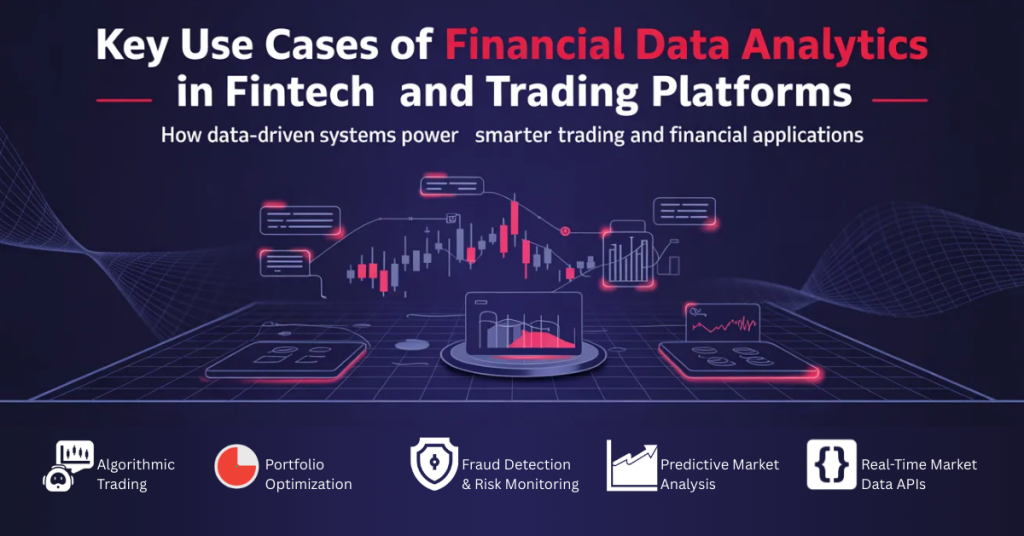
Key Use Cases of Financial Data Analytics in Fintech and Trading Platforms
The practical applications of financial data analytics have expanded dramatically as fintech infrastructure has matured. What once required dedicated quantitative teams at large institutions now runs inside consumer-facing apps used by millions of retail investors.
Trading apps use analytics to generate signals, display market context, and help users make faster decisions. Investment platforms track portfolio performance against benchmarks in real time and surface rebalancing opportunities based on market movements. Robo-advisors apply analytics continuously to manage asset allocation automatically, adjusting portfolios as market conditions shift without requiring manual input from users.
Financial dashboards aggregate data across multiple asset classes, such as crypto, forex, and commodities, into a single interface, using analytics to highlight what matters most at any given moment. Risk management systems are perhaps the highest-stakes application: they monitor exposure across positions, calculate value-at-risk in real time, and trigger alerts when predefined thresholds are breached.
What all of these platforms share is a dependence on high-quality analytics working continuously behind the scenes. The user experience, clean charts, helpful alerts, and automated decisions are the surface. Financial data analytics is the infrastructure that makes it all function.
Future of Financial Data Analytics in Multi-Asset Markets
The next chapter of financial data analytics is being written by artificial intelligence and machine learning. AI-driven analytics systems go beyond predefined patterns. They can discover new trends in data automatically and adapt to market conditions that have never appeared before. Predictive market modeling is becoming more sophisticated, with models that incorporate alternative data sources like satellite imagery of oil storage facilities, shipping traffic as a proxy for trade volume, and real-time news sentiment alongside traditional price and volume inputs.
Cross-market analysis examining crypto, forex, and commodity markets simultaneously to identify inter-asset relationships is an increasingly important frontier. When Bitcoin rallies alongside gold during periods of dollar weakness, or when oil prices and inflation-linked currencies move in sync, analytics systems that watch multiple markets at once can surface insights that single-asset analysis misses entirely.
The result is an emerging data-driven financial ecosystem where analytics is embedded at every layer, from individual trade execution to institutional portfolio construction to macroeconomic forecasting. The tools will become more powerful and more accessible simultaneously, democratizing insights that were once available only to the most resourced players in global markets.
The Foundation of Smarter Financial Decision-Making
Financial data analytics connects crypto, forex, and commodity markets through a common thread: the ability to turn constant streams of price data, exchange rates, and market signals into clear insights. Whether it’s a trader monitoring Bitcoin volatility, an analyst tracking gold during an inflationary cycle, or a fintech platform giving users live currency conversion rates, the same analytical infrastructure is at work processing, interpreting, and surfacing what matters.
As global markets grow more interconnected and data volumes continue to expand, the competitive advantage will belong to those who can move from raw data to insight faster and more accurately than everyone else. This isn’t a future state; it is already the reality for leading trading platforms, fintech companies, and institutional investors. The gap between data-driven participants and those operating without analytics support will only widen.
Financial data analytics is no longer a technical advantage reserved for large institutions. It is the foundation of modern financial decision-making, the layer beneath every informed trade, every accurate price displayed to a user, and every risk management system keeping portfolios from catastrophic loss. For any platform, investor, or analyst operating in today’s markets, it isn’t optional. It’s essential.
Frequently Asked Questions
What is financial data analytics in simple terms?
Financial data analytics is the process of analyzing market data like prices, trading volumes, and exchange rates to find patterns and insights that help traders, investors, and businesses make better decisions. Instead of looking at raw numbers, analytics turns those numbers into a clear story about where markets have been, where they are now, and where they might be heading.
How is financial data analytics used in crypto markets?
In crypto markets, financial data analytics powers real-time price tracking across hundreds of tokens, volatility analysis to help traders manage risk in fast-moving markets, and market sentiment analysis that draws signals from social media and on-chain activity. Trading platforms also use analytics to generate trend predictions and buy or sell signals based on live market data.
Why is real-time data important in financial analytics?
Real-time data ensures analytics models are working from accurate, current inputs rather than outdated information. In fast-moving markets, even a short delay in price data can lead to wrong signals, mispriced risk, or missed opportunities. Live price feeds allow platforms to detect market movements as they happen, making forecasting and decision-making faster and more reliable.
What data is used in financial data analytics?
Financial data analytics draws on a range of data types, including real-time market prices, historical price data, exchange rates between currencies, trading volume, order book depth, and commodity prices for assets like gold and oil. Analytics models combine these inputs, often alongside macroeconomic data and news sentiment, to generate actionable insights across asset classes.
Is financial data analytics useful for traders and investors?
Absolutely. For traders, analytics provides the signals and market context needed to make faster, better-informed decisions. For investors, it supports portfolio monitoring, risk management, and the identification of market trends before they become obvious. Whether you’re an active trader or a long-term investor, analytics removes guesswork and replaces it with data-driven confidence.
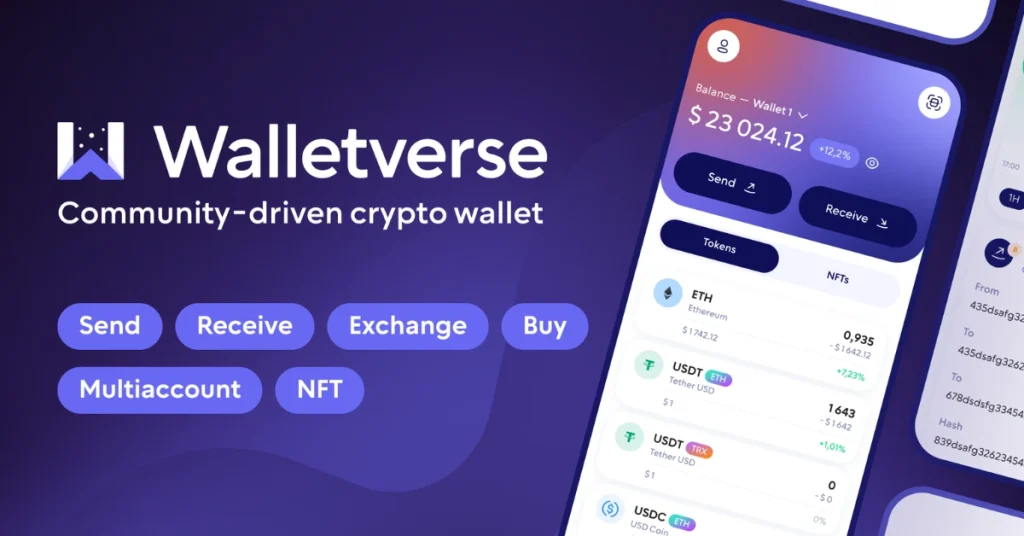
Walletverse today announced that 1inch is now live inside the Walletverse app, enabling users to swap crypto using one of the most widely used DEX aggregation infrastructures in DeFi. 1inch is designed to search across multiple liquidity sources and route swaps to improve execution compared with relying on a single venue.
With the integration, Walletverse users can access:
Better exchange rates by aggregating pricing across multiple liquidity sources.
Lower swap costs through optimized routing and efficient execution.
Support for both intra-chain and cross-chain exchanges, enabling users to swap within a network or move value across supported networks directly in the app.
The feature is fully live and ready to use.
Why this matters in 2026: swaps are an execution problem, not just a UI button
In decentralized markets, the final price you get depends on liquidity depth, routing, slippage, and how your trade is executed. DEX aggregators exist to solve this by splitting a trade across routes and venues when necessary to improve price and reduce slippage. 1inch’s routing approach (often referred to via its Pathfinder routing logic) is designed specifically for this “best-path” execution problem.
By bringing 1inch in-app, Walletverse aims to make that execution quality accessible in a simpler user flow, so users can swap without manually comparing routes or jumping between tools.
What users get with 1inch swaps inside Walletverse
1. Better pricing through aggregated liquidity. Instead of relying on a single DEX, 1inch aggregates liquidity and can route across multiple sources to find more efficient execution.
2. Reduced slippage on many swaps. When liquidity is fragmented, splitting swaps across routes can reduce price impact versus one-shot execution in a thin pool (especially for larger orders).
3. Cross-chain capability designed for modern multi-network users. Cross-chain swaps are becoming a default user expectation. 1inch has developed intent-based mechanisms (Fusion / Fusion+) intended to simplify cross-chain execution while improving user experience (including approaches that can reduce user overhead like gas handling, depending on the mode).
4. Reliability signals: security programs and published audits. For users, reliability is not only uptime it’s confidence that protocols are engineered and reviewed seriously. 1inch maintains active bug bounty programs (including rewards up to $500K for certain scopes) and also maintains a public repository of audit reports for multiple 1inch smart contract systems.
5. A more consistent swapping experience across major chains. As crypto becomes increasingly multi-chain, users want one place to manage assets and execute swaps. DEX aggregation is one of the most practical ways to deliver consistent execution across networks, without requiring users to learn different DEX interfaces for each chain.
Built for usability: fewer steps between intent and execution
Walletverse built the integration to keep swaps straightforward while still taking advantage of aggregator routing logic under the hood. Users can choose assets, review details, and complete swaps in one flow, without needing to navigate separate dApps or manually assemble routes.
Quote (Walletverse product manager): “This integration is about execution quality and user confidence: better routing, lower friction, and cross-chain flexibility inside a single app experience.”
Availability
The 1inch integration is available now in the Walletverse app.
Users can open the Swap feature, select assets and networks, review the quote, and confirm the transaction.
About 1inch
1inch is a DeFi aggregator built to help users trade tokens more efficiently by routing across multiple liquidity sources and optimizing execution.
About Walletverse
Walletverse is a non-custodial crypto wallet that supports 1500+ crypto assets and provides access to DeFi features, along with built-in AML and KYT tools designed to support safer crypto activity.
Major cryptocurrencies have declined between 7% and 11% over the past week as bitcoin remains confined to a $60,000–$70,000 range, trading near $62,900 and struggling to establish upward momentum. Ethereum, XRP, Solana and dogecoin have underperformed, reflecting broader risk aversion and elevated sell-side pressure across the market. Analysts warn that bitcoin’s prolonged inability to break higher is increasingly tilting the short-term technical outlook toward the bears.
Amid this environment, on-chain data also show selective capital flows into specific projects. While large-cap assets consolidate under macro and technical pressure, newer utility-focused protocols such as Mutuum Finance (MUTM) have continued to report inflows, highlighting a divergence in positioning during the broader market slowdown.
Bitcoin, Ethereum and Altcoins Record 7–11% Weekly Declines
Major cryptocurrencies declined between 7% and 11% over the past week as bitcoin remained locked inside a $60,000–$70,000 trading range. Bitcoin traded near $62,900 on Tuesday, down 2.1% on the day and roughly 7.5% on the week, extending a gradual downturn that has yet to produce either a decisive breakdown or a sustained rebound. Ethereum fell about 8% over the same period to around $1,829, while XRP dropped 10.8%, Solana lost 11.3%, and dogecoin retreated nearly 10%, reflecting broader weakness across large-cap altcoins.
On-chain data indicate elevated sell-side pressure, particularly among altcoins, where distribution has reached five-year highs according to CryptoQuant. The current decline has been characterized by steady structural selling rather than sharp liquidation events, resulting in a slower drawdown that has not triggered aggressive dip-buying activity. Analysts note that bitcoin’s inability to reclaim higher levels is shifting the short-term technical bias toward the downside, with a break below the mid-$65,000 area potentially confirming further weakness, while a move above $70,000 would invalidate bearish formations.
Broader macro factors are also weighing on sentiment. A renewed “AI scare trade” in equities has prompted risk-off positioning across technology-linked assets, indirectly affecting crypto markets. Bitcoin now trades approximately 48% below its October all-time high and remains beneath its 2021 peak of $69,000. The longer price action remains confined within the current range without establishing higher ground, analysts warn, the more the technical outlook tilts toward continued downside pressure.
Mutuum Finance
Mutuum Finance has reported more than $20.6 million raised to date, with over 19,000 holders of its native MUTM token, currently priced at $0.04. The team also stated that the Sepolia beta environment has surpassed $90 million in testnet total value locked (TVL), reflecting simulated liquidity activity during early-stage testing.
The project’s V1 protocol is now live on the Sepolia testnet, where users can mint supported assets including USDT, ETH, WBTC, and LINK. The beta version allows participants to interact with core lending and borrowing mechanics in a test environment before full mainnet deployment.
On-chain data further indicate that shortly after the beta release announcement, larger transactions were recorded, including transfers exceeding $240,000 in value from a single investor wallet.
Prior to the V1 protocol release, the lending and borrowing smart contracts underwent a security audit conducted by Halborn. The review was completed before the beta deployment, with the firm verifying the core contract logic and risk parameters ahead of public testing.
In addition to the protocol-level audit, the MUTM token smart contract was previously reviewed by CertiK. The assessment resulted in a Token Scan score of 90 out of 100.
How Mutuum Works
Mutuum Finance is a decentralized lending and borrowing platform built on the Ethereum network. The protocol allows users to supply and borrow crypto assets in a non-custodial environment, meaning participants retain control of their wallets and interact directly with smart contracts.
When users deposit assets into the platform, they receive corresponding mtTokens on a 1:1 basis. For example, supplying ETH results in the issuance of mtETH, which represents the depositor’s position in the liquidity pool and accrues interest over time.
mtTokens can also be staked within the ecosystem. Under the project’s model, a portion of revenue generated from protocol activity is allocated to purchasing MUTM tokens on the open market. These tokens are then distributed to users who stake their mtTokens, creating an additional reward mechanism tied to platform usage.
Limited supply
The total supply of MUTM is capped at 4 billion tokens. According to the project’s token allocation framework, 5% of the total supply has been designated for incentives. This allocation is intended to support community initiatives, including giveaways, leaderboard rewards, and other participation-based programs within the ecosystem.
Major cryptocurrencies closed the week lower, with price action remaining confined within established technical ranges amid continued macro uncertainty. Selling pressure has been more pronounced in large-cap altcoins, while bitcoin remains range-bound without a confirmed breakout in either direction.
At the same time, selected projects continue to report capital inflows and development updates, indicating that market activity has not fully stalled despite the broader pullback. The direction of the next move will likely depend on macro catalysts and whether Bitcoin can decisively exit its current trading range.
Trakx announced that its Crypto Tradable Indices (CTIs) are now live on-chain on the Canton Network, enabling B2B and B2B2C integrations for partners that want to embed tokenized strategy exposure directly into their own products and distribution channels.
The deployment supports a partner-first model: institutions operating within Canton’s permissioned, privacy-preserving environment can integrate CTIs as on-chain strategy components, while maintaining control over client relationships, compliance setups, and go-to-market execution.
CTIs as Tokenized Strategy Exposure, Built for Partner Integration
Trakx can issue CTIs on-chain as programmable index strategy tokens, moving beyond a single exchange-based access point and allowing CTIs to be integrated as modular exposures within partner stacks.
This architecture is designed for institutional participants building on Canton, including:
Banks and brokers seeking to offer packaged strategy exposure within compliant rails
Exchanges integrating on-chain strategy tokens into trading, lending, or distribution flows
Wealth platforms and asset managers embedding index strategies into portfolio solutions or structured offerings
Custodians and wallet infrastructure providers supporting holding, transfer, and lifecycle management
Tokenization platforms and financial infrastructure providers wrapping strategies into broader tokenized products
“This milestone is about crypto index products distribution at institutional scale. By bringing CTIs on-chain on Canton, we’re enabling partners to integrate regulated strategy exposure directly into their systems and reach end users through their existing channels.”
An Invitation to Canton Network partners
Trakx is inviting Canton Network ecosystem partners interested in integrating on-chain Crypto Tradable Indices – or exploring how tokenized strategy exposures can enhance their product stack – to start a discussion.
The B2B and B2B2C model is designed to keep partners in control: partners retain ownership of distribution, compliance configuration, and end-user relationships, while Trakx provides the on-chain issuance layer and strategy tokenization mechanics.
Institutional partners can begin the conversation by contacting canton@trakx.io.
What’s Next
In the near term, Trakx will onboard additional institutional partners within the Canton ecosystem and expand live integrations across issuance, transfer, and lifecycle workflows. Trakx also plans to progressively extend access to on-chain CTIs for retail users on the Trakx platform as integrations mature.
In parallel, the company is advancing compliant tokenization frameworks to expand issuance beyond crypto index strategies, enabling additional tokenized strategies and structures and, over time, other asset classes.

 Login
Login