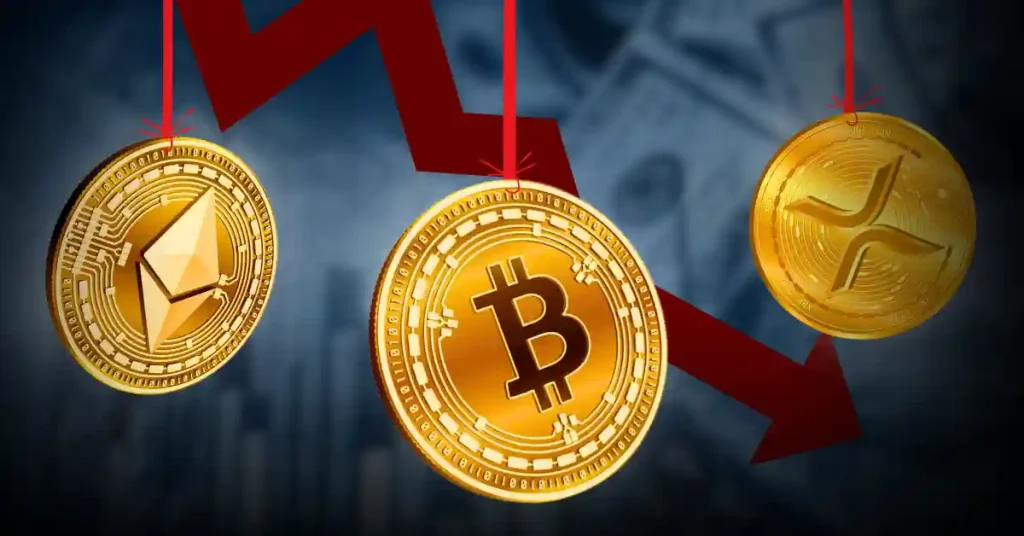
The crypto market is falling again, down about 2% and now near $2.27 trillion. Bitcoin, the flagship cryptocurrency, has erased its recent gains and is down to $65,253. Ethereum fell 4% in the last 24 hours.
Other altcoins, including XRP, Solana, Dogecoin, and Bitcoin Cash, also dropped between 5% and 18%.
So, what is pushing Bitcoin and Ethereum prices down today?
Hot U.S. PPI Data Triggers Selling
One major reason behind this drop is that the latest U.S. Producer Price Index (PPI) for January came in higher than expected.
January’s PPI came in at 2.9% year-over-year, above the expected 2.6%. Core PPI rose to 3.6%, also higher than forecasts. This suggests inflation remains strong, reducing the chances of an early interest rate cut by the Federal Reserve.
Higher rates usually make safer assets like bonds more attractive, pulling money away from riskier assets such as crypto.
Liquidations Hit Traders Hard
The sharp move caused heavy liquidations. Over 96,000 traders were wiped out in the past 24 hours, with total liquidations reaching around $260 million.
Nearly 70% of these were long positions, meaning traders who were betting on higher prices were forced to close. Bitcoin alone saw around $90 million in liquidations, while Ethereum recorded about $86.5 million.
Bitcoin Set to Close February in the Red
Bitcoin has erased all the gains it made on February 26, when it briefly moved close to $70,000. Now, the month is ending on a weak note, with Bitcoin down nearly 16.75% in February.
This marks the first time in Bitcoin’s history that both January and February have closed in the red, with losses of around 10% and 16.75%.
If Bitcoin falls below the $62,553 level, it could retest the recent four-week low near $60,000.
Interestingly, on the positive side, history shows that Bitcoin has often bottomed around 23 months after its previous all-time high. We are now at that same 23-month mark.
Altcoins Follow Bitcoin’s Drop
Meanwhile, Ethereum has also moved lower, falling about 5.7% in the past 24 hours after failing to break its recent four-week high.
Other major coins, including XRP, Solana, Dogecoin, and Bitcoin Cash, have recorded steeper losses between 5% and 18%. The broader market is clearly reacting to Bitcoin’s weakness.
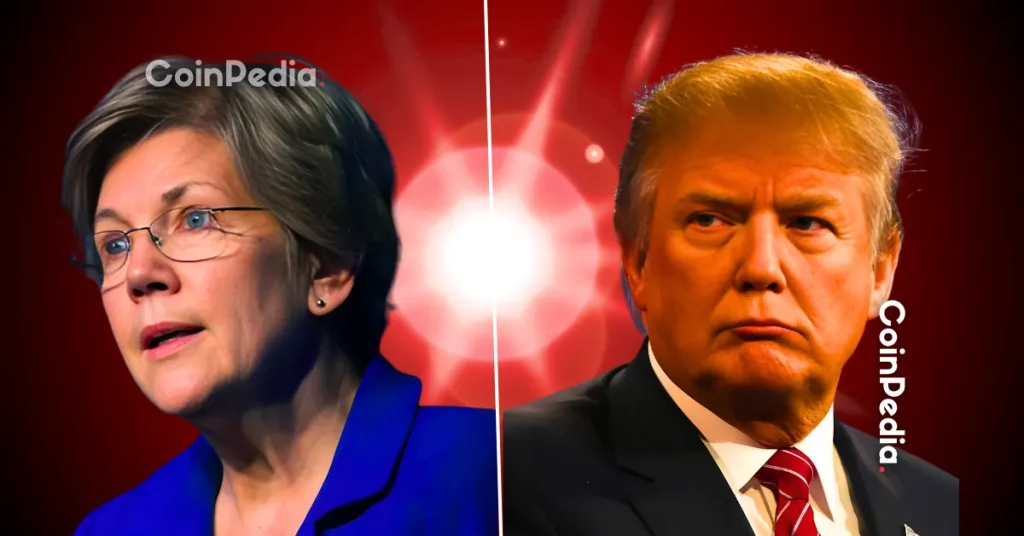
U.S. Senator Elizabeth Warren has strongly opposed World Liberty Financial’s plan to get a national bank charter. She called it a serious corruption issue linked to President Donald Trump.
The issue has sparked new concern about crypto rules, foreign investment, and political influence in the digital finance industry.
World Liberty Financial Bank Charter Application Faces Scrutiny
According to the filing on February 23, 2026, World Liberty Financial applied for a national trust bank charter through the Office of the Comptroller of the Currency (OCC).
The crypto firm, linked to Donald Trump and his family, plans to issue a dollar-pegged stablecoin called USD1 and offer digital asset custody services.
During a Senate Banking Committee hearing, Warren questioned OCC Comptroller Jonathan Gould over the approval process. She warned that granting the charter could create serious conflict-of-interest concerns if a president-linked company gains federal banking authority.
The firm is connected to Donald Trump Jr., Eric Trump, and other partners, with Trump listed as co-founder emeritus.
If approved, the charter would allow the company to operate under federal oversight similar to other national trust banks.
$500 Million UAE Investment Raises National Security Concerns
Warren also highlighted a reported $500 million investment tied to Aryam Investment 1, a vehicle linked to Sheikh Tahnoon bin Zayed Al Nahyan of the United Arab Emirates.
Reports suggest the investor acquired a 49% stake in World Liberty Financial shortly before Trump’s inauguration.
As per the reports, nearly $187 million from the transaction flowed to Trump family entities. Warren argued that such foreign financial ties raise national security and transparency questions. She demanded full disclosure of anyone owning 10% or more of the company.
BREAKING: Elizabeth Warren calls Trump-backed WLFI the “Worst Presidential #Crypto corruption scandal” and says 10%+ owners must be disclosed or the bank bid will be rejected. pic.twitter.com/qrhKV50v6t
Comptroller Gould defended the OCC’s review process, stating that applications are evaluated under standard regulatory procedures, not political pressure. He said the only political pressure he had felt came during the hearing itself.
The final decision on the bank charter may carry major implications for both crypto markets and political accountability.
Meanwhile, World Liberty Financial’s WLFI token has fallen nearly 30% over the past month and is currently trading around $0.1145.
Terra Classic (LUNC), which collapsed in May 2022 after its stablecoin UST lost its dollar peg, is back in the spotlight. This comes after Terraform Labs filed a lawsuit against Jane Street, claiming the firm used insider information to profit and may have accelerated the fall of TerraUSD (UST).
Now, Terra supporters are asking a big question: if Jane Street is proven responsible for the 2022 crash, could LUNC surge 100X from here?
Terraform Labs Filed Lawsuits Against Jane Street
On February 23, 2026, the bankruptcy administrator of Terraform Labs filed a lawsuit in Manhattan federal court against Jane Street. However, the complaint alleges that the firm used insider information before TerraUSD (UST) lost its peg in May 2022.
According to court filings, a former Terraform intern who later joined Jane Street allegedly shared private details about a planned $150 million UST withdrawal from Curve.
The lawsuit claims Jane Street sold large amounts of UST minutes after the withdrawal, which may have worsened panic and accelerated the collapse.
In response to these claims, Jane Street has denied all allegations, calling them baseless and blaming Terraform’s flawed design for the meltdown.
Is Do Kwon Not Guilty? Will He Be Pardoned!
The lawsuit has reopened debate about Terraform Labs co-founder Do Kwon. Some LUNC members say that if outside manipulation is proven, the crash may not have been only an internal failure.
However, legal experts say it is hard to prove market manipulation.
Even if Jane Street is found guilty, it does not automatically remove Do Kwon’s responsibility. Courts would still review Terraform’s stablecoin design and risk controls.
Speculation about a possible pardon for Do Kwon has already started online. Recently, President Trump pardoned Changpeng “CZ” Zhao, the founder of Binance, after he pleaded guilty & paid a fine of $4.3 billion.
Similarly, Trump also granted a full pardon to Ross Ulbricht, the creator of the Silk Road marketplace.
Could LUNC Rise 100X if Jane Street Is Proven Responsible for the Crash?
As of now Lunc is trading around $0.0000425; a 100X move would push the LUNC price close to $0.00425.
While such a surge is possible in crypto, but it would require strong investor confidence and major supply burns.
Terra Luna Classic (LUNC) is seeing a strong price surge today, climbing around 24% to a high near $0.00004905 as traders rush back into the token. The sharp rally comes even as the broader crypto market remains flat, with Bitcoin hovering near $67,000.
The sudden rally has caught traders’ attention. But what exactly is pushing LUNC higher today?
Massive LUNC Token Burns Reduce Supply
One of the biggest reasons behind today’s rally is large token burns. According to the Luna burn metrics, around 32 million LUNC tokens were burned today. This brings the total weekly burn to about 224.46 million tokens.
So far, about 85.58 billion LUNC tokens have been burned. That is nearly 19% of the total supply.
However, community-driven burns have been a key mechanism for restoring confidence in LUNC since its collapse in 2022.
Beyond the big burns today, LUNC also saw a sharp rise in trading activity. Its 24-hour trading volume surged 466%, reaching around $74.3 million,
Legal Action Against Jane Street Adds Attention Back to Terra
Another reason for the recent surge is fresh discussion about Terra’s past collapse. Reports say the SEC has started investigating Jane Street over possible market manipulation in stocks and crypto products.
The lawsuit alleges that the trading firm used insider information to front-run positions and intentionally trigger the depegging of TerraUSD on May 7, 2022. That collapse erased nearly $40 billion from the crypto market.
Some members of the LUNC community now believe the Terra crash may not have been only an internal failure, but possibly the result of an external attack.
At the same time, more people online are discussing Do Kwon. Some believe he made mistakes but did not plan a scam.
Despite today’s strong moves, LUNC remains far 100% below its historical peak of $117.
GMT eyes recovery in 2026 as 600M token burn and GMT Pay growth may push price toward $0.58, with long-term target of $8.50 by 2030.
After an 80% drop, GMT could rebound if token burns and adoption rise, targeting $0.18 short term and $8.50 by 2030.
Green Metaverse Token (GMT) is the native governance and utility token of the STEPN ecosystem, a Web3 “move-to-earn” platform built initially on Solana and now expanded to multiple chains.
Users earn GMT through physical activities such as walking or running with NFT sneakers. The token is used for governance voting, NFT upgrades, minting, and payments via GMT Pay.
With the token trading 80% below its previous highs, investors are questioning whether GMT can stage a meaningful comeback.
Here is CoinPedia’s GMT price prediction for 2026, 2027, and 2030.
March 2026 could be a decisive period for GMT as supply-side reforms begin to reflect in the market structure.
A key development is the BurnGMT initiative. Recently, the FSL team has repurchased 600 million GMT tokens, worth around $100 million, from early investors and advisors. These tokens will be permanently burned, reducing circulating supply and lowering long-term selling pressure.
This large buyback signals a strong commitment from the team to support token value and strengthen confidence among long-term holders.
Meanwhile, if ecosystem activity improves and user spending through GMT Pay increases, GMT could test the $0.18 zone in March 2026.
Technical Analysis
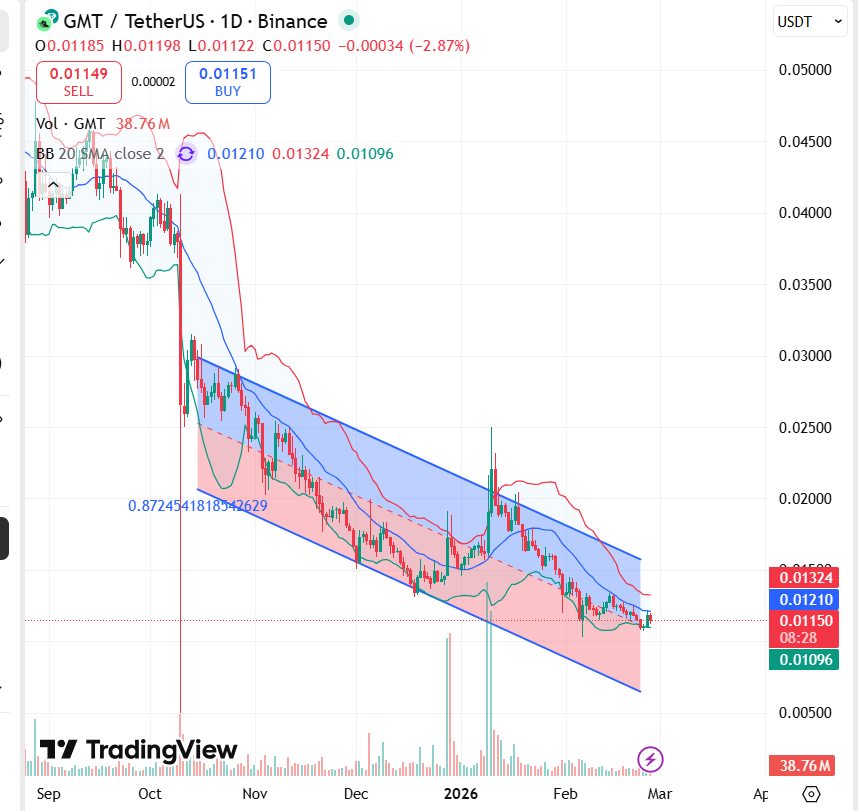
Looking at the GMT daily chart, the token remains in a clear downtrend, trading inside a descending channel with consistent lower highs and lower lows. Price is currently hovering near the lower boundary of the channel around the $0.0111 zone, which is acting as short-term support.
However, the mid-band (20-day MA) near $0.0121 is acting as immediate resistance, followed by stronger resistance around $0.0132–$0.0150 near the upper channel trendline.
Unless GMT breaks and closes above the descending channel resistance, the broader structure remains bearish. A breakdown below $0.0109 could open the door toward the $0.0090 region.
For trend reversal confirmation, bulls need a strong daily close above $0.018 with expanding volume.
Month
Potential Low ($)
Potential Average ($)
Potential High ($)
GMT Price Prediction March 2026
$0.090
$0.109
$$0.18
GMT (GMT) Price Prediction 2026
In 2026, GMT’s direction will likely depend on three main pillars.
First is token burns and DAO governance. Through the GMT DAO, holders vote every quarter on burn events and ecosystem proposals. If the community continues to approve token burns, the circulating supply could shrink over time, helping reduce selling pressure.
Second is utility expansion. If GMT Pay adoption increases and more users make real-world transactions, demand could shift from pure speculation to actual usage.
Third is STEPNEMBER 4 in September 2026. This major community milestone event could boost engagement, attract new users, and renew marketing momentum.
Year
Potential Low ($)
Potential Average ($)
Potential High ($)
GMT Price Prediction 2026
$0.0085
$0.22
$0.58
GMT Price Prediction 2026 – 2030
Year
Potential Low ($)
Potential Average ($)
Potential High ($)
2026
$0.0085
$0.22
$0.58
2027
$0.12
$0.56
$1.25
2028
$0.38
$1.05
$2.73
2029
$0.89
$2.42
$5.67
2030
$1.27
$4.60
$8.50
GMT Price Prediction 2026
If token burns remain consistent and GMT Pay transaction volume increases, GMT could approach $0.58.
GMT Coin Price Prediction 2027
By 2027, broader Web3 payment adoption and ecosystem partnerships could push GMT toward $1.25.
GMT Token Price Targets 2028
If move-to-earn evolves into a sustainable health and fintech model, GMT may test $2.73.
GMT Price Prediction 2029
However, Stronger institutional partnerships and expanded payment integrations could move GMT near $5.67.
GMT (GMT) Price Prediction 2030
If STEPN transforms into a global Web3 lifestyle platform with strong token burns and steady usage, GMT could target $8.50.
What Does The Market Say?
Year
2026
2027
2030
Coincodex
$0.03183
$0.0278
$0.157
Tradersunion
$0.0077
$0.00462
$0.00817
Digitalcoinprice
$0.0111
$0.00277
$0.00553
CoinPedia’s GMT Price Prediction
From CoinPedia’s view, GMT is no longer just a move-to-earn token. After a sharp correction, it now stands at a key turning point between hype-based trading and real, long-term use.
Its future depends on shifting from speculation to becoming a strong utility token for payments and governance.
If the BurnGMT initiative continues and GMT Pay adoption expands across multiple chains, GMT could reclaim the $0.40 range in 2026..
Year
Potential Low ($)
Potential Average ($)
Potential High ($)
2026
$0.0085
$0.22
$0.58
Never Miss a Beat in the Crypto World!
Stay ahead with breaking news, expert analysis, and real-time updates on the latest trends in Bitcoin, altcoins, DeFi, NFTs, and more.
FAQs
What is the GMT price prediction for 2026?
For 2026, GMT is projected between $0.0085 and $0.58, with $0.22 as an average estimate if adoption and burns stay strong.
What is GMT coin price prediction 2030?
GMT coin price prediction 2030 ranges between $1.27 and $8.50 if adoption grows, token burns continue, and overall crypto markets stay strong.
What is STEPN GMT coin price prediction 2050?
STEPN GMT coin price prediction 2050 is highly speculative and depends on global Web3 adoption, platform longevity, and sustained token utility.
Is GMT a good long-term investment?
GMT’s long-term potential depends on real utility, token burns, and ecosystem growth, not hype. Investors should assess risks carefully.
A viral claim is circulating on social media platforms like X and Telegram claiming that China is planning to launch a “Chinese Bitcoin” that is 10X cheaper and 10X faster than Bitcoin.
The claim has created excitement and confusion, especially as China continues to work on digital currency projects.
Therefore, Coinpedia decided to fact-check whether this claim is real or just another rumor.
Who Made This Claim?
The claim was made by Chinese crypto whale Wei Zhao, who said that China is launching a “Chinese Bitcoin” that is 10X cheaper and 10X faster than Bitcoin. Although these claims do not cite any official Chinese government announcement,
But is all this claim true? Let’s break it down.
Coinpedia’s Key Findings: What’s Actually True?
No Official Announcement from the Chinese Authority
There is no official announcement from the People’s Bank of China or state-backed blockchain projects about launching a “Chinese Bitcoin.”
The claim appears to come only from social media rumors and influencers, not from any official announcement or policy.
China Has Banned Bitcoin and Private Cryptocurrencies
Until now, China has maintained a strict ban on cryptocurrencies. The government already declared all crypto transactions illegal and banned trading, mining, and exchange activity.
Instead of promoting Bitcoin alternatives, China has focused on expanding its state-controlled digital yuan system.
China Is Developing a Digital Currency, But It’s Not Bitcoin
China has already developed its own state-backed digital currency called the digital yuan (e-CNY), issued directly by the People’s Bank of China. This is a central bank digital currency (CBDC), not a decentralized cryptocurrency like Bitcoin.
The Chinese government believes in a centralized powered token; therefore, they won’t be launching such a token that they cannot track and maintain control over.
Summary Table: Coinpedia’s Evidence Against the Theory
Claim Made by Theory
Coinpedia’s Counter-Evidence
Is China launching Chinese Bitcoin
No official announcement from a government body
Does China support any digital assets?
Yes, the digital yuan, which operates as a centralized legal tender backed by China’s currency, is not a Bitcoin competitor.
China is supporting decentralized crypto
No, because China banned Bitcoin, which is a decentralized cryptocurrency.
Conclusion
Claim
Is China launching a “Chinese Bitcoin” that is 10X cheaper and faster than Bitcoin?
Verdict
False
Fact-Check by Coinpedia
As per Coinpedia’s research and review of the official Chinese government policy, there is no verifiable evidence that China is launching a decentralized Bitcoin competitor.Until official confirmation is provided by Chinese authorities, this claim remains false and misleading.
Cardano (ADA) has jumped back into the top 10 cryptocurrencies by market cap after a strong 16% rally today. The token climbed from a low of $0.25 to nearly $0.312, pushing its total market value to around $10.6 billion.
Here’s what is actually driving the Cardano ADA price up today?
Crypto Market Recovery Helps Cardano Price Bounce
One of the main reasons behind this rally is the overall recovery in the crypto market. The total market cap has climbed to $2.34 trillion, up 4.4%. This strong move lifted major coins like Bitcoin, Ethereum, XRP, Solana, Dogecoin, and Cardano.
After the sharp recovery, Cardano surged 16%, rising from a low of $0.25 to around $0.312.
Cardano Surges 16% as Whales Buy $213M ADA,
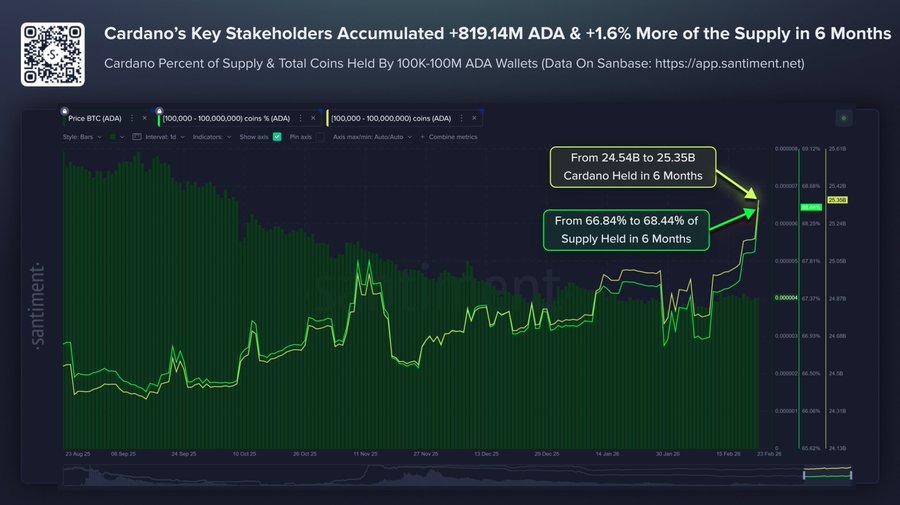
Another major reason behind Cardano’s rally is strong accumulation by whales and large investors. According to Santiment data, wallets holding between 100,000 and 100 million ADA have accumulated over 819.4 million ADA in the past six months.
This amount is worth about $213.9 million and represents around 1.6% of Cardano’s total supply. Such accumulation has historically marked early recovery phases in crypto markets.
Cardano Trading Volume Explodes 181%
Another slight push came from Cardano price, which saw a massive surge in 24-hour trading volume, which spiked 181% to $1.15B, indicating strong buying pressure and validating the price move.
Interestingly, Cardano’s price also saw a strong liquidation of $2.4 million in the last 24 hours. Most of the liquidation, around 75%, came from short liquidation.
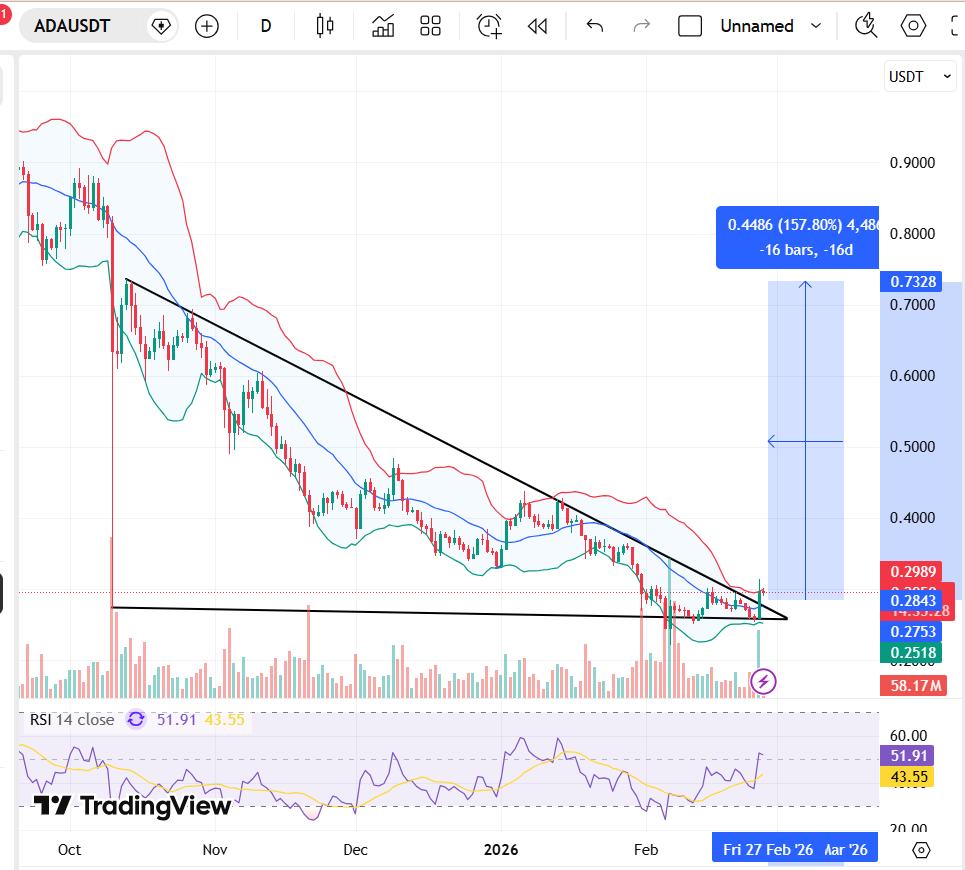
Looking at the Cardano daily chart, ADA shows early signs of a potential breakout after months of steady decline. Price has been trading inside a descending trendline since late 2025, forming lower highs and lower lows.
Recently, ADA compressed into a tight triangle pattern near the $0.27–$0.28 support zone, indicating reduced volatility and buildup for a larger move.
The price is now attempting to break above the short-term downtrend line around $0.29. A confirmed daily close above $0.35 could open the path toward $0.40, followed by a stronger resistance zone near $0.50.
The projected move on the chart suggests a possible upside toward the $0.70–$0.73 area if bullish momentum strengthens.
Never Miss a Beat in the Crypto World!
Stay ahead with breaking news, expert analysis, and real-time updates on the latest trends in Bitcoin, altcoins, DeFi, NFTs, and more.
FAQs
Why is Cardano (ADA) price going up today?
Cardano is up 16% due to a broader crypto market recovery, strong whale accumulation worth $213M, rising trading volume, and short liquidations.
Are whales buying Cardano right now?
Yes. Large wallets accumulated over 819 million ADA in six months, signaling confidence and often marking early recovery phases.
What is the next price target for Cardano (ADA)?
If ADA closes above $0.35, it could target $0.40, then $0.50. Strong momentum may even push it toward $0.70–$0.73.
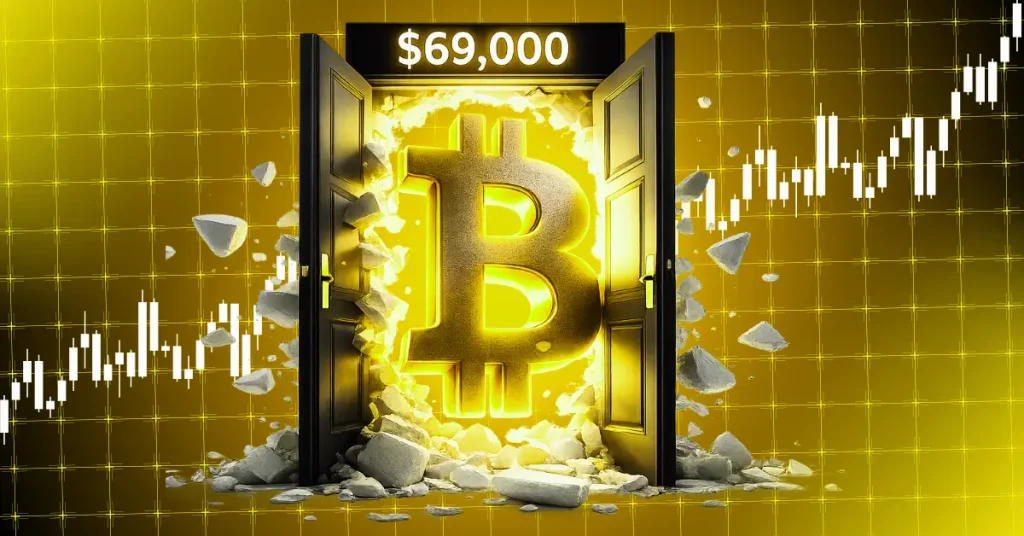
After a week of heavy selling, Bitcoin price has finally bounced back strongly, jumping 6% to to its previous 2021 high near $69,000. The sudden move forced bearish traders to close short positions, triggering total liquidations of about $571 million.
Despite this strong recovery, analysts say it is too early to confirm a long-term trend reversal, as key resistance levels are still intact.
Crypto Liquidation Driving Bitcoin Price Rally
Today’s crypto market rally was not driven by bullish news or new regulations. The main reason was forced liquidations. In the past 24 hours, more than 132,000 traders were liquidated, with total losses reaching about $571 million.
Bitcoin alone saw around $231 million in liquidations, while Ethereum recorded over $202 million. Most of these liquidations, more than 85%, came from short positions. Following this, the Fear & Greed Index jumped to 18, showing that traders are regaining confidence.
Another key reason behind the rally is strong inflows into Spot Bitcoin ETFs. On February 25, ETFs saw $506.6 million in inflows, bringing total inflows to about $54.57 billion.
Altcoins and Crypto Stocks Also See Strong Recovery
The recovery has not been limited to Bitcoin. Major large cap crpytocurreny such as Ethereum, XRP, Solana, Dogecoin, and Cardano have also recorded a rise of 6 to 12% momentum.
Additionally, crypto-related stocks have also seen a sharp recovery. Coinbase shares rose 14%, Strategy, the largest corporate Bitcoin holder, gained 9%, and even the Metaplanet saw a jump of 10%, trading around $331.
Similarly, Stablecoin company Circle surged 34% following strong earnings.
Bitcoin Faces Key Major Resistance Ahead
As the crypto market started to recover, crypto analyst Joel Kruger advised traders to stay careful. He believes the market is still in a bearish phase. According to him, another drop is possible if Bitcoin fails to break key resistance levels.
The first major resistance zone is between $70,000 and $72,000. Bitcoin has been rejected in this area three times before, and each time the price fell back below $65,000.
Another important level is near $78,000. This level reflects Bitcoin’s estimated fair value based on on-chain capital flow data. If Bitcoin breaks above $78,000, it would show strong bullish momentum.
Until that happens, the market may continue to move sideways in a consolidation range.
The crypto market recovered strongly today, with total market value rising 3.5% to around $2.26 trillion. Major cryptocurrencies like Bitcoin, Ethereum, XRP, and Solana are now trading in green, showing gains between 3% and 8%.
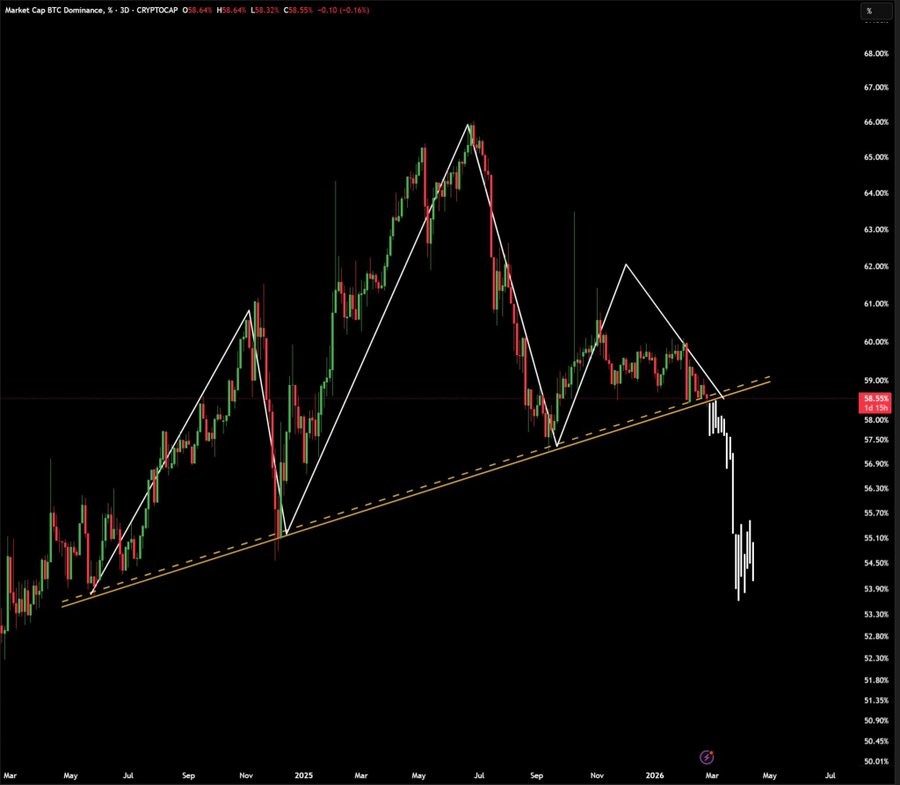
This recovery comes at a critical time as Bitcoin dominance has broken below an important support level, raising early signs that altcoins could rally soon.
Bitcoin, Ethereum, XRP, and Solana Lead Market Recovery
Bitcoin is now trading near $65,600 after recovering from recent lows near $62,000. The recovery shows that buyers are stepping in and preventing deeper losses.
Similarly, Ethereum has also jumped over 5.8%, while XRP has gained nearly 4%. Solana is among the top performers, rising more than 8.5% today.
The Relative Strength Index (RSI), a key indicator, has moved out of oversold levels. This means the heavy selling phase has ended, and the market is now stabilizing.
Experts say if Bitcoin stays above $64,000, it could try to move higher again and create a strong setup for altcoins to rise.
Bitcoin dominance is currently hovering around 58.42%, and the chart shows a clear break below a long-term rising support line. This trendline had been holding dominance up since 2024.
Now that dominance has broken below this key level, it signals that investors are starting to move capital into altcoins.
Once the breakdown happens, dominance will quickly move toward the 54% zone, confirming weakness. This is one of the strongest early signals of a potential altcoin season.
Altcoins Start To Outperform Bitcoin
Altcoins are now rising faster than Bitcoin. Coins like Cardano, LINK, AVAX, and LTC are up around 5 to 9%. Smaller coins such as VIRTUAL, MORPHO, and ETHFI have jumped more than 10%.
The Altcoin Season Index has climbed to 45, its highest level since January. This shows that altcoins are slowly gaining strength, but the market is still in the early stage of a bigger move.
If Bitcoin dominance keeps falling, altcoins could see even stronger rallies ahead.
Therefore, the next few weeks will be important to confirm whether the market is entering a full altcoin rally phase.
Never Miss a Beat in the Crypto World!
Stay ahead with breaking news, expert analysis, and real-time updates on the latest trends in Bitcoin, altcoins, DeFi, NFTs, and more.
FAQs
Why is the crypto market rising today?
The crypto market is up 3.5% as buyers returned after oversold conditions. Bitcoin holding above $64K improved sentiment and triggered gains across major altcoins.
Is this the start of an altcoin season?
It’s early but promising. The Altcoin Season Index at 45 shows improving momentum, yet confirmation requires sustained Bitcoin stability and continued dominance decline.
What price level is critical for Bitcoin right now?
Bitcoin holding above $64,000 is key. Staying above this level strengthens bullish momentum and increases the chances of further upside for the broader market.
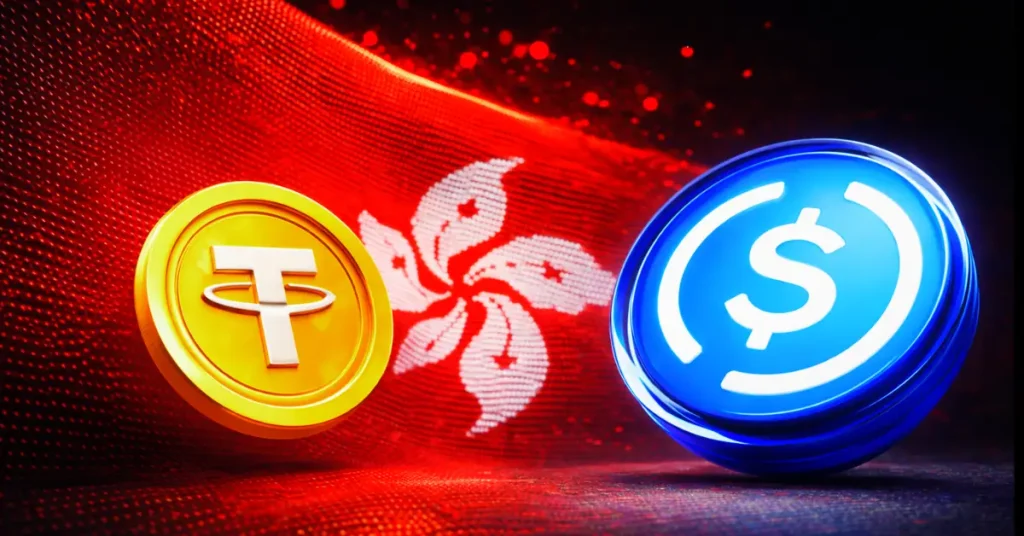
Hong Kong (HK) is preparing to issue its first stablecoin licenses in March, marking a major step in its plan to become a global leader in digital assets. The new licensing system will allow approved companies to issue fiat-backed stablecoins under clear regulatory oversight. This move will improve investor trust and attract global crypto firms to Hong Kong.
Hong Kong to Issue First Stablecoin Licenses
Financial Secretary Paul Chan announced the move in the 2026–27 budget speech, adding that Hong Kong has already introduced a licensing framework.
He said that the regulators will work closely with licensed companies to ensure compliance, risk control, and financial stability.
Crypto markets widely use stablecoins for trading, payments, and cross-border transfers. By introducing clear regulations, Hong Kong aims to create a safer environment for stablecoin adoption.
This makes Hong Kong one of the few major financial centers providing regulatory clarity for stablecoins.
Hong Kong regulators are also working to improve market liquidity and expand services for professional investors.
Hong Kong Expands Digital Asset Infrastructure and Tokenization
Alongside stablecoin licensing, Hong Kong is also developing its digital asset infrastructure. The Hong Kong Monetary Authority (HKMA) launched the pilot phase of “Project Ensemble,” which explores tokenized deposits and digital asset transactions.
CMU Omniclear, a subsidiary of HKMA, is also working on a digital asset platform to support the issuance and settlement of tokenized bonds.
The government is introducing guidelines and support programs to promote tokenization and enable blockchain-based asset issuance.
These efforts aim to modernize Hong Kong’s financial system and improve efficiency.
How This Could Impact the Global Stablecoin Market
The global stablecoin market is valued at over $314.8 billion, with major stablecoins such as USDT and USDC dominating usage.
Hong Kong’s licensing framework could attract new stablecoin issuers and increase competition in the regulated stablecoin sector. Regulated stablecoin systems are essential for institutional adoption, as financial institutions require legal clarity and secure infrastructure.
Never Miss a Beat in the Crypto World!
Stay ahead with breaking news, expert analysis, and real-time updates on the latest trends in Bitcoin, altcoins, DeFi, NFTs, and more.
FAQs
When will Hong Kong issue its first stablecoin licenses?
Hong Kong is scheduled to issue its first stablecoin licenses in March 2026, as announced in the Financial Secretary’s budget speech.
Why is Hong Kong regulating stablecoins?
Hong Kong is regulating stablecoins to enhance investor protection, ensure financial stability, and attract global crypto firms by providing clear compliance rules.
How will new licenses affect the global stablecoin market?
The new licenses are expected to increase competition among regulated issuers, potentially challenging current leaders like USDT and USDC by offering a secure, compliant alternative.
Artificial Superintelligence Alliance’s price could hit a maximum trading price of $1 in 2026
With a potential surge, the FET price may record a high of $12.45 by 2030.
As artificial intelligence continues to dominate global headlines, blockchain-based AI infrastructure projects are once again attracting investor attention.
Among them, the Artificial Superintelligence Alliance (ASI) stands out as a strategic merger of major AI-focused blockchain entities.
Founded through the collaboration of Fetch.ai, SingularityNET, and later CUDOS, the alliance aims to create the largest open-source, decentralized ecosystem focused on Artificial General Intelligence (AGI).
The FET token, originally native to Fetch.ai and now central to the ASI ecosystem, serves as the utility, governance, and settlement layer across AI services.
So let’s dive straight into CoinPedia’s Artificial Superintelligence Alliance (FET) price prediction for 2026, 2027, and 2030.
Artificial Superintelligence Alliance (FET) Price Targets For March 2026
Artificial Superintelligence Alliance is growing its AI agent marketplace, which allows users and apps to use AI services easily.
If ASI successfully brings everything together, it can host AI models on its network, allow AI agents to talk and work with each other, and enable users to pay for AI services directly on the blockchain. It is also working to form partnerships with businesses that want to use AI.
If more people start using AI on the network and demand for computing power rises, it could help increase activity and push the FET price towards $0.34 by March 2026.
Technical Analysis
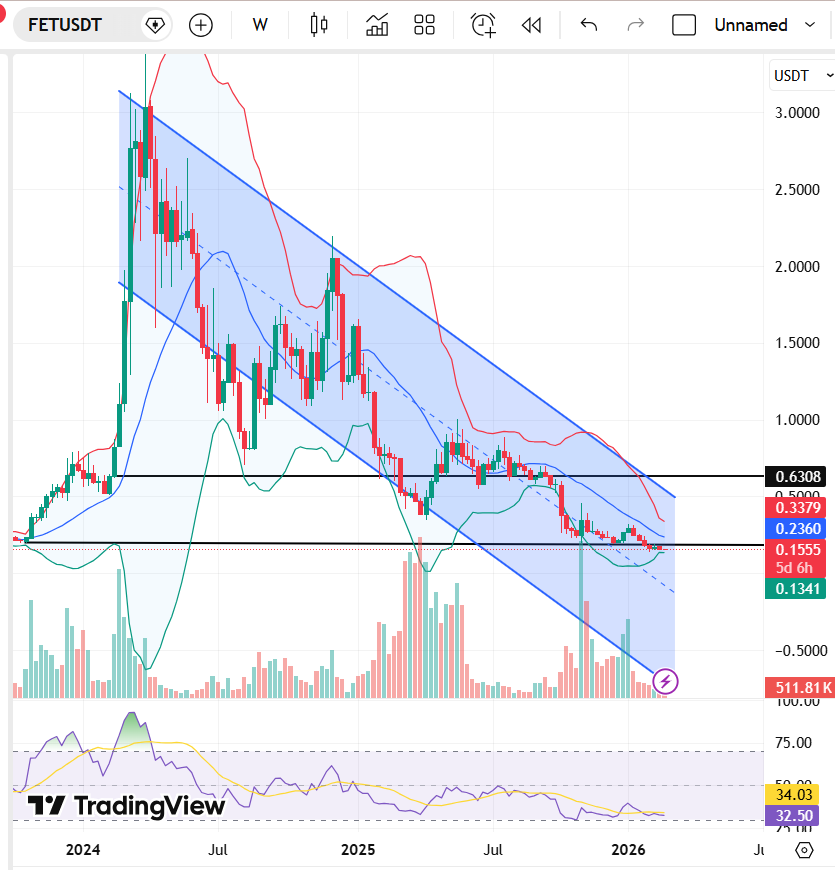
Looking at the FET weekly chart, it shows a clear long-term downtrend, trading inside a descending channel since early 2024. However, the FET price continues to form lower highs and lower lows, confirming a strong bearish market structure.
Recently, FET has been consolidating near the lower channel boundary around $0.15, which is acting as a key support zone. A breakdown below this area could trigger further downside toward $0.10.
On the upside, immediate resistance is at $0.23, followed by stronger resistance near $0.34. The major trend reversal level remains near $0.60 at the top of the channel. Only a weekly close above $0.34 would signal early bullish strength.
The RSI is near 34, indicating weak momentum but also approaching oversold conditions, which may slow selling pressure.
As AI technologies continue to expand and perform more complex tasks, the bull run in FET might witness new peak formations this year.
Unlike many AI tokens that grow only on hype, ASI is focused on building real technology. It is creating a strong base that includes smart AI agents, decentralized AI marketplaces, and shared computing networks.
These tools allow AI systems to work, connect, and provide services without relying on one central company.
With the increased adoption of AI, companies and users will start using these services, and the demand for FET could increase. This real usage can help FET grow stronger and support its long-term value and future growth potential steadily.
As per CoinPedia’s FET Price Prediction, the exponential growth observable in the field of artificial technologies will boost the value of AI tokens in the crypto world
If the alliance successfully aligns AI compute markets, decentralized agents, and open-source model hosting under one economic framework, FET could gradually reclaim the $0.950 range in 2026.
Year
Potential Low ($)
Potential Average ($)
Potential High ($)
2026
$0.0921
$0.340
$0.950
Never Miss a Beat in the Crypto World!
Stay ahead with breaking news, expert analysis, and real-time updates on the latest trends in Bitcoin, altcoins, DeFi, NFTs, and more.
FAQs
What is Artificial Superintelligence Alliance (FET)?
Artificial Superintelligence Alliance (FET) is a merged AI-blockchain ecosystem uniting Fetch.ai, SingularityNET, and CUDOS to power decentralized AI services.
What is the Artificial Superintelligence Alliance (FET) price prediction for 2026?
FET could trade between $0.09 and $0.95 in 2026, depending on AI adoption, network growth, and overall crypto market momentum.
What could FET be worth by 2030?
If decentralized AI scales globally, FET may test $12 by 2030, though long-term growth depends on real-world usage and regulation.
What Is the FET Price Prediction for 2040 and How High Can It Go?
By 2040, FET could trade between $25 and $40 if decentralized AI and AGI adoption expand globally with strong ecosystem growth.
What is the price prediction for FET in 2050?
By 2050, FET may exceed $60 in a mature AI economy, assuming sustained adoption, real utility, and stable crypto regulations.
Is FET a good long-term AI crypto investment?
FET offers exposure to decentralized AI infrastructure. Its long-term value relies on adoption, partnerships, and sustainable ecosystem growth.
In 2026, KAVA could attempt to recover toward the $0.35 zone.
By 2030, KAVA may target the $5 level.
Kava Network positions itself as a hybrid Layer-1 blockchain combining the developer flexibility of Ethereum with the speed and interoperability of Cosmos.
Its unique co-chain architecture allows Ethereum Virtual Machine (EVM) compatibility alongside Cosmos SDK infrastructure, aiming to deliver high performance with low fees.
Now that the KAVA token is trading near $0.048, investors are questioning whether Kava can see a comeback in the next cycle. Here is CoinPedia’s Kava (KAVA) price prediction for 2026, 2027, and 2030.
Historically, Kava was known for lending and stablecoin minting products within DeFi, but competition from larger ecosystems slowed its growth.
Perhaps March 2026 could be a stabilizing period for Kava as the market begins to look at undervalued Layer-1 projects.
KAVA serves as the settlement asset for AI compute costs, adding a new real-world demand layer beyond DeFi. With KAVA staked across the top 100 validator nodes under Proof-of-Stake, network security remains strong
If staking participation increases and ecosystem liquidity improves, KAVA price could pump to $0.0913.
Technical Analysis
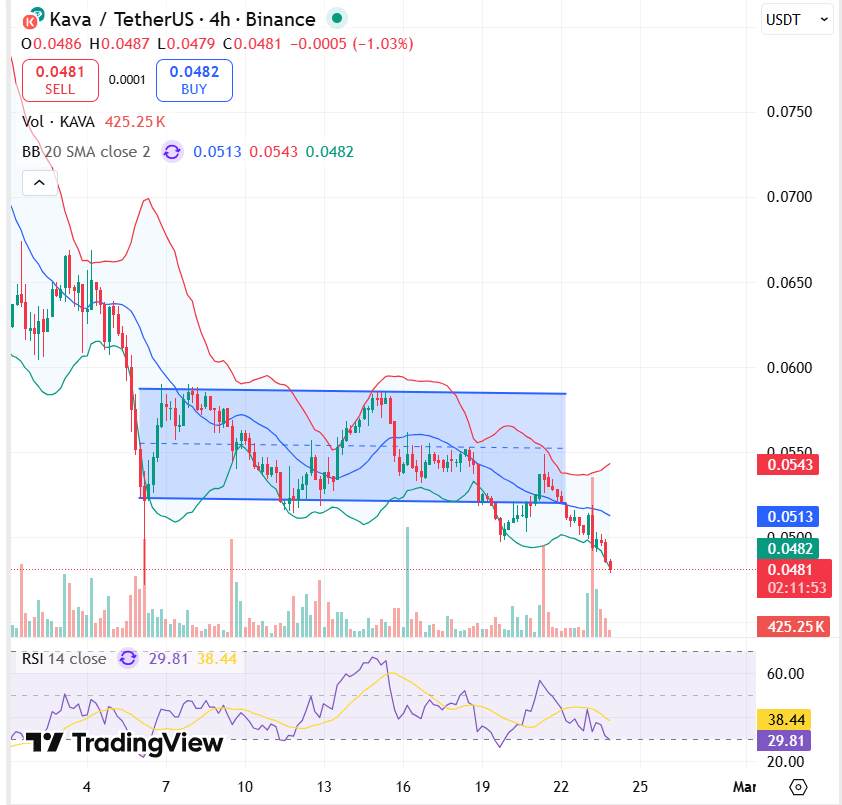
On the 4-hour price chart, KAVA shows clear bearish momentum after breaking below its key support at $0.050.
Earlier, the price was moving inside a range between $0.049 support and $0.058 resistance, but the recent breakdown confirms that sellers are now in control.
The price is trading below the Bollinger Bands midline (around $0.0513), which shows continued downward pressure. So, if the price continues falling, the next support is near $0.045.
On the upside, immediate resistance is at $0.0513, followed by the stronger resistance zone near $0.058. A move above this zone is needed to confirm trend reversal.
The RSI is near 30, which means the asset is close to the oversold zone.
Month
Potential Low ($)
Potential Average ($)
Potential High ($)
KAVA Price Prediction March 2026
$0.0371
$0.0582
$$0.0913
KAVA (KAVA) Price Prediction 2026
2026 could mark a structural shift for Kava, especially after the Kava 15 upgrade introduced a zero-inflation tokenomic model.
Unlike previous cycles, where new tokens were minted for rewards, the network now funds validator incentives entirely through transaction fees and the community pool. This significantly reduces long-term supply pressure.
Another major catalyst is Kava’s expansion into decentralized AI through its DeCloud infrastructure. The network now provides GPU resources for AI model training and on-chain inference.
If AI compute usage and DeFi TVL rise simultaneously, KAVA could approach the upper 2026 range
Year
Potential Low ($)
Potential Average ($)
Potential High ($)
KAVA Price Prediction 2026
$0.0054
$0.1452
$0.3401
Kava Price Targets 2026 – 2030
Year
Potential Low ($)
Potential Average ($)
Potential High ($)
2026
$0.0054
$0.1452
$0.3401
2027
$0.0474
$0.3756
$0.7146
2028
$0.138
$0.752
$1.55
2029
$0.540
$1.19
$2.36
2030
$0.826
$2.228
$5.17
KAVA Token Price Forecast 2026
If DeFi liquidity returns and Kava’s co-chain model proves efficient, KAVA could approach $0.34
KAVA Crypto Price Projection 2027
By 2027, the impact of the $750 million Kava Rise incentive program could become more visible. KAVA could benefit from increased utility demand.
KAVA Coin Price Action 2028
As interoperability deepens between Ethereum, Cosmos, and BNB Smart Chain, Kava may strengthen its cross-chain position, pushing KAVA’s price to $1.55.
KAVA Token Price Analysis 2029
If DeCloud becomes a recognized decentralized alternative for AI compute and the zero-inflation model continues reducing sell pressure, KAVA could test $2.4.
KAVA Price Prediction 2030
By 2030, Kava’s valuation will depend on whether it becomes a dual-purpose chain, then the token could target the $5.17.
What Does The Market Say?
Year
2026
2027
2030
Digitalcoinprice
$0.0511
$0.11
$0.17
Tradersunion
$0.0177
$0.0312
$0.0547
Coincodex
$0.05726
$0.0568
$0.2660
CoinPedia’s KAVA Price Projection 2025
From CoinPedia’s perspective, Kava represents a value-oriented Layer-1 project currently trading near long-term support. Its future depends heavily on whether DeFi adoption rebounds and whether its Ethereum–Cosmos co-chain model gains real traction.
If ecosystem liquidity increases and staking participation remains strong, KAVA could gradually reclaim the $0.34 level in 2026.
Year
Potential Low ($)
Potential Average ($)
Potential High ($)
2026
$0.0054
$0.1452
$0.3401
Never Miss a Beat in the Crypto World!
Stay ahead with breaking news, expert analysis, and real-time updates on the latest trends in Bitcoin, altcoins, DeFi, NFTs, and more.
FAQs
What does Kava coin do?
In simple words, KAVA allows users to borrow, lend, and trade assets, as well as offers a wide range of financial services, including stablecoin issuance and earning interest.
Does Kava coin have a future?
Kava’s future depends on its unique “co-chain” interoperability, zero-inflation model, and expanding decentralized AI infrastructure.
What is the KAVA price prediction for 2026?
KAVA could trade between $0.0054 and $0.34 in 2026, depending on DeFi growth, AI compute demand, and staking participation.
Can KAVA reach $1 or higher by 2030?
If adoption expands across DeFi, AI compute, and cross-chain use cases, KAVA could target multi-dollar levels by 2030.
Is KAVA a good long-term investment?
KAVA’s long-term outlook depends on ecosystem growth, zero-inflation tokenomics, and real adoption. Investors should assess risk carefully.
India’s Delhi High Court has refused to regulate cryptocurrency exchanges in India, making it clear that creating crypto laws is the government’s responsibility. The decision came after a crypto investor filed a case against Indian exchange Bitbns, asking the court to introduce regulations and order an investigation into withdrawal issues.
This ruling shows that India still does not have clear crypto laws, leaving investors to depend on existing legal systems.
Delhi High Court Rejects Investor’s Plea Against Bitbns
The case was filed by investor Rana Handa, who accused Bitbns of restricting withdrawals and manipulating asset values. Handa claimed he invested ₹14.22 lakh ($15,637) in 2021 and faced withdrawal limits, and later the platform showed the incorrect value of his Bitcoin holdings in 2025.
After filing a cybercrime complaint and receiving no response, he approached the Delhi High Court seeking regulatory action and a Central Bureau of Investigation (CBI) probe.
He accused Bitbns of financial mismanagement and asked the court to order a probe and introduce stricter crypto rules.
Just in: The Delhi High Court rejected a plea seeking #crypto exchange regulation and a CBI probe into Bitbns.
However, Justice Purushaindrakumar Kaurav dismissed the petition, stating that cryptocurrency exchanges are private entities and do not qualify as “State” under constitutional law.
Because of this, the court cannot create new regulations or order investigations without proper legal authority. Thus, the court advised the investor to use normal legal channels, such as police complaints or civil courts.
The Delhi High Court clarified that courts interpret and enforce laws but do not create new regulations. Crypto regulation falls under the authority of Parliament and government regulators, not the judiciary.
This means courts cannot regulate crypto exchanges unless the government first creates clear crypto laws.
The ruling shows the current legal gap in India’s crypto sector.
What This Means for Crypto Investors in India
The decision highlights the risks faced by crypto investors in India’s largely unregulated market. Without dedicated crypto laws, investors cannot rely on courts to enforce special protections specific to digital assets.
Instead, users must depend on general financial, civil, and criminal laws when disputes arise with crypto platforms.
Crypto User Still Faces Legal Gap in India
India remains one of the largest crypto markets globally, with 123.35 million active users investing in digital assets. Despite such a strong user base, the country still lacks clear regulatory guidelines governing crypto exchanges.
While the government has introduced crypto taxation, including a 30% tax on gains and 1% TDS, a comprehensive regulatory framework has not yet been implemented.
This regulatory gap creates uncertainty for both users and crypto companies operating in India.
Never Miss a Beat in the Crypto World!
Stay ahead with breaking news, expert analysis, and real-time updates on the latest trends in Bitcoin, altcoins, DeFi, NFTs, and more.
FAQs
Does India have a clear cryptocurrency regulatory framework?
No. India taxes crypto at 30% with 1% TDS but has no comprehensive law governing exchanges, investor protection, or licensing.
Who is responsible for regulating cryptocurrency in India?
Crypto regulation falls under the central government and Parliament. Agencies like RBI and SEBI may play roles once formal laws are enacted.
What legal protections do crypto investors currently have in India?
Investors must rely on existing civil, criminal, and financial laws. There are no crypto-specific consumer protection regulations yet.
What does this ruling mean for the future of crypto regulation in India?
It reinforces that only the government can introduce crypto laws, highlighting the urgent need for a clear regulatory framework for investors.

 Login
Login
BREAKING:
US CORE PPI: 3.6%
 BREAKING:

 3.79%
3.79%

 False
False

 The case followed user complaints over blocked withdrawals.