
Reading view

ASUS NUC 16 Pro Panther Lake Mini PC Launch Date and Price Detailed

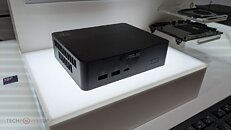
ASUS recently announced the NUC 16 mini PC at CES 2026, with the NUCs confirmed to feature Intel's Panther Lake Core Ultra Series 3 CPUs, LPDDR5X-9600 RAM, and Intel Arc B390 integrated graphics. When the NUC Pro 16 was revealed, pricing and availability were somewhat nebulous, but that information has been partially revealed ahead of launch thanks to @realVictor_M on X.

According to the leaker, who cites what appears to be leaked Chinese press materials, the NUC 16 Pro with the Intel Core Ultra X7, 32 GB of RAM, and 1 TB of NVMe storage will cost RMB 10,999, which converts to roughly $1,600 ($1,591.50 exactly, at the time of writing). Part of this high pricing is likely to be a direct result of the current memory crisis caused by AI center demand, but it should also be noted that international pricing is rarely ever as simple as a currency conversion, so expect prices to be somewhat higher than that $1,600 when the mini PC launches internationally. It's also notable that ASUS originally cited the Intel Core Ultra X9 as the high-end CPU spec for the mini PC, and the pricing cited by the leak is for the X7 version. Currently, the Chinese launch looks to be scheduled for March 11, so an international launch should follow shortly thereafter.

Steam Update Fixes Slew of Issues and Adds Polish

Valve has been working to improve SteamOS since the launch of the Steam Deck, and the latest SteamOS and Steam Client updates out of Valve combine a whole host of bug fixes that were previously fed into the testing streams. Most notably of the lot are the changes to the accessibility and Steam Input options, but Valve also fixed a few issues that have been part of the SteamOS experience for some time, including flickering UI elements, low-resolution thumbnails on the Recent Games screen of the game library, and issues with button mapping and Switch Pro controller LEDs coming on when they're not supposed to. There are also some additional improvements to features like family sharing and high contrast theme options, but the most interesting addition comes by way of the generic SteamOS 3.7.20 release.

SteamOS 3.7.20 officially merges the NTsync driver from a previous beta release into the mainline OS version, which is a change that could see some games get notably higher performance in some instances. NTsync is a Linux kernel driver that's been in a stable state for a little over a year, but in essence, it aims to increase performance by more closely matching Windows NT synchronization when using the Proton compatibility layer. Other versions of Proton and WINE have had NTsync for a while as a performance booster, but now Valve has added official support for it to the kernel, leaving less development work in the hands of the community and Valve itself. NTsync promises performance uplifts in some games, although not all of them, and it won't always necessarily offer better performance than the existing Fsync, but it gives Linux gamers another option to use when they're tinkering with Proton settings to eke out that last drop of performance.

Heart Machine Workers Join CWA Union Following Layoffs After Hyper Light Breaker Launch

Heart Machine, the studio behind Hyper Light Drifter, its spiritual successor, Solar Ash, and its actual successor, Hyper Light Breaker, recently implemented a round of layoffs following the launch of Hyper Light Breaker, and it appears this round of layoffs—the second in recent memory—has not been taken lightly by the remaining developers at the studio. According to a recent report by Game Developer, employees at Heart Machine have officially joined the CWA (Communication Workers of America) in a voluntary bargaining agreement in the name of job security and workers' rights. The union members are reportedly currently evaluating their priorities and what they plan to bargain for, but the developers at the studio say that the justification for joining the union is to be able to protect the craft and the creative collaboration that enables game designers and video game workers to create "something they'd want to play themselves." According to an announcement by The CWA, a majority of workers at Heart Machine signed the unionization agreement, meaning contracts at the studio will now be drawn up with CWA representation.

Unionization has been something of a trend in recent years in the video game industry, with video game voice actors joining the protracted
SAG-Aftra strike in 2024 and 2025 seeking protections against the exact sorts of layoffs that previously affected Heart Machine developers, in addition to protections against the AI systems currently taking over the gaming industry. 2025 also saw the launch of the United Video Game Workers' Union, which seeks similar protections against practices like layoffs in the name of profit. A recent video game industry survey also indicated that as many as 82% of video game workers support unionization, with younger workers responding even more positively. The news of Heart Machine joining the CWA also follows the announcement that EA is cutting an unspecified number of jobs at its Battlefield 6 studios.

Colorful Releases iGame Lab Vulcan Mini-ITX Chassis To Match RTX 50-Series GPUs

Not too long ago, Colorful released its iGame Lab Vulcan NVIDIA GeForce RTX 50-series GPUs, which feature a clean white design language. Now, the GPU maker has announced a new Mini-ITX case to go with those GPU designs. The Colorful iGame Lab Vulcan Armor chassis is a 617 × 186.6 × 210 mm, or roughly 24 L in volume. Colorful specifically lists compatibility with its iGame RTX 5070 Ti Vulcan W OC, 5080 Vulcan W OC, 5090 D v2 Vulcan W OC 24 GB, and 5090 D Vulcan W OC 32 GB, since those are the GPUs that feature the shroud design that fits into the dedicated cutout on the side of the chassis, which exposes the GPU intake fans to fresh air.

The chassis offers support for up to 240 mm radiators—and comes with a 240 mm radiator, rated at 240 W TDP, with slim fans pre-installed—and SFX PSUs up to 110 mm long. While the chassis is technically designed for Colorful's own GPU shrouds, it technically fits 3-slot GPUs up to 373.2 mm long—an enterprising modder could likely fairly easily 3D print a bracket to fill make up for any discrepancies between the case cutout and the GPU shroud on third-party designs. The case also sports a magnetic attachment base on the top panel for attaching things like the Colorful Vulcan screen. Front I/O consists of a USB 3.2 Type-C port and dual USB 3.0 ports. International pricing and launch dates have not yet been confirmed at the time of writing.

EA Lays Off Battlefield 6 Devs Across Multiple Studios Despite Record Profits Around Launch

The latest in a long line of layoffs and budget cuts affecting the gaming industry comes by way of EA, who has just been confirmed to be laying off developers across all four studios that worked on Battlefield 6—those being Criterion, Dice, Motive, and Ripple Effect. This is according to a report by IGN, although it's unclear how many employees will be affected by the layoffs. Battlefield 6 has seemingly been one of the most successful Battlefield game so far, allegedly topping 7 million unit sales in the first three days following the October 2025 launch, making it a big revenue driver for record profits in Q3 2025. As of the time of writing, Battlefield 6 has peaked at 747,440 concurrent players on Steam, with daily concurrent player counts peaking at around 65,000-70,000 players. Part of EA's justification for the layoffs is "feedback and insights from Battlefield Labs," so perhaps part of the reason for the layoffs is players moving from Battlefield 6 to the free-to-play Battlefield RedSec.

When asked for comment by GameIndustry.biz, EA said that "We've made select changes within our Battlefield organization to better align our teams around what matters most to our community. Battlefield remains one of our biggest priorities, and we're continuing to invest in the franchise, guided by player feedback and insights from Battlefield Labs." This round of layoffs comes mere weeks after EA laid off an unknown number of developers at Full Circle, the studio behind Skate. These layoffs are seemingly part of EA's plan to cut costs following a recent acquisition by a consortium of investors in late 2025.

Xiaomi Book 14 Leaks With Panther Lake CPU, 32 GB RAM, Arc B390 iGPU

Xiaomi's upcoming Book 14 laptop has leaked online, revealing the expected specifications for the upcoming thin-and-light productivity laptop. According to Digital Chat Station on Weibo, the Xiaomi Book 14 will feature Intel's Panther Lake Core Ultra Series 3 CPUs, specifically the Core Ultra 5 325 and Core Ultra X7 358H, with either 24 GB or 32 GB of memory and 1 TB of storage. This means that the Xiaomi Book 14 will be available in at least one configuration with Intel's impressive new Arc B390 iGPU, which has proven itself in both gaming and creative workloads aside from the usual productivity fare.

Following DCS's post, Aura Pig also posted on Weibo about the upcoming MacBook competitor, stating that the both the build quality and battery life of the Xiaomi Book 14 were impressive. The 14-inch display is also touch-enabled, although the laptop is purportedly squarely in the premium category, suggesting a high price. The current-gen Xiaomi Book 14 tops out at 16 GB of memory and is only available with Intel's 12th-Gen CPUs and up to 512 GB of storage, so the new model will be a significant upgrade in terms of performance and convenience if the leaked specifications are any indication. Weight on the new Book 14 will be slightly lower than the old model, at around 1 kg compared to the 1.37 kg in the current Book 14.

Razer Viper V4 Pro Gaming Mouse Leaks in Physical and Online Stores

Leaks about an upcoming Razer Viper V4 Pro have been circulating for a while now, with multiple e-sports pros seemingly using the new mouse in competitive tournaments. Now, though, the new wireless mouse has effectively been confirmed by two separate posts showing off early retail appearances of the Viper V4 Pro. First, a Reddit user posted in-store images of the Viper V4 Pro retail packaging that had seemingly accidentally been put in the storefront ahead of launch, and although the post was subsequently deleted by the r/MouseReview subreddit user, it didn't stop the images from showing up on X. For the most part, it seems like an iterative update to the existing Viper V3 Pro, as was expected, given the specs of the DeathAdder V4 Pro.

The aforementioned retail box gives us a good idea of what to expect from the Viper V4 Pro—that is, a minor sensor update to the Razer Focus Pro 50K, new Razer Optical Gen 4 switches, a Razer optical scroll wheel, and a 49 g total weight. Notably, the sensor is a slight improvement over even the Razer DeathAdder V4 Pro, although much of the rest of the mouse's specifications are practically identical. As expected, the Viper V4 Pro adopts the same more efficient and lower latency dome-shaped wireless receiver as the DeathAdder V4 Pro, replete with 8K polling and a claimed 180-hour battery life. According to Danish computer store, ComputerSalg, where the Viper V4 Pro was prematurely launched as well, although without any photos, the mouse will also be available in white at launch, and it will cost a staggering $199 (DKK 1,290 converted excluding VAT). This is significantly more expensive than both the existing Viper V3 Pro and the DeathAdder V4 Pro, so it's likely a pre-launch placeholder or the price of some special edition colorway. All of this indicates that the Viper V4 Pro is likely to launch within the next few weeks, but it will have to contend with both the new tech in the Logitech G Pro X2 Superstrike and the slew of Chinese gaming mice with similar hardware specs and much lower pricing.

PlayStation 6 Leak Tips 4K 120 FPS "In Most Games" With 6-12× RT Performance of PS5

Given the current state of the gaming industry, rumors have started to emerge about the next-gen gaming console launches, with previous rumors claiming that the PlayStation 6 would launch alongside a new standalone PlayStation Portable gaming handheld, and that the PS6 would have less graphical processing power than the upcoming Xbox console. In a new post on YouTube, ubiquitous leaker and industry insider, Moore's Law is Dead, claims that the PS6 Orion—the living room console—will feature 2.5-3× the rasterization performance of the PS5 and 6-12× the ray tracing performance of the PS5, or 3-6× faster ray tracing than the PS5 Pro and roughly twice the raster performance of the PS5 Pro. This is thanks to a significantly faster RDNA 5 GPU with 52-54 CUs running at around 2-3.6 GHz and delivering around 34-40 TFLOPS of theoretical performance.

The leaker also shot down rumors that recently surfaced claiming that the PlayStation 6 may be delayed to as late as 2029 due to the ongoing memory crisis, stating that the nature of memory and APU fabrication contracts make it unlikely that the PS6 will be delayed that long. Instead, we may see a brief period of increased pricing or scarcity at launch. Apparently, according to his sources, Sony has a contract with TSMC to start mass-producing the PS6 as early as Q2 2027. MLID also mentions the AMD "Canis" APU slated to arrive in the PS6 handheld console, claiming that it will feature four Zen 6c cores, two Zen 6 LP cores (for running the operating system), and 16 RDNA 5 CUs running at 1.6-2 GHz with a 15 W total board power, all being fed by LPDDR5X memory over a 192-bit bus. All of this will allegedly be targeting 1080p gameplay with a significantly higher power limit when docked. He also speculates that the handheld will feature "vastly better" ray tracing than the PS5.

Steam Machine May Be Delayed After All—Still Shipping in 2026

Valve's announcement of the Steam Machine has generated a lot of excitement amongst PC gamers and apparently more than a little consternation in the ranks of traditional console makers, although the recent announcement that pricing for the upcoming living room PC is delayed due to the RAM shortage has poured a bit of cold water on things. Adding to that disappointment, Valve recently softened its promise to deliver the Steam Machine and Valve Index in "early 2026" as it had initially promised.

In a recent Steam Year In Review news post, Valve says that "We shared recently that there have been challenges with memory and storage shortages, but we will be shipping all three products this year. More updates will be shared as we finalize our plans." Notably, however, this previously read "We hope to ship in 2026, but as we shared recently, memory and storage shortages have created challenges for us," according to VideoCardz, but the verbiage has since been changed. The Steam Store page for the Steam Machine only lists "coming soon" in the release date section, but it's also curious that Valve seems steadfast in its plans to release the Steam Frame, Machine, and Controller simultaneously, despite the potential delays in delivering the hardware.

Intel Core Ultra 5 250K Plus Benchmarks Reveal Performance Expectations for Arrow Lake Refresh

Intel's Core Ultra 7 270K Plus was recently leaked in an upcoming HP prebuilt desktop PC, ostensibly once more confirming the imminent launch of the new Arrow Lake Refresh desktop CPUs. Now, the Intel Core Ultra 5 250K Plus has appeared in PassMark's benchmark charts, potentially both confirming the specifications of the mid-range Arrow Lake Refresh and setting expectations of performance for the new CPUs. According to PassMark, the Core Ultra 5 250K Plus scored 50,478 points in the CPU benchmark, coming out around 16% faster than the 14-core Core Ultra 5 245K and Core Ultra 5 245 KF that preceded it.

That benchmark score, although based on a single benchmark, puts the Core Ultra 5 250K Plus almost exactly halfway between the Core Ultra 5 245K and Core Ultra 7 265K, which is not a terrible place to be. According to previous leaks, now somewhat validated by this benchmark score, the Core Ultra 5 250K Plus will add four additional E-cores over the original 14-core Core Ultra 5 245 CPUs, for a total of 18 cores and 18 threads—6 P-cores and 12 E-cores.

Slay the Spire 2 Peaks at Over 430,000 Players in First 24 Hours

Slay the Spire 2, the much-awaited successor to the indie roguelike deckbuilder, has finally launched on Steam, and within 24 hours of launch, it has rocketed to the top of the Steam Sales Chart and recorded some impressive player count figures. According to SteamDB, Slay the Spire 2 has attracted a peak of 430,456 concurrent players during its first 24 hours out the gates, and it has reached the number one spot in the Steam Sales chart, beating out both Marathon and Resident Evil Requiem for revenue on March 6, 2026. Mega Crit, the studio behind the game, even celebrated the game surpassing 179,456 concurrent players, marking it as "the highest ever for any roguelite."

By all indications, the indie game appears to have had a very successful launch, and the 97% positive review rating on Steam backs that up. The new installment in the game series builds on the gameplay and world of the original by adding new characters, cards, abilities, and secrets, but it notably adds a co-op mode as well. Judging by the Steam reviews, most of the improvements seem to successfully build on what made the previous game great without sacrificing anything in the process, and the multiplayer functionality seems to have been executed well, rather than shoehorned in for wider appeal.

Xbox Project Helix Officially Tipped As Next-Gen Console, Will "Play Your Xbox and PC Games"

There has been a lot of talk about the future of the Xbox gaming brand since it was announced that Phil Spencer would be stepping down as head of Microsoft's gaming business. The new CEO of Xbox, Asha Sharma, has previously defended against a barrage of this skepticism, revealing that she has in mind a "return to Xbox," and with new posts on X by both Xbox and Sharma, she confirmed that part of this return does indeed include a hardware launch. The next-gen Xbox is called Project Helix, and although neither Sharma nor Xbox itself has revealed much more about the next-gen console than the logo and project name, Sharma also hinted that more information may be revealed at GDC, which is slated to take place on March 9-13.

The next-gen Xbox has long been rumored, with recent rumors claiming that it will be a hybrid device, bridging the gap between a living room console and a PC—perhaps in response to the recent rise of devices like the Steam Deck and the pressure of the upcoming Steam Machine—and Sharma more or less hints at this in her post, stating that "Project Helix will lead in performance and play your Xbox and PC games." This isn't the first time Sharma has spoken about the next-gen Xbox hardware platform, having mentioned it in a recent interview as a key part of the brand's future. Speculation about Sharma's leadership of Xbox has also veered into deep skepticism, largely resulting from Sharma's history as CEO of Microsoft's CoreAI platform and her willingness to use AI in the gaming industry, even if she claims that she will not tolerate AI slop.

ATK Teases Translucent Zero Wireless Mouse with 8 kHz Polling, Frosted PC Shell

ATK, maker of the Blazing Sky Duckbill mouse that launched in mid-2025 and the recently announced Yogo75 mechanical keyboard, has officially unveiled the launch date, design, and some specifications for its upcoming Zero wireless gaming mouse. The Zero takes a slightly different approach to most of ATK's other gaming mice, opting, instead of the usual ABS or forged carbon fiber, for a translucent, textured polycarbonate shell that will allow you to see the internals of the mouse. The Zero has been confirmed to be arriving in at least three translucent colorways: black, pink, and white, although ATK is known for having a wide variety of color options on most of its gaming mice.

According to the official teaser on X and a recent Reddit post, the ATK Zero will feature much of the same tech as has been present in many of the brand's more recent releases, including the Nordic 54L15 MCU, a PixArt PAW 3950 Ultra sensor with up to 42,000 DPI sensitivity and a 20,000 FPS mode, 8 kHz polling, and a 300 mAh battery. The aforementioned spec sheet also mentions a 39 g weight and dimensions coming in at 120.1 × 63.2 × 38.1 mm, making it almost identical to the Pulsar X2 CrazyLight Medium in terms of size, shape, and weight. The ATK Zero will feature custom ATK optical switches for the main clicks, a TTC Gold encoder for the scroll wheel, and pure PTFE skates. The launch date is currently set for March 11, although pricing is still unknown.

Marathon May Come to Last-Gen Xbox and PlayStation Consoles

Marathon recently had quite a successful server slam weekend, drawing in nearly 150,000 players at one point on Steam alone. In the hours since its March 5 launch, it has consistently played host to around 80,000 concurrent players, showing that it wasn't just the free test drawing players into the new extraction shooter. However, it seems as though Bungie wants to include as many gamers in the fun as possible, according to the game's ESRB rating, which has recently been updated to include both the Xbox One and PlayStation 5 in addition to the previous ratings for PC, Xbox Series, and PlayStation 5 platforms.

Bungie has not confirmed whether it is planning to bring Marathon to older systems, but it's curious nonetheless that the game would receive a dedicated rating for last-gen consoles, especially since older games that launched on last-gen consoles but have since become playable on new consoles, like Destiny 2, have not been updated at the ESRB to include newer console generations in their ratings. Marathon's minimum hardware requirements for PC are far from high-end, calling for just an NVIDIA GeForce GTX 1050 Ti or AMD Radeon RX 5500 XT and an Intel Core i5-6600 or AMD Ryzen 5 2600 with 8 GB of RAM. The PS4, for its part, is powered by an AMD GCN 1.1.0 GPU with 1152 shading units, coming in at around 1.843 TFLOPS theoretical performance, which is substantially lower than the GTX 1050 Ti's 2.183 TFLOPS, but given the nature of tailored console hardware, it wouldn't be surprising if it could be run smoothly on the aging hardware. However, it has been reported that Marathon runs fairly well on Windows gaming handhelds, so it may be technically possible to get the game running on older consoles if the development team decides to put in the work.

Resident Evil 1 Remake May Be on the Cards

Resident Evil Requiem recently launched as the newest installment in Capcom's zombie horror franchise, and although it received glowing reviews, even topping the Steam charts and handily beating out every other Resident Evil game on PC, gamers were a little disappointed to find out that the game was originally meant to feature a return to Raccoon City and the Spencer mansion from Resident Evil 1. According to prominent game leaker, Dusk Golem on X, part of the reason for the mansion scene being cut from Requiem was to avoid repetition in both the upcoming Code Veronica remake and a Resident Evil 1 remake.

[Editor's note: Our in-depth review of Resident Evil Requiem is now live]

According to the leaker, Resident Evil 1 is confirmed as being in early development, and a Code Veronica will be the next game in the series, which would mean having gameplay in the same mansion in three successive games, which, in the leaker's own words would "start to feel very samey & not very special at all." Resident Evil Code Veronica Remake is slated to launch in 2027, although the Resident Evil 1 remake is still in the early stages of development, so it seems like a 2029 release date would be the earliest we can expect. Supposedly, the remake will be in the updated RE Engine in which Requiem was also made and demonstrates decent visuals and performance, even with modest hardware requirements.

Keychron Announces Q5 HE 8K TMR Gaming Keyboard With More Compact 1800 Layout

Keychron recently announced the new Q HE 8K gaming keyboard line-up, starting with the Q1 HE, Q3 HE, and Q6 HE, all of which feature Keychron's Ultra-Fast Magnetic Lime switches and full metal construction. Keychron has now also added the Q5 HE 8K to the list, for those who want a slightly more compact layout but don't want to sacrifice the num pad in the process. The Q5 HE 8K is available on the Keychron web store in black and white colorways for $239.99. It will likely also launch on Amazon at a later date, but it is not yet available there.

Everything about the Q5 HE 8K is just about identical to the other keyboards in the series, with the exception of the layout, from the polyurethane foam gasket mount to the aluminium plate and OSA profile double-shot PBT keycaps. The main draw over the Q5 HE 8K is that it condenses much of the same functionality as the full-size Q6 HE 8K into a small footprint—408 mm long vs 446 mm on the Q6 HE 8K—while only losing five keys and not compromising with a small zero key on the num pad. Unlike most 1800 layout keyboards, the Q5 HE 8K also has a programmable knob and a row of macro keys above the num pad. Like its brethren, the Q5 HE 8K is a wired-only keyboard, which has the side effect of bringing the front height down to 20.6 mm, and it has the same analog input features and 8 kHz polling rate as the other keyboards in the 8K series. The keyboard is also remappable and configurable in the Keychron Launcher web app, and it features all the usual analog keyboard trappings, like SOCD, DKS, Rapid Trigger, and controller emulation. It also has on-board macros with macro recording or manual programming functionality in Launcher, and it features Keychron's usual hardware OS selector switch alongside a hardware profile selector switch near the USB-C port.

NuPhy Launches Low-Profile Creative Engine Mechanical Keyboard Keycaps Inspired by Adobe Illustrator UI

NuPhy recently revealed the Aquarium keycap set in its custom nSA profile for low-profile mechanical keyboards, like the Air60 HE and Node series mechanical keyboards. Now, the brand has announced the latest iteration in its nSA keycap range, the Creative Engine design, which features a much more practical design than the Aquarium set. The NuPhy Creative Engine nSA keycap set is available on the NuPhy online store for $49.95 and includes 126 keys, providing a few alternative keycaps for some modifiers and navigation keys and supporting a little more than an average 100% keyboard. That said, the keycap set does not have proper extended compatibility for odd-ball layouts or even ISO, although you could probably make it work on a split space keyboard, thanks to the 2.25u and 2.75u enter and shift keys, thanks to the uniform height.

Much like the Aquarium keycap set, the Creative Engine keycap set is designed by BOHO and manufactured by KeyTok, a well-known OEM in the mechanical keyboard space. The Creative Engine keycap set is inspired by the UI of Adobe Illustrator, with three shades of gray for the main alphanumeric keycaps and bright yellow for the accent keycaps. The legend on the keycaps echoes the Illustrator theme, with each keycap featuring dye-sublimation printed iconography and lettering for built-in Illustrator keyboard shortcuts. The nSA profile features a 5.5 mm maximum height and a spherical top—this simply means that the top curves in both the X and Y axes, unlike something like Cherry, which uses cylindrical tops that only curve in the X axis. NuPhy explicitly lists compatibility with its own Air, Kick, and Node series low-profile keycaps, but the keycaps should be compatible with any mechanical keyboard that uses MX-style switches and has a layout somewhere between 60% and 100% and uses a 6.25u space bar.

Ubisoft Confirms Long-Rumored Assassin's Creed Black Flag Remake and More

An Assassin's Creed Black Flag Remake has been rumored for years at this point, with the most recent rumors claiming a 2026 launch date, but now, the new Assassin's Creed Head of Content, Jean Guedon, has confirmed in a recent brand update blog post that Assassin's Creed Black Flag Resynced is in development. While the game's existence is now confirmed, no launch date or window has been attached yet, and Ubisoft indicated in the blog post that it is but one of several AC projects "in various stages of development."

As the title of the blog post "Assassin's Creed Into 2026" indicates, Guesdon also gives us an idea of what to expect from the franchise for 2026 onwards, aside from Black Flag. Namely, he says that the next Assassin's Creed game slated for launch is Assassin's Creed Codename Hexe, which looks to have recently received a combat rework deep into its development cycle. Hexe is confirmed to be a narrative-driven, darker twist on the franchise, and Ubisoft will "be quiet for a little longer," ahead of release, but it looks to be the closest to launch. Assassin's Creed Invictus is the name of the PVP multiplayer Assassin's Creed game that Guedon has also confirmed to be in development alongside Codename Jade, which is an open-world mobile game that will seemingly take place in China and was originally rumored for a 2023 launch.

Morefine N1 NAS Launches With Ryzen 7 Pro 8845HS and dGPU Expansion Support

Morefine has announced the N1 NAS, a tower-style NAS solution that packs the AMD Ryzen 7 Pro 8845HS, up to 96 GB of DDR5-5600 ECC memory, dual 10 GbE ports, and built-in PCIe expansion. Pricing starts at $759 for a barebones version, but 32 GB of memory bumps that up to $1,209, while the 64 GB and 96 GB versions come in at $1,569 and $1,929. The Morefine N1 has three M.2 slots for up to 12 TB of SSD storage alongside four hot-swap 3.5-inch HDD bays accessible via the top of the case for an additional 120 TB. The aluminium case itself measured 218 × 193 × 372 mm, making it considerably smaller than many ITX systems but not quite as svelte as a traditional mini PC, like the recently announced Minisforum MS-A2.

The N1 also comes with a built-in 800 W PSU with 400 W dedicated to the GPU power budget, making it adequate for something like an NVIDIA GeForce RTX 5070 Ti, although the included PSU power connectors are not specified. Internal space for the dGPU is limited to 330 mm × 66 mm, too, so SFF GPUs will be the way to go. The port selection is also fairly decent for an SFF PC, packing dual USB 2.0, 1× USB4 port, 1× USB 3.2 Gen 2, 1× USB 3.2 Gen 1, a full size SD card reader, 1× HDMI 2.0, and dual 10 GbE RJ 45 ports. It also has a small 3-inch full color touch screen on the front of the case for displaying things like system information.

Steam Machine May Be To Blame for PlayStation PC Port Abandonment

Rumors recently popped up claiming that Sony would be moving away from PC ports of its major first-party game releases in 2026, especially single-player games. While those rumors have yet to be confirmed by Sony itself, Mike Ybarra, the former president of Blizzard Entertainment, has commented in a recent post on X that this may be the case, but he also points the finger at Valve's Steam Machine as partly to blame for this turn of events. He also adds that Sony sees the recent shake-up at Xbox as the "last nail in the coffin there," implying that Sony is making the right choice and that the shake-up will only embolden the Japanese gaming giant.

The former executive says that the incumbent console manufacturers "view Valve as a major new competitor" in the living room console space, adding that there will be third-party variants running SteamOS that will likely only compound this external pressure on Sony. He goes on to argue that Steam, and by extension the Steam Machine, has the biggest player base and biggest game library of all three living room console makers, and that "shipping good exclusive games matters." Ybarra also notes that Valve's independence, being a private company, allows it more freedom than Sony, who has to answer to shareholders and investors. For Sony's part, it's easy to see how cutting back on PC ports—effectively reducing the Steam Machine's library—could be an easy way to gain a competitive edge. As we discussed previously, it seems as though Sony's PC port business isn't a massive revenue driver in the first place, so it could be a low-risk way for Sony to protect its console ecosystem from incoming competition.

Highguard Officially Shuts Down After Tumultuous First Month

It's no secret that Highguard has languished under dwindling player counts and an apparent lack of funding since its launch in late January 2026, with rumors swirling that Tencent pulled funding from Studio Wildlight shortly after the launch of the game, prompting a round of layoffs that saw around 80% of the development team behind the game lose their jobs. Now, barely a month after launch, Wildlight has announced that it will shut down Highguard on March 12. Servers will remain online until March 12, but it's unclear if players will receive refunds for in-game purchases.

Despite the imminent shut-down, it seems like the developer will release the available content that has been completed in an upcoming update that will launch ahead of the shutdown and add a new Warden, a new weapon, account-level progression, and skill trees to the game—all content that may have added enough interest in the game if released earlier, but will likely suffer from being too little, too late. This isn't the first apparent last-ditch effort to save the game, with previous patches addressing complaints by adding new bases and a new game mode, among other new content, all of which again seemed to be positively received but didn't make a dent in the game's plummeting player counts.

Lenovo Addresses Legion Go Support Saga: Drivers and BIOS Until Late 2029

AMD and Lenovo recently drew ire from the gaming community over its apparent lack of support for the original Legion Go gaming handheld, although it was subsequently revealed that ASUS had more recent updates available for the ROG Ally, which is based on the same AMD APU. More recently, it was revealed by Adam Patrick Murray on The Full Nerd podcast that Lenovo has issued a statement in response to the news reports, and that the company has confirmed it will offer support for the Legion Go at least until October 2029. Murray says that his PR contact, who clarified the state of the Legion Go's support, denounced the original comment by Lenovo support that claimed that AMD and Lenovo were no longer supporting the device as an "ugly rumor." That said, the Legion Go's support has never had the best reputation for software support, with gamers often complaining in the r/LegionGo subreddit about slow updates.

Lenovo's full statement reads:
Support for the Lenovo Legion Go (8.8", 1) has not been discontinued. Lenovo is actively continuing to support the Legion Go (8.8", 1) with necessary driver and BIOS updates and will continue to do so through October 2029. Lenovo is working in concert with AMD on driver update cadence, and new updates will be released once they have passed Lenovo's rigorous review protocols.

Keychron Launches B11 Pro Pocketable Alice Layout Ergonomic Keyboard

Keychron has been revamping its mainline mechanical keyboard line-up pretty consistently lately, but its latest launch, the B11 Pro, is a deviation from those designs, falling square in the mobile productivity space rather than the enthusiast mechanical keyboard sphere. The B11 Pro adapts the ergonomic 65% Alice layout seen in Keychron's K11 Max and puts it into an ultraportable, foldable keyboard with scissor switches. The folding form factor and 65% layout mean that, when folded, the B11 Pro measures in at just 196.3 × 143 mm when folded up, making it a potential option for space-constrained travelers and commuters. The Keychron B11 Pro is currently available on the Keychron online store for $64.99, although it will likely launch on Amazon at a later date.

The B11 Pro has a 65% layout, meaning there is no num pad, nor is there an F row—likely a decision made in favor of a compact physical footprint—although there is a dedicated compact arrow cluster, which should make the adjustment to the smaller layout somewhat easier. It also uses Keychron's scissor switch mechanism and concave keycaps, meaning it should feel something akin to a laptop keyboard to type on. Keychron does not specify, but none of the other keyboards in the B Pro series feature NKRO, so it's safe to assume neither does the B11 Pro. Interestingly, Keychron has opted for a soft-touch material on the back of the B11 Pro, and the whole keyboard weighs in at just 258 g. The B11 Pro also features both 2.4 GHz and Bluetooth 5.3, and the keyboard supposedly gets around 135 hours on a single charge from a 250 mAh battery. There's also a nifty sensor that detects when the keyboard is closed—both a convenience and battery-saving feature. Keychron has also conveniently labelled the relevant modifier keycaps with both macOS and Windows legends, and the key maps themselves can be changed in Keychron Launcher, much like the brand's mechanical keyboard line-up.
❌