
 Login
Login
NVIDIA Announces RTX Mega Geometry Implementation in Witcher 4, Path Tracing for 007 First Light
NVIDIA at the 2026 GDC announced the first implementation of RTX Mega Geometry. Announced alongside its GeForce RTX 50-series "Blackwell" generation, Mega Geometry is a technology that seeks to significantly increase geometric complexity of objects or surfaces with ray tracing elements. A distant analogue of Mega Textures, Mega Geometry leverages nested triangle clusters to reduce video memory footprint as well as the hardware cost of ray intersection. The RT cores in "Blackwell" GPUs have hardware-level readiness for Mega Geometry.
At GDC, NVIDIA showed us two distinct examples of Mega Geometry, the first one is "Alan Wake 2," where it is shown boosting Path Tracing performance, with tens of thousands of ray traced objects on the scene with a 5-20% frame rate improvement versus conventional ray tracing methods, and a 300 MB video memory footprint reduction from the nested triangle clusters model. Next up, is a demonstration of Mega Geometry foliage system in the upcoming "The Witcher 4" title. A pre-release demo (not indicative of actual gameplay) shows Mega Geometry render a forest with thousands of trees with millions objects on the scene, each with its own unique animation. Besides cluster triangles, the scene also implements Opacity Micromaps that NVIDIA introduced with RTX 40-series "Ada."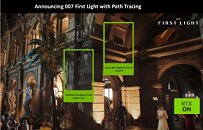


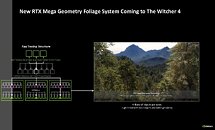

At GDC, NVIDIA showed us two distinct examples of Mega Geometry, the first one is "Alan Wake 2," where it is shown boosting Path Tracing performance, with tens of thousands of ray traced objects on the scene with a 5-20% frame rate improvement versus conventional ray tracing methods, and a 300 MB video memory footprint reduction from the nested triangle clusters model. Next up, is a demonstration of Mega Geometry foliage system in the upcoming "The Witcher 4" title. A pre-release demo (not indicative of actual gameplay) shows Mega Geometry render a forest with thousands of trees with millions objects on the scene, each with its own unique animation. Besides cluster triangles, the scene also implements Opacity Micromaps that NVIDIA introduced with RTX 40-series "Ada."


