Reading view

Best Cross-Chain Bridges to Watch in 2026

cross-chain-bridge

The post Best Cross-Chain Bridges to Watch in 2026 appeared first on Coinpedia Fintech News

Blockchain interoperability has moved from a niche engineering concern to a billion-dollar infrastructure priority. Here is what the landscape looks like today, and which platforms are earning trader trust.

For most of crypto’s first decade, the conversation about blockchain infrastructure revolved around a single question: which chain would win. Ethereum versus Solana. Solana versus Avalanche. Avalanche versus everything else. That framing has largely collapsed. The industry has settled, reluctantly at first and then decisively, on a different answer: all of them, simultaneously, connected.

That shift has transformed cross-chain bridges from a technical curiosity into load-bearing infrastructure. According to DeFiLlama, Bridges TVL hit $21.94B as of March 2026, consistently exceeding $20B through market cycles. Bridges, it turns out, are one of the few crypto infrastructure categories that grow with market fragmentation rather than despite it.

But choosing the right bridge is not trivial. The sector carries a history of catastrophic failures. The Ronin Bridge exploit alone cost users over $600 million in 2022, and the recovery has been uneven. Some protocols have since been rebuilt with stronger architectures. Others have not. And an entirely different class of solution, exemplified by platforms like ChangeNOW, has sidestepped the most dangerous design patterns entirely.

What follows is a working guide for practitioners: the frameworks for evaluating bridge quality, an honest accounting of the risks, and a considered list of the cross-chain platforms worth watching as 2026 develops.

First, Understand What Bridging Actually Involves

The phrase “bridging crypto” gets used loosely, but the mechanics matter for anyone moving meaningful capital. At its core, a blockchain bridge solves a specific problem: native assets on one chain cannot, by design, exist or be verified on another chain. Ethereum has no visibility into the Solana ledger. BNB Chain cannot read an Avalanche block header. Bridging is the set of mechanisms that creates a credible representation of value across this divide.

The dominant architecture for most of bridge history has been “lock-and-mint”: a user deposits an asset into a smart contract on Chain A, and an equivalent “wrapped” token is issued on Chain B.

The wrapped token’s value is backed by the locked original. When the user wants out, they burn the wrapped token and unlock the original.

In theory, it is elegant. In practice, it creates a single, obvious problem: the locking contract becomes a high-value target. A single vulnerability can expose all funds held within it.

The Risk Question That Nobody Asks Carefully Enough

Is bridging crypto safe? The accurate answer is: it depends almost entirely on which bridge, and how you use it. That is not a hedge, it is the substantive answer. 

The attack surface for bridges is distinctive. Unlike a DEX or lending protocol, where exploits typically drain one pool or one reserve, a compromised bridge contract can drain everything locked in it simultaneously.

The security environment has changed measurably. Audit standards have risen sharply, reputable bridges now carry multiple independent audits, often including formal verification. Bug bounty programs in the $1-10 million range have become standard for top-tier protocols. And the market has increasingly penalized protocols that cut corners: users have migrated capital toward bridges with stronger security track records.

That said, practical risks remain, and users should internalize them:

  • Smart contract risk is never zero. Even audited code can contain exploitable edge cases, particularly in complex multi-chain messaging logic.
  • Validator and multi-sig risk persists in bridges that rely on permissioned operator sets. The question is not whether these are trustworthy today, but whether they will remain so under adversarial conditions.
  • Wrapped token risk is underappreciated. Users who bridge using lock-and-mint models hold tokens whose value is contingent on the security of a contract on another chain they may never interact with directly.
  • Phishing risk is high and growing. Fraudulent bridge interfaces — visually identical to legitimate platforms are among the most common vectors for crypto losses that never appear in security research.

For most users, the most defensible posture is to prioritize non-custodial, swap-based bridges for routine cross-chain transfers and reserve lock-and-mint bridges for specific DeFi use cases where wrapped tokens are necessary. Users should also apply consistent hygiene by verifying URLs, starting with small test transactions, and avoiding keeping assets in bridge contracts between sessions.

Are Bridges Always Necessary?

This is the question most users skip.

For a growing segment of the market, the answer is increasingly no.

While bridges remain essential for certain DeFi-native use cases, particularly those involving wrapped assets or protocol-specific liquidity, alternative approaches to cross-chain execution have matured.

Instead of moving the same asset across chains, some platforms move value itself, using swaps rather than synthetic representations.

Platforms like ChangeNOW operate in this category. Rather than locking funds and issuing wrapped tokens, they facilitate cross-chain swaps, sourcing liquidity across networks. This removes the need for large locked pools, reducing exposure to one of the most critical bridge risks.

The trade-off is structural:

  • Users receive a different asset on the destination chain
  • Not a direct representation of the original

For payments, transfers, and portfolio rebalancing, this distinction is often irrelevant.

For DeFi strategies requiring specific wrapped assets, it still matters.

In practice, users are increasingly opting for either bridging or swapping based on risk tolerance, speed, and cost, rather than ideological considerations.

What Separates Good Bridges from the Rest

Across the best cross-chain bridges operating in 2026, several characteristics consistently separate the platforms worth trusting from those that require more caution.

Security architecture is the obvious starting point, but the relevant question is more specific than “has it been audited.” It is: what happens if a single component fails? The best blockchain bridges are designed with the assumption that individual nodes, validators, or contracts will be compromised, and they route around that failure gracefully. 

Weak ones concentrate risk in:

  • A single contract
  • A small validator set
  • A centralized multisig

Chain and asset coverage determine practical utility. A bridge that connects two chains handles a narrow use case. The most valuable crypto network bridges in 2026 span the major EVM chains, the principal Layer 2 rollups (Arbitrum, Optimism, Base, zkSync), non-EVM ecosystems like Solana and the Cosmos IBC universe, and the emerging Layer 1s gaining traction in the Sui and Aptos ecosystems. Asset coverage matters as much as chain coverage, a bridge that moves ETH but not ERC-20 tokens serves a fraction of user needs.

Fee transparency is a less glamorous but operationally important differentiator. Some bridges advertise low protocol fees while embedding margin in exchange rates. Total cost of transfer (including implicit spread) is the honest metric. Platforms that display both clearly earn a material advantage with sophisticated users.

Finally, non-custodial design and user experience increasingly travel together. The best bridges minimize or eliminate the window during which a third party holds user funds, and they deliver that security without requiring users to navigate complex wallet configurations or understand wrapped token mechanics.

Best Cross-Chain Bridges in 2026

Instead of a flat list, it is more useful to think in categories.

Infrastructure Layer (Messaging & Omnichain)

These protocols aim to abstract chains entirely:

  • LayerZero
  • Wormhole
  • Axelar

They focus on passing data, not just tokens.

Liquidity-Based Bridges

Fast and widely used, but dependent on liquidity pools:

  • Across Protocol
  • Stargate Finance
  • Synapse Protocol

Stablecoin Infrastructure

Focused on native asset transfer without wrapping:

  • Circle CCTP

Final Thought

Cross-chain bridges are no longer optional tooling. They are foundational infrastructure for a multi-chain financial system.

But they are not the only path.

For some users, avoiding bridge exposure entirely through swap-based execution is becoming a rational strategy, not a compromise. For others, especially within DeFi, bridges remain indispensable.

The market is no longer deciding between chains.

It is deciding how value moves between them.

And that question is still very much open.

Summ Review – The Global Crypto Tax Platform with Thousands of Integrations

Summmm

The post Summ Review – The Global Crypto Tax Platform with Thousands of Integrations appeared first on Coinpedia Fintech News

Managing your crypto portfolio is no longer only about finding the best trades, it’s also about staying tax compliant. That’s where using a crypto tax calculator comes in. The difficult part? Choosing which platform to use.

You may have heard of Summ (formerly Crypto Tax Calculator), a platform that helps you easily figure out what crypto taxes you owe, all while making sure you pay the least amount of tax possible. 

In this article, we’re diving deeper into Summ: who it’s for, key features, and pricing, so you can figure out if it’s the right choice for you. 

What is Summ?

Summ was started in 2018 by brothers Shane and Tim Brunette in Sydney, Australia. What began as a relatively simple crypto tax calculator has since expanded into an advanced crypto tax machine with extensive capabilities that span across smart transaction categorization,  complex DeFi activity, and producing audit-ready tax reports.

Who is Summ for?

Summ is designed for crypto investors at all levels. Whether you’re a beginner who trades a couple of times a month, or a seasoned investor who has thousands of transactions across multiple wallets and exchanges, Summ is for you. 

If you’re wondering if Summ supports your location, chances are it does, with support for over 180 countries. This is also helpful if you’re conducting transactions or managing portfolios across multiple jurisdictions and need to match local tax rules. 

And if saving dollars is important to you, Summ’s got you covered. With its exclusive Least Tax First Out accounting method, Summ uses the asset with the highest cost basis whenever a disposal is triggered to help you pay the least amount of tax possible.

Summ’s Key Features

Security

With enterprise-level security including SOC 2 Type 2 certification, multi-factor authentication, zero-trust architecture, and 24/7 threat detection, you can trade in comfort knowing that your data is secured. 

Customer support

Summ offers 24/7 live chat support, no matter what tier you have. Yes, that means talking to real humans. 

DeFi & NFT Support

With support for over 2,300 protocols, Summ is built for complex DeFi activity. It automatically categorizes cross-chain swaps, liquidity pool transactions, and yield farm activities, in addition to supporting staking, lending and borrowing, airdrops, wrapped tokens, and NFT mints and trades.

Thousands of integrations

Summ offers a whopping 3500 integrations (and counting) to cover a wide network of platforms to import data from. It also integrates directly with TurboTax, TaxAct, and other major tax preparation software to make filing your taxes just that much easier. 

Tax-compliant reports

Once you’ve imported your data, you can get IRS-compliant reports – including Form 8949 and Schedule D – ready to send to your accountant or file with your preferred online platform. 

How much does Summ Cost?

Summ has one free plan and four paid plans that offer a range of features: 

TransactionsFeatures
Free planPortfolio tracking for up to 100,000 transactions. Unlimited integrationsDeFi & NFT supportAuto-categorizationIf you want to download tax reports you’ll need to upgrade to a paid plan.
Rookie: $49/yearUp to 100 transactionsPortfolio tracking Tax reports for all prior years
Hobbyist: $99/yearUp to 1,000 transactionsAll the features from Rookie as well as: Automated on-chain activity Smart contract integrations
Investor: $249/yearUp to 10,000 transactionsAll the features from Hobbyist as well as:Tax minimization algorithmTax loss harvestingAudit report 
Trader: $499/yearUp to 100,000 transactionsAll the features from Investor as well as priority email and chat support.

Summ also offers customized pricing for clients with up to 10 million transactions.

Another thing to keep in mind is that Summ’s plans are priced on an annual subscription basis, so one plan covers historical years back to 2013. This means you can pay once and can generate reports for any previous year, which is amazing if you need to access old data. 

Should You Choose Summ? 

If you’re looking for a crypto tax platform that doesn’t need a 50-page document to figure out, Summ is the way to go. Not only does it have one of the most extensive integration networks on offer, but it also provides extensive DeFi and cross-chain support so you can leave most of the manual work behind.   

With the tax deadline around the corner, it’s built to support IRS tax guidelines. So you can rest easy knowing your capital gains, losses, and income are all being tracked (and reported) for you. 

Inside Outset Media Index (OMI) and How Its Proprietary Metrics Change Media Performance Analysis

omi

The post Inside Outset Media Index (OMI) and How Its Proprietary Metrics Change Media Performance Analysis appeared first on Coinpedia Fintech News

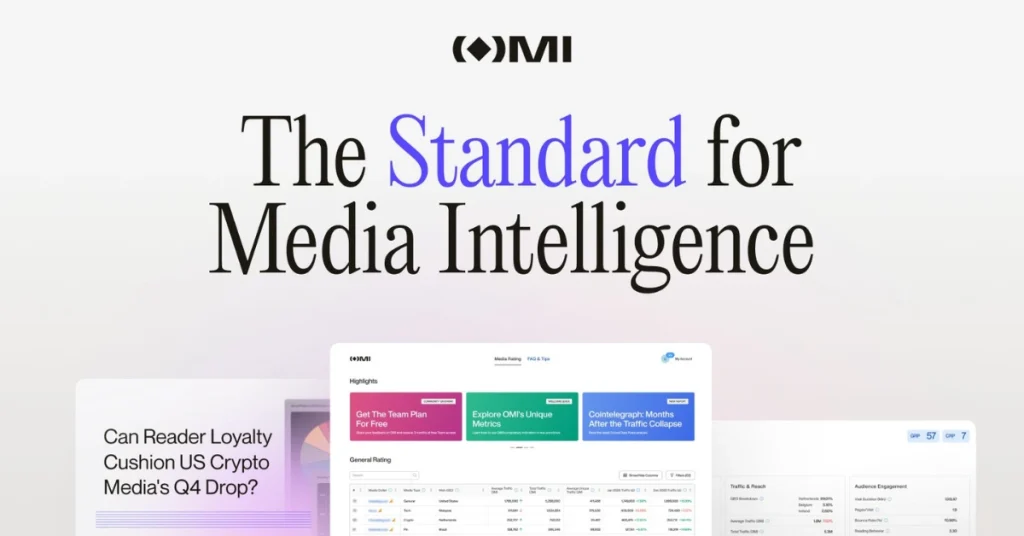
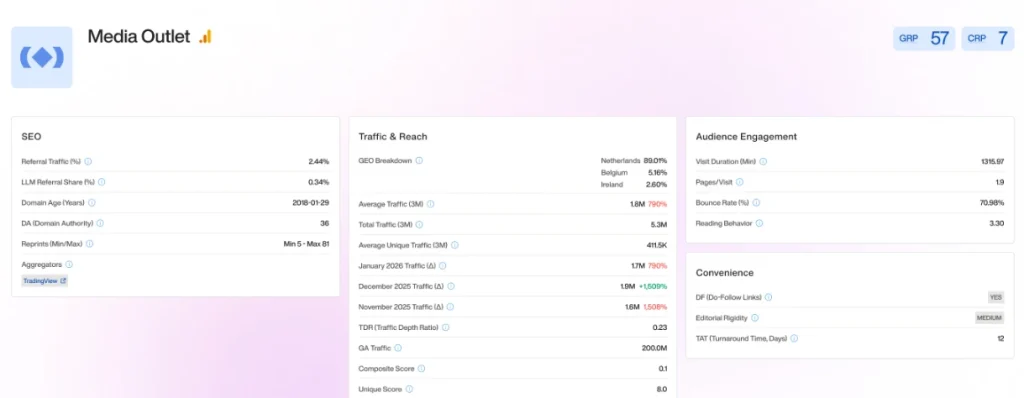
Outset Media Index (OMI), which recently entered the soft launch phase, introduces a standardized way of benchmarking media performance. It helps marketing, media, and PR teams, as well as advertisers and researchers, understand expected results, working conditions, and cost efficiency across more than 340 publications. At this stage, these include crypto-native, finance, tech, and broader news platforms that report on cryptocurrency.

OMI’s signals are also used by Outset Data Pulse (ODP) to reflect regional crypto media trends, with both being part of the emerging Outset PR ecosystem.

Out of 37 overall metrics, the index introduces a set of proprietary indicators:

  • Unique Score,
  • Composite Score,
  • Reading Behaviour,
  • Editorial Rigidity,
  • Reprints and Reprints Score

These are designed to capture what traditional data tends to miss.

Conventional metrics start with traffic, how many people saw a story and where it appeared – but often stop there. OMI brings that missing layer into view and shows what that attention turns into once the content is published.

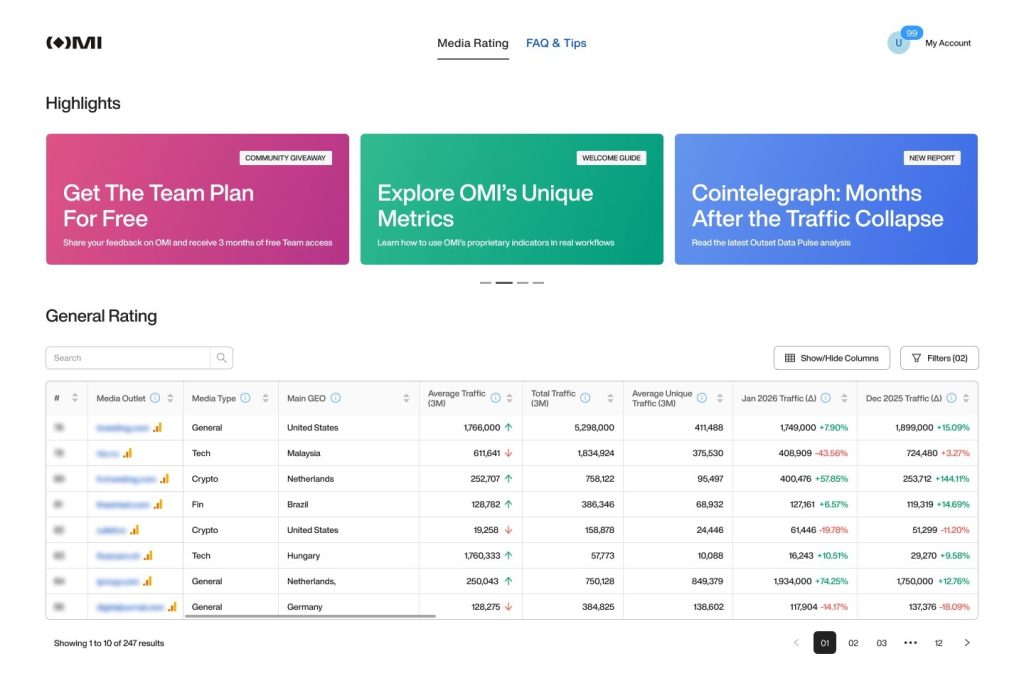
The platform structures traffic through indicators such as Average Traffic (3M), Total Traffic (3M), and monthly changes, covering both scale and short-term movement. But it goes quite a bit deeper than that.

omi

What follows looks closer at OMI’s in-house parameters, how they fit alongside traditional ones, and how to make sense of them together.

What OMI’s Proprietary Metrics Actually Show 

OMI’s proprietary metrics address what media and PR teams are really trying to figure out, which usually comes down to a few key questions:

  • Does coverage from this outlet work consistently, or only when the timing is right?
  • Does a placement keep bringing value, or does it fade quickly after it goes live?
  • Do the numbers reflect what people actually do with the content, or just surface-level visibility?

Total visits can seem impressive at first glance, but they’re often driven by the same audience coming back repeatedly. Unique Score brings attention to outlets that regularly reach fresh readers, rather than depending on returning ones. 

Meanwhile, Composite Score merges both relative and absolute traffic shifts to indicate whether an outlet is gaining steady traction or just experiencing brief surges in interest.

Reading Behaviour gets at whether people stay or pass through, because reaching on its own doesn’t mean much if no one sticks around.

Then there’s what happens after a story goes live. Some outlets just publish and move on, while others see their content picked up or resurface elsewhere. That’s what Reprints and Reprints Score are meant to catch.

Not everything comes down to the audience, though. Some of it is operational. Editorial Rigidity, for example, gives a sense of how easy it is to submit guest content to a given outlet.

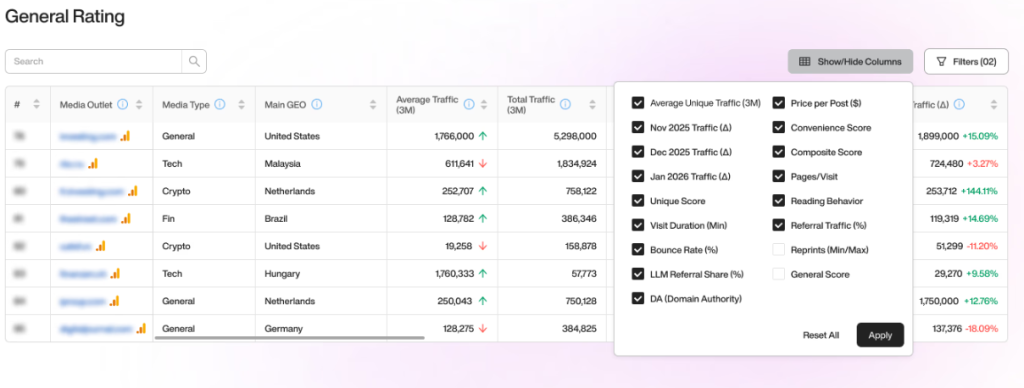
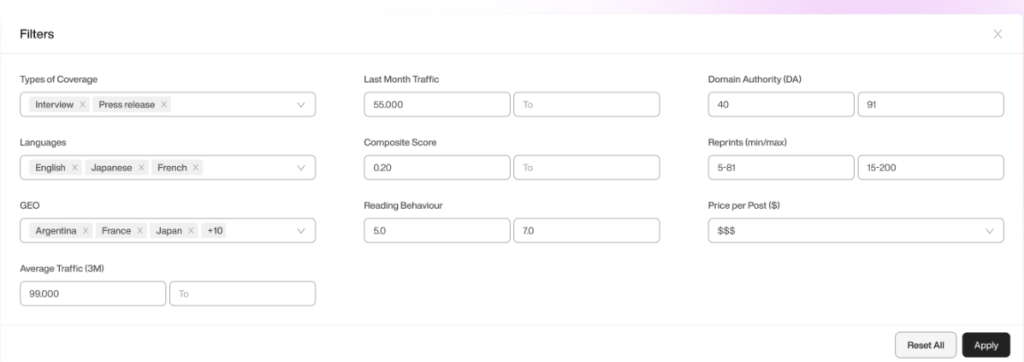
From there, the way the data is explored becomes just as important as the data itself. Inside OMI, users can:

  • Show or hide specific metrics 
rating
  • Apply filters to narrow down outlets or conditions
filters
  • Switch between comparing multiple outlets or focusing on a single publication
media-outlet
  • And also request coverage details of an outlet they are interested in through a dedicated media profile.

How to Read OMI Metrics 

OMI’s metrics are designed to be read together. Individually, each one highlights a specific aspect of performance. Combined, they show how an outlet behaves in real-world scenarios. 

For example, high traffic, strong domain authority, and a high Reprints Score reflect both credibility and active redistribution, signalling a good syndication opportunity.

Sometimes OMI and traditional metrics might not line up, and when that happens, it usually means the results aren’t as straightforward as they appear.

An outlet might show strong traffic, but if distribution signals are weak, that attention tends to peak and stop there instead of spreading further. In other cases, traffic may look more modest, but strong reprints and aggregator presence suggest the content keeps circulating well beyond the initial release.

There will also be situations where visibility seems solid on the surface, but engagement trends tell a different story – people arrive, but don’t stay. Then, there are operational trade-offs: fast turnaround paired with high editorial rigidity often means third-party content can be published quickly, but with limited flexibility.

These differences often explain why similar-looking outlets perform differently in practice.

Which OMI Metrics Matter Most for Different Campaign Goals

Different campaign goals require prioritizing different combinations of metrics.

  • For reach and impactful amplification, focus on how far content can travel by looking at Reprints and Reprints Score alongside traffic.
  • For engagement and audience quality, prioritize Composite Score, Unique Score, and Reading Behaviour to understand whether attention is meaningful, sustained, and extends beyond the first visit.
  • For smoother execution, rely on Editorial Rigidity to check how freely your content can be submitted.

For a quicker overview and easier benchmarking, OMI combines these and other metrics into two weighted scores: the General Score and the Convenience Score. These determine each outlet’s position in the corresponding rankings within the index: the General Rating and the Convenience Rating.

Represented as single numbers from 0 to 100, the General Score answers how strongly an outlet performs overall, and the Convenience Score shows how easy it is to actually run a campaign with that outlet.

OMI’s Real Impact on Media Coverage

Outset Media Index allows coverage to be viewed not just within one category of media, but across different types of outlets where the same story can appear in a different context and order of publication.

Where standard analytics tend to stop at visibility, OMI extends that view. That changes how impact is understood. Instead of being tied to a single moment, it becomes something that develops over time – shaped by how content moves, how long it stays visible, and how consistently it performs across outlets.

As media discovery continues to spread across platforms, aggregators, and AI-driven tools, this kind of measurement becomes more important. The real value of media coverage is no longer just about where it appears, but how it continues to circulate and hold attention beyond the initial release.

❌