Today, the crypto market suddenly dropped by 3.4% within just a few hours, wiping billions from the total market value. At the same time, Bitcoin price fell to a two-week low and is now trading around $66,510.
Other major cryptocurrencies like ETH, XRP, Solana, and AVAX also followed the drop, each falling around 5%. As a result, market sentiment has shifted to extreme fear, with the index at 23.
So, what is really causing the crypto market to crash today?
10 Year U.S Treasury Yields Hit July High
One of the biggest reasons behind the decline is the rising U.S. Treasury yields. The 10-year yield is nearing 4.5%, its highest level since July. Higher yields make risk assets like crypto less attractive as investors shift toward safer returns.
At the same time, the U.S. Dollar Index (DXY) rose 0.57% this week to 100.148. A stronger dollar usually puts pressure on Bitcoin and other cryptocurrencies. Adding to uncertainty, the MOVE index, which tracks bond market volatility, jumped 18% in just 24 hours.
Analysts also point to geopolitical tensions in the Middle East, creating a risk-off environment, pushing traders away from volatile assets like crypto.
Another key factor is a large batch of Bitcoin and Ethereum options expiring this Friday. The total value of expiring contracts stands around $15.58 billion, with Bitcoin accounting for roughly $14 billion. The key level traders are watching is near $75,000, often called the “max pain” point.
Ethereum also has about $2.2 billion worth of options expiring, with a key level around $2,300. Large expiries like this often increase volatility as traders adjust positions before settlement.
$451M Liquidations Hit Market Hard
Long liquidations also accelerated the drop. In the past 24 hours, 122,488 traders were liquidated, totaling $451.59 million. The largest single liquidation occurred on Hyperliquid, involving a BTC-USD position worth $3.96 million.
At the same time, institutional demand has also weakened. Bitcoin ETFs have recorded continued outflows this week, led by BlackRock, followed by Fidelity and Bitwise. This suggests large investors are reducing exposure during the current uncertainty.
As of now, Bitcoin trades near $66,500, down about 4%, while Ethereum hovers around $1,990, also showing notable losses as market pressure continues.
Anchorage Digital has introduced custody support for the TRON blockchain, giving U.S. institutions a regulated way to hold and manage TRX. The firm also plans to support TRC-20 tokens and native staking later, expanding access to one of the most active networks for stablecoin transfers.
Anchorage Digital Adds TRON for Institutional Access
According to the announcement, Anchorage Digital, the first crypto company with a U.S. banking charter, has introduced custody support for TRX, the native token of the TRON network. This allows institutions to securely hold TRX using Anchorage’s platform and its self-custody wallet, Porto, within a compliant U.S. framework.
The rollout will happen in phases. The first step includes custody for TRX. After that, Anchorage will add support for TRC-20 tokens built on TRON. The final stage will introduce native TRX staking, allowing institutions to earn rewards while helping validate the network.
This is the first time a federally chartered crypto infrastructure provider has integrated TRON in a regulated U.S. environment.
Anchorage Digital CEO Nathan McCauley said the move brings one of crypto’s largest ecosystems into an institutional setup, making it easier for traditional firms to access the network.
TRON Stablecoin Growth Drives Institutional Interest
TRON has become one of the busiest blockchains for moving stablecoins and payments. The amount of stablecoins on the network has grown steadily over the past three years and now stands near $86 billion. This accounts for more than a quarter of the total stablecoin supply.
With regulated custody now available, institutions can access TRON more easily without dealing with technical or compliance risks. The integration removes a key barrier that previously limited institutional participation in the network.
Anchorage already supports major networks including Bitcoin, Ethereum, Solana, Avalanche, and BNB Chain. It also provides access to layer-2 networks such as Arbitrum, Optimism, Base, and Linea. Adding TRON expands its coverage across high-activity ecosystems.
Institutional Crypto Access Continues to Expand
Anchorage’s move reflects a broader trend of regulated providers expanding blockchain support. The firm previously added networks like Sui and Aptos, suggesting regulatory clarity has been a bigger hurdle than technical readiness.
Meanwhile, institutional adoption continues to grow across the industry. Coinbase recently introduced a mortgage structure allowing borrowers to use crypto assets such as Bitcoin and USDC as collateral.
Together, these developments signal increasing integration between traditional finance and digital asset infrastructure.
Never Miss a Beat in the Crypto World!
Stay ahead with breaking news, expert analysis, and real-time updates on the latest trends in Bitcoin, altcoins, DeFi, NFTs, and more.
FAQs
What is Anchorage Digital’s TRON custody support?
Anchorage Digital now lets U.S. institutions securely hold TRX through a federally chartered, regulated platform the first of its kind for TRON.
Can institutions stake TRX through Anchorage Digital?
Not yet, but native TRX staking is planned in a future phase, allowing institutions to earn rewards while supporting network validation.
Is Anchorage Digital a regulated crypto platform?
Yes. Anchorage Digital holds a U.S. federal banking charter, making it the first crypto-native firm to offer TRON custody within a fully compliant U.S. framework.
Ripple CEO Brad Garlinghouse has taken a neutral stance in the growing debate around the CLARITY Act, saying the company is not actively involved in the ongoing industry clash.
He also warned that the growing number of similar USD stablecoins adds little value, arguing that only transparent and regulated players will survive.
Ripple Staying Neutral in CLARITY Act Fight
Speaking at the FII PRIORITY Miami summit, Brad Garlinghouse said Ripple does not have “a big dog in this fight” when it comes to the CLARITY Act. The company is intentionally staying on the sidelines while others who are more involved handle the discussions.
Still, he said the support from the White House is very important and believes the bill will eventually move forward. According to him, many industry participants are frustrated after repeated delays, but negotiations are still active.
He added that there is a growing urgency to finalize the framework, with hopes that something could reach the finish line by the end of May.
Too Many Stablecoins Are Useless
Garlinghouse also talked about stablecoins and said the market does not need too many USD-backed stablecoins that all do the same thing. To succeed, he outlined three key requirements, trust, regulation, and transparency
As the market matures, projects lacking strong compliance standards are likely to disappear, while institution-focused stablecoins gain dominance.
He also revealed that Ripple was once minting a large portion of USD Coin, which is why launching a Ripple stablecoin made sense, especially after USDC briefly lost its dollar peg during the Silicon Valley Bank crisis.
Lawmakers Moving Closer to Crypto Regulation
Meanwhile, US Senate Banking Chair Tim Scott said lawmakers from both political parties are making progress on crypto market structure rules. Companies like Coinbase are still part of the discussions, and negotiations are ongoing.
With lawmakers moving closer to agreement and industry players still negotiating, the outcome of the CLARITY Act could shape stablecoin competition, institutional adoption, and crypto regulation in the coming months.
If passed, it could become one of the most important crypto regulation laws and bring long-awaited clarity to the industry.
Brazil has passed a new law allowing authorities to freeze, seize, and liquidate digital assets, including cryptocurrencies, tied to serious crimes. However, President Luiz Inácio Lula da Silva signed the bill, expanding enforcement powers and redirecting seized crypto to public security funding.
Brazil Law Allows Seizure of Bitcoin and Digital Assets
According to Law No. 15.358, authorities can now block or confiscate “digital or virtual assets” during criminal investigations. The rule applies when courts find strong evidence linked to organized crime, paramilitary groups, or private militias.
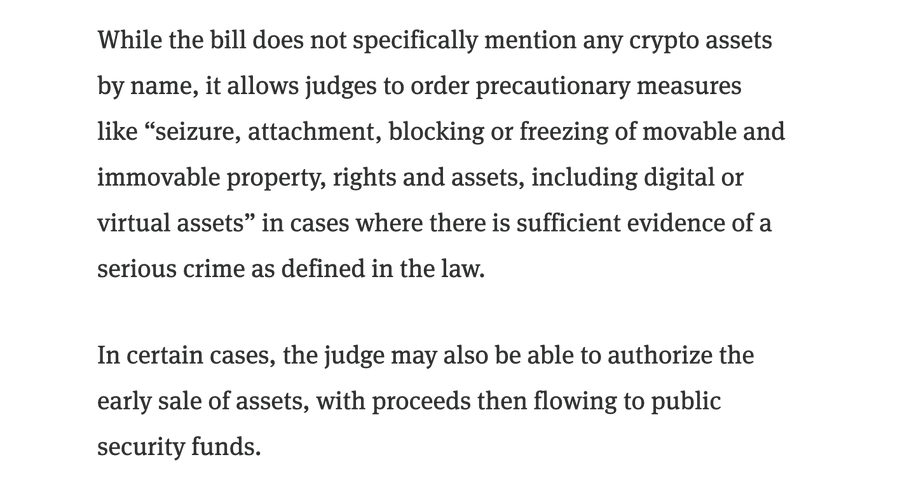
Judges can order precautionary actions such as freezing wallets, blocking exchange accounts, and restricting access to online platforms. The law allows courts to approve early liquidation of seized crypto before final conviction.
Authorities will redirect recovered funds to public security budgets, marking a shift in crypto treatment.
Authorities Can Freeze Wallets and Exchanges
The legislation expands enforcement tools by allowing authorities to suspend access to exchanges, digital wallets, and financial platforms during investigations. Meanwhile, authorities can apply permanent restrictions after conviction.
The law also strengthens international cooperation, allowing Brazil to work with foreign agencies to track and recover digital assets across borders. Officials aim to stop criminal groups from moving funds between jurisdictions.
In addition, the measure creates a national criminal database that links the financial structures of known criminal organizations. The system improves coordination between police, prosecutors, and courts.
Brazil Chooses Seized Crypto Over Bitcoin Reserve
The new law comes as Brazil debates broader crypto policies. In August 2025, lawmakers discussed creating a national Bitcoin reserve.
Coinpedia news reported that a revised proposal introduced in February 2026 suggested allowing purchases of up to 1 million BTC, though no decision has been finalized.
Instead of building a reserve, the government chose to redirect seized crypto funds to law enforcement.
Crypto Adoption Growing in Brazil
Brazil’s crypto adoption continues to rise. Around 17.5% of the population, roughly 16 million people, now own cryptocurrency. Public companies in Brazil hold about 4,328 BTC, valued at nearly $296 million, with additional exposure through ETFs and exchanges.
Meanwhile, Bitcoin is trading near $68,572, down about 2% in the last 24 hours, as markets react to broader macro pressure.
The new law signals that Brazil is moving beyond regulation and toward actively using seized crypto assets within state systems.
While many people believe that the most advanced crypto markets are in big financial cities or tech hubs, a new perspective from Reece Merrick, Managing Director for Middle East & Africa at Ripple, suggests something very different.
According to him, some of the fastest and most practical crypto growth is happening in Africa and other emerging regions, not in traditional financial centers.
Africa Crypto Adoption Growing Fast with Real Use Cases
According to Reece Merrick, Africa, which has 54 countries and more than 1.5 billion people, is building its digital asset ecosystem from the ground up. Instead of using crypto for speculation, many people there use digital assets for real-life financial needs like sending money, saving money, and making payments.
“In the past 12 months alone, Sub-Saharan Africa received over $205 billion in on-chain crypto value, showing a massive 52% growth compared to the previous year.”
This makes the region the third fastest-growing crypto market in the world.
One of the biggest contributors is Nigeria, which alone accounted for about $92 billion of that total, showing how quickly adoption is growing there.
Another major trend is stablecoins. Stablecoin usage in the region has grown by 180% year-over-year, showing that people are using crypto for practical purposes like payments and money transfers rather than just trading.
Crypto Remittances Solving Real Financial Problems
As per Reece one major reason for Africa’s crypto growth is remittances.
He says that remittance “Sending $200 to Sub-Saharan Africa using traditional banking systems costs about 8.9% in fees on average.”
Using digital assets, the same transaction can be completed in seconds with much lower fees, saving a significant amount of money for families and businesses.
This is why crypto adoption in Africa is driven by real financial needs rather than trading speculation.
At the same time, regulations are also improving. Countries like South Africa, Nigeria, and Kenya are working on new crypto laws, licensing systems, and stablecoin regulations.
Ripple XRP Expanding Role in African Payments
Ripple XRP is playing a growing role in this transformation by improving cross-border payments. XRP works as a bridge currency, helping convert one currency to another instantly. Transactions can settle in about 4 seconds with very low fees.
Ripple’s On-Demand Liquidity (ODL) system has already processed over $15 billion in cross-border payments globally. In Africa, XRP-based payment corridors are expanding across more than 27 countries, targeting a remittance market worth over $329 billion.
Some estimates show XRP-powered remittances already handle billions in yearly volume and can reduce costs by up to 40%, making it a strong alternative to traditional systems.
Never Miss a Beat in the Crypto World!
Stay ahead with breaking news, expert analysis, and real-time updates on the latest trends in Bitcoin, altcoins, DeFi, NFTs, and more.
FAQs
Why is crypto adoption growing so fast in Africa?
Crypto adoption is rising in Africa due to real needs like remittances, payments, and savings, offering faster and cheaper alternatives to traditional banking.
Which African countries are leading crypto adoption?
Nigeria leads Africa’s crypto adoption, followed by South Africa and Kenya, driven by strong demand for digital payments and evolving regulations.
What is driving crypto adoption across Africa?
High remittance costs, limited access to traditional banking, and demand for faster cross-border payments are pushing more Africans to use crypto.
ApeCoin trades near $0.09, down 84%, with future growth tied to ApeChain adoption, Otherside utility, and real ecosystem demand beyond NFTs.
With 90% supply unlocked, inflation pressure eases. If adoption improves, APE could target $0.21 short term and $1.89 by 2026.
Long-term outlook to 2030 depends on metaverse success, gaming growth, and DAO utility, with projections ranging from $1 to $16.21.
ApeCoin didn’t start as just another token; it launched as the economic layer of one of the most recognizable NFT brands in crypto.
Backed by Bored Ape Yacht Club (BAYC) and Yuga Labs, APE surged immediately after launch, briefly capturing the imagination of the entire NFT market. The token was meant to power a broader ecosystem, including Otherside metaverse, gaming experiences, DAO governance, and Web3 culture initiatives.
But as the NFT market cooled, ApeCoin’s demand followed. The token is now trading near $0.09061, over 84% below its peak, leaving investors questioning whether the ecosystem still has momentum.
So let’s explore CoinPedia’s Ape Price Prediction 2026, 2027 – 2030.
From Coinpedia’s perspective, ApeCoin’s future no longer depends on NFT hype; it depends on ApeChain utility.
With most tokens already unlocked and infrastructure improving, downside inflation risk is reduced. But recovery requires real ecosystem usage, especially from Otherside and gaming applications.
If ApeChain adoption grows, APE could move toward $1.89 in 2026. Long-term upside depends on whether Yuga Labs successfully builds a functioning metaverse economy.
Year
Potential Low ($)
Potential Average ($)
Potential High ($)
2026
$0.05
$1.15
$1.89
ApeCoin (APE) Price Targets For April 2026
April 2026 will depend heavily on ApeChain adoption as the pressure from token unlocks starts to decline. By March 2026, around 90% of the total APE supply (about 908.6 million tokens) is expected to be unlocked, which means the risk of future dilution will be much lower.
In the past, large token unlocks created constant selling pressure because new tokens were regularly entering the market. But now, since most of the supply is already in circulation, the downside pressure caused by inflation is expected to weaken.
Another important development is the ApeChain integration with Binance, which makes it easier for users to access ApeChain and interact with its ecosystem.
If adoption improves and market conditions remain stable, ApeCoin could surge toward the $0.211 level.
Month
Potential Low ($)
Potential Average ($)
Potential High ($)
APE Price Prediction April 2026
$0.087
$0.104
$0.211
Technical Analysis
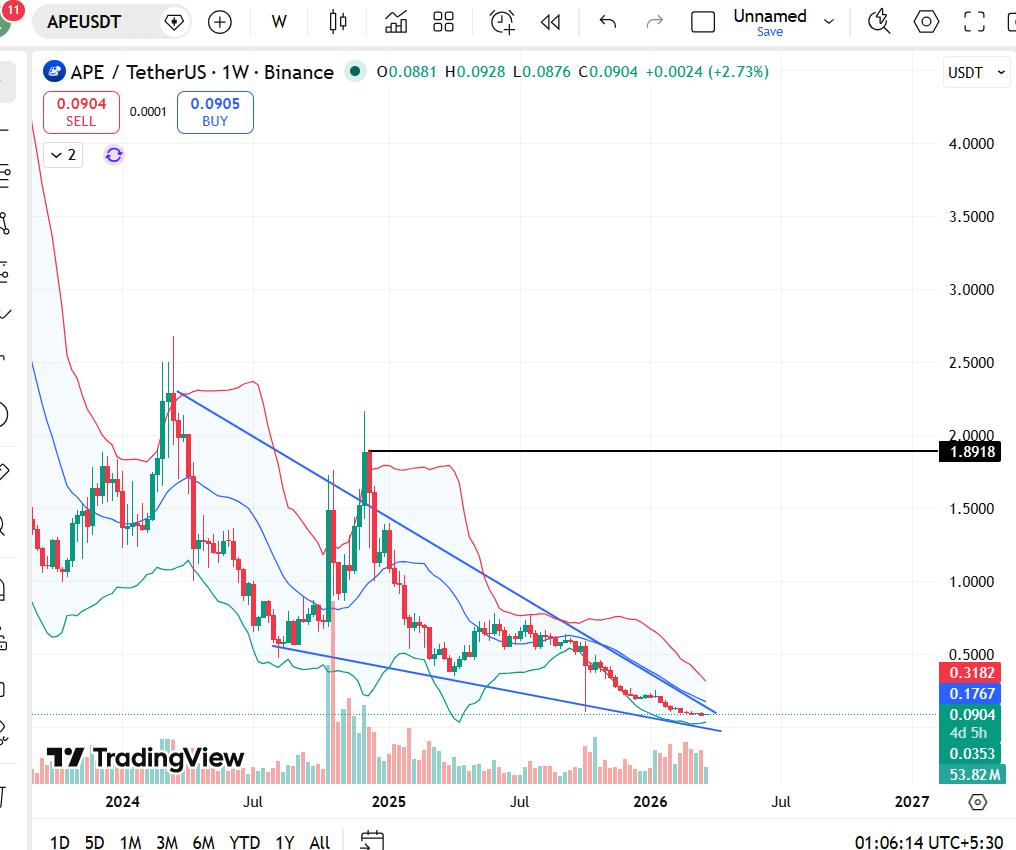
Looking at the weekly chart of ApeCoin shows a strong long-term downtrend, with price continuing to make lower highs and lower lows since 2024. The descending trendline is acting as major resistance, and the price has now fallen close to the long-term support trendline near the $0.09 area.
Currently, APE is trading around $0.09, which is a critical support zone. If this level holds, we could see a relief bounce toward $0.31, which is the next resistance level based on the weekly structure and moving averages. It will rally towards $1.89 by the end of this year, 2026.
However, if the $0.08 support breaks, the price could drop further toward $0.05.
ApeCoin Price Prediction 2026
The ApeCoin price prediction for 2026 will depend more on ApeChain adoption than on NFT market sentiment. ApeChain is important because it gives ApeCoin its own ecosystem, cheaper transactions, gaming compatibility, and metaverse integration, which could create real utility for the token.
If Yuga Labs successfully launches playable experiences in Otherside using ApeChain, this could create real demand for ApeCoin through gas fees, governance participation, ecosystem rewards, and metaverse usage, rather than just speculative trading.
Yuga Labs is also shifting ApeCoin toward community-driven governance, which may increase DAO participation and long-term engagement. However, there are still risks. The NFT market is still relatively weak.
Other side adoption is uncertain, and there is strong competition from other gaming and metaverse blockchains. Because of these factors, ApeCoin’s performance in 2026 will largely depend on whether ApeChain and Otherside can attract real users and developers.
Year
Potential Low ($)
Potential Average ($)
Potential High ($)
Apecoin Price Prediction 2026
$0.05
$1.15
$1.89
ApeCoin Price Prediction 2026 – 2030
Year
Potential Low ($)
Potential Average ($)
Potential High ($)
2026
$0.05
$1.15
$1.89
2027
$0.42
$1.77
$4.94
2028
$1
$3.12
$8.21
2029
$1.44
$6.63
$10.09
2030
$2.2
$11
$16.21
ApeCoin (APE) Price Prediction 2026
If ApeChain adoption increases and token unlock pressure disappears, APE could reach $1.89.
ApeCoin Price Prediction 2027
If Otherside launches interactive metaverse experiences and gaming integrations expand, APE could move toward $4.94.
APE Coin Price Prediction 2028
Broader Web3 gaming adoption and NFT ecosystem revival could support APE near $8.21.
ApeCoin Price Forecast 2029
By 2029, if ApeChain becomes a dedicated gaming and metaverse hub, APE may approach $10.09.
ApeCoin (APE) Price Prediction 2030
Long-term ecosystem growth and DAO-driven governance could push APE toward $16.21.
What Does The Market Say?
Year
2026
2027
2030
coincodex
$3.19
$1.30
$ 3.25
Changelly
$1.85
$2.66
$311.54
Binance
$1.26
$1.33
$1.66
Never Miss a Beat in the Crypto World!
Stay ahead with breaking news, expert analysis, and real-time updates on the latest trends in Bitcoin, altcoins, DeFi, NFTs, and more.
FAQs
What is ApeCoin (APE) and what is it used for?
ApeCoin is a Web3 token powering BAYC’s ecosystem, used for governance, payments, gaming, and metaverse apps like Otherside.
What is ApeChain and why does it matter for APE?
ApeChain is ApeCoin’s blockchain for cheaper, faster transactions, enabling gaming, metaverse apps, and real utility beyond speculation.
Is ApeCoin a good long-term investment?
APE’s long-term value depends on Otherside success, gaming adoption, and DAO growth. It has potential but carries high risk and volatility.
What is ApeCoin’s price prediction for 2026?
ApeCoin is expected to range between $0.05 and $1.89 in 2026, depending on ApeChain adoption, reduced inflation, and ecosystem growth.
How high can ApeCoin go by 2030?
ApeCoin could reach up to $16.21 by 2030 if metaverse adoption, gaming usage, and DAO participation expand strongly.
How much will ApeCoin be worth in 2040?
By 2040, ApeCoin could range between $5 and $25 if long-term adoption of ApeChain, metaverse growth, and DAO utility continue to expand.
U.S. lawmakers have introduced the bipartisan PREDICT Act to stop senior government officials from trading on political prediction markets.
The proposal would ban the president, vice president, members of Congress, and political appointees, along with spouses and dependents, from profiting on government-related outcomes.
PREDICT Act Seeks to Ban Political Prediction Market Trading
According to the March 25 proposal, Representatives Adrian Smith and Nikki Budzinski introduced the Preventing Real-time Exploitation and Deceptive Insider Congressional Trading (PREDICT) Act. The bill targets prediction market trading tied to political events, policy decisions, and government actions.
The restrictions would apply to members of Congress, the president, vice president, executive branch officials, and their spouses and dependent children. Lawmakers argue that officials with access to sensitive information could gain an unfair advantage by betting on policy outcomes.
The bill also outlines penalties for violations. Anyone covered under the rule could face a 10% fine based on contract value and would be required to give up all profits from the trade. The recovered funds would be sent to the U.S. Treasury.
Lawmakers Raise Concerns Over Insider Information
Supporters of the bill say prediction markets have recently drawn attention after traders reportedly made large profits from geopolitical events and policy decisions. These include contracts tied to war developments, government shutdowns, and regulatory outcomes.
Lawmakers argue that individuals with access to non-public information could influence markets or benefit from early knowledge.
The PREDICT Act aims to close this gap and ensure public officials do not profit from their roles.
Pressure Builds on Prediction Market Platforms
The PREDICT Act comes alongside other legislative efforts targeting prediction markets. Earlier this month, another proposal, the BETS OFF Act, aimed to restrict trading tied to sensitive government operations.
At the same time, multiple U.S. states have taken action against prediction markets. Reports indicate 11 states have launched legal actions, while two additional states are considering similar steps.
Federal lawmakers have also raised concerns about contracts that resemble sports betting or casino-style markets. Some proposals would restrict regulated entities from listing such products.
If passed, the PREDICT Act would significantly limit who can trade on political outcomes. It would also tighten oversight around insider information risks.
A U.S. federal court has allowed a class-action lawsuit against Nvidia and CEO Jensen Huang to move forward over claims the company hid crypto mining-related GPU sales.
Investors say more than $1 billion in revenue tied to crypto miners was not clearly disclosed.
Court Allows Nvidia Crypto Revenue Lawsuit to Proceed
According to the court ruling, the case covers investors between August 10, 2017, and November 15, 2018. Plaintiffs claim Nvidia earned large revenue from crypto miners but recorded much of it under its gaming business.
Court filings suggest Nvidia generated around $1.7 billion from crypto mining GPU sales during the period. Of this, roughly $1.13 billion was allegedly not clearly disclosed. Investors argue this created a misleading view of steady gaming demand.
The filings also state that more than 65% of crypto-related demand came from Nvidia’s GeForce gaming GPUs. This means growth in the gaming segment may have been driven by miners rather than gamers.
In addition, crypto demand may have accounted for about 83% of Nvidia’s GPU growth during the time covered by the lawsuit.
Stock Dropped After Crypto Demand Slowed
The issue became clear in 2018. In August 2018, Nvidia lowered its outlook and said crypto demand had slowed. Then, on November 15, 2018, the company admitted gaming revenue missed expectations due to unsold inventory after the crypto decline.
After this disclosure, Nvidia shares dropped about 28.5% in two trading sessions. Investors say the fall reflected the market reacting to the company’s earlier crypto exposure.
The judge said Nvidia failed to prove that its statements did not affect the stock price.
Because of this, the court allowed the lawsuit to proceed as a class action. A hearing is set for April 21.
SEC Previously Fined Nvidia $5.5 Million
This is not the first time Nvidia has faced scrutiny. In 2022, the U.S. Securities and Exchange Commission fined the company $5.5 million for failing to clearly disclose how crypto mining affected gaming revenue.
Regulators said investors should have been told that a meaningful portion of GPU demand came from crypto miners.
Following this, Nvidia stock has dropped about 9% over the past month, now trading near $178.68, as investors watch the case closely.
The UK government has announced a ban on cryptocurrency donations to political parties while also introducing a £100,000 annual cap on overseas political contributions.
The move aims to prevent foreign influence and improve transparency in election funding, as authorities tighten rules around political financing.
UK Bans Crypto Donations to Political Parties
According to the announcement, the UK government will prohibit all cryptocurrency donations to political parties until stronger regulation is introduced. Officials said crypto payments make it difficult to verify the true source of funds, raising the risk of hidden foreign influence in elections.
The government will implement the rule through amendments to the Representation of the People Bill. Once the legislation takes effect, political parties and candidates will have 30 days to return any donations that do not comply with the new requirements.
After that period, enforcement action may follow.
The decision follows recommendations from the Rycroft Review, which warned that crypto-based funding could bypass traditional financial checks. Authorities said the ban will remain in place until regulators and Parliament establish a more transparent framework for digital asset donations.
UK Caps Overseas Political Donations at £100,000
Along with the crypto ban, the government set a yearly limit of £100,000 on donations from British citizens living outside the UK. This limit also covers loans and other similar payments to political parties.
Officials said money coming from abroad is harder to track. This makes it difficult to check if anything is wrong. The new limit lowers the risk of large foreign-linked funds entering UK politics.
The review also said that British citizens living abroad can still donate. But very large transfers from outside the country could be misused. So, fixing a clear limit will help keep better control and make the system safer.
New Rules to Strengthen Election Transparency
The policy change also introduced stricter donor verification requirements. Political parties must confirm donor identity, ensure companies have genuine UK operations, and conduct stronger “Know Your Donor” checks before accepting funds.
Authorities are also considering granting the Electoral Commission additional powers to investigate suspicious donations. These steps are part of overall efforts to reduce foreign interference and improve accountability.
With crypto donations banned and overseas contributions capped at £100,000, the UK is moving toward tighter political funding rules while regulators work on future digital asset oversight.

 Login
Login






 -4.34%