
 Login
Login
Samsung’s 2nm GAA efficiency disappoints as Exynos 2600 consumes 40% more power than Snapdragon 8 Elite Gen 5 at its peak
The Exynos 2600 is the first chipset to use Samsung’s 2nm process, promising upgrades to both performance and efficiency, thanks to advanced lithography, increased nanosheet count, and improved gate control. However, things haven’t gone Samsung’s way, as the chip ended up drawing 30W at peak, making its rival, the Snapdragon 8 Elite Gen 5 (21W), significantly more power-efficient.
YouTube channel TechStation365 performed a series of tests on Galaxy S26 (powered by Exynos 2600), OnePlus 15 (powered by Snapdragon 8 Elite Gen 5), and Motorola Signature (powered by Snapdragon 8 Gen 5). For the sake of this article, we’ll focus on Geekbench 6 and a Decompression Test (for a 20GB ZIP file), which reveal rather interesting results.
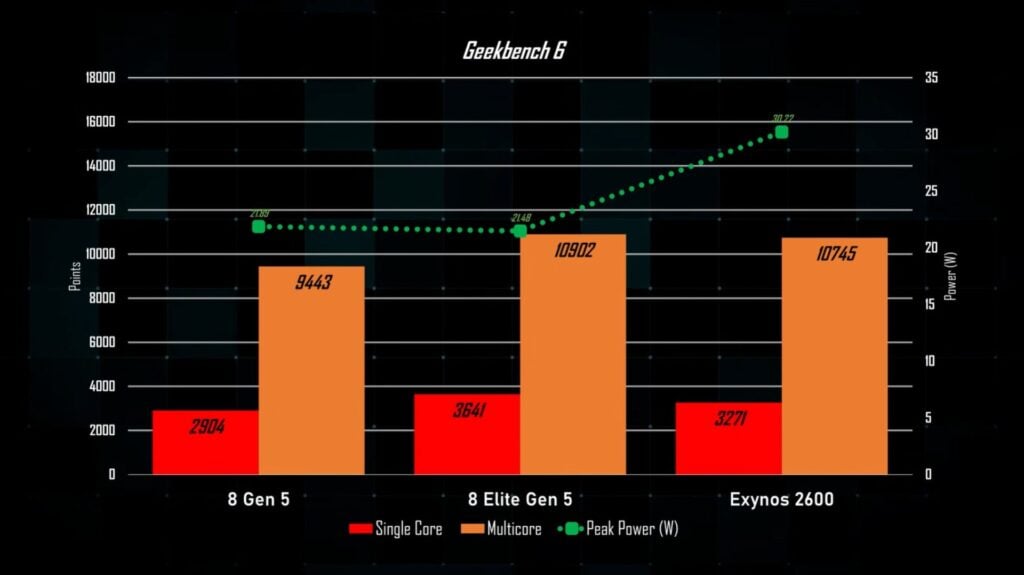
Both the Snapdragon 8 Elite and Snapdragon 8 Elite Gen 5 have a peak power draw of around 21W, while the Exynos 2600 reaches 30W, which is a pretty significant gap, even though the power draw may have just been for a few seconds. This also means the Exynos 2600 will perform poorly under sustained workloads due to increased power draw.
Snapdragon 8 Elite Gen 5
- Single core: 3,641 points
- Multi core: 10,902 points
- Peak power draw: 21.48W
Exynos 2600
- Single core: 3,271 points
- Multi core: 10,745 points
- Peak power draw: 30.22W
Snapdragon 8 Gen 5
- Single core: 2,904 points
- Multi core: 9,443 points
- Peak power draw: 21.89W
Even in the Decompression Test, the Exynos 2600 didn’t see any efficiency improvements. It reached up to 7.8W in peak power consumption, while the Snapdragon 8 Gen 5 and Snapdragon 8 Elite Gen 5 are below 5W. The Snapdragon 8 Elite Gen 5 also takes less time to decompress.
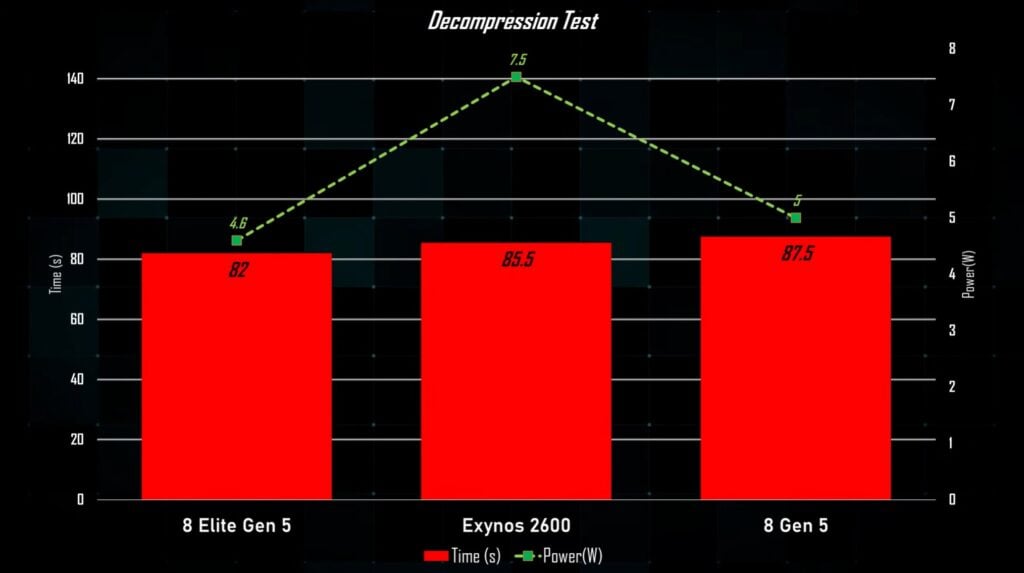
The results pretty much confirm that TSMC still has a solid upper hand in chip efficiency over Samsung. YouTube channel TechStation365 has concluded that the Exynos 2600 is a power-hungry chipset, as those 10-cores require a little more juice to perform optimally. Hopefully, we’ll see some real efficiency upgrades in Exynos 2700.
Check the complete video here.
Also read: Snapdragon 8 Elite Gen 5 vs Dimensity 9500 vs Exynos 2600: The flagship showdown
The post Samsung’s 2nm GAA efficiency disappoints as Exynos 2600 consumes 40% more power than Snapdragon 8 Elite Gen 5 at its peak appeared first on Gizmochina.

