
❌

Reading view

Microsoft Pulls Windows 11 Feature Update After Widespread Installation Errors

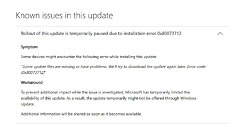
Microsoft has withdrawn its latest KB5079391 non-security feature update after users reported significant problems and installation errors. According to Microsoft's official documents, the company has temporarily paused the rollout of this update while investigating the installation error 0x80073712. If you applied this late March update, your operating system might display errors like "Some update files are missing or have problems. We'll try to download the update again later. Error code: (0x80073712)." To prevent further issues, Microsoft decided to temporarily pull this Windows 11 update until the problem is resolved. Microsoft has reportedly identified the issue and will share more information soon as the bug is fixed. Once the fix is applied, Microsoft will reintroduce the update, possibly with a different KB package number, through the Windows Update process.

This is happening just days after Microsoft published its Windows 11 plans and roadmap for upcoming updates. This includes a promised focus on stability to restore Windows 11 to its full glory, but this has been insufficient so far, as this late March KB5079391 non-security feature update had been prepared a little longer before the promise. Hence, the time has been insufficient for the update plans and what Microsoft has in store for Windows 11. It seems we will have to endure a few more cycles of challenging updates and releases before the entire issue portfolio is resolved and an update becomes an actual improvement rather than a nightmare for users.
Windows 11 Will No Longer Trust Old Drivers by Default Under New Kernel Policy

Microsoft is finally updating its long-standing kernel policy, which previously allowed old drivers with expired certificates to run and be trusted by the Windows 11 NT Kernel. This change means that Microsoft's early 2000s program for cross-signing root programs as valid will no longer function. This program had enabled NT Kernel-trusted code signing programs to execute even after their certificates expired. As a result, third-party driver developers, such as printer makers with their old printer drivers, could run old drivers on Windows 11 without a valid security certificate. However, this is coming to an end, as Microsoft will use its April update to instruct the Windows NT Kernel to only accept new drivers signed through the Windows Hardware Compatibility Program (WHCP).

The WHCP will ensure that each driver receives a valid security certificate that meets Microsoft's security standards. This update will be implemented with OS versions Windows 11 24H2, 25H2, 26H1, Windows Server 2025, and future releases. Despite this change, Microsoft will still allow Windows to load older, trusted drivers to maintain backward compatibility and its long-standing plug-and-play feature. The April 2026 Windows update will begin enforcing the new policy in evaluation mode on supported systems. During this period, Windows will monitor driver activity and only fully activate the policy once it determines that doing so will not cause compatibility issues. Microsoft is also maintaining a curated allow list of reputable cross-signed drivers, ensuring that widely used software and hardware can continue to function where necessary, easing the transition.

Apple Discontinues Mac Pro, No Future Hardware Updates Planned

Apple has officially discontinued its high-end Mac Pro desktop computer, with no plans to refresh the model in the future. According to the company, which confirmed the decision to 9to5Mac, Apple had been selling the Mac Pro alongside other Mac options that were more aligned with its strategic goals. Initially launched with a redesigned casing in 2019, the Mac Pro was powered by Intel processors until Apple decided to switch to its M2 Ultra SoC in 2023. However, this model has gone a long time without any hardware updates. Apple even introduced an M3 Ultra chip last year but decided to pair it with the Mac Studio instead. The Mac Studio is a smaller, more compact machine that offers greater performance than the Mac Pro while being more practical for various work environments. Multiple Mac Studios can also be interconnected with Thunderbolt 5, making them a potential compute cluster.

For now, Apple will maintain the Mac Studio as its "pro" Mac option, with a refresh expected either this year or next. The current top configuration of the Mac Studio includes an M3 Ultra chip with a 32-core CPU and an 80-core GPU. This powerful setup is paired with up to 256 GB of memory and up to 16 TB of SSD storage. With the introduction of this model without updating the Mac Pro, it was clear that the Mac Pro's days were numbered. Surprisingly, Apple's future desktop computer strategy will focus on the Mac Mini and Mac Studio, complementing its extensive lineup of MacBooks, which includes the Pro, Air, and the newly launched Neo. As one of the largest Apple computer lineups ever, simplifying and removing some products makes sense for a company that is focused on custom silicon.

Microsoft Works to Expand Dark Theme Support Across Windows 11

Microsoft's Windows 11 operating system officially has a dark mode, but many UI elements, menus, and applications from Microsoft still lack proper dark mode support. Microsoft is working to address this issue in the world's most widespread operating system. Since the introduction of WinUI, many releases and versions have been shipped with the operating system. For example, Windows 10 retains many UI elements from the Windows 7 era and earlier versions. However, Microsoft plans to modernize the entire UI ecosystem with more WinUI 3 for a modern look and feel, which will also enhance dark mode support. According to Marcus Ash, who leads Microsoft's Windows Design and Research team, the overhaul is near. When a user on X asked when dark mode support would come to Regedit, Marcus Ash responded:
We are pushing to get our tools and techniques to the point where we can implement the dark theme in more areas across Windows. No timelines to commit to yet for Regedit. As we make progress in various legacy system panels and dialogs, we will keep improving consistency.

Intel Officially Confirms: Core Ultra 9 290K Plus Won't be Released

When the rumor mill for Intel's "Arrow Lake Refresh" began, we expected three SKUs: Core Ultra 5 250K Plus, Core Ultra 7 270K Plus, and a flagship Core Ultra 9 290K Plus. However, we later discovered that Intel is not launching the flagship SKU and will only release the Core Ultra 5 and Core Ultra 7 models. Instead, Intel chose to focus on delivering value with its Core Ultra 7 270K Plus SKU, which features 8 P-Cores and 16 E-Cores with a maximum turbo boost of 5.5 GHz. For individual boosting frequency, P-Cores reach up to 5.4 GHz, with a base speed of 3.7 GHz. E-Cores have a maximum boost frequency of 4.7 GHz and a base speed of 3.2 GHz. The main reason for canceling the flagship SKU is product overlap, as the Core Ultra 9 290K Plus would have the same core configuration as the Core Ultra 7 270K Plus, just with slightly higher clock speeds. Consequently, Intel decided not to launch this SKU. It has now been confirmed by Intel Germany for PC Games Hardware that Intel will definitely not introduce this SKU at any point in the future.
Florian Maislinger, Tech Communication Manager, Intel GermanyIntel is excited to deliver exceptional value with our Intel Core Ultra 200S Plus series processors. The Intel Core Ultra 7 270K Plus and Intel Core Ultra 5 250K Plus are positioned to deliver outstanding gaming performance and incredible value compared to our competition. Our objective was to maximize performance for the desktop SKUs that are most widely available. As a result, Intel is not launching a U9 290K Plus SKU.

NVIDIA Releases GeForce 596.02 Hotfix Beta Driver to Address Game Stuttering

NVIDIA has officially released its second hotfix driver this month, GeForce 596.02 Hotfix, addressing the stuttering issue found in the previous 595.97 WHQL, which was released just yesterday. According to the official driver changelogs, the only game experiencing stuttering was Arknights: Endfield, which was apparently severe enough for NVIDIA to issue a complete hotfix driver. No other changes have been included in this hotfix release. NVIDIA notes that the quality of hotfix drivers is usually unknown, as they go through a much shorter quality testing pipeline than WHQL drivers. These hotfix drivers are designed to provide quick iterations and changes so that gamers who installed the new game-ready or regular WHQL drivers aren't left dealing with game stutters while waiting for the next driver release. Finally, NVIDIA advises that if you aren't experiencing any issues with your current 595.97 WHQL driver, it's best to wait for the next WHQL release to ensure your system remains as stable as possible. The next WHQL release will integrate the changes from the 596.02 Hotfix driver, so you won't have to worry.

DOWNLOAD: NVIDIA GeForce 596.02 Hotfix Beta.

AMD Joins Intel in Raising PC CPU Prices by Up to 15%

Last week, we reported that Intel is preparing to increase CPU prices by 10% across its client PC sector. However, a new report from Nikkei Asia suggests that AMD is also joining this trend, with plans for a PC CPU price hike as well. Reportedly, AMD Ryzen CPUs could see prices rise by 15% compared to the same time last year, when prices were typically around the MSRP at retailers. Now, as CPU demand has depleted inventories and the focus remains on server and data center CPU production, capacity for the client segment has been significantly reduced, leading to little to no inventory for PC enthusiasts. Large OEMs like HP and Dell are among the first to feel the pressure from the dwindling supply chain and have reported a significant gap between demand and supply for their PC systems.

Nikkei also notes that both AMD and Intel have informed their clients that CPU price increases will take effect by the end of March and into April, which should start to manifest very soon. What used to be a one or two-week wait from order to CPU shipment has now stretched to a process lasting eight to twelve weeks. This means that a CPU batch ordered in April might not arrive until June. This period is expected to be the worst in terms of supply in the second quarter of this year. Even if OEMs are willing to pay extra to secure CPU supply, availability is lacking. The CPU shortage is worsening daily, coinciding with the ongoing memory and storage shortage we are already experiencing.

Intel's Binary Optimization Tool Results Marked as Potentially Invalid by Geekbench

Alongside "Arrow Lake Refresh," Intel released a new Binary Optimization Tool, available for Core Ultra 270K Plus and 250K Plus SKUs. However, since the tool essentially changes the way .exe applications run, scores on popular benchmarking applications may be deemed invalid. According to Primate Labs, the developer behind Geekbench, the use of Intel's binary optimization tool will result in a special flag on Geekbench scores. Reportedly, as the tool modifies the instruction sequence that the CPU exhibits, benchmark scores will deviate from the standard range. In a standardized benchmarking environment, this is a massive negative consequence, as the inner workings of the Binary Optimization Tool are unknown and resemble a black box that benchmark makers like Primate Labs have to deal with. To combat the use of this tool, Geekbench will now display the message "This benchmark result may be invalid due to binary modification tools that can run on this system" as a warning.

In TechPowerUp's own testing of the Binary Optimization Tool, we found that Intel's Binary Optimization Tool boosts Geekbench v6 single-core performance by 8.2%, while the multi-core score has risen by 7.8%, resulting in about an 8% average uplift in Geekbench testing. Games like Cyberpunk 2077 experience smaller uplifts, while some select titles like Shadow of the Tomb Raider can see up to a 22% increase using the Binary Optimization Tool. In reality, Intel only supports 12 games for now, which will expand further as the company labs release more optimizations. For gamers, this is fantastic news as the performance uplift is essentially free without any drawbacks, but for benchmarks, it is a potential issue as it represents an execution mystery since no one outside Intel knows exactly how the tool runs and how the code paths get modified.

ASUS Plans 30% PC Price Increase in Taiwan, Other OEMs to Follow

PC pricing in Taiwan may see a significant increase next quarter, as ASUS Joint Technology Systems Division General Manager Yi-Hsiang Liao has announced a planned 30% price hike across the company's entire product line. He explains that the extremely high costs of DRAM and SSD storage, combined with a shortage of CPUs, are driving this increase. ASUS also claims that this issue is not limited to their company, as every Taiwanese PC maker will face similar challenges. Reportedly, ASUS did not comment on whether the price increase will affect overseas markets or remain exclusive to Taiwan. However, it seems likely that rising component costs in Taiwan will also impact Western markets, which have already experienced significant price increases in recent months.
UDN, Machine TranslatedYesterday, ASUS, in partnership with Qualcomm, held a press conference for its new Zenbook A16 laptop. During an interview, Liao Yi-hsiang, General Manager of ASUS United Technology Systems Business, revealed that ASUS has confirmed that PC prices in Taiwan will increase by 25% to 30% or more in the second quarter, with varying increases across different models.

AMD "Medusa Point" APU Gets "GFX1171" and "GFX1172" RDNA 4m GPU Targets

AMD's RDNA 4m graphics might be the company's most mysterious GPU IP, as they are reportedly rebranding some of their RDNA 3.5 IP to fit INT8 data types and support FSR 4 technology. We previously reported that AMD designated the GFX1170 target for RDNA 4m. However, in the latest merge request for the LLVM compiler, AMD added two new software IDs: GFX1171 and GFX1172 GPUs. These targets are not true RDNA 4 GPUs, which belong to a GFX12 branch, but rather extensions of RDNA 3. What was thought to be RDNA 3.5 has now evolved into RDNA 4m, which will power AMD's Ryzen 500 "Medusa Point" series of APUs. With RDNA 3.5 / RDNA 4m expected to be used by AMD until 2029, it makes sense for AMD to adapt RDNA 3.5 into RDNA 4m with support for FSR 4 upscaling technology.

In contrast, "Medusa Halo" will utilize AMD's next-generation RDNA 5 / UDNA GPU microarchitecture. "Medusa Point" will introduce a desktop-exclusive RDNA 4 with the new RDNA 4m variant. Although we initially lack comparisons between the two, some instruction set extensions, such as WMMA and SWMMAC instructions, indicate support in the new "GFX1170" GPU, which should be associated with the GFX11 generation, also known as RDNA 3. Currently, this is believed to be an upgraded RDNA 3 with many RDNA 4 modules, enabling FSR 4 support even on the less powerful "Medusa Point" APU.

FCC Bans New Foreign-Made Wi-Fi Routers From the U.S. Market

The United States Federal Communications Commission (FCC) has announced a ban on all new Wi-Fi routers made outside the "land of the free." With a clear goal of eliminating external supply chain vulnerabilities, the FCC has been collaborating with the White House to prohibit the sale of foreign-made Wi-Fi routers in the domestic market. Reportedly, the FCC claims that having foreign Wi-Fi routers in American homes has been a significant loophole for other countries to exploit, as Wi-Fi routers are one of the most critical points of security in any home network. These devices have long been targets of foreign attacks, which have disrupted security and introduced supply chain risks by creating points of failure that the U.S. government cannot control or prevent. These routers were sold openly to telecommunication companies or purchased by consumers independently. Additionally, foreign routers have been implicated in cyberattacks targeting vital U.S. infrastructure, such as Volt, Flax, and Salt Typhoon.

Interestingly, this decision does not affect any routers that consumers have already purchased. "Consumers can continue to use any router they have already lawfully purchased or acquired," notes the FCC. Furthermore, the FCC will allow any previously approved router models to continue being sold and imported. Only new router models will need to undergo FCC approval, which is a separate procedure coordinated with the Department of War (DoW) or the Department of Homeland Security (DHS). Both DoW and DHS grants of Conditional Approvals are honored by the FCC to ensure that devices receiving this approval can continue to be sold without posing a national threat.

Ayaneo Suspends Next 2 Handheld Sales as Component Pricing Becomes "Unsustainable"

Ayaneo, a well-known handheld gaming PC maker, has suspended its preorders for the Next 2 gaming handheld PC due to what the company describes as unsustainable pricing of its materials, making manufacturing and sales impossible. In an update on its Indiegogo page for the Next 2 device, Ayaneo states that the cost of storage has been higher than the company anticipated, surpassing an already inflated price quote. However, after the Chinese New Year, suppliers began providing quotes that exceeded every reasonable level, making Ayaneo's original lowest price of $1,999 for a device with an AMD Ryzen AI Max 385 processor, 32 GB of LPDDR5X memory, and 1 TB of SSD storage unfeasible. While the company offered more expensive variants with up to a Ryzen AI Max+ 395 SoC, 128 GB of RAM, and 2 TB of storage, even a price tag of $4,299 was insufficient to offset the losses from the costly components. The expensive RAM, very expensive NAND Flash, and AMD SoCs meant Ayaneo would be selling these handheld PCs at a massive loss.

This is where the advantage of larger OEMs comes into play, as they can secure slightly better contracts with memory and storage manufacturers, allowing them to get memory pricing into a somewhat decent range and even absorb losses until they can no longer sell their new PCs. Smaller makers like Ayaneo are not in such a position, and the company was forced to stop offering the Next 2 handheld for sale.

(PR) HP HyperX OMEN MAX PCs Gets Intel "Arrow Lake Refresh" Upgrade

Today, at HP Imagine 2026, HP Inc. (NYSE: HPQ) announced its next evolution of high-performance gaming with the new HyperX OMEN MAX 45L, HyperX OMEN 35L, expanded OMEN AI game support, and new OMEN Gaming Hub capabilities. Together, these innovations combine advanced hardware, intelligent optimization, and creative tools to elevate how gamers play, compete, and create. The lineup brings HyperX's vision for the future of play to life across hardware and software, enhancing both player and machine capability to unlock greater potential. From elite desktop power and modular expandability to AI-driven optimization, HyperX continues to deliver high-end gaming experiences that are more adaptable, more personal, and more capable.

"At HP, we put gamers first in everything we build," said Josephine Tan, Senior Vice President and Division President of Personal Systems Gaming Solutions at HP Inc. "With the new HyperX OMEN desktops, OMEN AI, and OMEN Gaming Hub experiences, we're bringing together powerful hardware and intelligent software to deliver more performance, simpler optimization, greater control, and more fun."

(PR) HP Refreshes Z Workstations With Up to Four NVIDIA RTX PRO 6000 Blackwell GPUs

Today, at HP Imagine 2026, HP Inc. announced a new generation of HP Z Workstations, and AI solutions to give people world-class high-performance compute, while also helping IT organizations modernize their infrastructure for a hybrid future. Across industries, power users such as engineers, architects, product designers, AI developers, and professional creators are facing unprecedented pressure as workflows grow more complex and performance demands accelerate. At the same time, IT leaders must balance these needs against cost, security, and manageability. HP's latest Z portfolio addresses both challenges and delivers uncompromising performance, future‑proof design, and solutions that help customers deploy the right compute in the right place at the right time.

"Technology and high-performance workflows are evolving faster than ever," said Jim Nottingham, SVP and Division President, Advanced Compute Solutions. "HP Z workstations are built to equip the best and brightest professionals with the tools they need for specialized workflows and AI at the edge, while giving IT decision makers the ability to scale performance responsibly."

Xbox Full Screen Experience Gets Renamed Into "Xbox mode"

Microsoft is renaming its Xbox Full Screen Experience (FSE) to the simpler "Xbox mode" to make the feature more appealing to a broader audience. Announced at this March's GDC 2026 conference, Microsoft confirmed that Xbox FSE is gradually being rebranded as Xbox mode, branded with a lower-case "m". This mode has been shown to enhance performance and reduce RAM usage, making it attractive to handheld console gamers and enthusiasts who plan to use it on their PCs to boost performance by minimizing background task load. In CPU-intensive games, this mode can provide a few extra frames per second and overall lower RAM usage, resulting in a smoother experience. According to the ASUS ROG Ally Life account on X, this feature has started rolling out to the Xbox Insider program with application version 2604.1000.30.0.

We have already observed that Xbox FSE, now called Xbox mode, enhances performance by using less system RAM than the standard Windows 11 desktop mode, as confirmed by MSI. Recently, Microsoft introduced this feature to regular Windows PCs, allowing them to play games using Xbox mode. MSI has confirmed that its handhelds running Windows 11 can significantly benefit from this feature. In standard Windows 11 desktop mode, the system uses 8.6 GB of RAM. However, with Xbox mode enabled, RAM usage drops to 7.8 GB, a 9.3% reduction. MSI describes this as a 5% difference based on the total system capacity of 16 GB, rather than the difference between the two usage figures. This reduction in background usage is what Microsoft is aiming for on a larger scale with the regular Windows 11 operating system, promising a smoother user experience and lower RAM usage. Xbox mode demonstrates that this is possible.

Microsoft Removes Registry Hack for Faster NVMe SSDs in Windows 11

Microsoft has quietly removed a registry hack workaround that enabled faster NVMe SSD speeds by activating a native NVMe software stack. Late last year, Microsoft gradually introduced native NVMe SSD support in Windows Server 2025 as an opt-in feature. This was significant news for Windows Server users who had been dealing with non-native NVMe SSD processing, which was emulated through a series of commands. For instance, Windows converted NVMe drive commands into SCSI commands, resulting in processing latency and overhead, which slowed down read/write speeds in typically high-performing storage configurations. With native NVMe support, the entire stack and I/O processing have been redesigned to achieve optimal SSD performance, running at native speeds.

Within the Windows enthusiast community, there were a series of registry hacks that allowed the system to run native NVMe processing through various unofficial OS modifications. Below is the old method, which Microsoft has now blocked. Perhaps the reason for blocking this hack is that Microsoft is preparing to launch native NVMe SSD processing with the upcoming Windows 11 25H2 update for everyone and the 26H2 update for Windows-on-Arm devices. For now Windows 11 doesn't support the native NVMe SSD processing, and instead relies on the older drive commands conversion into SCSI.

Imagination Teases PowerVR GPU Running on Windows with DirectX 11 Support

Imagination Technologies has demonstrated 3DMark Fire Strike running on its D-Series GPU using the DirectX 11 API. While this might seem like a minor achievement, it is a significant milestone for the company. Imagination Technologies aims to make its entire GPU IP family compatible with the Windows ecosystem and support Windows gaming seamlessly. Since DirectX is the most influential graphics API, the company is focused on achieving full DirectX 11 support, which has now been successfully implemented on D-Series GPUs based on the PowerVR architecture. For those unfamiliar, the PowerVR GPU architecture was initially used in Apple SoCs, which later evolved into a fully custom Apple solution. This GPU architecture is one of the most influential, alongside AMD's GCN and NVIDIA's CUDA.

3DMark Fire Strike is a DirectX 11 benchmark, so getting it to run on the D-Series is a promising indication that the GPU IP can handle real desktop-style workloads and gaming, rather than just lightweight or embedded graphics tasks. Imagination has described DXD as its first D-Series product with hardware-based DirectX 11 Feature Level 11_0 support. The company aims to demonstrate that its GPUs can manage demanding DirectX workloads in actual silicon. Imagination states that DXD is designed for desktop graphics and cloud gaming, supporting DirectX 11, DirectX 12, Vulkan 1.4, OpenGL 4.6, and OpenCL 3.0. This gives it a much broader software target compared to older mobile-first GPU designs. Imagination also offers E-Series GPU IP, which includes DirectX 12 Feature Level 11_0 support. This suggests that we might see more DirectX 12 enablement once most of the DirectX 11 functionality is complete.

AMD Releases FSR SDK v2.2 with FSR 4.1 and Ray Regeneration 1.1

AMD has released its official FSR Software Development Kit version 2.2, which includes the latest set of FSR technologies. This release features FSR Upscaling 4.1 and Ray Regeneration 1.1, showcased late last week as part of the Adrenalin Edition 26.3.1 WHQL driver. The updated FSR "Redstone" SDK v2.2 introduces a much improved FSR 4.1 upscaling technology for the RDNA 4 family of graphics cards. The transition from FSR 4.0 to FSR 4.1 demonstrates that the latest version provides much finer details of game scenery, especially when objects are in motion. In the Crimson Desert game demo, grass moved by the wind appears much more detailed with FSR 4.1 compared to FSR 4.0, which previously applied a somewhat blurry effect to the grass. This improvement brings the visuals closer to native rendering.

Additionally, AMD has included Ray Regeneration 1.1 in the FSR SDK 2.2. AMD's FSR Ray Regeneration processes the noisy output that ray tracing naturally produces and cleans it up in real time, resulting in noticeably sharper and more polished visuals without requiring developers to overhaul their existing pipelines. With the update to version 1.1, it delivers much better and deeper shadows, immersive lighting, and more. You can check out the images below for comparison. The latest SDK also includes AMD FSR Frame Generation 4.0.0 in its vanilla version, as well as AMD FSR Radiance Caching 0.9.0, which is now in technical preview.

Elon Musk Prepares "TERAFAB" $20 Billion Semiconductor Manufacturing Plant

Semiconductor manufacturing is arguably one of the greatest marvels of the modern world, with only a few companies competing for the top spot. Recently, Elon Musk announced an ambitious project called "TERAFAB," which he plans to build on Tesla's campus in eastern Travis County, Austin, Texas. This initiative will be a joint effort involving Tesla, SpaceX, and xAI. Musk introduced this idea during a livestream on X as a practical solution to the growing gap between his companies' future chip needs and the current pace of global chip production. The project could become one of the most engineering-intensive tasks these companies have ever undertaken, with some estimates placing the capital expenditure at $20 billion.

As Tesla, SpaceX, and xAI require substantial computing power to support their expanding user base, relying solely on external suppliers is insufficient for the scale of growth Musk envisions. Tesla is known for utilizing TSMC, Samsung, and even some of Intel's manufacturing and packaging capabilities to support its chip production. However, with the creation of TERAFAB, these companies aim to gain more control over the entire chip development process. The plant is expected to integrate several stages of semiconductor production at one site, including logic fabrication, memory, packaging, testing, and mask production. This setup is unusual, as these steps are typically spread across multiple specialized facilities. Musk believes that consolidating these processes could accelerate development by enabling engineers to design, test, and revise chips with fewer delays.

Crimson Desert Now Runs on Intel Arc GPUs, Full Optimization Coming Soon

After the controversy surrounding the open-world fantasy game "Crimson Desert" not being supported on Intel Arc GPUs, to the extent that the game wouldn't even launch on systems with these GPUs, Pearl Abyss has faced pressure from the gaming community. As a result, the game now officially boots on Intel Arc GPUs, with full optimizations to follow. In a statement on Friday, Intel claimed they had offered Pearl Abyss assistance in delivering full optimization for Intel GPUs, which the studio did not utilize. "Over the past several years, we've reached out to Pearl Abyss many times to help test, validate, and optimize support for Intel graphics, providing early hardware, drivers, and engineering resources across multiple generations, including Alchemist, Battlemage, Meteor Lake, and Lunar Lake."

As the controversy spread and the studio noticed the comments circulating online from millions of Arc GPU users, the situation improved. Pearl Abyss is now allowing Intel Arc GPUs to boot the game, with further performance optimizations to come. Previously, the Crimson Desert FAQ stated that there was no current support for Intel Arc graphics cards, but it has been updated to indicate that support is now present, with optimizations being added. The studio asks gamers to be patient. "We apologize for any confusion our previous FAQ wording regarding playability on Intel Arc GPUs may have caused. Please regard this as our latest official news on the subject," says Pearl Abyss.

Microsoft Plans Better Windows 11 RAM Management and a Smoother User Experience

Microsoft recently announced a plethora of changes coming to Windows 11 to reshape the operating system into a completely stable and enjoyable experience. Today we learn that Microsoft plans a major background usage overhaul with future updates, focusing on RAM usage and overall memory management, so even configurations with less RAM can enjoy the benefits of a smooth operating system. For example, the minimum requirement for Windows 11 is a system with 4 GB of memory, while Copilot+ PCs require a minimum of 16 GB. When a PC has 8 GB of RAM installed, standard Windows 11 versions like Home or Pro will take up a majority of that, leaving only about 2 GB free. Even with 16 GB installed, regular Windows allocation goes beyond 10 GB.

However, Microsoft plans to change this with better background memory management. For example, OS overhead is a significant performance and memory hog, which impacts the user's overall experience on the PC. Apple recently launched a MacBook Neo with 8 GB of memory, and reviews confirmed that users will be able to get a relatively smooth user experience with only 8 GB, while a comparable Windows-based machine would struggle. This has pushed Microsoft to think about memory management more, and the company now promises that the entire operating system will implement new background policies that will help with resource management. While the exact implementation is unknown, we suspect that doing something like Xbox Full Screen Experience, which is proven to increase performance and lower RAM usage, will be implemented on a wider scale. When the numerous background tasks disappear, memory is freed for other things like excessive Chrome browser tabs.

Windows 11 March Update Gets Emergency Patch for Microsoft Sign-In Issues

Microsoft has released the KB5085516 out-of-band (OOB) update to address sign-in issues caused by the Windows 11 March update on certain applications. These issues included sign-in failures in the free version of Microsoft Teams, OneDrive, Microsoft Edge, Excel, Word, and Microsoft 365 Copilot. In Windows 11 versions 24H2 and 25H2 with the March update KB5079473, OS Build 26100.8037, users experienced problems when trying to sign in to their Microsoft accounts. Now, the company is distributing the OOB update for OS Builds 26200.8039 and 26100.8039. Microsoft claims there are no known issues with this OOB update, suggesting that most concerns have been resolved and users can safely apply the update again.

The problem originally occurred when a device entered a specific network connectivity state that the Windows 11 March update did not handle well, causing some Microsoft applications to mistakenly identify the device as offline. Initially, Microsoft advised users to simply restart their devices to fix the issue, but the connectivity state where Microsoft accounts wouldn't sign in would often return. There was a significant chance that the device might revert to this specific networking state, resulting in repeated sign-in errors. However, now this has been resolved with the KB5085516 OOB update, which fixes networking states, so your device can continue running smoothly.

Reference Intel Arc Pro B70 "Battlemage" GPU Pictured

We are reportedly just days away from the launch of Intel's big "Battlemage" BMG-G31 GPU, specifically the professional graphics card SKU known as Arc Pro B70. Today, we get our first look at the official renders of Intel's Arc B70 GPU, thanks to a leak from VideoCardz. Pictured below is a reference design Intel GPU, which will also be available on the market and not just serve as a render. Intel will offer these GPUs in their reference design form, but add-in card partners will have their own custom designs to match, enhance, or perhaps surprise us with something like a dual-die configuration on a single GPU board, similar to what MaxSun did. Intel is set to launch the Arc B70 Pro, along with its smaller rumored siblingβ€”the B65 Proβ€”on March 25, which is just two days away from the time of writing.

The B70 Pro will feature 32 Xe2 cores, 32 GB of ECC GDDR6, and a 256-bit memory bus with a TGP range of 160-290 W. Intel's TBP for the reference design will be 230 W. The B65 Pro, on the other hand, is expected to launch with the same VRAM configuration but will have only 20 Xe2 cores, effectively making it a B60 Pro with more VRAM. The B65 Pro is also expected to have a peak TGP of 200 W. In terms of performance improvements, the Intel-tested B70 AI system showed about a 1.49x performance increase in the geometric mean of testing under SLA constraints and a 1.13x improvement at a fixed batch size, compared to the Intel Arc Pro B60 using the BMG-G21. Please note that VideoCardz upscaled the last pair of pictures, and distortion in the images is a natural consequence. We will be receiving official renders and images in a couple of days.

Windows 11 March Update Blocks Microsoft Account Sign-In in Office and Copilot Apps

Microsoft's Windows 11 March update has a confirmed issue affecting Windows 11 versions 25H2 and 24H2 with KB5079473. This issue causes sign-in failures in some Microsoft applications, including the free version of Microsoft Teams, OneDrive, Microsoft Edge, Excel, Word, and Microsoft 365 Copilot. After installing the Windows 11 March update, you might encounter a message saying, "You'll need the Internet for this. It doesn't look like you're connected to the Internet," even when your device is connected. This problem occurs when a device enters a specific network connectivity state that the Windows 11 March update does not handle well, causing some Microsoft applications to mistakenly identify the device as offline. It's important to note that this issue only affects Microsoft accounts.

To resolve this issue, Microsoft recommends simply restarting your device. This should fix the connectivity state that causes the connection to Microsoft accounts to fail. However, there is a significant chance that the device might return to this specific networking state, resulting in repeated sign-in errors. Microsoft is working on a fix, which is expected to be released in the coming days. As the week ends, the release will likely be early next week. No server platforms are affected by this issue; it only impacts Windows 11 versions 24H2 and 25H2 with the March update KB5079473, OS Build 26100.8037.

NVIDIA DLSS 5 Takes 2D Frame and Motion Vectors as Input

The public is still learning more about DLSS 5 technology, and NVIDIA is gradually revealing additional details. In a conversation between YouTuber Daniel Owen and NVIDIA's GeForce Evangelist Jacob Freeman, we discover that DLSS 5 essentially takes 2D frames and motion vectors as input, applying its generative AI model to output frames in a 2D context rather than 3D. This means that while the model is trained on materials that might appear 3D, its actual work is based on 2D imagery. It identifies each frame's motion vectors and anchors the model to them, operating in a 2D space instead of a full 3D environment. This approach to handling graphics is much more computationally efficient, as achieving complete photorealism in 3D would require more GPU power than is currently available. No underlying geometry is changed. Instead, 2D images and motion vectors serve as input, a generative AI model processes textures and applies scene photorealism, resulting in the final output that NVIDIA promotes as DLSS 5.
Below, you can see the complete Q&A exchange between Daniel Owen and Jacob Freeman, which was nicely compiled by VideoCardz. Numbers represent questions from Daniel Owen, while answers are provided by NVIDIA's Jacob Freeman.

SteamOS 3.8 Preview Brings Initial Support for Steam Machine

Valve has just introduced a preview of its SteamOS 3.8 operating system, designed for the Steam Deck and other upcoming hardware. This version marks a significant step toward enabling the future Steam Machine, as the SteamOS 3.8 preview build includes initial support for it. This update comes with a host of improvements, such as better support for third-party handhelds, reduced input latency of handheld controllers, optimized graphics drivers with performance and stability fixes, a new KDE desktop environment build, and support for a wider range of Intel and AMD SoCs. For the upcoming Steam Machine, we anticipate optimizations for a semi-custom six-core AMD "Zen 4" processor with 28 compute units of RDNA 3 graphics. Valve claims the PC can achieve 4K gaming at 60 FPS with ray tracing and FSR support. It features 16 GB of DDR5 system memory and 8 GB of GDDR6 VRAM, powering a semi-custom GPU that may be closer to AMD's RDNA 3.5 than pure RDNA 3.
A complete changelog of added features follows.

AMD FSR 4.1 Update Brings Sharper Details, Smoother Camera Motion, and Better Perfomance

With the latest Adrenalin Edition 26.3.1 WHQL, AMD introduced an updated version of its FSR 4.1 upscaling technology for the Radeon RX 9000 series graphics cards. The latest update focuses on several key quality improvements that AMD gamers have long wished for, and AMD is finally delivering. In a demonstration of the technology in the Crimson Desert game, AMD showed what Ray Regeneration 1.1 and FSR Upscaling 4.1 are capable of in real-world games. For example, comparing FSR 4.0 and FSR 4.1 clearly shows that upscaling in the latest version provides much finer details of the game scenery when there are objects in motion. In the Crimson Desert game, grass moved by the wind is much more detailed now with FSR 4.1 than it was previously with FSR 4.0, which applied a kind of blurry image effect on the grass. This has been improved to reflect scenarios similar to native rendering.

Additionally, AMD showcased what its Ray Regeneration 1.1 looks like. AMD's FSR Ray Regeneration processes the noisy output that ray tracing naturally produces and cleans it up in real time, resulting in noticeably sharper and more polished visuals without requiring developers to overhaul their existing pipelines. Now, with the update 1.1, we see it delivering much better and deeper shadows, immersive lighting, and more. You can check out the images below for comparison.
❌