Login
Login
After Final Four wins by UConn and Michigan, it's still clear freshmen can't beat experience in crunch time
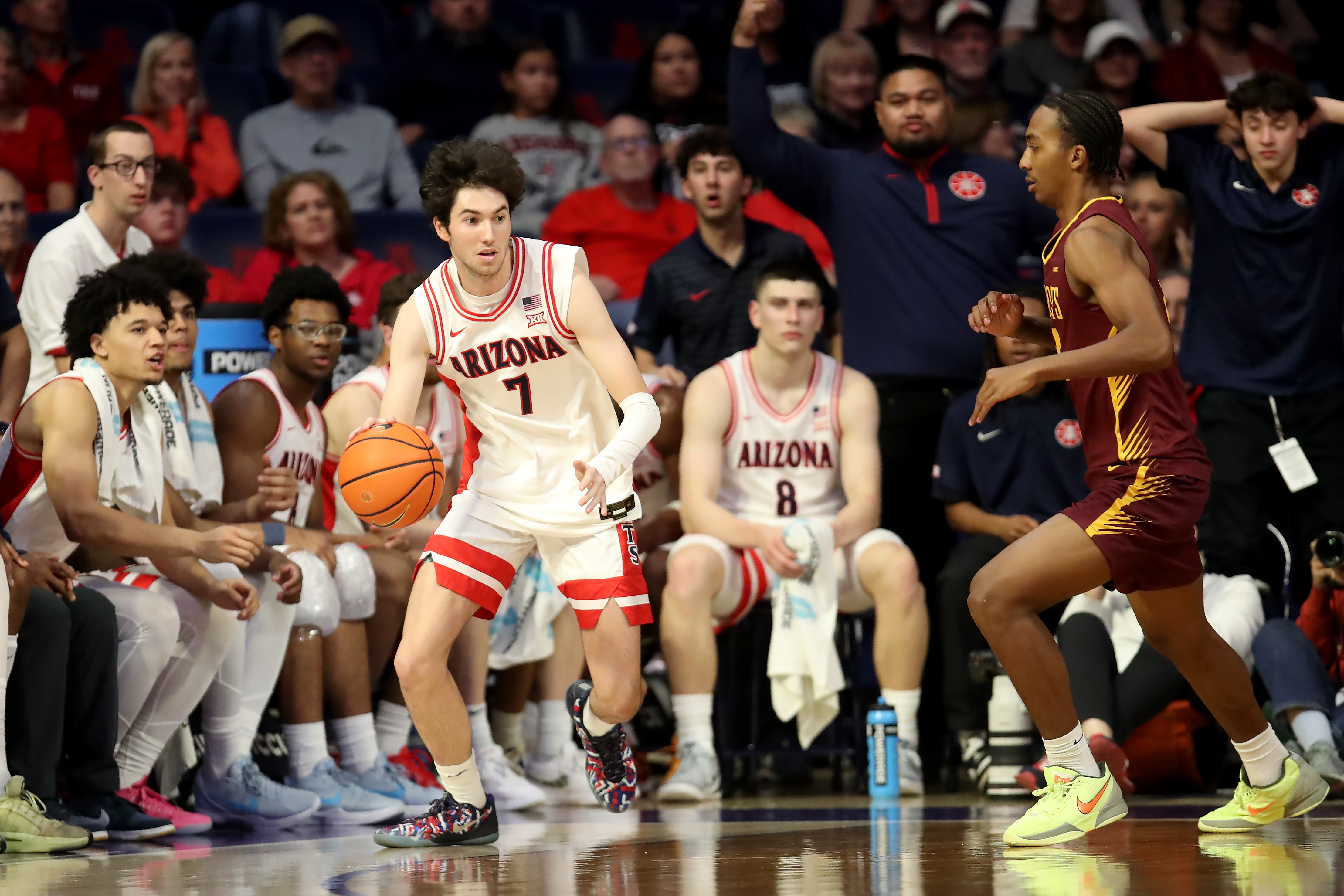
INDIANAPOLIS — With fewer than five minutes left in the first half of a game that was spiraling away from Arizona, freshman point guard Brayden Burries dribbled up the sideline near the Michigan bench and right into the grown-up body of 22-year-old senior Roddy Gayle.
Unable to power through the trap and with no room to escape it, Burries’ only option was to call timeout. As he walked toward the bench, he glared toward his fellow freshman, forward Koa Peat, who had been frozen at half court. The look Burries gave him said it all: Why did nobody come to help?
For an Arizona team with three freshmen in the starting lineup, there was no more defying gravity in the new college basketball landscape, where teams are older, more physically mature and fully professional. The history of this sport has long told us that winning a national title with a freshman-dominated team is exceedingly rare.
This Final Four has shown us that it may now be impossible.
Though the games played out in different ways at Lucas Oil Stadium, Michigan’s 91-73 win over Arizona and UConn’s 71-62 victory over Illinois both made the same statement: At the highest level of college basketball when championships are on the line, old beats young nearly every time.
“They had us on our heels all night,” Arizona coach Tommy Lloyd said. “We couldn’t get into a rhythm. No one has been able to do that to us all year.”
Eleven years ago in this building, Duke took down Wisconsin for the national title with a team led by four spectacular freshmen, all of whom eventually became first-round draft picks. Three years before that in New Orleans, Kentucky did it with Anthony Davis, Michael Kidd-Gilchrist and Marquis Teague.
But that’s it. They’re the outliers.
Every year before and every year since has been the same story: No matter how talented they are or what they’re projected to be in the NBA, teams that rely on multiple first-year collegians to be their best players will likely not win six straight games in March and April.
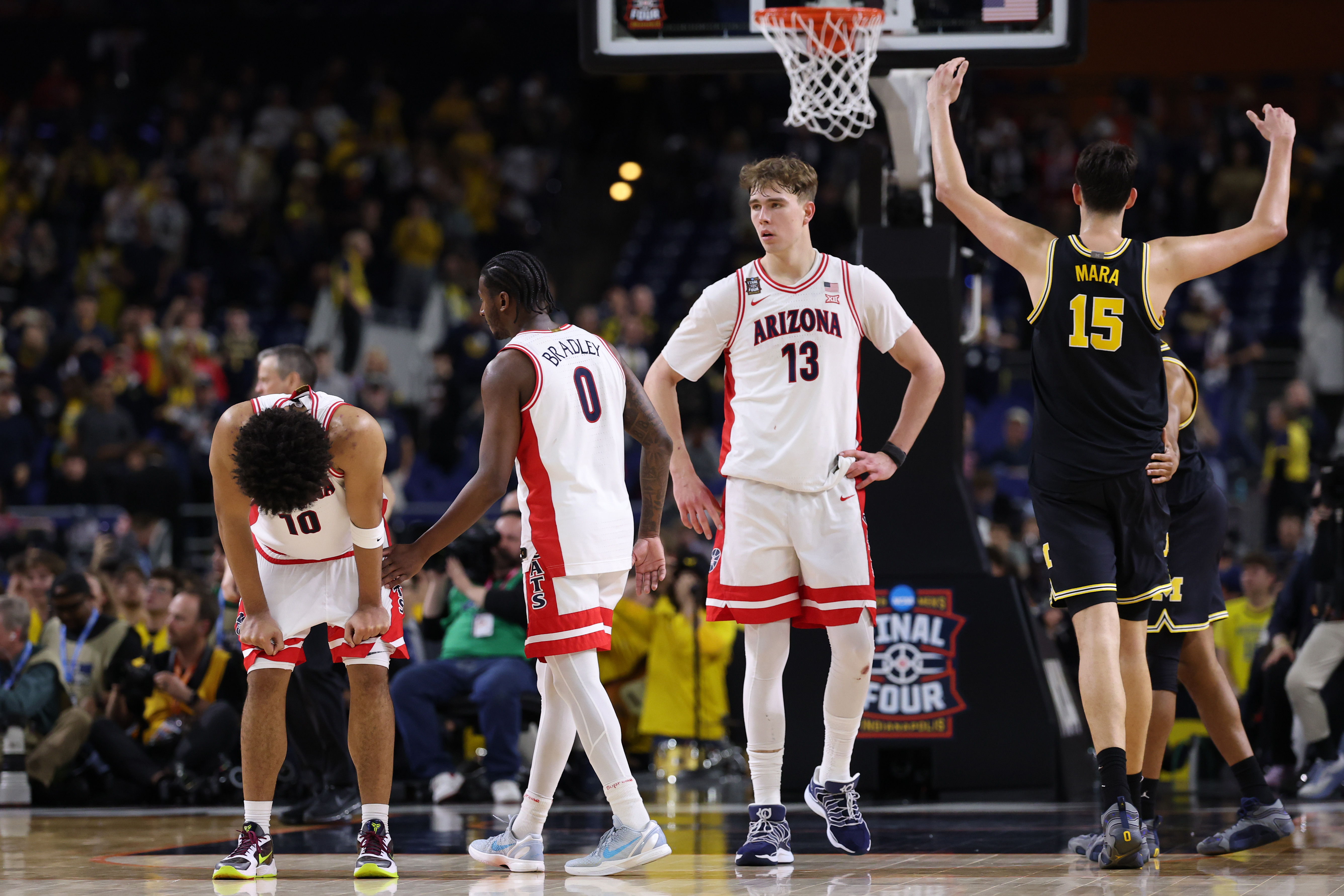
Across the two semifinals Saturday, there were four freshmen projected to be first-round draft picks as soon as this year and a fifth who could get there next year. All of them played well below the potential they showed all season:
For Illinois, forward David Mirkovic went 2-for-7 from the field for 6 points and 5 rebounds despite season averages of 13.5 points and 8.1 rebounds.
Illini point guard Keaton Wagler had 20 points, but it took him 16 shots. A 41 percent 3-point shooter for the season, he went 2-for-10 and also had difficulty handling the ball against UConn’s physicality, leading to 3 live ball turnovers while Illinois had 3 assists for the entire game.
Burries was 0-for-5 at halftime and 0-for-8 before hitting a few shots in the second half when Arizona was too far behind for it to matter.
Peat was 2-for-8 at halftime and missed several opportunities right at the rim before finishing with 16 points on 18 shots.
Arizona’s Ivan Kharchenkov, a role player who should eventually find his way into the NBA as well, had to be pulled in the first half because of 3 turnovers and a couple wild drives to the rim that resulted in backboard-clanging misses.
Mock drafts have rarely felt more irrelevant.
But here’s the moral of the story: No matter how much first-year players grow up through the course of a season, everything about the Final Four experience is different. The stadium is huge and sometimes disorienting. The pageantry from the moment you get to town is intense. The stakes are sky high.
It’s probably not a coincidence that both Arizona and Illinois, practically from the moment they stepped on the floor, played with the skittishness of a team that had not been here before.
Michigan and UConn played like themselves.
“They were, like, surgical,” Lloyd said. “We’ve had a great year, but even if you’re a great team and you can’t get in a rhythm, it’s going to be a tough night and that’s what we felt tonight.”
One freshman did perform up to expectations: Braylon Mullins, also a big-time prospect, made four of UConn’s 12 threes. But there’s a pretty big difference between being a star freshman and a role player on a team like UConn that starts Tarris Reed and Alex Karaban, both in their fourth year of college basketball, alongside juniors Solo Ball and Silas Demary.
UConn shot 34 percent from inside the arc and 36 percent from three — and won anyway. That’s the mark of a team built for tournament play, where one bad night can send you home. But it’s hard to put that kind of culture together in one year. With UConn, it shows.
“We haven’t been a machine of destruction,” UConn coach Dan Hurley said. “We’ve been a team that’s had to grind out games like this. We’re comfortable in a possession game like that. We’re a tough program. We’ve got incredible will. We go into these games, we’re ready for battle. It’s not a game that we’re just running around in uniforms throwing the ball around, hoping it goes in. We’re fighting. It’s a life-or-death struggle for us to get to Monday night for the opportunity to win a championship.”
Like UConn, Michigan’s starting lineup is experienced: Two graduate students, two juniors and a sophomore, taken mostly out of the transfer portal. It’s also quite large in the front court, which showed up big-time against Arizona’s wunderkinds. One team came out, set a physical tone right away and stuck to its plan. The other looked impatient from the beginning and got away from its season-long identity, settling for shots it had no business taking because of how formidable Michigan was in the paint.
“We felt like we were battle tested,” Michigan coach Dusty May said. “We felt like if a team relies on scoring 15 feet and in, because of our size and length, its just going to be tough to score enough points if we’re making some shots and we’re in a decent rhythm offensively. I think that’s what happened tonight.”
Arizona isn’t alone. Year after year since 2015, Duke has failed to nab a title despite a bevy of top-five draft picks. Houston stacked up on five-star freshmen this season and got eliminated in the Sweet 16. A.J. Dybantsa was a one-man show at BYU and the Cougars didn’t make it to the second weekend. The days of John Calipari recruiting like he did at Kentucky and making long tournament runs seem like they’re in the rear-view mirror.
Elite-level talent is always important, but Saturday showed once again how little it can mean on college basketball’s biggest stage.
So perhaps it’s fitting that the 2026 college basketball season will come down to two teams that have hit the talent and experience quotient right in the sweet spot. Both UConn and Michigan are loaded not just with future NBA players but guys who have been around the block.
As much as college basketball has changed, Saturday was a reminder of the one thing that seems to always remain the same.