If you have a cruise booked, there’s a new line item you may want to watch for: a fuel surcharge.
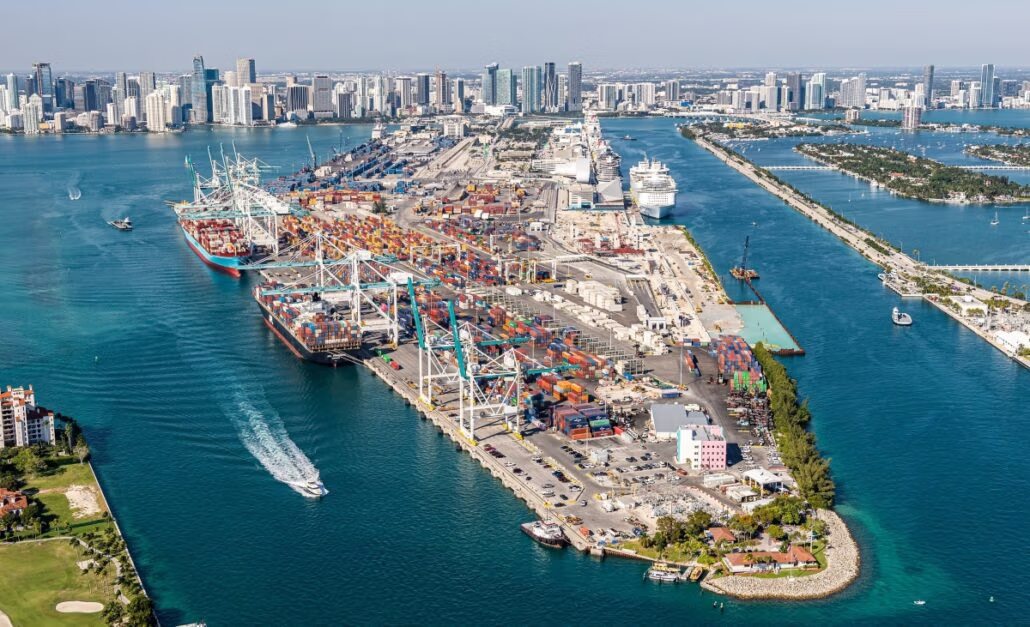
(Photo courtesy of PortMiami)
With oil prices climbing sharply since the start of the Iran conflict in late February, cruise passengers are asking whether the major lines will start passing those costs along. Two Asian cruise brands already have, and industry experts say others could follow.
What’s driving the concern
Since the Iran conflict began on February 28, global oil prices have jumped more than 40%, with Brent crude topping $100 per barrel amid disruptions in the Strait of Hormuz, according to reporting by MarketWatch. That’s well above the trigger thresholds written into most cruise contracts.
Cruise fuel costs are significant. Carnival Corporation spent more than $1.8 billion on fuel in 2025 alone, and Royal Caribbean Group spent roughly $1.1 billion.
Two lines have already acted
(Photo courtesy of Resorts World Cruises)
StarCruises and Dream Cruises, both operated under Resorts World Cruises, notified passengers on March 17 of new fuel surcharges that took effect for bookings made on or after March 20.
StarCruises is adding HKD 200 per person per night, which works out to about $25 per guest per day. Dream Cruises is charging SGD 15 per person per day, or roughly $12, on Genting Dream sailings out of Singapore, Port Klang, and Malacca.
“Due to recent geopolitical developments in the Middle East, oil prices have increased significantly, leading to higher fuel and related costs,” the companies said in letters to passengers.
Closer to home, one U.S. cruise line is already charging passengers a fuel surcharge and has been for nearly two years. Margaritaville at Sea has collected a $15 per person per night fuel supplement on sailings aboard the Paradise since June 2024. The fee does not apply to the line’s newer ship, the Islander, which launched from Tampa in 2024.
What the major lines say now
For now, the three biggest cruise companies are holding the line. Norwegian Cruise Line said it does not expect “any immediate impact on ticket prices or the guest experience.” Carnival said it has “no plans to change our current pricing model.” Royal Caribbean did not respond to requests for comment from MarketWatch.
But the fine print in cruise contracts tells a different story. Norwegian reserves the right to impose a surcharge of up to $10 per passenger per day with no prior notice if West Texas Intermediate crude tops $65 a barrel.
Carnival’s contract allows up to $9 per person per day above a $70-per-barrel threshold. Oil is currently trading well above both levels. MSC Cruises has a cap as high as $12 per person per day under similar conditions.
Crucially, these surcharges can be applied even after a cruise has been paid in full.
The math adds up fast. A family of four on a seven-night sailing could see an extra $252 added to their bill under Carnival’s contract terms, or $280 under Norwegian’s policy, if either line chose to act.
Fuel Purchasing Strategies
Not all cruise lines are equally exposed to rising oil prices.
Royal Caribbean has hedged roughly 60% of its fuel needs for 2026, giving it a financial buffer against the current spike and helping explain why the line has said it will not impose surcharges.
Norwegian Cruise Line also uses fuel hedging strategies to lock in costs in advance.
Carnival Corporation is a different story. The company does not hedge fuel purchases at all, making it the most directly exposed of the three major cruise groups to oil price swings.
That vulnerability is already showing up on Carnival’s bottom line. When the company reported first quarter results, it cut its full-year earnings guidance, absorbing more than $500 million in adverse fuel cost impacts compared to earlier projections.
Maritime attorney Michael Winkleman, told MarketWatch that cruise contracts are written to give lines flexibility. The cruise contract is a powerful document entirely in favor of the cruise lines,” he said.
The last time cruise passengers actually paid fuel surcharges on a widespread basis was nearly 18 years ago, during the 2007-2008 oil price spike that pushed crude above $100 a barrel.
I have sailed every Holland America ship except the Zaandam. So when I tell you the Volendam surprised me, that means something.
Not because it is new. It is not. Not because it is packed with amenities. It is not that, either. The ship surprised me because in a landscape where bigger supposedly means better, the Volendam reminded me what cruising felt like before square footage became the primary selling point.
First Impressions
The Volendam is just under 800 feet long and carries 1,400 guests across nine decks, ten if you count the forward sun deck.
On embarkation you find yourself on deck three, which opens into an atrium that is more understated foyer than grand entrance. If you are expecting the soaring multi-deck atriums found on newer ships, reset those expectations at the gangway.
Deck four handles guest services, deck five is the main artery connecting the casino to the Ocean Bar, and deck eight is the Lido.
Three decks cover almost everything you need, and you can walk the length of the ship in a couple of minutes. After navigating ships where you need a map just to find the main dining room, that simplicity was welcome.
The hallways are lined with framed photos of past Holland America ships. It is a small detail but a telling one: This is a line that knows its roots.
The Stateroom
My oceanview stateroom, cabin 1921, sat on the aft end of deck one. For a ship launched in 1999, last upgraded in 2024, it has held up well.
The bed was comfortable, the shower had a glass door instead of a curtain, and the water pressure was good with Elemis bath products in the shower and sink.
Storage was the real standout. Three large closets, multiple drawers, room under the bed for luggage, and additional drawers at the foot of each bed. These ships were designed for longer voyages and the storage reflects that.
No living out of a suitcase here!
The furnishings are worn the way an older ship’s furnishings should be: Lived in, not neglected. The TV ran smaller than what you’ll find on newer HAL ships, and there was a slight vibration at the stern during docking. At sea the cabin was quiet.
The natural light through the oceanview window was better than expected given how low in the ship’s structure it was located, giving you a mix of waterline and horizon that made for good sunrise and sunset photos.
If you are stepping off a Pinnacle-class ship (Koningsdam, Nieuw Statendam, or Rotterdam), temper your expectations on the finishes.
Dining
Lido Market
I tended to do most breakfasts and lunches in the Lido Market, and it earned that loyalty quickly. The salad bar stood out because the staff builds it for you to order rather than serving yourself. I ordered it nearly every day. The seared tuna was consistently fresh, and I worked my way through the rest of the buffet offerings throughout the week. Lasagna, steak… I tried it all. And the late-night pizza was a major hit.
Then there was the bread pudding with vanilla sauce. I had three bowls one afternoon. I am not proud of it, but I’m not sorry either. If you sail the Volendam and skip the bread pudding, you have made a serious mistake.
Main Dining Room
The main dining room on the Volendam spans two decks, which gives it a sense of scale you would not expect on a ship this size. It is an elegant space and a reminder that Holland America has always taken dining seriously regardless of the ship.
I ate there twice during the segment. The french onion soup was a solid starter, the steak was cooked to order, and the lobster pretty decent.
Nothing blew me away but everything was done correctly, which is its own kind of consistency. What stood out more than the food was the service. The team checked in regularly, coming out specifically to ask if the steak was cooked to my liking.
Pinnacle Grill
The Pinnacle Grill is Holland America’s signature steakhouse and a fixture across the fleet. On the Volendam it sits on deck four and is worth the supplement for a special night. Because it does not have ocean views on this class of ship, windows instead look out onto deck four. But don’t worry, not a lot of people use deck four!
I ordered the steak with a side lobster and the size of the crustacean was almost embarrassing. It was nearly the size of a football! The server extracted it from the shell without being asked, which I appreciated more than I let on. That would have been a challenge!
But the real standout was the clothesline candied bacon. If you have sailed Holland America before you already know. If you have not, order it. I have been getting it for years across multiple HAL ships and it never misses the mark.
It is the kind of thing where you half-jokingly consider ordering it for dessert and then realize there is no reason not to.
Canaletto
Canaletto is Holland America’s Italian venue and it’s tucked within a section of lido buffet, which gives it a different feel than a standalone restaurant but works well in practice.
We went on the final night and the food came in waves. We started with antipasto for the table.
I followed with ordering the meatballs. The chicken parmesan came next and was a solid finish to the meal.
If I had one note it is that the portions are generous to the point where pacing yourself early matters. As with any Italian restaurant worth its salt, the meal was topped off with homemade tiramisu.
Dive In
The Dive In is Holland America’s poolside burger spot and a good option for that gap between lunch and dinner when you need something to munch on but you’re not ready to commit to a full-blown sit-down meal.
The lettuce wrap burger was the move. The lettuce replaces the bun entirely and it works better than it sounds. The hotdog was also genuinely good and worth ordering.
However, I’d skip the cheese fries, where the topping’s watery consistency gave a goopy pool collecting at the bottom of the box. Everything else on the menu made up for that (perhaps a sign I did not need to eat the fries!)
Pools and Lido Deck
Deck eight runs the length of the ship’s outdoor area and has two pool areas worth knowing about. The main Lido pool sits midship and is the social hub during sea days, with the Dive In nearby and plenty of lounge seating in the area.
The aft pool is a quieter alternative if you want the water without the crowd. On a ship of 1,400 guests neither pool ever felt overwhelmed, which is a luxury you do not always get at sea. There’s also a retractable dome over the lido pool that can close during inclement weather.
The Lido deck overall never the chaotic scene you find on larger ships during a sea day, which fit the overall tone of the Volendam perfectly.
The Crow’s Nest
If there is one space on the Volendam that deserves a special shout-out, it is the Crow’s Nest on deck nine forward. This was hands down my favorite spot on the ship.
With gorgeous 270-degree views from the front of the ship, you see nothing but water and horizon in every direction. During scenic cruising it is unmatched.
The space doubled as a trivia venue during the day, had a coffee bar and a full bar for the evenings, and was consistently quiet enough at night to get work done without feeling like you were hiding from the rest of the ship.
If you are a remote worker like myself, or just someone who appreciates a good view with a drink in hand without being out in the weather, find a spot early and make it yours. As an added bonus, the Starlink internet service seemed to be blazing up there!
Entertainment
There’s a very “something for everyone” feel when it comes to entertainment on the Volendam. The highlight of most evenings for me was the live band in the Ocean Bar on deck five, which played to a good-sized crowd until around midnight. The nearby Piano Bar served as a natural next stop when the Ocean Bar wound down for the night.
World Voyages and similar long cruises are different from your typical sailings in that there aren’t a lot of big, splashy, jukebox musicals. Although make no mistake, they are still there.
Instead, the World Stage theater hosted an ever-rotating variety of performers. During my time on board, there was electric violinist and a magician. This spot also played host to enrichment talks and other programming, especially on sea days.
Casino
What the smallish casino lacked in square footage it made up for in energy, especially late at night when the Ocean Bar crowd made their way over.
The table games like blackjack, roulette, and craps stayed busy throughout the segment and the slots had a good mix of machines. Newer games like Buffalo Gold, Dragon Link and Super Flaming Hot Pots were joined by classics like the one I can never resist: Wheel of Fortune (which also lets me down!).
I donated my fair share to the cause, which was promptly claimed by the woman next to me who hit $500 and $576 on back to back nights!
The spa, basketball and pickleball courts were also extremely popular on sea days.
The Crew
The crew is where Holland America has always separated itself from the competition, and the Volendam was no exception.
The ship is predominantly staffed by Filipino and Indonesian crew members who bring a level of warmth and genuine hospitality that is hard to replicate.
What stood out most was the small things. Crew members remembered your name after meeting you once. Remembered your order. The person polishing the staircases in the morning greeted you like a long-lost friend.
Who Is This Ship For?
As cruise ships get bigger, it can be increasingly difficult to feel connected to the sea or the people around you. Those looking for bells and whistles don’t mind, but others (like me) sometimes miss the low-key joy of quiet moments spent staring at the ocean while contemplating everything and nothing.
That latter group is who Volendam is meant for.
Those wanting Broadway shows and ziplines aren’t going to get their needs met here. But folks who value conversation and community over bells and whistles will find themselves feeling right at home aboard Volendam.
The passengers ranged from their 30s to their 90s, and Holland America’s reputation as it’s only for old people did not hold up for a single day onboard. Some of these passengers ran circles around me in the heat of Southeast Asia. Not to mention kicking my butt in pickleball!
Book it for a segment and you will leave looking at longer voyages. That is probably the most honest thing I can tell you, and the highest compliment I could possibly pay this ship and her crew.
Small-ship luxury cruise experiences deliver advantages impossible on mega-ships carrying thousands of passengers, transforming ocean travel from anonymous resort experiences into intimate voyages where genuine connections, exclusive access, and personalized attention create fundamentally different value propositions.
For cruise passengers prioritizing destination immersion, cultural depth, and refined service over waterslides, casinos, and Broadway productions, understanding why boutique vessels outperform mass-market behemoths helps make informed choices aligning with actual vacation priorities.
The case for small-ship luxury cruising rests on eleven compelling advantages separating intimate vessels from floating cities:
1. Exclusive Destination Access
Small ships reach ports and anchorages mega-ships cannot physically access. Luxury cruise vessels like Swan Hellenic’s SH Diana and SH Vega, accommodating approximately 152 guests, navigate narrow fjords, shallow harbors, and remote coastlines where draft restrictions and turning radius requirements exclude vessels carrying 3,000+ passengers. This access difference proves dramatic:
Isolated Arctic settlements in Svalbard and Greenland with limited infrastructure
Mediterranean archaeological sites on small islands without developed ports
Pacific atolls and island chains where few vessels venture
Norwegian fjords, Chilean channels, and coastal waterways too narrow for large ships
Swan Hellenic luxury cruise lines prioritize these exclusive destinations through purpose-built expedition design featuring ice-class PC5 hulls enabling polar navigation, shallow draft allowing coastal exploration, and advanced positioning systems maintaining station without anchoring in sensitive environments. Their commitment to remote destination access means itineraries include locations competitors literally cannot reach regardless of willingness.
Mega-Ship Limitations:
Restricted to major ports with developed infrastructure handling thousands of passengers
Repeat same heavily-touristed Caribbean, Mediterranean, and Alaska routes
Dock alongside 3-5 other mega-ships overwhelming destinations
Cannot access remote regions where authentic discovery exists
Sacrifice destination variety for operational efficiency
The destination access advantage alone justifies small-ship premiums for travelers measuring trip value by unique experiences rather than onboard entertainment square footage.
2. Genuine Personalized Service
Small-ship crew-to-passenger ratios approaching 1:1 enable service impossible when crew members serve hundreds rather than dozens of passengers. Swan Hellenic ultra luxury cruise vessels maintain approximately 152 guests with comparable crew numbers, allowing:
What Personalized Service Actually Means:
Staff learning names, preferences, and interests within days rather than remaining anonymous throughout voyages
Butler service handling unpacking, pressing, and personal concierge needs attentively
Bartenders remembering drink preferences without asking
Dining staff recognizing dietary restrictions and preferences automatically
Expedition staff providing individualized attention during landings and activities
This genuine personalization differs fundamentally from mega-ship “personal medallions” and app-based service requests trying to scale service through technology rather than human attention. Small-ship staff have time building relationships, anticipating needs, and delivering the thoughtful touches creating memorable experiences.
Mega-Ship Service Reality:
Crew members juggling hundreds of passengers preventing genuine personalization
Automated systems substituting for human attention and relationship building
Long waits for services during peak periods when everyone wants same things
Impersonal interactions where staff don’t recognize passengers beyond room numbers
Premium service tiers creating two-class experiences within single vessel
3. Intimate Shipboard Atmosphere
Boutique capacity creates fundamentally different social dynamics where passengers know fellow travelers, meaningful conversations develop naturally, and shared interests create genuine connections. Swan Hellenic expedition voyages attract intellectually curious explorers sharing cultural and natural history interests, creating communities rather than anonymous crowds:
Small-Ship Social Benefits:
Meeting and knowing significant percentages of fellow passengers
Developing friendships and connections lasting beyond voyages
Intellectual conversations with like-minded travelers during meals and gatherings
Intimate lectures and discussions where asking questions and engaging experts feels natural
Shared expedition experiences creating bonds among participants
Mega-Ship Social Reality:
Anonymous atmosphere where you’ll never see most passengers aboard
Difficulty finding like-minded travelers among thousands with diverse interests
Crowded venues preventing intimate conversations or meaningful interactions
Impersonal lecture halls where audience participation proves impractical
Segregated by booking class, deck, or venue limiting social mixing
For travelers viewing voyages as social and intellectual experiences, small-ship intimacy creates value mega-ships cannot replicate regardless of facility investment.
4. Comprehensive All-Inclusive Value
Small luxury ships typically include shore excursions, premium beverages, specialty dining, and gratuities creating true all-inclusive experiences versus mega-ship “à la carte everything” models nickel-and-diming passengers constantly. Swan Hellenic’s comprehensive inclusion covers:
All shore excursions regardless of destination or complexity without premium program surcharges
Premium beverages including fine wines, champagne, and spirits throughout ships
Specialty dining at all restaurants without upcharges or reservation requirements
Gratuities for all staff eliminating tipping considerations and calculations
Expedition equipment including kayaks, snorkeling gear, and polar camping equipment
Wi-Fi connectivity even in remote regions without additional fees
This comprehensive inclusion allows focusing entirely on experiences rather than managing budgets, tracking expenses, or making constant purchase decisions. The mental freedom from commerce enhances enjoyment and prevents the “death by a thousand cuts” billing characteristic of mega-ship cruising.
Mega-Ship A La Carte Reality:
Shore excursions often costing $100-400 per person per port adding thousands to voyage costs
Beverage packages requiring upfront purchases with restrictions and limitations
Specialty restaurant surcharges of $30-100+ per person for dining beyond buffets and main dining rooms
Gratuities adding $15-25 per person daily to final bills
Wi-Fi packages charging premium rates for basic connectivity
Constant onboard sales pitches for spa treatments, photographs, shopping, and activities
5. Exceptional Dining Quality
Small-ship galleys prepare meals for 150-200 passengers versus mega-ship industrial food production feeding 3,000-6,000+ guests simultaneously. This scale difference dramatically impacts culinary quality:
Small-Ship Culinary Advantages:
Fresh ingredients prepared to order rather than mass-produced in advance
Chefs capable of accommodating dietary restrictions and special requests personally
Multiple dining venues offering variety without requiring reservations or surcharges
Regional specialties reflecting destinations and seasons
Sophisticated presentations and preparations matching fine dining restaurants
Wine pairings and beverage programs curated for culinary programs
Swan Hellenic’s dining philosophy emphasizes quality over quantity, featuring regionally-inspired menus showcasing destinations through culinary exploration, fresh ingredients sourced in ports when possible, flexible dining arrangements accommodating expedition schedules, and multiple venues offering variety without rigid seating times or formal night requirements.
Mega-Ship Dining Reality:
Industrial food production prioritizing volume over quality
Limited fresh ingredients due to inventory requirements for thousands
Main dining rooms serving reheated mass-produced meals
Specialty restaurants carrying hefty surcharges for acceptable quality
Buffets as primary dining option with food sitting under heat lamps
Rigid dining times and assigned seating in main restaurants
6. Meaningful Shore Programs
Small-ship shore excursions accommodate entire passenger manifests allowing comprehensive programming versus mega-ships where only fraction of passengers fit on premium excursions, creating tiered experiences. Swan Hellenic’s all-inclusive model means:
Comprehensive Shore Access:
Every passenger participates in expert-led cultural and natural history programs
Archaeological specialists leading UNESCO World Heritage site visits for all passengers
Marine biologists providing expertise during wildlife observations comprehensively
Cultural anthropologists facilitating authentic community interactions for everyone
No rushed rotations or limited spaces creating FOMO or requiring lottery systems
Swan Hellenic expedition voyages through SETI Institute partnerships bring astrobiology and astronomy programming where scientists conduct research during voyages and all passengers can participate, while Chopra wellness collaborations integrate mindfulness programming comprehensively rather than offering limited spots in premium programs. This inclusive approach means every passenger receives the full cultural and educational experience rather than tiered access based on willingness to pay surcharges.
Mega-Ship Shore Reality:
Premium excursions limiting participation to small percentages of passengers
Basic bus tours accommodating crowds to generic tourist attractions
Rushed schedules maximizing passenger throughput over quality experiences
Overwhelming local communities and cultural sites with thousands simultaneously
Limited expert guidance spread across too many passengers for meaningful education
7. Environmental and Community Impact
Small ships minimize environmental footprint and avoid overwhelming local communities. When Swan Hellenic’s 152 passengers visit remote villages, archaeological sites, or wildlife colonies, the impact remains manageable. When 4,000 passengers from mega-ship descend simultaneously, they overwhelm infrastructure, damage cultural sites through sheer numbers, and disrupt wildlife through human density.
Advanced wastewater treatment and emissions controls
Responsible wildlife observation maintaining safe distances and time limits
Respectful cultural interactions where communities can genuinely engage
Economic benefits distributed without destroying what attracts visitors
Mega-Ship Impact:
Thousands simultaneously overwhelming ports, attractions, and ecosystems
Massive waste streams challenging even developed port infrastructure
Wildlife harassment through excessive vessels and human activity
Cultural sites degraded by visitor volume exceeding capacity
Economic benefits concentrated in cruise company hands rather than local communities
8. Expedition Capability and Adventure Access
Small luxury ships like Swan Hellenic’s ice-class vessels combine genuine expedition capability with refined comfort. Their PC5 polar rating enables Antarctic and Arctic navigation reaching remote coastlines, comprehensive Zodiac operations facilitate daily landings at wildlife colonies and pristine wilderness, and expedition equipment including kayaks and snorkeling gear supports active exploration programs.
Small-Ship Adventure:
Ice-class hulls accessing polar regions and challenging coastal environments
Zodiac fleets enabling landings at beaches, ice shelves, and wildlife colonies
Kayaking programs providing quiet wildlife approaches and intimate experiences
Snorkeling and diving opportunities in appropriate regions
Polar camping and specialty programs impossible on conventional ships
Mega-Ship Limitations:
Restricted to ports with developed infrastructure
No Zodiac capability or expedition equipment
Cannot access wilderness areas or wildlife colonies
Limited to viewing destinations from ship rather than immersive exploration
Adventure activities confined to controlled ship environments like climbing walls and surf pools
9. Intellectual and Cultural Programming Depth
Small ships attract passengers sharing intellectual interests, enabling sophisticated programming impossible when audiences span from PhDs to those wanting Vegas-style entertainment. Swan Hellenic ultra luxury cruise programming through SETI Institute partnerships brings actual astrobiology and astronomy research to voyages, while archaeological specialists with PhDs lead cultural site visits creating comprehensive educational frameworks.
Diverse audience interests making depth programming impractical
10. Flexible and Responsive Operations
Small ships adapt itineraries for wildlife opportunities, weather optimization, or enhanced cultural experiences. When Swan Hellenic expedition teams spot rare wildlife or unexpected cultural opportunities emerge, they can adjust schedules accommodating extended time without disappointing thousands of passengers with complex logistics.
Small-Ship Flexibility:
Itinerary adjustments for exceptional wildlife encounters
Extended time at key locations when conditions warrant
Route changes optimizing weather and ice conditions
Spontaneous cultural opportunities requiring operational flexibility
Passenger consensus easier with 150 than 4,000 guests
Mega-Ship Rigidity:
Fixed schedules optimizing operational efficiency over experience quality
Inability to adjust for wildlife or cultural opportunities
Passenger scale making consensus and communication impractical
11. Authentic Rather Than Manufactured Experiences
Small luxury ships deliver authentic discovery and cultural immersion versus mega-ship manufactured entertainment and staged cultural performances. Swan Hellenic expedition voyages prioritize genuine cultural interactions in remote communities, authentic archaeological site visits with specialist guidance, real wildlife observation in natural habitats, and educational frameworks creating understanding rather than superficial sightseeing.
Small-Ship Authenticity:
Remote destinations where authentic discovery exists
Cultural interactions with genuine communities rather than tourist shows
Wildlife observation in natural environments without crowds
Archaeological and cultural sites accessed during non-peak hours
Experiences impossible to replicate on conventional vacations
Prioritize destinations and cultural immersion over onboard entertainment and facilities
Value personalized service and intimate atmospheres over anonymous resort experiences
Seek intellectual engagement and educational depth alongside recreation
Appreciate refined dining and comprehensive inclusion over buffets and à la carte pricing
Want expedition capability accessing remote regions versus heavily-touristed ports
Prefer genuine cultural interactions over staged performances and tourist attractions
Measure value by transformative experiences rather than facility square footage
Avoid crowds and value exclusive access to destinations and cultural sites
For Discerning Cruisers
For cruise passengers who care more about where they’re going than how big the ship is, small-ship cruising really stands out.
Instead of packed decks and over-the-top attractions, these sailings focus on destination access, cultural experiences, and more personalized service.
Lines like Swan Hellenic, with ships like SH Diana and SH Vega, carry just over 150 guests and lean into expedition-style cruising, all-inclusive experiences, and enrichment partnerships that go beyond the typical cruise offering.
It’s a very different approach. One that’s less about quantity and more about meaningful travel, deeper discovery, and a more relaxed onboard experience.
Not the kind you absent-mindedly order at a diner and don’t think twice about as you sip until the cup is empty.
The kind you sit down for, learn about, and share with a stranger from Madison, Wisconsin who you never would have spoken to otherwise.
That conversation at a tea house in Singapore, on day one of a six-day segment aboard Holland America’s Volendam, was the moment I realized this trip was going to be different.
Not because of the ship. Not because of the ports. Because of the people.
I joined the Volendam on day 79 of a 133-day Grand Voyage. The ship had already crossed oceans, made stops on multiple continents, and turned strangers into something closer to a floating community by the time I stepped aboard in Singapore.
I was the newcomer. What I did not expect was how quickly that stopped mattering.
On most cruises, you see people moving about the ship with their heads down and their phones up. They’re checking messages or using the app to plan their day. They are, in a word, distracted by technology. And there is nothing wrong with that. But on this sailing, something was different.
People said hello in the hallway.
Conversations started during sailaway. Nobody was allowing their phone to serve as a wall between themselves and the next person. They were taking photos of sunsets and posting sailaway videos, sure. But when it was time to talk, they were present.
I put my phone away too. Not in my cabin, granted. Just in my pocket. But it stayed a lot longer than usual.
It turns out that is what time spent on a world cruise segment does to you, if you let it.
The People You Meet on a World Cruise Are Not Who You Expect
Take, for example, the woman from Wisconsin. While chatting, she shared that she does variations of world cruises every year, switching between ships and itineraries.
For them, this was not a bucket list cruise. This was just what they have done since retiring from banking. I found that both impressive and quietly inspiring.
During that same shore excursion at a tea house in Singapore, I also met a recently retired nurse from Florida who had boarded in Sydney. Before joining the ship, she checked bungee jumping in New Zealand off her list. But that was only the beginning, as she had a long list of items and intended to work her way around the world, checking them off as she went.
A UK couple in their 70s told me the pandemic rewired how they think about time. They were not waiting anymore. If they wanted to do something, they were doing it. A 133-day grand voyage was not an extravagance to them, but an investment in their lives. It was the decision not to put things off.
And then there was the woman I spoke to in the elevator. She worked in healthcare and had sublet her New York City apartment for four months to fund the voyage. “It’s cheaper than staying home,” she shrugged, backing that up with some pretty solid math to prove her point.
Every one of them had a different reason for being there. None of them fit the profile most people picture when they hear world cruise.
The Ship Gets Out of Your Way
The Volendam has nine decks. Ten if you count the sun deck. You can walk from one end to the other in a couple of minutes.
After years of covering mega ships that require a map and a plan just to get to dinner, that simplicity was something I did not know I needed.
The ship runs quiet during the day. Port intensive itineraries will do that. Most guests are off exploring by mid morning, which means the lounges, the library, the Crow’s Nest (my favorite!), and the Ocean Bar are essentially empty until guests begin returning in the late afternoon.
For me, that was ideal. I am a remote worker, and finding a quiet corner to plow through a few hours of work before the ship pulled into port was never a problem. I noticed I was not the only one. Microsoft Teams meetings were happening in quiet corners and lounges all around the ship.
The only thing that required self control was the food. Something was always available no matter where you went or what time it was. That is both a feature and a problem, depending on how you look at it.
By evening the ship came back to life. There was live music in the Ocean Bar, the Piano Bar was slowly morphing into a gathering place, the World Stage filling with guests to see a super talented electric violinist named Jocelyn Ng.
For a ship of 1,400 guests it covered a lot of ground entertainment wise without ever feeling like it was trying too hard.
The size also made it easy to settle into a routine. Wake up, find a quiet spot, get some work done, head ashore, come back, eat well, catch some live music, and sleep. Repeat.
By day three it felt completely natural. A day later I was at the future cruise desk, just to see what a longer segment might look like.
That is probably the best endorsement I can give a ship.
Cruising as a Gateway
Cruising has a way of opening doors you did not know you wanted to walk through. A Celestyal Cruises sailing introduced me to Doha, Qatar. I have been back twice.
Holland America’s Eurodam showed me St. John in the US Virgin Islands. I have done three land trips since. Cozumel started the same way. The list now goes on and on.
This segment added Singapore and Halong Bay to that list. I stayed an extra day in Halong Bay after the ship left because I needed to explore more.
The bay is one of those places that does not fully register until you are standing in the middle of it. (Sunrise is something that might just have the ability to change your life, if only for a few moments.)
Singapore is already on the return list. It is not that far from Manila, which I know well, so it will happen sooner rather than later.
My Last Morning Onboard
I set my alarm for sunrise as the Volendam made its way into Halong Bay. What I woke up to looked like something out of a Bob Ross painting. If you are over 40, you’ll get the reference. If not, hit up Google.
Limestone karsts (mountains) rising straight out of the water in every direction. The ship threading through them like a needle, turning to port, then to starboard, with the kind of precision that makes you appreciate the river pilot’s knowledge of the local waterway.
Both sides of the ship had views worth standing for, and I found myself bouncing back and forth like a tennis ball, trying to take in as much as I possibly could.
I was not the only one. The crew had lined up on deck nine to take it in themselves. That is when you know a place is something special. When the people who have traveled the world show up for it.
Six days on a world cruise segment will not scratch the itch. It will just give you a bigger one,… even for an introvert like myself.

 Login
Login