
 Login
Login
Last man standing: Cub Swanson's UFC 327 swan song officially closes the book on the WEC
The whole thing started on a westbound interstate, in a brown four-door Cadillac sedan. Leonard Garcia and his three of his friends loaded in for a 1,200-mile road trip from Plainview, Texas to Lemoore, California. The car, a mid-1980s model, was the only one in good enough condition to make the journey. Garcia, along with fellow fighters Gabriel Garcia and Isaias Martinez, were heading out to compete at the original WEC event at Tachi Palace.
It had been dubbed, somewhat gallantly, WEC 1: Princes of Pain.
Nobody knew anything about it, other the fact that real fighters — meaning those who actually trained, rather than those who jumped in the cage on a lark — were competing. They also knew that Dan Severn, a veteran of UFC 4, was headlining the event against Travis Fulton. Such a main event spoke to the new promotion’s legitimacy.
“Travis had a billion fights,” Garcia says. “Even then he had like 180 or something like that.”
The cage was outdoors, and the canvas was bright blue. The crowd that assembled at the Tachi Palace was largely made up of bikers, day-drinkers and gamblers who’d come to see some bloodshed. Martinez lost at the end of the first round after eating a ferocious volley of elbows from Cruz Gomez, giving everyone a bang for their buck. Gabriel Garcia didn’t make it a full minute before Phil Ensminger lit him with punches. Of the 10 fights, only the main event went the distance.
And it was Leonard Garcia who stole the show with a head-kick knockout of Victor Estrada. Because this was in 2001, just two months after the unified rules in MMA were put in place, he only knew of Estrada through word of mouth.
“I mean, that was back when you were fighting for the experience,” Garcia, now 46, says. “Chuck Liddell was going to be there, which was a big deal. Victor Estrada was one of … who’s the guy that armbared Matt Hughes? The guy who got Matty early on … ?”
The details begin to drift as it was a full quarter-century ago, back when Garcia was just 21 years old and fighting as much on whim as he was on dreams. He made just $300 for his work that day. Three hundred dollars is what he received for driving nearly 2,500 miles roundtrip.
“Dennis Hallman!” he says. “Dennis Hallman.”
“So, Victor Estrada was one of Dennis Hallman's guys. And I had always heard of Hallman's phenomenal skills and how he had these great students. It was a really good experience to go get, and I needed bigger fights on my résumé. This was so early on that the sport was just starting, and the UFC was where everybody wanted to be.”
Garcia didn’t know it at the time, but he limped out of the Tachi Palace with a souvenir from that head kick he landed on Estrada. He realized it in full when he was trucking back down the interstate with his battered group of friends. His leg was swollen, and the pain was unbearable. By the time they got to Arizona, the air-conditioning went out in the Cadillac. As it was the middle of summer, the temperatures swelled to over 100 degrees. Garcia began running a fever.
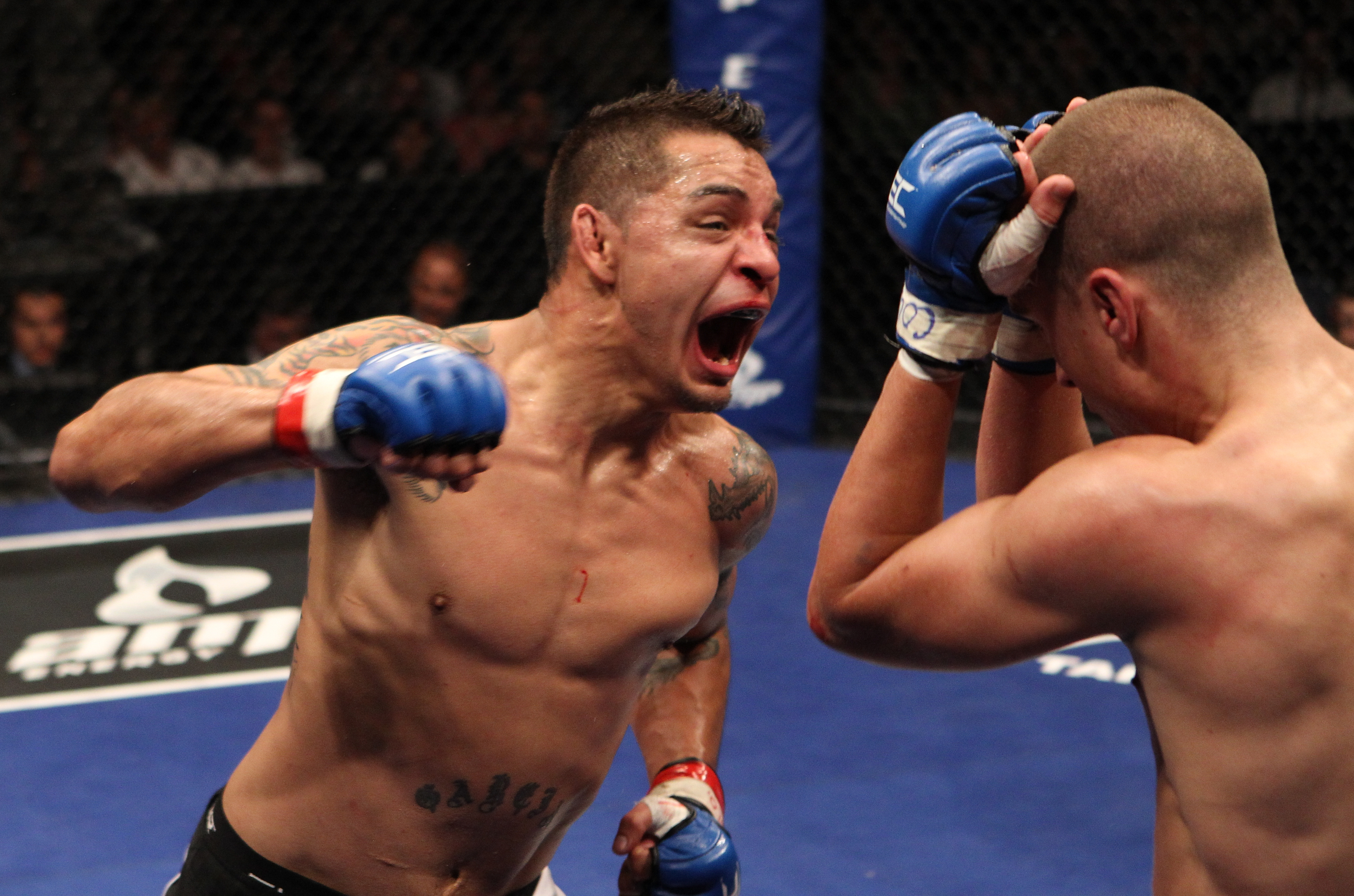
“We all thought it was just because it was hot and there's no AC, but it starts getting really bad,” Garcia says. “I started feeling really weird and I told my friend Ramiro, who drove us all the way, ‘Hey man, take me to the emergency room. I don't feel normal.’”
It turned out, Garcia’s leg was fractured.
“It had been a full day since the fight on Saturday,” he says. “On Sunday morning we loaded up and we took off. So now it's Sunday evening and I'm pulling into the emergency room. My leg is broken, and they're like, ‘Do you have any insurance or anything?’ I was like, ‘Well, no, I fought for the WEC.’ And they're like, ‘Oh, well, can you get ahold of them?’”
So he called WEC founder Reed Harris, who’d seen Garcia limping after the event and therefore told him to get his leg checked out once he got back to Texas.
“They called Reed and said, ‘Hey man, we got one of your fighters here, and his leg is broken.’ Reed was like, ‘No way his leg is broken — he was walking!’ And they're like, ‘Yeah, we know, we don't know how the hell he walked in here, but he did.’”
That first WEC didn’t clean up at the box office, in fact it inevitably lost money, yet Harris didn’t hesitate to take care of all the medical expenses for his fighter.
“Everything,” Garcia says. “He took care of it all, man. He kept in contact with me afterward and was like, ‘I never want to have a bad name — this is who I am as a person. I just want you to know that.’ Literally, he could have thrown me to the dogs, but instead he made sure that my leg was fixed, and we became lifelong friends.”
That’s how the WEC got started.

It all ends this Saturday with Cub Swanson, the last of the WEC fighters on the UFC’s roster. He will make the walk a final time against Nate Landwehr at UFC 327 in Miami, bringing an official close to an era. He is the last of a romantic past.
You can trace the WEC’s history to Cub through a series of strikes.
Leonard Garcia kicked Victor Estrada at WEC 1, breaking his leg in the process, and Estrada punched Rich Crunkilton at WEC 5: Halloween Fury. Crunkilton smacked Dave Jansen at WEC 43, who delivered a blow to Ricardo Lamas’ chin at WEC 50, who in turn punched Cub Swanson at the original UFC on FOX show when the whole thing evaporated into the past.
It’s a fraternity of blows that all ends with Swanson.
In between there were a flood of names that have those who remember seeing blue. Jens Pulver. Mike Brown. Miguel Torres and Dominick Cruz and Urijah Faber. Cowboy. Peripheral names that filled out cards. George Roop. Cole Escovedo. Poppies Martinez. Eddie Wineland, who had that big knockout of Antonio Banuelos at WEC 20: Cinco de Mayhem.
Swanson was 23 when he debuted at the WEC against Tommy Lee at WEC 26, fresh off a nice run in King of the Cage. It was still a couple of months before the WEC would begin airing on Versus, yet well after Zuffa had purchased the great showcase of smaller bodies. In the time he’s been competing, whole worlds have moved. An industry worth millions now is worth many billions.
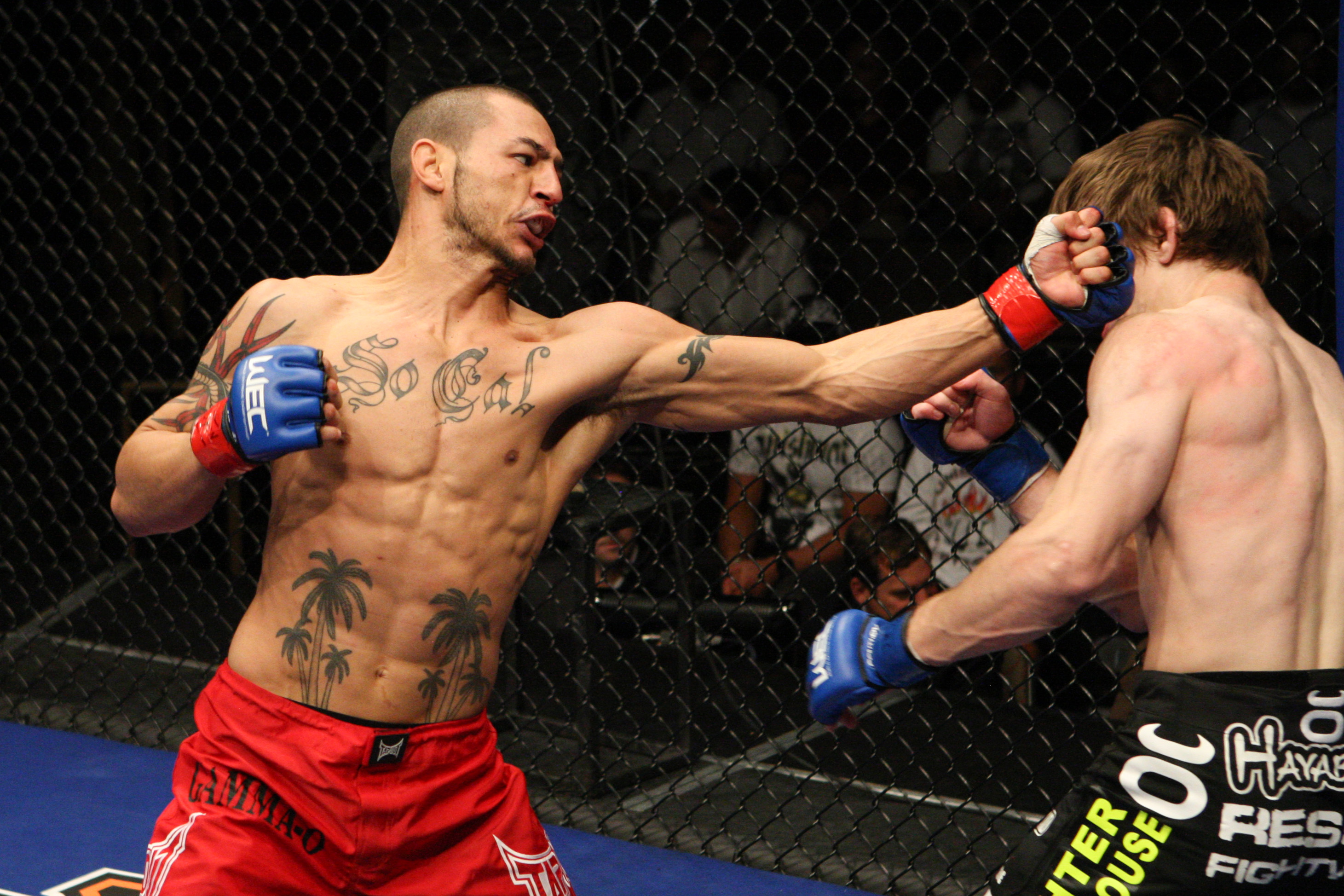
“I remember I was super nervous,” Swanson says. “Back then I was struggling as a fighter, trying to make ends meet, as I was coming up on the circuit. That meant I really couldn't afford to bring out a whole team. I'd just show up to the fights all alone and just stay to myself. And then when my coaches could get there right before weigh-ins, I’d feel a lot better.
“But that's kind of what gave everybody the impression that I was kind of a mean dude, because I would fight like that, but also just because I was always by myself. I just always had my guard up.”
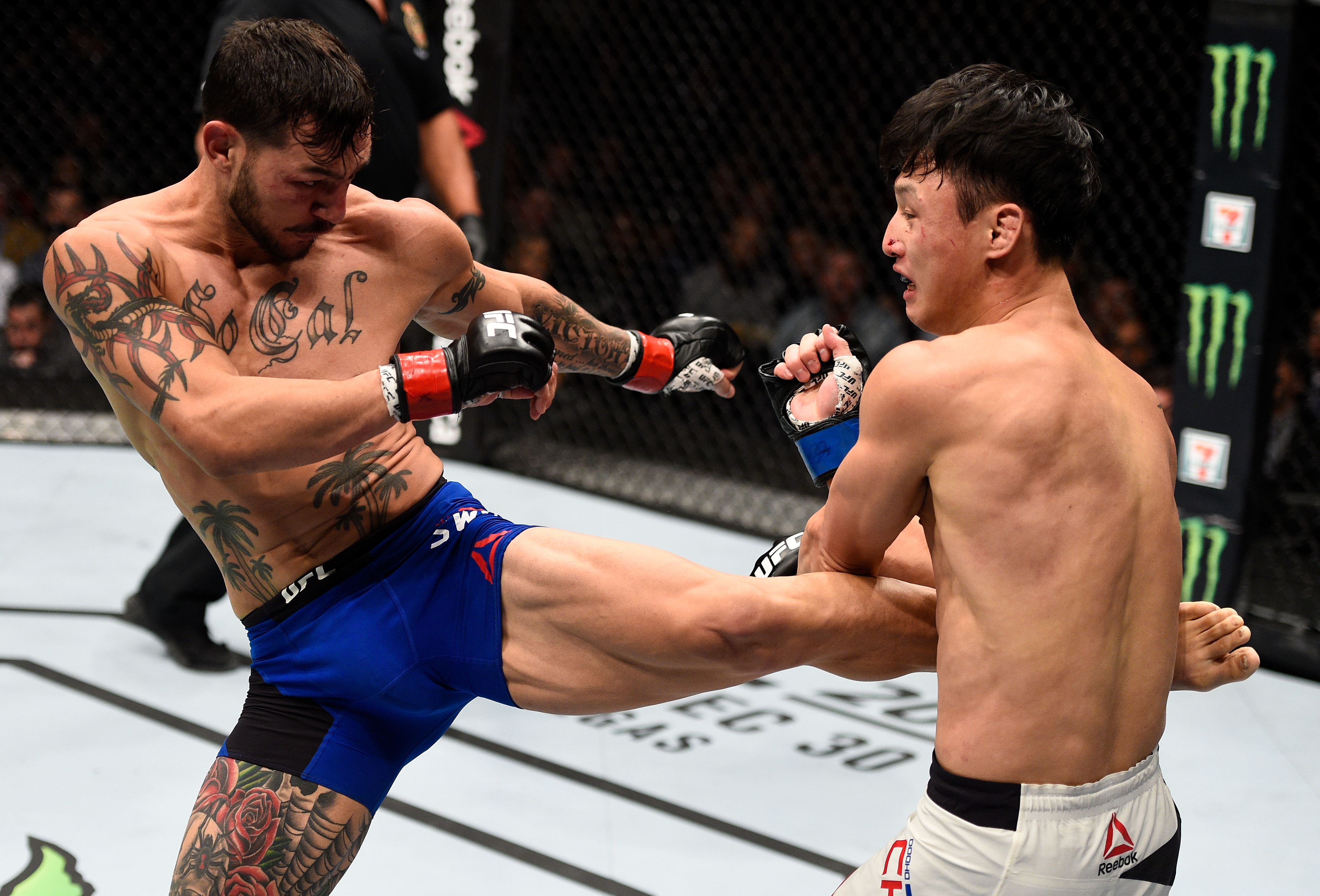
A lone wolf, who many years later would be inducted into the UFC’s Hall of Fame for his epic crossroads with Doo Ho Choi in Toronto, a fight in which he refused to lose. Swanson made 10 times what Garcia did that night in his WEC debut at the Hard Rock Casino in Vegas, receiving $3,000 to show. There were bigger names from the blue-floor wars, those who became the story when the WEC integrated with the UFC in 2011.
Swanson fought — and lost — to a good many of them.
Pulver got him with an anaconda. Jose Aldo a flying knee. Chad Mendes had to grind, but he proved too much in the end. They all had great careers in the UFC, too, yet Swanson hit the ground running when he arrived to the big show. After a loss to Ricardo Lamas to kick off the UFC’s new partnership with FOX in 2011, he won six in a row.
While names like Cruz, Faber and Aldo got the headlines, it was Swanson who carried a chip on his shoulder.
“I remember talking to [UFC matchmaker] Sean [Shelby] on the phone, and he would give me the same speech like, ‘Hey, so Dennis Siver, he dropped down to 145, he's probably going to fight for a title. We want you to fight him.’” Swanson says. “And then, ‘Ross Pearson, he was doing well at ‘55, now he’s dropping to ‘45, we want you to fight him.’ And then, ‘Charles Olivera, we think him being at ‘45, he’s going to make a run for the title.’ So it was obvious that I was kind of the gatekeeper in a sense, but I was like, ‘Whatever, keep them coming.’”
Swanson is the last to walk. In his time he has seen it all passing by him, camp after camp, 44 pro fights in all. He has seen champions come and go, and the sport morph into what it has become. He has been celebrated as much as he has been overlooked, famous and anonymous.
“I remember distinctively, one moment, Michael Johnson was training with us at [Greg] Jackson's right before he went on ‘The Ultimate Fighter’ show, and he was a fan of all of us,” Swanson says. “This was still when the show was at its height, and they’d taped the show we were all in Canada together. He was happy to see us because it had been a while. I remember some fans came by and they walked right past the WEC guys, they had no clue who we were, yet they just bombarded him.
“It was weird. I remember him just looking at me and apologizing, and I'm like, ‘Nah, man, enjoy it. Good for you!’ But just seeing those guys who were in the UFC, getting acknowledged, the casual fans just didn't understand that we were those guys, too.”
They did eventually. They do now.
Those WEC days are gone, but the fights live on. There was Torres going up against Takeya Mizugaki at WEC 40, in which Torres prevailed in his hometown of Chicago. There was Garcia’s war with “The Korean Zombie,” Chan Sung Jung, at WEC 48. There was Anthony Pettis’ “Showtime” kick off the fence against Benson Henderson in Phoenix at WEC 53, the very last WEC show.
Then there was Swanson’s fight with Mackens Semerzier, in what was Swanson’s swan song at WEC 52. It was at the Pearl at the Palms Casino, a small room that was perfect for the trademark blue cage. That card featured the galaxy of contenders and past and present champions, from Faber and Mendes to Joseph Benavidez, to Dustin Poirier and the flyweight GOAT, Demetrious Johnson. Swanson outlasted Semerzier in a classic battle that night. Then he outlasted everyone.
Now he’s the last man standing, closing out a most colorful era of MMA’s past.
