Reading view

Your Bitcoin Is Safe, But Satoshi’s 1.1M BTC Sits in a Quantum Risk Zone, Nobody Can Fix

15 Years Since Satoshi Nakamoto Went Silent

The post Your Bitcoin Is Safe, But Satoshi’s 1.1M BTC Sits in a Quantum Risk Zone, Nobody Can Fix appeared first on Coinpedia Fintech News

The mysterious creator of Bitcoin, Satoshi Nakamoto, has not been seen or heard from in over a decade and has now turned 51. Now, the focus is not on his return, but on the rising risk from quantum computers.

And the 1.1 million BTC he left behind, worth nearly $76 billion, may now be at risk. Experts say most Bitcoin holders are safe for now, but Satoshi’s untouched 1.1M BTC is not; here’s why.

Why is your Bitcoin safe?

Quantum computers could break Bitcoin’s current security in just nine minutes, while Bitcoin’s average block time is ten minutes. But this mainly matters when a user sends a transaction. Once a public key is visible, a strong quantum computer could try to find the private key quickly.

However, developers have a solution ready. A new quantum-safe system can be added to Bitcoin so that old addresses can move coins without exposing their keys. 

Using methods like zero-knowledge proofs, ownership is proven without revealing the public key. Proposals like BIP 360 would create a new address type, removing the public key from the blockchain and protecting new coins from quantum attacks.

That’s why most Bitcoin is safe, except for Satoshi’s untouched coins.

$76B in Satoshi’s Bitcoin Faces Quantum Threat

Satoshi’s Bitcoin has never been moved in over 15 years, and that is the main problem. The “zero-knowledge migration” fix only works if a wallet makes a transaction, but Satoshi’s wallet hasn’t moved and likely never will. 

There is no way to protect coins in a wallet that stays inactive, and no one knows if Satoshi is alive, gone, or just waiting.

Today, his coins are worth about $76 billion, making him stand in the top 25 of the world’s billionaires list.

But Didn’t Satoshi Already Send Bitcoin?

Some users point to the first-ever Bitcoin transaction, when Satoshi sent 10 BTC to Hal Finney in January 2009. If Satoshi moved coins once, why can’t the remaining BTC be secured?

The reason is simple, is that the 10 BTC came from one address, and the rest of the 1.1M BTC is spread across thousands of addresses. Each address has its own private key. Thus, moving one doesn’t give access to the others.

That’s why most of Satoshi’s Bitcoin remains locked and can’t be moved or updated without the owner’s action.

Options Left: Burn It or Leave It?

The community now faces two Options.

  • Option 1: Freeze or burn the coins

This would prevent a future quantum attacker from claiming them. This would take his coins without permission, showing that anyone’s Bitcoin could be controlled if enough people agree. 

“Your keys, your coins” would no longer be fully true.

  • Option 2: Leave the coins untouched

If quantum computers become powerful enough, whoever derives the private key could claim roughly $70 billion worth of BTC.

Both options break Bitcoin’s core promise. 
Bitcoin Price Jumps to $69K on US-Iran 45-Day Ceasefire Talks

$265M in Crypto Shorts Liquidated After Trump Hints at End of Iran War

The post Bitcoin Price Jumps to $69K on US-Iran 45-Day Ceasefire Talks appeared first on Coinpedia Fintech News

Bitcoin price today surged back to its last week’s high price of $69,509 after reports of a possible 45-day ceasefire between the U.S. and Iran. The recovery also pushed major altcoins up. Ethereum, XRP, Solana, and Dogecoin are all up by 3% to 5%.

Despite this 45-day ceasefire, all eyes are on Trump’s 6-day deadline, which is going to end on 7th April.

U.S.–Iran In 45-Day Ceasefire Talks

Multiple U.S., Israeli, and regional sources indicated that Washington and Tehran are discussing a 45-day ceasefire, which could open the door for a longer-term agreement. 

The proposed deal is structured in two stages. The first step is a 45-day pause to allow negotiations. The second step aims for a permanent end to the conflict. Key topics include reopening the Strait of Hormuz, addressing Iran’s uranium stockpile, and discussing compensation for conflict-related losses.

Last week, Trump said the U.S. is in deep negotiations with Iran and expects a deal before the deadline. 

Trump warned that failure to reach a deal could trigger U.S. strikes and retaliation targeting Gulf energy facilities.

Trump’s Repeated Deadlines and Delays

Trump has now set a new ultimatum for Iran of 7th April at 8 PM Eastern Time, demanding Tehran reopen the strategic Strait of Hormuz or face potential military action. 

This latest deadline continues a pattern of shifting targets. First, Trump gave Iran 48 hours on March 21, then extended it by five days on March 23, pushed it back by ten days on March 26, reset it to 48 hours again on April 4, and most recently postponed it to April 7 at 8 PM ET.

However, experts believe that the chances of reaching a deal before the deadline remain very unlikely. 

Bitcoin Price Eying $75K

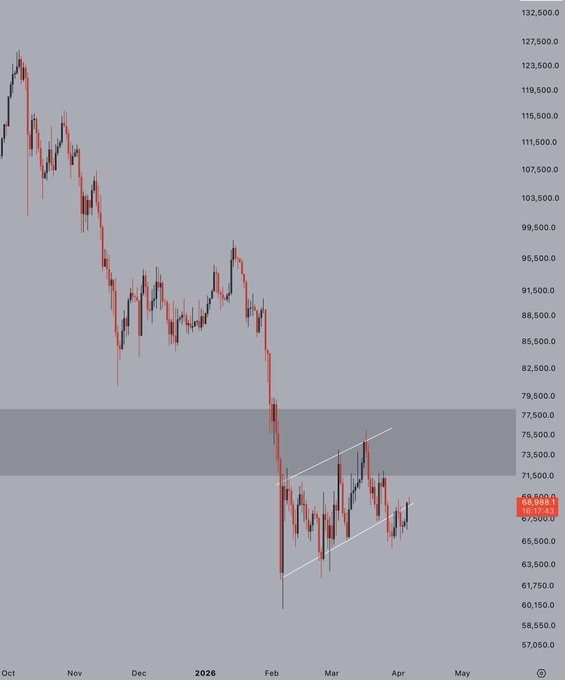
Following this news, Bitcoin quickly jumped 4%, rising from $66,000 to $69,509. In the past 24 hours, the crypto market saw $246.9 million in liquidations, with nearly $200 million from short positions alone.

Despite this recovery, Bitcoin remains in a broader consolidation range. Crypto trader Jelle noted that Bitcoin is retesting a bearish flag, though the pattern is losing strength. 

He highlighted the 200-week EMA as strong support, suggesting Bitcoin could move sideways before a clearer trend emerges..

Bitcoin Price Jumps to $69K on US-Iran 45-Day Ceasefire Talks

The charts show Bitcoin recovering from recent lows, forming a short-term upward structure. Meanwhile, key resistance lies between $72,000 and $75,000, where previous breakdown levels remain.

Quantum Computers Could Break Crypto by 2030, Circle Just Made the First Move

Circle Mints $1B USDC on Solana

The post Quantum Computers Could Break Crypto by 2030, Circle Just Made the First Move appeared first on Coinpedia Fintech News

Circle, the issuer of USDC, has just become the first major stablecoin company to address the threat of quantum computers. It officially released a quantum-resistance roadmap for Arc, its Layer 1 blockchain. 

The company warns that by 2030, powerful quantum computers could break current cryptography, putting wallets, transactions, and blockchain data at risk.

Circle’s Arc Targets Post-Quantum Security

Circle is designing Arc as a stablecoin-focused Layer 1 and building quantum protection into the network from the start.

Today, public-key cryptography protects every crypto wallet, including Bitcoin, Ethereum, and USDC. When you send a transaction, your private key creates a digital signature that proves it came from you. 

The problem is that quantum computers could eventually reverse these signatures, allowing attackers to access wallets. 

Security experts have also warned about “harvest now, decrypt later” attacks. This means attackers can collect encrypted data today and attempt to break it later with more powerful computers.

That’s actually Circle says Arc aims to reduce this long-term risk before the network fully scales.

Four-Phase Quantum-Resistance Plan

Circle’s roadmap for Arc is built in four clear stages, each targeting a different layer of the blockchain:

  • Phase 1 — Mainnet Launch

The first phase launches with support for post-quantum signatures, allowing users to create quantum-resistant wallets from day one. The system will be optional, letting users migrate at their own pace.

  • Phase 2 — Private State Protection

After the mainnet, the second phase extends protection to private balances and confidential transactions. Circle plans to add additional encryption layers to strengthen long-term privacy.

  • Phase 3 — Infrastructure Hardening

The third phase will focus on systems around the blockchain, like cloud services, access control, and data security. Protocols like TLS 1.3 already support post-quantum security, and many big tech providers are quietly upgrading their systems, following the industry shift toward post-quantum security.

  • Phase 4 — Validator Hardening

The final and most complex phase targets the validators that confirm transactions. Because Arc finalizes blocks in under one second, leaving attackers only about 500 milliseconds to fake a signature.

However, post-quantum signatures require more computing power, so the team will roll out upgrades gradually.

What This Means for Bitcoin, Why Long-Term Holders Should Worry

Bitcoin has no plan for quantum resistance. Since it was built in 2009 using classical cryptography, updating the entire network would be extremely challenging. Migrating all Bitcoin wallets to post-quantum security could take months of nonstop work.

Every Bitcoin address that has sent a transaction has its public key exposed on the blockchain. When quantum computers arrive, whether around 2030 or 2035, these addresses, including Satoshi’s wallets and early miner holdings, could become targets. 

All of it sits on a public ledger, waiting.

ZachXBT’s Circle Files: USDC’s Biggest Compliance Scandal

ZachXBT Announces Major Crypto Investigation

The post ZachXBT’s Circle Files: USDC’s Biggest Compliance Scandal appeared first on Coinpedia Fintech News

Circle, the issuer of USDC, is facing criticism after blockchain investigator ZachXBT shared a detailed thread called “Welcome to Circle Files.” Over the past three years, Circle’s handling of USDC has reportedly resulted in losses totaling over $420 million, involving multiple high-profile hacks and thefts.

ZachXBT questioned why Circle didn’t use its power to freeze stolen USDC sooner.

Case by Case — USDC Compliance Failures

This is not a small accusation from a random account. ZachXBT is one of the most respected on-chain investigators in the world, and every claim in the thread is backed by verifiable blockchain data.

  • The Drift Protocol Hack — April 1, 2026

One of the most recent cases is the April 2026 Drift Protocol exploit, over $232M USDC was bridged from Solana to Ethereum across more than 100 transactions in six hours. All using Circle’s own Cross-Chain Transfer Protocol, with no action from Circle.

Security researcher Specter noted that the attacker deliberately avoided converting to Tether during the bridging process, suggesting the hacker was confident Circle would not freeze the funds.

  • The Bybit Hack — February 2025

When the Lazarus Group stole $1.5 billion from Bybit, law enforcement asked both Tether and Circle to freeze a theft address. Tether froze within hours, while Circle reportedly acted 24 hours later.

  • Radiant Capital Hack – Oct 2024

In October 2024, Radiant Capital was hacked for $58 million by the Lazarus Group. The attacker stole USDC using open approvals and moved across multiple blockchains. The funds stayed in hacker wallets for hours, but Circle did not freeze them.

  • Mango Markets Hack – Oct 2022

Similarly, in October 2022, Mango Markets was hacked for $110 million. The attacker moved $57.5 million to a Circle deposit address on Solana and later transferred the funds to Ethereum. The attacker was eventually charged by the SEC, but the stolen funds were never frozen on-chain.

  • The Nomad Bridge Hack — August 2022

Around $45 million in USDC sat in hacker wallets for 30–45 minutes, and the hack was publicly known. Circle never blacklisted the addresses, and the funds were swapped out.

Why Circle Has Been Delaying in Taking Strong Action 

ZachXBT said Circle has the tools to act faster, but delays have affected users, with losses reaching nine figures. He noted that Circle is not helpless in this situation

USDC’s token contract includes a freeze and blacklist function, and Circle’s own terms of service explicitly state it reserves the right to restrict access for suspected illicit actors “in its sole discretion.”

This means Circle can freeze stolen USDC without waiting for court orders. But the problem, according to ZachXBT, is that Circle repeatedly chose not to act quickly.

❌