Reading view

Bitcoin Devs Build Quantum-Proof Wallet Prototype to Protect Funds
quantum computing threat to Bitcoin and Ethereum

The post Bitcoin Devs Build Quantum-Proof Wallet Prototype to Protect Funds appeared first on Coinpedia Fintech News

Bitcoin developers have built a working prototype to protect wallets from quantum attacks, allowing users to recover funds even if emergency security changes are activated. 

The solution addresses risks affecting up to 6.9 million BTC and signals proactive steps toward quantum-resistant Bitcoin security.

Bitcoin: Prototype Designed for Quantum Emergency

A senior Bitcoin developer and Lightning Labs CTO, Olaoluwa Osuntokun, introduced a working prototype that protects wallets from quantum computing threats. The system allows users to recover funds even if Bitcoin disables vulnerable signature mechanisms during a quantum emergency.

The tool uses zk-STARK cryptographic proofs to verify wallet ownership without exposing private keys. This means users could still move funds even if the current signature method becomes unsafe.

The prototype reportedly generates a proof in about 50 seconds on a standard MacBook, uses around 12GB of RAM, and produces a 1.7MB verification proof. Meanwhile, developers say performance could improve further with optimized production code.
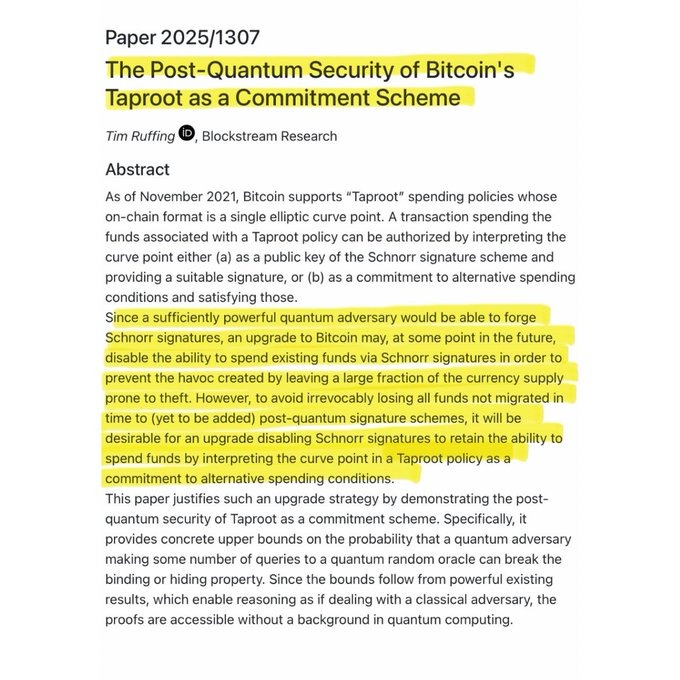
Bitcoin Devs Build Quantum-Proof Wallet Prototype to Protect Funds

Why It Needed: Growing Quantum Computing Threat

Bitcoin wallets rely on elliptic curve cryptography, which is secure against classical computers. However, quantum computers running Shor’s algorithm could theoretically derive private keys from public keys.

Recent research suggests such attacks may be possible faster than previously expected. Around 6.9 million Bitcoin in older and Taproot-style wallets already have exposed public keys, making them potential targets in the future.

To defend against this, developers could deploy an emergency soft fork that disables vulnerable spending paths. But this creates a new problem, many wallets would become unspendable even by their owners.

How Will This Solve Bitcoin Security

The new prototype solves this issue by allowing users to prove ownership through their seed phrase derivation path. This lets them recover funds even if the standard signature method is disabled.

This development reduces the risk of funds being permanently locked during a quantum defense upgrade. It also shows Bitcoin developers are preparing for long-term security threats.

Quantum computers capable of breaking Bitcoin do not exist yet. However, research suggests timelines may be shortening. The new prototype gives the community a working solution before the threat becomes real.

If needed, the system could be integrated into future upgrades, ensuring users can safely migrate funds during a quantum emergency while keeping Bitcoin secure.
Stablecoin Volumes Could Hit $1.5 Quadrillion by 2035: Chainalysis Report

Stablecoin Volumes Could Hit $1.5 Quadrillion by 2035 Chainalysis Report

The post Stablecoin Volumes Could Hit $1.5 Quadrillion by 2035: Chainalysis Report appeared first on Coinpedia Fintech News

Stablecoin volumes could reach $1.5 quadrillion by 2035, driven by generational wealth transfer and increasing retail adoption, according to a report by Chainalysis.

Currently, stablecoins process around $28 trillion annually, already surpassing many traditional payment systems. This suggests stablecoins could become a core global payment infrastructure within the next decade.

Stablecoins Growing Faster Than Traditional Payments

According to the Chainalysis report titled “The $100 Trillion Wealth Shift,” stablecoins are already handling massive economic activity. Adjusted stablecoin volume reached $28 trillion in 2025, reflecting real payments, settlements, and remittances.

If this growth continues at the current pace alone, volumes could reach $719 trillion by 2035. 

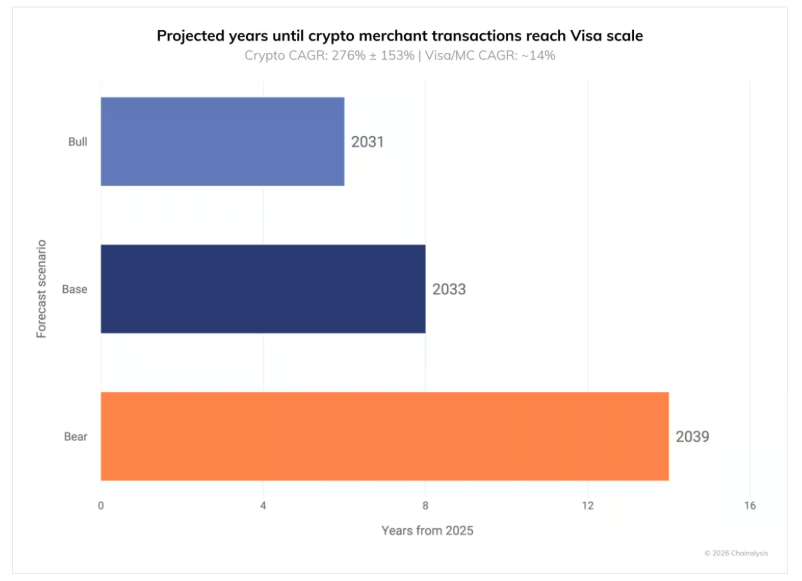
To understand the scale, as of now, Visa processes about $13 trillion annually, while Mastercard handles around $9 trillion. Combined, that is roughly $22 trillion per year. Stablecoins could surpass that range sometime between 2031 and 2039.

However, Chainalysis says two major structural forces could push the number even higher to around $1.5 quadrillion.

$100 Trillion Wealth Transfer Could Drive Adoption

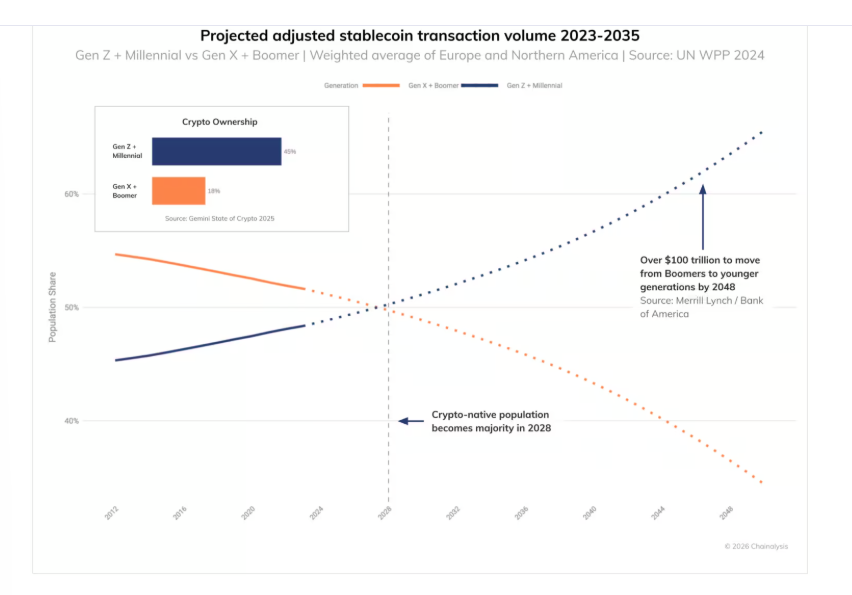
First is the historic generational wealth shift. Between 2028 and 2048, around $100 trillion is expected to move from Baby Boomers to Millennials and Gen Z.

Nearly half of the younger generations already hold or have used crypto. As this wealth moves, a portion is expected to flow into on-chain systems rather than traditional banks.

$100 Trillion Wealth Transfer Could Drive Adoption

Chainalysis estimates this generational shift alone could add $508 trillion in annual stablecoin volume by 2035.

Stablecoins Becoming Default Payment Method

The second driver is stablecoin acceptance at the point of sale. Today, using crypto for payments requires extra steps. But as merchants integrate stablecoin rails, payments could become as simple as swiping a card.

This transition mirrors how credit cards replaced cash over time. Stablecoin rails also offer faster settlement and lower transaction costs for merchants.

The report estimates that point-of-sale adoption alone could add another $232 trillion in annual volume by 2035.

Stablecoins Becoming Default Payment Method

What Next For Stablecoins

In the short term, stablecoin usage is expected to grow steadily with increased adoption.

If current trends continue:

  • Stablecoins could surpass traditional payment volumes between 2031 and 2039
  • They may become a default payment method globally

However, growth depends on regulation and infrastructure development.

FAQ

WHY ARE STABLECOINS GROWING?

Stablecoins are expanding rapidly due to three main factors:
Generational wealth transfer
Around $100 trillion will move to younger, crypto-native investors.
Retail adoption
Nearly half of Millennials and Gen Z already use crypto.
Merchant integration
Stablecoins are becoming easier to use for everyday payments.

Fed Rate Cuts Under Pressure as Iran War Fuels Inflation Risks

Will the Fed Cut Rates in December Crypto Weakens as Odds Shrink

The post Fed Rate Cuts Under Pressure as Iran War Fuels Inflation Risks appeared first on Coinpedia Fintech News

The Iran war pushed oil to $115, forcing markets to cut expectations from four Fed rate cuts to just one. The Federal Reserve kept rates at 3.50%–3.75%, as rising energy prices lifted inflation to around 3.0%. 

This signals delayed rate cuts and tighter liquidity for risk assets, which often pressure Bitcoin and altcoins.

Why the Iran War Lowered Fed Rate Cuts?

Before the U.S-Israel and Iran conflict escalated, markets expected four rate cuts this year. But the war caused oil prices to jump to nearly $118 per barrel, keeping inflation high at around 3%, above the Fed’s 2% goal. 

Because of this, the Fed decided to keep rates steady at 3.50%–3.75%.

Minutes from their March meeting show that Fed officials are taking a careful, “wait-and-see” approach. Some experts hope they can lower rates later if inflation drops

Fed officials also warned that higher oil prices from Middle East tensions could push short-term inflation higher, making it harder to reduce rates safely.

Ceasefire Pushes Oil Lower, Bitcoin Price Stalls

After a two-week ceasefire, oil dropped from $115 to below $95. This reduces inflation pressure and may bring rate cuts back into discussion. If oil stays low, markets may again price in easier policy.

For crypto, this creates short-term uncertainty. Bitcoin price may struggle to break higher without clear signals of rate cuts.

In past cycles, similar setups have pressured Bitcoin.

  • In 2022, when the Fed paused cuts and kept rates high, Bitcoin fell below $20,000.
  • In 2023, expectations of delayed cuts kept BTC range-bound for months.
  • On the flip side, when rate cuts were priced in mid 2025, Bitcoin jumped sharply above $100,000.

This shows how strongly crypto reacts to Fed policy shifts.

What Happens Next?

Several factors will decide the outcome, but as of now, CME data shows traders remain cautious. Only 25.4% expect a rate cut in December, while 99.5% see no change for April.

However, now all eyes are on tomorrow’s April CPI data to show whether the oil shock is fading. If inflation drops, rate cut expectations may rise for further months.

Additionally, leadership changes at the Fed could also matter. Jerome Powell is expected to leave in May, with Kevin Warsh seen as more supportive of lower rates.

Treasury Secretary Bessent Pushes Urgent Crypto Law, Warns “Act Now Before It’s Too Late” 

CLARITY Act

The post Treasury Secretary Bessent Pushes Urgent Crypto Law, Warns “Act Now Before It’s Too Late”  appeared first on Coinpedia Fintech News

U.S. Treasury Secretary Scott Bessent is urging Congress to pass legislation on the structure of the crypto market quickly, warning that delays could hurt America’s leadership in digital assets. However, unclear U.S. rules are pushing crypto to hubs like Singapore and Abu Dhabi.

Therefore, he framed the issue as a national priority, saying, “We must act now before it’s too late.”

Bessent Calls Crypto Law a National Priority

In a recent opinion piece, Bessent framed crypto regulation as a national priority, saying economic security is tied to digital asset leadership. He urged lawmakers to pass the Clarity Act immediately, stating that delays could push innovation overseas.

“Senate floor time is scarce, and now is the time to act.”

However, the bill has already been stalled in the Senate for more than 260 days, raising concerns that pressure from the upcoming midterm election could delay it further.

The timing is critical. Nearly 1 in 6 Americans now owns digital assets, and major financial institutions are already launching crypto-related products. Blockchain infrastructure is also expanding into payments, settlements, and tokenized real-world assets.

Even Senator Cynthia Lummis backed Bessent’s views, saying, “Now is the time to act. We have the Administration, the momentum, and we’ve made bipartisan progress. Congress must pass the Clarity Act now.”

.@SecScottBessent says it best: Now is the time to act.

We have the Administration, the momentum, and we’ve made bipartisan progress. Congress must pass the Clarity Act now.https://t.co/hNSysf4tq8

— Senator Cynthia Lummis (@SenLummis) April 9, 2026

Stablecoin Rewards Debate Slowing Progress

The biggest roadblock to the legislation has been disagreements over stablecoin rewards. Banking groups argue that allowing yield on stablecoins could pull deposits from traditional banks.

Recently, Coinpedia news reported that White House economic analysis suggests the impact would be minimal. Banning stablecoin rewards would increase bank lending by just 0.02%, equal to about $2.1 billion.

Most of that benefit would go to large banks, with limited effect on community lenders.

“Window for Action” Closing

Bessent warned that if Congress fails to act, the U.S. could lose its leadership in digital finance. He noted that unclear rules have already pushed crypto development to places like Singapore and Abu Dhabi, where firms benefit from clearer regulatory frameworks.

He also warned that upcoming election pressures could narrow the window for passing legislation. 

If delays continue, the U.S. risks falling further behind as other countries move faster on crypto regulation.


White House Economists Say Stablecoin Rewards Won’t Harm Banks

Stablecoin Reward Ban Debate Intensifies as Clarity Act Stalls

The post White House Economists Say Stablecoin Rewards Won’t Harm Banks appeared first on Coinpedia Fintech News

White House economists have pushed back against claims that stablecoin rewards could damage the traditional banking system. A new report from the Council of Economic Advisers says banning stablecoin yields would have only a minimal impact on bank lending, suggesting fears from banking groups may be overstated.

Stablecoin Rewards Unlikely to Drain Bank Deposits

According to a White House report titled “Effects of Stablecoin Yield Prohibition on Bank Lending,” banning rewards on stablecoin balances would have only a small impact on banks.

It would increase lending by just 0.02%, or about $2.1 billion, which is minimal compared to the overall banking system.

The analysis also found that most of this increase would benefit large banks. About 76% of the additional lending would come from major institutions, while community banks would account for the remaining 24%. 

In dollar terms, smaller banks would add around $500 million in loans, representing only a 0.026% rise.

💥BREAKING:

White House economists say stablecoin rewards won’t hurt banks.

Even banning yields would only increase lending by about 0.02%, per Bloomberg. pic.twitter.com/Y98SnceENd

— Crypto Rover (@cryptorover) April 8, 2026

Overall, the findings suggest that stablecoin rewards are unlikely to significantly drain deposits from banks, easing major concerns.

Report Counters Banking Industry Warnings

Some banking groups previously warned that stablecoins offering rewards could lead to major deposit outflows. One estimate suggested banks could lose up to $1.3 trillion in deposits and $850 billion in loans.

However, the White House economists said such outcomes appear unlikely. Even under extreme assumptions, the model showed total additional bank lending reaching $531 billion, equal to about a 4.4% increase. But this scenario would require the stablecoin market to grow to six times its current size, alongside major changes to monetary policy.

The report noted that these conditions are unrealistic, making the risk to banks limited.

Consumer Benefits Could Be Lost With a Ban

Economists also warned that banning stablecoin rewards could harm users. Stablecoin programs often offer competitive returns compared to traditional bank deposits.

For example, some platforms currently offer around 3.5% rewards on stablecoin balances. Removing such incentives could reduce competition and limit consumer choice.

The report concluded that prohibiting yields would do little to protect bank lending while eliminating potential benefits for users.

“I’m Not Satoshi,” Says Adam Back, denying NYT Claim

Adam Back Shuts Down Paper Bitcoin Controversy

The post “I’m Not Satoshi,” Says Adam Back, denying NYT Claim appeared first on Coinpedia Fintech News

After more than 15 years and countless investigations, the identity of Satoshi Nakamoto remains unknown. Now the New York Times thinks it has the answer, and the man they are pointing at is British cryptographer Adam Back.

Well, Adam Back has publicly denied claims saying he is not Satoshi and that similarities in early research and writings are being misinterpreted.

NYT Finds 3 Key Similarities Linking Adam Back to Satoshi

The investigation was led by John Carreyrou, the NYT journalist famous for exposing the Theranos fraud, alongside AI projects editor Dylan Freedman. Researchers spent over a year analyzing 134,308 posts from 620 candidates on major cryptography mailing lists from 1992 to 2008.

Using linguistic analysis, the team found strong similarities between Back’s writing and Satoshi’s messages. One test identified 325 hyphenation quirks in Satoshi’s writing, with Back sharing 67 of them. 

Bitcoin’s founder, Satoshi Nakamoto, has remained hidden for 17 years. A trail of clues — and a year of digging by our reporter, John Carreyrou — led us to a 55-year-old computer scientist in El Salvador named Adam Back. https://t.co/s6Jy00IDdk

— The New York Times (@nytimes) April 8, 2026

The second closest match had only 38, which narrowed the search significantly.

Secondly, both used British spellings, specific hyphenation patterns, double spacing between sentences, and alternated terms like “e-mail” and “email.

Lastly, the behavioral timeline added another layer. Back was consistently present in electronic cash discussions for over a decade. Then, when Satoshi announced Bitcoin in late 2008, Back went completely silent.

Adam Back Responds: “I’m Not Satoshi”

Responding to the Carreyrou report, Back rejected the claim and said the connections are mostly coincidental. He explained that he was active in cryptography discussions since the early 1990s, which naturally created an overlap with Bitcoin ideas.

“I’m not saying I’m good with words, but I sure did a lot of yakking on these lists, actually.”

Because he was one of the most active contributors on early mailing lists, his writing appears more often in any analysis, but this does not mean he created Bitcoin.

On technical similarities, Back said many experts were working on digital cash ideas at the same time, so shared concepts are not proof of identity. He also made it clear that he does not know who Satoshi is. 

According to Back, this mystery is actually beneficial, as it keeps Bitcoin independent and not tied to any single individual.

The “We Are All Satoshi” Clarification

One old tweet from Adam Back said, “We Are All Satoshi.” Some interpreted the line as a hidden admission. However, he clarified that the statement was taken out of context.

we are all satoshi pic.twitter.com/s99EdawfjM

— Adam Back (@adam3us) March 23, 2023

According to Back, the phrase referred to a short film titled “Block 170, The First Transaction.” The film featured a stone engraved with “We Are All Satoshi” as part of its artistic concept. 

He said his tweet was simply referencing the film, not suggesting any personal connection.

So Who Is Satoshi Nakamoto?

For over 15 years, the identity of Bitcoin’s creator has been the biggest mystery in the history of finance. Even one of the most detailed efforts by a major global newspaper has not provided a definitive answer.

Lastly, Back said he does not know who Satoshi is and believes that anonymity is actually beneficial. He noted that Bitcoin being founderless helps it be viewed as a new asset class.

Swiss Banks Launch CHF Stablecoin Sandbox Led by UBS and Partners

: Bitcoin Not Fit for Swiss National Bank Reserves, Says President

The post Swiss Banks Launch CHF Stablecoin Sandbox Led by UBS and Partners appeared first on Coinpedia Fintech News

Switzerland just made one of the biggest moves in its financial history. Six major banks, including UBS, PostFinance, Sygnum, Raiffeisen, Zurcher Kantonalbank, and BCV, have come together to test a Swiss franc-backed stablecoin. 

This is the Swiss banking establishment saying blockchain is real, and they are getting ready for it right now.

UBS and Swiss Banks Test CHF Stablecoin Use Cases

On April 8, 2026, UBS, PostFinance, Sygnum, Raiffeisen, Zurcher Kantonalbank, and BCV teamed up with Swiss Stablecoin AG to launch a controlled testing environment. 

The sandbox will allow participants to experiment with blockchain-based payments linked directly to the Swiss franc.

The stablecoin will be designed to maintain a 1:1 peg with the CHF, ensuring price stability. By testing the token in a live but controlled setup, the group aims to evaluate how digital francs could improve payment efficiency and settlement speed.

The initiative also focuses on connecting traditional banking infrastructure with blockchain-based financial applications. This approach allows institutions to test new payment models without introducing immediate systemic risk.

What Is a Sandbox and Why Does It Matter?

A lot of people will read the word “sandbox” and picture something cautious and experimental. In reality, a sandbox is a safe test space for new ideas. 

Swiss Stablecoin AG will run it, letting banks try a CHF stablecoin in real conditions.  This is not a paper exercise. Real transactions will happen. Real money will move. Real problems will surface, and that is exactly the point. 

The banks want to know what breaks, what works, and what needs to change before they scale this to millions of Swiss customers.

The project also welcomes additional banks, companies, and institutions, allowing a variety of participants to contribute and learn from different financial use cases. This approach ensures a safer and more reliable rollout of blockchain-based payments in Switzerland.

What This Means for the Crypto and Stablecoin World

This announcement is significant far beyond Switzerland. When six major traditional banks, not crypto startups or DeFi projects, join forces on a stablecoin, it sends a strong signal to the global financial system.

Currently, according to UBS, there is no widely used regulated Swiss franc stablecoin in Switzerland.

The stablecoin market has already grown to $320 billion, and payment flows could reach $56.6 trillion by 2030. This shows that traditional finance is increasingly exploring digital currencies, and Switzerland could become a key hub for regulated stablecoin adoption.

Iran Loses Nearly 77% of Its Bitcoin Mining Power

Bitcoin mining cost in Iran

The post Iran Loses Nearly 77% of Its Bitcoin Mining Power appeared first on Coinpedia Fintech News

Iran’s Bitcoin mining sector has taken a major hit amid the ongoing conflict involving the U.S., Israel, and Iran. The country has reportedly lost around 77% of its Bitcoin mining power, forcing thousands of miners offline. 

The crisis has slowed global Bitcoin mining too, with the network dropping 5.8% QoQ, while falling Bitcoin prices continuously.

Iran Bitcoin Hashrate Drops Sharply

According to a Hashrate Index report, Iran’s Bitcoin hashrate has plunged from around 9 exahashes per second (EH/s) to just 2 EH/s, a drop of nearly 7 EH/s quarter-over-quarter.

The country, which once ran roughly 427,000 active Bitcoin miners, is now operating at a fraction of that capacity.

The trouble began in February 2026, when the US and Israel launched strikes against Iran. This led to rising conflict, infrastructure risks, and energy disruptions, which appear to be forcing miners offline.

Recently, Trump even threatened to strike power plants, energy facilities, and bridges, further worsening the situation.

Interestingly, the crisis remains contained within Iran. Neighboring countries like the UAE and Oman, each controlling about 3% of the global Bitcoin hashrate, have seen no disruptions and continue steady growth, supported by long-term government infrastructure plans.

Global Bitcoin Hashrate Declines By 5.8% QoQ

The impact isn’t just in Iran; global Bitcoin hashrate has also fallen. Data shows the network dropped to around 1,004 EH/s in Q2 2026, down from 1,066 EH/s in Q1 2026, a 5.8% decline quarter-over-quarter.

While the network remains strong near 1,000 EH/s, the drop signals slower mining activity and tougher conditions for miners. 

Iran Loses 77% Bitcoin Mining Power as Conflict Pushes Global Hashrate Lower

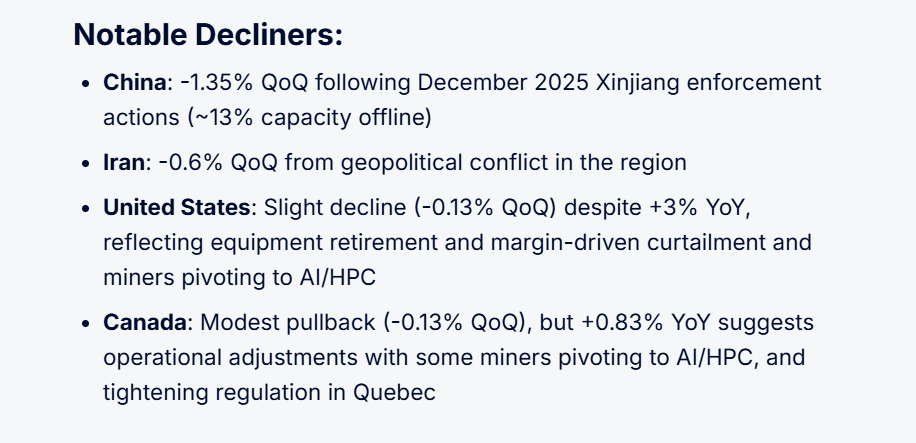
Looking at market share change, China has lost 1.35% QoQ after Xinjiang enforcement actions cut about 13% of its capacity. Meanwhile, Iran dropped 0.6% due to US-Israel conflicts, and the US fell by 0.13%.

Experts say the decline reflects broader pressure across the Bitcoin mining industry.

Bitcoin Price Drop Adds More Pressure

The mining slowdown also comes as the Bitcoin price remains below its previous highs. Bitcoin has fallen roughly 50% from its October 2025 peak near $126,000 and is now trading around $70,000.

Lower prices reduce mining profitability, pushing smaller operators offline. Hashprice has also dropped to around $27.89 per PH/s per day, marking historically low returns for miners.

Despite the decline, the Bitcoin network continues operating normally. 

Arthur Hayes Goes All-In on HYPE token, “Only Thing We’re Buying”

Arthur Hayes Sees $HYPE Hitting $150 by 2026

The post Arthur Hayes Goes All-In on HYPE token, “Only Thing We’re Buying” appeared first on Coinpedia Fintech News

BitMEX co-founder Arthur Hayes said he is currently buying only Hyperliquid’s HYPE token, as the asset posts strong gains and trading activity increases.

HYPE rose about 9% in the past 24 hours and has gained nearly 60% since the start of the year. The move follows Hayes’ public comment that “the only thing we’re buying right now is HYPE.”

Arthur Hayes Backs Hyperliquid’s HYPE Token

Arthur Hayes is very bullish on the HYPE token (the native asset of Hyperliquid). It is one of the fastest-growing trading platforms in crypto.

He recently said, “the only thing we’re buying right now is HYPE,” showing strong confidence.

One of the key reasons is its rapid growth. Hyperliquid is generating around $1 billion annually from trading fees. Also, the platform uses 97%–99% of fees to buy back HYPE tokens, which helps push the price up.

Hayes also says no other crypto project gives back this much value to token holders.

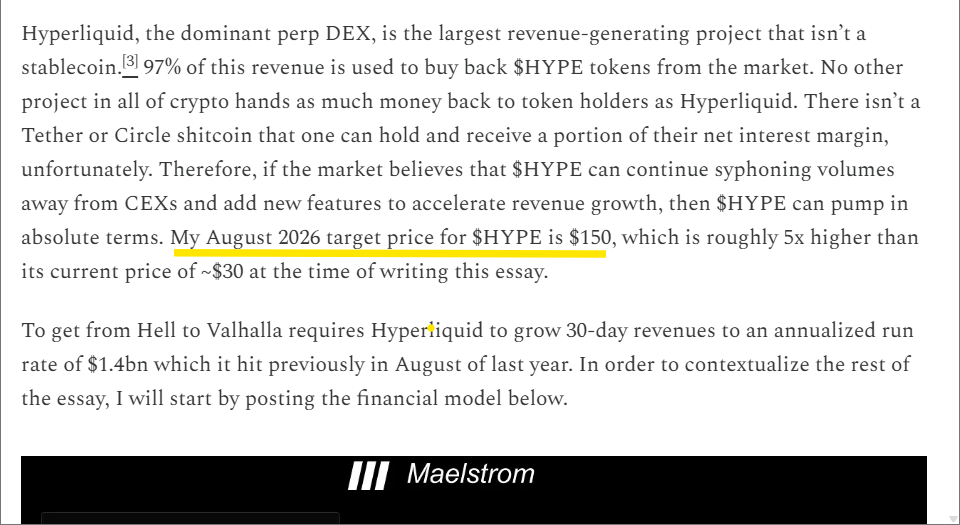
This is not the first time Arthur Hayes has turned bullish on HYPE. Last month, he predicted the token could surge to $150 by August 2026.

Arthur Hayes Says “Only Buying HYPE” as Hyperliquid Token Jumps 9%

Meanwhile, Arthur Hayes is buying HYPE while selling other tokens, including ETHFI and AUKI.

Big Buyers Keep Loading HYPE

HYPE

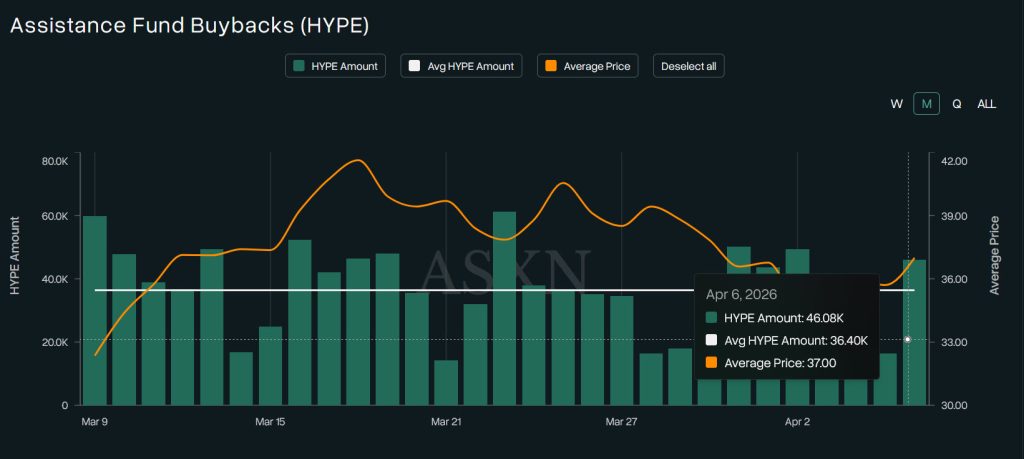
But it’s not just Arthur Hayes buying HYPE. The Hyperliquid Assistance Fund also bought 39,000 HYPE for $1.4 million at around $36.88.

On April 7, 2026, the fund holds 42.99 million HYPE, purchased for about $1.04 billion, with an average price of about $24.3. This is part of Hyperliquid’s buyback and burn plan.

At the same time, HyperCore continues to buy HYPE in small amounts, usually between $1.5M and $1.7M.

However, big whales are also joining in. One whale, “yeti.hl,” bought 58,884 HYPE worth $2.19M at around $37.21 per token.

HYPE Token Jumps 9%, Up Nearly 60% This Year

Following Hayes’ statement, the HYPE token recorded a sharp price move. The token is currently trading around $39, up nearly 9% in the past 24 hours. 

The token has also seen strong performance over a longer period. Since the start of the year, HYPE is up nearly 60%, making it one of the top performers in the derivatives space.

Hayes’ support brought more attention. As trading volume quickly jumped by 75%, reaching around $320 million in just 24 hours.

This rise shows growing use and higher activity on Hyperliquid.

India Crypto Tax Alert: Section 148A Notices Target Unreported Trades

Crypto Tax in India 2025 How RBI-Backed Digital Currency Changes the Game

The post India Crypto Tax Alert: Section 148A Notices Target Unreported Trades appeared first on Coinpedia Fintech News

India’s tax authorities are now cracking down on crypto traders. The Income Tax Department has begun sending Section 148A notices for FY 2021–22, targeting unreported crypto transactions. 

With exchanges, bank records, and PAN data under review, many traders could face reassessments and pressure to explain hidden profits. 

Are you on their radar? Check it out!

Why Crypto Users Are Receiving India Crypto Tax Notices?

The notices are being triggered after the tax department began scanning trading data through its Insight Portal and risk engines. These systems compare PAN-linked KYC information, exchange transactions, bank movements, and ITR filings.

If mismatches appear, users may receive a Section 148A notice. This typically happens when crypto income was not reported, returns were not filed, or transaction trails appear incomplete due to multiple exchanges and wallets.

Many traders assumed reporting was not required in FY 2021–22 because crypto rules were unclear at the time. However, income disclosure was still mandatory, and authorities are now reviewing past activity.

Notices May Show Inflated “Undisclosed Income”

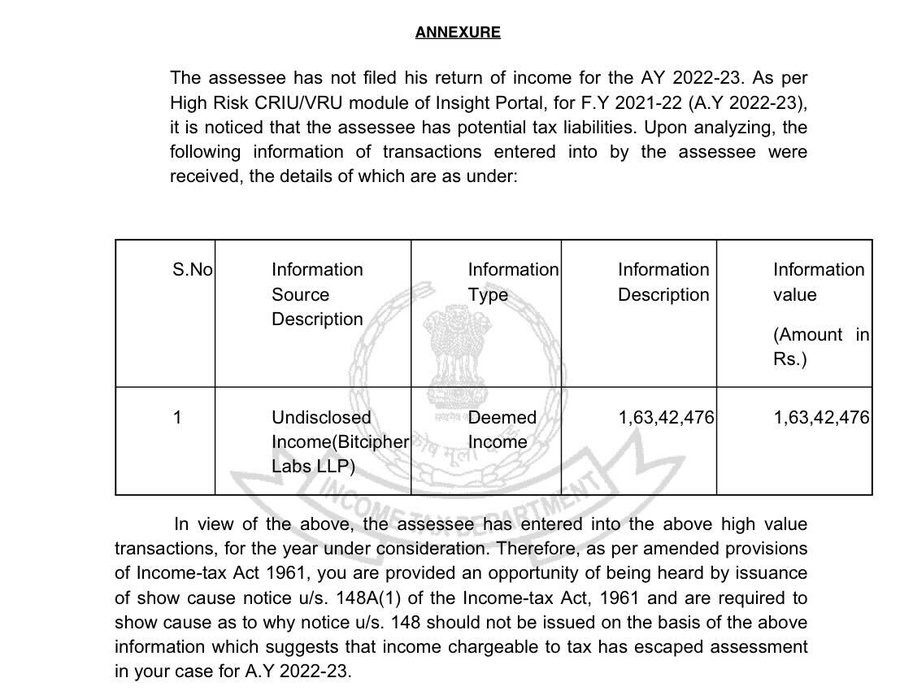
One major issue is that some notices display very high income figures. In certain cases, notices show amounts like ₹1.63 crore as “undisclosed income.” But this is often not the actual profit.

The system frequently calculates gross trading volume instead of net gains. For example, if a trader had a total trading volume of ₹ 1.6 crore but only ₹4–5 lakh in profit, the system may still flag the full ₹1.6 crore as income until it is clarified.

India Crypto Tax Alert: 148A Notices Begin for FY 2021–22 Transactions

This usually happens when the tax department sees only partial transaction data.

Multiple Exchanges Increasing Risk

Users who traded across several platforms are more likely to get flagged. A typical flow, such as CoinSwitch to Binance, then to a wallet, and later to another exchange, can create gaps in the data.

If the system sees only deposits or withdrawals without the full chain, it may treat transfers as fresh income. This leads to inflated estimates and triggers notices.

Another major red flag is not filing an ITR for AY 2022–23 despite having crypto activity. In such cases, the risk score rises sharply.

Also Read : No Crypto Tax Cuts in India Budget 2026, New Penalties Introduced for Non-Compliance

148A Notice Is Not a Tax Demand

Importantly, a Section 148A notice is not a final tax demand. It is a show-cause notice asking the taxpayer to explain the mismatch before the assessment is reopened.

Recipients are advised to reconstruct all transactions, calculate actual gains or losses, and submit supporting documents. In many cases, proper reconciliation can resolve the issue.

The development signals that crypto transactions in India are now fully traceable through AIS data, exchange reporting, and KYC records.

 With enforcement increasing, more notices for FY 2021–22 and FY 2022–23 are likely.

Polymarket Launches Its Own Stablecoin, Reduces USDC Dependence

Portugal Bans Polymarket Over €110M Election Bets

The post Polymarket Launches Its Own Stablecoin, Reduces USDC Dependence appeared first on Coinpedia Fintech News

Polymarket, one the biggest prediction market has announced a major platform upgrade that includes launching its own stablecoin, Polymarket USD. The prediction market will migrate from USDC.e to the new collateral token, which will be backed 1:1 by USDC. 

The aims to improve trading efficiency and giving Polymarket more control over its liquidity.

Polymarket Introduces Its Own USD Stablecoin

In a recent tweet post Polymarket developers team confirmed that Polymarket USD will replace USDC.e as the main collateral token on the platform. The transition will happen over the next two to three weeks alongside upgrades to smart contracts, order books, and the trading engine.

For most users, the migration will happen automatically. The platform’s frontend will handle the conversion with a one-time approval. However, power users and API traders will need to manually wrap USDC or USDC.e into Polymarket USD using the platform’s collateral onramp contract.

We've heard your feedback, and we're excited to announce Polymarket is getting a full exchange upgrade.

Over the next few weeks, we're rolling out a rebuilt trading engine, upgraded smart contracts, and a new collateral token (Polymarket USD) to move off USDC.e. 🧵

— Polymarket (@Polymarket) April 6, 2026

The platform said the update will also improve order matching, simplify orders, and enhance fee distribution. A new SDK will help developers migrate bots, though existing order books will be cleared.

This change comes as Polymarket sees rapid growth, recording over $22 billion in trading volume in the first 11 months of 2025.

Users Question Trust and Adoption, Warn Risk to Circle

The announcement triggered strong reactions from users. One X user said the move could become “the biggest threat for CRCL,” as Polymarket is currently paying around 3.5%–4% to Circle on deposits, which could push it to reduce this dependency.

If large platforms may start launching their own stablecoins, it may gives more control, lets them earn from deposits, and keeps users engaged.

While, not everyone is convinced the new stablecoin will succeed. 

Another X user pointed out that many institutions have tried launching stablecoins but failed to scale. They said that trust remains the most important factor, and Polymarket’s brand alone may not be enough.

Upgrade Requires Changes for Bots and Integrations

Polymarket is also releasing a new CLOB client SDK to support the migration. The update will automatically handle the switch from the old system to the new one, but developers must upgrade to the latest version.

Bots and integrations will need to re-sign orders using the new structure. TypeScript, Python, and Go clients will be supported, with documentation provided before launch.

During the upgrade, existing order books will be cleared, and the platform will enter a short maintenance window. Polymarket said it will announce the exact timing at least one week in advance.

If the rollout goes smoothly, the new stablecoin could streamline trading and improve platform performance

Your Bitcoin Is Safe, But Satoshi’s 1.1M BTC Sits in a Quantum Risk Zone, Nobody Can Fix

15 Years Since Satoshi Nakamoto Went Silent

The post Your Bitcoin Is Safe, But Satoshi’s 1.1M BTC Sits in a Quantum Risk Zone, Nobody Can Fix appeared first on Coinpedia Fintech News

The mysterious creator of Bitcoin, Satoshi Nakamoto, has not been seen or heard from in over a decade and has now turned 51. Now, the focus is not on his return, but on the rising risk from quantum computers.

And the 1.1 million BTC he left behind, worth nearly $76 billion, may now be at risk. Experts say most Bitcoin holders are safe for now, but Satoshi’s untouched 1.1M BTC is not; here’s why.

Why is your Bitcoin safe?

Quantum computers could break Bitcoin’s current security in just nine minutes, while Bitcoin’s average block time is ten minutes. But this mainly matters when a user sends a transaction. Once a public key is visible, a strong quantum computer could try to find the private key quickly.

However, developers have a solution ready. A new quantum-safe system can be added to Bitcoin so that old addresses can move coins without exposing their keys. 

Using methods like zero-knowledge proofs, ownership is proven without revealing the public key. Proposals like BIP 360 would create a new address type, removing the public key from the blockchain and protecting new coins from quantum attacks.

That’s why most Bitcoin is safe, except for Satoshi’s untouched coins.

$76B in Satoshi’s Bitcoin Faces Quantum Threat

Satoshi’s Bitcoin has never been moved in over 15 years, and that is the main problem. The “zero-knowledge migration” fix only works if a wallet makes a transaction, but Satoshi’s wallet hasn’t moved and likely never will. 

There is no way to protect coins in a wallet that stays inactive, and no one knows if Satoshi is alive, gone, or just waiting.

Today, his coins are worth about $76 billion, making him stand in the top 25 of the world’s billionaires list.

But Didn’t Satoshi Already Send Bitcoin?

Some users point to the first-ever Bitcoin transaction, when Satoshi sent 10 BTC to Hal Finney in January 2009. If Satoshi moved coins once, why can’t the remaining BTC be secured?

The reason is simple, is that the 10 BTC came from one address, and the rest of the 1.1M BTC is spread across thousands of addresses. Each address has its own private key. Thus, moving one doesn’t give access to the others.

That’s why most of Satoshi’s Bitcoin remains locked and can’t be moved or updated without the owner’s action.

Options Left: Burn It or Leave It?

The community now faces two Options.

  • Option 1: Freeze or burn the coins

This would prevent a future quantum attacker from claiming them. This would take his coins without permission, showing that anyone’s Bitcoin could be controlled if enough people agree. 

“Your keys, your coins” would no longer be fully true.

  • Option 2: Leave the coins untouched

If quantum computers become powerful enough, whoever derives the private key could claim roughly $70 billion worth of BTC.

Both options break Bitcoin’s core promise. 

Bitcoin Price Jumps to $69K on US-Iran 45-Day Ceasefire Talks

$265M in Crypto Shorts Liquidated After Trump Hints at End of Iran War

The post Bitcoin Price Jumps to $69K on US-Iran 45-Day Ceasefire Talks appeared first on Coinpedia Fintech News

Bitcoin price today surged back to its last week’s high price of $69,509 after reports of a possible 45-day ceasefire between the U.S. and Iran. The recovery also pushed major altcoins up. Ethereum, XRP, Solana, and Dogecoin are all up by 3% to 5%.

Despite this 45-day ceasefire, all eyes are on Trump’s 6-day deadline, which is going to end on 7th April.

U.S.–Iran In 45-Day Ceasefire Talks

Multiple U.S., Israeli, and regional sources indicated that Washington and Tehran are discussing a 45-day ceasefire, which could open the door for a longer-term agreement. 

The proposed deal is structured in two stages. The first step is a 45-day pause to allow negotiations. The second step aims for a permanent end to the conflict. Key topics include reopening the Strait of Hormuz, addressing Iran’s uranium stockpile, and discussing compensation for conflict-related losses.

Last week, Trump said the U.S. is in deep negotiations with Iran and expects a deal before the deadline. 

Trump warned that failure to reach a deal could trigger U.S. strikes and retaliation targeting Gulf energy facilities.

Trump’s Repeated Deadlines and Delays

Trump has now set a new ultimatum for Iran of 7th April at 8 PM Eastern Time, demanding Tehran reopen the strategic Strait of Hormuz or face potential military action. 

This latest deadline continues a pattern of shifting targets. First, Trump gave Iran 48 hours on March 21, then extended it by five days on March 23, pushed it back by ten days on March 26, reset it to 48 hours again on April 4, and most recently postponed it to April 7 at 8 PM ET.

However, experts believe that the chances of reaching a deal before the deadline remain very unlikely. 

Bitcoin Price Eying $75K

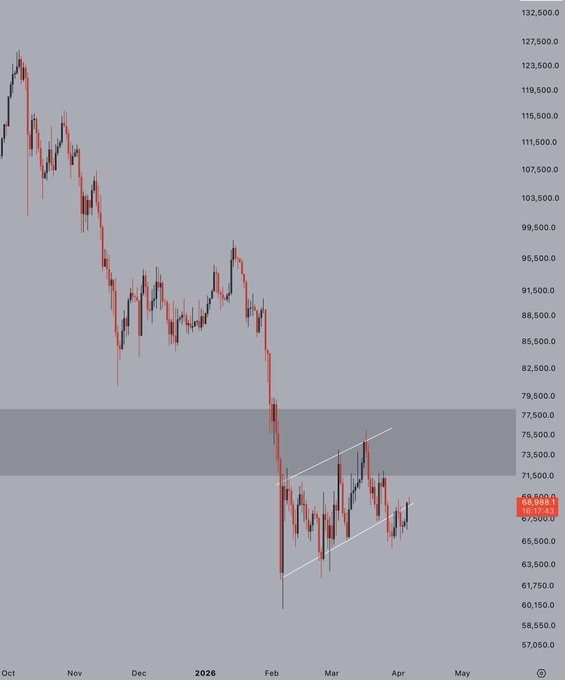
Following this news, Bitcoin quickly jumped 4%, rising from $66,000 to $69,509. In the past 24 hours, the crypto market saw $246.9 million in liquidations, with nearly $200 million from short positions alone.

Despite this recovery, Bitcoin remains in a broader consolidation range. Crypto trader Jelle noted that Bitcoin is retesting a bearish flag, though the pattern is losing strength. 

He highlighted the 200-week EMA as strong support, suggesting Bitcoin could move sideways before a clearer trend emerges..

Bitcoin Price Jumps to $69K on US-Iran 45-Day Ceasefire Talks

The charts show Bitcoin recovering from recent lows, forming a short-term upward structure. Meanwhile, key resistance lies between $72,000 and $75,000, where previous breakdown levels remain.

Quantum Computers Could Break Crypto by 2030, Circle Just Made the First Move

Circle Mints $1B USDC on Solana

The post Quantum Computers Could Break Crypto by 2030, Circle Just Made the First Move appeared first on Coinpedia Fintech News

Circle, the issuer of USDC, has just become the first major stablecoin company to address the threat of quantum computers. It officially released a quantum-resistance roadmap for Arc, its Layer 1 blockchain. 

The company warns that by 2030, powerful quantum computers could break current cryptography, putting wallets, transactions, and blockchain data at risk.

Circle’s Arc Targets Post-Quantum Security

Circle is designing Arc as a stablecoin-focused Layer 1 and building quantum protection into the network from the start.

Today, public-key cryptography protects every crypto wallet, including Bitcoin, Ethereum, and USDC. When you send a transaction, your private key creates a digital signature that proves it came from you. 

The problem is that quantum computers could eventually reverse these signatures, allowing attackers to access wallets. 

Security experts have also warned about “harvest now, decrypt later” attacks. This means attackers can collect encrypted data today and attempt to break it later with more powerful computers.

That’s actually Circle says Arc aims to reduce this long-term risk before the network fully scales.

Four-Phase Quantum-Resistance Plan

Circle’s roadmap for Arc is built in four clear stages, each targeting a different layer of the blockchain:

  • Phase 1 — Mainnet Launch

The first phase launches with support for post-quantum signatures, allowing users to create quantum-resistant wallets from day one. The system will be optional, letting users migrate at their own pace.

  • Phase 2 — Private State Protection

After the mainnet, the second phase extends protection to private balances and confidential transactions. Circle plans to add additional encryption layers to strengthen long-term privacy.

  • Phase 3 — Infrastructure Hardening

The third phase will focus on systems around the blockchain, like cloud services, access control, and data security. Protocols like TLS 1.3 already support post-quantum security, and many big tech providers are quietly upgrading their systems, following the industry shift toward post-quantum security.

  • Phase 4 — Validator Hardening

The final and most complex phase targets the validators that confirm transactions. Because Arc finalizes blocks in under one second, leaving attackers only about 500 milliseconds to fake a signature.

However, post-quantum signatures require more computing power, so the team will roll out upgrades gradually.

What This Means for Bitcoin, Why Long-Term Holders Should Worry

Bitcoin has no plan for quantum resistance. Since it was built in 2009 using classical cryptography, updating the entire network would be extremely challenging. Migrating all Bitcoin wallets to post-quantum security could take months of nonstop work.

Every Bitcoin address that has sent a transaction has its public key exposed on the blockchain. When quantum computers arrive, whether around 2030 or 2035, these addresses, including Satoshi’s wallets and early miner holdings, could become targets. 

All of it sits on a public ledger, waiting.

ZachXBT’s Circle Files: USDC’s Biggest Compliance Scandal

ZachXBT Announces Major Crypto Investigation

The post ZachXBT’s Circle Files: USDC’s Biggest Compliance Scandal appeared first on Coinpedia Fintech News

Circle, the issuer of USDC, is facing criticism after blockchain investigator ZachXBT shared a detailed thread called “Welcome to Circle Files.” Over the past three years, Circle’s handling of USDC has reportedly resulted in losses totaling over $420 million, involving multiple high-profile hacks and thefts.

ZachXBT questioned why Circle didn’t use its power to freeze stolen USDC sooner.

Case by Case — USDC Compliance Failures

This is not a small accusation from a random account. ZachXBT is one of the most respected on-chain investigators in the world, and every claim in the thread is backed by verifiable blockchain data.

  • The Drift Protocol Hack — April 1, 2026

One of the most recent cases is the April 2026 Drift Protocol exploit, over $232M USDC was bridged from Solana to Ethereum across more than 100 transactions in six hours. All using Circle’s own Cross-Chain Transfer Protocol, with no action from Circle.

Security researcher Specter noted that the attacker deliberately avoided converting to Tether during the bridging process, suggesting the hacker was confident Circle would not freeze the funds.

  • The Bybit Hack — February 2025

When the Lazarus Group stole $1.5 billion from Bybit, law enforcement asked both Tether and Circle to freeze a theft address. Tether froze within hours, while Circle reportedly acted 24 hours later.

  • Radiant Capital Hack – Oct 2024

In October 2024, Radiant Capital was hacked for $58 million by the Lazarus Group. The attacker stole USDC using open approvals and moved across multiple blockchains. The funds stayed in hacker wallets for hours, but Circle did not freeze them.

  • Mango Markets Hack – Oct 2022

Similarly, in October 2022, Mango Markets was hacked for $110 million. The attacker moved $57.5 million to a Circle deposit address on Solana and later transferred the funds to Ethereum. The attacker was eventually charged by the SEC, but the stolen funds were never frozen on-chain.

  • The Nomad Bridge Hack — August 2022

Around $45 million in USDC sat in hacker wallets for 30–45 minutes, and the hack was publicly known. Circle never blacklisted the addresses, and the funds were swapped out.

Why Circle Has Been Delaying in Taking Strong Action 

ZachXBT said Circle has the tools to act faster, but delays have affected users, with losses reaching nine figures. He noted that Circle is not helpless in this situation

USDC’s token contract includes a freeze and blacklist function, and Circle’s own terms of service explicitly state it reserves the right to restrict access for suspected illicit actors “in its sole discretion.”

This means Circle can freeze stolen USDC without waiting for court orders. But the problem, according to ZachXBT, is that Circle repeatedly chose not to act quickly.

❌