
 Login
Login
AMD Ryzen 9 9950X3D2 Dual Edition MSRP is $899
Ahead of its April 22 retail availability, AMD confirmed the U.S. MSRP (pre-tax) pricing of its upcoming flagship desktop processor, the Ryzen 9 9950X3D2 Dual Edition. The chip comes with an AMD MSRP of $899, or $200 higher than the launch MSRP of the Ryzen 9 9950X3D. This doesn't necessarily mean that the processor will be available to buy at $899, retailers could mark the chip further up, and taxes could push its street price above the $1,000-mark. At launch, the processor will be sold both as retail PIB (processor in box) packages, as well as part of pre-built gaming desktops by popular OEMs and systems integrators.
The Ryzen 9 9950X3D2 Dual Edition is a 16-core/32-thread processor powered by "Zen 5" microarchitecture and 3D V-Cache technology, with stacked 3D V-Cache on both its 8-core chiplets, resulting in an on-package L3 cache of 192 MB, and a total cache (L2+L3) of 208 MB. In comparison, the 9950X3D only has 3D V-Cache on one of its two CCDs, and relies on software-based OS scheduler guidance to ensure gaming workloads are directed to the CCD with 3D V-Cache. Besides cache, the 9950X3D2 Dual Edition is mostly similar to the 9950X3D, except its maximum boost frequency is 5.60 GHz, or 100 MHz lower than the 9950X3D; and it comes with a higher TDP of 200 W, compared to 170 W of the 9950X3D. While technically compatible with any Socket AM5 motherboard, support requires UEFI firmware updates from motherboard vendors.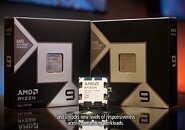
The Ryzen 9 9950X3D2 Dual Edition is a 16-core/32-thread processor powered by "Zen 5" microarchitecture and 3D V-Cache technology, with stacked 3D V-Cache on both its 8-core chiplets, resulting in an on-package L3 cache of 192 MB, and a total cache (L2+L3) of 208 MB. In comparison, the 9950X3D only has 3D V-Cache on one of its two CCDs, and relies on software-based OS scheduler guidance to ensure gaming workloads are directed to the CCD with 3D V-Cache. Besides cache, the 9950X3D2 Dual Edition is mostly similar to the 9950X3D, except its maximum boost frequency is 5.60 GHz, or 100 MHz lower than the 9950X3D; and it comes with a higher TDP of 200 W, compared to 170 W of the 9950X3D. While technically compatible with any Socket AM5 motherboard, support requires UEFI firmware updates from motherboard vendors.


