
 Login
Login
Intel Foundry Combines GaN and Silicon Semiconductors on a Single Thin Chip
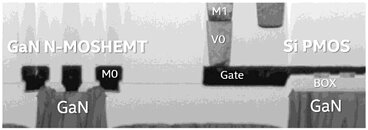
Intel Foundry has been delivering some interesting research lately, and the newest installment is the world's thinnest gallium nitride (GaN) chiplet, with the base silicon measuring just 19 micrometers in thickness. The company manufactured a 300-millimeter GaN-on-silicon wafer, which is one of the first combinations of GaN with traditional silicon logic on a single chip. In traditional manufacturing setups, GaN is reserved for power electronics and is not mixed with silicon-based computational logic. However, Intel has managed to combine GaN semiconductors for power delivery with silicon-based compute logic, meaning that power chips can now perform basic computations and actions on their own, without needing a separate chip to dictate behavior.
Intel manufactured the GaN wafer with silicon combined on the 30 nm process, which reportedly demonstrated excellent properties. This includes stable current carrying, very low power loss, and the ability to block voltages up to 78 V without leakage. What is fascinating is that GaN is usually used for wide bandgap applications, with high radio frequency performance exceeding 300 GHz. GaN also provides much better power delivery due to its superior material properties and operates more stably at higher temperatures. This is especially significant for workloads like electric vehicles or data center point-of-load delivery, where space is limited, temperatures can reach about 150°C, and stability is crucial.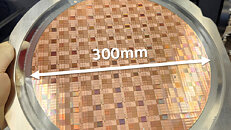

Intel manufactured the GaN wafer with silicon combined on the 30 nm process, which reportedly demonstrated excellent properties. This includes stable current carrying, very low power loss, and the ability to block voltages up to 78 V without leakage. What is fascinating is that GaN is usually used for wide bandgap applications, with high radio frequency performance exceeding 300 GHz. GaN also provides much better power delivery due to its superior material properties and operates more stably at higher temperatures. This is especially significant for workloads like electric vehicles or data center point-of-load delivery, where space is limited, temperatures can reach about 150°C, and stability is crucial.


