Today’s crypto attacks generally prey on human error rather than exploiting system vulnerabilities, leading to new approaches to wallet security.
An innovative wallet security solution, Ledger Recover is optional and not enabled by default. Users can choose their preferred level of protection.
When Ledger Recover is enabled, no single party can access a full recovery phrase, and recovery requires identity verification.
Data breaches have never compromised Ledger wallets. Ledger devices do not expose private keys, which remain encrypted inside the Secure Element chip.
Seed phrases were introduced with the Bitcoin Improvement Proposal 39 standard in 2013, enabling users to back up and recover their crypto wallets using a 12–24 word phrase.
For well over a decade, then, crypto security has depended on one fragile assumption: that users can safely store and never lose a recovery phrase. This model gives users full control over their assets, but it also creates a single point of failure. If the phrase is lost, access is permanently lost. If it is exposed, assets can be transferred without recourse.
As crypto adoption grows, it has become clear that security must evolve beyond this fragile foundation. Most crypto attacks today target users and software environments, not cryptographic systems or hardware wallets themselves. This shift has led to new approaches designed not only to prevent theft, but also to reduce the risk of irreversible loss.
The Limits of Seed Phrase Security
The current self-custody model is inherently risky, because it relies entirely on a single recovery phrase. If that phrase is lost, there is no way to restore access. Unlike traditional financial systems, there is no recovery process or support mechanism.
This is not a theoretical issue. It is estimated that between 17% and 23% of Bitcoin supply has been lost due to forgotten keys or misplaced seed phrases, representing billions of dollars in inaccessible assets.
At the same time, the seed phrase is also a complete access key. Anyone who obtains it can control the associated funds immediately and irreversibly. A seed phrase is both the master key and the weakest point in the system – whoever controls it controls the assets.
This creates a fundamental limitation whereby the system depends not only on strong cryptography, but on perfect user behaviour. As a result, improving security requires more than discipline. It requires better system design.
How Ledger Secures Private Keys
Ledger hardware wallets address many of these risks by isolating private keys inside a tamper-resistant Secure Element chip, similar to those used in passports and credit cards.
Private keys stored on a Ledger device do not leave the Secure Element. Ledger does not have access to user private keys or funds. Ledger hardware wallets are designed so that remote attackers cannot access private keys.
Transactions are signed within the device itself. The hardware wallet receives transaction data from a connected device, but the signing process happens internally. Only the signed transaction is returned, ensuring that the private key remains protected at all times.
This design protects against malware and compromised computers. Even if a connected device is infected, the attacker cannot extract private keys or alter transactions without detection. Users must physically verify and approve transactions on the device screen.
What Breaches to Ledger’s Ecosystem Actually Involved
Reports of “Ledger breaches” often refer to incidents involving customer data, not the security of hardware wallets.
For example, attackers have obtained customer information such as email addresses and physical addresses through third-party service breaches. This data has primarily been used for phishing attempts. However, Ledger data breaches have not exposed private keys or allowed attackers to access user funds.
Similarly, earlier incidents involving marketing databases resulted in the exposure of contact information, but not cryptographic assets. In all cases, the security model of the hardware wallet remained intact.
Security researchers consistently emphasize that these types of incidents increase the risk of social engineering, not cryptographic compromise. Hardware wallet security depends primarily on users keeping their recovery phrase secure and verifying transactions carefully.
From Single Point of Failure to Distributed Security
Crypto security faces two primary challenges: preventing theft and preventing irreversible loss.
Traditional self-custody relies on a single secret stored in one place. This creates a single point of failure, where a single mistake can permanently impact access to funds.
Modern security models are evolving toward distribution and redundancy. Techniques such as key fragmentation and multi-party authorization are designed to ensure that no single point of compromise exists.
The challenge in crypto security is not just preventing theft, it is also preventing irreversible loss.
Ledger Recover is an optional service and is not enabled by default. Users must explicitly opt in and approve the process on their device.
When enabled, the recovery phrase is encrypted within the Secure Element and split into multiple fragments. These fragments are distributed across independent providers.
No single party, including Ledger themselves, can access a complete recovery phrase. The fragments are individually useless and cannot reconstruct the key on their own. Recovery requires multiple independent fragments and identity verification, ensuring that only the legitimate user can restore access. The fragments are reassembled on the user’s device, not on external servers.
This model eliminates the single point of failure inherent in traditional seed phrase storage while preserving the core principles of self-custody. By fragmenting and distributing encrypted data, the system introduces redundancy without exposing private keys.
Why This Model Reduces Risk
By distributing encrypted fragments, the system removes the single point of failure that exists with a written seed phrase.
Loss becomes recoverable, as access can be restored through a controlled process. At the same time, theft becomes significantly more difficult, as an attacker would need to compromise multiple independent parties and pass identity verification checks.
This approach builds on established cryptographic techniques such as Shamir’s Secret Sharing, which allows sensitive data to be divided into parts that can only be reconstructed when a required number of fragments are combined.
The result is a system that reduces both the risk of loss and the risk of unauthorized access.
Different Users, Different Security Models
Not all crypto users have the same needs or risk tolerance.
Users who prefer full self-custody can choose not to use Ledger Recover and continue managing their own backups independently.
Ledger Recover is designed for people who want an additional safety net against losing their recovery phrase. It provides an option for those who prefer redundancy without compromising the underlying security model.
This flexibility reflects a broader shift in crypto security: moving away from one-size-fits-all solutions toward adaptable systems.
Conclusion
Crypto security is evolving from single-point solutions to layered systems designed to reduce both risk and user error.
Ledger devices do not expose private keys, and those keys remain protected inside Secure Element hardware. Private keys stored on a Ledger device do not leave the Secure Element, and no remote attacker can access them.
Ledger Recover extends this model by replacing a single point of failure with a distributed, encrypted recovery system. It introduces redundancy while ensuring that no single party can access a complete recovery phrase.
As crypto adoption grows, the focus is shifting from simply protecting keys to building systems that are resilient to both attacks and human error.
Building a crypto product in 2026 means dealing with data from dozens of blockchains, hundreds of exchanges, and thousands of tokens. Most teams do not have the time or the resources to index all of that themselves. That is where crypto APIs come in.
Whether you are building a portfolio tracker, a trading bot, an analytics dashboard, or an AI-powered agent that needs live market data, the API you choose will shape how fast you ship and how much maintenance you inherit. The right provider depends on what you are building, how deep your data needs go, and how much infrastructure you want to manage on your own.
This guide covers 10 crypto API providers that serve different parts of the development stack, from aggregated market data and wallet tracking to onchain analytics and instant swap infrastructure. Each one handles a different job, so rather than ranking them against each other on a single scale, the goal here is to help you match the right tool to the right use case. That said, providers that cover more ground from a single integration tend to save the most development time in practice.
What to Look for in a Crypto API
Before picking a provider, it helps to think through a few practical questions.
Data scope. Does the API cover the chains, exchanges, and asset types your product needs? An API that returns wallet balances across 100+ blockchains from a single endpoint saves weeks compared to wiring up individual RPCs.
Data freshness. For trading tools, stale pricing is a dealbreaker. For portfolio dashboards, a few seconds of delay might be fine. Know what your use case requires.
Pricing model. Some providers charge by request, others by credit, and some use flat monthly tiers. Free tiers matter for prototyping, but production costs are what you should plan around.
Developer experience. Clear documentation, consistent response schemas, and working SDKs will save your team more time than any feature list.
AI and agent compatibility. With more developers building AI-powered crypto tools in 2026, MCP (Model Context Protocol) support and structured data outputs have become a practical differentiator.
With that in mind, here are 10 providers worth evaluating.
1. CoinStats Crypto API
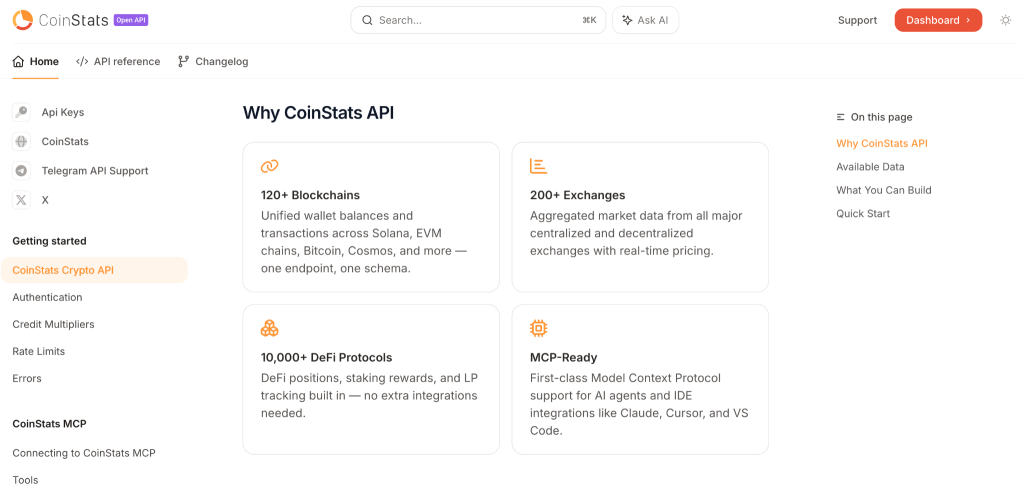
CoinStats Crypto API is a unified crypto data platform that aggregates market data, wallet balances, DeFi positions, and crypto news into a single REST API. Where most providers on this list specialize in one data vertical, CoinStats covers several at once, which makes it a practical starting point for teams that want to reduce the number of integrations they manage.
The API covers 100,000+ coins across 200+ exchanges (including Binance, Coinbase, and Hyperliquid), with onchain data from 120+ blockchains and tracking for 10,000+ DeFi protocols. Wallet support spans Solana, Ethereum, EVM-compatible chains, and Bitcoin (with xpub/ypub/zpub support), so building a multi-chain portfolio tracker or wallet explorer does not require stitching together separate services for each network.
Historical data goes back 10 years, and the platform also provides a news feed aggregated from 200+ sources. For teams building AI-native applications, CoinStats offers an MCP Server alongside its REST API, which exposes structured crypto data as callable tools for AI assistants and developer environments like Claude Code, Cursor, and VS Code.
Pricing follows a credit-based model with a free tier. Credits scale with endpoint complexity and request parameters, so testing and prototyping do not require upfront costs. The same infrastructure powers the CoinStats consumer app with 1M monthly users, which means the API draws from a production-grade system. That combination of market data, wallet tracking, DeFi coverage, news, and MCP support under one API is difficult to find elsewhere on this list without combining two or three providers.
Where it fits: Portfolio dashboards, multi-chain wallet apps, market aggregators, AI agents that need structured crypto data, and fintech products that combine pricing with portfolio and DeFi data. A detailed breakdown of endpoints, credit costs, and use cases is documented here.
Limitations: Does not provide raw blockchain RPC or node-level access. Not designed for high-frequency trading at the microsecond scale.
2. CoinAPI
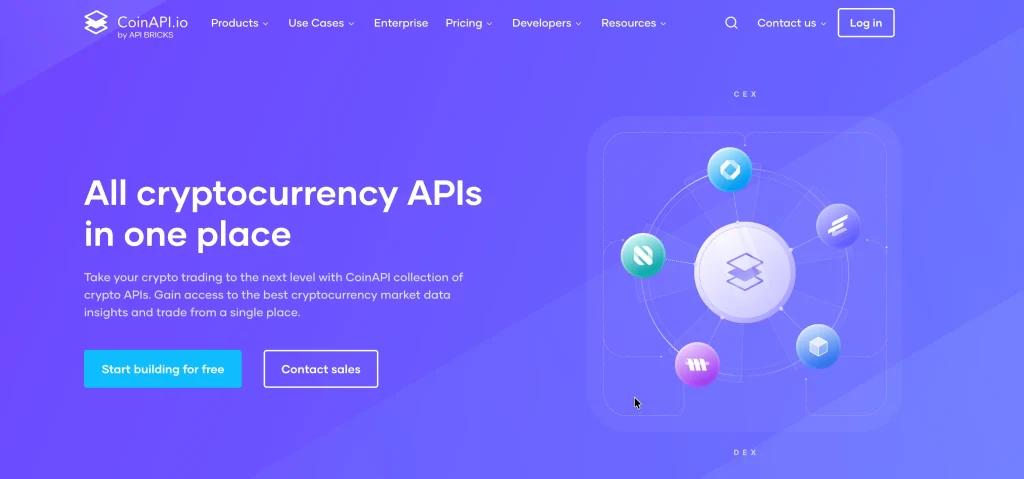
CoinAPI is an API-first provider focused on structured market data aggregated from centralized exchanges. It covers 400+ exchanges with support for spot, derivatives, and options data, and offers tick-level historical archives going back 14+ years.
The platform supports multiple delivery protocols, including REST, WebSocket, FIX (for institutional trading systems), and flat-file downloads via S3 for bulk historical data. It also provides full-resolution order books (Level 2 and Level 3), which makes it relevant for teams building execution systems, quantitative research tools, or market microstructure analysis.
CoinAPI recently added MCP compatibility, making it a data source for AI models and trading agents through the Model Context Protocol. Pricing starts at $79/month for the Developer tier, with $25 in free credits available at signup. CoinAPI operates under the ApiBricks umbrella, which also develops FinFeedAPI for prediction markets, SEC filings, and equity data, so teams working across both crypto and traditional finance can stay within the same ecosystem.
Where it fits: Institutional trading desks, quantitative research, backtesting pipelines, execution management systems, and any project that needs normalized multi-exchange market data with deep historical coverage. CoinAPI operates within ApiBricks company, which also develops FinFeedAPI, focused on prediction markets, SEC filings, and equity data.
Limitations: Primarily focused on CEX market data. Does not offer wallet tracking, portfolio aggregation, or onchain analytics.
3. ChangeNOW
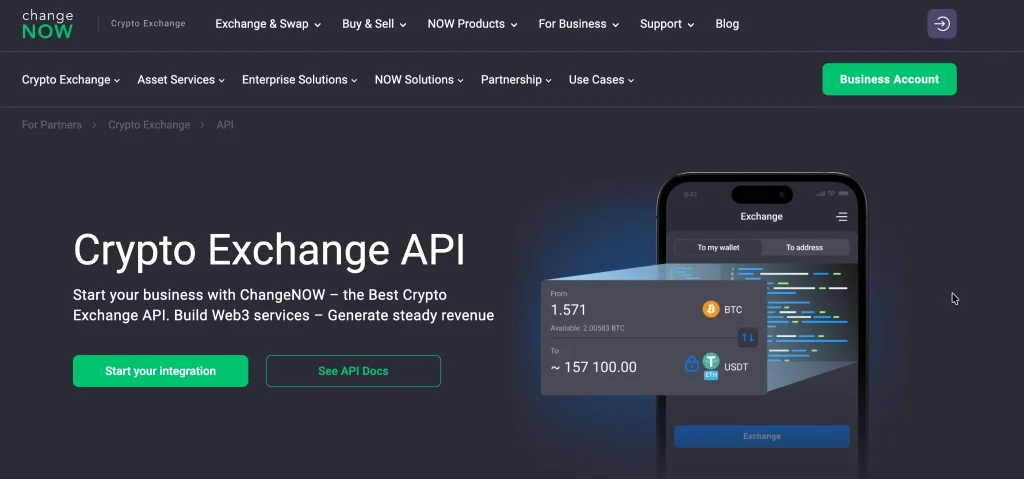
ChangeNOW takes a different approach from data-focused APIs. It is a non-custodial exchange infrastructure provider that lets developers embed instant crypto swaps directly into their products through a REST API.
The API supports 1,500+ cryptocurrencies across 110+ networks, with over 2 million exchange pairs. Developers can offer both fixed-rate and floating-rate swaps, and the backend handles liquidity aggregation from both centralized and decentralized sources. There are no setup or monthly fees; the model is based on transaction volume and revenue sharing with partners. Swaps typically settle in under 1 minute, backed by a 99.99% uptime SLA.
ChangeNOW also holds SOC 2 Type II and ISO 27001:2022 certifications, which matters for teams building products with compliance requirements. Integration options include a full API, an embeddable widget, and a white-label solution.
Where it fits: Crypto wallets adding in-app swap functionality, DeFi platforms, payment gateways, Web3 apps that want to monetize through exchange features, and Telegram bots.
Limitations: Not a market data provider. You will still need a separate API for price feeds, historical data, or portfolio analytics. Minimum swap amounts apply (typically $1.70 to $20). Not available to users in the UK due to regulatory restrictions.
4. CoinDesk Data (formerly CCData)
CoinDesk Data, formerly known as CCData (and before that, CryptoCompare), was acquired by CoinDesk in late 2024 and rebranded in February 2025. It is an FCA-authorized data provider focused on institutional-grade market data, indices, and reference pricing.
The platform delivers spot, derivatives, and reference pricing products, including the CCIX index family. Its main differentiator is regulatory alignment and explicit data licensing: the platform offers a free non-commercial license with defined terms and separate commercial packages for redistribution. This clarity on usage rights is a significant factor for financial institutions and compliance-heavy applications.
CoinDesk Data covers a broad range of exchanges and provides OHLCV, trade, and order book data, along with social data feeds and onchain metrics. Documentation is geared toward enterprise and institutional users.
Where it fits: Financial institutions, compliance teams, index providers, and enterprise applications that need benchmark-grade data with clear licensing and regulatory credentials.
Limitations: Pricing is often gated behind sales conversations for commercial use. Less developer-friendly for indie builders or small teams compared to more self-service providers.
5. Bitquery
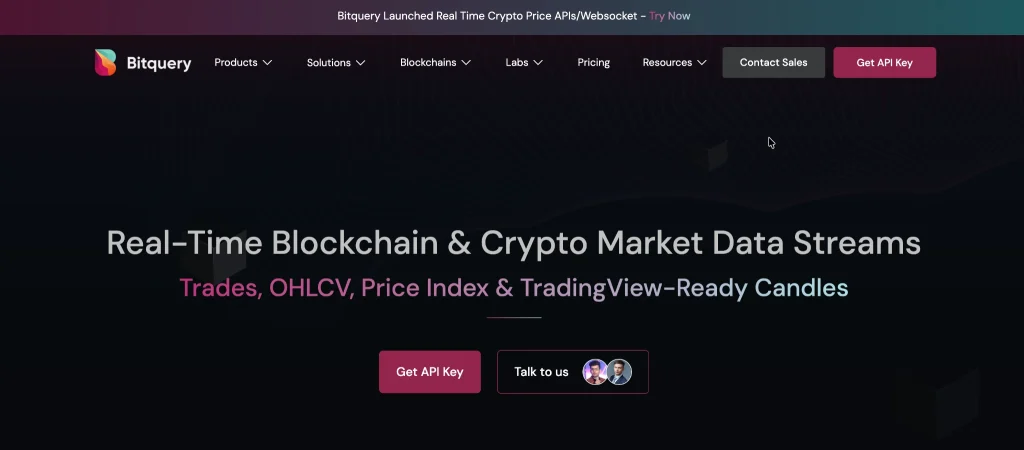
Bitquery is a blockchain data platform that indexes onchain activity across 40+ blockchains and exposes it through GraphQL APIs, WebSocket subscriptions, and Kafka streams. It also makes data available through cloud integrations with AWS S3, Snowflake, Google BigQuery, Azure, and Databricks.
The platform provides pre-indexed and enriched blockchain data rather than raw node responses. Developers can query token trades, transfers, holder counts, smart contract events, DEX activity, and mempool data using flexible GraphQL filters. Real-time OHLC data with 1-second aggregation is available for trading applications.
Bitquery covers a wide range of onchain use cases, from DEX trade monitoring to wallet activity analysis and compliance workflows. Its Streaming API enables live data feeds for bots and alerting systems.
Where it fits: On-chain analytics dashboards, DEX trading tools, compliance monitoring, wallet activity tracking, and any project that needs granular, queryable blockchain data across multiple networks.
Limitations: Requires familiarity with GraphQL, which creates a learning curve for developers used to REST APIs. Data accuracy should be validated against known transactions during integration, as is standard with any indexed data source.
6. altFINS Analytics Data API
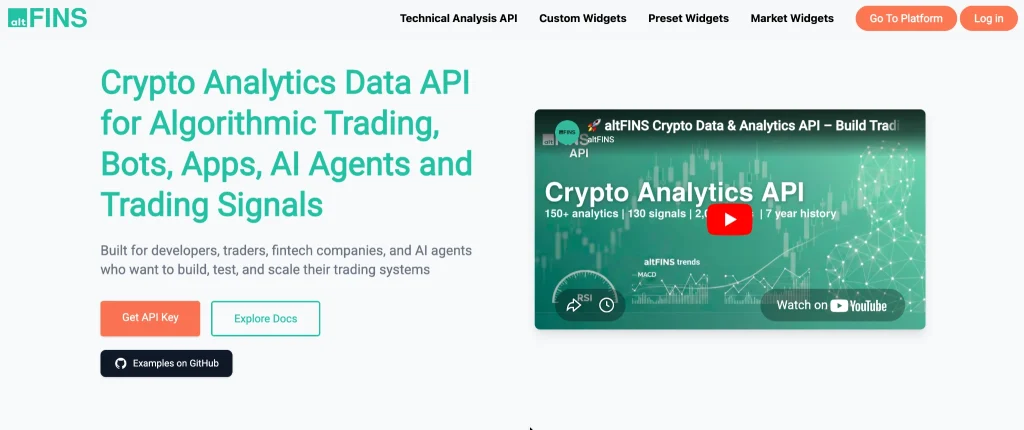
The altFINS Analytics Data API is built specifically for algorithmic trading, AI agents, and fintech applications that need technical analysis data delivered through an API rather than a charting interface.
The API provides access to 150+ technical indicators, 130+ pre-built trading signals, and data on 2,000+ crypto assets across 5 time intervals (15-minute to 1-day). It aggregates real-time and historical data from 30 exchanges, offering OHLC, volume, price changes, and over 150 metrics per asset, along with fundamental data such as TVL and token revenues.
A key differentiator is its “out-of-the-box” signals feed and curated trade setups. Rather than building complex analytics pipelines from scratch, developers can consume ready-to-use signals for strategy implementation. Historical data goes back 7+ years, which supports backtesting and quantitative research.
altFINS also offers an MCP Server, which abstracts the API into a format optimized for LLMs and AI agents, enabling natural language-driven trading tools and autonomous systems.
Where it fits: Trading bots, AI agents, quantitative trading systems, analytics dashboards, and signal-based trading platforms.
Limitations: Focused on technical analysis and trading signals rather than wallet tracking, portfolio data, or raw blockchain access. Asset coverage (2,000+) is narrower than broad-market data providers.
7. GoldRush (by Covalent)
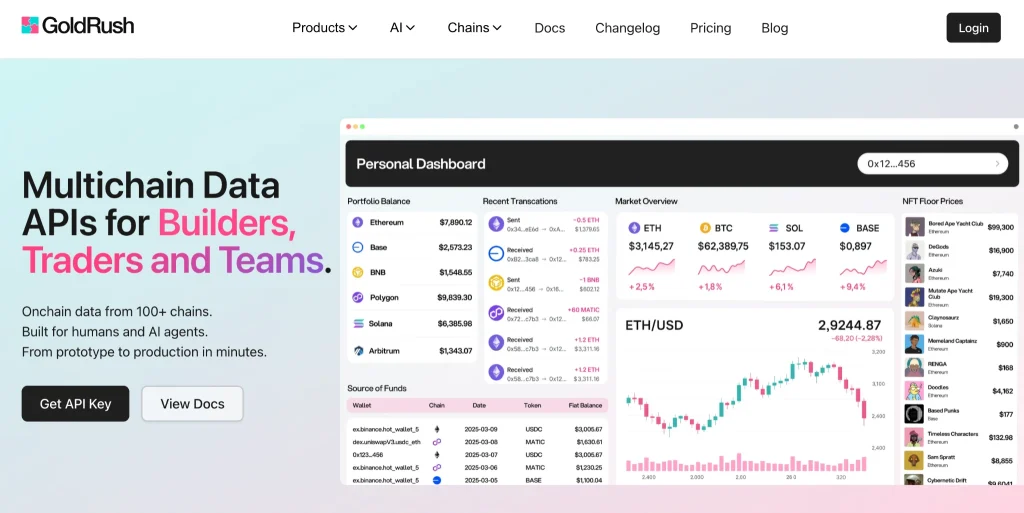
GoldRush, powered by Covalent, provides structured onchain data across 100+ blockchains through a unified REST API. The platform indexes token balances, transaction histories, NFT data, event logs, and gas prices, and returns it all in a consistent schema regardless of which chain you query.
The API is designed so that switching between blockchains requires changing a single path parameter. SDKs are available for TypeScript, Python, and Go, and a React UI kit (GoldRush Kit) offers pre-built components for common use cases like wallet portfolio views and transaction explorers.
GoldRush also provides an MCP Server with 27+ tools for AI coding agents, a CLI for terminal-based blockchain queries, and a recent x402 payment protocol integration that lets AI agents pay for data per-request using stablecoins, without API keys or accounts.
Pricing includes a free tier, a $10/month “Vibe Coding” plan, and enterprise options. The platform has a 99.99% uptime SLA and is SOC 2 compliant.
Where it fits: Multi-chain dApp backends, wallet interfaces, block explorers, DeFi dashboards, compliance tools, and AI agent infrastructure.
Limitations: Focuses on onchain data. Does not provide centralized exchange market data, price feeds, or portfolio aggregation from CEX accounts.
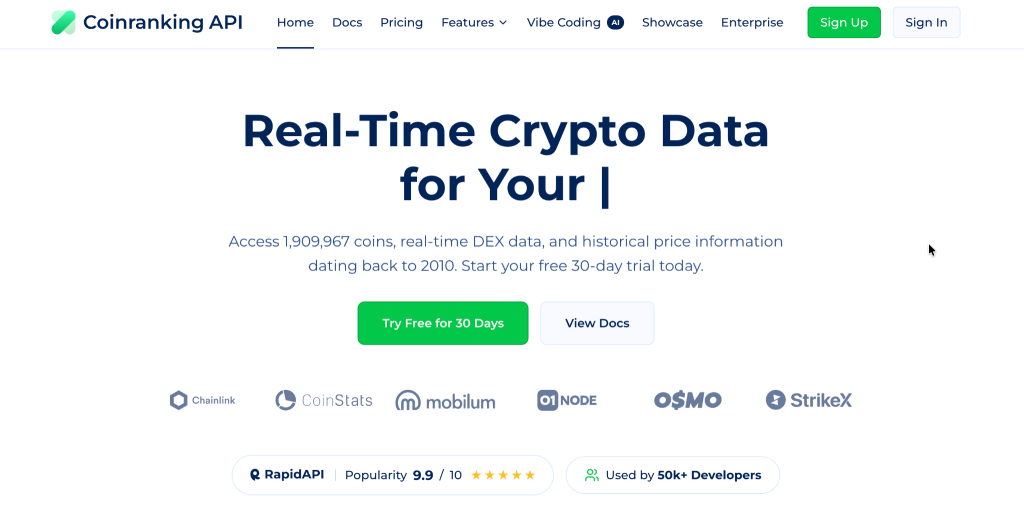
8. Coinranking API
Coinranking API is a crypto market data API built around real-time price streaming. Instead of requiring developers to poll endpoints on a timer, the API supports live price subscriptions where updates push automatically as prices change.
The API aggregates prices across centralized exchanges and delivers a single market price per asset, which removes the need to build your own aggregation layer. Coverage includes historical OHLCV data, exchange listings, and market statistics. One streaming connection can serve live prices for thousands of users without increasing request load.
Coinranking API is oriented toward consumer-facing applications where users expect prices to update while they are looking at the screen. The API is straightforward to integrate and keeps the data stack simple for teams that need pricing, market stats, and historical data from one provider.
Where it fits: Live price tickers, market overview dashboards, price alert systems, and consumer-facing apps where real-time price display is a core feature.
Limitations: Focuses on market-level aggregated prices. Does not provide raw trade-by-trade exchange data, wallet tracking, or onchain analytics.
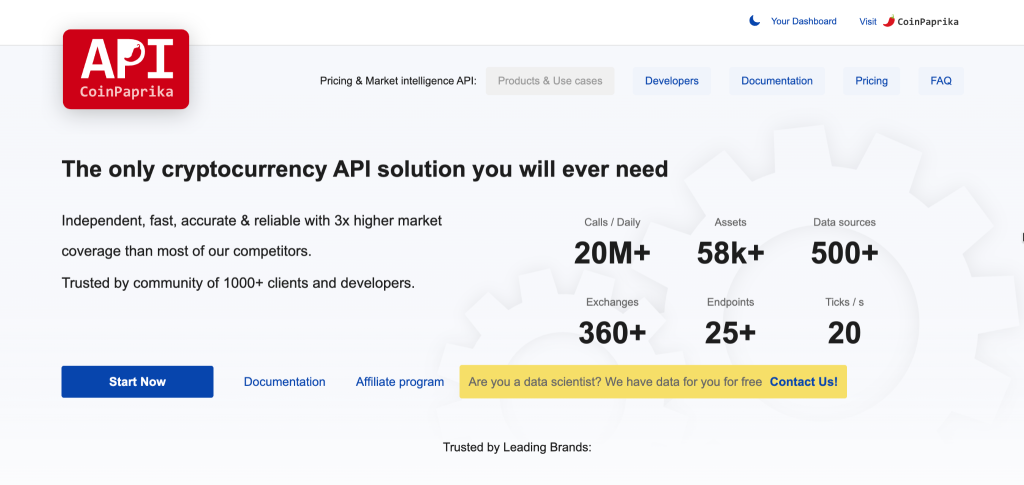
9. CoinPaprika
CoinPaprika is a market data API that provides on-demand price lookups, project metadata, and exchange information for thousands of crypto assets. Prices are fetched per request rather than streamed, which makes it a fit for applications where price updates happen on page load or at fixed intervals.
Beyond pricing, the API includes project-level metadata such as team information, descriptions, social links, and tag-based categorization. This reduces the need for a separate data source when building asset detail pages or directory-style applications. The API also provides historical data, OHLCV, and global market statistics.
CoinPaprika offers a free tier that allows for evaluation and prototyping.
Where it fits: Market overview pages, asset directory applications, research tools, and internal dashboards where real-time streaming is not required.
Limitations: Not designed for live price streaming or real-time trading applications. Price updates are request-based, so it works best when periodic refresh is acceptable.
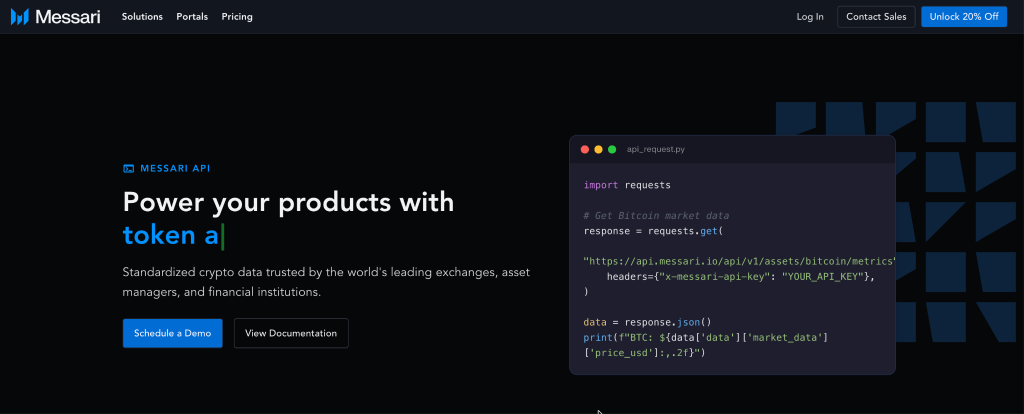
10. Messari API
Messari provides a crypto data API that combines real-time and historical market data for 40,000+ assets with research intelligence, onchain metrics for 200+ DeFi protocols, and news aggregation from 500+ sources.
What sets Messari apart from pure market data providers is the research layer. The API exposes not just pricing and OHLCV data, but also fundraising intelligence (14,000+ funding rounds, 800+ M&A deals, 13,000+ investors), token unlock schedules, governance data, and AI-powered analysis through Messari AI. For teams that need market context alongside raw data, this combination reduces the number of sources required.
The free tier allows 20 requests per minute and covers basic asset metrics and market data. Enterprise plans unlock full API access to research content, alert systems, custom screeners, and dedicated infrastructure. Pricing for enterprise features is handled through sales conversations.
Where it fits: Research platforms, fund managers, compliance teams, analysts building screeners or monitoring tools, and applications that need structured market intelligence beyond raw price feeds.
Limitations: Enterprise features and full API access require a paid plan gated behind sales. Not designed for high-frequency trading or real-time streaming at the millisecond level. Research-heavy orientation means it is less of a fit for lightweight consumer apps that only need pricing.
How to Choose
There is no single provider that covers every use case, and most production crypto products end up integrating more than one API. The practical question is which provider handles the largest share of your data needs with the least integration overhead.
If you need aggregated market data, wallet balances, and DeFi tracking from one endpoint, CoinStats API covers the broadest surface area and is likely the most practical first integration for general-purpose crypto apps. If your project is institutional trading infrastructure, CoinAPI and CoinDesk Data serve that layer. For embedding swap functionality into a wallet or app, ChangeNOW handles the exchange infrastructure. For onchain analytics and multi-chain indexing, Bitquery and GoldRush each take different approaches. For signal-based trading and technical analysis, altFINS delivers ready-to-use analytics. And for straightforward market data and pricing, Coinranking and CoinPaprika each serve slightly different patterns of data consumption, while Messari adds a research intelligence layer on top of market data.
Start with the use case, not the feature list. The provider that matches how your product actually consumes data will save you more time than the one with the longest spec sheet.

 Login
Login