Reading view

Why is XRP price up today?

Why is XRP going up today?

The post Why is XRP price up today? appeared first on Coinpedia Fintech News

XRP, the fourth-largest cryptocurrency with a market cap of about $86.89 billion, has jumped 4% today. The token, which was recently struggling for nearly four straight weeks, is now trading near $1.41. At the same time, trading activity has picked up, with volume rising to $3.1 billion, a 21% increase.

This sudden move has now raised a key question in the market: what XRP price is up today?

Ripple’s Korea Deal Brings Back Long-Term Confidence

One of the biggest reasons behind today’s rally is Ripple’s new partnership with Kyobo Life Insurance in South Korea. The company plans to test tokenized government bond settlement using blockchain.

While this is still a pilot project, it shows that Ripple’s technology is being taken seriously by large institutions. This kind of progress often boosts long-term confidence, even if it does not immediately increase demand for XRP.

At the same time, there are reports that large banking groups in the U.S. are exploring XRP-based systems.

Solana Viral “XRP” Post Fuel to the Rally

Interestingly, social media also played a role in today’s rally. A viral post from Solana’s official account simply mentioned “XRP,” which quickly caught attention.

XRP pic.twitter.com/PEqNUf1H4S

— Solana (@solana) April 15, 2026

This led to a wave of reactions from both XRP and Solana communities, creating a rare moment of positive engagement across different crypto groups. 

While no real partnership was announced, the buzz helped improve market sentiment.

Broader Market Strength Lifts XRP

The overall market is also helping. Global tensions, especially between the U.S. and Iran, appear to be easing. This has pushed stock markets higher, with the Nasdaq and S&P 500 hitting new highs. 

As a result, Bitcoin climbed near $75K, lifting the overall crypto market, including XRP.

XRP ETF Inflows Show Institutional Interest

Another key factor is steady inflows into XRP ETFs. Over the past few days, millions of dollars have flowed into these funds, showing growing interest from big investors

On April 14 and 15 alone, inflows reached about $11.2 million and $17.1 million. Total inflows have now crossed $1.25 billion, showing growing institutional interest.

This kind of demand often supports price stability and builds a base for future moves.

What Comes Next For XRP Price?

Even after today’s rise, XRP is still down nearly 63% from its peak, so this move looks more like an early recovery rather than a full breakout.

As of now, the key level to watch is $1.38. If XRP stays above this support, it could try to move again toward the recent high near $1.45. 

But if it fails to hold this level, the price may slip back toward the 200-day moving average around $1.35.
Top Reasons Why Crypto Prices Are Up Today?

Why Crypto Market is Going Up Today

The post Top Reasons Why Crypto Prices Are Up Today? appeared first on Coinpedia Fintech News

After 11 straight weeks of slow and sideways movement, the crypto market is finally showing signs of recovery. Today, the total market value has risen by about 1.5% to reach $2.54 trillion.

Bitcoin is leading this move, jumping around 7% this week and trading near $75,063. Other major coins like Ethereum, Solana, XRP, Dogecoin, and Hyperliquid are also moving up, gaining between 2% and 5%.

Now the big question is, why is the crypto market suddenly going up today?

Why Are Crypto Prices Up Today?

One of the key reasons behind today’s crypto rally is the strong surge in U.S. tech stocks, which pushed the Nasdaq to a new all-time high of 24,021.03,1. Meanwhile, the S&P 500 also reached a record 7,023, rising 0.77%. 

Investors are also feeling positive as tensions between the U.S. and Iran may ease soon. In a recent interview, President Donald Trump said the war is “very close to being over,” easing geopolitical concerns.

As fear goes down, money is moving back into stocks and crypto, pushing prices higher.

Also Read : Bitcoin Targets $80,000, Ethereum Eyes $2,700 and XRP Could Hit $1.55 Says Chart Analyst

CLARITY Act May Reach Senate Floor Soon

Another positive sign is that the CLARITY Act could soon reach the Senate floor.

Senator Thom Tillis said discussions are still ongoing, especially around stablecoin yield rules. He added that some points still need negotiation, but he remains optimistic about moving forward soon.

🚨NEW: @SenThomTillis (R-NC) told reporters on Capitol Hill this afternoon that he’s still “going back and forth” with stakeholders on whether stablecoin yield text will be released publicly this week.

“We’ve got some open switches that may require some more negotiation, but I’m… https://t.co/lkg1sJwJAD

— Eleanor Terrett (@EleanorTerrett) April 15, 2026

At the same time, White House crypto advisor Patrick Witt said both parts of the bill are close to the final stages, with key negotiations nearly complete.

This means clear crypto rules in the U.S. may arrive sooner than expected, possibly around Consensus 2026.

Bitcoin and Ethereum ETF Inflows Support Crypto Market Recovery

Another key reason crypto prices are rising today is the return of ETF inflows.

After several days of outflows, both Bitcoin and Ethereum ETFs are seeing fresh investor interest again.

On April 14 and 15, Bitcoin ETFs recorded inflows of $411.4 million and $186.1 million. Fidelity led with $47.3 million, followed by Ark with $42.2 million, while BlackRock also continued to see steady inflows.

At the same time, Ethereum ETFs saw continued inflows for the week, led by Grayscale and BlackRock.

Massive Short Liquidations Accelerate Crypto Rally

Short liquidations also played a big role. As per CoinGlass data, in the last 24 hours, over $225 million in positions were wiped out, and most of them were short trades. This means traders who expected prices to fall were forced to buy back, pushing prices higher.

What Next For Bitcoin & Crypto Market

For the past two months, Bitcoin has tested the $76K level many times but failed to break it. If Bitcoin finally breaks this level, it could move up fast and target $90K.

Once Bitcoin breaks out, other major coins like ETH, XRP, Solana, and Doge are likely to follow with strong moves.  

SOL and XRP Show Deeper Unrealized Losses Compared to BTC & ETH

SOL and XRP Show Deeper Unrealized Losses Compared to BTC & ETH

The post SOL and XRP Show Deeper Unrealized Losses Compared to BTC & ETH appeared first on Coinpedia Fintech News

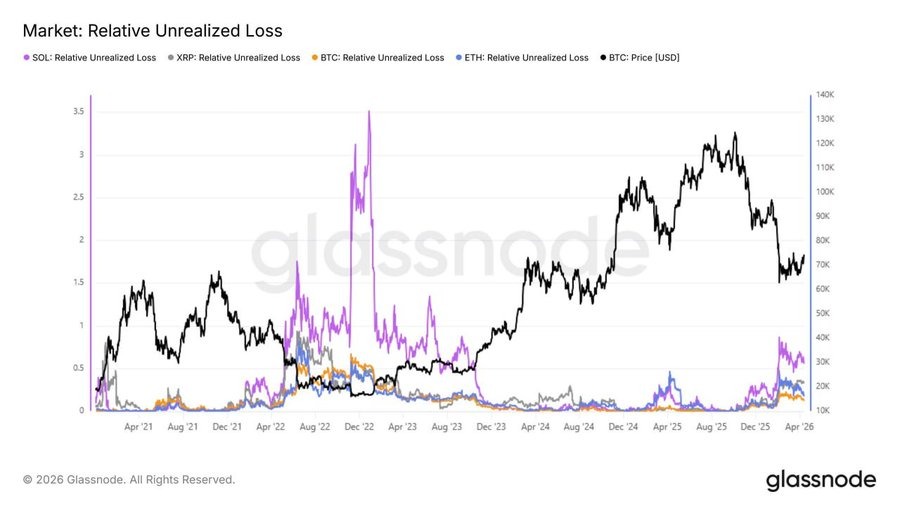
Solana and XRP are showing significantly higher unrealized losses compared to Bitcoin and Ethereum. On-chain data from Glassnode reveals that a large portion of SOL and XRP holders remain 65 to 75% in loss in unrealised loss. This signals weaker positioning in altcoins and slower recovery strength.

SOL and XRP Holders In Deep Loss 

According to the Market Relative Unrealized Loss chart, SOL’s loss sits at approximately 0.8, while XRP hovers around 0.3. In comparison, Bitcoin and Ethereum are close to 0.1 or even lower. 

This clearly shows that more SOL and XRP holders are still in a loss, while BTC and ETH holders are in a much better position.

SOL consistently shows higher spikes in unrealized losses, especially during major downturns like late 2022 and again in 2026. These spikes indicate panic phases where a large share of holders entered at higher prices and are now holding losses.

Solana XRP in Unrealized losses compare to BTC & ETH


XRP spiked to around 0.6 during the same period. BTC and ETH, by contrast, never crossed above 0.5 even at their worst moments on this chart. 

Fast forward to the current 2026 cycle, Bitcoin has fallen from its high of about $126K to around $74K. During this drop, Solana and XRP are again falling more than Bitcoin and other major coins, showing stronger losses compared to the market leader

Solana & XRP Face Weak Demand and Bearish Signals

However, it’s not just price charts, on-chain and derivatives data also point to weakening demand and a bearish market setup.

Solana is under pressure as both institutional and retail interest continue to fade. Solana ETFs have seen three straight weeks of outflows, while this week’s inflows remain very weak. Retail activity is also slowing.

This weakness is reflected in derivatives data. Solana’s Open Interest has dropped 4.57% to $4.98 billion, while funding rates have turned negative at -0.0046%, showing a shift toward short positions. The long-to-short ratio of 0.9798 also confirms a slightly bearish bias. 

As a result, SOL is now around $83.44, down nearly 72% from its peak of $294.96.

XRP is showing a similar but less severe trend. ETF inflows have slowed, signaling weaker institutional demand, even though outflows remain limited.

In derivatives, XRP Open Interest is down 2.87% to $2.48 billion, and funding rates at -0.0006% suggest mild short positioning. XRP is currently trading near $1.35, down about 65% from its all-time high of $3.82.

Why Bitcoin & ETH are Recovering Faster

Bitcoin is doing better because money first moves into it when the market starts to recover. When market conditions improve a little, investors usually choose Bitcoin first since it is the safest and most trusted crypto. 

This is why Bitcoin has been able to stay steady around $74K. 

Ethereum is in the middle, it is not as strong as Bitcoin, but it is still doing better than most altcoins. 

On the other hand, Solana and XRP are still under pressure and facing bigger losses, so they are not recovering as fast.

Bitcoin Developers Propose Freezing Satoshi-Era Coins to Block Quantum Threat

Bitcoin Developers Propose Freezing Satoshi-Era Coins to Block Quantum Threat

The post Bitcoin Developers Propose Freezing Satoshi-Era Coins to Block Quantum Threat appeared first on Coinpedia Fintech News

Bitcoin’s oldest and most dormant wallets, including those believed to belong to Satoshi Nakamoto, could be permanently frozen under a new developer proposal called BIP-361, introduced in April 2026. 

The idea has split the Bitcoin community, with some supporting stronger security and others calling it a violation of Bitcoin’s core principles.

New Proposal Introduces Quantum-Resistant Bitcoin Design

A group of Bitcoin developers, led by cypherpunk Jameson Lopp and five others, has proposed a new upgrade called BIP-361. It protects Bitcoin from future quantum computer attacks by changing how some addresses work. About 34% of Bitcoin, or 6.9 million coins, are still in older addresses that could be at risk.

This proposal builds on an earlier idea called BIP-360, which introduces a safer address type called Pay-to-Merkle-Root (P2MR), similar to Taproot but safer and more secure.

The main goal is to stop future quantum machines from breaking Bitcoin’s security and stealing funds.

BIP 361: "Post Quantum Migration and Legacy Signature Sunset" has been published.

You can read it here: https://t.co/JIuMbitQQj pic.twitter.com/iH63XIWi6k

— Murch (@murchandamus) April 14, 2026

Meanwhile, developers say this is a soft upgrade that improves safety without changing how Bitcoin works today.

New Plan to Phase Out Old Bitcoin Addresses

A new proposal suggests a three-phase upgrade plan over several years. 

  • First, no new Bitcoin can be sent to old-style addresses. 
  • Second, five years after activation, older signatures could be disabled completely, which would make any Bitcoin unusable if they are not moved in time.
  • Third, a final recovery option using zero-knowledge proofs is also being discussed for users who still have their wallet keys. 

Developers say freezing coins is a “push to upgrade.” If some coins are lost or frozen, other Bitcoins may become a little more valuable. But if quantum computers steal coins, it could badly harm Bitcoin’s value and trust.

Quantum-Safe Wallet Recovery Prototype

Apart from the BIP-361 proposal, Coinpedia news recently reported that another Bitcoin developer, Olaoluwa Osuntokun, has built a prototype to protect wallets from future quantum attacks. 

It allows users to recover funds even if Bitcoin’s current system becomes unsafe.

It uses zk-STARK proofs to prove ownership without exposing private keys. The system works in about 50 seconds on a normal MacBook, uses 12GB RAM, and creates a 1.7MB proof file. Developers say it can be improved further.

Community Pushes Back on Bitcoin Upgrade Plan

The Bitcoin community is strongly reacting to the new BIP-361 proposal. Many say no one should ever have control over someone else’s coins, not developers or any group.

Bitcoin is built on the idea: “not your keys, not your coins.” But also, once you hold your keys, your coins are yours forever. Critics say this plan goes against that bitcoin core principle because it could freeze old coins after a deadline.

They worry this could set a bad example. If coins can be frozen for one reason, it might happen again for other reasons in the future. This could blur the line between protecting Bitcoin and controlling it.

Industry experts, like Phil Geiger from Metaplanet, said,

“We have to steal people’s money to prevent their money from being stolen.”

Well, this is only a proposal, not an active change. If accepted, users would need to move funds to new addresses for safety. 

If rejected, Bitcoin stays the same but may remain exposed to future quantum risks.

Ripple Partners Kyobo Life to Launch Korea’s First Tokenized Bond Settlement

Evernorth XRP Nasdaq listing

The post Ripple Partners Kyobo Life to Launch Korea’s First Tokenized Bond Settlement appeared first on Coinpedia Fintech News

Ripple, a blockchain-based payment solution, has partnered with Kyobo Life Insurance to explore tokenized government bond settlement using blockchain in South Korea. 

The partnerships aim to make bond settlement from two days to near real-time. Despite this big news, Ripple’s XRP remains near $1.35, showing no sign of a rally. 

Kyobo brings Korea’s First Tokenized Bond Settlement On-Chain

According to the announcement, on April 15, 2026, Ripple and Kyobo Life Insurance, one of South Korea’s largest insurers, will explore bringing government bond settlement onto the blockchain using Ripple Custody. 

Ripple Custody will act as the main system, handling the safe storage, transfer, and settlement of tokenized assets in a regulated setup.

This move makes Kyobo Life the first Tier-1 insurer in Korea to study tokenized bond settlement. It aims to replace the current manual process, which takes up to two days, with near-instant settlement.

Announcing our partnership with #KyoboLifeInsurance—one of Korea's largest and most established life insurance companies—to explore on-chain financial infrastructure using Ripple Custody: https://t.co/Mk8URCOM8K

Kyobo becomes the first Tier 1 Korean insurer to take this step,…

— Ripple (@Ripple) April 15, 2026

As per the partnership plan, tokenized government bonds will be recorded and settled directly on-chain. This can reduce counterparty risk, improve capital flow efficiency, and make financial processes more transparent and automated.

Focus on Regulation, Stability, and Future Use Cases

Both companies are also studying how tokenized bonds can fit into Korea’s existing financial rules. Fiona Murray, Managing Director for Asia Pacific at Ripple, said the partnership shows that institutional blockchain adoption is already becoming real.

She said, “Korea’s institutional financial market is at an inflection point… institutional-grade digital asset infrastructure is no longer a future aspiration; it is available, proven, and ready to deploy in Korea today.”

Along with bond settlement, the partnership will also explore stablecoin-based payment systems. These systems could allow financial transactions to run 24/7, even outside traditional banking hours, while still staying within regulatory boundaries.

On the other side, Jin Ho Park, Senior Executive Vice President at Kyobo Life Insurance, said,

 “Our partnership with Ripple is not simply about digital assets — it’s about validating how traditional financial instruments can operate securely and efficiently on blockchain.”

XRP Price Remains Flat, While BTC Rally Continues

Despite strong global expansion efforts, the XRP price has not reacted much. It is currently trading around $1.35, reflecting a drop in 1.4%.

Meanwhile, the Bitcoin price has recently surged to $74,000 after weeks of weaker movement.

IMF Warned the World Is Heading Toward Recession, Crypto Faces Downside Risk

Morocco’s Crypto Regulation Collaborating with IMF and World Bank for Success

The post IMF Warned the World Is Heading Toward Recession, Crypto Faces Downside Risk appeared first on Coinpedia Fintech News

The International Monetary Fund (IMF) cut its global growth to 3.1%, warning that the world economy could fall into a recession if the US-Iran war continues and oil prices surge through 2027. 

Bitcoin is currently trading around $74,000, down from its $126,000 peak. This IMF’s warning indicates a fragile macro setup that could weigh on digital assets.

IMF Recession Warning Cuts Growth

On April 14, 2026, the IMF warned that the global economy is moving closer to a recession as conditions continue to worsen. It cut its 2026 growth forecast to 3.1% from 3.4%, citing the ongoing war in Iran and oil prices staying above $100 through 2027.

Meanwhile, the IMF outlined three possible scenarios: weak, worse, and severe. In the worst-case scenario, global growth could drop to 2.0%, a level seen only during major crises like the 2009 financial crash and the 2020 COVID pandemic. 

In this case, oil could average $110 in 2026 and $125 in 2027, inflation could rise above 6%, and Europe’s gas prices could surge up to 200%.

IMF chief economist Pierre-Olivier Gourinchas said that “the situation unfolding in the Gulf is ‘potentially much, much larger’ than Trump’s tariff wave from a year ago, and that downside risks clearly dominate the outlook right now.”

Citadel CEO Ken Griffin warned that if disruption continues for 6–12 months, a recession becomes almost unavoidable.

JUST IN: Ken Griffin claims the world is “going to end up in a recession” if the Strait of Hormuz remains closed for 6-12 months.

— Polymarket (@Polymarket) April 14, 2026

Global Debt Hits Record High

At the same time, global debt has reached a record $348 trillion, increasing by $29 trillion in 2025 alone. Since 2017, total debt has jumped by over $120 trillion, driven by repeated crises, heavy government spending, and rising deficits.

Even the M2 money supply just hit a new all-time high of $22.7 trillion.

The situation has become even more fragile due to the Iran conflict, which disrupted energy markets.

Why This Hits Crypto Harder Than Most Asset Classes

When the IMF warns about a recession, it’s not just about the economy slowing down. It also means less money flowing in the system, which directly affects crypto assets.

This is already visible. In April 2026, the U.S. Federal Reserve kept interest rates unchanged at 3.5%–3.75% instead of cutting them.

When inflation is still high, mainly due to rising oil prices, central banks often avoid rate cuts. Higher rates reduce liquidity in the market, meaning less money is available for investing. Since crypto depends heavily on this liquidity, prices tend to struggle when financial conditions stay tight.

Veteran crypto analyst Benjamin Cowen calls the current phase a “slow bleed.” He believes Bitcoin could go higher in the future, but for now, the market may stay stuck because liquidity hasn’t returned yet.

Over the last 6 months, major crypto coins like Bitcoin, Ethereum, XRP, Solana, and Dogecoin have fallen by around 50%. Some altcoins are down even 80%–90% from their peak levels.

Now, the IMF’s recession warning adds more pressure, making the overall market outlook even more uncertain and turbulent.

US CLARITY Act Will Die In 14 Days If The Senate Doesn’t Act

CLARITY Act Moves Closer to Senate Vote

The post US CLARITY Act Will Die In 14 Days If The Senate Doesn’t Act appeared first on Coinpedia Fintech News

The CLARITY Act, a major U.S. crypto regulation bill, is now facing a do-or-die moment. Senator Bill Hagerty confirmed the bill will enter the Senate Banking Committee this week.

If it doesn’t get a vote by the end of April, the biggest crypto legal framework will die without ever reaching a full Senate floor vote.

14 Day Deadline or End Of Clarity Act Bill

Senator Bill Hagerty confirmed that the CLARITY Act will go before the Senate Banking Committee during the current work period. The Senate now faces a tight two-week window before the Memorial Day break limits action time.

The main issue is that Chairman Tim Scott has not set a date for the markup yet. Without a set date, the bill is still stuck, and there is no clear progress.

After the Memorial Day break, the 2026 midterm elections will dominate the calendar. By October, senators will shift focus toward campaigning instead of passing legislation.

There is also a political risk. If Democrats regain control of the House and Senate in November, passing this bill could become significantly more difficult.

Therefore, senators said, if the bill does not reach the Senate floor by the end, it will then die. 

Stablecoin Yield Fight That Almost Killed the Bill

The main issue delaying this bill for four months is stablecoin yield, whether platforms like Coinbase can give interest-like rewards on stablecoins.

Banks strongly opposed it, saying it could pull money out of bank accounts. The Independent Community Bankers of America even warned of $1.3 trillion in deposit losses for small banks, and big banks spent about $56.7 million lobbying against it in 2025.

Recently, Coinpedia news reported that a White House report challenged that claim. It said banning stablecoin yield would only increase bank lending by about $2.1 billion, which is just 0.02% of total U.S. loans, while consumers would lose around $800 million each year.

Why America Desperately Needs This Bill?

For almost 10 years, crypto rules in the U.S. have come mainly from lawsuits. The SEC sues projects, courts decide what a security is, and everyone else is left guessing the rules. There is still no clear law for exchanges, developers, or investors.

The CLARITY Act tries to fix this. It clearly splits control between the SEC and the CFTC.

On March 17, 2026, the SEC and CFTC said in a joint report that Bitcoin, Ethereum, Solana, XRP, and Dogecoin are digital commodities. The CLARITY Act will turn this rule into official law, preventing future changes easily.

The next two weeks are critical. If the Senate Banking Committee schedules and passes the markup. If the bill reaches the Senate floor in May, then it will be well and good, and final approval could happen by early summer

If lawmakers fail to act, they will delay the bill until after elections or abandon it in its current form.

Alameda Research Moves $16 Million in SOL to FTX Creditor Wallet

Alameda Research Moves $16 Million in SOL to FTX Creditor Wallet

The post Alameda Research Moves $16 Million in SOL to FTX Creditor Wallet appeared first on Coinpedia Fintech News

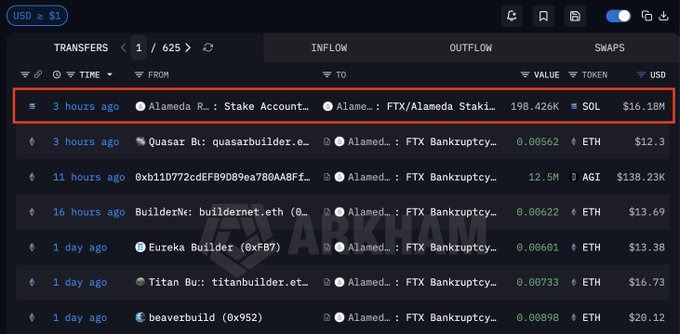
Defunct crypto exchange FTX’s sister company, Alameda Research, just unstaked 198,425 SOL worth around $16 million and moved it to an FTX creditor distribution wallet.

The transfer is part of the ongoing $12.7 billion repayment plan, and with $5.1 billion still owed.

198K SOL Unstaked and Sent to FTX Wallet

According to on-chain data tracked by Arkham Intelligence, Alameda Research’s staking account transferred approximately 198,425 SOL, valued at around $16.18 million, to an FTX-linked bankruptcy wallet. 

Despite this transfer, Alameda still holds around 3.57 million SOL, valued at over $293 million.

This is not the first time Alameda has unstaked large amounts of Solana. Earlier in March 2026, Alameda unstaked $17 million worth of SOL as part of the same repayment process. 

Alameda 198K SOL Unstaked and Sent to FTX Wallet

All this transfer is a part of ongoing payments to creditors after one of crypto’s biggest collapses. Meanwhile, a New York court ordered FTX and Alameda to repay $12.7 billion, of which $7.6 billion has been paid so far, with about $5.1 billion remaining.

Will Solana Token Price Dip, Following Alameda Unstaked

The bankruptcy team is not selling everything at once. Instead, they are splitting the total amount into smaller parts and moving them through different wallets. This helps avoid a sudden crash in SOL price and protects the value for creditors.

Even with this careful approach, SOL is down about 1% in the last 24 hours, trading near $81.93. 

In the past, each large unlock caused a short-term drop of around 3%–5% as traders expected more selling.

With billions still to recover and monthly transfers continuing, Alameda’s SOL wallet will remain one of the most watched addresses in crypto until the final creditor is made whole.

U.S.-Iran Peace Deal Failed, Crypto Markets Brace for Volatility 

Why is the Crypto Market Down Today

The post U.S.-Iran Peace Deal Failed, Crypto Markets Brace for Volatility  appeared first on Coinpedia Fintech News

After 21 hours of continuous talks in Islamabad, Pakistan, the U.S.-Iran peace deal broke down on April 12, 2026. Financial experts said that this will now trigger a market crash once the market opens on Monday.

And Crypto will take the hardest hit. Early signs of weakness are already visible, with Bitcoin and Ethereum both slipping around 1.5% today.

U.S.-Iran Peace Talks Fail

In a recent press release, U.S. Vice President JD Vance announced that the peace talks between the U.S and Iran failed to reach an agreement, saying Iran had “chosen not to accept our terms.” The sticking point was non-negotiable for Washington. 

Vance stated that the U.S. needed “an affirmative commitment that they will not seek a nuclear weapon and will not seek the tools that would enable them to quickly achieve a nuclear weapon,” calling it the core goal of President Trump’s entire negotiation strategy.

Within hours of the announcement, President Trump took to Truth Social, declaring that Iran was “unwilling to give up its nuclear ambitions” and ordered the U.S Navy to immediately begin blockading the Strait of Hormuz. 

However, the collapse also puts a fragile two-week ceasefire at risk, increasing fears of further escalation.

Rising Pressure To Dump Stock Market 

With diplomacy failing, traders are now pricing in conflict risk.

At the same time, bonds are being sold, yields are rising, the dollar is weakening, and liquidity is tightening.

The Federal Reserve has also raised its 2026 inflation forecast to 2.7% as oil stays above $100, and hopes of rate cuts are fading. This leaves central banks with limited options to support the economy.

With all this pressure, stock markets may see heavy selling when trading opens on Monday.

Crypto To Hit Hard, BTC and ETH Both Fall

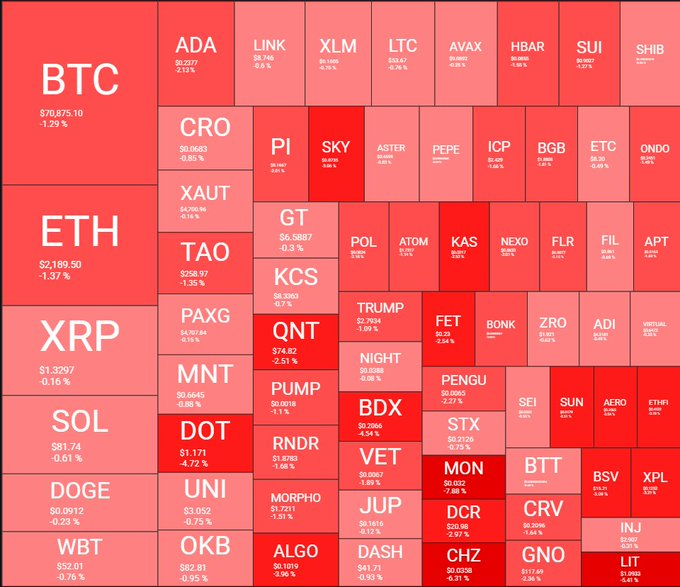
Crypto is usually hit harder than stocks in these conditions. That’s already starting to show. Bitcoin price already dropped below $71,000, while Ethereum fell below $2,200, and the total crypto market cap slipped nearly 1%, falling to $2.41 trillion.

Crypto To Hit Hard, BTC and ETH Both Fall

This fearful behavior can be seen in whale activity, too. A large whale made a big trade of over $10 million as soon as Bitcoin dropped below $71,000. This is often seen as a sign that the current trend may continue.

At the same time, market makers are selling, and both open interest and spot trading volume are going down.

In Ethereum, a whale holding 131,000 ETH (worth about $288 million) recently made a profit. They bought 5,039 ETH at $1,985 two weeks ago and just sold 5,000 ETH at $2,202, locking in gains.

Polkadot Exploit: 1B DOT Minted, Dumped for $237K, Price Crashed

Polkadot Exploit 1B DOT Minted, Dumped for $237K, Price Crashed

The post Polkadot Exploit: 1B DOT Minted, Dumped for $237K, Price Crashed appeared first on Coinpedia Fintech News

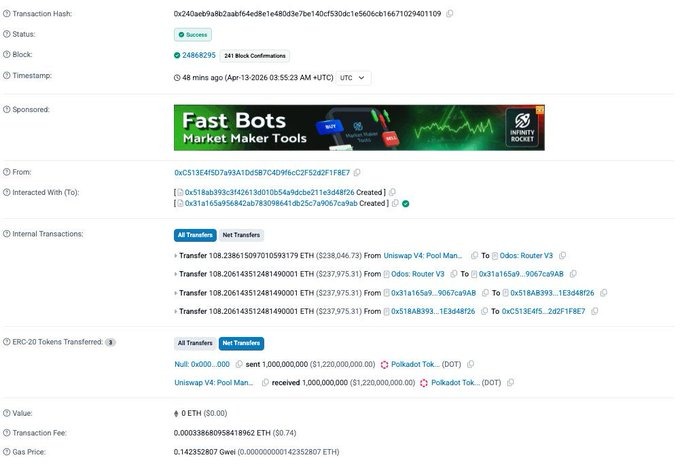
Polkadot (DOT), an open-source sharded multichain protocol, was exploited after an attacker minted 1 billion tokens and dumped them for 108.2 ETH ($237K), crashing the bridged DOT price from $1.22 to near $1.

Multiple exchanges, including Upbit, suspended DOT deposits and withdrawals in response.

How The Polkadot (DOT) Exploit Happened

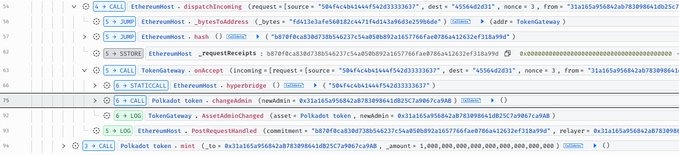
On April 13, 2026, the attacker sent a fake proof to a vulnerable contract on Ethereum. This proof looked real to the system, so it passed the security checks and triggered an important function in the bridge.

That single action caused two major problems. First, it gave the attacker full control of the bridged DOT token contract by changing the admin to their own wallet. This meant they now had the power to manage and create tokens.

Polkadot Exploit: 1B DOT Minted, Dumped for $237K, Price Crashed

After gaining control, the attacker minted 1 billion DOT tokens out of thin air and sent them to a new wallet. This was around 2,805 times more than the actual supply at that time.

They then dumped all the tokens into Uniswap V4 in a single move, draining about 108.2 ETH (around $237,000) from the liquidity pool.

The attacker routed the funds through Odos Router V3 and sent them back to their wallet, while the fake supply crashed the token value.

Why This Happened: HyperBridge Security Failure

The exploit was possible due to a flaw in how the bridge verified cross-chain messages. This happened because the system trusted a fake proof.

Hyperbridge developers built the system to remove human control and rely only on cryptographic proofs for cross-chain verification. But the attacker managed to create forged proof that the system mistakenly accepted as valid.

Polkadot Exploit: 1B DOT Minted, Dumped for $237K, Price Crashed

Once that fake proof passed, the contract automatically executed it, giving the attacker control and allowing them to change permissions and mint tokens.

DOT Price Crashed to $1

The impact was felt almost instantly; the DOT token price crashed from around $1.22 to nearly $1 in the same transaction block.

Some platforms have already reacted quickly. Upbit temporarily suspended DOT deposits and withdrawals as a precaution.

Developers are now working to investigate the exploit and fix the vulnerability. Exchanges may continue adding more restrictions until teams fully understand the issue and assess ongoing risks.

Hyperbridge and Polytope Labs have not released any official detailed statement on mitigation steps, recovery plans, or system pauses yet.

❌