
 Login
Login
NVIDIA Develops 2-3x Faster Real-Time Path Tracing with Better Image Quality
NVIDIA has developed a new algorithm for path tracing that will make it 2-3 times faster, deliver better visual quality, and improve the robustness of real-time path tracing. Scheduled for a technology demo at the ACM conference on Computer Graphics and Interactive Techniques in May, NVIDIA has found a way to make real-time path tracing a fully realistic rendering process, moving beyond the usual emulation, software denoising, upscaling, and other techniques we use today. Since real-time path tracing is extremely compute-intensive, modern GPUs are still not powerful enough to execute the full path tracing technology in all its potential. Instead, we currently rely on emulations in modern games, implemented across many titles to address this computational demand. Below is the abstract described on NVIDIA's paper page, though the paper itself is not yet available as its publication is scheduled for May. However, note that the technology is still in development, and we have to wait more for it to hit commercial games.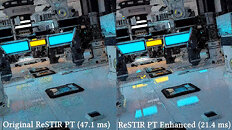
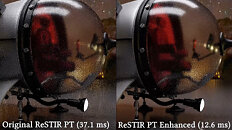
NVIDAAlgorithms leveraging ReSTIR-style spatiotemporal reuse have recently proliferated, hugely increasing effective sample count for light transport in real-time ray and path tracers. Many papers have explored novel theoretical improvements, but algorithmic improvements and engineering insights toward optimal implementation have largely been neglected. We demonstrate enhancements to ReSTIR PT that make it 2-3x faster, decrease both visual and numerical error, and improve its robustness, making it closer to production-ready. We halve the spatial reuse cost by reciprocal neighbor selection, robustify shift mappings with new footprint-based reconnection criteria, and reduce spatiotemporal correlation with duplication maps. We further improve both performance and quality by extensive optimization, unifying direct and global illumination into the same reservoirs, and utilizing existing techniques for color noise and disocclusion noise reduction.


