Reading view

Ripple Says National Bank SoFi Listing Grows XRP Utility, Community Says Not So Fast
Ripple XRP cross-border payments partnership

The post Ripple Says National Bank SoFi Listing Grows XRP Utility, Community Says Not So Fast appeared first on Coinpedia Fintech News

SoFi has added XRP to its crypto platform, and Ripple wasted no time calling it a win. But inside the XRP community, the reaction is more complicated.

The national bank now lets users deposit and hold XRP alongside Bitcoin, Ethereum, and Solana. Ripple framed the listing as a step toward broader participation, arguing that putting XRP inside a regulated banking app means more people can access it with less friction.

The problem is that users cannot withdraw XRP to external wallets. That single limitation has shifted the conversation from adoption to whether this move means anything at all.

Access Is Not the Same as Usage

More people holding XRP inside more systems builds utility over time. Getting into a regulated, nationally chartered bank is not a small thing, and the visibility alone matters.

Critics disagree. If XRP cannot move off the platform, it cannot be used in cross-border payments, DeFi, or self-custody. It sits inside the app and goes nowhere. For an asset whose core value proposition is fast, low-cost settlement, that is a significant caveat.

One community member put it plainly, asking how this increases utility when XRP is locked inside a SoFi account and is not being used for cross-border payments, the way SoFi uses the Bitcoin Lightning Network.

SoFi’s support team responded publicly, confirming that crypto withdrawals are coming soon without giving a specific date.

A Longer Game?

Not everyone is writing the integration off. Analyst Bill Morgan said Ripple may have a deliberate longer-term plan behind the listing. In his view, the limited launch could be intentional, with deeper functionality rolling out once deposit volumes grow. He also flagged RLUSD, Ripple’s stablecoin, as a possible next step if the partnership expands.

Where XRP Stands

XRP currently ranks as the fourth largest cryptocurrency by market cap, sitting at roughly $89B billion. The SoFi listing adds a retail banking channel, but without withdrawal support, its practical impact on network activity remains limited for now.

The debate cuts to something XRP holders have argued about for years: the difference between price exposure and actual utility. SoFi gives users the former. Whether the latter follows depends on what comes next.

Justin Sun Sues Trump’s World Liberty Financial Over Frozen Tokens

Justin Sun, HTX

The post Justin Sun Sues Trump’s World Liberty Financial Over Frozen Tokens appeared first on Coinpedia Fintech News

Justin Sun has filed a lawsuit in a California federal court against World Liberty Financial, a DeFi project backed by Eric Trump and Donald Trump Jr., over a dispute involving frozen tokens and governance control.

Sun says the issue began when the team froze all his WLFI holdings, removed his voting rights, and allegedly threatened to permanently burn his tokens. He calls this the breaking point.

Today, I filed a lawsuit in California federal court against World Liberty Financial to protect my legal rights as a holder of $WLFI tokens.
 
I have always been—and remain—an ardent supporter of President Trump and his Administration’s efforts to make America crypto friendly.…

— H.E. Justin Sun 👨‍🚀 🌞 (@justinsuntron) April 22, 2026

He also says he tried multiple times to resolve the matter privately, but the team refused to unfreeze his tokens or restore his rights, leaving him with no option but to move to court.

“I have tried in good faith to resolve this situation with the World Liberty project team without resorting to litigation. But the project team has refused my requests to unfreeze my tokens and restore my rights as a token holder. They have left me with no choice but to turn to the courts.”

Frozen Tokens and Lost Control

Sun’s main issue is control over his tokens. He says his WLFI holdings are locked, and he’s fully excluded from governance decisions. He argues there was no clear explanation or justification for the freeze, and that being locked out also prevents him from voting on matters affecting his own investment. 

He adds that he was once a major early backer of the project but is now in direct conflict with it.

Governance Proposal Adds Pressure

However, the dispute intensified after a governance proposal from World Liberty Financial introduced stricter rules, including:

  • A 10% advisor token burn requirement
  • A 2-year cliff plus 2-year vesting for early investors
  • Indefinite token locks for users who don’t explicitly accept the terms

Sun criticized this setup, saying it effectively forces investor compliance, especially since frozen holders cannot vote against the proposal in the first place.

Smart Contract Allegations and Backlash

Tension increased further when Sun alleged that the WLFI smart contract may contain a hidden blacklisting function capable of freezing or restricting tokens at will. He raised concerns about transparency and control within the system.

WLFI rejected these claims, accusing Sun of “playing the victim” and making baseless allegations, while also suggesting potential legal action against him, turning the dispute into a full standoff.

Political Context and Court Battle

Despite the lawsuit, Sun clarified that his support for U.S. President Donald Trump and the administration’s pro-crypto stance remains unchanged. He stresses that the dispute is strictly with the project team, not political leadership.

As both sides refuse to back down, the case has now moved into the legal system, raising wider questions about investor rights, governance power, and control in politically linked crypto projects.

Pi Network News: Developers Can Now Test Subscription Smart Contracts Before Full Rollout

Pi Network News Bitcoin and Ethereum Are Rallying and Pi Is Down 30%, Here’s Why

The post Pi Network News: Developers Can Now Test Subscription Smart Contracts Before Full Rollout appeared first on Coinpedia Fintech News

Pi Network has rolled out Pi Request for Comment 2 (PiRC2), opening its testnet subscription smart contracts for developers and the community to review, test, and give feedback. The move is aimed at stress-testing recurring payment systems inside the ecosystem before full deployment.

The update focuses on a subscription smart contract system that enables recurring payments directly on-chain.

Also Read : Pi Network News: Industry Asks Why Binance Listed a 95% Crash Token When Millions of Pi Holders Await

What PiRC2 Brings

The system allows users to approve a subscription once, after which payments can be executed automatically on a set schedule. Unlike traditional models that lock full funds upfront, Pi’s approach keeps funds in the user’s wallet and only deducts when a payment is triggered.

It is built using Soroban technology from the Stellar ecosystem, using token allowance mechanisms for controlled and secure billing. Developers can also design flexible payment structures, including weekly, monthly, or usage-based models, depending on their application needs.

The framework is aimed at practical use cases such as digital memberships, AI tools, streaming services, e-commerce subscriptions, and local service billing systems. Users retain full control over their subscriptions, with the ability to pause, modify, or cancel at any time.

Security is handled through automated smart contract execution, reducing manual intervention. Transactions are recorded on-chain, making the system transparent and harder to manipulate, while also removing intermediaries from the payment flow.

Community Response

A Pi Network community account, 𝕏 FireSide, described the release as a transparency milestone, stating that smart contract code has been made publicly available on GitHub for testing and auditing. It also highlighted early technical progress, including a Pi Node-based RPC successfully connecting to smart contracts, suggesting deeper infrastructure integration.

Pi Price Outlook

Pi Network is currently trading around $0.16–$0.17 with a market cap of $1.7B+. Despite steady interest, it remains over 90% below its all-time high of $2.98.

The outlook remains mixed. Retail engagement is still strong, but price action is largely driven by speculation rather than real utility at scale. Supply unlock pressure also remains a key factor limiting upside.

Arrington Revisits His 2017 XRP Call: What He Got Right and Why It Still Matters

Crypto Analyst Calls XRP a “Zombie Asset” Despite Ripple’s Growth

The post Arrington Revisits His 2017 XRP Call: What He Got Right and Why It Still Matters appeared first on Coinpedia Fintech News

In a recent Onchain Economy episode, Michael Arrington doubled down on a long-standing belief that XRP has been misunderstood for years. He pointed out that critics labeling it a “banking coin” missed the bigger picture, arguing that XRP is actually a foundational part of the crypto ecosystem.

“Ripple and XRP have been completely misunderstood in the last decade. Skeptics of XRP would call it the corporate coin, the banking coin.”

Arrington also reflected on entering XRP early in 2017, during the ICO boom, when it traded between $0.03 and $0.05, well before most institutional narratives formed.

Ripple’s Execution Sets It Apart

A major theme in his analysis is Ripple’s consistency. He credited Chris Larson for the original vision and Brad Garlinghouse for executing it over time. Unlike most crypto projects that faded after the ICO era, Ripple continued building through acquisitions and product expansion.

He stresses that this mission-driven approach is what makes Ripple stand out in an industry where many projects have failed to deliver.

Stablecoin Push Could Fuel Growth

Arrington highlighted Ripple’s stablecoin strategy as a trigger catalyst. According to him, this move makes it “inevitable” that more startups will begin building within the XRP ecosystem, similar to how early internet infrastructure attracted developers.

This aligns closely with the earlier breakdown; both point to stablecoins as a growth driver rather than a threat to XRP’s relevance.

Fixing Crypto’s Infrastructure Gap

Another critical point is infrastructure. Arrington stressed that crypto still lacks the advanced tools available in traditional finance, especially for institutional players.

Ripple’s push into prime brokerage (Ripple Prime) was shown as a major step. He said that it was a missing backbone for crypto markets, something that exists in traditional finance but is still underdeveloped in crypto.

Validation: Same Narrative, Stronger Conviction

Overall, his views are focused on XRP’s misunderstood narrative, Ripple’s execution, and the importance of infrastructure and stablecoins.

Arrington concluded in a note that if Ripple continues executing, there may be no upper limit to how big the XRP ecosystem can become.

Top Altcoins April 2026: Analysts Flag Eight Names as Bitcoin Season Keeps Most Tokens Down

Altcoins near all-time lows

The post Top Altcoins April 2026: Analysts Flag Eight Names as Bitcoin Season Keeps Most Tokens Down appeared first on Coinpedia Fintech News

The crypto market has slipped into green today, with Bitcoin trading around $75,900, up over 2% in the last 24 hours. The total market cap has climbed to roughly $2.5 trillion.

Despite the upside, the market is still in a “Bitcoin season,” with the Altcoin Season Index sitting below 40, meaning most altcoins are still lagging behind BTC’s performance.

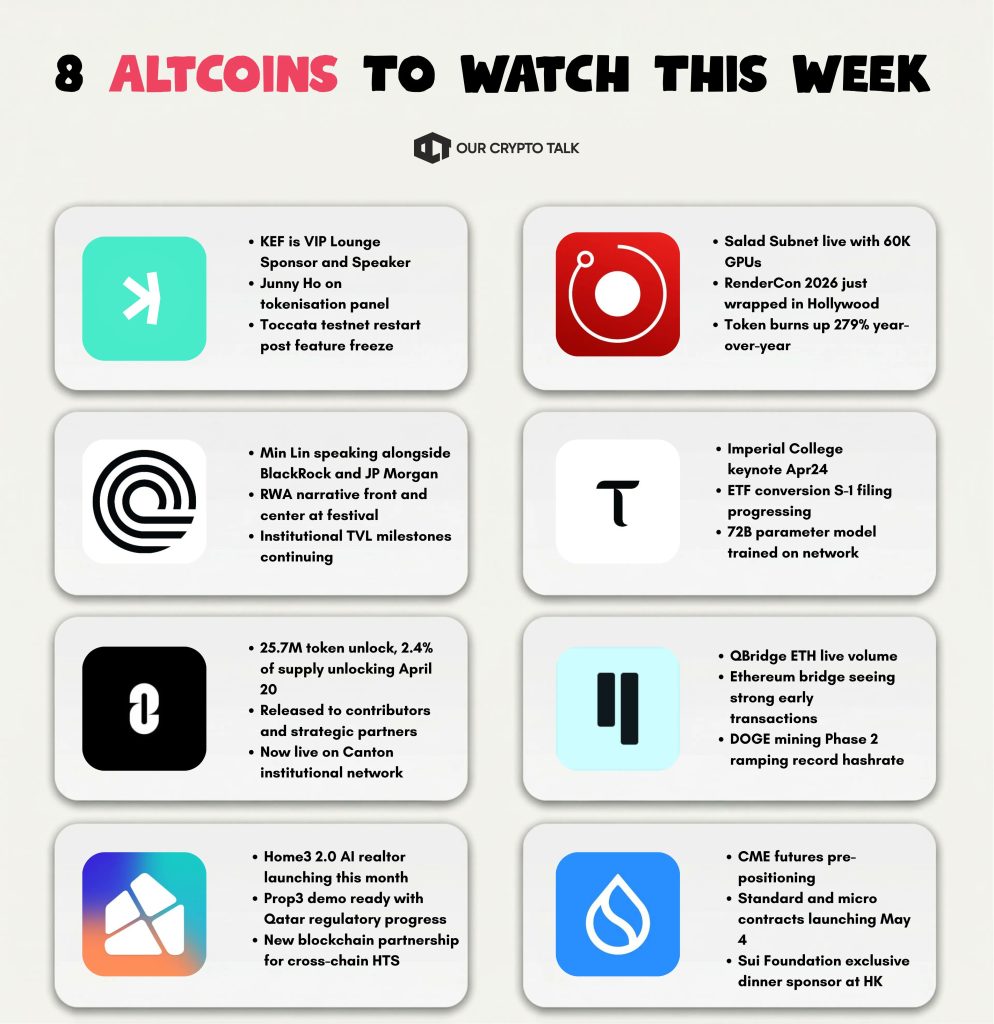
Amid this, analysts at Our Crypto Talk dropped a solid watchlist this week:

Kaspa — Event Buzz + Upgrade Catalyst

Kaspa is front and centre at the Hong Kong Web3 Festival this week. KEF is serving as a VIP Lounge Sponsor and featured speaker, while Junny Ho joins the tokenisation panel. On the tech side, the Toccata testnet restart is expected imminently following a recent feature freeze, a critical step toward bringing Kaspa’s Covenants++ upgrade to mainnet.

  • Fair launch (no presale/pre-mine), fully community-driven
  • ~$940M market cap, still ~84% below ATH

Render Network — AI Demand Surging

Render’s biggest fundamental catalyst in months landed this week. RenderCon 2026 just wrapped in Hollywood (Apr 16–17) with keynotes from NVIDIA, WME, and Stability AI. 

  • Salad subnet adds ~60K GPUs (RNP-023 approved)
  • AI jobs now 35–40% of usage; $210M workload spike
  • Token burns up 279% YoY; price testing $1.70 support

Ondo Finance — Leading RWA Narrative

Ondo Finance is a crucial player in the RWA narrative at the Hong Kong Web3 Festival, with Min Lin sharing the stage alongside BlackRock and J.P. Morgan. Even though the token is still 88% below its ATH, its TVL has hit a record $3.6B, with steady growth driven by rising institutional interest.

  • Franklin Templeton ETF tokenisation + EU expansion
  • Major overhang: 4.67B tokens still locked

Bittensor TAO — Strong Fundamentals, Weak Sentiment

Despite recent selling pressure, Bittensor remains strong. Jacob Steeves is set to speak at Imperial College London on April 24, breaking down decentralized AI, how Bittensor rewards useful work, and how new users can get started.

  • 128 subnets generated $43M revenue (Q1 2026)
  • 72B parameter AI model trained on the network
  • ~20% drop due to developer exit, not fundamentals

LayerZero— Unlock Pressure, Big Institutional Play

LayerZero faces short-term selling but long-term strength. LayerZero faces maximum short-term pressure, a 25.7M token unlock (2.4% of total supply) hit on April 20, released to core contributors and strategic partners. Price dropped sharply. 

  • Live on Canton Network (handles $350B daily volume)
  • Access to $8T monthly RWAs + 750+ apps
  • Backed by major institutions; new “Zero” L1 in works

QUBIC — A feeless Layer 1 focused on AI + compute.

Qubic had a strong week on the tech side. Its QBridge went live on Ethereum, bringing QUBIC to Uniswap v4 as wQUBIC with real trading volume already. At the same time, DOGE mining Phase 2 is ramping up with record hashrate, and the network is now ranked #3 globally by 7-day TPS.

  • QBridge ETH live volume — Ethereum bridge recording strong early transactions
  • DOGE mining Phase 2 ramping — record hashrate (15.81 TH/s peak on Apr 16)

Home3 — High-Risk Micro-Cap

Home3 is a blockchain-based real estate platform focused on making property deals more transparent and efficient. This month, it’s rolling out Home3 2.0, featuring an AI-powered realtor experience called Prop3.

  • Qatar regulatory progress + cross-chain expansion
  • ~$370K market cap, very low liquidity
  • Down 96% from ATH → highly volatile

SUI — A high-speed Layer 1 is getting serious institutional traction.

SUI is gaining strong institutional traction this week. CME Group plans to launch SUI futures on May 4, while the 21Shares SUI ETF is already live on Nasdaq, giving institutions two ways to gain exposure.

  • $1T+ stablecoin volume (March), $585M+ TVL
  • Token unlocks ongoing; ~82% below ATH
altcoins to watch

Reddit Post Sparks Debate on Whether Ripple’s Own Stablecoin Kills the XRP Use Case

XRP News: Stablecoins Take Center Stage, Ripple’s RLUSD Celebrates First Year

The post Reddit Post Sparks Debate on Whether Ripple’s Own Stablecoin Kills the XRP Use Case appeared first on Coinpedia Fintech News

A Reddit post has sparked debate inside the XRP community after a user spent two to three hours running XRP’s investment thesis through both Claude and DeepSeek, prompted by a German finance analyst setting a $9 mid-term price target for the token.

What the AI returned was not reassurance. It was a list of structural concerns.

The RLUSD Question

Banks hate volatility. XRP’s original use case was as a bridge currency providing liquidity between fiat pairs via a brief token hop. But Ripple now offers RLUSD, a dollar-pegged stablecoin running on its own infrastructure.

“Ripple is pushing its own stablecoin (RLUSD). Banks hate volatility. Why would they voluntarily take on the price risk of XRP for their transactions when they could just use Ripple’s software to send a price-stable RLUSD? Doesn’t this mean the XRP token loses its most important institutional use case, or am I missing something here?”

If banks can settle transactions using Ripple’s software with a stable asset, why would they voluntarily absorb XRP’s price risk? The post argued this potentially removes XRP’s most important institutional use case by design, replaced by a product Ripple itself created.

The SWIFT and Chainlink Alternative

The AI raised a competing thesis. SWIFT serves over 11,000 institutions globally and is increasingly connecting to blockchains through Chainlink’s oracle infrastructure rather than replacing its existing rails. Analysts cited in the discussion put LINK’s five-year target at $100 to $150 from a current $9 price, with the mathematical argument being that a 10 to 15x move requires significantly less capital than XRP reaching $9.

The AI also flagged heavy sell pressure clustered between $2.40 and $3.00 from long-term holders, making a clean breakout structurally difficult.

The post concluded by framing this as two competing philosophies for global financial settlement, with the implicit suggestion that only one model will ultimately dominate. Ripple is building the rails and the asset, and SWIFT is evolving through Chainlink integration while keeping its existing infrastructure intact.

Ice Open Network News: ICO Complaint Filed After Insider Breach Exposes User Database

Ice Open Network News What Really Happened to the ION Token

The post Ice Open Network News: ICO Complaint Filed After Insider Breach Exposes User Database appeared first on Coinpedia Fintech News

Ice Open Network has confirmed a security breach involving its identity database, shaking user confidence while highlighting growing risks tied to third-party service providers in crypto.

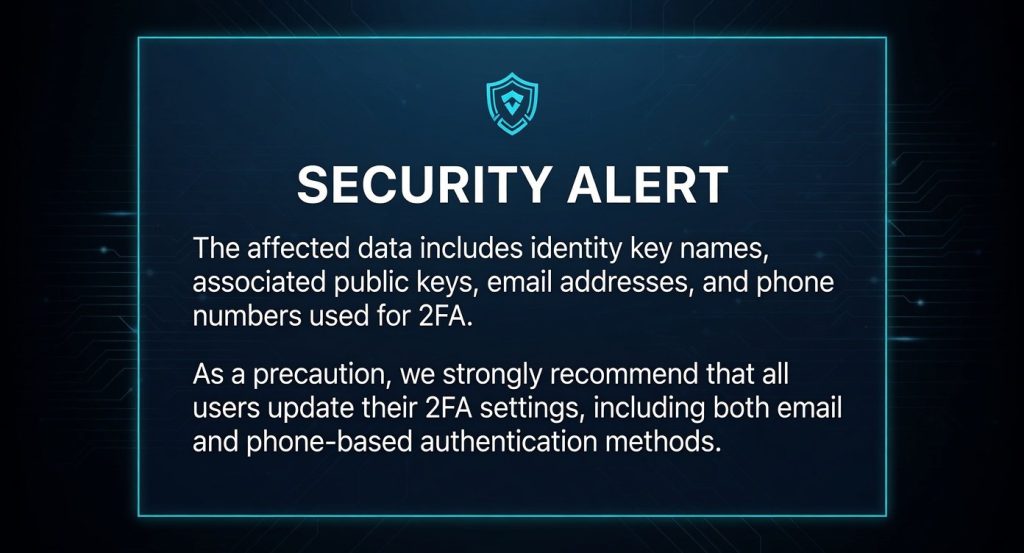
The April 15 breach came from four former partners tied to a third-party service provider, who leaked user data like emails and 2FA phone numbers after accessing an external server.

Ice Open Network, which runs the $ION token and Online+ on BNB Chain, made it clear this wasn’t a system hack but an insider misuse from outsourced operations, not a failure of the core protocol.

Funds Safe, Core System Intact

Even though the breach sounds serious, the team says funds are safe, no private keys, no wallets touched. The core blockchain wasn’t hacked either, and activity on the network is still stable, so no direct money impact.

Emails, phone numbers, and identity-linked data got exposed, which raises privacy concerns. The team is now telling users to quickly update their 2FA to stay safe.

security alert

Legal Action, Migration, and What’s Next

The company has already filed complaints with the Information Commissioner’s Office and is pursuing legal action against those responsible. A technical migration scheduled for April 21 aims to strengthen security, though temporary disruptions on the Online+ platform are expected.

From Price Crash to Full Restructure

This comes just weeks after the $ION 93% crash on April 7 from $0.003 to $0.00024. The CEO pinned it on a long-term service provider dumping tokens, calling it a funding shock, but didn’t share proof. Back then, the team admitted they had spent $18M, were burning $400K monthly, and were close to shutting down.

But things flipped fast. Within 48 hours, they slashed costs by 89% to around $45K/month, cut the team down to core devs, and rolled out a fresh 8-week roadmap, now aiming for a long-shot comeback toward a $1B valuation.

This breach also comes amid a surge in crypto security incidents, with over $606 million lost across protocols in just the first half of April 2026. 

Ripple CEO Brad Garlinghouse Goes All In on Paul Atkins as SEC Ditches Enforcement-First Approach

Ripple

The post Ripple CEO Brad Garlinghouse Goes All In on Paul Atkins as SEC Ditches Enforcement-First Approach appeared first on Coinpedia Fintech News

Something is clearly shifting inside the U.S. Securities and Exchange Commission, and Ripple CEO Brad Garlinghouse isn’t staying quiet about it. Responding to recent comments from Paul Atkins, he described the new direction as a long-overdue reset, especially after what he sees as a difficult period for the crypto industry under earlier leadership.

From “War on Crypto” to a Reset

Garlinghouse directly contrasted Atkins’ approach with former SEC Chair Gary Gensler, saying the agency had drifted away from its core mission of protecting investors. Instead, he argues, it leaned heavily into enforcement, creating confusion and pushing innovation out of the U.S.

In his view, that period felt like a “war on technology,” with courts eventually stepping in to challenge parts of the SEC’s stance. Now, he sees things moving in a very different direction.

Moreover, this includes better coordination with the Commodity Futures Trading Commission and clearer distinctions between securities and commodities. The goal is simple: reduce confusion and make the U.S. competitive again in crypto.

Having said that, even before Atkins was officially confirmed, signs of change were already visible. Under interim leadership, the SEC launched a crypto task force led by Hester Peirce and began dropping major enforcement actions, including cases against Coinbase. 

In the last 12 months, the agency has also approved multiple crypto ETFs and eased its stance on classifying most cryptocurrencies as securities, a major crypto win. 

What Atkins Is Actually Changing

During his interview with CNBC’s Squawk Box, Atkins laid out a clearer roadmap, and this is where the tone really takes a fresh turn. He says the SEC is moving away from that enforcement-first style and into something more structured, what he calls the ACT strategy: Advance, Clarify, Transform.

“And so, basically, we’re instituting a strategy. That I’m calling our ACT strategy, advance, clarify, and transform.”

“Advance” means embracing new tech like crypto instead of pushing it away. “Clarify” is about finally giving the market clear rules, something the industry has been asking for years. And “Transform” focuses on updating outdated systems so markets, including IPOs, can actually keep up with modern finance.

Why This Matters Now

What makes this stand out is how aligned it feels with what the crypto industry has been pushing for: clear rules, less guesswork, and room to innovate. Garlinghouse summed it up by calling Atkins a “breath of fresh air,” which says a lot given the tension between regulators and crypto over the past few years.

Instead of pushing crypto out, the SEC now seems to be trying to bring it back in, with clearer guidelines and a more open approach. If that continues, it could finally give the industry the stability it’s been waiting for.

❌