
Reading view

Spurs lose Victor Wembanyama — and control — as Portland evens series. How can they adjust if Wemby misses Game 3?

SAN ANTONIO — “Whatever we do, we gonna do this s*** together!” — Keldon Johnson

A few minutes before tipoff of Game 2 against the Trail Blazers, the entire Spurs team and coaching staff formed a huddle near half-court, with the backdrop of adoring fans, cheering and congratulating Victor Wembanyama on his first unanimous Defensive Player of the Year award. 

Roughly 30 minutes later, with a little over a quarter of basketball played, that same huddle formed, only this time off the basis of confusion, trepidation and angst. Moments earlier, Wembanyama, in an attempt to drive to the basket while being defended by Blazers guard Jrue Holiday, got his feet tangled up and hit the ground — the velocity so high that his face planted directly into the floor before briefly bouncing off the surface. 

For a moment, Wembanyama lay motionless on the ground before resting against the stanchion in an attempt to gather himself. In some ways, the Spurs’ hopes and dreams laid there with him. He would later be followed to the locker room after leaving on his own power before being officially ruled out with a concussion and entered into protocol. Per NBA rules, there is a 48-hour mandatory recovery period from the onset of a concussion before a player can be evaluated by a team physician or athletic trainer for a return to action. 

Right then and there, San Antonio’s unspoken horrors manifested: the worst-case scenario of Portland’s physicality, a game plan in need of a major audible and an unknown postseason territory without Wembanyama.

“Give a lot of credit to Portland, the staff, the game plan and their players,” Spurs head coach Mitch Johnson said following San Antonio’s 106-103 loss. “There was a level of fatigue there that kicked in, in terms of the intensity of the game and the output in minutes the guys had to play. And that’s a playoff game. That’s what it’s gonna feel like.”
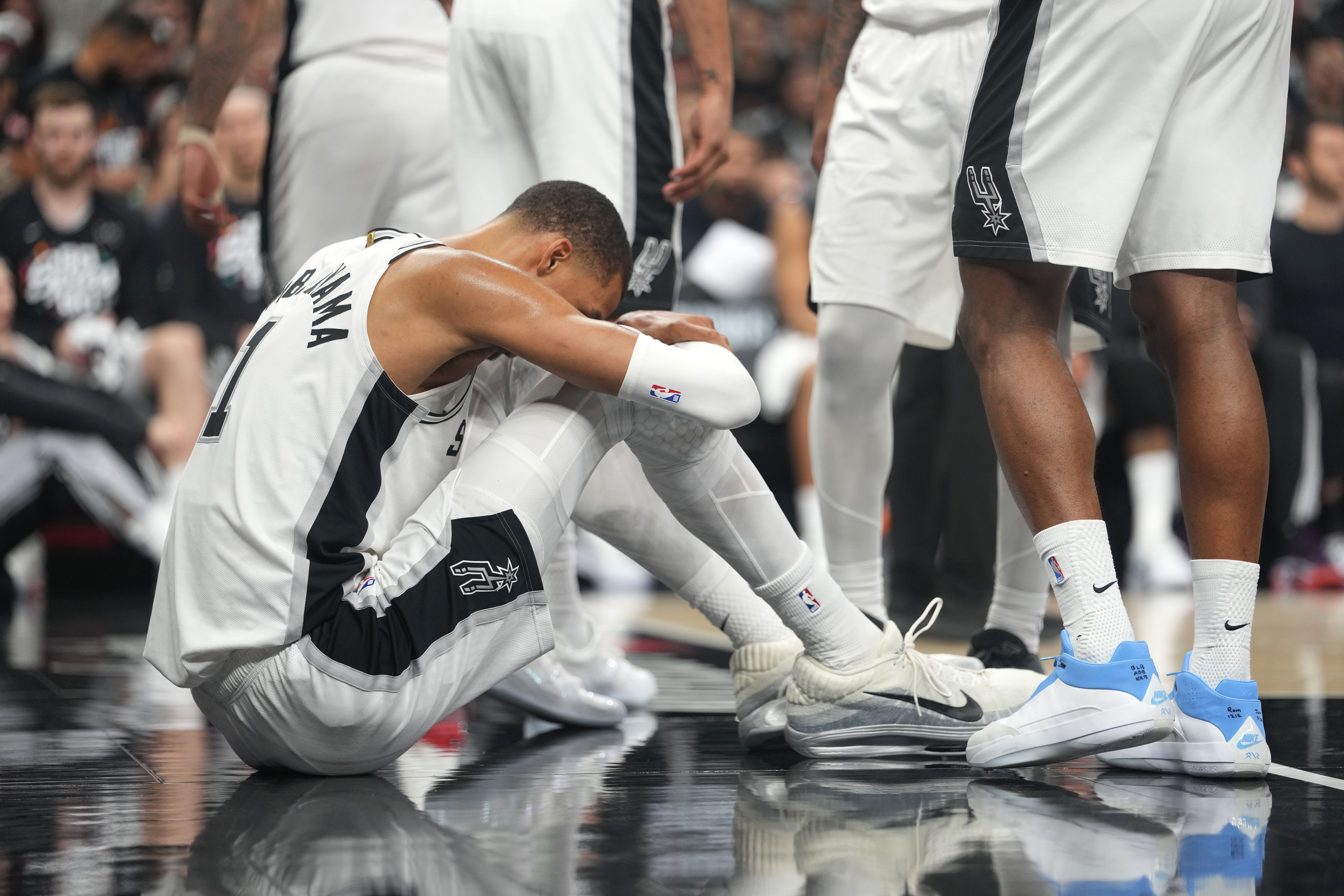
Apr 21, 2026; San Antonio, Texas, USA; San Antonio Spurs forward Victor Wembanyama (1) reacts after falling to the ground during the first half of game two of the first round of the 2026 NBA Playoffs against the Portland Trail Blazers at Frost Bank Center. Mandatory Credit: Scott Wachter-Imagn Images

Victor Wembanyama's scary fall shifted the tone of the night and left the Spurs staring at an uncertain series.

IMAGN IMAGES via Reuters Connect / Reuters

To the Spurs’ credit, even without Wembanyama, there was an admirable effort on the defensive end of the floor. San Antonio held Portland to just 76.1 points per 100 half-court possessions, one of the best defensive outputs both in the regular season and playoffs. They also won the rebounding battle despite going small for large portions of the evening, won the transition battle and held the Blazers to just 34 percent from 3 and 43 percent from the field overall. “We didn’t give up 150 or anything like that,” Johnson added. “I thought the guys actually fought their butts off, did a really good job.”

The problem with silver linings, however, is that a dark cloud frequently accompanies it. San Antonio, a top-half team in 3-point rate, attempted just 24 shots from behind the arc — including just four corner 3s for the NBA’s most proficient corner shooting unit — converting only seven(!) of them. A Spurs team that finishes nearly 70% of shots at the rim only saw 44 percent go down. In the fourth quarter, Stephon Castle and De’Aaron Fox combined to shoot a woeful 2-for-10 from the field, the majority of which came in hotly contested back-and-forth final minutes with the game hanging delicately in the balance. Devin Vassell finished with 16 points on 16 shots, missing all five of his 3-point attempts, including the final chance at forcing overtime. 

Moreover, San Antonio committed the one cardinal sin in a playoff series against an underdog: They gave them momentum, life and a chance. Portland, which has performed as one of the NBA’s top-10 defenses since Feb. 1, presented its deck of why this series is anything but over. The Blazers, led by the defensive grit of Holiday, Toumani Camara and Scoot Henderson, are as pesky of a trio as any around the league, able to use their abundance of physicality and lateral quickness to crowd the airspace of even the quickest opposing guards. Donovan Clingan and Robert Williams III are about as shrewd of a frontcourt one-two punch as there is around the Association, not only because of their ability to protect the interior but because of their snarl, soft touch and uncanny nature of their in-between game. What once appeared to be a breeze of a first-round series now has all the makings of a grueling, risky marathon.

As the entire city of San Antonio awaits Wembanyama’s immediate next steps, the Spurs coaching staff will reconvene to determine how to avoid letting go of the rope altogether in what will surely be a deafening Moda Center for Game 3. The Spurs are quite familiar with playing without Wembanyama, only being outscored by a single point in around 2,000 minutes this season. Their ability to remain even-keeled with Portland in non-Wembanyama minutes nearly brought them over the finish line on Tuesday evening and will certainly be at the forefront of any Game 3 preparation. 

“We’ve played tough games without him,” Castle said about the prospect of Game 3 without Wembanyama. “Obviously, we want everybody healthy and to have him on the court, but I’ll get whatever five guys we have on the court. We’re gonna play like ourselves.”

(Within that game plan will certainly come some tough decisions. San Antonio’s most-played lineup without Wemby in Game 2 — regular starters plus Luke Kornet — were outscored by seven with a -46.7 net rating. Playing four guards alongside Kornet swung the pendulum to a +66.7 net rating in four minutes. There’s also the question of whether rookie Carter Bryant, who was deputized as a small-ball five, can withstand the pressure and physicality of the Clingan/Williams tandem on the road.)

Still, some tough questions remain. How did San Antonio’s elite defense allow Henderson — who has played in just 30 games all year and scored more than 25 points twice — to command the show like that with a game-high 31 points? How can the Spurs replicate Wembanyama’s vertical spacing and gravity, the centripetal force of their inside-outside balance, spacing and efficiency? What happens when Wembanyama, who literally forced Portland to adjust their line of offensive — and defensive — thinking, is not there to save the day? (San Antonio allowed 117.4 points per 100 possessions without Wembanyama this season, which would rank inside the bottom 10 among NBA defenses.)

How do you account for Deni Avdija, who was largely kept in check in Game 2, knowing one of the league’s most adept drivers will roam freely without the Defensive Player of the Year at the rim?

“It’s really the same game plan,” Castle said. “Most of their offense ends in guard-to-guard screening or one-on-one dribble drives. So being able to contain the ball, still be able to help each other. Obviously, we can’t make up for what Vic is for us defensively, but you’re trying to do it as a team. Stay in shifts for each other, communication and rotations.”

Trail Blazers-Spurs takeaways: Scoot Henderson's emergence crucial as Portland capitalizes on Victor Wembanyama's absence

SAN ANTONIO — When San Antonio Spurs superstar Victor Wembanyama jogged to the locker room Tuesday night at 8:57 of the second quarter after his face slammed to the floor, everything changed for San Antonio.

He was ruled out for the game shortly after entering concussion protocol, and the Spurs were forced to regroup.

They led by double-digits late in the fourth quarter, but couldn’t find any consistent offense down the stretch as Portland stayed steady and out-shot and outworked San Antonio in Game 2 to claim a 106-103 victory that evened the first-round playoff series.

Here are the key takeaways for how the Trail Blazers capitalized on their big opportunity Tuesday night:

Life without Wemby

With Wembanyama ruled out early in the second quarter, Spurs head coach Mitch Johnson turned to a seldomly used lineup to keep his team afloat: Dylan Harper, Stephon Castle, Devin Vassell, Julian Champagnie and Luke Kornet. The combination of four guards and Kornet played just 29 minutes together this season, but outperformed teams by a +12.6 net rating — as well as operated at a pace that would rank at the top of the league.

The drawbacks to a lack of size against one of the larger playoff teams around were apparent, but the benefits and potential tradeoffs were too tantalizing to ignore. All four guards are capable of initiating and finishing plays, can create for others as well as themselves and can space the floor. At the other end, what they lack in size they make up for in speed, smarts and connectivity. San Antonio played Portland evenly for the remainder of the half and those players helped the Spurs extend their lead in the fourth quarter, something to monitor moving forward depending on how many non-Wembanyama minutes the Spurs will play in the coming days.

Unfortunately with no Wemby available, the smallish Spurs were exploited on the glass late and the offense collapsed down the stretch as the squad seemed to lack the connectivity and familiarity that had been its hallmark.

The emergence of Scoot Henderson

Around the six-minute mark of the first quarter, Blazers guard Scoot Henderson drilled his second 3 of the game, giving him 10 early points and the Blazers a surprise 22-9 lead over the Spurs. But it wasn’t his shot-making ability that was making the most waves. Henderson’s activity at the other end — pressuring the ball and more importantly, being an active ballhawk in passing lanes — was the key to Portland keeping Frost Bank Center on edge.

On two separate occasions, Henderson was at the heart of breaking up a Castle alley-oop and what would have been a key entry pass to Wembanyama. Henderson appeared in only 30 games during the regular season due to injury, but his defensive impact as a sharp, rangy lateral stopper is clear. Henderson ranked third in deflections per game, and the Blazers were nearly four points better per 100 possessions defensively in his minutes, good for 79th percentile.

Offensive consistency has always been an issue with the 22-year-old electric guard, but he seems to be figuring things out on the biggest stage and his penchant for making defensive plays — even in his limited time — is a huge chunk of the Blazers’ viability.

Henderson scored five points in the last five minutes of the game and was vital as Portland closed things out down the stretch.

Henderson led all scorers in Game 2 with 31 points, hitting five 3s and finishing plus-9 in what seemed to be a legit breakout performance.

Spurs will need to step up

When Spurs reserve Keldon Johnson first stepped on the floor, his team trailed 17-9 and looked like it was sleepwalking. By the time the buzzer for the first quarter sounded and Johnson walked off the floor, San Antonio had retaken the lead.

Johnson's plus-9 led all players on the floor at the time, an indication of his simple approach to basketball that continues to yield positive results. Johnson's game isn't particularly flashy — he recorded a steal, assist and rebound during his initial stint — but his constant motor, energy and intangibles are vital for a team that was somewhat lethargic to begin the game.

The combination of Johnson and rookie guard Harper — the latter of which continues to provide a huge boost in the playmaking, downhill driving and gravitational department but seemed to aggravate his left thumb Tuesday night — is an underlying storyline in a series that just got a whole lot more interesting.

Johnson finished the game plus-7 with 7 points, 4 rebounds and 2 steals, but more will be needed if Wembanyama misses Game 3 in Portland.

NBA playoffs 2026: Victor Wembanyama's dominance and a new day for the Spurs

SAN ANTONIO — As Victor Wembanyama ducked under the awning and triumphantly emerged from the tunnel for his pregame warmup ahead of his playoff debut — an entrance that would make Shawn Michaels proud — the warm embrace of Frost Bank Center became a stage for the arts. 

At the same time that a sea of proud onlookers whipped out their phones ready to document a piece of history, Spurs legend Manu Ginóbili, tucked away in the southeast corner of the arena with his son, reached for his own mobile device as his smile widened in length. 

At that moment, Ginóbili wasn’t one of the most decorated figures in the franchise’s illustrious history. Nor was Tim Duncan or David Robinson. They were family members and friends alike, gathered in the house that Gregg Popovich helped build to see one of their own walk across the stage. 

“The first time I stepped on the court for warmups, I felt the atmosphere,” Wembanyama said following the Spurs’ 111-98 Game 1 win over the Blazers. “It was different. Everybody’s ready. The fans are ready. It’s probably the most excited I’ve seen this area, this arena.”

By the time Wembanyama walked off the floor in the final minute to a sea of roaring, rising cheers, the game already decided long before, the Frenchman’s stamp on the evening — and perhaps the series — had been made: 35 points on 13-for-21 shooting in 33 minutes to go along with five rebounds and two blocks. A Portland bench stunned, confused and dazed. In some ways, it felt like a coming-out party. In other ways, it simply felt like a reminder; a continuation of a regular season lost in superlatives, new heights and records. A 22-year-old isn’t supposed to command a five-man group, let alone a gathering of 20,000 people. But this dominance, this elegance, is the new normal. 

“I think that there’s an approach that we all have,” Spurs head coach Mitch Johnson said, “in terms of an expectation of the level of preparation, detail, nuance, competitiveness, physicality, everything. And I think there’s a real desire from that young man to want to participate in that. This is his first playoff game, and he has lofty expectations and goals for himself. Being in the playoffs is squarely a part of that, so it’s good to get the first one and get that experience under your belt.”

The unfortunate truth for the Blazers, as they attempt to course correct to avoid a 2-0 hole, is that from a pure structural standpoint, there are a number of similarities between themselves and the Spurs. Both teams share a willingness to let it fly from deep (Portland is fourth in 3-point rate, San Antonio is 14th.) Both teams also hunt shots at the rim, each among the top seven in rim rate. The Blazers are ninth in pace and Spurs are 12th. And the two teams are among the league’s best in offensive rebounding — Portland being fourth, San Antonio ninth. 

But the difference: A 7-foot-4 shot-altering, three-level two-way wrecking ball is an otherworldly distinction. It’s like saying the Earth and the moon are structurally similar, but one possesses an atmosphere and one doesn’t, therefore it’s the difference between the sustenance of life and the absence of it altogether. 

It also doesn’t help that Wembanyama took the Blazers’ biggest strength — their physicality — and turned it into a weakness. Portland attempted various coverages on the third-year big; Toumani Camara got the initial assignment, then Deni Avdija, Jerami Grant, Jrue Holiday, their two centers, the cameraman and the elevator attendant. Fronting him turned into laughable shots at the rim, whether they were outright dunks or fouls. Denying him underneath the arc allowed Wembanyama to put the ball on the floor and showcase his dribbling, sweeping his feet in rhythmic fashion en route to the rim. And keeping either Donovan Clingan or Robert Williams III on him behind the arc only dared him to shoot over the top — which he did. (All five of his made 3s came against centers.) Portland’s roughhousing inputs were simply downloaded into Wembanyama’s megaprocessor, and like Grok or Claude, information was stored for later. 

“Of course,” Wembanyama said when asked if he knew of the Blazers’ physicality. “It’s their identity, something to be expected, and it’s also expected that they’ll double up on that in the next games, but we’re ready.”

Defensively, the story could have written itself. Portland shot just 42% from the field and 26% from 3, but it was more about the shots they didn’t take. Wembanyam’s two recorded blocks don’t capture the full scope of decision-making by the Blazers. On one occasion, Grant’s whole existence was erased in one sweeping motion at the rim. In another, Matisse Thybulle drove along the baseline, saw Wembanyama’s shadow and completely changed his mind. That’s what Wembanyama’s lifeblood is. Not the erasure of shot — the erasure of thought. 

Game 1 also reinforced that San Antonio is also more than just Wembanyama. During the regular season, Wemby was third in touches per game and fourth in time of possession. He never needed, nor asked, to dominate the ball, usage or shots. This win is not possible without Stephon Castle driving the boat, without Devin Vassell’s incredible third-quarter stretch, De’Aaron Fox’s consistent pressure or even Luke Kornet’s solid deputy display. The Spurs are a family concept, with Wembanyama as their centripetal force that is ready for a deep run. Watch out. 

“We’re locked in,” Vassell said. “We can clean up some stuff and I think we’ll be a whole better in Game 2 [on Tuesday]. … Everybody has each other’s back. It makes it easier to communicate in the game. All of us are like brothers off the court, so it makes it easier to play on the court.”

❌