Reading view

Pantera Capital wants Satsuma to Dump Its Remaining $50 Million in Bitcoin 

Will the Fed Buy Bitcoin? Analyst Says Saylor’s Strategy Beats Powell

The post Pantera Capital wants Satsuma to Dump Its Remaining $50 Million in Bitcoin  appeared first on Coinpedia Fintech News

The Crypto venture fund Pantera Capital, with $3.8 billion in AUM, has urged London-listed Satsuma Technology to sell its remaining $50 million in Bitcoin and return that capital directly to shareholders.

Meanwhile, Satsuma’s stock has collapsed more than 99% from its June 2025 peak, now trading around $0.21 with a market cap of just $25 million. 

Pantera Pushes Satsuma to Exit Bitcoin Holdings

Satsuma’s Executive Chairman, Ranald McGregor-Smith, said that pressure is building on Satsuma as key investors are now pushing the company to exit its Bitcoin position. 

He said some shareholders “have requested a return of capital,” but did not name them directly.

While he did not directly name Pantera, he said, 

“We are exploring options to facilitate these requests while protecting the interests of all shareholders.”

Pantera, which holds around 7% stake in the firm, has invested over $300 million in digital asset strategies and is believed to be among those asking Satsuma to sell its Bitcoin and return the money to investors before more value is lost.
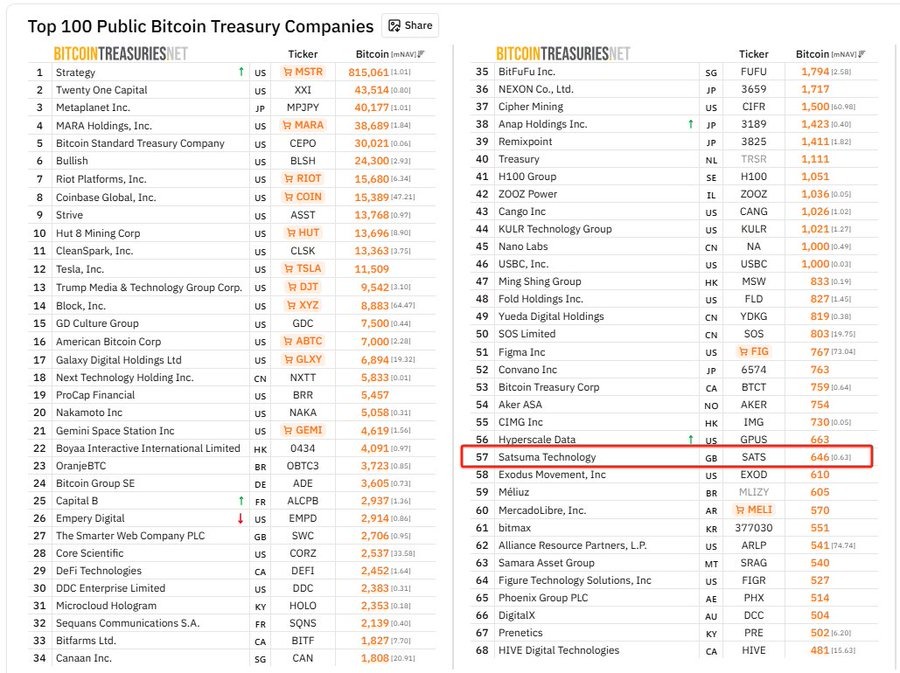
Pantera Capital wants Satsuma to Dump Its Remaining $50 Million in Bitcoin

Tensions Build After Earlier Bitcoin Sale

The current situation did not happen overnight. The tension started back in December 2024, when Satsuma sold nearly half of its Bitcoin holdings. The goal was to repay note holders who chose not to convert their loans into company shares.

However, this move upset some investors, including Pantera Capital. Reports say they were unhappy with the decision and even asked for changes in the company’s leadership.

By March 2025, the situation had led to big changes. The company’s CEO, Henry Elder, and CFO Andrew Smith both stepped down.

Now, the pressure is back again. Investors want Satsuma to sell its remaining Bitcoin, and the company must decide its next step carefully.

From $221 Million Dream to a 99% Crash

In August 2024, the London-listed company raised £164 million ($221 million) through a convertible loan note, announcing an ambitious “AI-powered” Bitcoin treasury strategy that put it squarely in the middle of one of the hottest investment trends in the world.

However, after Bitcoin surged above $126,000, it later dropped nearly 40%, hurting company valuations. 

At the same time, Satsuma, which used borrowed money to buy near the top, was left in a tough spot.

Following this, Satsuma’s stock has collapsed more than 99% from its peak, now trading near $0.21. However, its market value has dropped to around $25 million.

Why Bitcoin Price Stuck at $79K, Michael van de Poppe Explains

Bitcoin (BTC) Price Just Started Rising—Top 3 Signals Point to a Move Toward $100K

The post Why Bitcoin Price Stuck at $79K, Michael van de Poppe Explains appeared first on Coinpedia Fintech News

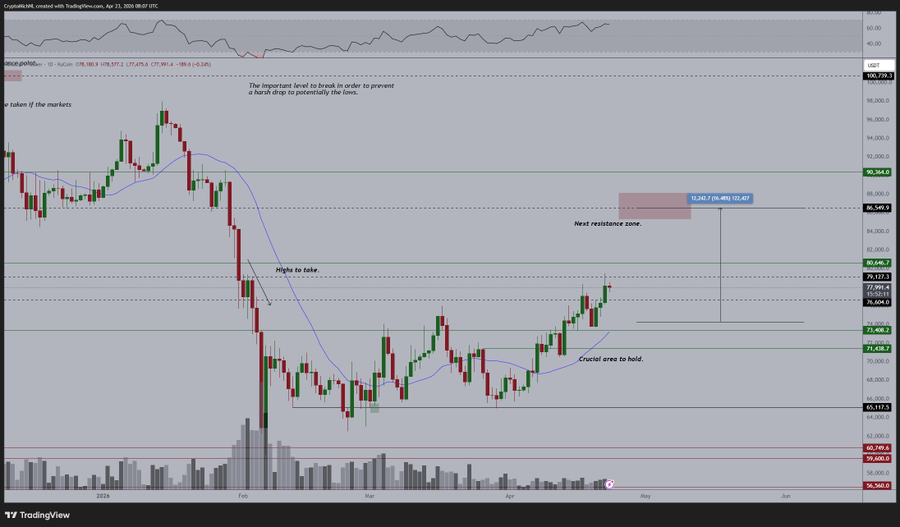
Bitcoin, the pioneer cryptocurrency, jumped roughly 6% over the past week, pushing straight into the key $79K resistance zone. Meanwhile, well-known crypto trader Michael van de Poppe says that as long as the $75,000 support holds, Bitcoin could still move higher toward $85,000–$88,000 in the next one to two weeks.

Why $79K Is Such a Hard Wall to Break

For the past weeks, Bitcoin has been showing healthy price behavior despite a small pullback after testing the $79,468 level.

According to van de Poppe’s analysis, this level is filled with sell orders and short positions that have been building up over weeks. Of this, Bitcoin may pause or move slightly lower before attempting another breakout.

Poppe says that Bitcoin could gather strength again before making another attempt higher. The more likely scenario, and the one van de Poppe lays out clearly, is a three-step process:

  • First, Bitcoin tests the $79K wall. 
  • Second, it pulls back slightly to gather momentum. 
  • Third, it finds fresh buying strength and pushes through, this time targeting $86,000 with real force behind it.
bitcoin price chart

Poppe notes that “this is not weakness. It is the market doing what it needs to do before a bigger move.”

Coinglass Data Hint, Short Squeeze Setup

Market data also points to a possible short squeeze. According to CoinGlass data, Bitcoin’s funding rate is slightly negative at -0.0092%, while open interest has increased to $60.54 billion. 

This means more traders are betting that the price will fall, but Bitcoin is still holding steady.

When this kind of setup plays out, short sellers often get forced to close their positions at the same time. This can quickly push the price higher.

Key Levels Traders Are Watching

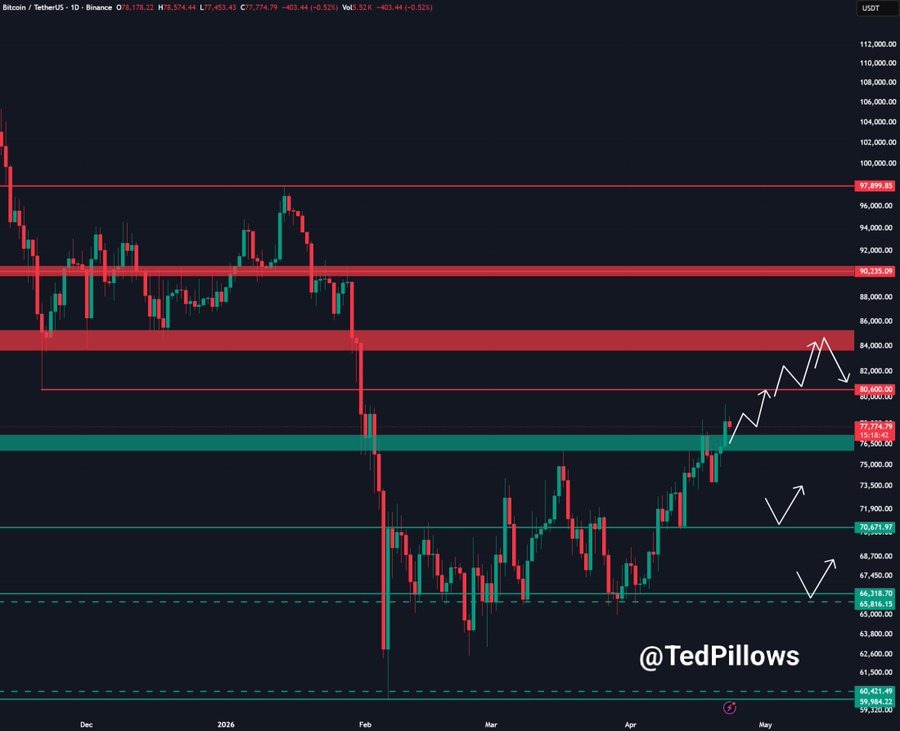
Not every analyst is purely bullish. Crypto analyst Ted Pillow laid out the support structure clearly for those watching the downside.

The immediate floor sits near $76,000. Below that, $75,650 and $75,400 are the next meaningful support levels. If selling pressure intensifies further, $74,250 comes into play, and the main line in the sand sits at $73,200, which van de Poppe also identifies as the broader support range that must hold for the bullish case to remain intact.

bitcoin price chart

A failure to reclaim $77,350 in the near term would be the first warning sign that Bitcoin needs more time before its next push higher.

CLARITY Act May Pass by the End of May, Says Senator Moreno

CLARITY Act May Pass by the End of May, Says Senator Moreno

The post CLARITY Act May Pass by the End of May, Says Senator Moreno appeared first on Coinpedia Fintech News

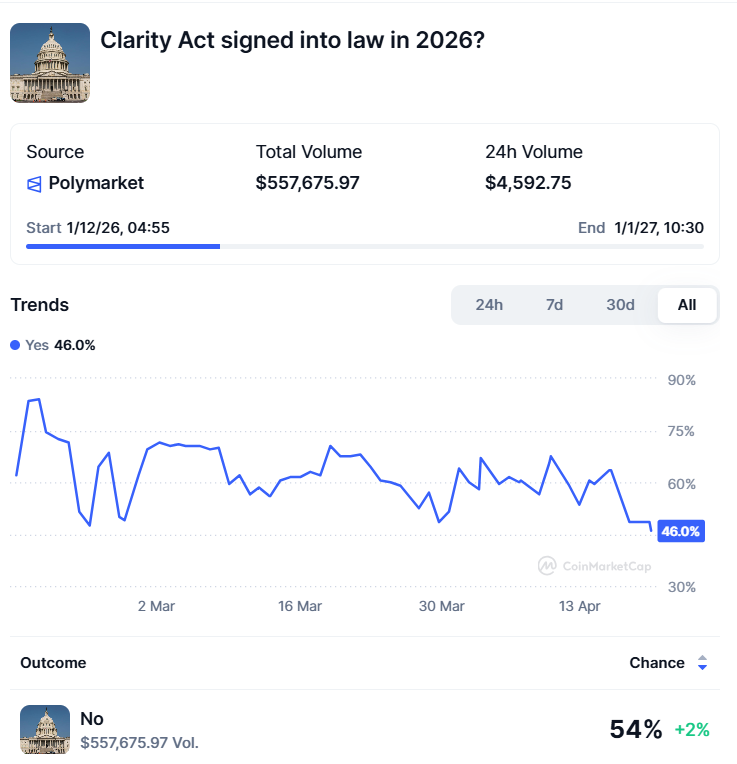
The CLARITY Act could be completed by the end of May 2026, according to Senator Bernie Moreno, raising hopes for long-awaited crypto regulation. Meanwhile, prediction market odds have slightly improved from 38% to 46%, but delays and political pressure remain doubtful.

On the other hand, a Republican on the Senate Banking Committee is still pushing to delay the CLARITY Act markup to May.

CLARITY Act Timeline Points to End of May Decision

The CLARITY Act, which aims to define crypto market structure, has been stuck in the Senate despite earlier momentum. A delay in the markup process now risks pushing the timeline further.

Speaking at a DC event in Washington, Senator Bernie Moreno said,

“I think we’re going to get it done by the end of May.” 

His statement comes at a time when concerns are rising over whether the bill can move forward fast enough.

The delay in scheduling a markup has created uncertainty. Without it, the bill cannot move to a full Senate vote, making timing very important.

Pressure Builds as May Deadline Becomes Critical

Moreno has already warned that missing the May window could push crypto legislation off track for a long time. If the bill does not progress soon, it risks being lost amid a busy political calendar and the upcoming election cycle.

At the same time, he strongly pushed back against banking-sector concerns about stablecoin yields. He called these concerns “noise” and even said they are “completely fake,” urging banks to focus on innovation instead of slowing progress.

At the same time, global competition is increasing. 

Treasury Secretary Scott Bessent warned that if the U.S. delays crypto regulation, innovation could move to other countries like Dubai and Singapore. Countries like Russia are legalizing BTC for cross-border trade, and the U.S. risks falling behind.

Clarity Act Odds Jumped On Polymarket Prediction

The uncertainty is already affecting market sentiment. On prediction platform Polymarket, the odds of the CLARITY Act passing in 2026 moved from 38% to 46% after Moreno said we’re going to get the CLARITY Act done by the end of May.

Clarity Act Odds Jumped On Polymarket Prediction

The next few weeks are critical. If the Senate moves quickly and schedules the markup, the bill still has a chance to pass by May.

Coinbase Warns on Quantum Risk, Hoskinson Questions Bitcoin’s Approach

Bitcoin Developers Propose Freezing Satoshi-Era Coins to Block Quantum Threat

The post Coinbase Warns on Quantum Risk, Hoskinson Questions Bitcoin’s Approach appeared first on Coinpedia Fintech News

Coinbase’s Quantum Advisory Board has released a new report warning that quantum computing could one day affect crypto security. There is no immediate risk, but it says the industry should start preparing early. 

The discussion over Quantum Risk has drawn criticism from Cardano founder Charles Hoskinson over Bitcoin’s chosen security path.

Coinbase Quantum Report Flags Future Risk to Crypto Security

In an X post, Coinbase CSO Philip Martin said that they have released their first detailed paper on how quantum computers could affect blockchain systems.

The board includes researchers from top institutions like Stanford, UT Austin, UC Santa Barbara, and Bar-Ilan University, along with experts from major crypto projects. 

Experts say quantum computing is not an immediate threat right now, but it could become a real risk in the future. Today’s machines are not strong enough to break blockchain security, but this could change within the next decade.

Today we've published the first position paper from the Coinbase Independent Advisory Board on Quantum Computing and Blockchain, a group of leading researchers from Stanford, UT Austin, the Ethereum Foundation, and beyond.

The short version: your crypto is safe today. But a…

— Philip Martin (@SecurityGuyPhil) April 21, 2026

The main concern is not the blockchain itself, but user wallets. The system that proves ownership of funds could become weak, especially for wallets where key data is already public.

The council clearly says the industry should start preparing now, because waiting too long could make the problem much harder to fix.

What Is Actually at Risk?

Not all parts of crypto face the same risk. Bitcoin’s core system, like mining and transaction history, is mostly safe.

The main risk is at the wallet level. Around 6.9 million BTC could be exposed because their keys are already public. If quantum computers become powerful, they could break these signatures and access funds.

Proof-of-stake networks also have extra risk because of how validators work. So, the bigger issue is user security, not the blockchain itself.

Upgrading Crypto Will Be a Big Challenge

Solutions already exist.

Quantum-resistant cryptography has been in development for years, and new standards have already been approved.

But the real challenge is implementation.

Upgrading millions of wallets, networks, and systems will take years and coordination. These new systems are also heavier, which could affect speed and costs.

Coinbase says it is working with partners and developers to ensure systems are ready when the transition becomes necessary, stressing that no single company can solve this alone.

Charles Hoskinson Questions Bitcoin’s Strategy

When it comes to the quantum computing threat, Charles Hoskinson has raised strong concerns about Bitcoin’s approach. He recently criticized Adam Back’s approcehe of use of SPHINCS+, a quantum-safe signature system, calling it safe but too limited and inefficient.

Lol, let's use the least expressive and interesting PQS to solve the quantum issue. Never change Bitcoin https://t.co/2mcytWyb12

— Charles Hoskinson (@IOHK_Charles) April 21, 2026

According to him, this approach solves the problem but does not improve Bitcoin’s overall capabilities. He believes a more advanced and adaptable solution should have been considered.

He also warned that once Bitcoin adopts a system, changing it later could take years.

However, quantum risk is not urgent, but ignoring it now could become a problem later.

Russia’s State Duma Officially Recognizes Crypto as Property, but Bans Domestic Usage

Crypto News: Trump Administration Set to Focus on U.S.-Based Altcoins, Expert Reveals Bullish Outlook

The post Russia’s State Duma Officially Recognizes Crypto as Property, but Bans Domestic Usage appeared first on Coinpedia Fintech News

Russia’s State Duma passed the country’s long-awaited crypto regulation bill in its first reading on April 22, 2026, formally recognizing cryptocurrency as property under Russian law. However, Bitcoin and Ethereum are expected to be among the first approved assets. 

Russia Crypto Bill Classifies Crypto as Property

Russia’s State Duma has passed the first reading of a new law titled “On Digital Currency and Digital Rights,” officially recognizing cryptocurrencies like Bitcoin as property. 

The bill received overall political support and sets the foundation for a structured crypto framework in the country.

THIS IS MASSIVE FOR CRYPTO

🇷🇺 Russia just "PASSED" the crypto regulation bill to allow businesses and companies to use crypto as payment for cross-border and foreign trade settlements, even under sanctions.$BTC and $ETH are expected to be the first assets approved under the… pic.twitter.com/Y3vG7jlqm7

— Ash Crypto (@AshCrypto) April 22, 2026

Under the proposed rules, cryptocurrencies can be used for cross-border payments and foreign trade, but they will remain banned for everyday domestic use. This means crypto cannot be used to pay for goods, services, or salaries inside Russia. 

Meanwhile, the ruble will continue to be the only legal currency for internal transactions. This shows that Russia is opening the door to crypto, but in a limited and controlled way.

Additionally, the bill also makes crypto mining legal, but with clear conditions. Miners must register their equipment and operate within Russia’s infrastructure. This could help the government track and regulate the industry more effectively.

Strict Rules for Exchanges, Investors, and Banks

The bill gives the Bank of Russia full control over crypto operations. It will license exchanges and brokers, set rules, and supervise all activity in the sector.

  • License exchanges and brokers
  • Set rules for operations
  • Monitor all crypto-related activity

Investors will also be divided into two groups:

  • Qualified investors (with fewer limits)
  • Non-qualified investors (limited to around $3900 to $4,000 per year)

This approach aims to protect smaller investors from high market risks.

What Happens Next for Russia’s Crypto Law

If fully passed, the law is expected to come into force on July 1, 2026, with some sections taking effect later. This gives Russia time to refine the system before full implementation.

With over 20 million crypto users, Russia is now building a structured system rather than leaving the market unregulated.

Bitcoin News: Why is Bitcoin Price up Today?

Altcoin Season 2.0? Trader Predicts 50x Rally as Bitcoin Dominance Starts to Fall

The post Bitcoin News: Why is Bitcoin Price up Today? appeared first on Coinpedia Fintech News

Bitcoin, the pioneer cryptocurrency, is up around 3% to $78,112.87 in the last 24 hours, outperforming the broader market’s 2.47% gain. The rise is mainly driven by easing global tensions following Trump’s ceasefire update and strong institutional buying.

Let’s look at the key reasons why the Bitcoin price is up today.

Trump Extends Iran Ceasefire

One major trigger came from Donald Trump, who announced on Truth Social that the United States will extend its ceasefire with Iran.

However, the extension is at Pakistan’s request, acting as a mediator. It allows more time for Tehran to present its proposal. Meanwhile, the original two-week ceasefire was set to end on Wednesday

However, the situation remains complex as Iran has not officially responded yet. While the US will continue its blockade of Iranian ports.

Institutional Accumulation Race Heats up

At the same time, institutional accumulation continues to strengthen the market. Michael Saylor’s firm, Strategy, recently purchased 34,164 BTC worth around $2.54 billion at an average price of $74,395. 

This brings the company’s total holdings to 815,061 BTC, making it the largest corporate Bitcoin holder, ahead of BlackRock’s iShares Bitcoin Trust (IBIT).

This signals an intensifying institutional accumulation race, adding strong support to Bitcoin’s price.

Bitcoin ETF Continues to Record Inflows

Another key factor behind today’s rally is the steady inflow into Bitcoin exchange-traded funds. 

Over the past six days, Bitcoin ETFs have attracted more than $1.62 billion in net inflows, creating consistent buying pressure in the market. 

Major funds, including BlackRock’s IBIT and products linked to Morgan Stanley, have recorded up to ten consecutive days of inflows, effectively absorbing selling pressure and supporting price stability.

Short Squeeze Adds Fuel to Bitcoin Rally

The rally was also intensified by a short squeeze. CoinGlass data shows more than 107,000 traders were liquidated, with total liquidations reaching $454.87 million in 24 hours.

Short positions alone accounted for a $319.99 million, helping push prices higher quickly. 

What to Watch Next for Bitcoin Price

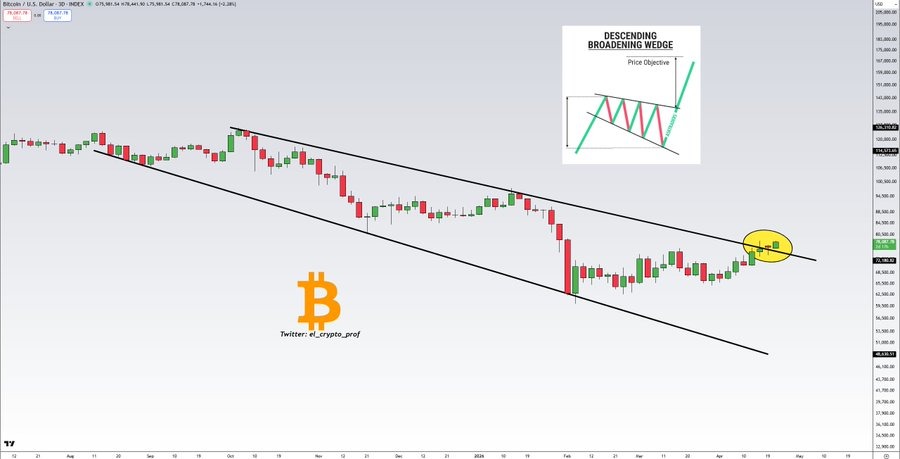
For now, Bitcoin has broken out of a descending broadening wedge, effectively ending the downtrend that had persisted for more than seven months.

Bitcoin News: Why is Bitcoin Price up Today?

If it stays above $78,000, the next possible target is around $81,952.

But if buying slows down or ETF inflows weaken, the price could fall back toward $75,170.

SpaceX Eyes $60B Cursor Deal, Signaling New AI Coding Era

SpaceX Moves 2,395 BTC Amid Bitcoin Slump, Is Musk Selling or HODLing?

The post SpaceX Eyes $60B Cursor Deal, Signaling New AI Coding Era appeared first on Coinpedia Fintech News

Elon Musk’s SpaceX revealed that it has secured an option to acquire Cursor, the AI coding assistant developed by Anysphere, in a deal valued at $60 billion later this year, with an alternative $10 billion payment tied to their joint work if the acquisition does not go through. 

This signals that the AI coding race has entered a completely different league.

SpaceX Steps In To Buy Cursor With $60 Billion Offer

On 22nd April, SpaceX announced on X that Cursor has granted the company an option to acquire the startup for $60 billion later this year. 

If the full acquisition does not happen, SpaceX will instead pay $10 billion, structured essentially as a breakup fee tied to the two companies’ ongoing collaboration. The reasoning behind the deal was stated clearly by SpaceX in their post: 

“The combination of Cursor’s leading product and distribution to expert software engineers with SpaceX’s million H100 equivalent Colossus training supercomputer will allow us to build the world’s most useful models.”

They added: “SpaceXAI and Cursor are now working closely together to create the world’s best coding and knowledge work AI.”

However, this partnership makes sense on paper. Cursor is one of the fastest-growing developer tools in tech history. 

FTX Missed Billion-Dollar Opportunity

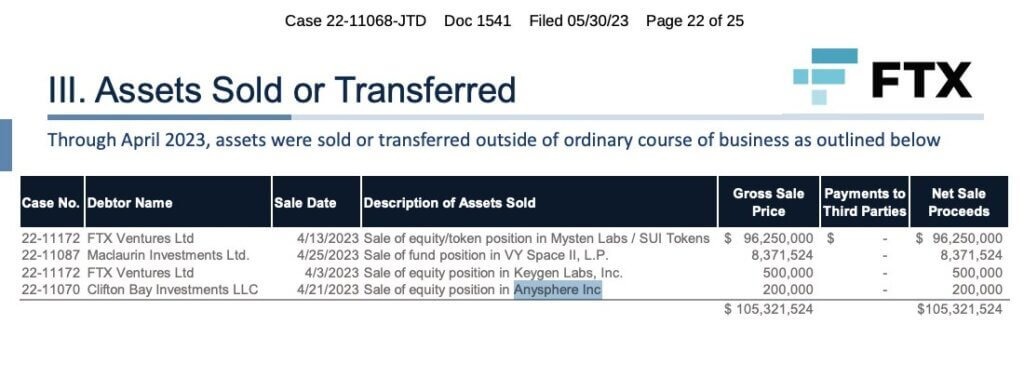
Back in April 2022, FTX’s trading arm, Alameda, invested $200,000 in Cursor for about 5% equity. However, during FTX’s bankruptcy process, this stake was sold at the same price.

FTX Missed Billion-Dollar Opportunity

Fast forward to today, and that same stake of Anysphere, based on Cursor’s valuation, has crossed $50 billion in recent funding talks. 

This makes it one of the biggest missed investment opportunities linked to the FTX collapse.

Why SpaceX Is Not Buying Cursor Right Now – IPO Plan

Interestingly, SpaceX is not rushing to complete the acquisition. The company is preparing for a potential IPO that could value it at around $1.75 trillion, with plans to raise $75 billion.

Closing a major $60 billion acquisition before the IPO would force the company to update its financial filings and disclosures, potentially pushing back the entire listing timeline.

So instead of buying now, SpaceX has locked in the right to buy later, keeping the IPO process clean while securing its position in the AI coding race before a competitor moves in.

What Comes Next

For now, all eyes are on three things, SpaceX’s IPO timeline, the outcome of Cursor’s ongoing $2 billion funding round, and whether the $60 billion acquisition option gets exercised before year’s end.

As demand for AI coding tools continues to rise, the company is positioned at the center of a major tech shift.

❌