The Enjin debate got a lot more louder today after CoinMarketCap amplified a brutal industry claim: roughly 93% of Web3 gaming projects are now “effectively dead,” with token values down 95% from 2022 peaks and studio funding collapsing 93% by 2025. That post landed hard because when a heavyweight speaks, markets listen. Then came the big pushback.
Enjin’s COO didn’t just disagree in fact he leaned into it, arguing most of those failed projects were “token first, game never,” while claiming Enjin belongs to the surviving 7%. The timing wasn’t random either. The comment came as “Enjium,” a game launched on Enjin, went live the same day.
Now, let’s be honest. Critics were quick to point out the obvious: ENJ itself is still down more than 95% from historical highs. That fact doesn’t disappear because a team posts bravado on X. But here’s where it gets interesting as the market isn’t treating Enjin price like a dead ticker right now.
ENJ Price Surge Changes The Conversation
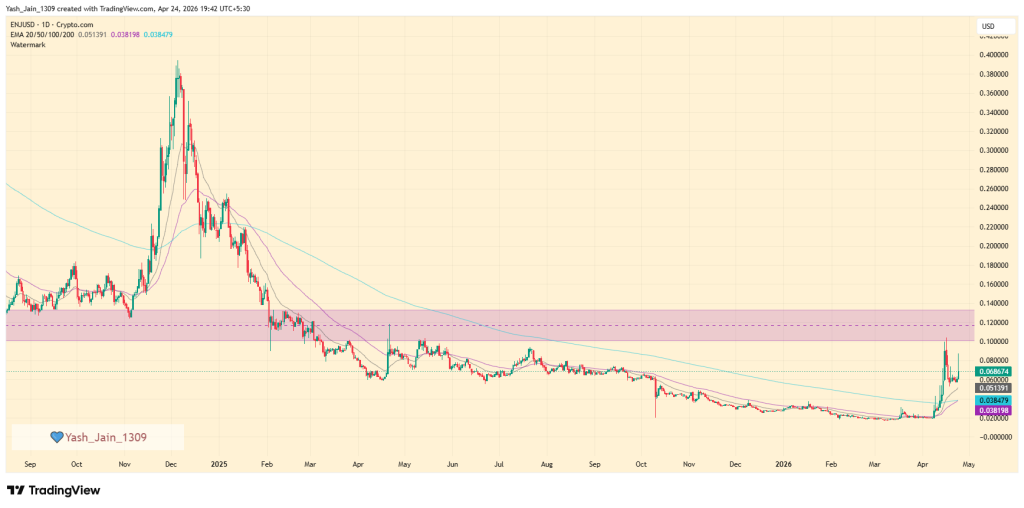
On the daily chart, Enjin price has quietly staged something most “dead” projects haven’t managed which is movement with intent.
From roughly $0.020 in April 2026, ENJ ripped to $0.103, a gain north of 400%. That’s not a casual bounce. That’s the kind of move that forces traders to look twice.
Sure, the pullback from the spike cooled momentum, but it doesn’t necessarily scream weakness. If anything, it resembles a healthy retracement after an explosive run. And in crypto, structure matters more than headlines.
There’s a supply zone sitting around $0.103 to $0.130, and that’s where the real test lives. Clear that, and suddenly the broader structure that’s looked broken since 2022 starts looking… less broken. That’s a very different story than “effectively dead.”
Weekly Chart Still Tells Hard Truths
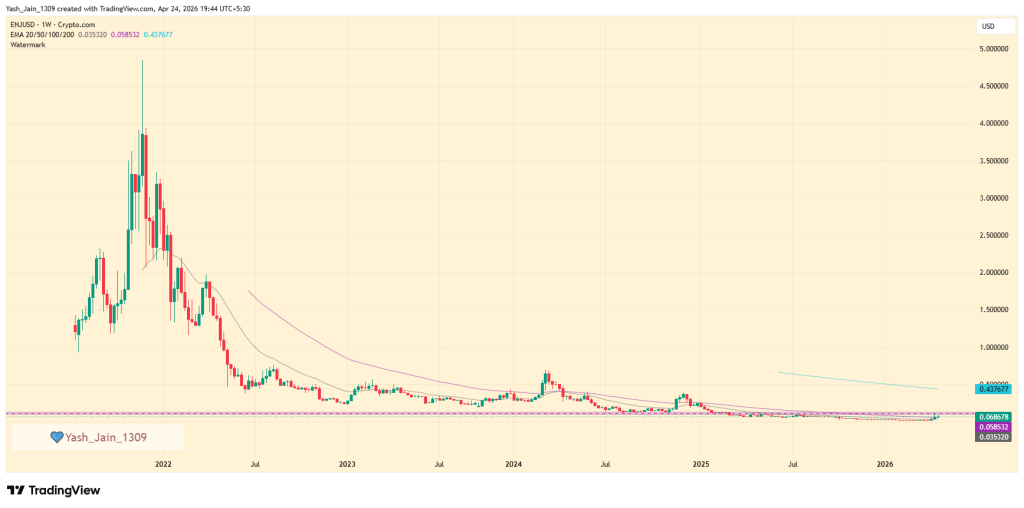
But let’s be real when you try to zoom out and the weekly chart still seems ugly, raises doubts in mind.
Because, ENJ token price remains buried deep below prior cycle levels. Long-term moving averages haven’t flipped decisively, and no one can seriously argue a full macro trend reversal has happened yet. Not from this structure.
That’s what makes this moment weirdly compelling. Because both things can be true: Enjin can still be down 95% historically, and it can also be showing signs of actual development-driven price response now.
Those aren’t contradictions. That’s markets. The bigger difference, perhaps, is activity.
As in a sector accused of becoming a graveyard, “doing something” carries weight. Shipping products, launching games, generating token reaction, even if early that also separates a project from those merely surviving on nostalgia.
So, Can Enjin Escape The 93% Narrative?
So, what’s next? Since the 93% Web3 gaming collapse narrative may dominate sentiment, but Enjin is trying to trade against that script. If Enjin price reclaims and breaks through that $0.103–$0.130 supply wall, traders may start revisiting whether this is just another reflex rally or the first structural shift in years.
And that’s the nerve CoinMarketCap may have touched today without meaning to. Because sometimes the projects under fire respond by disappearing. Sometimes they respond by building. Right now, Enjin is trying to make the market decide which one it is.
SKR price just snapped out of its slumber and it did it violently on intraday session. A 40% intraday surge isn’t subtle, especially for an asset that’s been grinding lower for weeks. Suddenly, the market cares again. And yes, there’s a reason this time.
The spike didn’t come out of nowhere. It followed a string of ecosystem updates tied to Solana Mobile and its expanding presence, which seems to have finally translated into price action.
SKR price surge fueled by Solana Mobile updates
So what flipped the switch today? Well, its product Solana Mobile is making noise again. The team confirmed its presence at multiple upcoming events, including Solana Accelerate, Ship Week, and Consensus 2026 in Miami this May. Visibility matters, and right now, they’re making sure they have plenty of it.
But that’s not all. The Seeker device just got a meaningful boost with the rollout of XONA directly into its dApp store. What used to live on the web is now integrated into the mobile experience which is complete with agent-powered tools for creating images, videos, and audio.
As they say they don’t charge any subscriptions. No API keys. Pay-per-use via x402 kind of offer which sounds attractive to many out there and its response is reflected in SKR token today. It’s the kind of update that sounds niche, until it isn’t. And markets, as always, react faster than they think.
Price structure shifts as EMA support holds strong
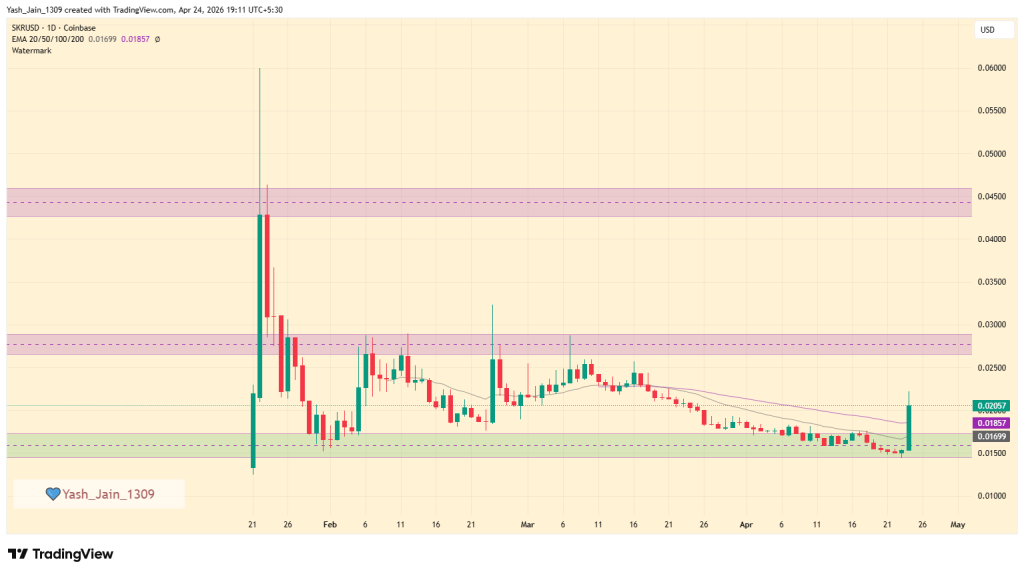
Now let’s talk charts, because the SKR price move wasn’t random. The rally originated from a key demand zone around $0.016–$0.018, a level that had been quietly acting as a base during the prolonged downtrend. When price bounced, it didn’t hesitate.
Short-term EMA bands are now acting as support, which is usually the first sign that momentum is shifting at least temporarily. The latest candle pushed SKR price toward the $0.0205 region, signaling that buyers are finally stepping in with intent.
But let’s not pretend this is a clean breakout just yet. The structure still needs confirmation, and that brings us to the next hurdle.
Key resistance levels decide SKR price next move
The immediate resistance sits between $0.026 and $0.028. That zone has historically acted as a rejection point, and it’s not going to roll over easily. If SKR price can push through it with conviction, the next logical target sits near $0.045.
Sounds ambitious? Maybe. But after a 40% move, the market’s clearly in the mood for risk.
On the flip side, failure at resistance could drag price right back into its previous range. That’s the part traders don’t like to talk about.
So, what’s next? Its fact that momentum is building, narrative is strengthening, and ecosystem updates are finally aligning with price. But let’s be real none of it matters if SKR price can’t clear resistance and hold. Because in crypto, hype gets you the move. Structure decides if it lasts.
The live price of Axie Infinity crypto is $ 1.12246633.
AXS price could trade as high as $2.20 in 2026.
Axie Infinity with a potential surge could hit $12.00 by 2032.
As we move into 2026, Axie Infinity (AXS) is no longer just a “play-to-earn” game infact it has evolved into a sophisticated, multi-layered gaming nation. Under the leadership of Sky Mavis, the ecosystem has undergone its most aggressive economic transformation since the 2021 peak, pivoting toward long-term sustainability and “risk-to-earn” mechanics.
The introduction of Bonded AXS (bAXS) in early 2026 and the total cessation of SLP emissions in Origins have effectively dismantled the “farm-and-dump” cycles of the past, replacing them with a reputation-based economy that rewards genuine players over automated bots. With the Ronin Network transitioning into a full-scale Ethereum Layer 2 and the highly anticipated Atia’s Legacy MMO on the horizon, the project is taking “bigger swings” to recapture its crown.
In this Axie Infinity (AXS) Price Prediction 2026–2032 guide, we analyze whether these structural reforms can decouple AXS from speculative noise and drive a new era of value accrual for the original titan of GameFi.
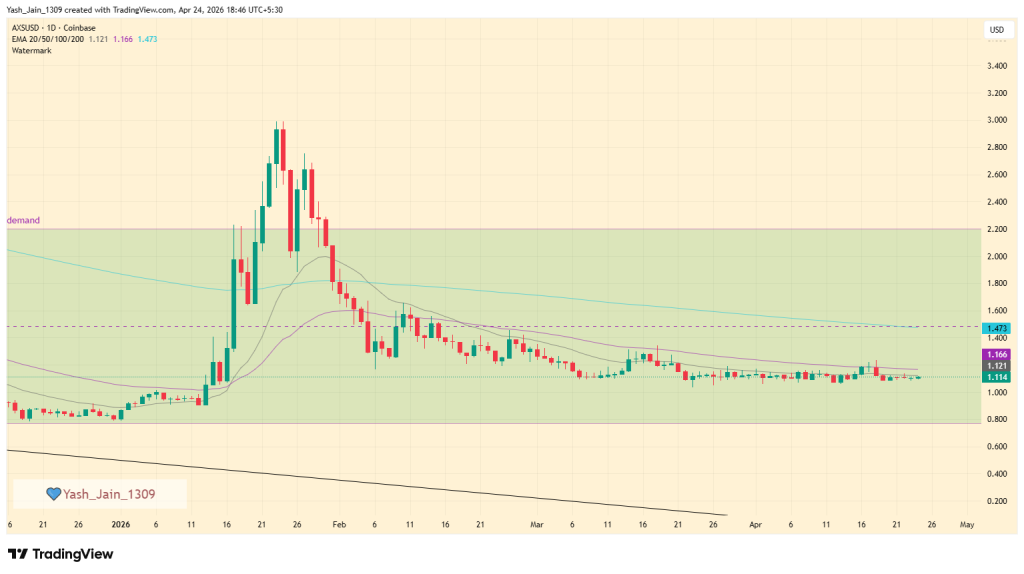
On the daily timeframe, Axie Infinity price (AXS) is currently fluctuating within a horizontal consolidation range that overlaps with a critical macro demand zone. After spending Q1 from January through March, within these boundaries, the market structure even in Q2 is confined here and this suggests that it might continue this sideways trend more as the asset builds the necessary liquidity for its next major move. This phase represents a significant period of accumulation, during which the price effectively “bases” after its long-term decline.
That said, a shift in momentum hinges on a decisive daily candle close above $1.40. Reclaiming this level would flip the current bearish narrative, potentially opening the door for AXS price to target higher resistance levels at $1.70 and $2.20.
Conversely, investors should watch the psychological floor at $1.00; a breach below this level could trigger a final capitulation and a retest of the macro support at $0.80 before the end of April.
Recent News/ Opinions
On April 3, 2026, the Axie Infinity has officially announced “Atia’s Legacy Playtest 2,” using a humorous Simpsons-themed teaser to ignite excitement for its upcoming open-world MMO. This milestone is critical as it marks the next phase of Lunacia’s evolution, allowing players to explore a massive persistent world and integrate existing Axie assets into high-stakes, large-scale strategy and combat.
Axie Infinity (AXS) Price Prediction 2026
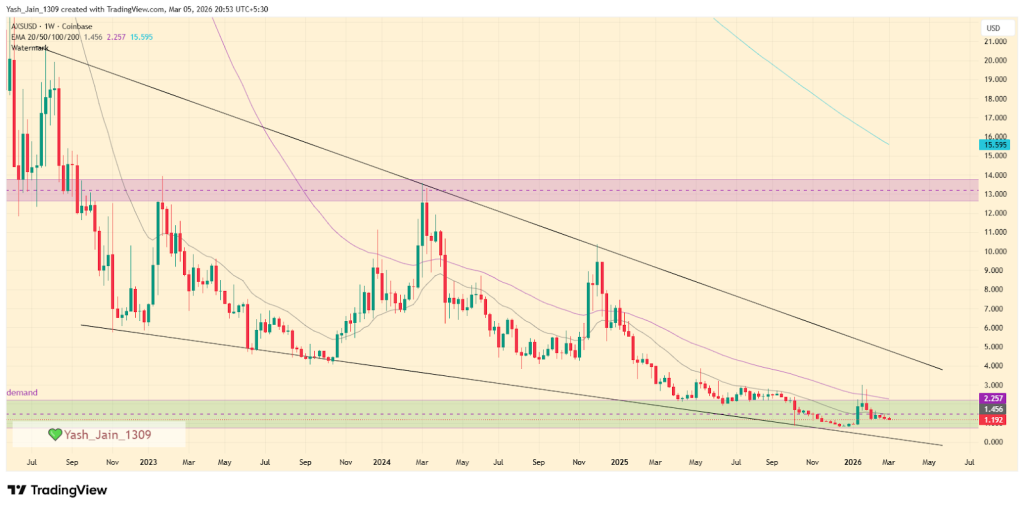
The long-term weekly chart for AXS/USD reveals a persistent declining trend that has finally reached a critical inflection point in early 2026. After hitting record lows near the $0.80 support level, the asset attempted a significant relief rally in Q1. However, this momentum was halted by the 50-week EMA band, which acted as a dynamic ceiling, forcing the price back into the primary demand zone.
Currently, the corridor between $0.80 and $2.30 is solidifying as a major accumulation area, suggesting that internal ecosystem developments are beginning to provide a fundamental floor for the price action.
Technically, AXS price is navigating a massive falling wedge pattern, a structure typically associated with bullish reversals upon completion. The lower boundary of this wedge provides a “double confirmation” for the current accumulation phase. Throughout the remainder of 2026, we anticipate the Axie Infinity price will continue to build a base within this pattern. A successful breakout could see the price targeting the upper resistance border near $4.00.
Conversely, if broader market stress persists, a final liquidity sweep toward the lower border at $0.25 remains a possibility, offering a deep-value entry point for long-term believers.
Axie Infinity (AXS) Price Prediction 2027 – 2032
Year
Minimum Price ($)
Maximum Price ($)
Average Price ($)
2027
0.80
4.50
2.60
2028
1.20
5.90
3.50
2029
1.80
7.10
4.80
2030
2.20
8.90
5.50
2031
2.50
9.80
6.90
2032
3.00
12.00
7.50
Axie Infinity (AXS) Price Prediction 2027
In 2027, AXS is expected to find a stable market floor at $0.80 as the Ronin ecosystem matures further. Increased adoption of “risk-to-earn” mechanics could drive the token to a maximum of $4.50, maintaining an annual average of $2.60.
Axie Infinity Price Prediction 2028
By 2028, scalability improvements are projected to push the minimum price to $1.20 during periods of market consolidation. Sustained gaming demand may ignite a rally toward a peak of $5.90, with the price likely hovering around a $3.50 average.
Axie Infinity Price Targets 2029
Entering 2029, the token is forecasted to show strong resilience with a decentralized bedrock established at $1.80. Market analysts anticipate a climb to visionary heights of $7.10, centering on a robust yearly average trading price of $4.80.
Axie Infinity Coin Price Prediction 2030
As Axie Infinity potentially becomes a linchpin of the crypto economy in 2030, the minimum price is expected to rise to $2.20. Growth in institutional gaming interest could propel AXS to a $8.90 zenith, with a projected average of $5.50.
AXS Price Prediction 2031
The 2031 outlook suggests a meticulous consolidation phase where AXS trades at a minimum of $2.50 even during bearish cycles. Optimistic projections set an impressive high of $9.80, with price stability expected to settle near the $6.90 mark.
Axie Infinity (AXS) Price Prediction 2032
Rounding out the decade, 2032 targets represent a significant milestone with a projected peak performance of $12.00. While volatility remains a factor, the asset is expected to average $7.50, supported by a long-term accumulation floor of $3.00.
Never Miss a Beat in the Crypto World!
Stay ahead with breaking news, expert analysis, and real-time updates on the latest trends in Bitcoin, altcoins, DeFi, NFTs, and more.
FAQs
What is the Axie Infinity (AXS) price prediction for 2026?
AXS could trade between $0.25 and $4.00 in 2026. A breakout from its falling wedge pattern may push prices higher if market sentiment and ecosystem growth improve.
How much will Avax be worth in 2030?
Market forecasts suggest AXS could trade between about $2.20 and $8.90 by 2030 if the Ronin network grows and GameFi adoption continues expanding.
What is the Axie Infinity (AXS) price prediction for 2040?
By 2040, AXS could potentially trade between $15 and $35 if blockchain gaming becomes mainstream and Axie Infinity maintains strong ecosystem growth.
What is the Axie Infinity price prediction for 2050?
Some long-term projections estimate AXS could range between $25 and $60 by 2050 if GameFi adoption accelerates and the ecosystem remains competitive.
How high can AXS price go in the future?
Long-term projections suggest AXS could reach around $12 by 2032 if GameFi adoption grows and the Ronin ecosystem continues expanding.
The live price of the Zilliqa crypto token is $ 0.00412917.
Zilliqa’s price could move toward $0.045 if the recovery structure develops.
Broader adoption may support a long-term rise toward $0.20.
Zilliqa is a high-performance, public blockchain platform designed to solve the long-standing challenges of scalability and speed through its pioneering use of “sharding.” By dividing the network into smaller, parallel groups called shards, the protocol can process thousands of transactions per second, ensuring the network remains efficient as it grows.
At the heart of this ecosystem is the ZIL token, which serves as the primary utility and governance asset. ZIL is used to pay for transaction fees, execute smart contracts written in the secure Scilla language, and reward miners and stakers for securing the network.
As the platform expands its presence in DeFi and the metaverse, ZIL acts as the essential fuel driving all on-chain activity. But as competition in the Layer 1 space intensifies, can Zilliqa’s technical edge translate into sustained market dominance? To explore the long-term outlook, read our Zilliqa price prediction 2026-2030 for a deep dive.
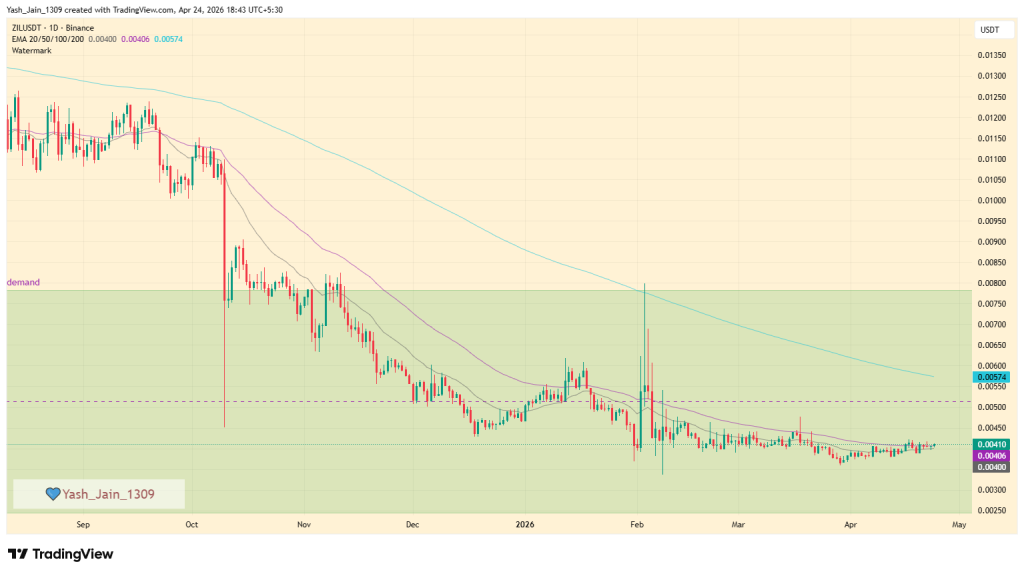
The daily chart for Zilliqa (ZIL) illustrates a persistent long-term downtrend that has carried over into the start of 2026. Throughout Q1, the price remained trapped within a broad green demand zone, consistently trading below the box’s median level. As Q2 is ongoing, ZIL is still in the zone, now odds suggest that if short-term bearish pressure intensifies, a breakdown toward the $0.0025 level remains a distinct possibility, which is the current zone’s lower border.
Conversely, for a bullish recovery to take shape, ZIL price must first reclaim the mid-band of the demand zone at $0.0050. A successful move above this level would likely set the stage for a retest of the 200-day EMA, currently hovering near $0.0060. Reclaiming and flipping this moving average is crucial for a structural trend shift, as it would provide the necessary momentum to challenge the upper edge of the demand box and potentially end the cycle of lower highs that has dominated the chart.
Recent News/ Opinions
On April 1, 2026, Zilliaqa’a product ZilPay wallet has officially announced its rebranding to Bearby, introducing a bolder identity for its secure, quantum-resistant wallet ecosystem. The transition marks a strategic evolution toward a more robust DeFi experience while maintaining the same high standards of non-custodial security and privacy.
Zilliqa Price Prediction 2026
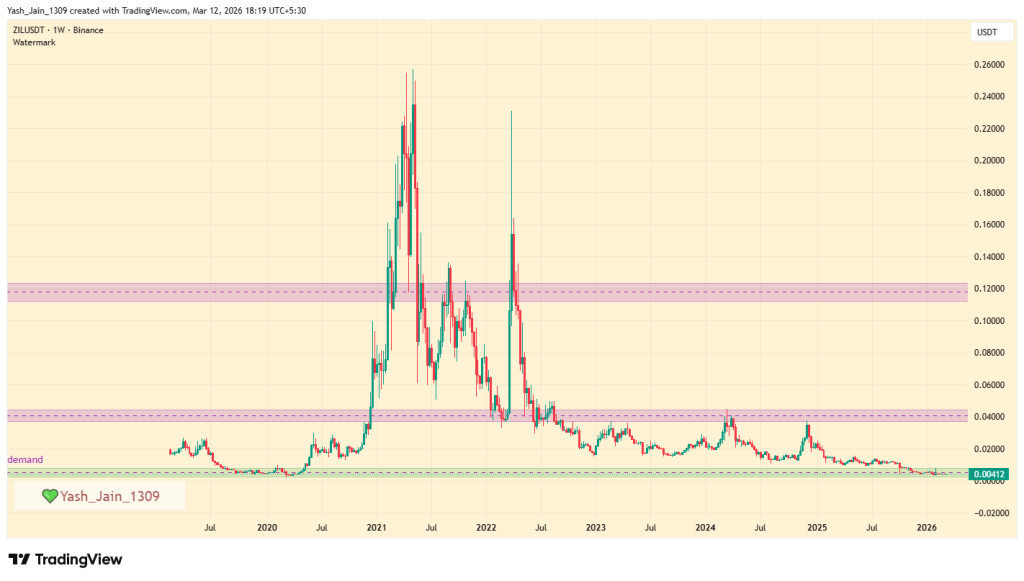
Based on the weekly chart for ZIL/USDT, the price is currently revisiting a critical historical demand zone between $0.003 and $0.008. This area carries immense technical significance, as it served as the primary accumulation floor in early 2020 before Zilliqa’s massive rally toward its all-time high of approximately $0.240.
After years of retracement, the ZIL price has returned to these baseline levels in early 2026. This prolonged sideways movement suggests a deep phase of accumulation, where supply is being absorbed by patient buyers.
As the consolidation continues within this green-shaded support band, the market is essentially “filling its demand quota.” Once the selling pressure is fully exhausted and accumulation is complete, the groundwork for a trend reversal is set.
Therefore, If historical patterns repeat and demand outweighs supply, a significant recovery rally is anticipated. By the end of 2026, ZIL could realistically target the first major resistance flip at the $0.040 level, which represents a key structural pivot point on the macro scale.
Zilliqa (ZIL) Price Prediction 2026 – 2030
Year
Potential Low ($)
Potential Average ($
Potential High ($)
2027
0.028
0.045
0.065
2028
0.050
0.080
0.120
2029
0.090
0.140
0.180
2030
0.120
0.165
0.200
Zilliqa Price Prediction 2027
As per the Zilliqa Price Prediction 2027, Zilliqa may see a potential low price of $0.028 The potential high for Zilliqa price in 2027 is estimated to reach $0.065
Zilliqa Price Forecast 2028
In 2028, Zilliqa price is forecasted to potentially reach a low price of $0.050, and a high price of $0.120
Zilliqa Coin Price Prediction 2029
Thereafter, the Zilliqa (Zilliqa) price for the year 2029 could range between $0.090 and $0.180.
Zilliqa Price Prediction 2030
Finally, in 2030, the price of Zilliqa is predicted to maintain a steady and positive. It may trade between $0.120 and $0.200
The long-term projection assumes Zilliqa sustains relevance in enterprise blockchain use cases, with growth moderating over time as the asset matures.
Year
Potential Low ($)
Potential Average ($)
Potential High ($)
2031
0.15
0.22
0.30
2032
0.20
0.30
0.45
2033
0.28
0.42
0.60
2040
1.20
1.80
2.50
2050
4.00
6.50
9.00
Zilliqa (ZIL) Price Prediction: Market Analysis?
Year
2026
2027
2030
Changelly
$0.038
$0.050
$0.085
CoinCodex
$0.040
$0.060
$0.090
WalletInvestor
$0.050
$0.070
$0.140
Never Miss a Beat in the Crypto World!
Stay ahead with breaking news, expert analysis, and real-time updates on the latest trends in Bitcoin, altcoins, DeFi, NFTs, and more.
FAQs
What is the price prediction for Zilliqa (ZIL) in 2026?
Zilliqa could trade between $0.018 and $0.045 in 2026 if support holds and the crypto market strengthens, signaling steady recovery, not hype-driven spikes.
What is the Zilliqa price prediction for 2028?
Zilliqa could trade between $0.050 and $0.120 in 2028 if adoption improves and the broader crypto market enters a sustained growth cycle.
How high can Zilliqa price go by 2030?
By 2030, ZIL may reach up to $0.20 in a strong market cycle, supported by ecosystem growth and consistent long-term development progress.
What is the Zilliqa (ZIL) price prediction for 2040?
If Zilliqa maintains relevance and real-world use, ZIL could trade between $1.20 and $2.50 by 2040, reflecting gradual long-term expansion.
What role does Zilliqa 2.0 play in ZIL’s future price?
Zilliqa 2.0 shifts the network to Proof-of-Stake, improving speed and efficiency, which could support long-term value if adoption rises.
Is Zilliqa (ZIL) a good investment?
Zilliqa may appeal to long-term investors if upgrades translate into real usage, but it carries risk due to strong Layer-1 competition.
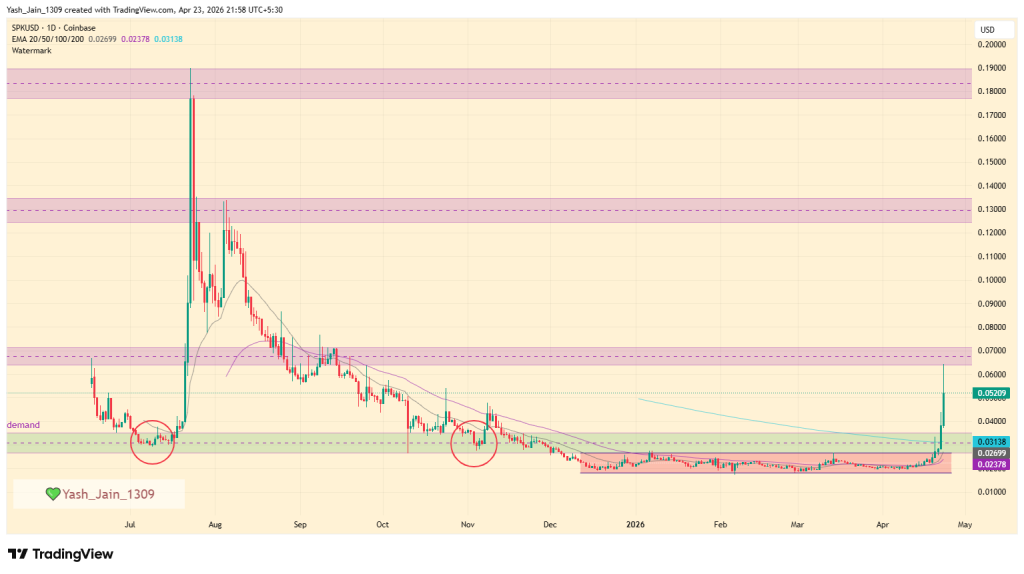
SPK price is back from the dead and it didn’t come quietly. After months of grinding sideways and shaking out weak hands, the token just ripped higher, smashing through its accumulation phase and tagging $0.063 in April. For something that looked completely forgotten after its brutal post-2025 decline, this kind of move feels… almost suspiciously aggressive.
SPK price breakout ends long painful accumulation phase
Let’s rewind a bit. SPK price had its moment back in July 2025 with a ridiculous 540% parabolic surge. Then came the hangover months of steady decline, lower highs, and that slow bleed that kills interest more than price.
Eventually, it settled into a deep accumulation range below a key demand zone. Boring, flat, lifeless. Until it wasn’t.
The recent breakout flipped that entire structure. Price didn’t just creep higher it launched strong, reclaiming lost ground and pushing straight into the $0.063–$0.070 supply zone. That’s now the battlefield. Break it, and suddenly $0.130 doesn’t sound so far-fetched anymore.
Upbit listing and staking surge fuel momentum
Today SPK got listed on Upbit’s KRW markets that lit the fire. That’s not just another exchange listing; it’s liquidity, visibility, and a fresh wave of retail attention all rolled into one. And markets love that combination.
At the same time, fundamentals quietly did their job. Total staked SPK has crossed the 500M mark, which signals growing commitment from holders. Add in the Spark Points Program Season 4 which is designed to reward long-term participation and you’ve got a system actively encouraging people not to sell.
Fascinating about how that works. But, the result? A sharp expansion in both confidence and price action. Not exactly rocket science, but effective nonetheless.
Momentum indicators scream strength but caution remains
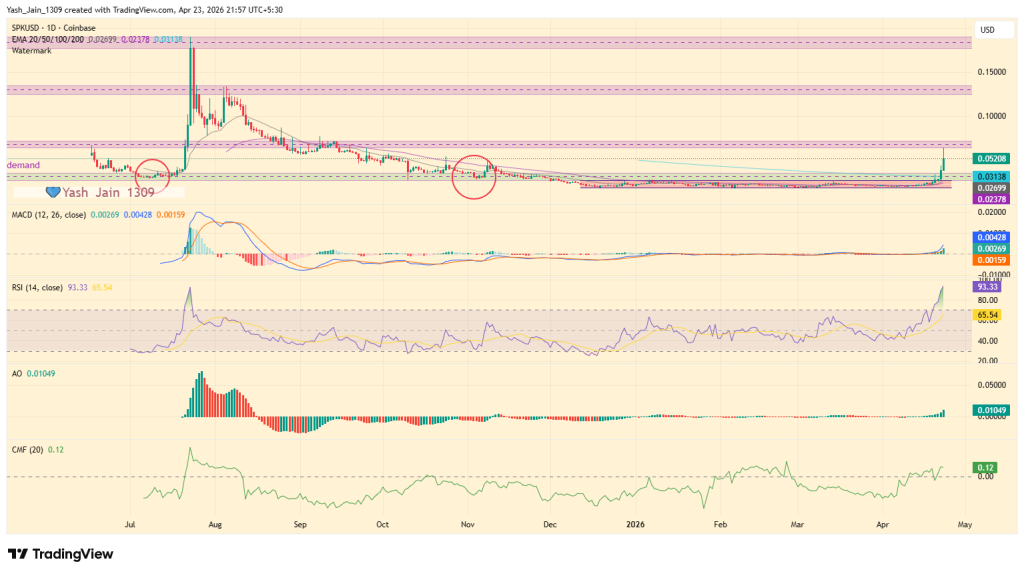
Now let’s talk about what the charts aren’t politely ignoring. RSI is sitting at a wild 93.33. That’s not just overbought but it’s overheated. Historically, levels like this don’t sustain without some kind of pullback, even in strong trends. And yet… momentum refuses to back off.
MACD is firmly bullish, printing expanding signals, while the Awesome Oscillator is pushing higher as well. More importantly, CMF sits at 0.12, confirming that actual capital is flowing in and its not just speculative noise.
So you’ve got this strange mix: a technically overextended asset that’s still attracting real money. That usually means one thing that if a cooldown comes, it’s likely a pause, not a full reversal.
SPK price now sits at a crossroads. Crack the $0.070 supply wall, and the narrative flips entirely toward continuation. Fail here, and you probably get a short-term reset before any serious attempt higher. Either way, SPK price isn’t boring anymore and that alone changes everything.
STABLE price after days of silence it just woke up again and not quietly. A sharp 15% intraday spike has pushed the token back into relevance, fueled less by fundamentals and more by something crypto markets oddly love: attention. This time, it came from the project’s CEO stepping into the spotlight at the RWA & Payments 2026 event in Hong Kong. And fascinatingly, the market noticed and took interest in STABLE price.
CEO spotlight drives STABLE price sudden momentum
The narrative shift was immediate. During the event, the messaging was clear stablecoins aren’t just a category anymore, they’re infrastructure. That kind of framing tends to resonate, especially in a market constantly hunting for the next “big theme.”
So, naturally, STABLE price reacted.
But let’s not pretend this is purely organic growth. The move looks heavily sentiment-driven, sparked by visibility rather than a structural shift in fundamentals. Still, in crypto, narrative often comes first and price follows.
Bullish structure builds as resistance comes into play
Now flip to the chart, because this is where things get interesting.
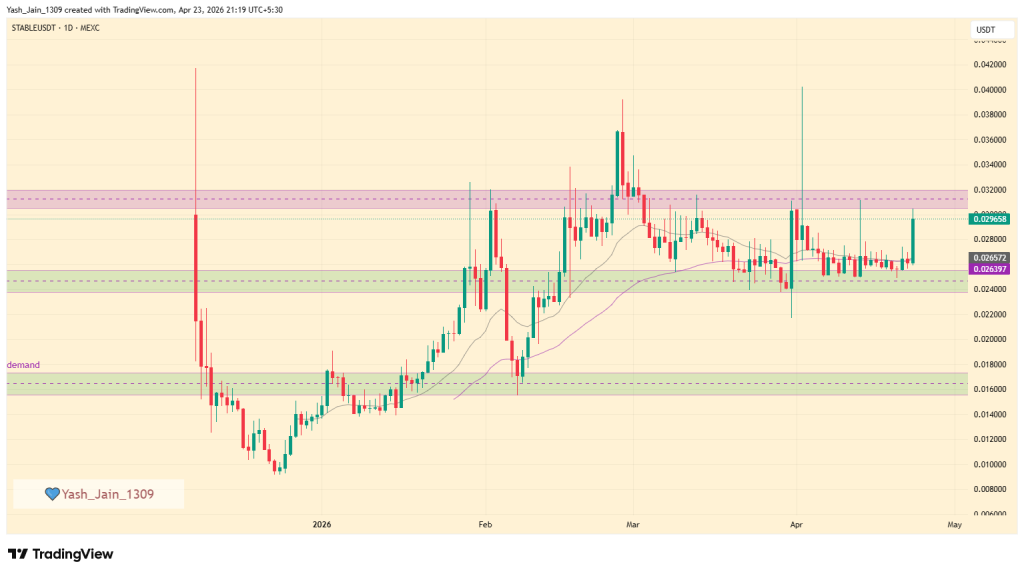
STABLE price has clawed its way back from a consolidation phase and reclaimed the $0.0264 level, which previously acted as a key pivot. That’s not nothing. It suggests buyers are stepping in with intent, especially as price continues to hold above the EMA cluster.
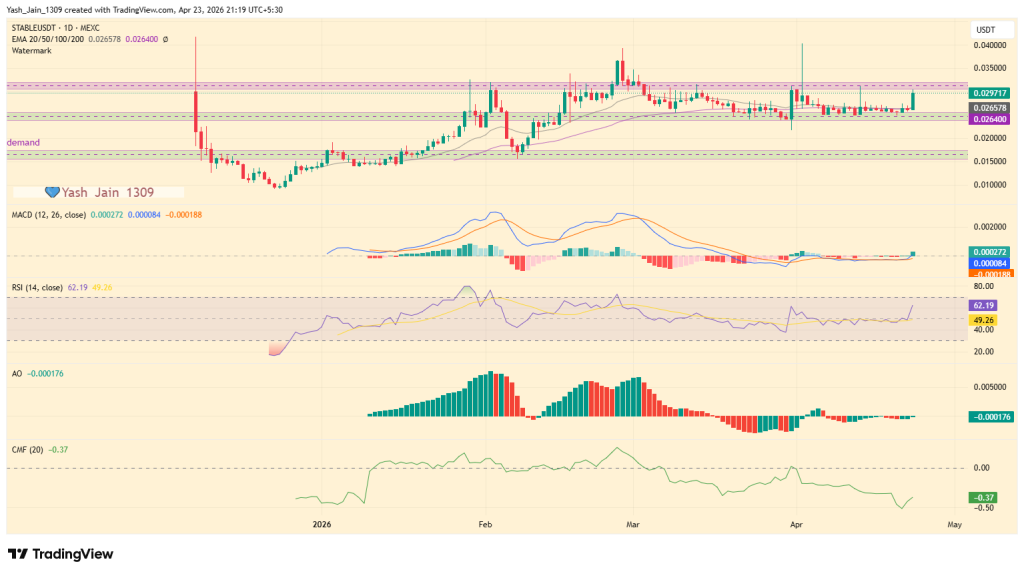
The 20-day and 50-day EMAs are now curling upward, signaling a shift toward short-term bullish momentum. Add to that a fresh MACD crossover with expanding green histogram bars, and suddenly the structure starts to look… constructive.
But here’s the catch. Price is now knocking on the door of the $0.0297 to $0.0320 resistance zone a level that has historically shut down rallies just as quickly as they started.
So yeah, momentum is building. But it’s also being tested.
Momentum rises but money flow tells different story
And this is where things get messy. RSI has climbed to 62.19, comfortably above neutral and edging toward overbought territory. That confirms strength but not exhaustion. There’s still room to run.
However, the Chaikin Money Flow sits at -0.37. That’s a problem. It signals that despite the rising STABLE price, there’s no strong institutional capital backing the move. In simple terms, this rally might be driven more by retail enthusiasm or thin liquidity than by serious accumulation.
Translation? It can move fast… and drop just as quickly. So, what’s next?
If STABLE price breaks and holds above the $0.030 range, the path toward higher levels opens up. But if it fails and especially if it loses the $0.0265 support zone then the downside risk toward $0.016 comes back into play.
Right now, STABLE price is caught between hype and hesitation. And in this market, that’s usually where things either explode or fall apart.
After months of grinding lower inside a falling wedge, the ONDO price chart is finally tightening up and not quietly. With tokenized stocks suddenly back in the spotlight, ONDO might just be sitting on the kind of narrative fuel traders pretend they don’t chase… until they do.
Tokenized stocks narrative suddenly grabs Washington spotlight
Here’s the twist. Tokenized stocks aren’t just a niche experiment anymore they’re getting regulatory attention at the highest level. That alone shifts the tone.
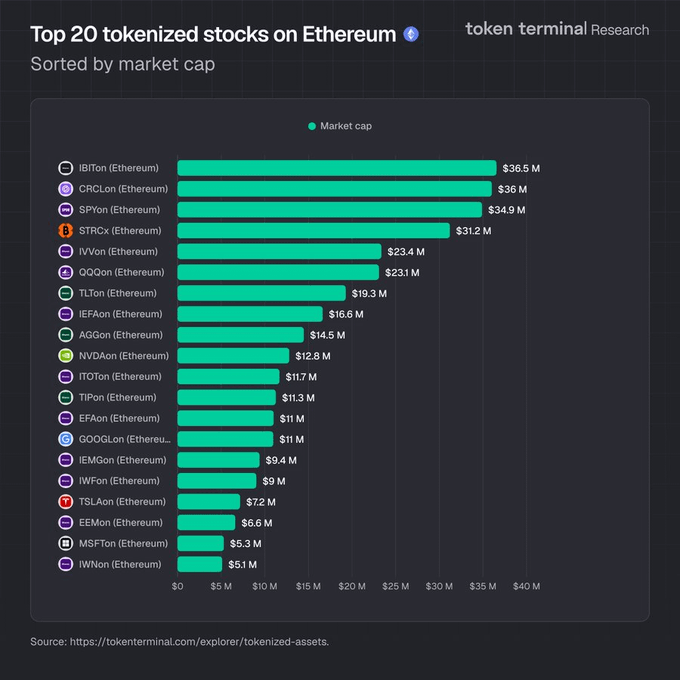
Today Ondo Finance announced on X that Nineteen of the top twenty tokenized stocks on Ethereum now come from Ondo Global Markets. That’s not a small footprint. On Ethereum alone, Ondo’s tokenized stocks and ETFs account for nearly $500 million in total value locked, alongside billions in trading volume and tens of thousands of holders.
And then came the policy angle. A recent statement pointed toward an upcoming “innovation exemption” aimed at facilitating on-chain trading of tokenized securities. Translation? Washington isn’t debating whether this sector should exist but clearly it’s figuring out how to regulate it. Well, that changes things for good in the sector.
Tokenization has Washington's attention.
“We are on the cusp of releasing an 'innovation exemption' to begin facilitating the trading of tokenized securities onchain.”
SEC Chairman Paul Atkins, speaking at the Economic Club of Washington, outlining the regulatory framework… pic.twitter.com/txldrIptrb
ONDO price compresses inside falling wedge structure
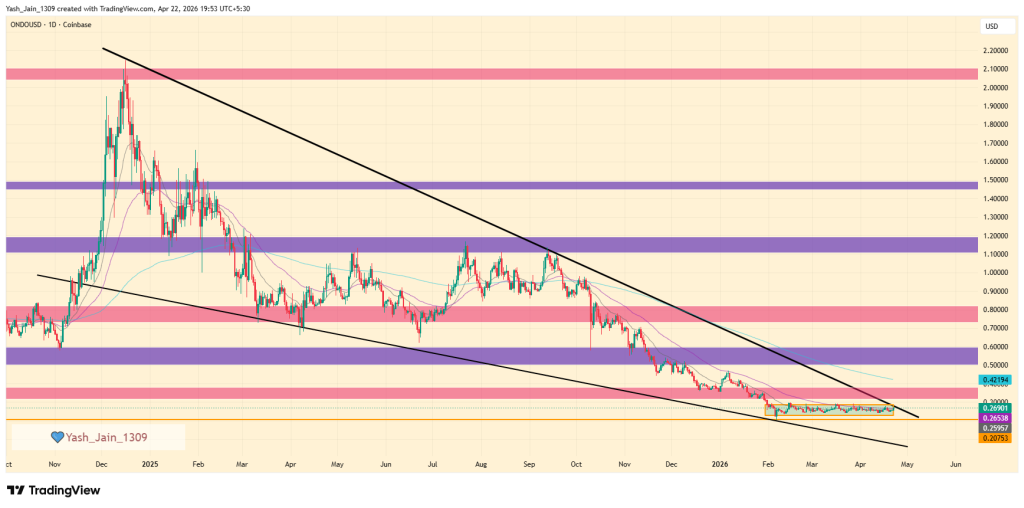
Now flip to the chart, because this is where it gets tactical. ONDO price has been stuck in a prolonged downtrend, forming a clean falling wedge pattern since early 2025. Lately, though, price action has shifted into a tight horizontal consolidation box near the lower boundary, which is kinda classic pre-breakout behavior. But here’s the catch: it’s not just any resistance overhead.
The $0.42 level sits right in line with the 200-day EMA band and the wedge’s upper boundary. That makes it a double-layered barrier and the kind that doesn’t break easily unless momentum shows up with intent.
Still, price is creeping toward it again. Slowly. Quietly. And markets love breaking when everyone’s bored. So, what happens next?
If ONDO price manages a clean break above $0.42, that level flips from resistance into a magnet. Not immediately explosive but structurally important. From there, the next major zone sits near $0.80, which aligns with prior resistance clusters.
But let’s be real. None of that matters if the breakout fails. This setup is binary. Either the falling wedge resolves upward, supported by fresh narrative momentum from tokenized securities… or it drifts sideways and fades back into irrelevance.
Right now, though, the timing is hard to ignore. ONDO price is sitting at the edge of a technical breakout while the tokenized stocks story gains traction at both institutional and regulatory levels. That’s not confirmation but it’s definitely a setup worth watching.
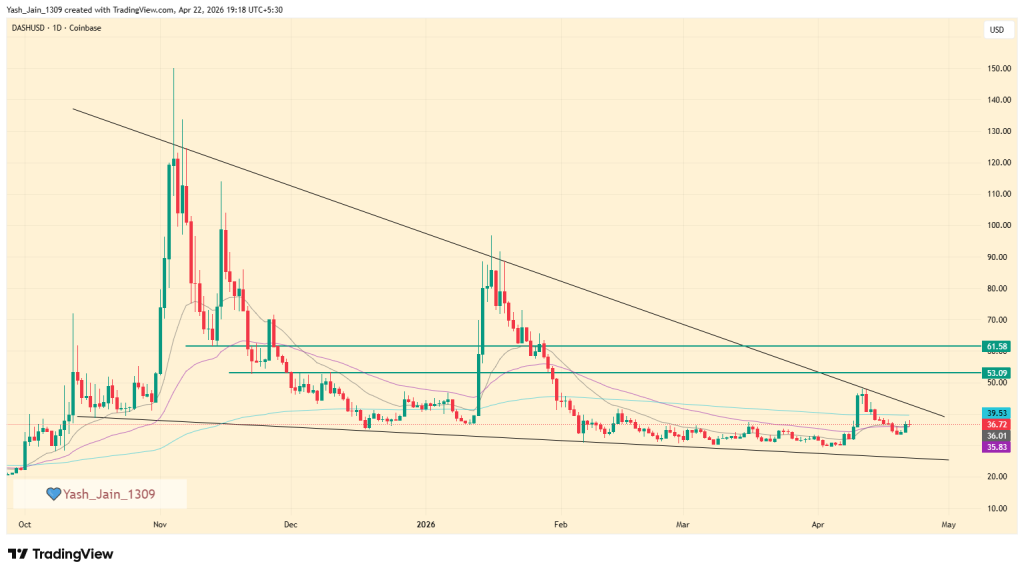
DASH price is sitting right at that uncomfortable edge where patience runs thin and volatility usually kicks the door in. After months of grinding lower since Q4 2025, the daily chart now shows a clear falling wedge structure, and it’s tightening fast. April’s price action isn’t subtle about it either; momentum is compressing, and something’s got to give.
But here’s the catch there’s a ceiling. And it’s not just any ceiling.
Falling Wedge Pressure Builds Toward Key Breakout Zone
The falling wedge has done what it’s supposed to do: squeeze price into a narrowing range while quietly building breakout pressure. Now, DASH price is pressing right into the upper boundary of that structure. Typically, that’s where reversals start to show up.
Except this time, there’s a second wall stacked right on top.
The 200-day EMA around $40 is sitting exactly where the wedge resistance lies. That’s not coincidence ina fact that’s confluence. And in markets, confluence tends to matter more than narratives.
So yeah, breaking $40 isn’t just another level. It’s the most key level right now.
Why $40 Is The Only Level That Matters
As the data suggest, if DASH price clears $40 cleanly meaning a proper breakout, not a weak wick then the structure flips. Simple as that. Now, what happens next depends on how aggressive that move is.
If price rips through $40 with strong momentum, then the $53–$61 resistance zone probably won’t slow things down much. That kind of breakout tends to ignore intermediate levels and go straight for expansion.
But markets aren’t always that generous. If DASH climbs slowly and stabilizes above $40, then $53 and $61 become real checkpoints. Not barriers, but tests. Fail those, and the breakout risks losing steam.
Decentralization Narrative Enters The Conversation Again
And then there’s the timing. While price structures are tightening, the broader crypto space is dealing with a different kind of pressure that’s trust and decentralization doubts.
With recent events involving asset freezes raising eyebrows across the industry, DASH crypto decided to step in with a not-so-subtle reminder. The network publicly stated that it is decentralized and cannot, and will not, censor or surveil users.
PUBLIC SERVICE ANNOUNCEMENT
The Dash network is decentralized and cannot, and will not, censor or surveil its users.
That’s not just PR it’s positioning in people minds that are in fear of assets freezing.
In a market where decentralization is suddenly being questioned again, that message isn’t random. It’s strategic. Whether it actually shifts investor sentiment, though, is a different story.
Artificial Superintelligence Alliance’s price could hit a maximum trading price of $1 in 2026
With a potential surge, the FET price may record a high of $12.45 by 2030.
As artificial intelligence continues to dominate global headlines, blockchain-based AI infrastructure projects are once again attracting investor attention.
Among them, the Artificial Superintelligence Alliance (ASI) stands out as a strategic merger of major AI-focused blockchain entities.
Founded through the collaboration of Fetch.ai, SingularityNET, and later CUDOS, the alliance aims to create the largest open-source, decentralized ecosystem focused on Artificial General Intelligence (AGI).
The FET token, originally native to Fetch.ai and now central to the ASI ecosystem, serves as the utility, governance, and settlement layer across AI services.
So let’s dive straight into CoinPedia’s Artificial Superintelligence Alliance (FET) price prediction for 2026, 2027, and 2030.
Artificial Superintelligence Alliance (FET) Price Targets For April 2026
The Artificial Superintelligence Alliance (ASI) is expanding its AI agent marketplace, making it easier for users and applications to access various AI services.
If ASI successfully integrates its offerings, it will be able to host AI models on its network, facilitate communication and collaboration among AI agents, and enable users to pay for AI services directly on the blockchain. Additionally, ASI is working to establish partnerships with businesses interested in utilizing AI.
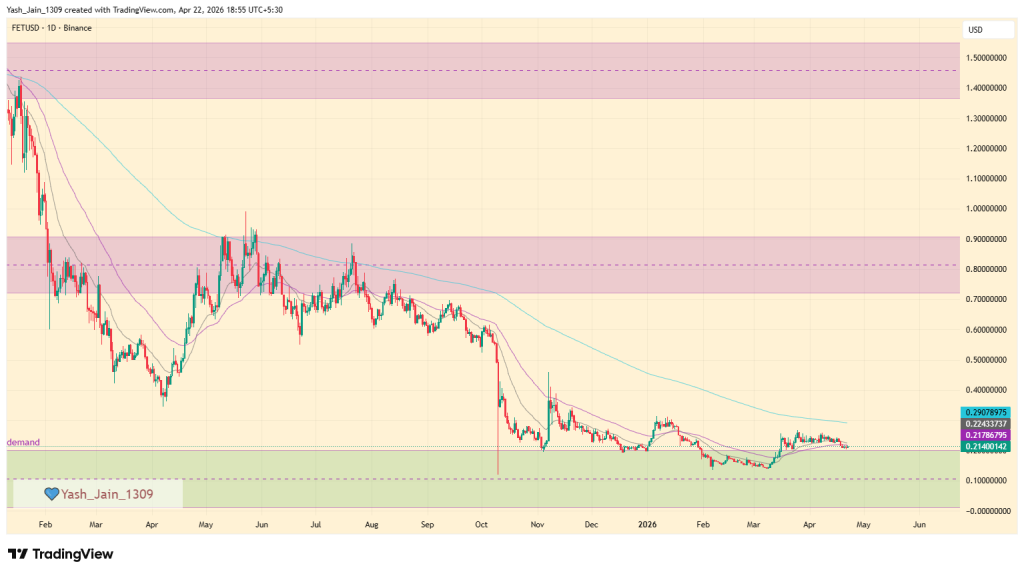
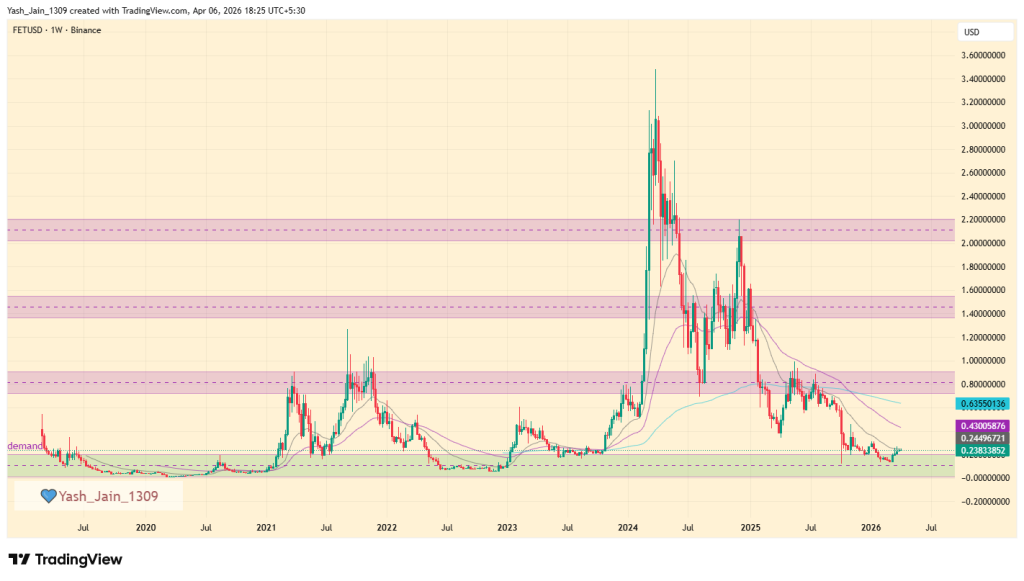
As more people begin to use AI on the network and the demand for computing power increases, this could drive up activity and potentially push the FET price towards $0.32 by late April to May of 2026. The price already reached $0.25 in mid-March, now approaching the 200-day EMA band. It has also found support in the green box, which aligns with a multi-year demand zone. If bearish pressure increases, the price could re-enter this support zone; however, if it continues on its upward trajectory, testing $0.32 could be within reach or even higher.
Unlike many AI tokens driven by hype, the Artificial Superintelligence Alliance (FET) is building a foundation in decentralized compute and autonomous agents. This shift from speculation to real-world utility suggests that FET’s value will increasingly mirror actual network usage. As companies adopt these decentralized services, the organic demand for the token could provide a structural floor for long-term growth.
Technically, FET’s 2026 outlook remains tied to key market cycles. A potential low of $0.0582 serves as a deep support zone during “risk-off” periods. However, as the ecosystem matures, an average price of $0.0913 is expected as it maintains a steady trend. In a bullish breakout scenario, FET could surge toward $0.3013, driven by high-volume demand for decentralized AI infrastructure.
FET Price Prediction 2026 – 2030
Year
Potential Low ($)
Potential Average ($)
Potential High ($)
2026
$0.0921
$0.340
$0.950
2027
$0.173
$0.820
$2.14
2028
$0.468
$1.938
$5.53
2029
$1.40
$4.30
$8.05
2030
$2.126
$6.78
$12.45
FET Price Prediction 2027
Growing wider adoption of autonomous AI agents in supply chains, logistics, and digital services could push FET near $2.14
FET Price Forecast 2028
By 2028, if decentralized AGI frameworks mature and institutional AI infrastructure adopts ASI tooling, FET may approach $5.53.
FET Coin Price Prediction 2029
In 2029, AGI research networks integrate token-based compute markets, and valuation expansion could drive FET toward $8.
What will Fetch AI be worth in 2030?
In a strong AI-dominant economy where decentralized compute markets compete with centralized cloud providers, FET could test $12.45
As per CoinPedia’s FET Price Prediction, the exponential growth observable in the field of artificial technologies will boost the value of AI tokens in the crypto world
If the alliance successfully aligns AI compute markets, decentralized agents, and open-source model hosting under one economic framework, FET could gradually reclaim the $0.950 range in 2026.
Year
Potential Low ($)
Potential Average ($)
Potential High ($)
2026
$0.0921
$0.340
$0.950
Never Miss a Beat in the Crypto World!
Stay ahead with breaking news, expert analysis, and real-time updates on the latest trends in Bitcoin, altcoins, DeFi, NFTs, and more.
FAQs
What is Artificial Superintelligence Alliance (FET)?
Artificial Superintelligence Alliance (FET) is a merged AI-blockchain ecosystem uniting Fetch.ai, SingularityNET, and CUDOS to power decentralized AI services.
What is the Artificial Superintelligence Alliance (FET) price prediction for 2026?
FET could trade between $0.09 and $0.95 in 2026, depending on AI adoption, network growth, and overall crypto market momentum.
What could FET be worth by 2030?
If decentralized AI scales globally, FET may test $12 by 2030, though long-term growth depends on real-world usage and regulation.
What Is the FET Price Prediction for 2040 and How High Can It Go?
By 2040, FET could trade between $25 and $40 if decentralized AI and AGI adoption expand globally with strong ecosystem growth.
What is the price prediction for FET in 2050?
By 2050, FET may exceed $60 in a mature AI economy, assuming sustained adoption, real utility, and stable crypto regulations.
Is FET a good long-term AI crypto investment?
FET offers exposure to decentralized AI infrastructure. Its long-term value relies on adoption, partnerships, and sustainable ecosystem growth.
Cronos coin price is expected to go as high as $0.3000 to $0.3500 in 2026.
CRO crypto may cross the $1 mark, with a potential high of $1.3190 by 2029.
Cronos (CRO) serves as the backbone of the Cronos Chain, a high-performance, open-source ecosystem engineered by Crypto.com. Designed to bridge the gap between traditional finance and Web3, CRO acts as a versatile utility token that facilitates instantaneous, low-cost global transactions while powering a vast suite of DeFi applications, perpetuals, and fiat-integrated markets.
Driven by institutional-grade infrastructure and a rapidly expanding global footprint, CRO’s market performance increasingly reflects a surge in investor confidence and real-world utility. As the network matures into 2026, its role in the next generation of digital asset exchange becomes even more pivotal.
In this analysis, we leverage advanced technical indicators and historical performance models to forecast the trajectory of Cronos. Whether you are a long-term holder or a strategic investor, this guide provides essential price projections for 2026 and through to 2035, helping you determine if CRO/USD is the missing piece for your portfolio.
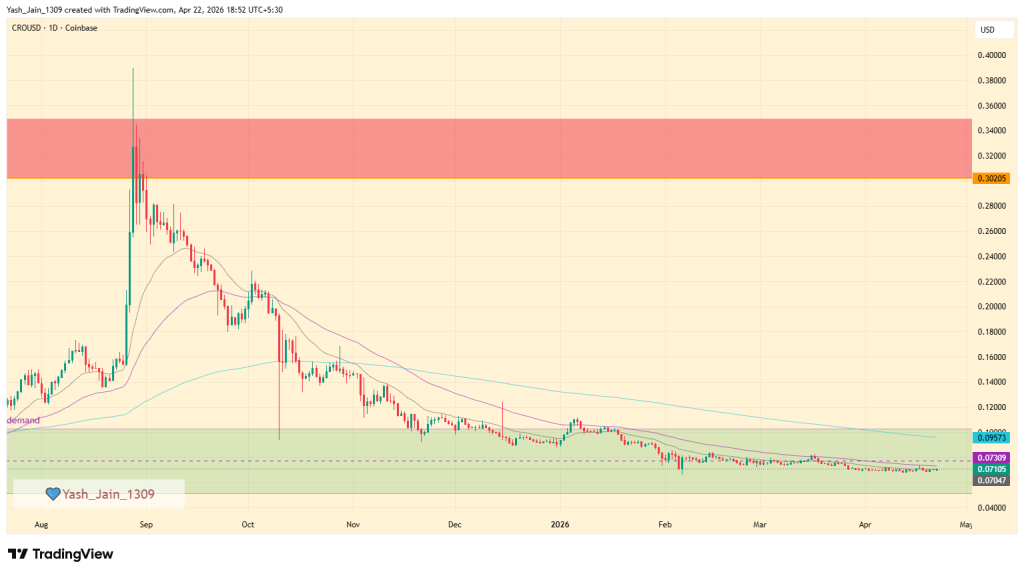
Currently, the Cronos price is experiencing a period of consolidation on the daily chart, hovering around the key horizontal line at approximately $0.0777, which marks an important multi-year demand range (indicated in green). This phase indicates a decrease in momentum, and if this trend continues, we could observe its persistence into March.
On a more optimistic note, should the price successfully break above $0.1000, we can anticipate a robust move towards the 200-day EMA band, potentially reaching around $0.1200 by late April to may. However, if bearish factors come into play, we might see the price retreat to the lower end of the current demand range, possibly down to around $0.0600.
Recent Updates & Network News
On February 5, 2026, Cronos announced the development of a unified trading platform offering tokenized stocks, commodities, and prediction markets. This expansion is supported by a strategic integration with Fireblocks, providing the secure, institutional-grade custody infrastructure necessary for market makers to trade at scale.
Following this, a post on February 28 announced the Cronos v1.7 Network Upgrade is scheduled for March 10 at 07:00 GMT. This technical maintenance will involve approximately 30 minutes of downtime to align with recent SDK updates and implement RPC performance improvements to ensure long-term chain stability.
CRO Price Prediction for 2026
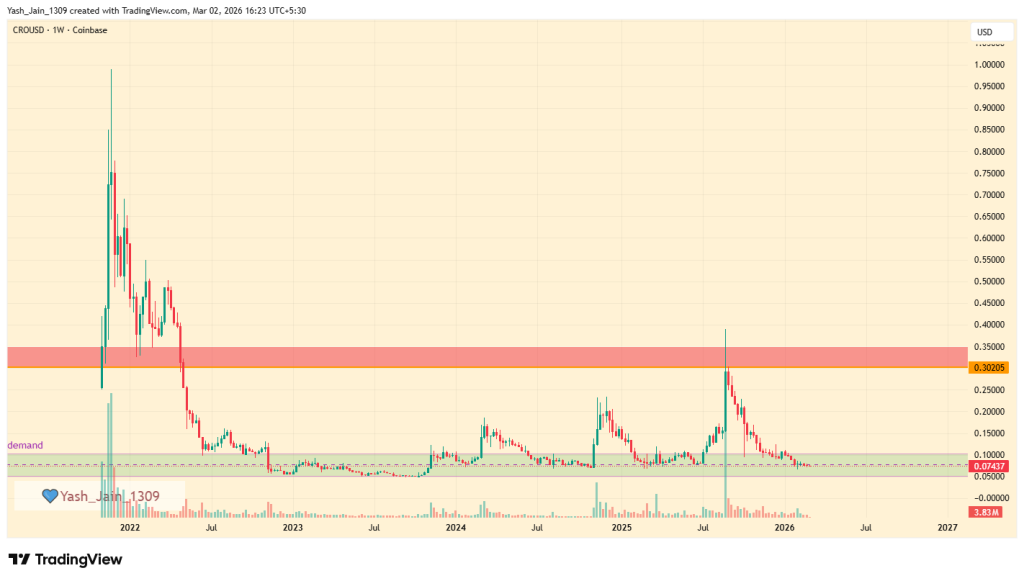
The weekly chart for CRO/USD reveals a persistent long-term structure defined by a well-established accumulation zone. Since late 2023, Cronos has consistently found a floor within the $0.0500 to $0.1000 demand area. This “buy zone” has historically triggered significant rallies, notably in late 2024 and mid-2025, where the price peaked at $0.3900.
As of early 2026, CRO has returned to this familiar base, setting the stage for its next major move.
The current weekly price action suggests a period of base-building. We are seeing a repeat of the historical pattern where CRO enters a deep consolidation phase before a vertical expansion.
Supply Zone: The primary target for a breakout lies between $0.3000 and $0.3500.
The Pivot Point: Simply hitting the supply zone isn’t enough; for a true trend reversal, CRO must flip this resistance into support to reclaim its 2022 highs.
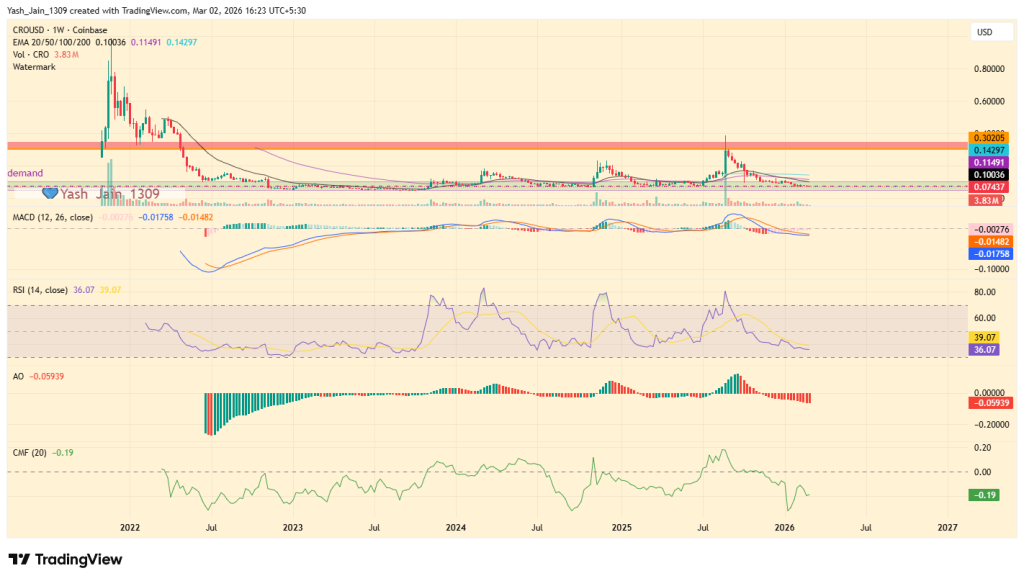
Moreover, While the price remains flat, the underlying “engine” of the market (indicators) is starting to show signs of exhaustion from the bears:
In MACD for instance we are currently approaching a weekly bullish cross. Historically, this cross has served as the starting gun for intensified consolidation that eventually leads to a breakout at later stage.
CMF is the most encouraging sign. The CMF has bounced sharply from a low of -0.32. This move toward the zero line suggests that selling pressure is fading and capital is starting to stabilize within the ecosystem.
RSI & AO, Both indicate that the “cooling off” period is still in effect. This lack of a clear direction in RSI confirms we are in a neutral accumulation phase, which is often known as the quiet before the storm.
What Makes CRO Interesting in 2026?
In 2026, Cronos (CRO) stands out as a unique bridge between high-finance and retail utility. The landscape shifted dramatically in late august 2025 when Trump Media Group announced a $6.42 billion CRO Digital Asset Treasury strategy, signaling a massive institutional endorsement of the token’s scarcity.
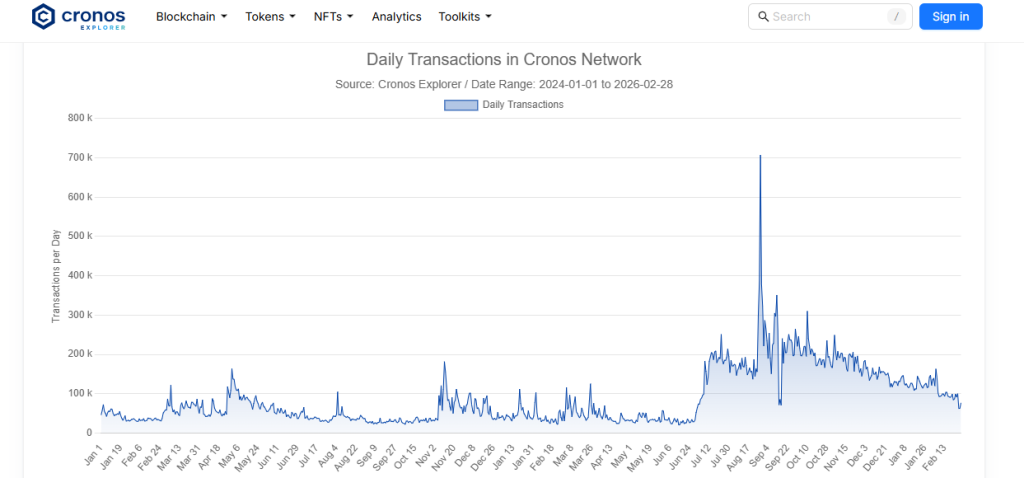
Beyond the headlines, Cronos remains a technical powerhouse with zero downtime over four years. It currently supports 150M+ users via the Crypto.com ecosystem and powers payments for 10M+ merchants. While the broader market has cooled in Q1, Cronos maintains a healthy 100,000 daily transactions, proving its resilience. This blend of “battle-tested” infrastructure and “institutional-grade” liquidity makes it a critical pillar of the 2026 digital economy.
Cronos (CRO) Price Prediction for 2027-2035
Year
Minimum Price ($)
Maximum Price ($)
Average Trading Price ($)
2027
0.1690
0.3490
0.2490
2028
0.3570
0.6990
0.5090
2029
0.7100
1.3190
0.9890
2030
1.3490
2.4010
1.8210
2031
2.4200
4.1990
3.2350
2032
4.2210
7.1000
5.5290
2033
7.1090
11.5050
9.1650
2034
11.5910
18.4510
14.7650
2035
18.4290
28.7110
23.1990
Cronos Token Price Prediction for 2027
By 2027 Cronos token price is expected to trade between $0.1690 and $0.3490. The average expected trading cost is $0.2490.
CRO Price Prediction for 2028
In 2028, CRO price is expected to trade between $0.3570 and $0.6990. The average expected trading cost is $0.5090.
Cronos (CRO) Crypto Price Prediction for 2029
Experts expect Cronos crypto to trade between $0.7100 and $1.3190 in 2029. The average expected trading cost is $0.9890.
CRO Price Prediction for 2030
Based on technical CRO price analysis it is expected to trade between $1.3490 and $2.4010 in 2030. The average expected trading cost is $1.8210.
CRO/USD Price Prediction for 2031
Based on technical analysis by experts, in 2031 CRO/USD is expected to trade between $2.4200 and $4.1990. The average expected trading cost is $3.2350.
Cronos Price Prediction for 2032
Following 2031, in 2032, Cronos price is expected to trade between $4.2210 and $7.1000. The average expected trading cost is $5.5290.
CRO Token Price Prediction for 2033
In 2033, CRO token price is expected to trade between $7.1090 and $11.5050, with an average expected trading cost of $9.1650.Price Prediction for 2034
CRO Crypto Price Prediction for 2034
Based on technical analysis by cryptocurrency experts, in 2034 CRO crypto is expected to trade between $11.5910 and $18.4510. The average expected trading cost is $14.7650.
CRO Price Prediction for 2035
According to technical analysis by top specialists, the CRO price is projected to range from $18.4290 to $28.7110 by 2035. The anticipated average trading price is $23.1990.
Never Miss a Beat in the Crypto World!
Stay ahead with breaking news, expert analysis, and real-time updates on the latest trends in Bitcoin, altcoins, DeFi, NFTs, and more.
FAQs
What is the Cronos (CRO) price prediction for 2026?
CRO is expected to trade within the $0.05–$0.35 range in 2026, with a breakout above $0.30 needed to confirm a bullish reversal.
Can Cronos (CRO) reach $1 by 2030?
Based on long-term projections, CRO could trade between $1.34 and $2.40 by 2030 if adoption and momentum continue.
Is Cronos a good long-term investment through 2035?
Long-term forecasts suggest gradual growth toward higher ranges by 2035, but returns depend on adoption and market cycles.
What could drive CRO price growth in 2026?
Institutional integration, network upgrades, rising utility, and a confirmed bullish MACD cross could support upside momentum.

 Login
Login
 1.59%
1.59%



 -0.96%