Reading view

Dogecoin Price at Key Level, Will This Breakout Finally Happen?

A gold Dogecoin coin next to a candlestick trading chart showing a price rejection at $0.1018 with a red downward arrow.

The post Dogecoin Price at Key Level, Will This Breakout Finally Happen? appeared first on Coinpedia Fintech News

Dogecoin (Doge) is once again catching traders’ attention after a steady price rise this week. The meme coin has climbed around 6%, but the real story is what’s happening behind the chart. Crypto analyst Ali Martinez highlights a key resistance level that is being tested again and again.

So, is DOGE finally ready to break out?

Dogecoin (DOGE) Gets a Major Regulatory Boost

Dogecoin’s recent price rise comes after a major regulatory update. The U.S. Securities and Exchange Commission and the Commodity Futures Trading Commission have now classified Dogecoin as a digital commodity under a new crypto framework.

This clearly separates DOGE from digital collectibles and other token types. It is now placed in the same category as Bitcoin and Ethereum, which brings long-awaited clarity to the market.

This clarity has been missing for years, and now that it’s here, it gives DOGE a stronger foundation. 

Dogecoin On-Chain Activity Picks Up

Dogecoin has started gaining momentum again as the overall crypto market santiment improves. Recently, the price moved close to $0.10, which pushed trading activity higher. 

Data from Coinglass shows that open interest jumped near $1.4 billion, reaching its highest level in over two months.

At the same time, large investors are stepping in. Data shows that whales have bought over $330 million worth of Dogecoin in the past week.

Thus, crypto analyst Ali Martinez noted a potential breakout movement for Dogecoin.

Tight Range Signals a Bigger Move

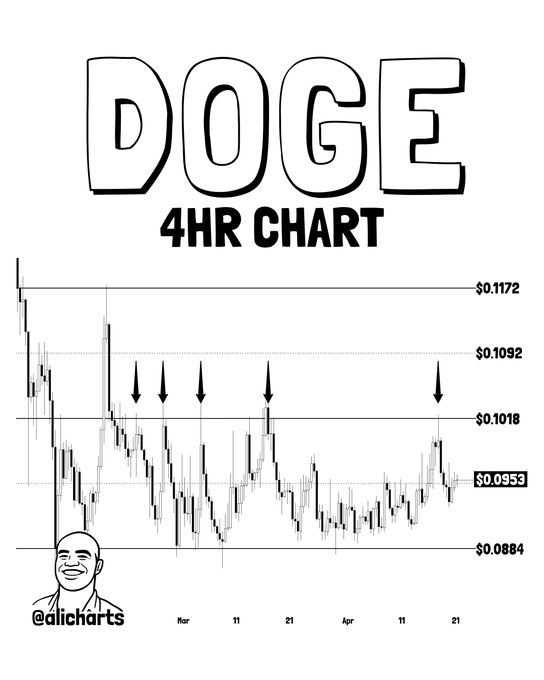
Ali Martinez highlighted a key pattern on the 4-hour chart. According to him, Dogecoin is trading inside a parallel channel, where the price is getting squeezed into a narrow range.

This type of setup often points to a big move ahead. As the price continues to tighten, pressure builds, and sooner or later, a breakout usually follows.
Dogecoin Price at Key Level, Will This Breakout Finally Happen?

Right now, the most important level to watch is $0.1018. This level has acted as strong resistance, stopping the price from moving higher multiple times. In fact, DOGE has already been rejected here five times.

This shows that sellers are still active. However, repeated attempts to break the same level can weaken resistance over time.

Breakout Could Trigger Rally

There are early signs that buyers are gaining strength. If Dogecoin manages to close above $0.1018 on the 4-hour chart, supported by strong volume, it could confirm a breakout.

If that happens, the next target could be around $0.1172, which is near the top of the channel. A move to this level would signal a strong short-term rally for DOGE.


ECB Partners With European Standards Groups to Launch Digital Euro Payments

European Banks Are Moving Into Crypto Who’s Live, Who’s Lagging, and What’s Next

The post ECB Partners With European Standards Groups to Launch Digital Euro Payments appeared first on Coinpedia Fintech News

The European Central Bank has taken a major step toward launching the digital euro by partnering with Europe’s biggest payment standard bodies. The aim is to bring the Digital Euro into everyday European payments to improve adoption and reduce costs.

This move signals stronger preparation to reduce dependence on American and global payment technology.

ECB Signs Three Major Agreements To Launch Digital Euro

In a recent press release, the European Central Bank officially signed partnership agreements with three of Europe’s most important payment standards organizations: the European Card Payment Cooperation (ECPC), Nexo Standards, and the Berlin Group. 

The goal of these agreements is to use existing open standards that everyone can access to process digital euro payments across Europe.

This will help the digital euro work smoothly with current payment systems, so banks and businesses can use it easily without making big changes.

ECB Executive Board member Piero Cipollone said,

“This partnership shows our strong commitment to making sure the digital euro works with existing European standards that the private sector can also use.”

Why These Agreements Crucial for Europe

Europe’s payment system has long depended on American and global payment technology. When you tap your Visa or Mastercard anywhere in Europe, the transaction flows through infrastructure owned by US companies. 

When you pay with Apple Pay or Google Pay, the rails belong to American tech giants.

This dependence creates real problems. European banks and businesses have to pay fees to foreign companies for basic payments. It also makes it hard for local payment providers to grow in other countries because systems are different everywhere.

For example, a French payment system cannot easily expand to Germany or Spain without costly upgrades to payment machines.

The digital euro agreements are designed to fix exactly this. These standards support contactless payments, mobile transactions, and merchant systems. This means users will experience smoother and more consistent payments across different countries.

What Nexts?

These agreements do not mean the digital euro is launching tomorrow.

The European Central Bank has said it can only move forward after the European Union approves a law to make the digital euro official money across the euro area.

The digital euro still needs final approval from EU lawmakers. Once approved, it is expected to gain legal tender status, giving more confidence to businesses and users.

India Expands E-Rupee Use With Welfare Payments to Farmers and Food Schemes

CBDCs vs Cryptos: Why India Is Betting Big on Digital Currency?

The post India Expands E-Rupee Use With Welfare Payments to Farmers and Food Schemes appeared first on Coinpedia Fintech News

India launched new e-rupee pilots to distribute welfare payments directly to farmers and food subsidy beneficiaries, aiming to reduce corruption and boost CBDC adoption. The move shifts funds from traditional systems to digital wallets. This indicates a push toward controlled and targeted digital payments.

RBI Rolls Out CBDC Pilots Across Welfare Programs

According to the Reserve Bank of India, nearly 10 pilot programs are now active to integrate the e-rupee into the country’s $80 billion welfare system.

These pilots focus on sending subsidies directly into digital wallets, cutting out middlemen and reducing delays. Farmers and food scheme beneficiaries are now receiving funds instantly, improving efficiency in distribution.

A key feature of this system is programmability. This means the money can only be used for specific purposes, such as buying seeds, fertilizers, or essential food items.

BREAKING: 🇮🇳India is pushing the e-rupee (CBDC) through welfare payments.

New Delhi is running 10 CBDC pilots for farmers and food subsidies to stop corruption and boost adoption.

India is also exploring a BRICS CBDC link ahead of the 2026 summit to cut reliance on the US… pic.twitter.com/yx4DYPpgnU

— Crypto India (@CryptooIndia) April 24, 2026

Why India Is Pushing CBDC Adoption

India’s digital currency has struggled to gain traction since its launch in December 2022.

So far, the e-rupee has reached around 10 million users, with total transactions near $3.6 billion. In comparison, India’s UPI system processed over 22.6 billion transactions in March 2026 alone.

This gap shows that people already have efficient payment options, making it harder for the e-rupee to grow naturally.

To solve this, the RBI is now focusing on real-world use cases, especially through government payments, where adoption can be driven directly.

The new system brings clear advantages.

Funds now reach the intended users directly, reducing the chances of leakage or misuse. Payments are faster, more transparent, and easier to track.

For example, in states like Maharashtra and Gujarat, subsidies are already being tested with restrictions on where the money can be spent, ensuring it is used for its intended purpose.

Concerns Over Control and Limited Use

Despite these benefits, concerns are growing.

Critics argue that programmable money limits user freedom, as people cannot spend funds however they choose. This raises questions about financial control and privacy.

Some also believe that forcing adoption through welfare programs may not create long-term user interest.

India’s CBDC push is also tied to its global ambitions.

The country is exploring a potential CBDC link within the BRICS group to make cross-border payments faster and reduce reliance on the US dollar.

If adoption grows, CBDCs could become a bigger part of everyday finance. If not, existing systems like UPI may continue to dominate.

BTC’s Rally Was a Short Squeeze, Not Real Buying, CryptoQuant

Bitcoin Price

The post BTC’s Rally Was a Short Squeeze, Not Real Buying, CryptoQuant appeared first on Coinpedia Fintech News

This week, Bitcoin jumped 4%, rising from $76,351 to $79,447. But CryptoQuant analyst Carmelo Aleman says the move was not driven by real buyers. Instead, the push came from the futures market, forcing short sellers out of their positions in a $1.19 billion short squeeze.

Thus, Carmelo Aleman says the rally looks strong but is fragile and could turn bearish soon. 

BTC Rally Driven by Derivatives, Not Spot Demand

According to Carmelo Aleman, the recent Bitcoin rally was not backed by strong buying in the spot market.

During the rally, Bitcoin’s open interest across all exchanges surged from about $24.8 billion to nearly $28 billion. This sharp increase shows that traders were heavily adding leveraged positions using borrowed funds.

Instead of fresh capital entering the market, the move came from pressure in the futures market. As prices rose, short sellers were forced to close their positions, triggering a chain reaction that pushed Bitcoin even higher.

Aleman said, “As long as price depends more on derivatives than on solid spot validation, the structure will remain vulnerable to reversal.”

Over $1.1 Billion Liquidations Shock the Market

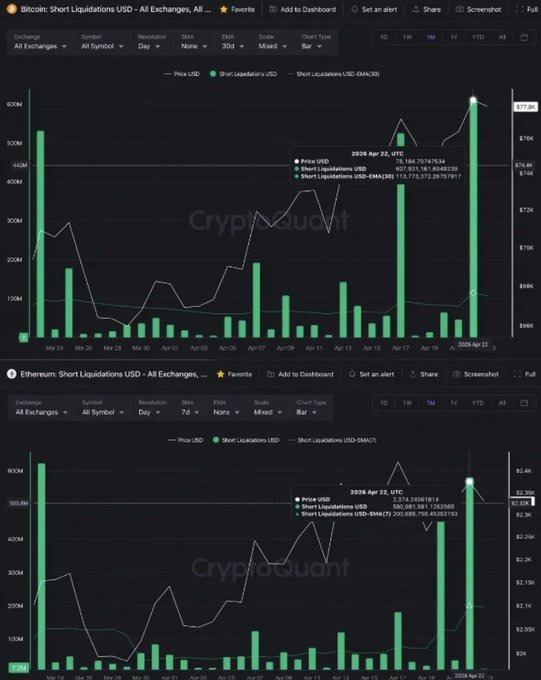
The charts shared by the analyst highlight a clear spike in short liquidations. On April 22, Bitcoin short liquidations across all exchanges reached over $607 million in a single day. 

Ethereum was not far behind. ETH short liquidations on the same day hit $581 million. Together, this pushed total short liquidations to about $1.19 billion, wiping out in one single session.

Open interest jumped to $28 billion,

That forced liquidation created a wave of buying pressure that pushed prices up sharply, but it was not real demand.

On the other hand, long liquidations were much smaller, totaling just over $111 million across both assets.

$9.87 Billion in Options Expiry Added More Pressure

Another factor adding uncertainty is the large number of options expiring today.

According to Deribit data, around $9.87 billion in Bitcoin and Ethereum options contracts are expiring.

🚨 April-End Options Expiry Alert.
At 08:00 UTC tomorrow, ~$9.8B in crypto options are set to expire on Deribit.$BTC: ~$8.47B notional | Put/Call: 0.94 | Max Pain: $72,000$ETH: ~$1.33B notional | Put/Call: 0.74 | Max Pain: $2,200

Both assets are trading above max pain heading… pic.twitter.com/WPGZuV0iJU

— Deribit (@DeribitOfficial) April 23, 2026

Bitcoin’s max pain level is currently near $72,000, while the market price is trading significantly above it. On the options side, Bitcoin’s put-to-call ratio stands at 0.93, showing that bearish and bullish positions are almost evenly balanced.

Ethereum, however, shows a slightly stronger bullish tilt. Its put-to-call ratio is lower at 0.72, with ETH trading around $2,315 compared to a max pain level of $2,200.

What Next for BTC Now?

For now, the overall trend still looks positive, with Bitcoin forming higher highs and higher lows through April.

However, a stronger move will likely depend on real spot buyers stepping in. If that demand picks up, Bitcoin could once again attempt to break above the $80,000 level.

U.S State Wisconsin Sues Coinbase, Polymarket, Kalshi, & Others Over ‘Illegal Betting’

U.S. Soldier Charged for Insider Trading on Polymarket, Made $409K Profit

The post U.S State Wisconsin Sues Coinbase, Polymarket, Kalshi, & Others Over ‘Illegal Betting’ appeared first on Coinpedia Fintech News

U.S state Wisconsin filed a lawsuit against the five major platforms, including Coinbase, Polymarket, Kalshi, Robinhood, and Crypto.com, claiming their prediction markets violate state gambling laws. The case argues these “event contracts” are actually sports bets.

This adds pressure on the industry and raises a simple question: are these platforms real trading tools, or just gambling in disguise?

Wisconsin Targets Prediction Platforms Over “Event Contracts”

According to the complaint filed by the state, these platforms are offering products that closely resemble sports betting, which is illegal in Wisconsin outside tribal casinos.

Wisconsin Attorney General Josh Kaul accused platforms like Kalshi, Coinbase, Polymarket, Robinhood, and Crypto.com of violating state gambling laws

He said that labeling these products as “event contracts” does not change what they actually are. According to him, these platforms are still facilitating illegal sports betting.

“The state says it wants to halt their alleged facilitation of illegal sports betting, a form of unlawful commercial gambling, in Wisconsin.”

Kaul also made it clear that no company is above the law. He argued that firms are simply using financial language to hide gambling activity. The state is now asking the court to stop these platforms from offering such services to users in Wisconsin.

Why Wisconsin Says This Is Gambling?

Prediction platforms claim users are trading financial contracts based on real-world outcomes. But Wisconsin disagrees.

The lawsuit shows that:

  • Users are effectively betting on outcomes like sports events
  • Platforms charge fees similar to betting systems
  • Marketing often promotes activities like gambling

Because of this, the state argues these contracts should be treated as traditional bets under local law.

Just in: Wisconsin DOJ is suing Kalshi, Robinhood, Coinbase, Polymarket, https://t.co/FZDqOPWpCL, and their affiliates. State says it wants to "halt their alleged facilitation of illegal sports betting, a form of unlawful commercial gambling, in Wisconsin."

— Jason Calvi (@JasonCalvi) April 23, 2026

Therefore, the lawsuit has been filed in Dane County, asking the court to declare these platforms illegal in Wisconsin. It also seeks to block them from offering sports-related contracts to users in the state.

Companies Push Back With Federal Argument

The companies strongly deny the allegations. They say users are not gambling but trading on outcomes, similar to financial markets. Platforms like Robinhood and Kalshi argue that their services are regulated at the federal level by the Commodity Futures Trading Commission (CFTC).

Kalshi, in particular, claims its contracts are legal financial instruments traded on a regulated exchange, not gambling products.

This creates a direct conflict between state and federal views.

Growing Nationwide Pressure on Prediction Markets

This is not the first time prediction markets have faced legal trouble. Other states like Nevada and New York have already raised similar concerns, calling these contracts no different from gambling.

If Wisconsin wins, it may force platforms to change or limit their services in multiple states. 

But if companies win, prediction markets could expand more freely across the U.S.

U.S. Soldier Charged for Insider Trading on Polymarket, Made $409K Profit

U.S. Soldier Charged for Insider Trading on Polymarket, Made $409K Profit

The post U.S. Soldier Charged for Insider Trading on Polymarket, Made $409K Profit appeared first on Coinpedia Fintech News

A U.S. Army soldier has been charged with using classified military information to place bets on a crypto prediction platform, earning about $409,000 from roughly $33,000 wagers. The case has raised serious concerns about insider trading risks in prediction markets.

U.S. Soldier Accused of Insider Trading Case on Polymarket

According to U.S. prosecutors, Gannon Ken Van Dyke, a 38-year-old active-duty soldier, used sensitive information linked to a U.S. operation
(Operation Absolute Resolve), targeting Venezuela’s former president, Nicolas Maduro.

Authorities say Van Dyke had direct access to confidential details due to his role in planning and executing the operation.

U.S. Soldier Charged for Insider Trading on Polymarket, Made $409K Profit

Instead of keeping that information secure, he allegedly used the information to predict outcomes on the polymarket platform, giving him an unfair advantage over other users. 

How Insider’s Bets Generated $409K Profit on Polymarket

The activity took place between late December 2025 and early January 2026. During this time, he allegedly placed around 13 bets on Polymarket, spending close to $33,000 in total. 

Using a trading account, he bought over 436,000 “Yes” shares tied to a contract related to Maduro’s status.

When events played out as expected, his positions paid off heavily. Reports suggest he made nearly $409,000 in profit from these trades

This type of activity is considered insider trading, even in emerging platforms like prediction markets.

Legal Action and Serious Charges

The case has now moved to federal court in New York. Authorities have charged Van Dyke with multiple offenses, including wire fraud, unlawful monetary transactions, and violations of the Commodity Exchange Act. 

If found guilty, he could face up to 20 years in prison for the most serious charge.

At the same time, the Commodity Futures Trading Commission (CFTC) has filed a civil case seeking penalties, repayment of profits, and a permanent ban from trading.

Even CFTC Chair Mike Selig said,

“I’ve been crystal clear: anyone who engages in insider trading in any of our markets will face the full force of the law.”

Further, Selig said that the CFTC won’t tolerate insider trading in our markets.

Polymarket Responds to the Incident

Responding to Van Dyke’s arrest, Polymarket said on X that it detected suspicious trading activity and reported it to authorities. The platform stated that it has strict rules against insider trading and is working to improve market integrity.

“When we identified a user trading on classified government information, we referred the matter to the DOJ & cooperated with their investigation.

Insider trading has no place on Polymarket. Today’s arrest is proof the system works.”

This case comes as prediction markets continue to grow in popularity. However, it also shows the risks when users with access to sensitive information try to exploit these systems. 

CoinEx Founder Yang Haipo Says Crypto’s Collapse Is Inevitable, And Numbers to Back It Up

Bitcoin sentiment analysis

The post CoinEx Founder Yang Haipo Says Crypto’s Collapse Is Inevitable, And Numbers to Back It Up appeared first on Coinpedia Fintech News

Yang Haipo, founder of CoinEx, said that the cryptocurrency industry is moving toward an “inevitable endgame.” He believes that Bitcoin’s trillion-dollar value will eventually crash hard.

While many still see long-term growth, others are starting to question, and is there any proof behind this? 

Founder Who Knows the Industry From the Inside

When a random critic attacks Bitcoin, it is often ignored. But when CoinEX and ViaBTC founder Yang Haipo shares his view, it draws attention. 

According to Yang Haipo, the crypto market may be reaching a turning point where its current model can no longer sustain itself. 

In a detailed analysis, Yang says the crypto system mostly runs on new capital entering the market, not on real income from outside users. 

Due to this, the crypto industry spends 10’s of billions every year on mining, exchanges, and development, but real income from actual use is still very small. This creates a gap where more money is going out than coming in, which could slowly weaken the system over time.

Yang Haipo: Cryptocurrency is Heading Towards an Inevitable Endgame

Yang Haipo, founder of CoinEX and ViaBTC, published an article expressing despair about the industry, stating that:

Bitcoin's dramatic collapse from its current trillion-dollar market capitalization is… pic.twitter.com/0NZ8HvlG5Q

— Wu Blockchain (@WuBlockchain) April 23, 2026

Bitcoin Has No Real Value On Its Own

Yang’s first big point is about Bitcoin itself. Yang argues that Bitcoin does not produce value like traditional businesses. It does not generate profits, and it is not widely used for daily payments. Instead, its price depends mostly on people believing in it.

He also pointed out that Bitcoin needs constant support systems like electricity, internet, and miners. Without them, the network cannot function.

Another issue, he says, is built into Bitcoin itself. Mining rewards keep getting cut over time, so the network will one day rely mostly on transaction fees to stay secure. 

But Bitcoin culture is mostly about holding, not spending. Yang says this creates a basic conflict that still has no clear solution.

Industry Spends Far More Than It Ever Earns

Running the crypto industry costs a lot of money every single year. Mining Bitcoin alone burns through $10 billion to $15 billion in electricity and hardware. Exchanges spend another $15 billion to $25 billion on staff, computer systems, legal costs, and advertising. 

Now here is the painful part. How much real money does the industry bring in from the outside world? From actual services, real payments, genuine outside demand?

A few hundred million dollars a year. Less than one percent of what it spends.

The gap between what crypto earns and what it costs to run is so large that the only thing that has ever closed it is new people putting fresh money in. 

ETFs and Institutions: A Temporary Boost?

The recent bull market has been supported by institutional inflows, especially through Bitcoin ETFs and treasury strategies. Between 2024 and 2025, Bitcoin climbed from around $40,000 to over $120,000. Everyone called it proof that crypto had gone mainstream

But Yang sees this as a short-term boost rather than a permanent solution. 

He says that once these inflows slow down, the market could struggle to maintain its current size.

Every time crypto crashed badly in the past, a new group of buyers showed up and saved it. Yang says those recoveries were not proof of strength. They were lucky.  

How Much Time Is Left?

Yang’s math on timing is not comforting.

The total pool of usable money sitting inside the crypto system right now is around $200 billion. The system burns through $60 billion to $80 billion of that every year. With no major new source of outside money on the horizon, that gives the current setup roughly two and a half to three years before something breaks badly.

And that is the best-case version. Bear markets make everything move faster. People panic. They pull money out quickly. In 2022, $65 billion drained out of crypto in less than a year. 

If that kind of panic happens again from a weaker starting position, the timeline shortens dramatically.

❌