
 Login
Login
Intel "Wildcat Lake" Outruns Apple's MacBook Neo and Its Successor in First Benchmarks
Intel recently unveiled its "Wildcat Lake" Core 300 series of laptop processors, designed for the entry-level market with excellent CPU and GPU capabilities to meet basic needs. By combining two "Cougar Cove" P-cores with four LPE "Darkmont" cores, these processors should provide sufficient CPU power for basic tasks in the entry-level segment. Especially when paired with the NPU 5, Xe display and media engine, and a GPU featuring up to two Xe3 cores, this SoC should handle tasks with ease, including some very light entry-level gaming. Today, the first benchmarks appeared, showcasing what this CPU is capable of and how it compares to industry-leading solutions in this price range, such as Apple's newest MacBook Neo, thanks to the initial PassMark benchmark results.
In the latest benchmark, PassMark recorded the Intel Core 5 320 "Wildcat Lake" with two P-cores running at up to 4.6 GHz and LPE cores with a maximum turbo frequency of 3.4 GHz. This SoC scored about 4,047 points in the single-threaded rating and approximately 15,222 in the multithreaded rating in the PassMark evaluation benchmark. This places its rating just above Apple's first-generation M1 SoC in both single and multithreaded results. Additionally, the design surpasses Apple's A18 Pro SoC in the current MacBook Neo and the A19 Pro SoC that is expected to be included in the second-generation MacBook Neo design scheduled for 2027. Technically, both are based on different architectures, but they serve the same purpose: providing customers with an affordable SoC/laptop design that delivers solid computing power for all basic tasks.
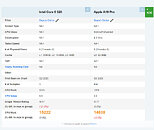
In the latest benchmark, PassMark recorded the Intel Core 5 320 "Wildcat Lake" with two P-cores running at up to 4.6 GHz and LPE cores with a maximum turbo frequency of 3.4 GHz. This SoC scored about 4,047 points in the single-threaded rating and approximately 15,222 in the multithreaded rating in the PassMark evaluation benchmark. This places its rating just above Apple's first-generation M1 SoC in both single and multithreaded results. Additionally, the design surpasses Apple's A18 Pro SoC in the current MacBook Neo and the A19 Pro SoC that is expected to be included in the second-generation MacBook Neo design scheduled for 2027. Technically, both are based on different architectures, but they serve the same purpose: providing customers with an affordable SoC/laptop design that delivers solid computing power for all basic tasks.


