Reading view

Tom Lee’s Bitmine Locks $508M in ETH, Hold 4% Of Total ETH Supply

Bitmine Crosses 10% of ETH Staking Supply

The post Tom Lee’s Bitmine Locks $508M in ETH, Hold 4% Of Total ETH Supply appeared first on Coinpedia Fintech News

Just like Michael Saylor’s Strategy, Tom Lee’s Bitmine Immersion Technologies is showing no signs of slowing down. According to on-chain data from Arkham Intelligence, Bitmine recently locked around $508 million worth of ETH, adding to its already massive holdings.

The firm now holds a significant share of the network’s staked supply, impacting ETH’s available supply.

Bitmine Adds $508 Million ETH Stake

Arkham transaction data shows that six large transfers were made from Bitmine-linked wallets to Coinbase Prime staking addresses over the last day. The transactions included multiple ETH deposits worth tens of millions of dollars each.

Some of the largest transfers were worth around $73 million, $69 million, $65 million, and $52 million. Combined, the recent batch of transactions totaled roughly $508 million in Ethereum staking activity.

Tom Lee just staked $508.4M ETH

Bitmine has now staked over 4 MILLION ETH (worth $9.3B) – that’s 10.5% of the total staked ETH supply.

Tom Lee is buying and staking ETH. pic.twitter.com/NofM7r0YRG

— Arkham (@arkham) May 1, 2026

This suggests Bitmine is still aggressively expanding its long-term Ethereum strategy instead of slowing down.

Bitmine Now Holds Over 4 Million ETH

Reports suggest that Bitmine has now accumulated more than 4 million ETH, valued at roughly $9.3 billion. This places the firm among the largest institutional holders of Ethereum. 

Even more notable is its dominance in staking. Bitmine now controls about 10.5% of all staked ETH.

In total, its holdings represent over 4% of Ethereum’s entire supply, which stands near 120 million ETH.

Tom Lee’s Ethereum Bet Grows Bigger

In less than a year, Bitmine has built this position at a fast pace. Reports suggest the firm accumulated over 5 million ETH within 10 months as part of a long-term target to hold a significant share of total supply.

However, X users say “that’s NOT good for eth. Too much supply in one hand makes other investors choose other investments.”

Despite holding large unrealized losses estimated at over $6 billion, the firm continues to increase its exposure. 

Ethereum Price Outlook

As of now, EThreum price is trading around $2304 relfecitng a rise of 1.7% with a market cap hitting $278 billion. Meanwhile, on April 30, U.S. spot Bitcoin ETFs recorded total net inflows of $14.76 million, marking their first positive day after three straight sessions of outflows.

Bitcoin ETFs Turn Positive, Ethereum Outflows Continue

On April 30 (ET), Bitcoin spot ETFs recorded a total net inflow of $14.7578 million, marking the first net inflow after three consecutive days of net outflows. Ethereum spot ETFs saw a total net outflow of $23.6426 million,… pic.twitter.com/Ps2PKKY7B5

— Wu Blockchain (@WuBlockchain) May 1, 2026

At the same time, spot Ethereum ETFs saw net outflows of $23.7 million, extending their losing streak to four consecutive days.

Japan Launches SBI Visa crypto card, Letting Users earn BTC, ETH, and XRP rewards

SBI ripple

The post Japan Launches SBI Visa crypto card, Letting Users earn BTC, ETH, and XRP rewards appeared first on Coinpedia Fintech News

Japan’s top financial giants SBI Holdings, APLUS, and Visa have launched a new credit card that lets users earn Bitcoin (BTC), Ethereum (ETH), or XRP through everyday spending.

Starting May 1, the new SBI VISA Crypto Card and SBI VISA Crypto Card Gold automatically convert reward points into cryptocurrency. This move could bring crypto rewards to millions of regular users.

Credit Card That Earns BTC, ETH, XRP As a Reward

At the press conference held at SBI Holdings that day, President of SBI VC Trade Tomohiko Kondo explained the aim of issuing the card, saying,

“Because it is a highly volatile asset, we thought that a system that allows you to accumulate a little bit each month would help build your assets.” 

He also touched upon the collaboration with Visa, stating, “We would like to cooperate and promote the settlement of cryptocurrencies and stablecoins as well.

Both cards will allow users to collect reward points from normal spending, which will then be automatically converted into selected assets, including Bitcoin, Ethereum, or XRP.

Takayuki Shimada, President and CEO of APLUS, said,

“Our mission is to evolve the safe and secure payment infrastructure we have cultivated in our credit card business into the next generation of finance.”

How the Crypto Reward System Works

The reward points earned from card spending will be converted into the user’s chosen cryptocurrency once every month, with no exchange fee. Users need an SBI VC Trade account to receive rewards, while existing users can link their current account.

The standard card is made for beginners, while the Gold card offers higher rewards and extra benefits.

SBIグループとVisaが連携、暗号資産(BTC、ETH、XRP)が貯まるクレジットカード誕生[SBI VCトレード, アプラス] https://t.co/xjz9GX3z8Z

— 北尾吉孝 (@yoshitaka_kitao) May 1, 2026

To celebrate the launch, users who apply between May 1 and May 31, 2026, can get bonus rewards. Meanwhile, the regular card offers up to 2.5%, while the Gold card offers up to 10%. 

Why XRP Users May Be Watching Closely

While Bitcoin and Ethereum remain popular choices, the inclusion of XRP stands out. Japan has long been one of XRP’s strongest markets, and SBI has supported Ripple’s ecosystem for years.

Earlier Coinpedia news reported that SBI Holdings Chairman Yoshitaka Kitao said SBI owns around a 9% stake in Ripple.

This makes the addition of XRP rewards more meaningful, as it could drive stronger interest and wider use among Japanese users.

Crypto Payments Expand in Japan

Earlier this week, Japan also saw other crypto payment launches. On April 27, EPOS Card and Bitbank introduced the EPOS CRYPTO Card, allowing users to withdraw crypto from their accounts. 

On April 20, SLASH VISION, I-Kitas, and Orient Corporation launched the Slash Card, which uses the US dollar stablecoin USDC for payments.

These new launches, along with SBI and Visa’s latest card, show that crypto is steadily becoming part of everyday finance.

Will the Structure Market Bill (Clarity Act) Pass in May? What Experts Say!

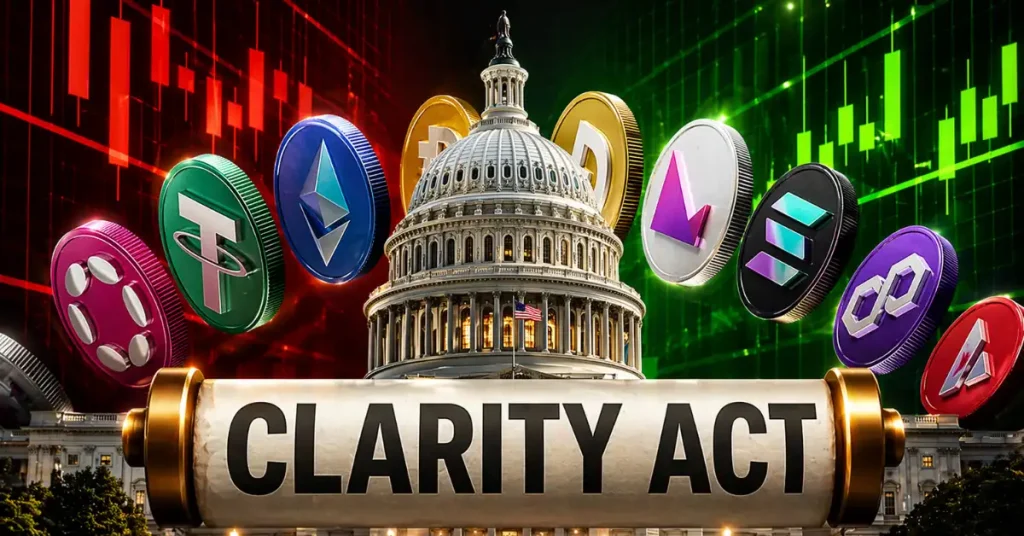
A "CLARITY ACT" scroll in front of the US Capitol Building, surrounded by various cryptocurrency coins including Bitcoin, Ethereum, and Solana against a trading chart background.

The post Will the Structure Market Bill (Clarity Act) Pass in May? What Experts Say! appeared first on Coinpedia Fintech News

The CLARITY Act, America’s most ambitious attempt to create a proper regulatory structure for digital assets, is approaching its final, make-or-break moment. And the question everyone in crypto space is asking: Will May 2026 finally be the month it actually happens?

Here’s what Industry experts and prediction markets say about it.

CLARITY Act is “in the Red Zone”

Senate Banking Committee Chairman Tim Scott said the CLARITY Act is “in the red zone,” meaning the bill is close to moving forward. He said it could reach committee markup in May, followed by a possible Senate floor vote in June or July.

Scott also said he expects the bill to reach the President’s desk this summer, showing growing momentum in Washington.

Other lawmakers also sounded confident. At the Bitcoin 2026 Conference, Senator Cynthia Lummis said crypto market structure legislation will be marked up in May, adding,

“We are gonna get it to the finish line.”

Senator Tillis also backed the bill and urged leaders to “move forward.”

Meanwhile, Senator Bernie Moreno warned that missing the end of May deadline could delay the bill for a long time, as the political calendar becomes tighter later this year.

Industry Experts Say Time Is Running Out

While the U.S. senators are optimistic about the bill, industry voices are also closely watching the timeline.

Ripple CEO Brad Garlinghouse recently shifted his expectations from April to May, warning that the bill has only a few weeks left to move forward. 

“If it doesn’t pass now… it’s NOT HAPPENING anytime soon.”

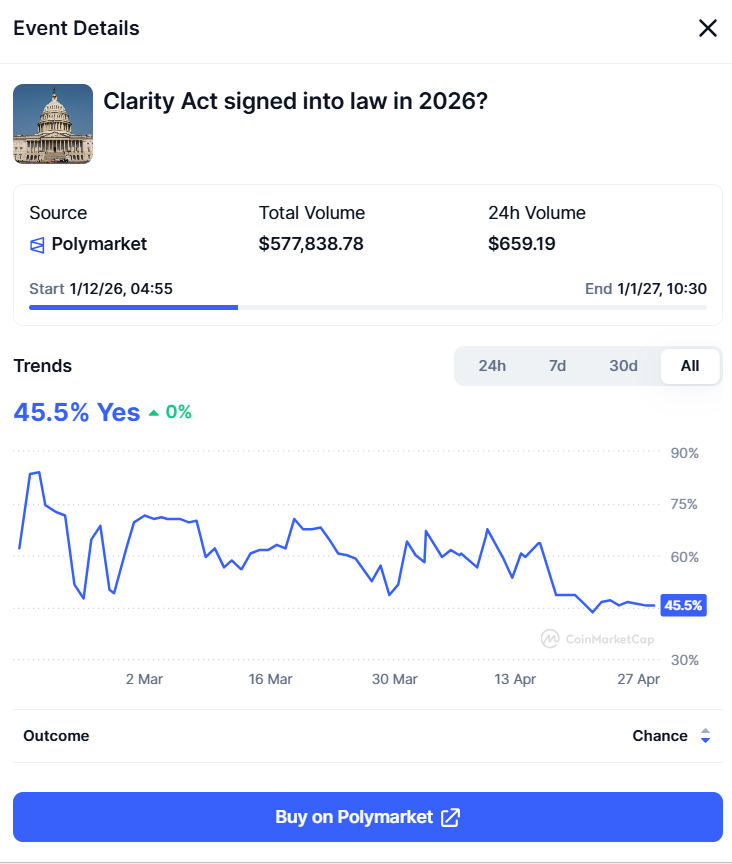
Polymarket now shows a 46% chance of the bill being signed in 2026, down sharply from 82% in February. 

Clarity ACt

Meanwhile, Kalshi gives only a 19% chance of approval before July and a 37% chance before August.

Key Hurdle For Passing the Clarity Act

The Clarity Act is expected to move forward in May, but a few important issues remain.

  • Stablecoin Yield Issues Largely Resolved

Passive yield, where users earn money just by holding stablecoins, may be banned. But reward programs linked to activity are still allowed, which is good for current stablecoin projects.

  • Conflict for Trump To Sign Due to the Coin Act

Democrats want to ban top officials, lawmakers, and their families from owning or profiting from crypto while in office. Many see this as targeting Trump-linked projects like WLFI and the TRUMP memecoin.

However, Democrats may demand that the Coin Act be passed; otherwise, they won’t vote yes. This may prevent Trump from signing the Clarity Act, making it a major hurdle for the bill.

Overall, the crypto industry remains hopeful.

Key Steps Needed to Sign the CLARITY Act

Most expect the next major step to be a Senate Banking Committee markup around the week of May 11.

Before reaching President Trump’s desk, the bill still faces five key hurdles: committee approval, a 60-vote Senate floor vote, merging with the Senate Agriculture version passed in January, aligning with the House version passed last July, and final presidential approval.

Crypto Hacks Hit $650M in April, Biggest Losses Since 2022: CertiK

Crypto Hacks Surge to $52M in March 2026

The post Crypto Hacks Hit $650M in April, Biggest Losses Since 2022: CertiK appeared first on Coinpedia Fintech News

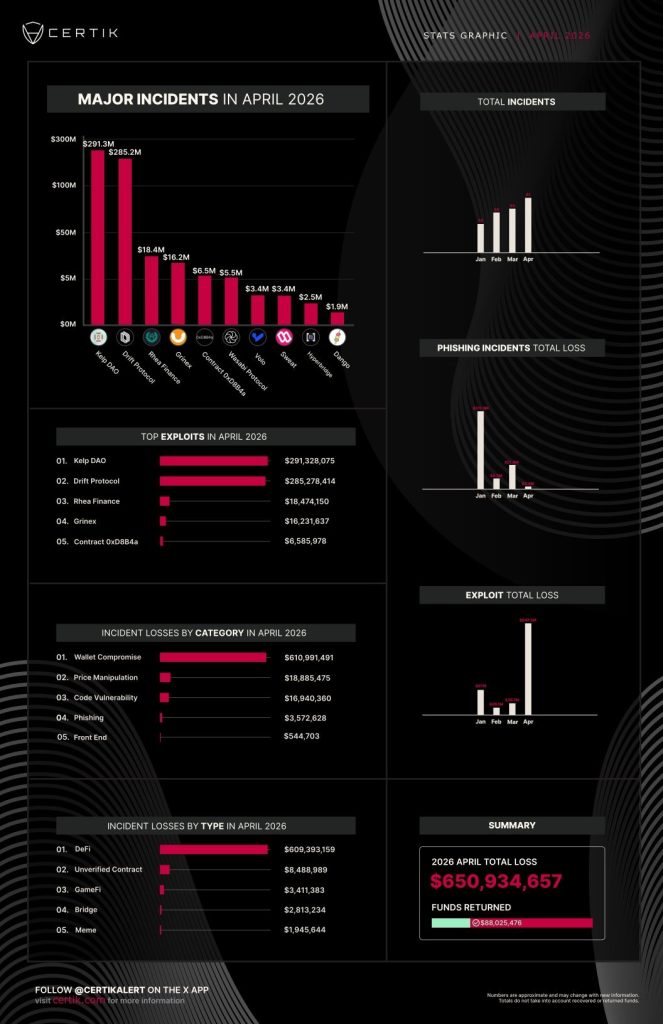
April 2026 turned into a nightmare for the crypto world. According to CertiK, a blockchain security company, the total amount lost to hacks, scams, and exploits this month crossed $650.9 million. 

That makes it the worst month for crypto losses since March 2022, when the industry lost roughly $715 million

Major Exploits Drove the Losses

According to CertiK’s data, the majority of losses came from exploit-based attacks rather than phishing or scams.

The largest exploit came from KiloEx, which alone saw losses of about $291.3 million. This was followed by Drift Protocol, with losses of roughly $285.23 million, making it one of the biggest single incidents of the month.

Meanwhile, other notable attacks included Rhea Finance at $18.47 million, Grinex at $16.23 million, and a contract exploit labeled 0x8B84 with losses of around $6.585 million.

Crypto Hacks Hit $650M in April, Biggest Losses Since 2022: CertiK

Wallet Compromises Led the Losses

Looking at how the money was lost, wallet compromise was the biggest category by far, responsible for over $610 million of the total. 

Price manipulation schemes came second at around $18.88 million, followed by code vulnerabilities at nearly $17 million. 

Meanwhile, phishing attacks, though smaller in total, still caused $3.57 million in damage across multiple incidents. Front-end attacks rounded out the list at $544,703.

DeFi Remains the Biggest Target

CertiK’s breakdown shows that DeFi platforms continue to be the most affected sector. By sector, DeFi platforms were hit the hardest, losing nearly $609.39 million in April alone.

Centralized platforms recorded losses of about $8.48 million, while gaming-related projects saw around $3.41 million drained.

Smaller losses were recorded in bridges ($2.83 million) and other categories totaling nearly $9.85 million.

What This Means for the Crypto Market

The number of security incidents also increased steadily from January to April, with April recording the highest activity level. 

The surge in losses raises fresh concerns about security standards across the industry. While innovation continues to push the space forward, these incidents highlight the urgent need for stronger audits, better risk management, and improved user awareness.

Despite these setbacks, the industry has shown resilience in the past. 

Bitcoin Price Near Bottom as Institutional Demand Surges, as Retail Demand Weakens

bitcoin

The post Bitcoin Price Near Bottom as Institutional Demand Surges, as Retail Demand Weakens appeared first on Coinpedia Fintech News

Bitcoin is trading near $76,000 after recent selling pressure, while big investors continue to show interest. This shows a growing gap between weak retail confidence and strong long-term buying by major players.

Crypto analyst Michael van de Poppe says Bitcoin is now at an important stage, with mixed signals showing a big move could come soon.

Institutional Crypto Interest Grows Despite Market Uncertainty

According to recent market observations, large financial firms are steadily increasing their exposure to crypto. Coinpedia news reported Morgan Stanley launched a spot Bitcoin ETF earlier this month, raising $100 million within its first week. 

Soon after, Goldman Sachs filed for its own Bitcoin investment product. At the same time, Deutsche Borse invested $200 million into Kraken, while Intercontinental Exchange made a similar move by backing OKX. 

These show that large institutions are focusing on building long-term infrastructure rather than reacting to short-term price swings.

Retail Activity at Lowest Level Since January 2025

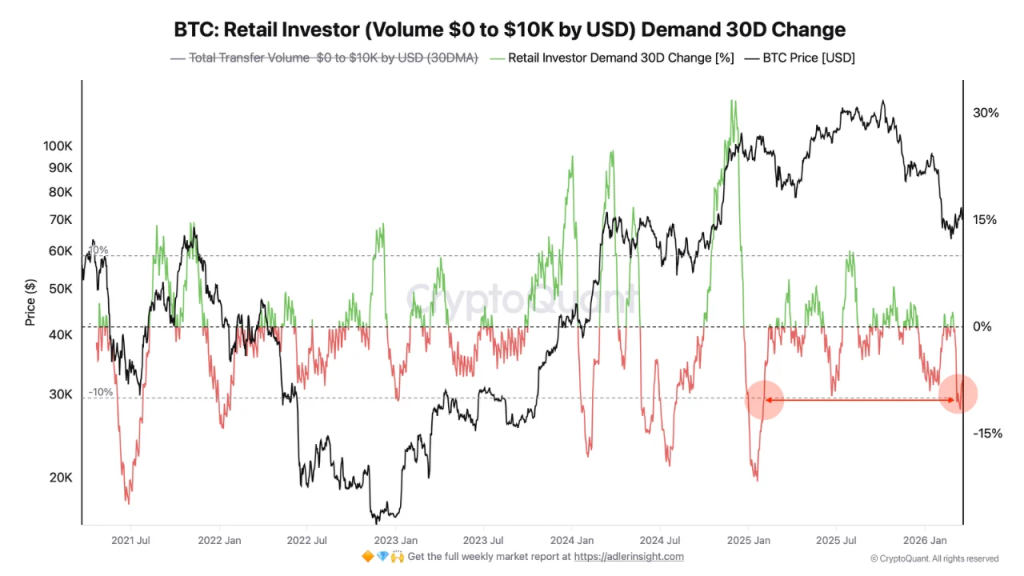
Retail Bitcoin activity has fallen to its lowest level since January 2025.

Crpytoquant analyst darfost highlighted the chart showing transactions under $10K, which usually represent small investors. Demand has now dropped to -10%, showing weaker retail interest.

Bitcoin

Retail investors have mostly stayed away during this cycle, with only a few short spikes in activity.

This matters because weak retail demand has often appeared during market corrections or near price bottoms.

Liquidity Signals Point to Strong Market Foundation

Another key trend is the rise in stablecoin supply, which is now at record levels. This indicates that capital is ready to enter the market when conditions improve. At the same time, Bitcoin ETFs have seen steady inflows since 14th April around $1.5 billion, helping absorb selling pressure. 

The current market setup suggests a shift from a highly leveraged environment to a more stable, spot-driven market.

Bitcoin Near Capitulation Point

Despite strong institutional activity, Bitcoin price action remains weak in the short term. 

Van de poppe note that bitcoin being at its capitulation point means the market may be near a bottom. The van de poppe note 11 indicators are flashing signals last seen in Q4 2022, when Bitcoin later began a strong recovery.

Bitcoin Near Capitulation Point

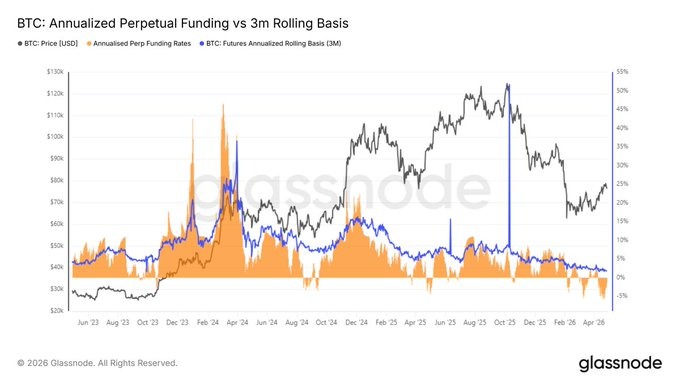
Funding rates are currently negative, meaning short sellers are paying long positions. The futures premium is also at its lowest since 2022, showing low bullish confidence. 

MegaETH Launches on Top Exchanges as MEGA Price Jumps

Upbit Lists MegaETH Across KRW, BTC, and USDT Markets

The post MegaETH Launches on Top Exchanges as MEGA Price Jumps appeared first on Coinpedia Fintech News

MegaETH (MEGA), a new Ethereum Layer 2 network focused on real-time performance, is listing across multiple major centralized and decentralized exchanges simultaneously, including KuCoin, Bitget, Bithumb, Upbit, and Coinbase on 30th Arpil 2026.

According to the coinmrket cap, Mega token’s pre-launch price surged past $0.195, jumping over 8% in a day. 

MegaETH (MEGA) Goes Live on Exchanges

MegaETH (MEGA) launched on April 30, 2026, across several major exchanges, announcing support for MEGA trading and deposits. 

KuCoin started with a “World Premiere” listing, one of its biggest launch categories. The MEGA/USDT spot trading pair went live on April 30.

Bitget also listed MEGA for spot trading. Deposit services opened first, while trading started later the same day.

In South Korea, one of the world’s busiest crypto markets, Upbit, Bithumb, and Huobi HTX confirmed MEGA listings on April 30. Upbit, the country’s largest exchange, launched trading pairs in KRW, BTC, and USDT.

Bithumb listed MEGA against the South Korean Won, giving local traders another way to buy the token.

Meanwhile, Huobi HTX listed MEGA on launch day, with deposits opened earlier.

Coinbase & Binance Exchanges Yet to Confirm

Coinbase, known for being very selective with new listings, opened deposit support for MEGA before the token generation event (TGE). This was seen as a strong positive sign, as Coinbase usually adds support only when it expects solid demand.

Binance has not yet confirmed a spot trading listing based on the latest reports. However, Binance Square has been sharing verified official updates about the MEGA launch, keeping hopes alive for a future listing.

MEGA Also Listing On Decentralized Exchange

On the decentralized exchange side, Kumbaya is the leading native DEX on the MegaETH network, holding a strong share of trading volume.

Prism is another decentralized exchange with active MEGA trading activity.

SectorOne V2.2 is also a decentralized platform that supports assets within the MegaETH ecosystem.

MEGA Price Surges Ahead of Launch

Before the official token generation event (TGE), MEGA saw strong buying activity. The token briefly crossed $0.215 and is currently trading near $0.197, marking an 8% daily gain. 

MegaETH has a total supply of 10 billion tokens. Only 5% was allocated to the public sale, helping keep early supply limited.

The biggest share, 53.3%, is reserved for staking rewards to support long-term users. Team and advisors hold 9.5%, while the Foundation and Ecosystem Reserve gets 7.5%.

The remaining 24.7% is for investors and reward programs.

Early data shows the network already holds around $200 million in total value locked (TVL) and is processing about 26 transactions per second. These numbers suggest that the chain is active from the start.

Bitcoin ETF Inflow Stops After $2.1B Run, Outflows Cross $490M

Bitcoin ETF Inflows Hit $767M in 5 Days Why Isn't the BTC Price Moving

The post Bitcoin ETF Inflow Stops After $2.1B Run, Outflows Cross $490M appeared first on Coinpedia Fintech News

U.S. spot Bitcoin ETFs have now recorded their third straight day of outflows, with total withdrawals crossing $490 million. Following this selling pressure, Bitcoin price dropped 3% after the Federal Reserve kept interest rates unchanged, and is now trading at $75,621.

Last week alone recorded a strong consecutive inflow of $823.7 million, contrasting sharply with the recent outflows.

Three Days, $490 million in BTC ETF Outflow

It has been a rough week for Bitcoin ETFs. Since the start of this week, money has been leaving these funds for three straight days.

On Monday, April 27, the biggest hit came in the form of $263.2 million in net outflows from ETFs. This was the largest single-day withdrawal of the week. April 28 brought a little relief, but money continued to leave. Another $89.7 million flowed out of the market.

Then on April 29, the day of the Fed’s rate decision, ETFs recorded another $137.6 million in outflows. This confirmed that the selling was not just a one-day event, but part of a growing trend.

Leading the withdrawals was Fidelity’s FBTC, which recorded the largest outflow of $191.5 million. It was followed by BlackRock’s IBIT, the largest spot Bitcoin ETF by assets under management, with $166.9 million in outflows. Ark Invest’s ARKB came next with $73.3 million.

In total, more than $490 million was pulled from U.S. spot Bitcoin ETFs in less than 72 hours.

This outflow comes right after nine consecutive days of inflows, during which Bitcoin ETFs recorded steady inflows totaling $2.111.2 billion.

Fed Held Rates, No Hope of Cuts Soon

The main reason behind this week’s ETF outflows is that the Federal Reserve kept interest rates unchanged at 3.50%–3.75%. This was the third straight time rates were left unchanged.

Fed Chair Jerome Powell’s press conference also disappointed markets. He gave no signal of rate cuts anytime soon. There was no softer stance on inflation and no sign that easier financial conditions are coming soon.

Iran and the Strait of Hormuz Tension

Tensions between the United States and Iran have increased sharply in recent weeks, with much of the focus on the Strait of Hormuz.

Recently, Donald Trump said the strait could be blocked again if Iran does not surrender. This has added more fear and uncertainty to global markets.

The rising tension this week is creating a cautious mood among investors, and that fear is clearly showing in the Bitcoin ETF outflow numbers.

What Next For Bitcoin

After falling near $74,000 earlier this month, Bitcoin recovered strongly and moved back toward the $80,000 level.

However, much of that gain now appears to be erased, with Bitcoin trading around $75,621. If ETF outflows continue, BTC could soon retest the $74,000 support level again.

Even so, many traders still believe Bitcoin can move toward $85,000 to $88,000 in May, as long as macro conditions do not worsen further.

First Prediction Market ETFs to Launch Next Week – Bloomberg Analyst

Bitcoin ETF Outflows Top $100 Million as Ethereum Also Declines

The post First Prediction Market ETFs to Launch Next Week – Bloomberg Analyst appeared first on Coinpedia Fintech News

The U.S. ETF market may be about to enter a completely new phase. Bloomberg ETF analyst James Seyffart says the first-ever prediction market ETFs may begin trading next week, letting investors bet on U.S. election outcomes like regular stocks.

This comes after Roundhill’s latest filing showed a May 5 effective date, opening the door for six new ETFs tied directly to upcoming U.S. political races.

New Type of ETF Is About to Launch

It all began on February 14, when New York-based fund issuer Roundhill Investments filed for a new group of ETFs linked to political prediction markets.

The RPM Democratic President ETF and RPM Republican President ETF are tied to the outcome of the 2028 U.S. presidential election.

The RPM Democratic Senate ETF, RPM Republican Senate ETF, RPM Democratic House ETF, and RPM Republican House ETF focus on the November 2026 midterm elections, tracking which party wins control of Congress after the votes are counted.

Now, these six prediction-based ETFs could go live as early as next week.

If launched, they would give investors a new way to take positions on political outcomes through regular ETF products.

Prediction Market ETFs Set to Launch on May 5

Bloomberg senior ETF Analyst James Seyffart quickly noticed the latest filing and said, 

“Looks like we are going to see prediction market ETFs launch next week.” Roundhill’s filing now shows an effective date of May 5, signaling that launch day may be close.

Six funds are included, all tied directly to real U.S. political outcomes. These products would let investors take positions on which party wins control of the House, Senate, or future presidential races.

Seyffart said this is part of a bigger trend he calls the financialization and ETF-ization of everything, where almost anything people can speculate on may eventually become an ETF product for mainstream investors.

Bitwise and GraniteShares Could Follow

Roundhill may not be the only issuer launching soon. GraniteShares and major crypto ETF firm Bitwise also filed similar products in February.

Seyffart expects all issuers to launch around the same time, meaning the week of May 5 may bring multiple prediction market ETFs to the market at once.

I'm expecting all filers to likely launch on or around the same day. That means we should be on the lookout for @Bitwise and @graniteshares to have similar filings in coming days (or hours).

— James Seyffart (@JSeyff) April 28, 2026

He added that investors should now watch for similar updated filings from Bitwise and GraniteShares in the coming days.

Prediction Markets Are Already a Multi-Billion Dollar Business

Prediction markets have grown rapidly in recent years, especially during major political events. Platforms like Polymarket and Kalshi became popular by letting users trade contracts based on real-world outcomes.

The two leading U.S. platforms reportedly recorded a combined $24.3 billion in trading volume in March 2026 alone.

Now, Wall Street appears ready to bring the same idea into ETF form. 

If successful, these products could attract investors who prefer using regular brokerage accounts instead of separate prediction market platforms.

❌