Reading view

Samsung Flaunts A Smartphone Display That Can Measure Blood Pressure With A Single Touch

A person interacts with a Samsung Display screen showing health metrics and 'Heart Rate Sensing.'

Samsung might have a lot of faults, but a lack of innovation is certainly not among those. As a case in point, look no further than the recent SID exhibition in the United States, where Samsung just unveiled two revolutionary display technologies, unlocking a veritable suite of biomarker-led applications in the process. Samsung flexes its innovative muscle with the "Flex Chroma Pixel" and "Sensor OLED" The famous tipster Ice Universe has just detailed two new display technologies that Samsung recently showcased at the SID exhibition. Samsung's "Flex Chroma Pixel" display combines next-gen emissive materials, such as phosphorescent sensitized fluorescence (PSF), […]

Read full article at https://wccftech.com/samsung-flaunts-a-smartphone-display-that-can-measure-blood-pressure-with-a-single-touch/

Samsung unveils Flex Chroma Pixel smartphone display with 3,000 nits brightness and enhanced color accuracy

At Display Week 2026, Samsung Display pulled the wraps off its new Flex Chroma Pixel OLED, a smartphone panel that pushes brightness to 3,000 nits while dramatically improving color accuracy.

If this display technology makes its way into upcoming Galaxy flagships, we’re looking at a serious leap in outdoor visibility and true-to-life visuals.

The headline number is that 3,000 nits peak brightness in High Brightness Mode. Samsung is pairing that with BT.2020-96 color gamut coverage, which is where things get interesting.

BT.2020 is the gold standard for color in UHD and HDR content. It covers a much wider range than the DCI-P3 space used in most smartphones today, roughly 1.7 times broader.

Most phone displays only hit around 70 percent of that range, whereas Samsung’s Flex Chroma Pixel jumps to 96 percent, which is a massive jump.

Inside Samsung’s Flex Chroma Pixel

Samsung Display is using a new material approach called phosphorescent sensitized fluorescence, or PSF. This helps improve how OLED pixels emit light, leading to better color purity without sacrificing efficiency.

Then there’s LEAD, Samsung’s proprietary polarizer-free OLED tech. Some recent panels have boosted color accuracy, but at the cost of peak brightness.

Samsung is claiming it doesn’t have to make that trade-off anymore. With LEAD, the panel maintains high brightness, wide color gamut, and long lifespan all at once.

This is exactly the kind of tech that tends to trickle down into Galaxy S and Galaxy Z devices over time. It might not land immediately in the next release cycle, but the direction is clear.

Samsung Display Flex Chroma Pixel

The post Samsung unveils Flex Chroma Pixel smartphone display with 3,000 nits brightness and enhanced color accuracy appeared first on Sammy Fans.

Samsung’s Visual Display gets new chief, former head takes DX advisory role

On May 4, Samsung confirmed a reshuffle in its Visual Display leadership, replacing the division’s chief and transferring the former head to DX as advisor.

Samsung Electronics has named Won-Jin Lee as the new Head of its Visual Display (VD) Business, marking a leadership change at the top of its TV division.

Outgoing VD chief Seok Woo Yong will transition to an advisory role under the Device eXperience (DX) Division, where he will focus on future technologies, including AI and robotics.

Lee is not a traditional hardware or R&D-led executive. His background sits squarely in marketing, content, and services. The VD Business is being handed to someone whose strength lies in building a content ecosystem and shaping user engagement.

Expect tighter integration between Galaxy devices and Samsung’s TV lineup. Expect more emphasis on services that sit on top of the hardware rather than the panel itself.

Seok Woo Yong’s move to the DX Division reflects a parallel focus on long-term platform capabilities. His expertise in R&D and product development aligns more naturally with Samsung’s broader push into AI-led experiences and robotics.

The post Samsung’s Visual Display gets new chief, former head takes DX advisory role appeared first on Sammy Fans.

Samsung making four-sided curved display for Apple iPhone

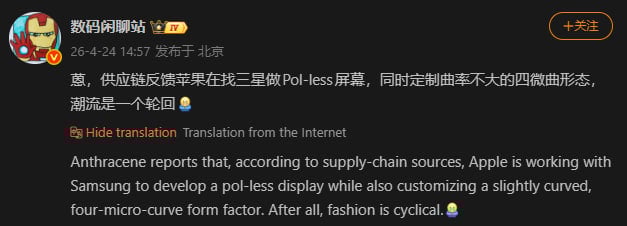
Apple’s two-decade iPhone milestone could coincide with a notable shift in display engineering. Supply chain inputs indicate that the 20th anniversary Apple iPhone may adopt a custom OLED panel developed by Samsung, built around a pol-less architecture and a four-sided curved display.

Samsung-Apple display relationship has remained steady since the first OLED iPhone. Now, Weibo leaker DCS claims that Apple and Samsung are collaborating on the development of a pol-less four-sided curved display for the 20th anniversary iPhone.

A four-sided curve pushes the screen-to-body ratio closer to a true edge-to-edge finish. It is something Apple has approached incrementally over several generations.

The reported move to a polariser-free OLED points to Color Filter on Encapsulation, or COE integration, a method Samsung has been refining for its own premium panels.

By eliminating the traditional polariser layer, the stack becomes thinner and allows more emitted light to pass through. The result is improved brightness at a lower power envelope, a balance.

For Apple, the anniversary iPhone is an opportunity to reset expectations. Edge gestures become more fluid when the transition from frame to display is less abrupt.

From a strategic standpoint, the shift underscores Samsung Display’s continued role at the high end of the OLED supply chain.

Apple iPhone Pol-Less OLED Display

The post Samsung making four-sided curved display for Apple iPhone appeared first on Sammy Fans.

Samsung may revive curved display phones if iPhone 20 does

Don’t be surprised if you see the Galaxy S28 Pro and/or Ultra launching with a curved display, as Apple is reportedly exploring this radical redesign for the iPhone 20.

According to Weibo leaker DigitalChatStation, Apple plans to use a quad-curved display in the iPhone 20 next year, and Samsung might consider bringing it to the Galaxy S28 Pro or Ultra, just an assumption.

Apple surprised the industry with the 10th anniversary iPhone, and the next shock is being planned for the 20th anniversary model. iPhone 18 Pro is coming this year, and Apple will bring iPhone 20 in 2027, skipping iPhone 19.

The Cupertino giant is collaborating with the Korean company to develop a four-sided micro-curved display panel. The idea is currently in an early phase, and we may see a shift too, as the tentative launch is more than a year away.

Apple plans to bring a bezel-less design to the iPhone 20. The company has actively trimmed the thickness of bezels, but the next year’s model may completely eliminate that letdown by featuring quad-curved display tech.

Apple iPhone 20 Curved Display Design Rumor

Additionally, the iPhone’s screen may ditch the legacy polarizer layer for a pol-less design. This technological shift could offer extended brightness. Besides, the thickness of the screen will be reduced, and efficiency will improve.

Samsung is accused of blindly copying Apple in recent years. Removal of the charging adapter, adoption, and elimination of titanium frame are recent examples. The display redesign may also be explored for the following Galaxy model.

The post Samsung may revive curved display phones if iPhone 20 does appeared first on Sammy Fans.

Galaxy S28 may feature 3D display you can switch on and off

Samsung’s newly unveiled display tech could offer glasses-free 3D viewing on the Galaxy S28 Ultra. The official press release itself confirms the potential adoption of the screen technology in phones, tablets, and other devices.

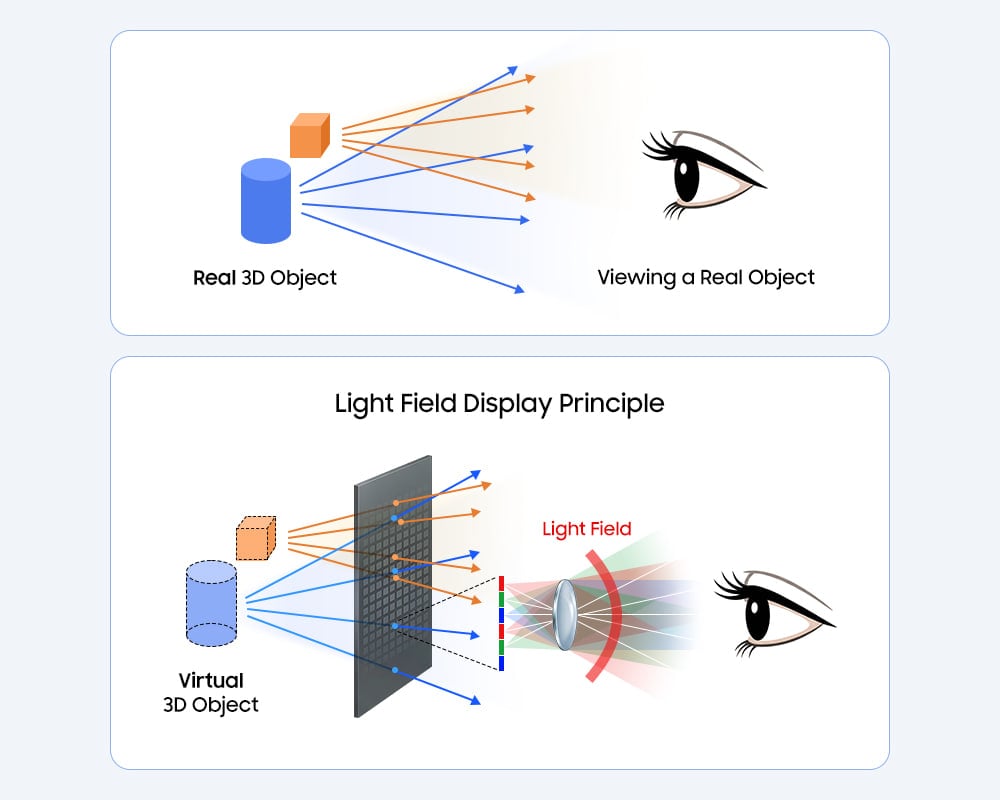
A newly published paper in Nature details a collaboration between Samsung’s Visual Technology Team and POSTECH. The focus is on a new display architecture built around something called a Metasurface Lenticular Lens.

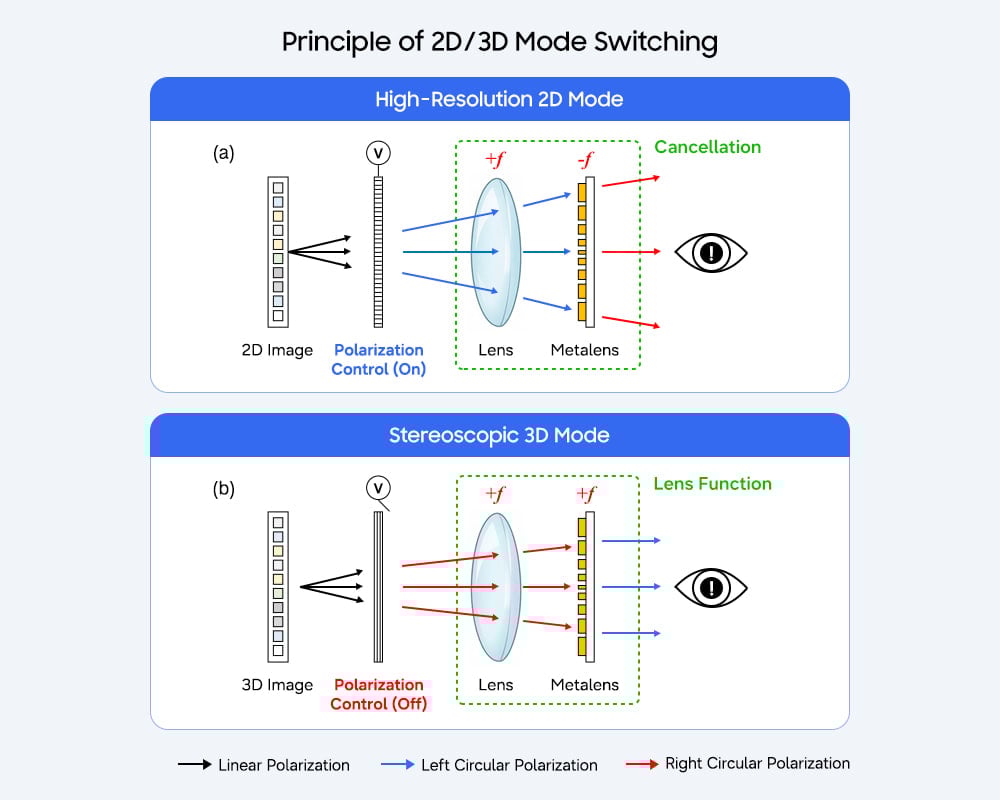
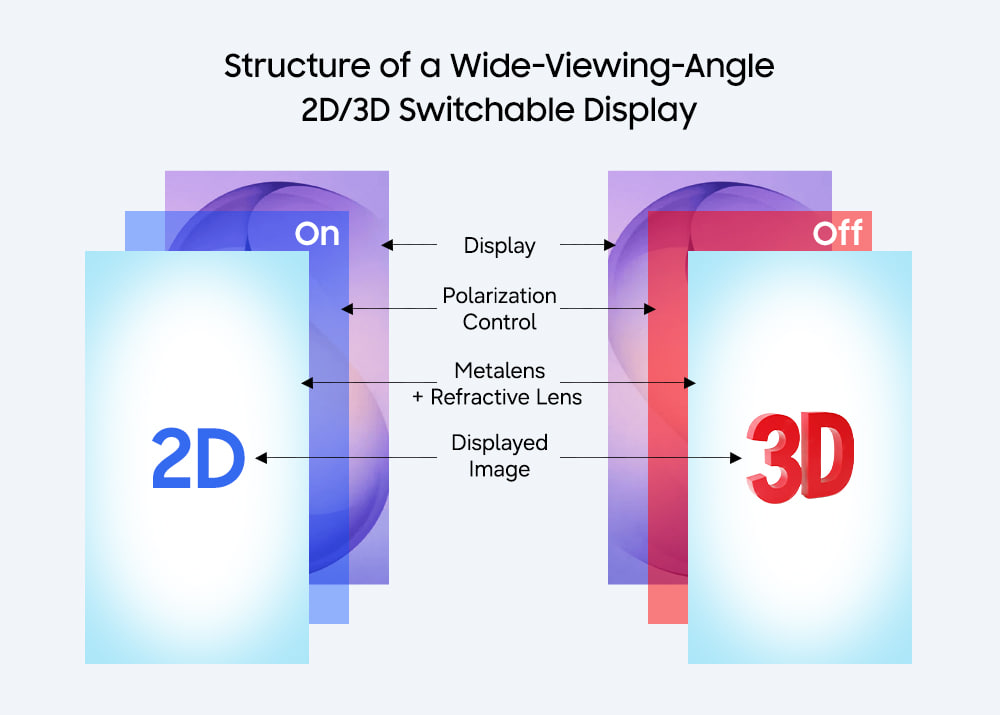
Instead of relying on traditional lenticular layers, Samsung uses nanoscale structures to precisely control how light is directed toward your eyes. The system can switch between standard 2D and immersive 3D using voltage control.

The display adjusts polarization states in real time; users can toggle depth effects on demand. Samsung claims a viewing angle of up to 100 degrees, which is roughly six times wider than older glasses-free 3D implementations.

Samsung switchable 2D to 3D display

This eliminates the rigid head positioning that killed earlier attempts. You are no longer locked into a narrow zone where the effect works. Move naturally, share the screen, and the 3D holds up. The entire optical layer comes in at just 1.2mm thin.

This approach of the South Korean tech giant fits into modern OLED stacks without forcing major design trade-offs. The team has already tested the concept on real OLED panels using a fabricated 50x50mm metalens.

Samsung switchable 2D to 3D display

The timing lines up with the Galaxy S28 generation, especially as Samsung continues to push display differentiation beyond brightness, refresh rate and Privacy screen.

A switchable 3D panel fits naturally into that strategy. It also opens doors for the Galaxy Z Fold lineup, where larger screen real estate makes depth effects more meaningful for gaming, media, and even multitasking.

If Samsung gets this right, glasses-free 3D will not feel like a gimmick anymore.

Samsung switchable 2D to 3D display

The post Galaxy S28 may feature 3D display you can switch on and off appeared first on Sammy Fans.

Samsung unveils switchable 2D-3D display for smartphones and other devices

With the demonstration of switchable 2D-to-3D display tech, Samsung is not just refining smartphones, tablets, and commercial displays anymore. It is rewriting how depth itself is perceived on a flat slab of glass.

In a newly published paper in Nature, Samsung, alongside POSTECH, details a switchable 2D to 3D display built around a metasurface lenticular lens. The reveal hints that it quietly solves the problems that killed 3D on mobile long ago.

The new tech allows the display to decide when to behave like a normal panel and when to bend light into a multi-view field. The switch happens through polarization control, effectively toggling the metalens between concave and convex states.

  • In 2D mode, the optics cancel out. Light passes straight through. You get a clean, high-resolution image, no penalties.
  • In 3D mode, the same layer reshapes the light field. Depth appears. Perspective shifts with viewing position; no glasses, no tracking.

Samsung switchable 2D to 3D display

Samsung is pushing the viewing window to 100 degrees. It means multiple people can view the same 3D scene from different angles. Samsung’s metalens sits at just 1.2 mm, thin enough to integrate into an OLED without redesigning the device.

What this means for future Galaxy devices

Expect 3D to emerge as a premium toggle, not a permanent mode. A glasses-free 3D mode on a Fold could turn it into a portable light field viewer. Tablets could quietly become the first mainstream 3D consumption devices.

Samsung switchable 2D to 3D display

The post Samsung unveils switchable 2D-3D display for smartphones and other devices appeared first on Sammy Fans.

❌