Reading view

Motorola Edge 70 Pro vs Samsung Galaxy A57: Flagship Features Without Flagship Prices
motorola vs samsung

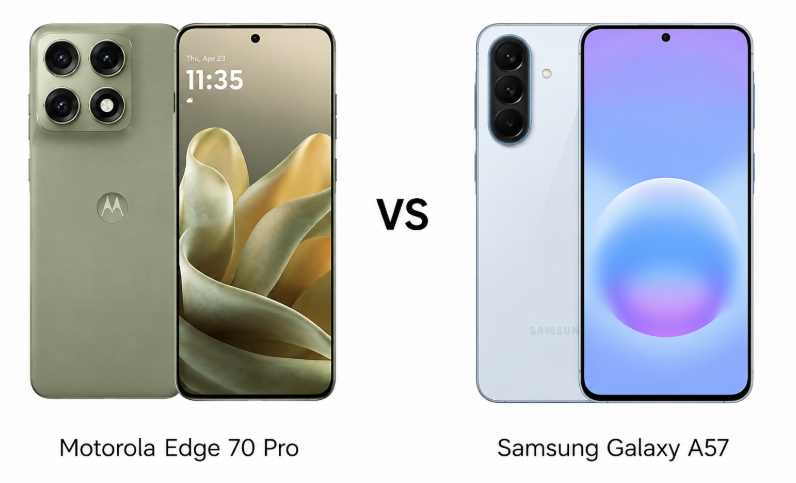
Motorola Edge 70 Pro and Samsung Galaxy A57 target two very different types of buyers in the premium mid-range segment. Motorola focuses on delivering aggressive hardware with a faster display, bigger battery, and more versatile cameras, while Samsung emphasizes polished software, premium build quality, and longer update support. Both phones bring flagship-like features at lower prices, but their priorities make this comparison far more interesting than a simple specs battle. 
Major Features:

FeatureMotorola Edge 70 ProSamsung Galaxy A57Winner
Display6.78-inch AMOLED, 144Hz, 1272p, 5200 nits6.7-inch Super AMOLED+, 120Hz, FHD+, 1900 nitsMotorola – Sharper, brighter, and smoother
BuildGorilla Glass 7i, eco leather back, IP69Gorilla Glass Victus+, aluminum frame, IP68Samsung – More premium materials
ProcessorDimensity 8500 ExtremeExynos 1680Motorola – Faster overall performance
GPUMali-G720 MC8Xclipse 550Motorola – Better gaming capability
Storage TypeUFS 4.1UFS 3.1Motorola – Faster storage speeds
RAM & StorageUp to 12GB + 512GBUp to 12GB + 512GBTie – Similar configurations
Software Support3 Android upgrades6 Android upgradesSamsung – Longer software support
Main Camera50MP OIS50MP OISTie – Similar primary camera quality
Telephoto Camera50MP periscope, 3.5x zoomNo telephotoMotorola – Superior zoom photography
Ultrawide Camera50MP ultrawide12MP ultrawideMotorola – Better detail and versatility
Selfie Camera50MP AF12MPMotorola – Sharper selfies with autofocus
Video Recording4K 120fps rear4K 30fps rearMotorola – More advanced video features
Battery6500mAh5000mAhMotorola – Larger battery capacity
Charging90W wired, wireless charging45W wiredMotorola – Faster and more versatile charging
Wireless ChargingYesNoMotorola – Extra flagship-level feature
AudioStereo speakers, Dolby Atmos, Hi-Res AudioStereo speakersMotorola – Richer audio experience
ConnectivityWi-Fi 7, Bluetooth 5.4Wi-Fi 6E, Bluetooth 6.0Motorola – Better Wi-Fi support
DurabilityIP68/IP69 + MIL-STD-810HIP68Motorola – Stronger protection
Starting Price~$400 / ₹39,000~$550 / ₹57,000Motorola – Better value for money
Overall WinnerMotorola – Better specs, cameras, battery, and pricing
Disclaimer: Specs are based on available data. Actual performance may vary. Verify details from official sources before buying.

Design and Display

Build and Feel

The Motorola Edge 70 Pro focuses on a sleek yet practical design with its eco-leather finish and curved AMOLED panel. The texture gives the phone a more comfortable grip and a slightly more premium in-hand feel despite the plastic frame. Samsung takes a different route with the Galaxy A57 by using Gorilla Glass Victus+ on both the front and back, along with an aluminum frame, making it feel more flagship-inspired. Both devices offer IP68 protection, but Motorola adds IP69 resistance and MIL-STD-810H certification, which gives it a more rugged personality for long-term use.

Display Quality

Motorola clearly pushes display hardware harder with a 144Hz AMOLED panel, higher resolution, and an impressive 5200 nits peak brightness. Animations feel smoother, gaming appears more responsive, and HDR content looks richer. Samsung’s Super AMOLED+ display is still excellent with strong color tuning and HDR10+ support, but the 120Hz refresh rate and lower resolution make it feel slightly less premium beside Motorola’s panel. Samsung’s display tuning remains more natural for streaming and social media consumption.

Verdict

The Galaxy A57 feels more refined in materials, but the Edge 70 Pro delivers the more exciting overall multimedia experience. Motorola’s brighter and sharper display gives it the edge for gaming and entertainment lovers.

Specifications Including Battery

Performance

The Motorola Edge 70 Pro gains a major advantage from the Dimensity 8500 Extreme chipset paired with UFS 4.1 storage. App launches feel quicker, gaming performance remains more stable, and multitasking is noticeably smoother during heavier workloads. Samsung’s Exynos 1680 is efficient and optimized well for One UI, but it does not match Motorola in raw speed or GPU performance. The Galaxy A57 compensates with a stronger software commitment, offering up to six major Android upgrades compared to Motorola’s three. That longer support cycle makes Samsung a safer long-term choice for users who prioritize stability and updates.

Battery and Charging

Motorola dominates battery hardware with a massive 6500mAh silicon-carbon battery and 90W charging support. The addition of wireless and reverse wireless charging also adds flagship-level flexibility rarely seen in this segment. Samsung’s 5000mAh battery is dependable for daily use, but 45W charging feels conservative at this price point. Motorola simply feels more future-ready for heavy users.

Verdict

The Edge 70 Pro is the stronger performance and battery package by a clear margin. Samsung’s software longevity is attractive, but Motorola offers more power, faster storage, and significantly better charging technology.

Camera

Main and Secondary Lenses

Motorola equips the Edge 70 Pro with one of the more versatile camera systems in its category. The triple 50MP setup includes a periscope telephoto lens with 3.5x optical zoom alongside a high-resolution ultrawide camera, giving users far more flexibility for portraits and long-range photography. The camera tuning also benefits from Pantone color validation, helping images look vibrant without becoming overly saturated. Samsung’s Galaxy A57 keeps things simpler with a reliable 50MP main sensor, a decent ultrawide camera, and a macro lens that adds limited real-world value. Daylight shots from Samsung are clean and social-media friendly, but the lack of a telephoto lens makes the setup feel less ambitious.

Selfie Camera

Motorola again takes the lead with a 50MP autofocus selfie camera capable of detailed 4K recording. Samsung’s 12MP front camera delivers natural skin tones and strong HDR handling, though it lacks the sharpness and flexibility of Motorola’s sensor.

Verdict

The Edge 70 Pro offers a more complete camera experience. Samsung delivers consistency, but Motorola feels far more versatile and premium for photography enthusiasts.

Pricing

The Motorola Edge 70 Pro is priced at around $400 or ₹39,000, while the Samsung Galaxy A57 sits much higher at roughly $550 or ₹57,000. That price difference immediately changes how both devices are viewed. Motorola enters the market as a value-focused performance flagship, while Samsung positions the A57 closer to a premium mid-range device built around software support and brand trust. For many buyers, the hardware gap does not justify Samsung’s significantly higher pricing.

Motorola offers a sharper display, a larger battery, faster charging, stronger gaming performance, and a more capable camera setup at a noticeably lower cost. Samsung’s higher price mainly reflects its polished software experience, longer update cycle, and premium materials. Those advantages matter, but they may appeal more to users planning to keep a phone for four to five years.

Verdict

The Edge 70 Pro delivers substantially better value for the money. Samsung offers long-term reliability, but Motorola provides more hardware for far less cash.

Disclaimer:
Prices are approximate and may vary based on country, region, launch timing, and applicable taxes. Always check whether the listed price is for a China unit or a global/international variant when purchasing.

Conclusion

The Motorola Edge 70 Pro stands out with features rarely seen at this price, including a 144Hz AMOLED display, periscope zoom camera, 90W charging, wireless charging support, and a huge silicon-carbon battery. It feels designed for users who want flagship-like hardware without crossing premium pricing territory. Samsung’s Galaxy A57 takes a more balanced approach by focusing on polished software, longer Android support, and a refined premium design. One UI continues to be one of the most user-friendly Android experiences, especially for productivity and ecosystem integration.

Motorola feels more exciting from a hardware perspective, while Samsung feels safer and more dependable for long-term ownership. The choice ultimately depends on whether cutting-edge specifications or long software support matters more in daily use.

Verdict

The Motorola Edge 70 Pro is the stronger overall smartphone for most buyers because of its superior value, performance, display, and camera versatility. The Galaxy A57 remains a solid option for users prioritizing software longevity and Samsung’s ecosystem experience.

Disclaimer: This comparison is based on the specifications provided and is intended for general informational purposes. Actual performance, camera results, battery life, and overall experience may vary depending on real-world usage, software updates, and individual preferences.

Read More:

The post Motorola Edge 70 Pro vs Samsung Galaxy A57: Flagship Features Without Flagship Prices appeared first on Gizmochina.
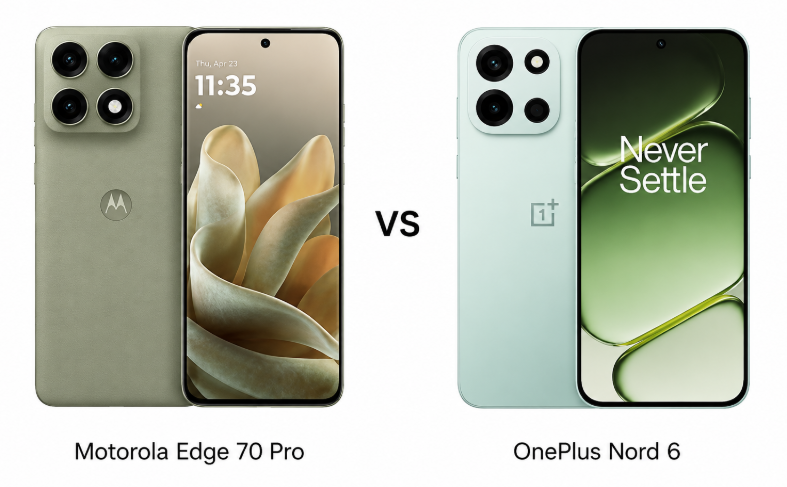
Motorola Edge 70 Pro vs OnePlus Nord 6: Full Specs and Features Comparison

motorola vs oneplus

Motorola Edge 70 Pro and OnePlus Nord 6 take two very different approaches to the premium mid-range market. One focuses on flagship-style cameras and premium features, while the other pushes raw performance and massive battery life. With both phones priced similarly, this comparison breaks down which one actually delivers the better overall value.

Major Features:

FeatureMotorola Edge 70 ProOnePlus Nord 6Winner
DesignEco-leather back, premium curved designGlass back with sporty stylingMotorola – More premium and comfortable feel
DurabilityIP68/IP69, MIL-STD-810HIP68/IP69, MIL-STD-810HTie – Both are equally durable
Display6.78-inch AMOLED, 144Hz, 5200 nits peak6.78-inch AMOLED, 165Hz, 3600 nits peakMotorola – Better brightness and HDR experience
Smoothness144Hz refresh rate165Hz refresh rateOnePlus – Smoother gaming and animations
ProcessorDimensity 8500 ExtremeSnapdragon 8s Gen 4OnePlus – Stronger flagship-level performance
GPUMali-G720 MC8Adreno 825OnePlus – Better gaming optimization
Software ExperienceNear-stock Android 16OxygenOS 16Motorola – Cleaner and lighter UI
RAM & StorageUp to 12GB + 512GB, UFS 4.1Up to 12GB + 512GB, UFS 4.1Tie – Similar memory setup
Main Camera50MP with OIS50MP with OISMotorola – Better sensor quality
Ultrawide Camera50MP ultrawide8MP ultrawideMotorola – Much sharper ultrawide shots
Telephoto Camera50MP periscope, 3.5x zoomNo telephoto lensMotorola – Huge advantage in zoom photography
Selfie Camera50MP AF selfie32MP selfieMotorola – Better detail and autofocus
Video Recording4K 120fps rear camera4K 60fps rear cameraMotorola – More advanced video capability
Battery Capacity6500mAh7500mAh Global / 9000mAh IndiaOnePlus – Massive endurance advantage
Charging Speed90W wired + wireless charging80W wiredMotorola – Faster and more versatile charging
Wireless Charging15W wirelessNoMotorola – Premium charging feature
Reverse ChargingReverse wired and wirelessReverse wired onlyMotorola – More convenient feature set
Gaming FeaturesGood thermal balanceBypass charging supportOnePlus – Better for long gaming sessions
AudioStereo speakers with Dolby AtmosStereo speakersMotorola – Better multimedia tuning
ConnectivityWi-Fi 7, Bluetooth 5.4Wi-Fi 7, Bluetooth 6.0, IR blasterOnePlus – Slightly better connectivity extras
Overall ValueBalanced premium experiencePerformance and battery focusedMotorola – Better all-round flagship-style package
Disclaimer: Specs are based on available data. Actual performance may vary. Verify details from official sources before buying.

Design and Display

Build and Feel

The Motorola Edge 70 Pro and OnePlus Nord 6 both aim at premium mid-range buyers, but their designs appeal to different audiences. Motorola focuses more on elegance and comfort with its eco-leather finish, curved styling, and slimmer overall profile. The phone feels cleaner and more refined in daily use, especially with the soft-touch rear panel that gives it a flagship-like character. The Nord 6, in comparison, adopts a more aggressive and performance-oriented look with a glass back and a bolder frame design. Both devices offer IP68/IP69 protection along with MIL-STD-810H certification, making durability a strong point on either side.

Display Quality

Both smartphones feature sharp AMOLED displays with 1B colors and identical resolution, but the tuning differs noticeably. The Nord 6 pushes a faster 165Hz refresh rate, giving animations and gaming a smoother appearance. Meanwhile, the Edge 70 Pro counters with higher peak brightness and stronger HDR optimization, making streaming and outdoor visibility more impressive. Motorola’s display feels more cinematic and balanced for multimedia, while OnePlus leans heavily toward responsiveness and gaming fluidity.

Verdict

The Edge 70 Pro feels more premium and polished overall, while the Nord 6 is better suited for users who prioritize ultra-smooth visuals and gaming-focused display performance.

Specifications Including Battery

Performance

The OnePlus Nord 6 clearly targets enthusiasts with the Snapdragon 8s Gen 4 chipset and Adreno 825 GPU. Gaming performance, multitasking, and sustained thermal management are stronger here, especially during heavier workloads. OxygenOS also keeps the software experience extremely fluid and responsive. The Motorola Edge 70 Pro, powered by the Dimensity 8500 Extreme, still delivers excellent day-to-day performance and reliable gaming capability, but its approach feels more balanced rather than aggressively performance-focused. Motorola’s near-stock Android experience also gives the device a lighter and cleaner feel in regular usage.

Battery and Charging

Battery capacity heavily favors the Nord 6. The global version carries a massive 7500mAh battery, while the Indian model stretches all the way to 9000mAh, giving it exceptional endurance for gaming and media consumption. However, Motorola answers with faster 90W charging, wireless charging support, and reverse wireless charging, features rarely available in this segment. The Edge 70 Pro feels more complete in terms of convenience, while the Nord 6 focuses purely on long-lasting power.

Verdict

The Nord 6 wins for raw performance and battery endurance, but the Edge 70 Pro offers a more balanced flagship-style experience with better premium hardware features.

Camera

Main and Secondary Lenses

Motorola takes a major lead in camera versatility with its triple-camera setup. The Edge 70 Pro includes a 50MP main sensor, a 50MP ultrawide camera, and a 50MP periscope telephoto lens with 3.5x optical zoom. This combination delivers far more flexibility for photography enthusiasts, especially for portraits and zoom shots. The Nord 6 uses a simpler dual-camera system with a 50MP primary sensor and an 8MP ultrawide lens. While the main camera performs well in daylight and social media photography, the secondary sensor feels less impressive for this price segment.

Selfie Camera

The Edge 70 Pro also pushes ahead with a sharper 50MP autofocus selfie camera capable of 4K recording. The Nord 6 still produces respectable selfies through its 32MP front camera, but detail retention and focus consistency are noticeably stronger on Motorola’s device. Motorola’s image processing also tends to look more natural and balanced without excessive sharpening.

Verdict

The Edge 70 Pro is clearly the stronger camera smartphone overall. Its periscope zoom lens and higher-quality secondary cameras give it a more flagship-like photography experience.

Pricing

Both the Motorola Edge 70 Pro and OnePlus Nord 6 are priced around $400 or roughly ₹39,000, placing them directly against each other in the premium mid-range category. At this price, the competition becomes extremely close because both phones prioritize different strengths. The Nord 6 focuses heavily on performance, battery capacity, and gaming-oriented hardware. Buyers who want maximum endurance and stronger sustained gaming performance will likely find better value in OnePlus’ approach.

The Edge 70 Pro, however, feels like a more complete premium smartphone package. Wireless charging, reverse wireless charging, a dedicated periscope telephoto camera, and a more premium eco-leather finish help it stand out from typical mid-range competitors. These additions give Motorola a stronger flagship-like identity, especially for multimedia and photography-focused users. The decision ultimately depends on whether raw power or overall versatility matters more.

Verdict

The Nord 6 delivers stronger value for gamers and power users, while the Edge 70 Pro feels like the better all-around premium smartphone for the same money.

Disclaimer:
Prices are approximate and may vary based on country, region, launch timing, and applicable taxes. Always check whether the listed price is for a China unit or a global/international variant when purchasing.

Conclusion

The Motorola Edge 70 Pro stands out because it combines premium extras rarely seen in this segment. Wireless charging, reverse wireless charging, a periscope zoom camera, Pantone-validated imaging, and a cleaner, premium design help it feel more refined and feature-rich. It targets users who want a flagship-style experience without stepping into ultra-premium pricing territory.

The OnePlus Nord 6 takes a completely different route by focusing on raw hardware power. The Snapdragon 8s Gen 4 chipset, huge battery capacity, bypass charging support, and 165Hz AMOLED display make it one of the most performance-oriented phones in its category. It feels specifically designed for gamers and heavy users who prioritize endurance and speed above everything else. OxygenOS also continues to appeal to users who prefer a fast and responsive software experience.

Verdict

The Motorola Edge 70 Pro is the better-balanced smartphone overall, especially for cameras, multimedia, and premium features. The OnePlus Nord 6 is the stronger choice for gaming, battery life, and long-term performance-heavy usage.

Disclaimer: This comparison is based on the specifications provided and is intended for general informational purposes. Actual performance, camera results, battery life, and overall experience may vary depending on real-world usage, software updates, and individual preferences.

Read More:

The post Motorola Edge 70 Pro vs OnePlus Nord 6: Full Specs and Features Comparison appeared first on Gizmochina.

Motorola Edge 70 Pro vs Nothing Phone (4a) Pro: Don’t Buy Before Reading This

Motorola vs Nothing

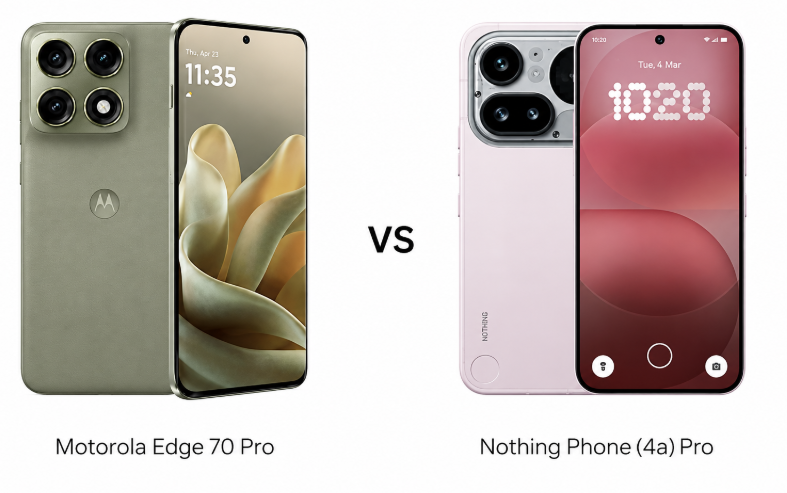
Motorola Edge 70 Pro and Nothing Phone (4a) Pro target the same premium mid-range audience, but they approach the experience very differently. Motorola focuses on raw hardware value with a massive battery, flagship-style cameras, and faster performance, while Nothing leans into bold design, software polish, and visual identity. Both promise high-end features without entering true flagship pricing, making this one of the most interesting smartphone comparisons in the segment right now. 

Major Features:

FeatureMotorola Edge 70 ProNothing Phone (4a) ProWinner
Display6.78-inch AMOLED, 144Hz, 5200 nits peak6.83-inch AMOLED, 144Hz, 5000 nits peakMotorola – Brighter outdoor visibility
ProtectionGorilla Glass 7i, IP68/IP69Gorilla Glass 7i, IP65Motorola – Better durability and water resistance
BuildEco leather back, plastic frameAluminum unibody designNothing – More premium in-hand feel
ChipsetDimensity 8500 ExtremeSnapdragon 7 Gen 4Motorola – Higher performance tier
Storage TypeUFS 4.1UFS 3.1Motorola – Faster app and file speeds
RAM & StorageUp to 12GB + 512GBUp to 12GB + 256GBMotorola – Higher storage option
Main Camera50MP OIS50MP OISTie – Similar flagship-grade main sensors
Telephoto Camera50MP periscope, 3.5x zoom50MP periscope, 3.5x zoomTie – Comparable zoom hardware
Ultrawide Camera50MP ultrawide8MP ultrawideMotorola – Much stronger secondary camera
Selfie Camera50MP AF, 4K video32MP, 1080p videoMotorola – Better detail and video support
Rear Video4K up to 120fps4K up to 30fpsMotorola – More advanced video recording
Battery6500mAh5080mAh / 5400mAh IndiaMotorola – Larger capacity
Charging90W wired, wireless charging50W wiredMotorola – Faster and more versatile charging
Wireless Charging15W wireless, reverse wirelessNoMotorola – Extra flagship feature
AudioStereo speakers, Hi-Res audioStereo speakersMotorola – Better audio feature set
ConnectivityWi-Fi 7, Bluetooth 5.4Wi-Fi 6, Bluetooth 5.4Motorola – More future-ready connectivity
SoftwareAndroid 16, 3 upgradesNothing OS 4.1, 3 upgradesNothing – Cleaner and more unique UI
Special FeaturesSmart Connect, MIL-STD durabilityGlyph-style LED interfaceNothing – More distinctive experience
Price₹39,000 / $400₹40,000 / $500Motorola – Better hardware value
Disclaimer: Specs are based on available data. Actual performance may vary. Verify details from official sources before buying.

Design and Display

Build and Feel

The Motorola Edge 70 Pro and Nothing Phone (4a) Pro take very different approaches to design. Motorola focuses on practicality with its eco-leather finish, slimmer profile, IP68/IP69 protection, and MIL-STD-810H certification. It feels cleaner and easier to grip, while the curved styling gives it a more premium in-hand experience. Nothing, meanwhile, leans heavily into visual identity with its aluminum unibody chassis and signature Glyph-style mini-LED setup on the back. The metal construction feels more flagship-like, though the glossy finish may not appeal to users who prefer understated designs.

Display Quality

Both phones offer 144Hz AMOLED panels with HDR support and excellent sharpness, but the experience differs slightly. Motorola pushes brighter peak brightness levels and delivers stronger outdoor visibility, while Nothing counters with richer HDR tuning and slimmer bezels for a more immersive look. The Nothing display feels more cinematic, whereas Motorola’s panel appears more aggressive and vibrant for gaming and scrolling.

Verdict

Motorola feels more practical and durable for daily use, while Nothing delivers a stronger visual personality. Users who prefer clean usability may gravitate toward Motorola, but Nothing stands out more in a crowd.

Specifications Including Battery

Performance

The Motorola Edge 70 Pro clearly targets power users with the Dimensity 8500 Extreme chipset, UFS 4.1 storage, and faster CPU cores. App loading, multitasking, and gaming performance should feel noticeably quicker, especially during sustained workloads. The Nothing Phone (4a) Pro uses the Snapdragon 7 Gen 4 paired with UFS 3.1 storage, which remains efficient and capable for everyday tasks, but it does not reach the same performance tier. Motorola also gains an advantage with Wi-Fi 7 support, making it feel slightly more future-ready.

Battery and Charging

Battery capacity is another major win for Motorola, thanks to its 6500mAh silicon-carbon battery and 90W charging. It also includes wireless and reverse wireless charging, features usually missing in this price segment. Nothing’s 5080mAh global battery and 50W charging are respectable, though less impressive considering the price. Charging speeds remain good, but Motorola simply offers more flexibility and endurance overall.

Verdict

Motorola provides stronger raw hardware value and a more complete battery package. Nothing focuses more on balanced efficiency, but Motorola feels better suited for heavy users and long-term performance needs.

Camera

Main and Secondary Lenses

Both phones use a 50MP primary camera with OIS and a 50MP periscope telephoto lens offering 3.5x optical zoom, making this one of the closest camera battles in the segment. Motorola gains an edge with its 50MP ultrawide camera, which should preserve more detail and consistency across focal lengths. Nothing uses an 8MP ultrawide sensor, which feels less competitive beside its otherwise premium setup. Video capabilities also favor Motorola with support for 4K at up to 120fps and HDR10+, while Nothing focuses more on Dolby Vision HDR tuning and cinematic processing.

Selfie Camera

Motorola again appears stronger on paper with a 50MP autofocus selfie camera capable of 4K recording. Nothing’s 32MP front camera is solid for casual use, but the lack of 4K selfie video makes it feel less premium. Motorola’s setup seems more creator-friendly overall.

Verdict

Motorola offers a more versatile and technically complete camera system. Nothing may produce more stylized processing and social-media-friendly colors, but Motorola delivers stronger consistency across all lenses.

Pricing

The Motorola Edge 70 Pro is priced at around ₹39,000 ($400), while the Nothing Phone (4a) Pro sits near ₹40,000 ($500). Despite the small gap in India, the hardware difference is surprisingly noticeable. Motorola includes a stronger chipset, a larger battery, faster charging, wireless charging support, a higher-resolution ultrawide camera, and faster storage. On pure specifications alone, it feels aggressively priced for the segment.

Nothing justifies part of its premium through design identity, software polish, and the Glyph-inspired LED experience. The aluminum body and cleaner Nothing OS experience also add emotional appeal that some buyers may value more than benchmark numbers. It feels more lifestyle-oriented, while Motorola is clearly chasing maximum hardware value.

Verdict

Motorola Edge 70 Pro delivers stronger value for money and offers more flagship-grade hardware for the price. Nothing Phone (4a) Pro still appeals to buyers who prioritize unique design and software experience over raw specifications.

Disclaimer:
Prices are approximate and may vary based on country, region, launch timing, and applicable taxes. Always check whether the listed price is for a China unit or a global/international variant when purchasing.

Conclusion

The Motorola Edge 70 Pro stands out through its performance-focused approach. Features like the Dimensity 8500 Extreme chip, 6500mAh silicon-carbon battery, wireless charging, Wi-Fi 7, and triple 50MP camera setup make it feel unusually complete for its price category. It targets users who want flagship-like hardware without crossing premium pricing territory.

The Nothing Phone (4a) Pro focuses more on identity and software personality. Its Glyph-inspired LED system, aluminum unibody design, and clean Nothing OS experience create a device that feels different from mainstream Android phones. The interface and visual styling give it a more distinctive character, especially for users bored with conventional smartphone designs.

Verdict

Motorola Edge 70 Pro is the stronger all-rounder with better specifications, battery life, charging, and camera versatility. Nothing Phone (4a) Pro succeeds more as a design-first smartphone with a cleaner aesthetic and unique personality. 

Buyers focused on value and power will likely prefer Motorola, while Nothing remains appealing for users who prioritize style and software experience.

Disclaimer: This comparison is based on the specifications provided and is intended for general informational purposes. Actual performance, camera results, battery life, and overall experience may vary depending on real-world usage, software updates, and individual preferences.

Read More:

The post Motorola Edge 70 Pro vs Nothing Phone (4a) Pro: Don’t Buy Before Reading This appeared first on Gizmochina.

❌