
 Login
Login
Link building for legitimacy: Building brand credibility in a competitive search environment by Resolve
Link building for legitimacy means earning authoritative backlinks, brand mentions, and media coverage that signal trust, expertise, and credibility to search engines and AI systems. Instead of chasing link volume, it uses digital PR, original research, thought leadership, and journalist relationships to earn editorial citations — the authority signals behind Google’s E-E-A-T framework that help brands appear in AI Overviews, get cited by LLMs, and build visibility that survives ranking swings.
A little competition is healthy in almost every part of life. It challenges us and pushes us to keep striving for bigger, better things.
But in today’s search environment, LLMs and algorithm updates are changing the game and reshaping search behavior, making it nearly impossible to keep up.
The metrics you once used to keep brands afloat (e.g., traffic, DA increases, keyword rankings) no longer define SEO success. You can top the SERP and still see minimal conversions.
If we keep chasing these metrics, we’ll be left behind. We have to adapt.
Instead of focusing on these metrics, we need to widen our view to the “metrics” that truly matter: trust and brand authority. Unlike traditional metrics, trust and authority don’t come easily or quickly.
It takes time to spread the word about your brand and even more time to build trust. But once you do, it takes a lot to knock it down.
Traffic can dip overnight after an algorithm update. Trust can’t.
But how can you build trust and boost your brand when every other organization is trying to do the same? And how do you measure such nebulous ideas?
The answers may involve some nuance, but they’re simpler than you think. It just takes a shift in perspective.
Why link building is more than just rankings now
For years, link building was a popularity contest. Whoever earned the most votes won spots at the top of the SERP.
But over time, Google and other search engines updated their algorithms to improve searchers’ experiences. With each update, Google has cracked down on more sites trying to “hack” the system with high backlink volume instead of links with real editorial and searcher value. Inevitably, countless sites lost traffic, with repercussions still felt today.
Instead of ranking by backlink volume, Google began prioritizing relevance to the searcher’s query, industry trust, and authority. That means big-name brands with similar content and keywords often attract more searchers than the little guy.
Large language models (LLMs) and Google’s AI Overviews have widened this divide even further. These systems use retrieval-augmented generation (RAG) to pull sources with the most relevant information, often preferring proprietary data. Because of this, if you’re citing the same information as a top-tier publication, RAG will often choose the top-tier publication to avoid spreading misinformation.
With this shift, new generations of searchers are increasingly using AI instead of search tools — 61% of Gen Z use generative AI in lieu of Google, according to a 2025 Resolve study.
That doesn’t mean all link building signals spam to Google and LLMs. Instead, backlinks should work alongside authority signals.
Publications and journalists citing your brand signal authority. Original content and proprietary data signal authority. Eye-catching graphics and informative videos signal authority.
Once Google and LLMs see these signals and the backlinks that act as votes of confidence, your site is more likely to rank higher in SERPs, appear in the AI Overviews, and receive more citations in LLM answers.
The role of E-E-A-T in a competitive search environment
In 2018, Google updated its rater guidelines so content showing expertise, authoritativeness, and trustworthiness (E-A-T) could better reach relevant searchers. In 2022, it added another E: experience. Together, these factors form a framework for how Google evaluates a site’s credibility and legitimacy:
- Experience: Whether the site’s author has personally engaged with the topic, such as a forum of users who tested a product or a gardener’s blog post about personal trials with pest prevention.
- Expertise: Whether the content’s author has credentials that support their information and advice.
- Authoritativeness: Whether other credible sources and industry voices have linked back to the site, establishing it as a leading figure in the community.
- Trustworthiness: Whether the site is transparent and consistently accurate. It doesn’t deceive users or engage in link-building activities that manipulate them.
While E-E-A-T plays a role in on-page SEO — author bios can demonstrate expertise, accurate sourcing can demonstrate trustworthiness, and so on — it also plays a role in off-page SEO. Specifically, Google evaluates E-E-A-T based on who links to you and which journalists rely on you as a trusted source. Both on-page and off-page E-E-A-T affect how Google assesses your value to searchers and whether you provide trustworthy, accurate information.
If your site consistently earns backlinks from dozens of irrelevant sites, Google sees that as a sign of low quality. But if a few journalists mention your brand because of a study you just published, Google is more likely to see that as a vote of confidence.
In this way, link quantity no longer signals legitimacy. Google looks for backlinks that demonstrate real value.
You can’t earn these links half-heartedly. You earn them with a multifaceted strategy that works on and off the page.
Off-page SEO tactics that demonstrate value to search engines
So what can you do to build strong links that search engines and LLMs use to evaluate whether you’re a trusted source? They don’t come from a single outreach. They come from multiple tactics you address continuously.
Creating linkable assets
To show that people actually want to link to your site, you need to create content that people and publishers want to reference. For brands used to quick, easy links, this may mean investing more in content than they’re used to. A typical “how-to” article or listicle won’t cut it anymore.
Instead, “linkable” now means anything journalists or people find unique and engaging — something they haven’t seen before. This could include any of the following content formats:
- Original data and proprietary research: One of the best ways to catch searchers’ and journalists’ attention is to publish information they can’t find anywhere else. In such a competitive, information-rich search environment, that means creating original research no one has created before. When a journalist wants to reference a statistic and your site is the only one with it, you earn a natural backlink.
- Thought leadership and expert commentary: If you feature an original perspective from a credible voice at your brand, you provide a quote publishers may use later.
- Authoritative long-form guides: Anyone can answer a question simply. But if you answer it fully and address every related follow-up question, you can earn more links over time as searchers go deeper into their research.
- Engaging visuals and infographics: YouTube mentions strongly correlated with sites featured in AI Overviews, according to Ahrefs. That means visuals, especially videos, carry extra weight in search algorithms. It isn’t limited to videos, either. Informative infographics give publishers something they crave: a visual they can use with their own audience.
While these formats may take more time, effort, and money to create, they’re often more sustainable than other content. They help earn credible citations from publications and build industry authority that no algorithm update can disrupt.
Digital PR
At the heart of every authority-building discussion is digital PR — and for good reason. It bridges brand establishment and link building. It can help you earn more links and spread the word about your organization through credible journalists. In the eyes of search engines, that’s exactly what they look for when assessing your site’s legitimacy.
Unlike traditional PR, digital PR focuses on generating online coverage through backlinks from news sites and media outlets. Often, this means creating assets and proprietary data journalists find interesting, then pitching stories that align with their beat.
Many of these publications hold major sway online and have large audiences that can spread the word about your brand. If the publication is highly authoritative, other journalists may naturally pick up the news and share it organically. This can be amplified through syndication, when a media conglomerate posts an article on subsidiary sites, helping you earn dozens of links at once.
Some of the best digital PR campaigns use one or more of these tactics:
- Data-led PR campaigns: When creating a campaign, don’t focus on topics or ideas you find interesting. Check local news sites or Google News to see what journalists find interesting and which topics are trending. If you consider journalists’ intent from the start, you’re more likely to earn responses and successful link placements.
- Newsjacking or reactive PR: If your organization can move quickly, newsjacking or reactive PR can be one of the best ways to get media attention fast. You jump on breaking news relevant to your brand by providing expert opinions, data, or commentary journalists can use when covering the story.
- Proactive PR: Proactive PR anticipates trends before they break. You provide unique insights that align with recurring news, holidays, and relevant media moments.
- Contributed content and guest features: Featured content, written by you or experts at your organization, can be one of the best ways to speak directly to a publication’s audience and earn recognition.
These tactics elevate your brand to a level competitors can’t easily reach.
Building relationships with journalists, publishers, and industry authorities
Even the most interesting proprietary data, packaged in an expertly built linkable analysis, can fail if you don’t approach journalist outreach strategically.

Today, journalists receive countless PR pitches every day that can either help or hinder their work. Nearly nine in 10 journalists say at least some of their stories come from PR pitches, according to a 2026 MuckRack study.
Still, the same survey found that 54% seldom or never respond to most PR pitches. The reason? Relevance. Nearly half of journalists in the study said relevant pitches are rare.
If a journalist at an economics journal receives a pitch about music-listening trends, they’ll likely turn it down because only a small share of their readers would care. It’s nothing personal. Journalists build careers around specific topics and beats, and PR professionals should supplement that beat, not distract from it.
Instead, approach journalist outreach as relationship-building: a two-way exchange that benefits both parties. Treat the person on the other end as a real person.
- Personalize your emails.
- If they say no, respond kindly. They may bite on your next pitch.
- Share their publications on social media.
- Leave comments.
- Cite them in future content.
The more you build the relationship, the more likely they are to respond to future opportunities. Journalists are more likely to respond positively to follow-ups or second pitches when they know you have good data on hand.
PR relationships grow over time, so even if your first pitch doesn’t fit a journalist’s beat, don’t hesitate to reach back out with new data.
How to measure metrics that reflect real brand authority
Authority, trust, and legitimacy are less concrete than hard metrics like traffic or keyword positioning. But they’re even more crucial today. Traffic volume may seem positive, but it can signal temporary attention from keyword manipulation, which can change quickly after an update or once web crawlers detect that searchers are losing interest in the page.
On the other hand, authority and legitimacy last. And you can still measure the impact of these tactics through metrics like:
- Earned media placements: Track publications that cover your brand, including unlinked brand mentions. This is a strong measure of brand credibility.
- Branded search volume: As people discover your brand through different publications, they’ll search for it naturally.
- Industry coverage: After you successfully reach one publication, others — even those you haven’t contacted — may naturally cite you to stay relevant. This helps establish you as an authority in your industry.
- Conversions: When searchers find you credible, they’re more likely to trust you and your products or services, leading to more conversions — the metric every SEO and marketing professional strives for.
- Organic ranking improvements for target keywords: While traditional link building can improve keyword rankings, rankings can also show how search engines compare you to others on the SERP. As you become more authoritative, you may start to see movement.

These “metrics” don’t appear overnight.
- Creating proprietary data takes effort.
- Building trust with journalists takes relationship-building.
- Growing authority takes time.
Be patient. You’ll see results.
How to build a credibility-focused link building strategy
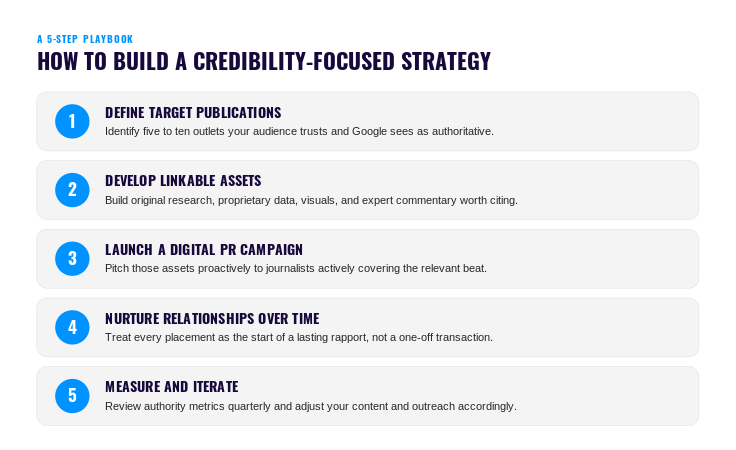
Even if you know the best practices for building SEO authority, creating a full campaign around them can be a different beast. That’s why we’ve created this step-by-step guide:
- Step 1 — Define target publications: Identify five to 10 publications your audience trusts most and Google sees as authoritative in your space. These are your primary link targets. Your goal is to earn coverage from journalists in these spaces.
- Step 2 — Develop linkable assets: Create at least a couple of content pieces or media assets designed to interest your target publications. Rely on proprietary data from original surveys, visual guides, and thought leadership.
- Step 3 — Launch a digital PR campaign: Pitch these assets proactively to target publications. Use platforms like Connectively or MuckRack to generate ongoing backlink opportunities with writers covering stories relevant to your linkable assets.
- Step 4 — Nurture relationships over time: Treat every positive media interaction as the start of a longer relationship. Follow up with useful information, engage with the coverage, and build rapport journalists can rely on.
- Step 5 — Measure and iterate: Review the metrics above quarterly and adjust your content and outreach strategies accordingly.
This process can easily consume your team, especially if you’re working with limited resources or know-how.
In these cases, it may be worth working with a link building and digital PR specialist who can amplify your efforts and keep up with algorithm updates. Doing so can keep your brand afloat long term, so you don’t have to sweat the small stuff.
Build brand authority that lasts with Resolve
Today, most SEOs know quality stands the test of time over quantity. But for most brands, the hard part is keeping their eye on the prize.
Don’t get distracted by flashy metrics or competitors seeing temporary traffic spikes. Instead, focus on what matters: real authority and legitimacy built through years of content production, PR outreach, and relationship-building.
When that patience is hard to come by, Resolve can step in.
Resolve works with brands to build credibility-focused SEO campaigns through linkable content, data-driven digital PR, and boots-on-the-ground link building. With it, you can help your brand build sustainable organic growth — not temporary results that decay after the next algorithm update.

It’s an approach we’ve seen pay off. A recent data-led campaign for EZ Contacts earned more than 1,000 placements in outlets like the New York Post and Yahoo. As coverage built, its visibility in ChatGPT and Google’s AI Overviews doubled — the kind of durable growth that lasts beyond the next algorithm update.
Ready to build links that last? Visit growresolve.com today to learn more.
FAQs about link building strategy and brand authority
What is the difference between link building and Digital PR?
Link building and digital PR overlap significantly, but they aren’t identical. Link building is the broader practice of acquiring backlinks from other websites to improve search authority. Digital PR is a specific approach within that category — one focused on earning backlinks through media coverage, journalist relationships, and placements in credible publications rather than directory submissions, guest post exchanges, or other lower-authority tactics. Digital PR tends to generate the highest-quality backlinks from outlets with real editorial standards while building brand visibility and consumer trust in ways other link building methods don’t.
How long does a credibility-focused link building campaign take to produce results?
Authority backlinks and earned media coverage don’t produce overnight results. That’s one honest trade-off of a credibility-focused approach versus more aggressive tactics. Most brands start seeing meaningful domain authority gains and initial ranking movement within three to six months of consistent campaign execution. More competitive keywords and higher-authority placements may take longer. The advantage is that results compound and last: links from credible publications don’t disappear, journalist relationships recur, and the brand authority built through consistent coverage keeps generating value long after the initial campaign investment.
What is an authority backlink, and how is it different from a regular backlink?
An authority backlink comes from a source that search engines — and its users — treat as credible and trustworthy. These are typically publications with high domain authority, real editorial processes, genuine audiences, and topical relevance to your industry. A regular backlink can come from any site willing to link to yours, regardless of authority, relevance, or editorial standards. The distinction matters because search engines weigh backlinks based on the authority of the linking source. One link from a high-authority industry publication can carry more weight than dozens from low-authority sites — and signal E-E-A-T credibility in a way bulk links never can.
Can brand mentions count as a link building signal even without a hyperlink?
Yes. Google can associate brand mentions with brand entities even when those mentions don’t include a hyperlink. Unlinked mentions in credible publications, especially in relevant industry coverage, contribute to the brand authority signals that inform E-E-A-T evaluation. That’s why digital PR efforts that generate coverage, even without always securing a link, still strengthen a brand’s overall search authority. It also reinforces why a credibility-focused off-page SEO strategy shouldn’t be reduced to link acquisition alone. The real goal is building a brand that publications want to mention, cite, and cover.
What’s the risk of using outdated link building tactics?
The risks are real, ranging from ineffectiveness to active penalties. Tactics like link buying, link exchange schemes, private blog networks (PBNs), and manipulative anchor text optimization violate Google’s guidelines. They can trigger manual actions or algorithmic penalties that significantly suppress a site’s visibility. Even when they don’t trigger immediate penalties, they often lose effectiveness as algorithm updates get better at identifying and devaluing manufactured signals. Recovering from a link-related penalty is time-consuming and expensive. Investing in credibility-focused link building from the start is lower-risk and more durable than repairing damage from outdated tactics.
