Nym Technologies has released a major update to the NymVPN iOS app, adding several new connectivity and convenience features.
At the core of the update are new features designed to give users control over the balance between privacy and performance.
NymVPN is one of the more technical VPNs on the market. Central to its operation is the titular Nym mix network, or mixnet, which hides user metadata by routing traffic through a mixture of servers, scrambling IP addresses on both sides of the connection.
At the same time, a blend of other users’ traffic and decoy traffic is sent through the same mixnet, making it effectively impossible to trace any actions back to you.
NymVPN has seen several notable improvements of late, adding post-quantum encryption as standard in June this year, split tunneling for Windows users in April, and an ad-blocker earlier in 2026.
It now resembles a typical VPN a little more closely, though the new features and fixes included in the 2026.11.0 iOS update are a bit more complex than your typical VPN update. Read on for a breakdown of the new features (based on the information NymVPN has given us, anyway).
Key features
(Image credit: Nym Technologies)
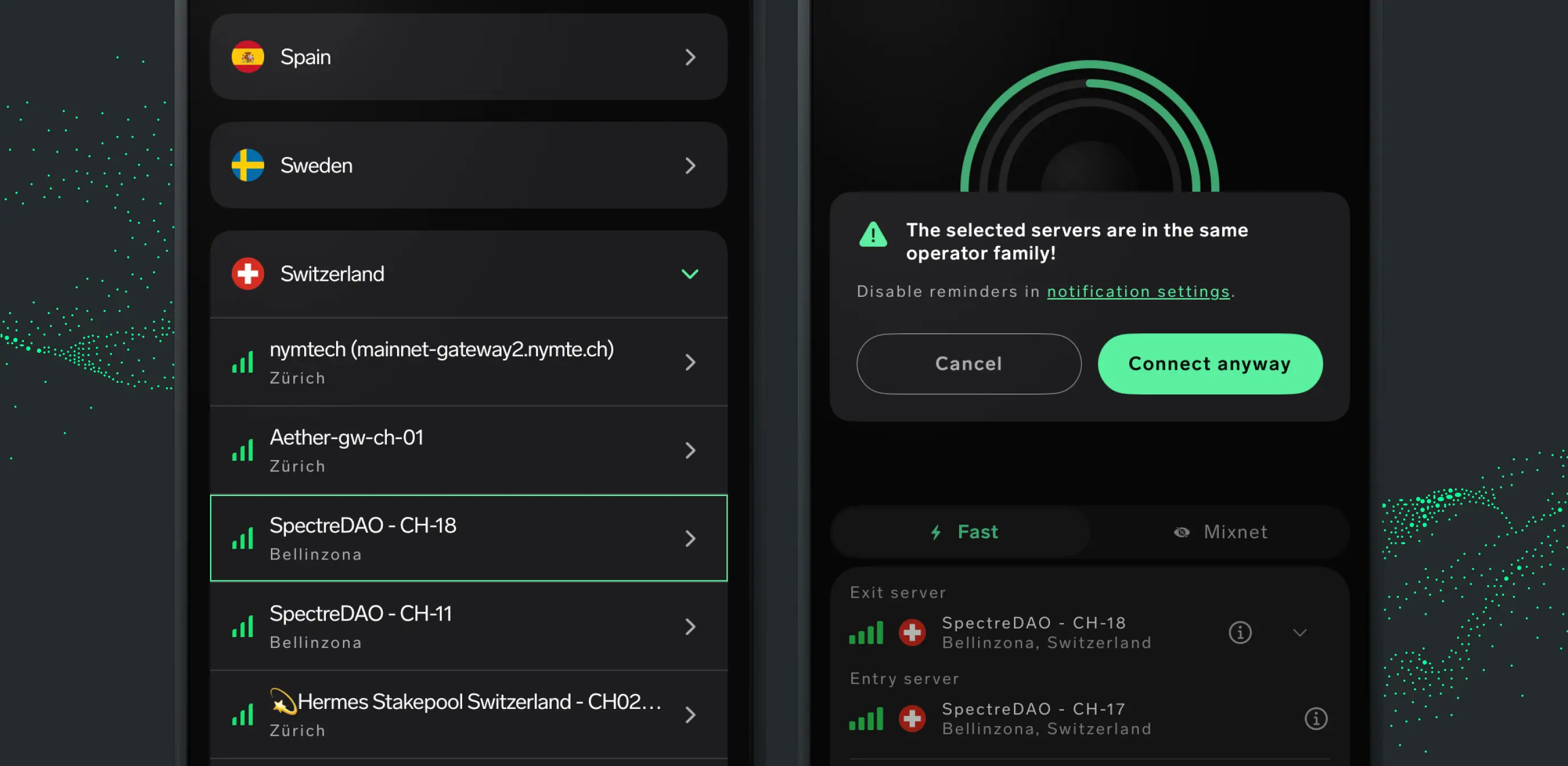
The update introduces Server Families, a new alert system that lets users know when their chosen mixnet servers may belong to the same operator or subnet. This allows users to maintain decentralization by choosing servers from different operators for each node in the mixnet.
All Nym servers are community-run and decentralized using blockchain technology, but using different operators for each node maximises the possible obfuscation of network traffic.
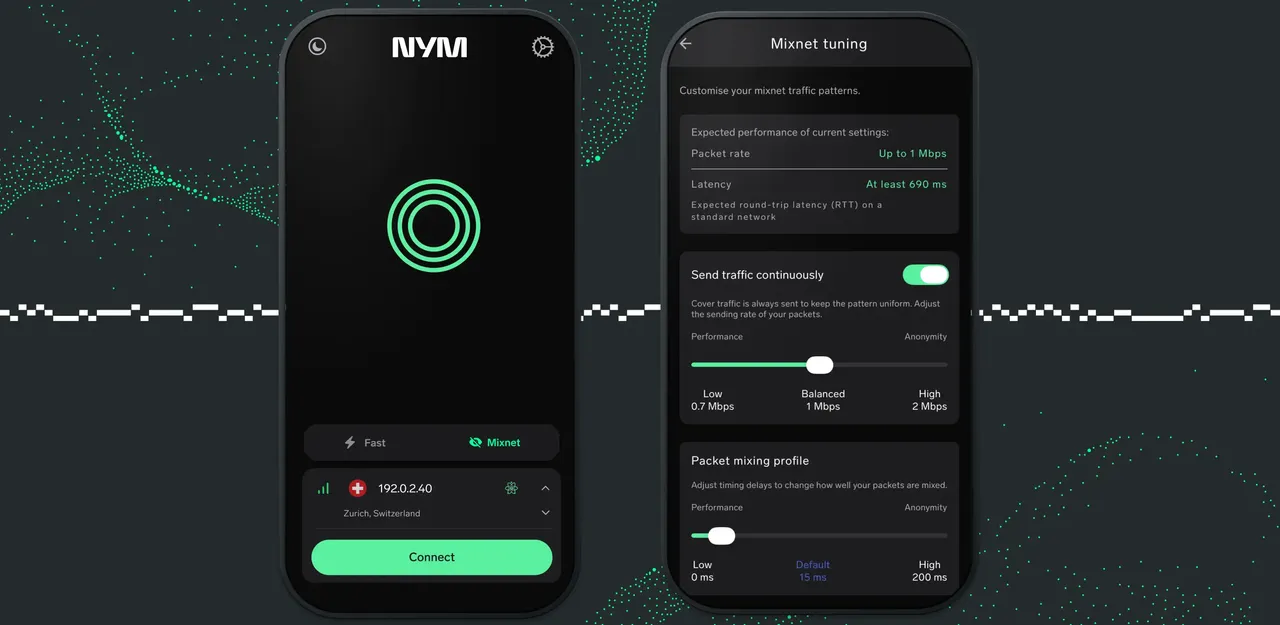
Additionally, the update adds a new Mixnet Tuning feature in beta, allowing users to adjust the balance between anonymity and privacy.
Mixnets operate through a number of ‘hops’, referring to individual nodes between the origin and destination of network traffic. Nym uses a five-hop mixnet as standard, with an entry, exit, and three connection points in between.
This creates latency – according to Nym, its mixnet adds 15ms of delay per hop by default, totalling 75ms across five hops.
This is an intentional measure designed to hide the timing of your network traffic, as well as its origin and destination, but could be annoying for streaming video or playing online games, where latency should be as low as possible to maximise performance.
Mixnet Tuning adds two settings that allow users to adjust the NymVPN’s default instructions while maintaining connection. These are the ‘Send traffic continuously’ setting, which offers a range of 0.7Mbps to 2Mbps for decoy traffic, and ‘Packet mixing profile’, which changes how long each mix node holds onto your traffic, from 0ms to 200ms.
Keeping it convenient
(Image credit: Nym Technologies)
NymVPN’s latest iOS update also brings some quality-of-life improvements to the app, and while it’s still a fair way from our list of the best VPNs, it’s good to see that the app will now be easier to use on the best iPhones and best iPads.
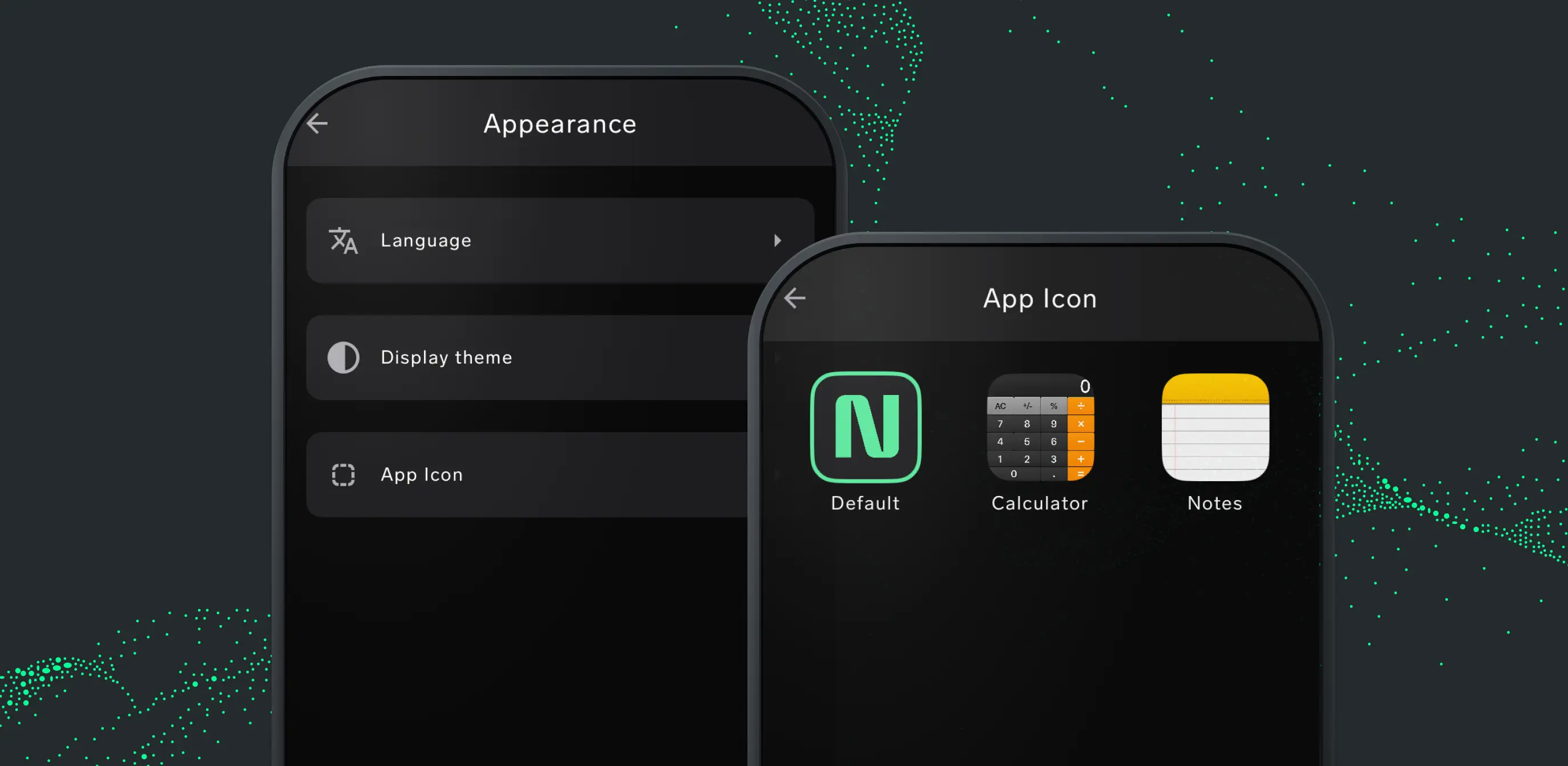
These improvements include the ability to change the app icon to a calculator or notepad to avoid prying eyes, a bug fix for an issue that displayed subscription data incorrectly after a fresh install, and stronger ad blocking.
Nym’s blog says that the app’s daily data allowance has been increased, but at the time of writing the company hasn’t confirmed the total allowance or by how much it’s been increased.
Similarly, Nym has not expanded on its claim that the update makes it NymVPN easier to use in areas and territories that restrict VPN use.
TechRadar has reached out to NymVPN for more information on these areas, and we'll update this article once we know more.
Government report shows British kids mainly use a VPN to improve their privacy
Only a fifth of VPN users use the tech to bypass age verification
Pretending to be older is the most common way to dodge age checks
As the debate surrounding potential VPN restrictions heats up in the UK, a government report has cast doubt on whether such drastic measures are justified.
Content unblocking ranks as the second most common motivation, with children using the tools to access specific apps and media from other countries.
Crucially, the desire to bypass mandatory age checks ranks much further down the list, with only about a fifth of young VPN users actively using the software to evade age checks. This equates to just 7% of all British children using a VPN to access restricted platforms.
In response to requests for comment, a spokesperson for DSIT shared a press release that confirms that "VPNs play a limited role in circumventing age check."
"As platforms implement more robust age verification to comply with the newly announced restrictions, many of the common routes used to bypass age checks today will become increasingly difficult," they continued.
Kids and VPNs: What the DSIT report found
(Image credit: Jose Sarmento Matos/Bloomberg via Getty Images)
Following a nationwide survey of over 2,000 young people aged 11 to 17, researchers at BMG Research discovered that familiarity with virtual private networks among British children is high.
58% of children surveyed reported that they are aware of the software, while roughly a quarter of all respondents admitted to using a VPN in their lifetime.
The underlying motivations of these young users appear to challenge the argument in favor of stricter controls.
Among active VPN users, 30% state they use the software specifically to secure their online privacy. This aligns with warnings from digital rights advocates who argue that restricting VPN access could strip vital security tools away from minors.
And while young people do use these apps to bypass content restrictions, the study shows they are primarily interested in evading regional entertainment geoblocks or school network restrictions rather than maliciously outsmarting age verification.
Bypassing age checks ranks fifth on the list of motivations. These findings mirror separate YouGov research commissioned by the VPN Trust Initiative, which revealed that a mere 1.4% of surveyed minors use a VPN specifically to access platforms meant for older demographics.
So how do children actually bypass age checks?
It seems that British children have found much simpler workarounds to evade online controls than using a VPN.
Over half of the children surveyed admitted they simply migrate to different platforms, with 37% choosing websites that completely lack age verification and 34% opting for services known to enforce weak, easily tricked checks.
Posing as an adult remains the most common tactic, with roughly 63% of those who bypass checks admitting they pretended to be someone older.
Specifically, 45% do so by giving a false date of birth during self-declaration checks, while a notable minority (11%) use their parents'or relatives' identification details.
IPVanish added OpenVPN Data Channel Offload (DCO) to its Windows app
Internal testing recorded download increases of up to 196%
The feature cannot be used at the same time as OpenVPN Scramble
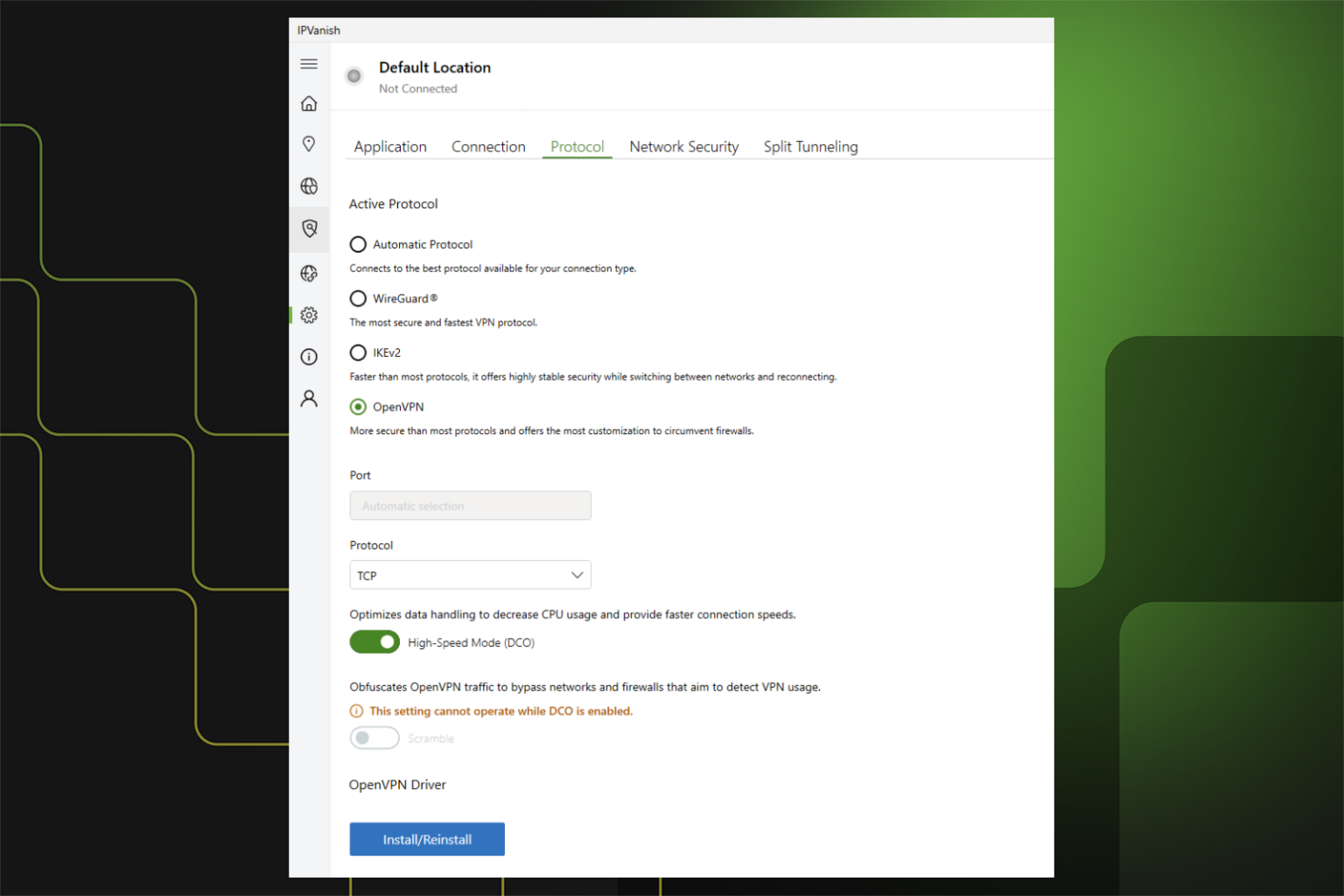
IPVanish has released a new Windows client built around High-Speed Mode, the provider's implementation of OpenVPN Data Channel Offload (DCO). The company claims the feature lifts OpenVPN download speeds by up to 196%.
OpenVPN remains one of the most widely supported protocols in the industry, prized for its maturity and its ability to work almost anywhere. Its weakness has always been pace, which is why so many of the best VPN services now steer users towards WireGuard by default.
OpenVPN DCO addresses this problem. It moves the heavy lifting of encryption out of the app and into the deepest core of the operating system, cutting latency and easing CPU load without changing the protocol's security.
IPVanish has also swapped its Windows OpenVPN cipher from AES-256-CBC to AES-256-GCM, a change it says trims 32% off the time needed to connect to a server.
OpenVPN DCO remains an exclusive for Windows users. As the provider confirms to TechRadar, "OpenVPN DCO isn't possible on macOS, iOS, or Android. Those operating systems have locked-down kernels."
What IPvanish's High-Speed Mode actually changes, and how to use it
(Image credit: IPVanish)
Standard OpenVPN shuttles data back and forth between the VPN app and the operating system. Every one of those handovers costs time. DCO keeps the data channel closer to the Windows networking layer instead, so encrypted traffic moves through the system with fewer stops.
IPVanish tested servers in New York, London, Berlin, and Tokyo, three times a day across three consecutive days. Averaged out, downloads improved by 131% on TCP and 196% on UDP, while uploads rose 34% and 101% respectively.
"IPVanish is already known for offering fast VPN speeds, and today we're raising the bar for Windows OpenVPN," said Subbu Sthanu, General Manager, Consumer Cybersecurity at IPVanish, adding that streamers, gamers, and remote workers should all feel the difference.
You can turn the feature on by updating your Windows app and going to the OpenVPN protocol in the Settings tab.
One catch is that High-Speed Mode is not compatible with OpenVPN Scramble — IPVanish's obfuscation feature that disguises your VPN traffic to slip past networks that block it. Turn one on, and you lose the other. For anyone connecting from a school, an office, or a country that filters VPNs, Scramble is probably the more important feature.
Which other VPNs offer OpenVPN DCO
ExpressVPN was among the first providers to unveil OpenVPN DCO in March 2025, claiming a 2,000% jump in UDP performance. Windscribe also added DCO on Windows at the same time, recently extending it to Linux, too.
Surfshark, NordVPN, and PrivadoVPN all ship a DCO adapter in their Windows clients, too. It's still a short list, with most providers betting on WireGuard instead.
20+ digital rights groups and tech firms urge the UK not to restrict VPNs
Age-gating VPNs would undermine the online privacy of millions, they warn
Signatories believe VPN restrictions are ineffective, technically unfeasible
The UK government's ongoing debate around tightening online safety rules to protect kids has drawn fierce pushback from the global cybersecurity sector.
On July 9, a coalition of 24 major digital rights organizations and top VPN providers, including Amnesty International, ExpressVPN, NordVPN, Surfshark, and Mozilla, issued a stark warning to the UK government: leave VPNs alone.
As lawmakers weigh up potential restrictions ahead of an expected online safety consultation update this month, the stakes for your digital privacy have never been higher.
If you currently use the best VPN to protect your personal data on public Wi-Fi or secure your connection while working remotely, new regulations could fundamentally alter how these tools work. Any move to force VPN providers into verifying the age of their users would require you to hand over sensitive personal data, effectively destroying the anonymity you pay to protect.
"The challenge is ensuring measures strengthen child safety without weakening the privacy and security millions of people rely on every day, including children," the letter explains.
Beyond everyday consumers, the coalition notes that VPNs provide critical protection for vulnerable groups.
The open letter emphasizes that these tools are a lifeline for "human rights defenders and journalists, domestic abuse survivors, the LGBTQ+ community, and others at heightened risk online." As rights groups have noted previously, weakening this protection could actively infringe human rights.
Addressing the reality check of age verification head-on, the group didn't mince words about the dangers of ID checks.
"Age-gating VPNs would require everyone to surrender sensitive personal information simply to access tools designed to protect privacy," the letter states.
A technically unfeasible approach
Critics of the UK's proposed teen social media ban have repeatedly pointed out that restricting privacy tools is a flawed approach to child safety. The letter backs this up with hard data, pointing to Ofcom research which "found that only around 3% of children had used VPNs to access content meant for older audiences."
The coalition also highlights that teenagers will simply find other, lower-tech ways to bypass rules. "Evidence from Australia shows children are much more likely to get around age checks by not being asked, giving false information, or even drawing on a moustache," the letter adds.
Ultimately, the cybersecurity industry is warning that while restricting privacy tools is failing to protect kids, it will succeed in punishing regular users. "Blocking VPN traffic reliably is technically unfeasible," the letter warns, noting that it risks locking employers and schools out of the web, while pushing regular citizens toward "unregulated, data-exploiting services that are harder to oversee, leaving them less secure."
Rather than breaking encrypted tools, the coalition urges the government to focus its upcoming policies on the root causes of online harms, suggesting investments in "strong enforcement of platform obligations, better parental controls, investment in digital literacy, and safety- and privacy-by-design obligations."
West Coast Labs found that the VPN battery drain is just a myth
Leaving NordVPN on for 24 hours drains just up to 1.8% of battery
NordVPN's NordLynx uses up to 31% less battery than OpenVPN
One of the biggest reasons people turn off their cybersecurity apps is the fear of a dead smartphone. For years, the conventional wisdom has been that running a virtual private network (VPN) in the background will relentlessly chew through your daily charge.
However, new independent research commissioned by NordVPN reveals that this long-held belief is actually a massive misunderstanding. If you've been avoiding firing up the best VPN to save a few precious battery percentage points, your phone has probably been lying to you.
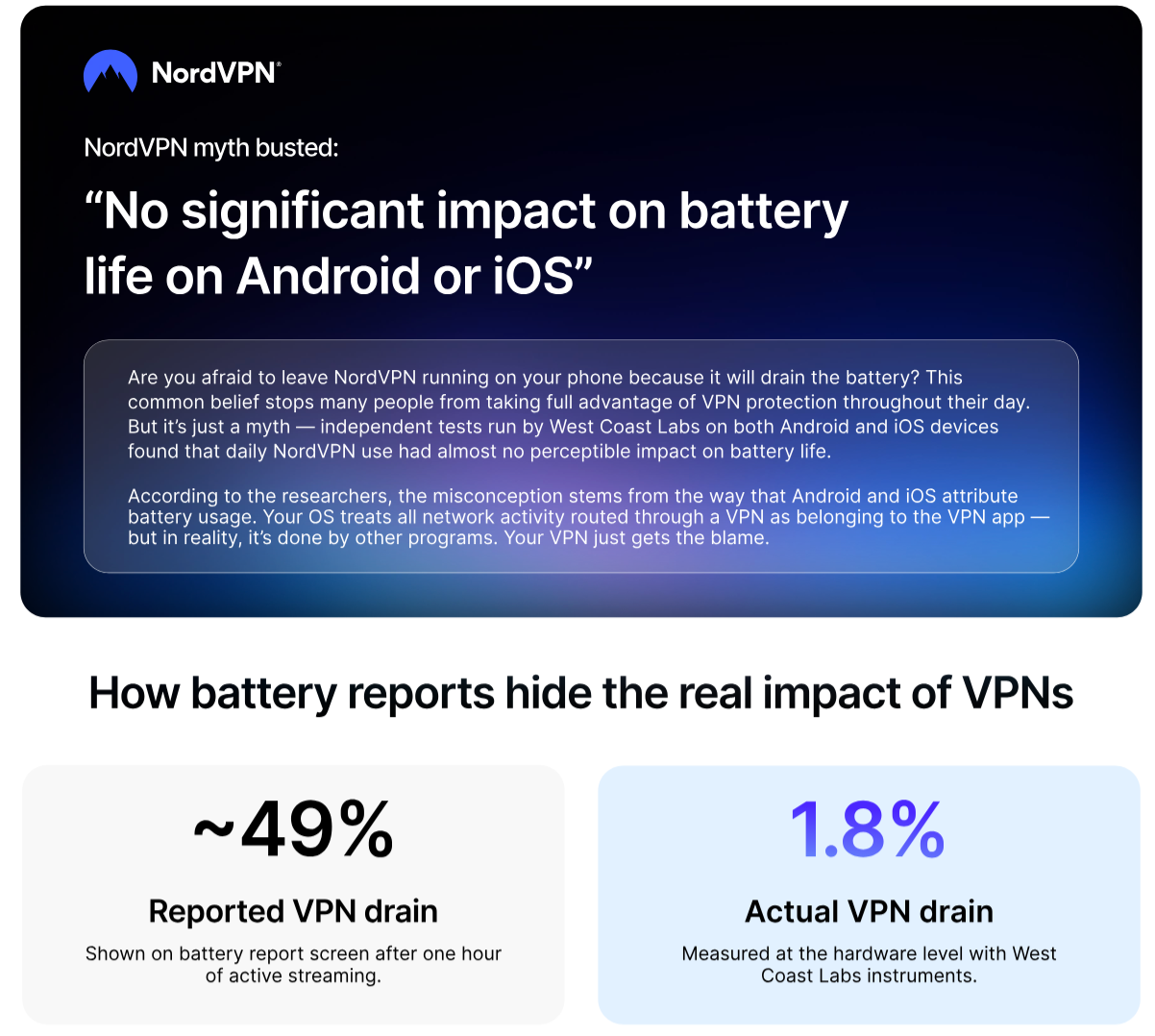
West Coast Labs carried out an evaluation across flagship Apple, Samsung, and Google devices. Testing showed that running NordVPN continuously for a full 24 hours added a mere 1.4% to daily battery use on Android and just 1.8% on iOS.
To put that into perspective, leaving the VPN active all day on a premium Android device means you would only need to charge it roughly half a day earlier over the course of an entire month.
Why your phone's battery screen is lying to you
(Image credit: NordVPN)
"Battery drain is one of the biggest reasons people avoid using a VPN," says Marijus Briedis, chief technology officer (CTO) at NordVPN. "We wanted to know if that myth holds up, and it turns out it largely doesn’t. Your phone makes VPN battery use look a lot scarier than it actually is."
The confusion stems from how Android and iOS calculate power consumption. When a VPN is active, your device routes all its internet traffic through that encrypted tunnel. Because of this, your smartphone's operating system labels all that transferred data as belonging to the VPN app.
If you stream a video or browse the web, your battery usage screen blames the VPN for the power drop. During an hour of streaming, West Coast Labs found that phones attributed an average of 49% of the session's battery drop to NordVPN.
However, when researchers used hardware instruments to measure the actual electrical current draw, the real VPN overhead was just 1.6% to 2.1%. Essentially, your phone's battery screen is simply counting data volume, not actual power loss. When idle, the background overhead is less than 0.5% of battery capacity per hour.
The commuter test and modern protocols
Another scenario notorious for eating up battery life is the daily commute. Phones rapidly switching between Wi-Fi and mobile data networks can force apps to constantly reconnect, draining juice in the process.
West Coast Labs simulated a two-hour commute with automated network switches every nine minutes. Even under this stress, NordVPN's transition overhead stayed at just 5.1% on Android and 6.8% on iOS. The app also successfully reconnected after more than 99 out of every 100 network switches.
So, where did the battery-draining myth come from? The report points the finger at older technology, specifically OpenVPN. Built in 2001, OpenVPN was designed long before mobile battery efficiency was a priority.
In contrast, NordVPN’s proprietary NordLynx protocol — which is built on the much lighter WireGuard standard — uses modern cryptography requiring significantly less processing power. Benchmarking tests showed NordLynx uses 31% less battery per unit of data than OpenVPN on Android, and 24% less on iOS.
“People deserve to make informed choices about their online security. If battery drain was the reason someone wasn’t using a VPN, we hope this report puts that concern to rest for good," says Briedis.
Some Mastercard’s users can install NordVPN for free
The VPN now offers its services as part of the credit card’s perks
This move indicates that digital awareness is growing among consumers
Do you have a Mastercard? If so, you'll be happy to know that you may be eligible to use NordVPN's services for free.
These days, we know that using a VPN has become crucial for protecting one's digital identity. But when a major payment service provider enables its cardholder to access one of the best VPNs for free as part of the benefits included in their package, you realize that digital security has truly become an integral part of everyday life.
Indeed, Mastercard cardholders can now redeem a NordVPN subscription in exactly the same way they currently access airport lounges, fast-track services, and other lifestyle perks included in Mastercard's list of exclusive benefits.
How to get your VPN
(Image credit: Pixabay)
Depending on your bank or Mastercard issuer and the country where you live, your Mastercard payment plan may now include NordVPN Basic and NordVPN Standard.
The basic version is already packed with features and serves as a golden ticket to digital security, thanks to its excellent unblocking capabilities, servers in 126 countries, 10 simultaneous connections, and the ability to block ads and malicious domains.
The luckiest users will be able to take advantage of NordVPN Standard, which exceeds all expectations, especially thanks to its next-gen antivirus digital suite.
The service helps protect your device from ads, trackers, malware, and malicious websites or downloads, and was previously ranked by the cybersecurity specialist AV-TEST and West Coast Labs (WCL) as the best tool for blocking malicious websites and anti-malware evaluation. We also tested it and can confidently confirm that it outperformed most other VPNs.
Mastercard cardholders can redeem their NordVPN subscription by checking their eligibility at https://nordvpn.com/partners/mastercard.
Customers are advised to contact their bank or card issuer to ensure that NordVPN’s digital benefits are included in their plan. Once they activate their NordVPN subscription, the service will ask them to set up their Nord account and download the NordVPN app.
A huge lifestyle plus
The partnership between NordVPN and Mastercard reflects a growing focus on privacy protection within financial services, particularly in industries where digital security is critical because sensitive data is constantly being shared.
In fact, virtual private networks (VPNs) allow cardholders to boost privacy by encrypting their browsing data and masking IP addresses. This provides solid protection against the risks associated with transactions made on public Wi-Fi networks, offering a defense against hackers who might intercept sensitive data.
The fact that a VPN is included among the lifestyle benefits offered by a payment giant shows that customers are paying closer attention to the digital world and view VPNs as an essential tool in their lives — just like vacations or entertainment.
"Digital security is becoming an essential part of everyday life, especially as people increasingly manage their finances, shop, and access important services online," stressed Kestas Saulis, Head of Payments at NordVPN.
Indeed, we might expect an ever-growing demand for digital security among payment services customers as they become increasingly aware of the real risks they face every time they conduct online transactions and share personal data.
Over the past 12 months, however, mandatory age-verification regulations have been spreading rapidly across the world. The era of anonymous browsing — and perhaps the very concept of online privacy — may be quickly coming to an end.
To keep pace with these seismic changes, Proton — the Swiss-based company behind one of the best VPN and secure email services on the market — has launched an interactive map tracking the global spread of age verification laws.
While these laws continue to provoke criticism from scientists, tech experts, and digital rights advocates, Proton aims to ensure that the public remains properly informed by providing timely updates as new legislation advances.
Proton's age verification map provides a real-time overview of where these measures are being introduced and how they are being implemented.
Clicking on any country reveals information about the progress of legislative proposals in that region, with the tool offering a detailed overview of the different approaches adopted by governments regarding age verification legislation.
A glance at the map is enough to show just how rapidly laws are proliferating.
In Europe, for example, 18 countries have already implemented or proposed age verification requirements targeting adult content. Fifteen of these have already introduced measures specifically aimed at social media platforms.
On the other side of the pond, 49 US states have put forward proposals, and 27 have successfully implemented mandatory age checks for websites with harmful content for minors. In addition, many states have either successfully implemented or are considering parental consent or verified age mechanisms for mainstream social apps.
But this pattern stretches way beyond Europe and North America. In the Asia-Pacific region and the emerging markets of Latin America, governments are targeting a wide range of channels, including adult websites, social media platforms, online gaming platforms, and apps.
The death of privacy worldwide?
Andy Yen, founder and CEO of Proton, strongly argued that requiring every user to provide their identifying information is simply tantamount to "the death of privacy online."
He is not alone in holding these views. Many privacy advocates and digital rights organizations argue that current age verification methods encourage the growth of surveillance while compromising users' privacy.
Proton advocates for a different approach to child protection. One that does not compromise the very concept of online privacy and is based on client-side processing, with results that are fully anonymized thanks to end-to-end encryption and publicly accessible open-source code.
"We simply can’t afford to get this wrong. Who stands to benefit? The same tech giants who build today’s privacy nightmare," Yan said.
Australian eSafety Commissioner views VPN detection as a "reasonable step" for tech companies enforcing age limits
The watchdog notes that service providers must prevent workarounds under new industry codes
Australia's position mirrors a growing global debate surrounding age assurance and VPNs
Australia's internet watchdog is keeping a close eye on VPN services as the country steps up its efforts to enforce strict online age verification rules.
According to documents obtained by The Guardian under freedom of information (FOI) laws, the Australian eSafety Commissioner expects tech platforms and service providers to actively block workarounds that allow users to bypass age-restricted content and social media bans.
The internal documents explicitly detail how the government plans to approach these privacy tools under its Unlawful Material Codes and Standards. Under the Codes, the documents state, "service providers must take reasonable steps to prevent workarounds like VPNs so eSafety will look at this when considering compliance with codes."
For everyday web users, this raises a troubling question: could turning on a virtual private network (VPN) to protect your personal data soon flag you as a circumventor?
As cybersecurity protections increasingly find themselves in the crosshairs of child safety regulations, digital privacy advocates are sounding the alarm.
The push for VPN detection
(Image credit: Unsplash / Brooke Cagle)
Under the new codes, the Australian government is placing the burden directly on industry providers to prevent the exposure of age-restricted material, defined by regulators as Class 1 and Class 2 material.
Because a VPN encrypts your internet traffic and spoofs your IP address, it can easily make you appear as though you are browsing from a different country, bypassing local geoblocks and age gates. That's exactly why VPN downloads skyrocketed after Australia enforced mandatory age verification for adult content last March.
However, Australian authorities are confident that platforms can counter this.
According to the FOI documents, the government's ongoing Age Assurance Technology Trial has convinced regulators that network detection is feasible. The documents note that "the Department of Infrastructure, Transport, Regional Development, Communications, Sport and the Arts knows that tech companies can tell when a VPN is in use."
Consequently, the eSafety Commissioner is treating the detection of these tools as a fundamental requirement. The internal log clarifies that "this is similar to eSafety’s regulatory guidance for the social media minimum age, where eSafety considers VPN detection as a reasonable step to prevent underage users from having an account."
A global ripple effect?
Australia is far from the only country struggling to balance child safety legislation with the right to online privacy. The debate over whether to treat VPNs as essential security software or mere circumvention tools is heating up worldwide.
Recent analysis of Australia's age verification rules suggests that trying to plug these "loopholes" could severely compromise the digital safety of the broader population. In fact, some experts argue that demanding that platforms actively block VPN connections sets a dangerous precedent for civil liberties.
The ripple effect is already visible across Europe.
Whether everyday Australians will still be able to freely protect their data on public Wi-Fi without being blocked from their favorite sites remains to be seen.
We always caveat our VPN speed tests by saying something like "but you only need around a 30 Mbps connection to stream 4K video". The trouble is that it's not always as simple as that when you're watching a UHD stream – particularly for an event as popular as the FIFA World Cup 2026.
The best VPNs offer ultra-fast network speeds that can handle ultra-high definition 4K video streaming – but network traffic spikes can bring this to a standstill.
Events like the World Cup cause traffic surging with some popular ISPs, VPNs, and the streaming services themselves struggling under the capacity stresses of having so many users demanding bandwidth at once. The results are often buffering or a reduction in video resolution at the least. Hence why your 4K football match might look a lot rougher than it should.
Server congestion can also cause packet loss, where packets of data sent through a network are unable to reach their destination, resulting in dropped frames or stuttering.
The solution is a two-parter. Firstly, you want to find a VPN with support for high-speed WireGuard connections that can remain stable under pressure from congestion. Secondly, switch your stream to 1080p, rather than 4K, in order to reduce the bandwidth you require. This should keep frame rates high and buffering to a minimum.
If you’re looking for a new VPN to keep up with the World Cup or watch other major events in 4K, our Norton VPN review found a solid choice with average Wireguard speeds of 1010mbps. What’s more, Norton VPN is currently available for up to 60 per cent off:
Norton VPN boasts a high-speed Wireguard protocol, averaging 1010mbps in our in-depth review testing. That means it’s a great pick for streaming high-definition video, even at times of increased demand. With 116 server locations in 74 countries, you’ve got plenty of options to choose from if one specific server is overwhelmed.
And with a discounted price of $3.33 per month for the first year, the Standard plan will let you add up to three devices – stepping up to the Deluxe plan will get you five devices at once for $4.17 per month, while the Ultimate plan covers 10 devices for the equivalent of $5 per month. All three plans come with a 60 day money-back guarantee, twice the standard for VPN services. View Deal
If you’re just not willing to step down to 1080p, you might want to look into using a Smart DNS service instead of a VPN. This will allow you to spoof your location on a less crowded server (i.e your home network), but won’t encrypt your data or hide your IP address.
And if Norton VPN just doesn’t float your boat, there are other options on the market. Norton is still slower than many of the best VPNs: ExpressVPN (1177mbps), NordVPN (1249mbps), and Proton VPN (1475mbps) all boast faster speeds. And for those on a budget, Surfshark still reigns as our pick for the best cheap VPN.
Ukrainians reportedly manipulate Russian fuel maps through coordinated online participation
Over a million users visit the website behind the fuel map campaign
Digital platforms become another battlefield during ongoing geopolitical conflicts worldwide
A coordinated online campaign has reportedly encouraged users to alter fuel station information on digital maps across Russia, creating confusion among drivers.
The activity involves changing station statuses by marking locations with available fuel as empty or showing closed stations as operational.
Supporters of the campaign claim the effort is designed to disrupt travel decisions, increase uncertainty, and create additional pressure around fuel availability.
Map manipulation campaign spreads through online communities
The campaign reportedly centres around a website known as "GdeBenz," which has attracted more than one million visitors since its launch.
Participants are encouraged to use VPN services while accessing mapping platforms, allowing them to contribute altered information from outside locations.
Some users have reportedly relied on free VPN services to access the campaign tools and participate without revealing their actual network locations.
The changes reportedly affect fuel station details seen by drivers relying on online navigation tools when searching for available supplies.
Some participants have shared instructions through social media platforms, encouraging others to join the activity and modify fuel station information in different Russian cities.
The campaign has been described by supporters as an online operation aimed at creating confusion rather than directly affecting fuel infrastructure itself.
Reports surrounding the activity have not independently verified the full scale of the disruptions or confirmed how many fuel stations were affected by altered map information.
However, the campaign shows how digital platforms can become another area of competition during ongoing geopolitical tensions, where information accuracy can influence everyday decisions.
Digital disruption creates uncertainty around fuel searches
The reported campaign relies on crowd participation rather than technical attacks against fuel companies or mapping providers, making it different from conventional cyber operations.
By changing publicly visible location data, participants attempt to influence how drivers interpret fuel availability before travelling to specific stations.
Such changes could potentially cause unnecessary journeys, increased fuel consumption, longer queues, and frustration among motorists if users encounter inaccurate information.
The activity has also drawn attention to how Russia VPN searches and related privacy tools can become part of wider online campaigns where participants attempt to bypass regional restrictions or conceal their locations.
Supporters have celebrated the effort as an example of collective online action, while independent assessments of its practical impact remain limited.
Whether altered map information can create significant disruption over time depends on how quickly platforms detect inaccurate updates and restore correct information.
The incident also shows how digital services used for routine tasks can become vulnerable to manipulation when large groups coordinate around a shared objective.
Proton VPN is now officially published by Proton AG on the Snap Store
The release offers one-click install for Ubuntu and other compatible distros
Some features are missing from this initial build due to sandboxing limits
Linux users looking for a top-tier security boost just got a major convenience upgrade. The team behind Proton VPN has announced that its app is now officially available to download directly from the Linux Snap Store.
While the Swiss-based provider always supported Linux VPN distributions, previous accessibility for Snap users was limited to a "community-maintained fork." This release marks the very first time the official build has been published directly by Proton AG.
The move makes downloading one of the best VPN services on the market significantly easier for the open-source community. According to Proton's announcement, users can now perform a straightforward "one-click install on Ubuntu and any distro that supports snaps," saving them the usual hassle of manual command-line configurations or repository hunting.
Proton's Snap Store build arrives complete with a "verified publisher badge," ensuring users aren't accidentally downloading a compromised or outdated client. Yet, it still lacks some key features due to sandboxing limits.
What’s missing from the first release?
While the Snap Store debut provides the broader community with an "official, trustworthy way to install Proton VPN," the developers were highly transparent about a few technical trade-offs in this initial version.
Most notably, there is "no split tunneling" available just yet.
This highly requested feature, which lets you choose which specific apps bypass the encrypted tunnel to maintain high network speeds, was introduced to Proton’s standard Linux app last year. However, it is absent in the Snap version. "Like our Flatpak, this is due to sandboxing limitations," the team explained, adding that it is "something we hope to resolve in the future."
The provider's anti-censorship tool, the Stealth protocol, also missed the cut. "Stealth protocol isn't included yet. It's not part of this first Snap release," the company confirmed.
Hardware compatibility also comes with a slight catch. The new package offers "no ARM support at this time." While Proton noted that they "expect ARM device volume to be low for now," they are "keeping an eye on it."
Software-wise, the developers warned that "older distros may have issues," cautioning that if users are on an operating system "older than Ubuntu 24, you might run into connection problems."
A big year for Proton’s Linux community
Despite these early missing features, the Snap Store launch is just the latest in a rapid string of upgrades demonstrating Proton’s dedication to its Linux user base. Unlike many competitors that treat open-source platforms as a secondary concern, Proton has spent recent months closing the feature gap between its Linux, Windows, and Mac applications.
This included upgrading the graphical app to the modern GTK4 framework to pave the way for a complete interface redesign. Meanwhile, command-line interface (CLI) power users received vastly improved server selection tools, alongside support for advanced features like custom DNS settings and the NetShield Ad-blocker.
With the brand-new official Snap release now live at snapcraft.io/proton-vpn, Linux fans finally have the reliable, hassle-free installation method they've been waiting for.
Decentralized, encrypted, and completely private messages. That's what Session promises.
You may never have heard of the app, but for its 1.7 million monthly users, Session is an important piece of privacy tech worth fighting to sustain.
Due to a severe funding shortfall, Session was expected to cease operations this week. However, after securing $200,000 to keep the project afloat, the team is now ready to look ahead.
Session co-founder Chris McCabe described the app as a "critical tool for fighting against an Orwellian future." But what is Session, and what does it offer that mainstream giants like Signal can't?
How Session survived its financial crisis
Launched in 2018, the project originally sustained its decentralized infrastructure through its own crypto tokens. According to McCabe, the Session Technology Foundation (STF) sold roughly $2.4 million worth of tokens toward the end of 2024 to keep the project going.
However, the model wasn't sustainable and, when a crisis in the crypto market drained Session's finances last year, the founders were forced to terminate the contracts of all 16 of their team members.
Unwilling to let the platform die, the founders scrambled for alternative lifelines. Following a high-profile emergency donation from Ethereum co-founder Vitalik Buterin — who gifted 128 ETH to support the app's mission — the foundation decided it was time to turn to its user base for long-term survival.
Without additional funding, Session's doors will close next month. Please read this appeal from Session co-founder Chris McCabe.https://t.co/nTJCocoDwIMarch 19, 2026
That grassroots fundraising campaign ultimately paid off.
To date, Session has received hundreds of community donations totaling $205,000. While that is still a long way off the project's ultimate $1 million sustainability goal, it is enough to keep the platform operational, albeit with far fewer resources than it once had.
"This funding allows us to retain three developers and one community operations person to maintain the app," McCabe explains.
How Session protects your messages
(Image credit: Session)
"Send messages, not metadata" is Session's mantra. To back this up, the app uses a variety of advanced techniques to ensure users' messages remain private and secure.
From basics like end-to-end encryption to the use of a decentralized infrastructure and onion routing, Session goes significantly further than mainstream messaging apps.
"Session is completely trustless," McCabe told TechRadar. "You don't even have to trust us because the open-source code guarantees your security."
In the future, the app's design should also make it less vulnerable to increased surveillance and monitoring, such as the initiatives currently being proposed in Canada, the EU, and the UK.
Did you know?
(Image credit: Photo by Darrian Traynor/Getty Images)
In October 2024, the platform's creators shifted operations to Europe to help protect users' privacy. The move allowed the team to escape an Australian legal landscape that the founder described as "increasingly hostile" toward encrypted apps, relocating to the traditionally privacy-friendly jurisdiction of Switzerland.
Because the platform is open source, McCabe claimed the app can continue to operate even in countries where it has been banned from mainstream app stores, noting that users can easily bypass those restrictions by sideloading the app on Android devices.
And what happens if a repressive government demands data about an individual user? McCabe noted that the foundation simply couldn't comply, saying: "It's technically impossible for our company to copy or store that data."
Crucially, users do not need a phone number or email address to sign up for the service. That anonymity is especially beneficial for citizens in conflict zones or highly restrictive digital environments, where hostile governments can block SMS two-factor authentication messages to cut off access to mainstream messaging networks.
So, how exactly does Session stack up against mainstream giants like Signal?
Is Session really better than Signal?
(Image credit: Michele Ursi / Shutterstock)
Signal is widely recognized as the gold standard for privacy-preserving messaging apps. Like Session, it is fully open-source, collects minimal metadata, and uses advanced end-to-end encryption via the Signal Protocol.
While McCabe agrees that "Signal is great," he believes that being completely decentralized and eliminating the need for a phone number tips the scales in Session's favor.
However, not everyone in the cybersecurity community shares this view.
A prominent cryptanalyst who uses the pseudonym Soatok has publicly argued against switching from Signal to Session. A major point of criticism is Session’s decision to remove Perfect Forward Secrecy (PFS) — an important security feature that ensures that past chats remain private even if a user’s long-term identity keys are compromised in the future. Soatok also suggested that Session contained several other cryptographic flaws and implementation mistakes.
Bill Budington, Senior Staff Technologist at the Electronic Frontier Foundation (EFF), backed Soatok’s analysis, telling TechRadar that Session appears to be another aspiring Signal competitor that "comes up lacking on its security claims."
Mohammed Al-Maskati, the Digital Security Helpline Director at Access Now, shared this concern. He argued that sticking with a widely implemented standard like the Signal Protocol is generally a safer option because it significantly reduces the risk of making critical errors during development.
Responding to these critics, McCabe explained that while Session initially relied on the Signal Protocol, the team was forced to build its own encryption method because Signal's architecture wasn't designed to handle a decentralized node network.
However, he confirmed that PFS is officially slated to be reintegrated into the platform with the upcoming Session Protocol V2 upgrade.
Security experts have also pointed out that Signal remains a stronger choice for most users due to the sheer size of its network, which makes it far easier to use with friends and contacts.
However, McCabe rejects the idea that popularity equates to security, arguing that by that logic, WhatsApp would be considered a better privacy option than Signal. "Which it is not," he said.
What’s next for Session?
As Session prepares to enter its next phase, the foundation is focused on achieving long-term financial sustainability.
To generate steady revenue, the platform plans to launch a premium subscription tier called Session Pro. Similar to Telegram Premium, Session Pro will offer power users advanced features — such as higher message character limits, expanded group sizes, more pinned chats, and animated profile pictures — backed by cryptographic proofs that preserve user anonymity during payment.
Most pressing, however, is finalizing Session's Protocol V2. Beyond reintroducing Perfect Forward Secrecy (PFS), it will also introduce post-quantum cryptography to secure users' chats against 'harvest now, decrypt later' threats.
While the wider InfoSec community continues to be divided on whether Session's custom architecture outperforms legacy rivals, the core team remains fiercely dedicated to the project.
"Many former team members are incredibly passionate and are taking pay cuts or donating their time to help get it back together," said McCabe.
La Liga and French media giants, including LFP Media and Canal+, have formally submitted a complaint to football's governing body, slamming the new sponsorship as a "disastrous" message to the football ecosystem, according to reports from French sports newspaper L'Equipe.
"La Liga believes that this agreement is manifestly incompatible with the principles of protecting football's audiovisual rights that should govern the actions of world football's governing body," said La Liga president Javier Tebas.
Rightsholders are furious that FIFA would accept sponsorship money from a company they previously targeted with lawsuits for "facilitating access to pirated content," Tebas added.
In a statement to TechRadar, a spokesperson for ExpressVPN strongly denies such allegations.
"Any suggestion that ExpressVPN has been 'found guilty' of facilitating piracy is entirely inaccurate; we have not been convicted of any such conduct in any jurisdiction," the company told us.
While reiterating that a virtual private network (VPN) is a privacy and security tool — "not a loophole for illegal activities" — ExpressVPN also argues it has already presented a framework to national and EU authorithies to tackle the illegal distribution of copyrighted content, without breaking its no-logs VPN commitment.
For everyday football fans and privacy advocates, this corporate clash highlights the growing tension between rightsholders wanting total control over internet traffic and privacy companies defending open, unrestricted access.
If you are looking to secure your digital footprint, utilizing the best VPN is essential to bypassing unfair network restrictions and ensuring your online activity isn't monitored by your internet service provider (ISP) or third-party organizations.
A clash of privacy and anti-piracy
(Image credit: Getty Images)
In France, organizations like the Association for the Protection of Sports Programs (APPS) have aggressively pursued court orders forcing ISPs and tech companies to block access to pirated streams.
ExpressVPN has historically resisted these demands, refusing to implement network-wide blocks. This staunch defense of an open internet led to the VPN provider being formally condemned in the country, making FIFA's sponsorship announcement a bitter pill for French broadcasters to swallow.
The situation has escalated similarly in Spain, where La Liga's president has spearheaded a controversial crusade against illegal streaming. La Liga’s heavy-handed tactics have been heavily criticized by digital rights groups, especially after a recent anti-piracy campaign backfired spectacularly, wrongly blocking over 500,000 legitimate websites in Spain.
The Spanish league has also previously attempted to fine individual users and pressure tech platforms into handing over user data. With La Liga’s war on piracy breaking the internet in Spain, privacy experts have warned that your VPN could be the next target.
Despite the immense legal pressure and the latest formal complaint to FIFA, top VPN providers have consistently argued that enforcing rightsholder site-blocks fundamentally compromises the security and architecture of a privacy service.
Meanwhile, the climate in France remains incredibly hostile for privacy tools.
Earlier this year, a French court backed the LFP and ordered top VPNs to block illegal football streams. This sweeping injunction set a dangerous precedent, forcing the VPN industry to react to France’s aggressive order to block illegal streaming sites and defend the technical realities of zero-logs infrastructure.
VPN pricing is a little unorthodox, and we see deals like these appear all the time, so it's important to point out where the value really lies here. I spent a long time paying month by month for a VPN subscription, not realizing how much money I was actually spending by choosing a rolling, 30-day sub over locking in for a longer period. The $69.72 cost means that you're paying the equivalent of just $2.49 a month for the 28 months of access you're gaining here, compared to $15.99 a month for the 30-day access.
This deal for ExpressVPN's Basic plan unlocks a solution that'll protect 10 devices simultaneously with the same account. You can use it to keep your identity safe while you browsing, but if you're still unsure, new customers can take advantage of ExpressVPN's 30-day money-back guarantee. If you're unhappy, you can ask for a full refund within those first 30 days, giving you enough time to fully test the service to see if it matches up to your expectations.
This massive discount on a 2-year ExpressVPN subscription drops the price by 84%, with an extra four months of subscription thrown in for free. It comes with a 30-day money-back guarantee for new customers.View Deal
ExpressVPN is a no-logs provider, meaning it can't give up your data while you're using it, as it doesn't track or store any data about its users' connections. This is regularly audited, with the last audit in 2025 by KMPG confirming "reasonable assurance" of its systems and policies. This is real peace of mind for users: you're free to use the web how you want.
It also gives you a shield of privacy that your regular ISP just can't. A VPN sub like this means you can shop online or browse the web without trackers monitoring where you're from via your IP address. Your location stays hidden, obfuscated through the 105 different countries that ExpressVPN hosts servers, with 24 different server locations in the U.S. alone.
Don't underestimate how important that privacy is in the modern world. Every page you're visiting leaves a trace, whether it's a ping in a server log or a tracker on-page, giving the site owner data to build a profile on who you are, but using a VPN can stop this data from being useful. Likewise, a VPN connection can help you to connect as if you're from a certain location, which is particularly useful if you're traveling abroad and want to be able to access your home streaming services. It's also a good idea to use a VPN as a way to protect yourself if you're accessing the internet from a public WiFi network, where malicious actors could otherwise be snooping on your connection.
Using ExpressVPN, the encryption between your device and its servers is encrypted using industry-standard AES-256 encryption, as well as post-quantum encryption techniques for the initial handshake process. This can stop your data from being intercepted while you're accessing the web. If you lose your connection, features like ExpressVPN's kill switch will stop the data from leaking out, blocking any access until you reconnect. The Basic plan also includes a private email relay service to give you 10 anonymous email aliases to use for registering online, along with basic ad and malicious site protection for your browser.
This $69.72 price tag for the ExpressVPN Basic plan is a good deal for a 28-month privacy upgrade. Yes, VPN pricing can seem confusing, but by locking in for that period, you're getting online privacy protection for the equivalent of just $2.49 a month. You can always give it a go and, if you don't like it, request a refund using ExpressVPN's 30-day money-back guarantee.
If you've survived the first 24-hour gap in this year's World Cup schedule, then it's time to ensure your viewing of the quarter-finals is the best it can be.
The World Cup's mass appeal puts a huge strain on streaming providers. And if you're travelling, you could easily miss out on commentary in your native language or be stuck behind paywalls if you're in the US.
This is where the best streaming VPNs come in handy. They offer high-performance encryption protocols, servers with huge capacity, and all the tech you need to securely watch your regular World Cup coverage from wherever you are.
Right now, the cheapest VPN for this is Norton VPN. It ranks second in our best streaming VPNs rankings, but is a dollar a month cheaper than our top pick — NordVPN.
Norton VPN has servers across 91 countries, speeds of over 1000 Mbps on WireGuard, and hardly struggled with any streaming services we tested.
It's also even cheaper when you pick up a 12-month plan. These now start from only $39.99.
Watch France vs Morocco in the World Cup quarterfinals uninterrupted. Norton VPN delivers fast, secure connections with servers worldwide, so you can stream from anywhere.
You can now get Norton VPN Plus for the same price as the standard plan. That means you get AI-powered scam detection and a password manager effectively for free.
Additional features include:
🛡️ Cover up to 5 devices 🔓 Unlock World Cup streams ⚡ 1010 Mbps download speeds
Norton VPN also offers a 60-day money-back guarantee — double the industry standard. View Deal
By comparison, a year of NordVPN is $65.88, over $25 more.
So, if you're just after World Cup protection, why spend the extra? You even get AI-powered scam protection, real-time ransomware and malware protection, password management, dark web alerts, and 10GB cloud storage thrown in if you choose a Plus plan (still $15 cheaper than NordVPN).
For the absolute cheapest experience possible, only PIA, CyberGhost, and PrivadoVPN come with our seal of recommendation. These are all under $1.60/month but are far less reliable with streaming services, especially if you're planning to watch live events like the World Cup or Wimbledon.
NordVPN has launched Message Protection for Android users worldwide, adding SMS screening to its Call and Message Protection suite.
The tool checks incoming texts from unknown senders and pushes a notification when a message looks malicious or suspicious.
Flagged texts open in a safe view that stops links being tapped by accident, and NordVPN says it never stores message content.
NordVPN is rolling out a Message Protection feature to Android users worldwide, giving people a way to catch fraudulent texts before they become a threat. The tool automatically screens incoming SMS messages and flags anything that looks like a scam.
The feature, which was already made available to iPhone users at the beginning of June, joins existing Call Protection on a single screen, so there is now one place to manage defenses against both suspicious calls and malicious texts.
NordVPN has long been a front-runner for the title of best VPN, but this update is another step in its shift toward an all-in-one privacy and security app, rather than a service that simply encrypts your traffic.
Why text scams keep climbing
According to GASA's Global State of Scams 2025 report, text and SMS rank as the second most common channel used by fraudsters. The same research, which surveyed 46,000 adults across 42 markets, found that 57% had been scammed in the past year, with global losses reaching an estimated $442 billion.
Citing the US Federal Trade Commission, NordVPN says text scam losses hit $639 million in 2025, a 36% jump compared to the previous year. Fake package deliveries, bogus bank alerts, and unpaid toll notices remain some of the most common lures.
"Text messages have always been one of the easiest ways for scammers to reach people at scale," says Domininkas Virbickas, product director at NordVPN. "Message protection is about breaking that chain before it starts."
How Message Protection works
(Image credit: NordVPN)
The feature screens every incoming SMS from an unknown sender, checking it against phone reputation data, URL analysis, and content categorization. When a message is judged malicious or suspicious, users get an instant push notification naming the threat type and the recommended action.
If you want to view a flagged message, you can do so in a safe viewer that prevents links from opening, and you can track how many messages and calls get flagged in the unified dashboard.
The feature runs quietly in the background, even when the VPN is switched off, and NordVPN says it doesn't store the content of any of the calls or texts.
How to switch it on
On a fresh install, you can enable Message Protection during the onboarding steps. Existing users can go from the Home screen to Call and Message Protection under the Product hub, then follow the permission setup.
NordVPN has also launched Prompt Guard, a separate Chrome and Edge extension that warns you before you paste sensitive data, such as passwords or card numbers, into AI tools.
Russia’s Digital Development Ministry confirmed it has completely dropped its plan to charge users for international internet traffic.
The proposal initially aimed to charge users roughly 150 rubles per extra gigabyte after a 15GB monthly allowance.
Demand for censorship circumvention tools remains at an all-time high as the Kremlin continues its broader crackdown on digital privacy.
Internet users in Russia can breathe a sigh of relief as the government has abandoned its controversial plan to tax international mobile traffic.
The proposal, which heavily targeted those using the best VPN services to bypass state censorship, would have forced residents to pay steep premiums to access a free and open internet.
The policy reversal was confirmed during a recent State Duma session by Deputy Minister of Digital Development, Ivan Lebedev.
Responding to parliamentary questions about the initiative from Communist Party lawmaker Oleg Smolin, Lebedev categorically stated: “Fees for foreign traffic are not being considered”, according to reports from Meduza.io.
First introduced during a late March meeting between Digital Development Minister Maksut Shadayev and domestic telecom operators, the plan aimed to hit privacy-conscious users' wallets.
Because Russian carriers inherently classify VPN data routing as international traffic, the government intended to implement a strict 15-gigabyte monthly cap. According to initial reports from the BBC’s Russian service, authorities intended to charge users roughly 150 rubles for every additional gigabyte consumed beyond that limit.
The sudden U-turn comes after months of ongoing logistical hurdles and industry pushback. The tax was initially scheduled to take effect on May 1, but was subsequently postponed to June 1 after the Russian business daily Vedomosti reported that carriers were not ready to configure their billing systems.
The deadline was later pushed again to "closer to fall" or after the September elections, before finally being scrapped altogether.
As previously reported by TechRadar, an inside source confirmed that Russia's internet regulator, Roskomnadzor, lacks the technical abilities to effectively prevent residents from using VPNs at scale.
A temporary victory in a wider digital crackdown
(Image credit: Shutterstock)
While the scrapped tax is a definitive win for privacy advocates, it remains just one battle in an increasingly hostile digital war.
Russian demand for circumvention tools has surged dramatically following the state-ordered blocking of major global platforms, including YouTube, Facebook, Instagram, WhatsApp, and Telegram.
Without a VPN, everyday citizens are largely cut off from independent news sources and international social networks.
Rather than relying purely on financial deterrents, the Kremlin has steadily escalated its technical and legislative attacks to plug the gaps.
By mid-April, authorities successfully pressured major domestic internet platforms to comply with new regulations, actively restricting users from accessing their sites and apps while a VPN was enabled.
Cybersecurity experts have also repeatedly warned of more drastic state-led interventions aimed at entirely isolating the country's internet infrastructure from the rest of the world.
For now, millions of citizens continue to rely on robust privacy tools to navigate the web safely and maintain digital contact with the outside world. If you find yourself dealing with this restrictive landscape, learning exactly how to survive Russia's VPN crackdown is more crucial than ever.
ExpressVPN has grown to 214 'distinct, app-selectable server locations'
The 214-location count across 113 countries does not mean 214 cities
ExpressVPN now covers around 196 cities, up from 189
ExpressVPN has rolled out the biggest network in its history, expanding to 214 distinct, app-selectable server locations across 113 countries.
It's a significant step up for a provider TechRadar last clocked at 189 locations, and it arrives as the fight to top our best VPN list increasingly turns on where you can connect, not how many servers hide behind the app.
The fresh additions reach places the network had not touched before, including Nuuk in Greenland, Lagos in Nigeria, Doha in Qatar, Valencia in Spain, and Manchester in the UK. The move builds on ExpressVPN's rollout to all 50 US states earlier this year, bringing that same local-first approach to the wider world map.
It's worth noting, however, that what the provider refers to as a "server location" is a connection option in the app, rather than a guaranteed unique city. For example, ExpressVPN's UK entries bundle multiple London-area spots that each count separately toward the total.
If you strip those duplicates out, the real coverage is narrower. By TechRadar's own tracking, ExpressVPN now reaches roughly 196 cities, up from 189. It's a definite upgrade, but it still trails NordVPN, which covers around 224 cities and leads on country count, too.
A bigger, more local network
(Image credit: EpressVPN)
ExpressVPN is pitching this as a local-first expansion rather than a raw server-count boast. The new connection points span Europe, Africa, the Middle East, and North America, while established markets have been deepened rather than simply widened.
The UK line-up now runs from Docklands and Tottenham to Manchester and the Midlands, Australia stretches from Adelaide to Woolloomooloo, and Japan covers Osaka, Shibuya, Tokyo, and Yokohama.
More nearby options can cut latency, give you a backup when a route is busy, and let you match a specific city, state, or region to whatever you are doing, from streaming and gaming to banking or working while travelling.
Every new location runs on ExpressVPN's RAM-only TrustedServer tech, which wipes data on each reboot, alongside its no-logs policy and its record of independent audits.
How to switch to the new locations
Getting to the new spots is simple. Update to the latest version of the ExpressVPN app, open the location picker, and browse the expanded country and city list.
If you would rather not choose, Smart Location will pick the fastest option for you automatically, based on speed, latency, and distance.
You can preview the full network on ExpressVPN's server locations page before you connect. And if precise city-level control is what you are after, it is worth checking if the list covers the exact places you need, rather than trusting the headline figure alone.