
 Login
Login
Heating up and slowing down: How extreme heat is putting stress on World Cup players and fans
A destructive tornado that rips through a neighborhood, hurricane force winds tearing roofs, and storm surge toppling homes and flooding communities. All of these hazards make headlines for their impressive visuals, but it is an invisible killer — heat — that is by far the deadliest weather and climate hazard. As the biggest sporting event on the globe attracts millions of visitors in the heart of summer, many World Cup host cities are feeling the need to be resilient against this hazard.
"Heat-related illness and some of the more severe forms of that are completely preventable." Dr. Nichole Quick is the Chief Science Officer at the Los Angeles County Department of Public Health, a city that has hosted many of the U.S. national team's World Cup matches this tournament, drawing thousands into not only an open-air stadium, but outdoor watch parties.
While different individuals are more susceptible than others, Dr. Quick adds, "some of the signs and symptoms of heat illness include dizziness, headache, nausea, muscle cramps, confusion, fatigue, [and] as it progresses, symptoms become more pronounced." She stresses that education and awareness is key to this invisible killer. "Any time we are going into heat season or projecting a heatwave or any large gatherings outdoors, we let people know that heat can be a serious effect for anyone, even healthy folks." Dr. Quick says these impacts can become more pronounced for players on the pitch, "as you're exerting yourself, you're creating body heat and so you can compound those effects."
Scientists have actually studied the impacts of heat and humidity on soccer players during the World Cup, observing 340 players from 32 national teams during the 2014 tournament in Brazil. "Results presented indicate that the conditions most comfortable for physical activity on the part of players occur at 71°F (22 °C), and with relative humidity under 60%." Players ran the greatest distance in these more pleasant conditions. Temperatures over 82°F (28 °C) impacted player performance on the pitch, especially how far and frequently they ran during a match.
A new analysis from Climate Central took these thresholds and applied it to this summer's tournament, forecasting the games that will be most likely to stifle with player performance-impairing heat over 82°F (28 °C). By comparing these forecasts in atmospheres with and without carbon pollution, scientists are able to determine the direct impacts of climate change.
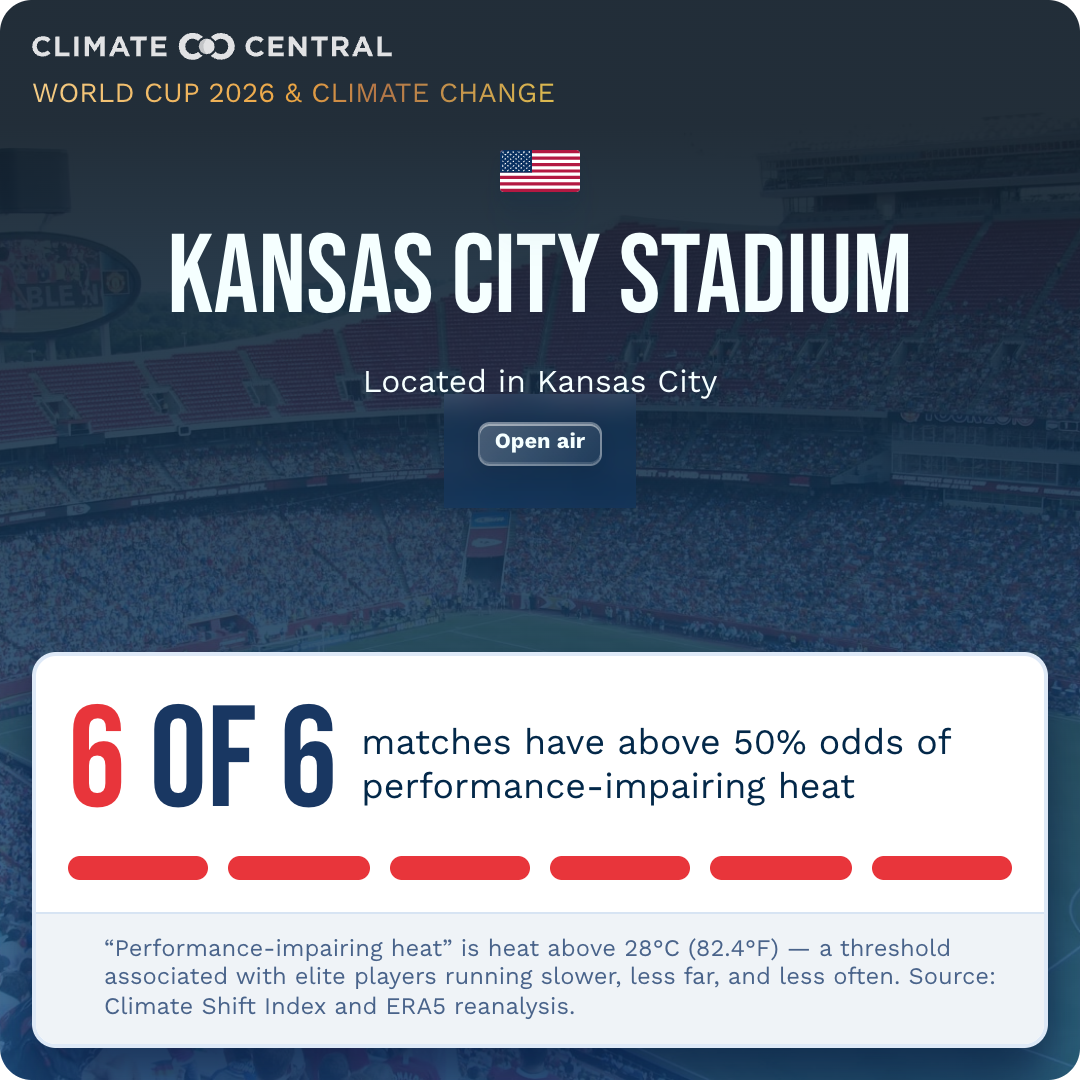
"Warming caused by climate change is boosting the odds of performance-impairing heat during most scheduled World Cup matches (97 of 104), by about 8 percentage points on average." Nearly half of the matches have at least a 50% chance of performance-impairing heat, in Kansas City that's the case for all six of the matches hosted at their open-air stadium.
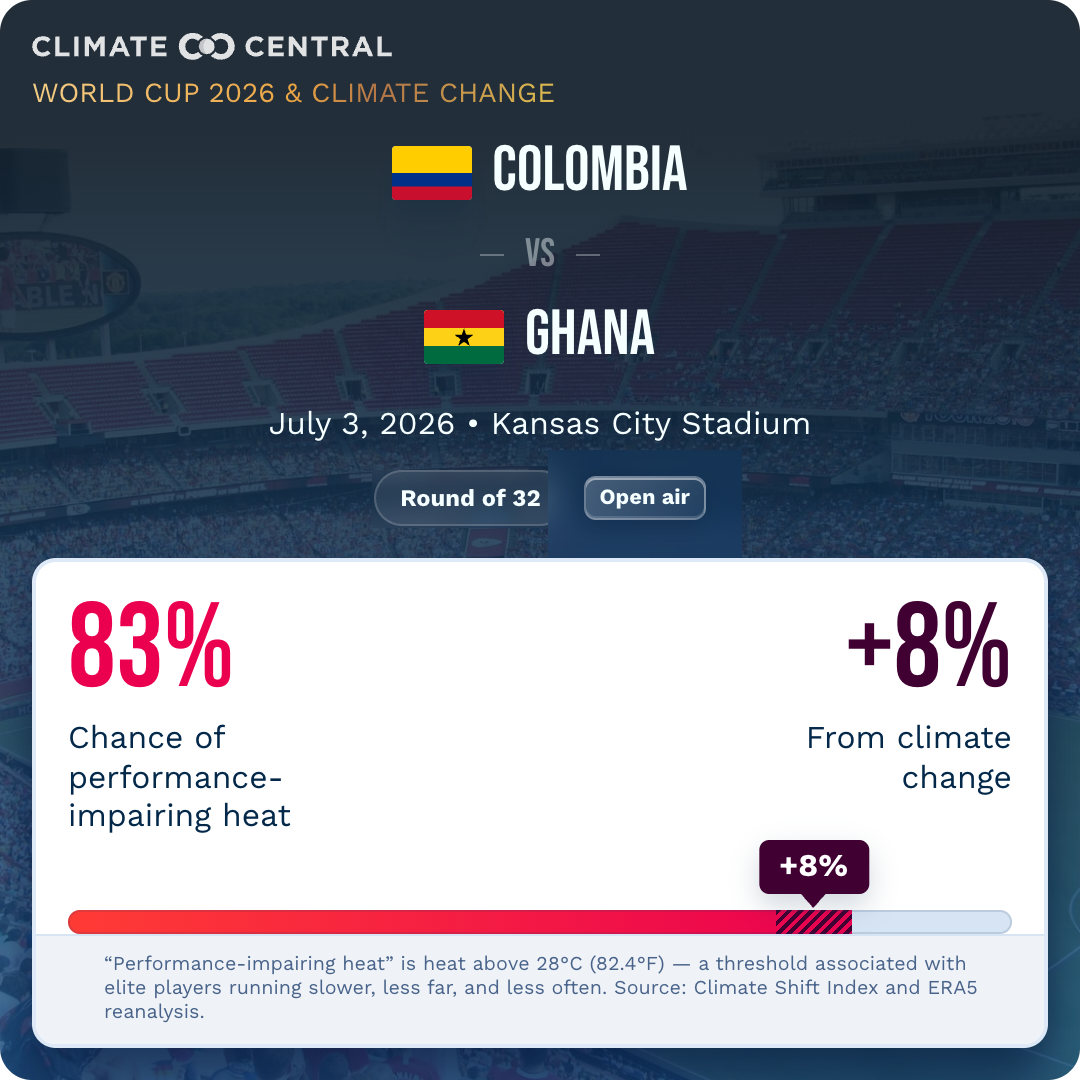
Group K winner Colombia plays its Round of 32 knockout match against Ghana at Kansas City Stadium on Friday. There is an 83% chance of performance-impairing heat for players on the pitch during the game. Colombia has played most of its games in these extreme heat conditions, playing the group stage at open-air stadiums in Guadalajara and Miami.
But the impacts go far beyond a player's speed on the pitch. World Weather Attribution used wet bulb globe temperature in its study, a common weather measurement that captures multiple environmental factors besides temperature that impact the body's ability to cool down, like humidity and sunlight. This more directly zeroes in on player's health impacts on the pitch and is a common tool used in decision-making for heat risk in sports. FIFPRO, a global soccer player union, recommends hydration breaks for games with wet bulb globe temperatures over 78°F (26°C). Delays or postponements must be considered on sweltering days with wet bulb globe temperatures over 82°F (28°C).
Scientists in this analysis found that the number of days deemed unsafe for play has nearly doubled in this World Cup compared to the last time the United States hosted in 1994 due to climate change: "These results indicate that, without substantial adaptation measures such as widespread access to air conditioning and cooling infrastructure, staging football matches during the northern hemisphere summer will become increasingly dangerous for both players and spectators in a warming climate."
To mitigate extreme heat impacts on the pitch, FIFA has mandated three-minute hydration breaks midway through each half for the first time in the tournament for all matches. "At what cost," when asked about the hydration breaks, professional soccer player Jasmyne Spencer is hesitant it's enough, "three minutes isn't sufficient to really make a difference in what it feels like and what you still need to be able to do and demand of your body." The time spent in the break is added back on the clock in stoppage time at the end of each half, only making time on the field longer. Alex Jacobs, another professional player, adds that the hydration break is often still spent discussing gameplay strategy with coaches and teammates, "adding another ten minutes on is a meaningful percentage of time where you need to stay locked in mentally, and the mental bit is taxing."
Climate-controlled stadiums are a growing solution to extreme heat exposure to fans, but Dr. Quick points out that is only a piece of the puzzle. Increased tourism around these games means that visitors, some from cooler climates, could be caught off guard and even more vulnerable to heat sickness. "There's an element of complacency that takes place with heat," she says. Watch parties, tailgates and celebrations surrounding these matches all often occur outside.
Miami is hosting seven World Cup matches including a quarterfinal match and the third-place match final. Loren Parra, Miami-Dade County's chief resilience officer and director of the Department of Environmental Resources Management emphasizes, "Even though we know that our residents may bd becoming more and more educated on the impacts of heat, we know a lot of our visitors may not be as familiar." Dubbing the soccer-centric campaign, "heat is not a game," the team makes sure all education and outreach on heat risk is available in at least three languages: English, Spanish and Haitian Creole. World Cup planning included several cooling and hydration stations across public transit to cater to visiting fans, and even planting more trees near the stadium to increase access to shade.
Parra's team has worked closely with the National Weather Service and emergency managers to establish a heat season to focus education and outreach from May to October. "We have actually seen a marked decrease in heat-related visits to the ER and we have the lowest of those visits across the entire state." Likewise in Los Angeles, Dr. Quick emphasizes education is key to preventing heat sickness, especially surrounding big events like the World Cup. Her team issues area-wide heat advisories and alerts that send texts or emails when the conditions are ripe for heat illness. They also track all emergency visits related to heat. "We urge people to plan ahead and be prepared for it. We like to get the message out that anyone can be affected by heat."
As heat waves kick up earlier, last longer and become more extreme, long-duration outdoor events like the World Cup remind us that summers aren't what they used to be, and the science shows it. Scientists warn widespread adaptation and curbing carbon emissions will be needed to ensure future summers of soccer can continue to be enjoyed safely. And while it may seem obvious, heat sickness can really sneak up on you during a 90+ minute football match.
"Hydration is key," says Dr. Quick, "Letting folks know that you should be drinking water before you get thirsty, wearing light clothing, [and] taking breaks in cool areas."
