Reading view

Meta says it will spend an extra $40 billion on its nearly 4,000-acre data center campus in Louisiana in its quest for more compute power

  • Meta's 4,000 acre Hyperion data center will receive an additional $40 billion investment
  • Meta says the project has been a huge benefit for the local community of Richland Parish
  • Multiple groups and local residents have criticized the massive campus and its energy sourcing

Meta has announced that an additional $40 billion will be used to fund the construction of its enormous 4,000 acre data center campus in Richland Parish, Louisiana.

This additional funding brings the total Meta investment for the ‘Hyperion’ site to over $250 billion when combined with Bloomberg reporting of $200 billion allocated for the project in May, plus a previously announced $10 billion investment for the data center and surrounding community.

The data center itself is expected to consume 5 gigawatts of computing power, with an additional 2 gigawatts for wider campus needs, placing the predicted total usage upon completion at more than three times the power consumed by the city of New Orleans.

A boon or bane for the local community?

In a Meta blog post, the company boasted about the benefits of the enormous data center campus for the local community.

It cites $50,000 bonuses for local teachers thanks to increased tax revenues on the Hyperion campus, alongside $1.6 billion in contracts for local businesses and other funding from Meta for public schools and youth programs via the Data Center Community Action Grants project.

“It’s life-altering for our teachers and their families, and it’s transforming our schools. Meta’s investment has made Richland Parish a destination for education as well as industry,” Richland Parish’s School District Superintendent, Sheldon Jones, told Meta.

Meta also said that once the project was completed, it would support 1,000 jobs. There is also a further $1 billion earmarked for investment in local infrastructure improvements, including roads, water and wastewater systems.

A promotional video accompanying Meta’s local funding news shows the story of a backwater town faced by a lack of business and opportunities, with local residents, teachers, and business owners speaking of the positives of having the Hyperion campus being constructed, accompanied by upbeat orchestral music.

While the select individuals featured in the Meta PR video preach of the benefits, there has also been local opposition to the project, which has been steeped in controversy.

The other side of the coin

Multiple environmental and consumer groups have pushed back against the project since its announcement, particularly around how the power for the data center will be generated. Entergy Louisiana is spending billions to construct 10 new gas-fired power plants to provide the necessary electricity. But many communities across the US who live in the vicinity of such power plants have reported a wave of symptoms, such as dizziness, nausea, vertigo, and sleep disruption.

A Floodlight investigation, published by the Guardian, found that the success of Hyperion’s approval rested largely on the shoulders of a single Louisiana state senator, John “Jay” Morris.

Many of the land purchases and sales required for Entergy to construct the planned gas turbine plant were undertaken by Morris and his partners, Floodlight claims. Louisiana law requires government officials to recuse themselves from voting when a conflict exists, and prohibits the use of public office for private gain.

Morris has denied any wrongdoing. “It makes a nice story if you can try to show that I have some sort of conflict. But under Louisiana’s ethics laws, I don’t,” Morris told the Guardian.

The Union of Concerned Scientists (UCS) and the Alliance for Affordable Energy (AAE) have both criticized the Hyperion site, especially the amount of power it is planned to consume, warning that the site will unfairly shift the cost of electricity and infrastructure upgrades on to the site.

Additionally, the approval for the Entergy gas turbine power plant was fast-tracked through the Louisiana Public Service Commission, with the UCS warning that Entergy ratepayers would have to cover the costs of a $550 million transmission line that is only necessary because of the Hyperion site, alongside the fuel costs for the new gas turbine plant.

'You essentially pay for intelligence twice, once with money, and again with something even more valuable': Microsoft CEO Satya Nadella warns AI users not to give away too much

  • Microsoft CEO Satya Nadella has warned AI companies are training their models on the business secrets of their customers
  • These secrets are then used to train new, more powerful models, that are sold to their customer's competitors
  • But, Nadella says there is a way to remain competitive without being locked in to one AI vendor

Microsoft CEO Satya Nadella has warned the big players in the AI industry are using their proprietary models to learn the business secrets of their customers, which they can then use to train and deploy more advanced AI models.

The crux of the issue, Nadella said in a blog post, is that, “You essentially pay for intelligence twice, once with money, and again with something even more valuable: the proprietary knowledge you must reveal to make that intelligence useful. The better you want the model to perform, the more of that knowledge you have to feed it!”

What Nadella is saying in essence, is that AI companies are harvesting sensitive business data from their customers, using it to make training their models cheaper, and then launching these models for use by their own customer’s competition.

“The kind of knowledge a competitor could never buy”

“Models learn from ‘exhaust,’ the prompts people write, the tools agents use, and especially the corrections people make when the model is wrong. Every correction is distilled into institutional know-how,” Nadella explained.

Nadella also criticized how AI companies are increasingly complaining about how their models are being distilled by their own competition. For example, Anthropic accused retailer and e-commerce company Alibaba for using thousands of Claude prompts to distill their own models. By figuring out how a proprietary model works, you don’t have to spend the enormous amount of capital needed to source training data and create your own AI model.

This, for Nadella, is a major contradiction in how AI companies work. “While the great innovation that comes from model providers having fair use rights to train models on public data is needed, I find it ironic that the status quo is to then turn around and impose restrictive terms on distillation,” he said.

It is also therefore hypocritical for AI companies to accuse other companies of distilling their own product, and then include within their AI usage contracts clauses that allow AI companies to “reserve the right to learn from customer usage and interaction data.”

“In consuming intelligence, you are creating intelligence. And what you create should belong to you,” Nadella added.

On-prem is back in fashion

Nadella’s fix for this growing problem? It’s time to move back to on-prem. Nadella encourages businesses to “retain ownership” of the data they feed AI models by switching to the use of “proprietary learning environments” built on the cloud.

The added benefit of moving to these environments is that they allow businesses to switch between different AI models provided by different companies using “orchestration layers” and AI gateways.

There is also a growing trend of businesses switching to using open source technologies, which goes hand in hand with businesses operating in the cloud. Businesses can train open source AI models using their data that is already available in cloud environments to do much of what the proprietary models do, for far cheaper — and without handing over that same sensitive data to be used by AI companies to train their own models.

The on-prem solution also has additional benefits. AI models operated on-site within manufacturing plants, stores, and other premises are far cheaper and require less specialized hardware. Businesses that operate using a centralized cloud are increasingly encountering issues with data egress fees, storage bloat, and idle specialized hardware.

Google Cloud recently released a report about these very issues, and also encouraged businesses to move towards using AI gateways and on-prem models to reduce latency, improve resilience, and cut per-token costs by switching to local, highly optimized models.

Via TechCrunch

Watch out Windows users, a Secure Boot update has been blocked on Windows 11 PCs due to failing on some devices — here's how to check if you're affected

  • Microsoft has blocked Secure Boot updates on some devices
  • There have been issues with some devices updating from the 2011 certificate to the latest 2023 certificate
  • Some older devices or those not supported by their OEM may be restricted in downloading the latest Secure Boot certificates

Microsoft has blocked some Windows 11 PCs from installing Secure Boot updates due to known issues with certificate updates.

The company is currently rolling out an update for Secure Boot on devices using certificates issued in 2011, which are now expired. The new 2023 certificate is being applied through Windows Update, but issues on devices with faulty firmware have forced Microsoft to halt the rollout.

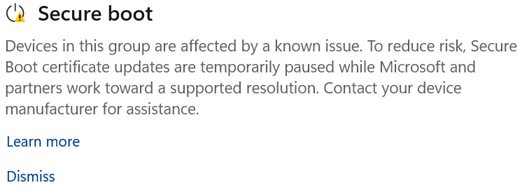
“Devices in this group are affected by a known issue. To reduce risk, Secure Boot certificate updates are temporarily paused while Microsoft and partners work toward a supported resolution,” Microsoft said.

Secure Boot issues

Secure Boot has long been a device-saving feature when it comes to removing malicious files, as it allows the device to verify and load only authentic software before booting to Windows. However if the device cannot receive certificate updates it can fall victim to threats at the boot-level before Windows is loaded.

Microsoft is currently working with manufacturers to issue a patch that will allow affected devices to install the new Secure Boot 2023 certificate, with HP issuing a BIOS update to allow the installation of the latest certificate.

What this means in practice is that some older devices, or devices that no longer receive updates via their Original Equipment Manufacturer (OEM), will not be able to apply Secure Boot and Boot Manager protections. Microsoft clarified that, “this results in a gradual reduction in long-term security—not an immediate risk or system failure. Continue to follow standard security practices, including staying current with Windows updates.”

So even if your device is blocked from installing the latest Secure Boot certificate, it will continue to work properly, other Windows updates will continue to work, and your Secure Boot version will continue to protect against known vulnerabilities. It’s just future vulnerabilities that users affected by this issue will need to be aware of.

Many users may not be aware of issues until they need to use Secure Boot, so the silver lining in Microsoft’s warning is that now is the perfect time to check if your Secure Boot is working properly.

How to check Secure Boot is up to date

To check if you are using the latest Secure Boot certificate, take the following steps:

  • Open the Windows Security app using the search bar
  • Navigate to the Device Security dashboard using the menu on the right hand side
  • Look at the Secure Boot section, and check for the following messages:

The Windows Secure boot section on the Device Security dashboard, showing that Secure Boot is working properly.

(Image credit: Microsoft)
  1. "Secure Boot is on"

If you see this message, Secure Boot is likely working properly. However, this does not display your certificates’ current state. Microsoft has been rolling out an update to show if your Secure Boot is running on the latest certificate, so make sure your don't have any pending Windows updates.

The Windows Secure boot section on the Device Security dashboard, showing that Secure Boot is affected by a known issue but can be updated by the OEM.

(Image credit: Microsoft)
  1. “Devices in this group are affected by a known issue.”

Devices with this message will likely be able to install the latest certificates once a firmware update has been issued by your OEM. Check your OEM update channel for availability.

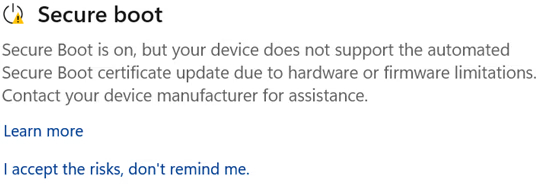
The Windows Secure boot section on the Device Security dashboard, showing that Secure Boot is not supported for the latest Secure Boot certificate.

(Image credit: Microsoft)
  1. “Secure Boot is on, but your device does not support the automated Secure Boot certificate update due to hardware or firmware limitations.”

Devices with this message may no longer be supported by your OEM, or the OEM might no longer be able to provide the firmware updates needed. Microsoft recommends checking your OEM’s Secure Boot support page to confirm whether your device is out of support.

Via WindowsLatest

‘The fate of humanity must not be decided behind closed doors’: US artificial intelligence sovereign wealth fund sees surge in support as AI job losses mount — 69% of Americans want to see half of AI stock placed into new state-owned investment fund

  • Americans want the massive wealth of AI firms added to a sovereign wealth fund
  • 69% would see AI firms forced to transfer 50% of stock into a sovereign fund
  • The fund would help redistribute wealth and back new infrastructure and developments for working class Americans

A national survey has found over two-thirds (69%) of US citizens want to see AI firms transfer half of their stock into a sovereign wealth fund.

The survey, conducted by Verasight among 1,690 adults, also found that there was overwhelming support (89%) for AI companies to publicly disclose the results of all internal safety testing.

The sovereign wealth fund, proposed by Senator Bernie Sanders, would provide wealth for current and future generations, as well as acting as a source of capital for investment in new projects and developments designed to improve the lives of working class Americans.

Americans want AI wealth redistribution

At the announcement of Sanders’ proposed American AI Sovereign Wealth Fund Act, the senator said, “It would guarantee that the economic benefits generated by AI are used to improve the lives of all of us — not simply to make the richest people in the world even richer.”

“The future of AI and the fate of humanity must not be decided behind closed doors in Silicon Valley by billionaires seeking to maximize their power and profit,” Sanders said.

Interestingly, the survey only saw a small dip in support to 64% when the sovereign wealth fund was tied directly to Sanders, showing the bi-partisan desire for the enormous growth in AI wealth to be redistributed among Americans.

According to a Goldman Sachs report, companies operating in the AI industry have added more than $27 trillion in market value since late 2022, with corporate profits and tech investment soaring. But at the other end of the scale, working class Americans are seeing jobs replaced and entry level positions disappearing due to AI technologies.

A further report from Goldman Sachs predicts that during the 10 year AI transitional period, up to 15 million US workers could lose their jobs - around 9% of the current US workforce.

In 2026 alone, the tech sector has seen more than 166,000 layoffs, with many attributed to the adoption of new AI technologies. The trueup layoff tracker expects this number to rise to 312,000 by the end of the year.

Electricity prices are also surging in the US due to the demand of AI data centers, raising the cost of day-to-day life of millions of Americans. As a result, US representatives have put forward a bi-partisan Ratepayer Protection Act that would force AI companies and hyperscalers to pay for the energy they use, with additional charges to help fund the expansion of electricity infrastructure that has been placed under additional load by data centers.

Via CNBC

Ireland’s data center electricity consumption rises 360% in ten years, and is set to account for as much power as every home combined — 23% of national power sent to servers despite moratorium on new data center grid connections

  • Ireland's data center electricity demand reportedly rises 360% in ten years
  • Data centers now account for 23% of the entire country's power consumption
  • New data centers can now only be constructed if certain power demand considerations are met

Ireland’s data center electricity consumption has risen 360% in ten years, and now accounts for 23% of the entire country’s electricity demand in 2026.

With total residential consumption accounting for 28%, and data center demand rising quickly, it won’t be long before the server farms overtake the consumption of Ireland’s population of just over five million.

These figures come from an Ireland Central Statistics Office report, which shows data center electricity consumption has risen 10% year over year from 2024 to 2025, despite a moratorium on new data center grid connections enacted in 2021. In total, the country’s data centers consumed 7,663 GWh last year, despite the rest of Ireland's demand rising only 2% in the same period.

Ireland battling data center power demand

The 2021 moratorium, put in place by Ireland’s Commission for Regulation of Utilities (CRU), required the national grid operator, EirGrid, to stop processing standard power applications for data centers in the Greater Dublin Area. New data centers built after this ruling were therefore required to supply their own on-site energy or construct new projects in regions not subject to this restriction.

Consumption since 2021 has risen steadily, prompting the CRU to replace the previous moratorium with the Large Energy Users (LEU) Connection Policy, which subjects new data center projects to a set of measures designed to ease the level of consumption on the national grid, while also creating new sources of energy.

Data centers over 10 MVA are now required to construct on-site, flexible power generation that covers 100% of demand, while also sourcing at least 80% of their annual electricity from new, unsubsidized renewable projects within six years.

Ireland has become a hub for big tech. Many companies have built European headquarters in the country, with hyperscalers such as AWS, Google, Meta, and Microsoft building and operating the majority of Ireland’s 89 data centers to power cloud infrastructure and AI models.

As a result of the rapid increase in demand, Ireland now has the highest electricity cost in Europe, with Irish households paying around €480 ($550) more per year compared to the EU average. Higher electricity prices have been a catalyst for data center opposition, especially in the US, where working class communities are challenging new data center projects at an unprecedented scale.

This opposition has been a leading contribution to more than half of US data centers being cancelled or delayed, with US citizens citing rising electricity costs, concerns over water consumption, and fears of AI job replacement as the main causes for opposition.

❌