❌

Normal view

Before yesterdayMobile

Snapdragon 8 Gen 3 vs Dimensity 8400: Benchmark score, spec sheet, and more

27 June 2026 at 09:50
Snapdragon 8 Gen 3 vs Dimensity 8400

While the Snapdragon 8 Gen 3 is almost three years old, it has gained significant popularity in recent months, and all of us are aware of the reason: the rising cost of memory and RAM, and the difficulty of securing chip production. MediaTek isn’t immune to these challenges either, but its Dimensity 8400 has fast become a strong alternative for high-end devices.

Both Snapdragon 8 Gen 3 and Dimensity 8400 deliver excellent performance and power efficiency, but there are areas where one is ahead of the other. In this post, I’ll break down the benchmark scores and key differences to help you figure out the best choice for your needs.

[Note: The Dimensity 8400 Max and Dimensity 8400 Ultra simply represent brand-specific software optimizations. They share identical hardware as the Dimensity 8400.]

Here’s the spec sheet to begin with:

Snapdragon 8 Gen 3Dimensity 8400
AnnouncedOctober 2023December 2024
Process node4nm (TSMC)4nm (TSMC)
CPU1 x 3.3 GHz (Cortex-X4)
3 x 3.15 GHz (Cortex-A720)
2 x 2.96 GHz (Cortex-A720)
2 x 2.27 GHz (Cortex-A520)
1 x 3.25 GHz (Cortex-A725)
3 x 3 GHz (Cortex-A725)
4 x 2.1 GHz (Cortex-A725)
GPUAdreno 750
ray tracing support
Snapdragon Elite Gaming features
Mali-G720 MC7
ray tracing support
MediaTek HyperEngine Adaptive Gaming Technology 3.0
NPUQualcomm Hexagon NPUMediaTek NPU 880
MemoryLPDDR5x, up to 4.8 GHzLPDDR5x, up to 4.2 GHz
StorageUFS 4.0UFS 4 + MCQ
CameraQualcomm Spectra triple AI ISP (18-bit)
up to 200MP single camera
up to 108MP single camera with zero shutter lag
up to 36MP triple cameras with zero shutter lag
real-time semantic segmentation (up to 12 layers)
up to 8K/30fps or 4K/120fps video recording
MediaTek Imagiq 1080 ISP
up to 320MP single camera
up to 32MP triple cameras at 30fps
semantic segmentation support
up to 4K/60fps video recording
ConnectivitySnapdragon X75 5G modem
download speed: up to 10 Gbps
upload speed: up to 3.5 Gbps
Wi-Fi 7 (peak speed: 5.8 Gbps)
Bluetooth 5.4
MediaTek 5G modem
download speed: up to 5.17 Gbps
Wi-Fi 6E
Bluetooth 5.4

Snapdragon 8 Gen 3 vs Dimensity 8400: Benchmark numbers

Note: The benchmark tests were performed on the iQOO 12 (powered by the Snapdragon 8 Gen 3) and the iQOO Z10 Turbo (powered by the Dimensity 8400).

Geekbench score

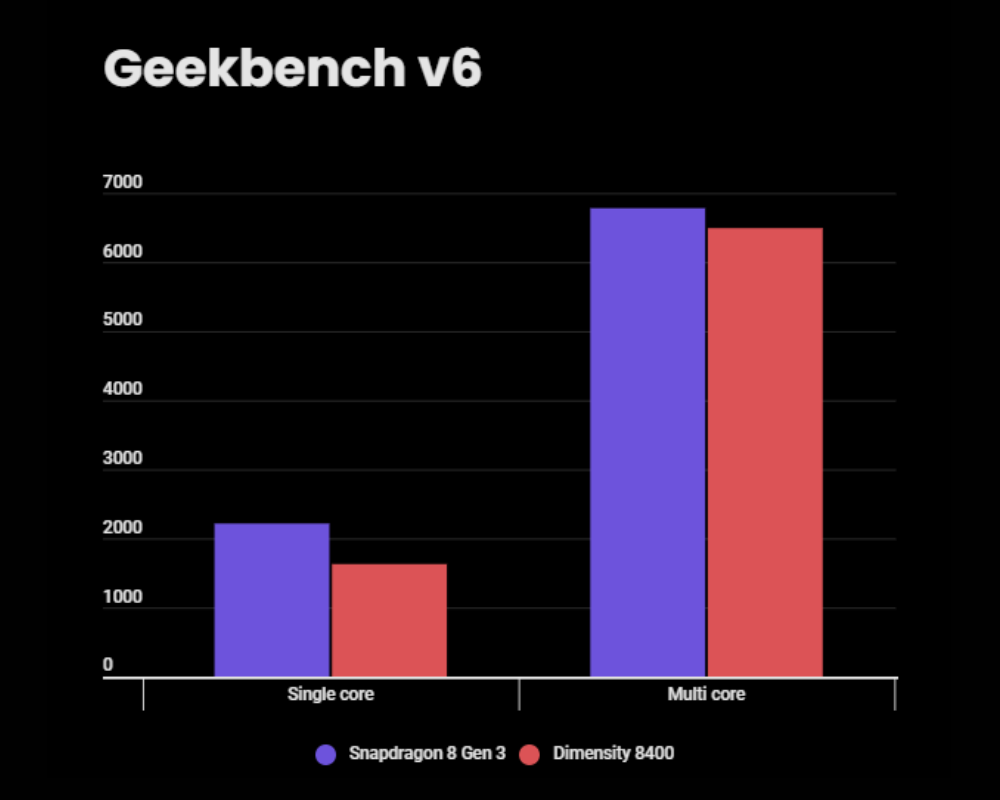
Snapdragon 8 Gen 3 vs Dimensity 8400 - Geekbench score

On Geekbench 6, the Snapdragon 8 Gen 3 posts a strong lead in the single-core performance, scoring 36% higher than the Dimensity 8400. That’s because of the powerful Cortex-X4 prime core.

Multi-core scores don’t have a significant difference, but the Snapdragon chip is still on the higher side.

Snapdragon 8 Gen 3Dimensity 8400
Single core22161629
Multi core67816492

AnTuTu score

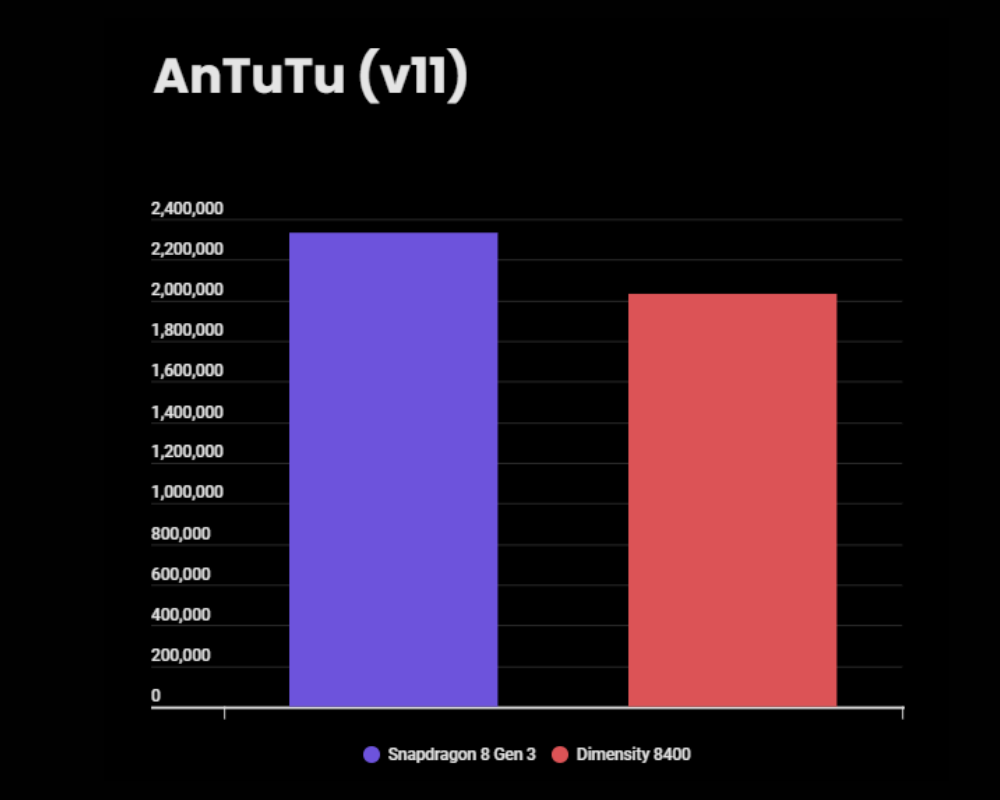
Snapdragon 8 Gen 3 vs Dimensity 8400 - AnTuTu score

On AnTuTu v11, the iQOO 12, powered by the Snapdragon 8 Gen 3 SoC, achieves a total score of over 2.3 million, while the Dimensity 8400-powered iQOO Z10 Turbo posts a total score of just above 2 million. That’s a solid 14% boost for the Snapdragon chip.

But what matters more is the breakdown of the AnTuTu score, which provides a clearer picture.

Snapdragon 8 Gen 3Dimensity 8400
AnTuTu score2,332,7912,031,886
CPU643,123624,883
GPU818,651645,958
Memory348,240295,315
UX522,777465,730

The Snapdragon 8 Gen 3 leads the CPU chart, but the difference is thin. The GPU score, however, makes a significant impact here. The Snapdragon chip achieves a massive 26% lead over the Dimensity 8400.

Memory and UX performance also favor the Snapdragon chip.

From benchmark results, it’s clear that the Snapdragon 8 Gen 3 has a more powerful CPU and GPU than the Dimensity 8400. However, benchmarks leave some important aspects untouched, such as connectivity and the camera. We’ve included the important differences in the following section.

Snapdragon 8 Gen 3 vs Dimensity 8400: Key differences that matter

Performance

Both the Snapdragon 8 Gen 3 and the Dimensity 8400 use ARM-designed CPUs but have completely different core configurations. The Snapdragon chip features a β€˜1+3+2+2’ core structure, while the Dimensity chip uses a β€˜1+3+4’ structure.

Snapdragon 8 Gen 3Dimensity 8400
Prime core1 x Cortex-X4 at 3.3 GHz1 x Cortex-A725 at 3.25 GHz
Performance core3 x Cortex-A720 at 3.15 GHz
2 x Cortex-A720 at 2.96 GHz
3 x Cortex-A725 at 3 GHz
Efficiency core2 x Cortex-A520 at 2.27 GHz4 x Cortex-A725 at 2.1 GHz

The Dimensity 8400 has an all-big-core CPU design, featuring superior mid-level and low-level cores. However, the powerful Cortex-X4 core and higher clock speeds on the Snapdragon chip have a greater impact.

For graphics-heavy tasks, the Snapdragon 8 Gen 3 has an Adreno 750 GPU, featuring more shading units and higher FLOPS than the Mali-G720 GPU on the Dimensity 8400. When it comes to gaming, the Snapdragon chip delivers higher, more consistent performance without noticeable lag.

Both processors also have integrated NPUs for on-device AI intelligence. The Hexagon NPU on the Snapdragon 8 Gen 3 supports generative AI models with up to 10 billion parameters. It also powers the image signal processor (ISP) to improve semantic segmentation, night shots, and photo expansion.

The Dimensity 8400 features a MediaTek NPU 880, optimized to support both Generative AI and Agentic AI, allowing the device to run complex, multi-step on-device AI agents. The AI engine is tightly coupled with the ISP, enabling real-time AI image and video enhancements.

Camera

The Snapdragon 8 Gen 3 utilizes the Spectra Cognitive ISP with three 18-bit pipelines to handle simultaneous data streams. It features real-time semantic segmentation up to 12 layers and integrates advanced AI features, including Video Object Eraser, Photo Expansion, Night Vision Video, and Generative AI Editing.

The Dimensity 8400, on the other hand, features a MediaTek Imagiq 1080 ISP, optimized to deliver high dynamic range, reduce noise in low-light environments, and ensure zero shutter lag across multi-camera configurations.

The Dimensity 8400 supports up to 4K video recording, while the Snapdragon 8 Gen 3 goes further up to 8K. The latter also supports Dolby HDR photo technology and Vlogger’s View.

Connectivity

The Snapdragon 8 Gen 3 utilizes an advanced Snapdragon X75 5G modem, offering up to 10 Gbps download speed and up to 3.5 Gbps of upload speed. In contrast, the Dimensity 8400 offers a lower peak speed of 5.17 Gbps.

While both chips support sub-6GHz connectivity, the Snapdragon chip also supports mmWave, which operates on ultra-high frequency bands. The Snapdragon chip also benefits from the newer Wi-Fi 7 standard, while the Dimensity 8400 is limited to Wi-Fi 6E.

Snapdragon 8 Gen 3 vs Dimensity 8400: Which is better?

The Snapdragon 8 Gen 3 is the clear winner here. It holds a distinct edge in raw performance, thanks to its higher clock speeds, powerful prime core, and superior Adreno 750 GPU. The chipset delivers more consistent, lag-free gaming and smoother graphics-heavy performance compared to the Dimensity 8400. It also offers modern connectivity features and higher peak speeds.

However, if you aren’t a gaming-heavy user, the Dimensity 8400 could be a better choice. It delivers smooth everyday performance, excellent power efficiency, and lag-free gaming on moderate settings. The Dimensity chip also stands out for agentic AI support.

The post Snapdragon 8 Gen 3 vs Dimensity 8400: Benchmark score, spec sheet, and more appeared first on Gizmochina.
OnePlus Nord 6 vs OnePlus 13R: Which OnePlus Phone Offers Better Value?

27 June 2026 at 08:03
oneplus nord 6 vs 13R

OnePlus has two compelling phones in the upper mid-range segment, but they target different buyers. The OnePlus Nord 6 is the newer 2026 model that focuses on modern hardware, exceptional battery life, and improved durability. Meanwhile, the OnePlus 13R launched in early 2025 as a premium performance-focused device with flagship-grade cameras and build quality.Β 

Although both belong to the same brand, they prioritize different aspects of the smartphone experience. Here’s a detailed comparison to help determine which OnePlus device deserves your money.

Major Features:

CategoryOnePlus Nord 6OnePlus 13RWinner
Design & BuildPlastic frame, plastic back, OnePlus Crystal Guard, IP68/IP69, MIL-STD-810HAluminum frame, glass back, Gorilla Glass 7i, IP65Nord 6 – Better durability
Display6.78-inch AMOLED, 165Hz, 3,600 nits peak, 3,840Hz PWM6.78-inch LTPO AMOLED, 120Hz, 4,500 nits peak, Dolby Vision13R – Better display quality
PerformanceSnapdragon 8s Gen 4, UFS 4.1, Android 16Snapdragon 8 Gen 3, UFS 4.0, Android 1513R – Faster flagship chip
Battery & Charging7,500mAh (Global) / 9,000mAh (India), 80W, bypass & reverse charging6,000mAh, 80W chargingNord 6 – Massive battery advantage
Rear Cameras50MP + 8MP ultrawide50MP + 50MP telephoto + 8MP ultrawide13R – More versatile cameras
Selfie Camera32MP AF, 4K video16MP, 1080p videoNord 6 – Better selfies
Software & FeaturesAndroid 16, OxygenOS 16, Bluetooth 6.0, Wi-Fi 7Android 15, OxygenOS 15, Bluetooth 5.4, Wi-Fi 7Nord 6 – Newer software
DurabilityIP68/IP69, MIL-STD-810HIP65Nord 6 – Superior protection
PricePriced around $500 / β‚Ή43,000Priced around $450 / β‚Ή40,00013R – Better value
OverallLatest generation with huge battery and longer software relevancePremium flagship experience with better cameras and performance for less13R – Better overall value
Disclaimer: Specs are based on available data. Actual performance may vary. Verify details from official sources before buying.


Design and Display

Build and Feel

The OnePlus Nord 6 adopts a practical approach with a plastic frame and back protected by OnePlus Crystal Guard on the front. While it doesn’t feel as premium as glass and metal, it compensates with IP68/IP69 protection and MIL-STD-810H certification, making it significantly more durable against water and dust than the OnePlus 13R. The 13R, however, offers a more premium in-hand feel thanks to its aluminum frame and glass back. It carries an IP65 rating, which is adequate for everyday use but falls behind the Nord 6’s much stronger protection. The newer Nord 6 clearly prioritizes longevity and durability over premium materials.

Display Quality

Both phones feature sharp 6.78-inch AMOLED displays with HDR support and excellent color reproduction. The Nord 6 stands out with a 165Hz refresh rate, 3840Hz PWM dimming, and up to 3600 nits peak brightness, delivering smoother animations and improved eye comfort. The OnePlus 13R counters with an LTPO AMOLED panel supporting Dolby Vision, HDR Vivid, and an even brighter 4500-nit peak. LTPO technology also improves power efficiency by dynamically adjusting the refresh rate. The Nord 6 feels smoother during gaming, while the 13R offers a richer multimedia experience.

Verdict

The OnePlus Nord 6 wins for durability and high-refresh gaming, whereas the OnePlus 13R delivers a more premium design and a better display for movies and everyday viewing.

Specifications Including Battery

Performance

The OnePlus Nord 6 introduces Qualcomm’s Snapdragon 8s Gen 4 paired with faster UFS 4.1 storage and Android 16 with OxygenOS 16 out of the box. Despite being positioned below the flagship series, it delivers excellent efficiency and modern AI capabilities. The OnePlus 13R uses the flagship Snapdragon 8 Gen 3, which still offers stronger GPU performance and slightly better sustained workloads, especially for demanding gaming and video editing. However, being a 2025 device means it starts with Android 15 and has one fewer year of software freshness compared to the Nord 6. The newer software gives the Nord 6 a longer useful lifespan.

Battery and Charging

Battery life is where the Nord 6 creates a huge gap. Its global model packs a massive 7500mAh battery, while the India variant increases that to an enormous 9000mAh. Combined with efficient hardware, it is built for multi-day usage. The 13R’s 6000mAh battery remains excellent, but cannot compete with such capacity. Both support 80W wired charging, though the Nord 6 also adds bypass charging and reverse wired charging for greater versatility.

Verdict

The OnePlus 13R remains the stronger raw performer, but the OnePlus Nord 6 feels like the more future-ready package thanks to newer software, dramatically larger batteries, faster storage, and improved charging features.

Camera

Main and Secondary Lenses

Camera hardware clearly favors the OnePlus 13R. It features a versatile triple-camera setup with a 50MP primary sensor, a dedicated 50MP telephoto lens offering 2x optical zoom, and an 8MP ultrawide camera. The telephoto lens makes portraits and zoom photography noticeably better. The Nord 6 uses a dual-camera system with a 50MP main camera and an 8MP ultrawide sensor. Optical image stabilization and 4K recording are available on both, but the lack of a telephoto lens limits the Nord 6’s photography flexibility. For users who enjoy capturing different perspectives, the 13R provides a more complete camera experience.

Selfie Camera

The Nord 6 surprisingly takes the lead for selfies with its 32MP front camera featuring autofocus and 4K video recording. The OnePlus 13R uses a simpler 16MP selfie camera limited to 1080p video. Content creators and frequent video callers are likely to appreciate the sharper selfies and higher-quality video offered by the newer Nord 6.

Verdict

The OnePlus 13R is the better overall camera phone because of its dedicated telephoto lens, but the Nord 6 delivers stronger selfies and better front-facing video quality.

Pricing

The OnePlus Nord 6 is priced around $500 (β‚Ή43,000), while the OnePlus 13R is priced around $450 (β‚Ή40,000). Although the 13R launched in early 2025, its lower price makes it an incredibly attractive option. Buyers get a flagship Snapdragon 8 Gen 3 processor, a premium aluminum-and-glass build, an LTPO AMOLED display, and a versatile triple-camera system with a telephoto lens for less money.Β 

The Nord 6 commands a premium because it introduces newer hardware, Android 16 out of the box, significantly larger battery options, stronger IP68/IP69 protection, and faster UFS 4.1 storage, making it better equipped for long-term ownership.

Verdict

OnePlus 13R offers better value for money at its current pricing. However, the OnePlus Nord 6 remains worth considering for users who prioritize battery life, durability, and a newer software platform over premium materials and camera versatility.

Disclaimer:
Prices are approximate and may vary based on country, region, launch timing, and applicable taxes. Always check whether the listed price is for a China unit or a global/international variant when purchasing.

Conclusion

The biggest difference between these phones lies in their priorities. The OnePlus Nord 6 is the newer-generation device, offering Android 16, Snapdragon 8s Gen 4, massive 7,500mAh or 9,000mAh battery options, IP68/IP69 protection, Bluetooth 6.0, and faster UFS 4.1 storage, making it a stronger choice for longevity. The OnePlus 13R, despite launching in early 2025, continues to impress with its flagship Snapdragon 8 Gen 3 chipset, premium aluminum-and-glass construction, LTPO AMOLED display with Dolby Vision, and a dedicated telephoto camera.Β 

Verdict

The OnePlus Nord 6 is the better choice for users who want the latest software, exceptional battery life, and stronger durability for years of use. The OnePlus 13R, however, becomes the better overall buy for most people thanks to its lower price, premium design, flagship performance, and more capable rear camera system.Β 

Disclaimer: This comparison is based on the specifications provided and is intended for general informational purposes. Actual performance, camera results, battery life, and overall experience may vary depending on real-world usage, software updates, and individual preferences.

Read More:

The post OnePlus Nord 6 vs OnePlus 13R: Which OnePlus Phone Offers Better Value? appeared first on Gizmochina.

❌
❌