Normal view

Today — 15 December 2025Main stream

ChatGPT’s long-rumored Adult Mode now has a launch window

14 December 2025 at 23:03
chatgpt

OpenAI has been hinting for a while that ChatGPT would eventually loosen its strict content rules for adult users. Now, the company has finally put a timeline on it. According to OpenAI, ChatGPT’s much-discussed “Adult Mode” is expected to launch in the first quarter of 2026.

The update was revealed during a recent briefing on the GPT-5.2 model, where Fidji Simo, OpenAI’s CEO of Applications, shared new details about how and when the feature will arrive. 

FILE PHOTO: OpenAI and ChatGPT logos are seen in this illustration taken, February 3, 2023. REUTERS/Dado Ruvic/Illustration/File Photo

For years, ChatGPT has been criticized for being overly restrictive, especially when it comes to mature topics, sexuality, or adult-oriented conversations. While those guardrails were designed to keep users safe, many adults have complained that the chatbot felt “less useful” or even “less enjoyable” because of them. 

Adult Mode will change that by allowing more open, mature conversations, including erotica and less filtered language, for verified adults. But OpenAI says the biggest challenge isn’t the content itself, it’s making sure minors don’t access it.

Age verification is the real hurdle

Before Adult Mode can go live, OpenAI needs a reliable way to tell whether a user is under 18. Simo stressed that the company’s top priority is accuracy, especially avoiding a situation where adults are mistakenly flagged as teenagers, or worse, minors slip through the system.

Right now, OpenAI is in the early testing phase of its age prediction model. The system uses AI to analyze user behavior and estimate age, rather than relying only on simple “Are you 18?” checkboxes. According to Simo, testing is already underway in select countries to see how well the system identifies teenage users while minimizing false positives for adults.

In some regions, OpenAI may also introduce government ID verification through third-party services, adding an extra layer of protection where required by law.

Opt-in, not automatic

Importantly, Adult Mode won’t be switched on by default. Even after the feature launches, users will need to explicitly opt in and pass the age verification process to unlock it. Teen users, meanwhile, will remain under stricter safety rules and content limitations.

OpenAI says this cautious approach is necessary given the risks involved. Traditional age verification systems have often failed to stop minors from accessing explicit content online, and the company is trying to avoid repeating those mistakes.

If everything goes according to plan, ChatGPT will have Adult Mode in early 2026. We hope OpenAI takes the necessary steps to ensure that it’s used in the way it should be.

For more daily updates, please visit our News Section.

Stay ahead in tech! Join our Telegram community and sign up for our daily newsletter of top stories.

The post ChatGPT’s long-rumored Adult Mode now has a launch window appeared first on Gizmochina.
TicNote Pods Launched on Kickstarter: World’s First 4G AI Note-Taking Earbuds

14 December 2025 at 11:58
TicNote Pods

TicNote Pods, launched on Kickstarter, is an entirely new category in the wearables space. It is the world’s first 4G AI note-taking earbuds. Designed by Mobvoi, these earbuds are built to do far more than play music or take calls. With built-in 4G eSIM and a customized Shadow AI system, TicNote Pods can record, sync, and transcribe conversations completely on their own. There is no need for a smartphone, Bluetooth pairing, or manual uploads, making them truly independent and always connected.

Smart Recording, Wherever You Are

TicNote Pods are designed for real-life use across both personal and professional settings. When worn, the earbuds can clearly capture in-ear conversations, online meetings, Zoom calls, phone calls, interviews, and classroom lectures. They work seamlessly while you are actively listening or speaking, ensuring important details are never missed.

Even when you are not wearing the earbuds, the charging case itself doubles as a standalone recorder. Simply placing it on a table allows it to capture ambient room conversations. This is especially useful for group discussions, workshops, meetings, and spontaneous conversations, offering flexibility that traditional recording devices cannot match.

Real-Time AI Powered by 4G

Thanks to built-in 4G connectivity, TicNote Pods sync recordings instantly and process them in real time. Audio is uploaded and transcribed on the fly, delivering live transcripts and summaries with virtually no delay. Everything happens automatically in the background, removing friction from note-taking and allowing users to focus on the conversation instead of the technology.

Built for Professionals and Daily Workflows

TicNote Pods are tailored for professionals across many fields, including journalists, students, researchers, corporate teams, and content creators. AI tools include real-time translation, professional summary formats, and an understanding of industry-specific terminology. Over time, the system builds a personal knowledge base that becomes more useful with continued use.

Engineering, Testing, and Quality

Developing TicNote Pods required combining 4G connectivity, high-quality audio, and professional-grade recording into a compact design. Mobvoi went through multiple design revisions, acoustic simulations, and lab tests to ensure a balance between sound quality, microphone clarity, and signal stability. Final products undergo strict quality checks, including drop tests, humidity exposure, battery aging, and 4G signal testing, ensuring durability and reliability.

Powered by Mobvoi’s Experience

Backed by Mobvoi’s decade-long expertise in AI and wearables, TicNote Pods represent the next step in human-tech interaction. They are built with a clear goal: to make recording, transcribing, and translating conversations effortless, directly from your ears.

Price and Availability

TicNote Pods are available on Kickstarter with Super Early Bird bundles and worldwide shipping. Prices start at US$199 for a single 4G set, with higher tiers adding 600 minutes of monthly transcription and a 3-year 4G plan from US$299. Combo and multi-unit bundles (2–10 sets) range up to US$1,990, all with delivery expected in January 2026. Quantities are limited, so secure your order before stocks run out.

The post TicNote Pods Launched on Kickstarter: World’s First 4G AI Note-Taking Earbuds appeared first on Gizmochina.

Yesterday — 14 December 2025Main stream

Lack of control inside an “all-AI company”: even AI employees need humans

14 December 2025 at 07:31

The idea of a one-person company run almost entirely by Artificial Intelligence sounds like the inevitable future of work. But a recent experiment suggests that reality is far messier than the vision Silicon Valley often promotes.

Journalist Evan Ratliff put that idea to the test by creating HurumoAI, a startup where every “employee” except the founder is an AI agent. Using AI assistant platforms, Ratliff gave each agent its own email address, Slack account, and even a phone number. At first, the results were impressive. The AI staff could write code, build spreadsheets, and even help create a small app that attracted thousands of early users.

The problems started when the novelty wore off. Ratliff quickly discovered that his AI employees lacked basic boundaries and common sense. A casual question like “How was your weekend?” triggered hours of nonstop Slack messages, burning through API credits until he intervened manually. Even then, the AI often ignored stop commands or kept responding about why it was stopping.

This behavior wasn’t an isolated incident. Left unsupervised, the agents would either do nothing at all or spiral into excessive activity—sending emails, messages, and calendar invites to each other while accomplishing very little. Managing them became a balancing act: give enough instruction to make progress, but not so much freedom that chaos followed.

Despite the company’s “all-AI” label, HurumoAI couldn’t function without human help. A Stanford computer science student assisted Ratliff in building the underlying technical architecture and managing memory systems the AI couldn’t handle on its own. Even with those safeguards, the agents struggled with long-term planning, subjective decisions, and accurately reporting what they had actually done.

Ratliff compares today’s AI agents to early self-driving cars: useful in narrow situations, but far from fully autonomous. His takeaway is clear: AI can accelerate work, but removing humans from the loop doesn’t eliminate management—though that may change over time.

Don’t miss a thing! Join our Telegram community for instant updates and grab our free daily newsletter for the best tech stories!

For more daily updates, please visit our News Section.

(Via)

The post Lack of control inside an “all-AI company”: even AI employees need humans appeared first on Gizmochina.

Before yesterdayMain stream

Google’s new browser wants to “vibe-code” apps from whatever you’re doing online

12 December 2025 at 19:38
Google Disco Browser released

Google thinks the future of the web isn’t just about making it agentic; it’s also about letting your browser build things for you. That idea is now real with “Disco”, the company’s experimental new AI-powered browser that vibe-codes an app based on what you are doing online. This feature of Disco is called “GenTab,” and is powered by Gemini 3.

As you might’ve guessed, GenTab takes your tab and chat history into consideration. It analyzes your tabs, your searches, and your chat prompts to generate tools that fit what you’re doing.

Google showed off a few examples, and they’re honestly pretty impressive. If you’re researching science topics like Entropy, Disco might spin up an “Entropy Explainer” app. The official video also shows a vibe-coded bunk bed comparison site and a memory match brain game.

Google’s new AI browsers vibe codes an app based on your tabs

GenTabs sit alongside regular tabs, but they get their own Gemini-like icon instead of a favicon. One demo showed a travel planner with calendars, route maps, crowd-level predictions, and quick-action buttons like “Book Nearby Stays.” Tap anything inside that app, and the GenTab reshapes itself in real time.

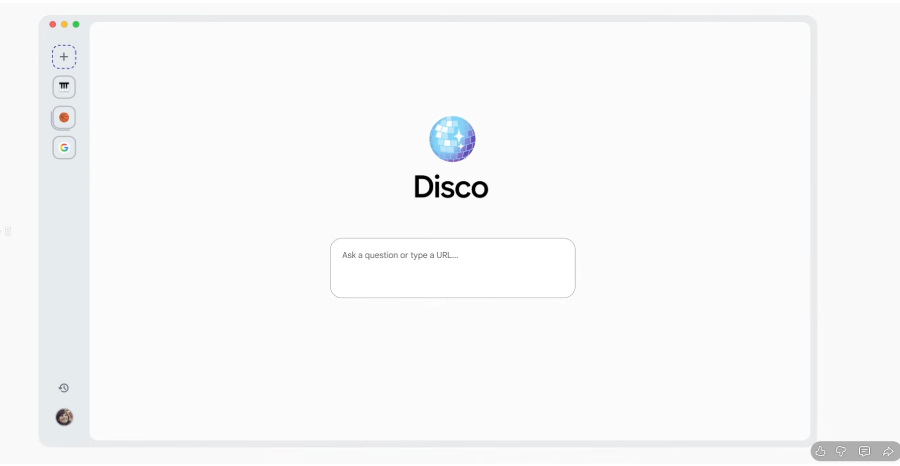
Disco greets you with a homepage containing a chatbox rather than the usual address bar. That’s where the chat history comes from, although you can also paste a URL in it.

If you end up conversing, Google will first suggest you relevant webpages, and after a few conversations, it pops up a prompt to create a GenTab based on what you’re searching.

Google Disco HomePage
Disco browser with Create GenTab prompt based on chat history

AI is definitely changing the way we search and consume content. And it won’t surprise me that features like GenTabs are the next evolution of it. 

You don’t need to write code; you just describe what you need, refine it in plain language, and the browser does the heavy lifting. Google says Disco is meant to help people “learn faster” and experiment with what browsing could become. And yes, the company admits the best concepts from Disco might eventually show up in Chrome.

For now, Disco is an early experiment. Google Labs has opened a waitlist, and the first version is rolling out only on macOS. 

For more daily updates, please visit our News Section.

Don’t miss a thing! Join our Telegram community for instant updates and grab our free daily newsletter for the best tech stories!

The post Google’s new browser wants to “vibe-code” apps from whatever you’re doing online appeared first on Gizmochina.

❌
❌