
 Login
Login

Snapdragon 8 Elite Gen 5 vs Dimensity 9500 vs Exynos 2600: Benchmark score, spec sheet, and key differences

Samsung has just released the Exynos 2600 with the Galaxy S26 series, and it feels like a real upgrade rather than just an annual refresh. The CPU now features all big cores, the GPU’s performance has improved dramatically, and the connectivity speed is just unmatched.
While the Exynos 2600 brings serious upgrades over the Exynos 2500, the real question is: how does it perform against its biggest rivals, the Snapdragon 8 Elite Gen 5 and Dimensity 9500? We’ll look at the spec sheet, benchmark numbers, and important differences to figure it out.
Here’s the spec sheet to begin with:
| Snapdragon 8 Elite Gen 5 | Dimensity 9500 | Exynos 2600 | |
|---|---|---|---|
| Announced | September 2025 | September 2025 | December 2025 |
| Process node | 3nm (TSMC) | 3nm (TSMC) | 2nm (Samsung) |
| CPU cores | 8-core | 8-core | 10-core |
| CPU configuration | 2 x 4.6 GHz (Oryon Gen 3 – Prime) 6 x 3.62 GHz (Oryon Gen 3 – Performance) | 1 x 4.21 GHz (C1-Ultra) 3 x 3.5 GHz (C1-Premium) 4 x 2.7 GHz (C1-Pro) | 1 x 3.8 GHz (C1-Ultra) 3 x 3.25 GHz (C1-Pro) 6 x 2.75 GHz (C1-Pro) |
| GPU | Adreno 840 ray tracing support Snapdragon Elite Gaming features | Immortalis Mali-G1 Ultra MP12 ray tracing support MediaTek HyperEngine Gaming Technology | Exynos Xclipse 960 GPU ray tracing support Exynos Neural Super Sampling Heat Path Block (HPB) |
| NPU | Qualcomm Hexagon NPU | MediaTek NPU 990 | AI engine with 32K MAC NPU |
| Memory | LPDDR5X, up to 5.3 GHz | LPDDR5X, up to 5.3 GHz | LPDDR5X |
| Storage | UFS 4.1 | UFS 4.1 | UFS 4.1 |
| Camera | Qualcomm Spectra Triple ISP (20-bit) up to 320MP single camera up to 108MP single camera (MFNR, ZSL, 30fps) up to 48MP triple cameras (MFNR, ZSL, 30fps) up to 4K/120fps video recording real-time semantic segmentation support | MediaTek Imagiq 1190 ISP up to 320MP single camera up to 8K video recording real-time semantic segmentation support | up to 320MP single camera up to 108MP single camera (30fps) up to 64MP+32MP dual cameras (30fps) up to 8K video recording real-time semantic segmentation support |
| Connectivity | Snapdragon X85 5G modem download speed: up to 12.5 Gbps upload speed: up to 3.7 Gbps Wi-Fi 7 (peak speed: 5.8 Gbps) Bluetooth 6.0 | integrated 5G modem (3GPP R17) download speed: up to 7.4 Gbps Wi-Fi 7 (peak speed: 7.3 Gbps) Bluetooth 6.0 | Exynos 5410 modem download speed: up to 14.79 Gbps upload speed: up to 4.9 Gbps Wi-Fi 7 Bluetooth 6.0 |
Quick verdict:
Choose Snapdragon 8 Elite Gen 5 if you want the best overall performance, stronger gaming power, and the most complete flagship experience.
Choose Dimensity 9500 if you care more about better gaming stability under heavy load and strong Wi-Fi 7 performance.
Choose Exynos 2600 if you want a more balanced chip with solid everyday performance, strong memory results, and promising efficiency and connectivity upgrades.
Snapdragon 8 Elite Gen 5 vs Dimensity 9500 vs Exynos 2600: Benchmark numbers
Note: To obtain the benchmark results, the tests were performed using these devices:
– Galaxy S26 Ultra (Snapdragon 8 Elite Gen 5)
– Vivo X300 Pro (Dimensity 9500)
– Galaxy S26 Plus (Exynos 2600)
Geekbench score
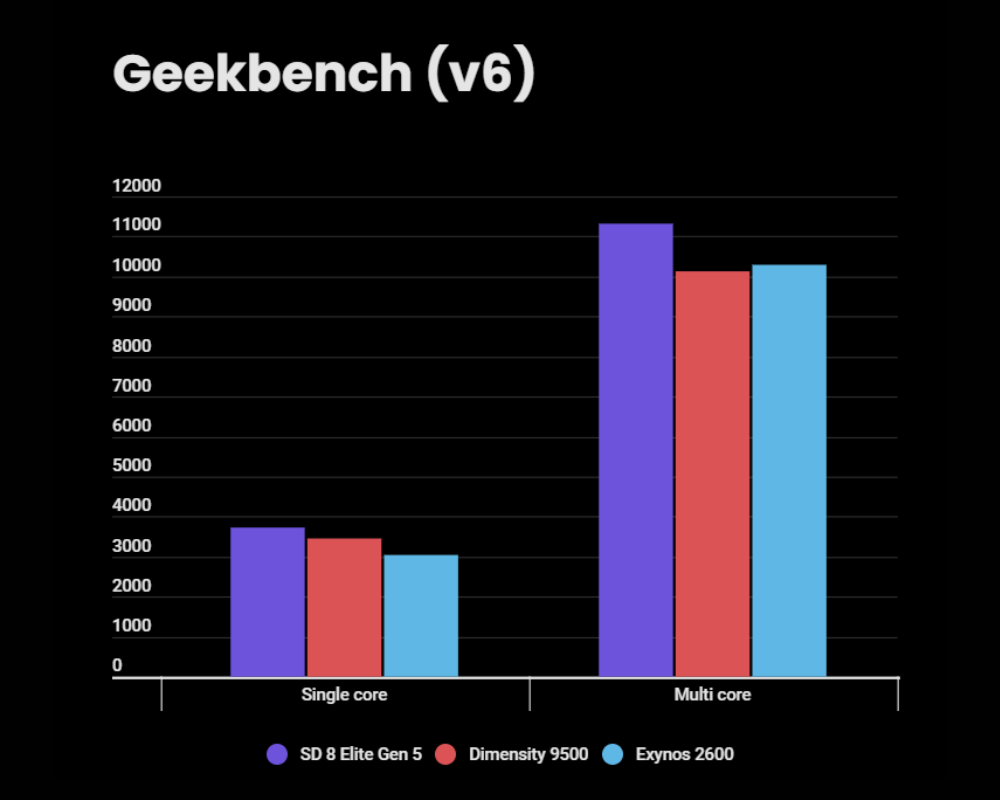
The Snapdragon 8 Elite Gen 5 delivers the best result in the Geekbench CPU test. It scored 3725 points in the single-core test, which is about 7% higher than the Dimensity 9500 (3452 points) and about 22% higher than the Exynos 2600 (3040 points).
| Snapdragon 8 Elite Gen 5 | Dimensity 9500 | Exynos 2600 | |
| Single core | 3,725 | 3,452 | 3,040 |
| Multi core | 11,318 | 10,128 | 10,290 |
In multi-core performance, however, the Exynos 2600 delivers a noticeably better score than the Dimensity 9500, scoring 10,290 points (vs. 10,128). The Snapdragon 8 Elite Gen 5 is miles ahead of them with a total score of 11,318 points.
AnTuTu score
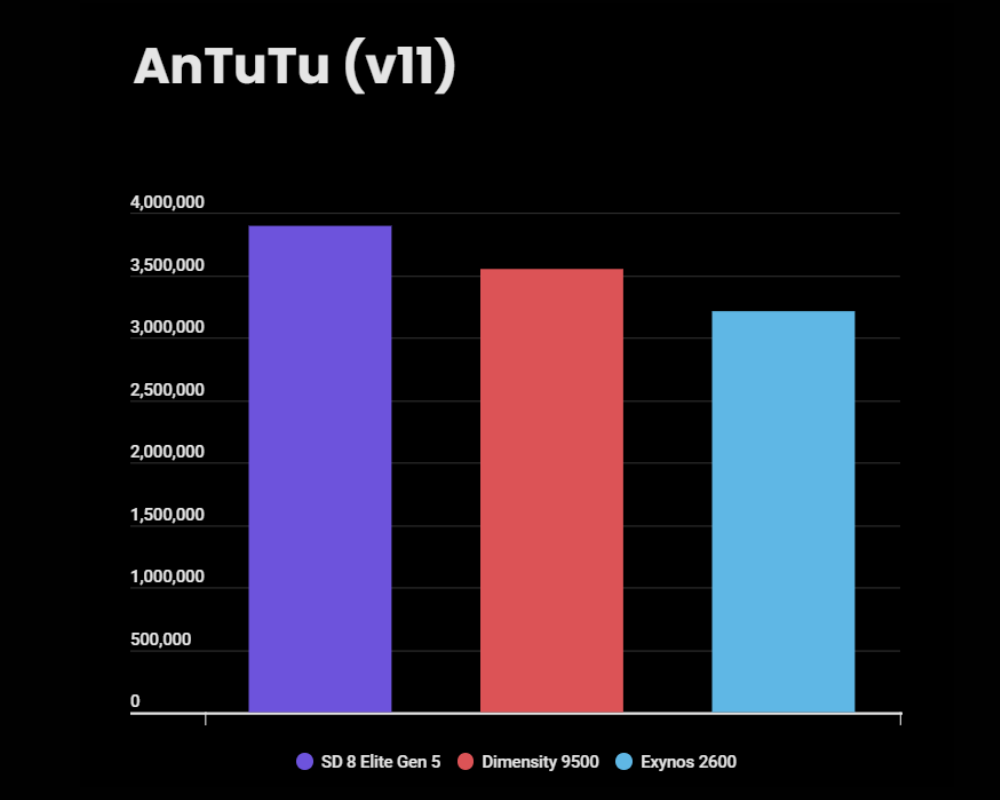
On the AnTuTu platform, the Snapdragon 8 Elite Gen 5 has scored close to 3.9 million points, putting it well ahead of the other two. The Dimensity 9500 scored 3.5 million, and the Exynos 2600 scored 3.2 million.
More important is the breakdown of the total score, which offers clearer insights. It shows a stronger CPU for the Snapdragon 8 Elite Gen 5, which scored 1.16 million points, followed by the Exynos 2600 (1.06 million points) and the Dimensity 9500 (1.03 million points).
| Snapdragon 8 Elite Gen 5 | Dimensity 9500 | Exynos 2600 | |
| AnTuTu score | 3,893,781 | 3,548,426 | 3,210,573 |
| CPU | 1,162,784 | 1,028,694 | 1,065,772 |
| GPU | 1,568,941 | 1,413,659 | 1,212,568 |
| Memory | 411,037 | 385,723 | 413,700 |
| UX | 751,019 | 720,349 | 518,533 |
The Snapdragon chip also scores the highest in the GPU test among the three chips, with a total of 1.56 million. The Dimensity 9500 is just behind it with 1.41 million score, while the gap widens with Exynos 2600, which has scored just 1.21 million points. Memory performance, however, favors the Exynos chip over the other two.
3DMark score
Wild Life Extreme performance
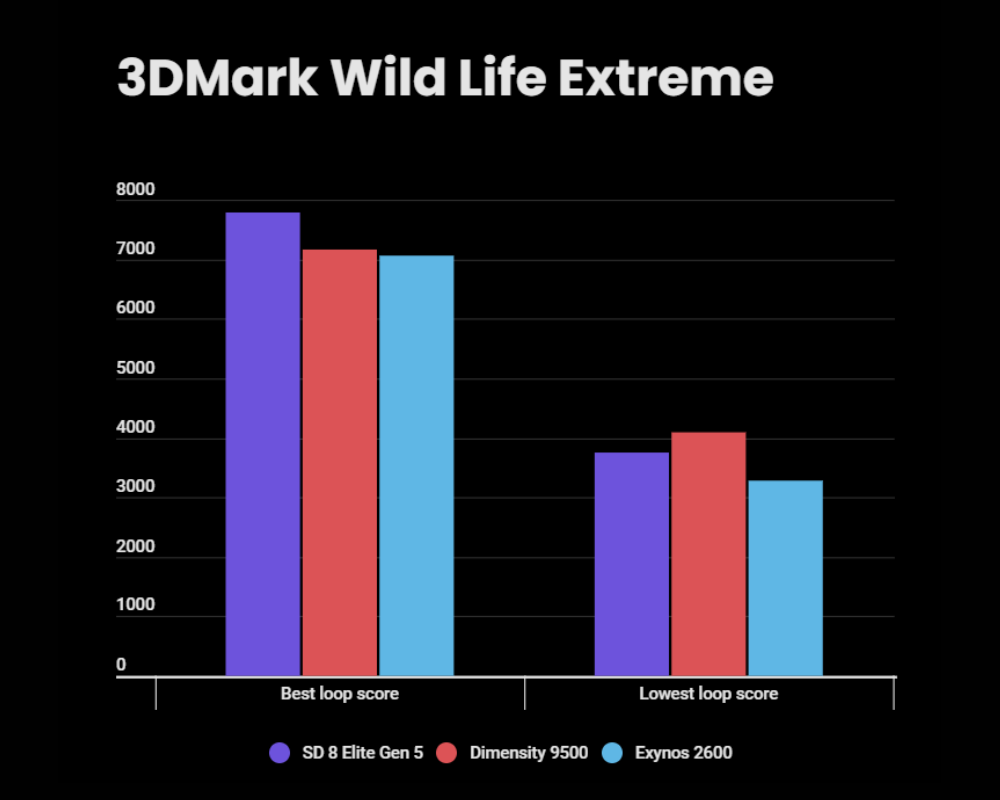
The Snapdragon 8 Elite Gen 5 takes the top spot here as well with the best score of 7786. The Dimensity 9500 sits below it with 7,163 points, and then comes the Exynos 2600 with 7,061 points. However, the order changes in the low score.
The Dimensity 9500 surprises with the best low score of 4,092 points. The Snapdragon 8 Elite Gen 5 and Exynos 2600 achieve a low score of 3,753 and 3,280, respectively. This results in better stability on Dimensity 9500.
| Snapdragon 8 Elite Gen 5 | Dimensity 9500 | Exynos 2600 | |
| Best loop score | 7,786 | 7,163 | 7,061 |
| Lowest loop score | 3,753 | 4,092 | 3,280 |
| Stability | 48.2% | 57% | 46.4% |
According to benchmark results we’ve seen so far, the Snapdragon 8 Elite Gen 5 offers much more promising CPU and GPU performance than the other two, while the competition between the Dimensity 9500 and Exynos 2600 is closer.
The benchmarks alone do not tell the full story; therefore, we’ve included a section below that discusses the camera, connectivity, and other important aspects.
Snapdragon 8 Elite Gen 5 vs Dimensity 9500 vs Exynos 2600: The differences you should know
The Snapdragon 8 Elite Gen 5 and Dimensity 9500 were announced in September 2025, built using TSMC’s advanced 3nm process node. Three months later, the Exynos 2600 arrived as the world’s first mobile chipset to use the 2nm GAA process, offering enhanced efficiency and thermals.
Performance
The Snapdragon 8 Elite Gen 5 offers an 8-core CPU, featuring third-generation Oryon cores, while the Dimensity’s 8-core CPU includes ARM’s C1-Ultra, C1-Premium, and C1-Pro cores. Unlike them, the Exynos 2600 features a 10-core CPU comprising C1-Ultra and C1-Pro cores.
The Snapdragon chip offers the highest peak clocked speed of 4.6 GHz, while the Dimensity 9500 peaks at 4.21 GHz and the Exynos 2600 peaks at 3.8 GHz. This helps the Snapdragon 8 Elite Gen 5 achieve better performance during demanding tasks.
For graphics-intensive workloads, the Snapdragon 8 Elite Gen 5 relies on the Adreno 840 GPU, which delivers excellent gaming performance and ray tracing capabilities. Plus, it comes with a full suite of Snapdragon Elite Gaming features to further enhance the gaming performance, stability, and battery efficiency.
The other two chips, the Dimensity 9500 and Exynos 2600, also deliver smooth gaming performance and support ray tracing. Plus, they integrate a range of features to improve the frame rate and the overall performance. Notably, the Exynos 2600 features Heat Path Block (HPB) for the first time on a mobile chipset, while the Snapdragon 8 Elite Gen 5 and Dimensity 9500 rely on phone-level passing cooling solutions, such as vapor chambers and graphite sheets.
AI and NPU
The Snapdragon 8 Elite Gen 5 features a hexagon NPU with agentic AI capabilities, enabling a proactive, on-device AI assistant for a personalised experience. The Dimensity 9500 with MediaTek NPU 990 NPU also supports agentic AI, but it isn’t explicitly mentioned on the Exynos 2600 official page. However, the latter, with 32K MAC NPU, offers on-device inference, Visual Perception System for proactive camera AI, and Nota AI integration for enhanced offline processing.
Camera and connectivity
All three chips feature advanced triple ISPs with support for up to 320MP single camera, real-time semantic segmentation, and 8K video recording. The Snapdragon and Exynos chips also offer Advanced Professional Video (APV) codec for lossless pro-level video capture and editing on smartphones.
On the connectivity side, there are several crucial differences. The Snapdragon 8 Elite Gen 5 and Exynos 2600 have integrated 5G modems, while the Exynos 2600 uses an external modem for better manufacturing yields and improved power efficiency. Furthermore, the Exynos chip excels at peak upload and download speeds over a 5G connection, while the Dimensity 9500 offers the highest Wi-Fi 7 speeds. The Snapdragon chip benefits from a mature modem with superior carrier integration.
The post Snapdragon 8 Elite Gen 5 vs Dimensity 9500 vs Exynos 2600: Benchmark score, spec sheet, and key differences appeared first on Gizmochina.
