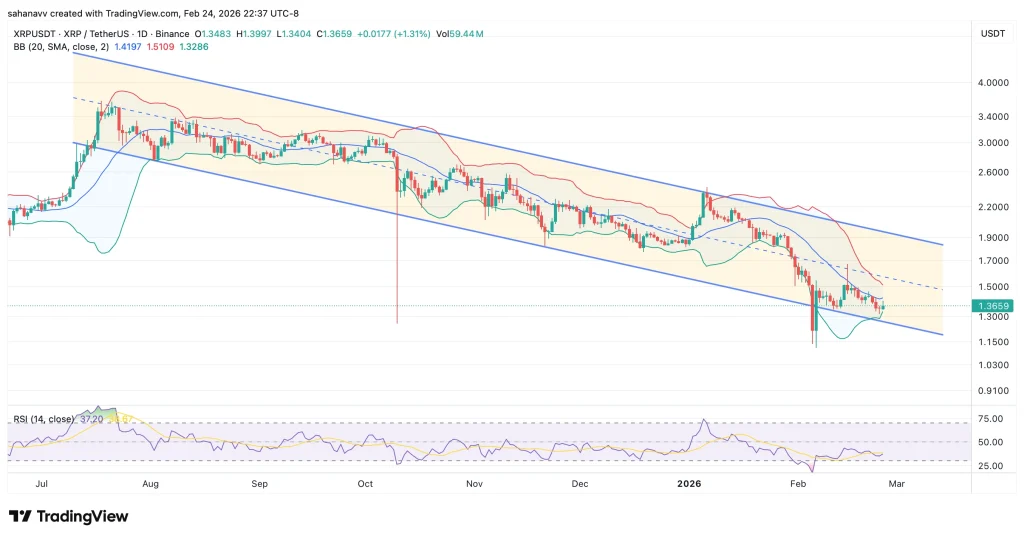
The crypto market is falling again, down about 2% and now near $2.27 trillion. Bitcoin, the flagship cryptocurrency, has erased its recent gains and is down to $65,253. Ethereum fell 4% in the last 24 hours.
Other altcoins, including XRP, Solana, Dogecoin, and Bitcoin Cash, also dropped between 5% and 18%.
So, what is pushing Bitcoin and Ethereum prices down today?
Hot U.S. PPI Data Triggers Selling
One major reason behind this drop is that the latest U.S. Producer Price Index (PPI) for January came in higher than expected.
January’s PPI came in at 2.9% year-over-year, above the expected 2.6%. Core PPI rose to 3.6%, also higher than forecasts. This suggests inflation remains strong, reducing the chances of an early interest rate cut by the Federal Reserve.
Higher rates usually make safer assets like bonds more attractive, pulling money away from riskier assets such as crypto.
Liquidations Hit Traders Hard
The sharp move caused heavy liquidations. Over 96,000 traders were wiped out in the past 24 hours, with total liquidations reaching around $260 million.
Nearly 70% of these were long positions, meaning traders who were betting on higher prices were forced to close. Bitcoin alone saw around $90 million in liquidations, while Ethereum recorded about $86.5 million.
Bitcoin Set to Close February in the Red
Bitcoin has erased all the gains it made on February 26, when it briefly moved close to $70,000. Now, the month is ending on a weak note, with Bitcoin down nearly 16.75% in February.
This marks the first time in Bitcoin’s history that both January and February have closed in the red, with losses of around 10% and 16.75%.
If Bitcoin falls below the $62,553 level, it could retest the recent four-week low near $60,000.
Interestingly, on the positive side, history shows that Bitcoin has often bottomed around 23 months after its previous all-time high. We are now at that same 23-month mark.
Altcoins Follow Bitcoin’s Drop
Meanwhile, Ethereum has also moved lower, falling about 5.7% in the past 24 hours after failing to break its recent four-week high.
Other major coins, including XRP, Solana, Dogecoin, and Bitcoin Cash, have recorded steeper losses between 5% and 18%. The broader market is clearly reacting to Bitcoin’s weakness.
On February 27, Bitcoin (BTC) was trading at $65,640, after failing to reclaim the $70K level two days ago. Its price is also below its 200-week exponential moving average (EMA) of $68,300, something that would trigger a historical additional bearish acceleration.
As stated in its Q4, 2025 earnings report, fintech conglomerate Block Inc. (NYSE: XYZ) acquired an extra 340BTC in that quarter, bringing its total holdings to 8,883 BTC and making it the 14th largest publicly traded holder of Bitcoin globally.
everyone worried about ai but consider that bro fired half his staff to free up cash to buy the BTC dip https://t.co/cbUmkqvVhn
Meanwhile, the leading publicly traded holder of BTC, Strategy, just recently acquired 592 BTC, bringing its stash to a total of 717,722 BTC.
Institutionally, BlackRock led the recent $1.1 billion inflows to US spot Bitcoin ETFs, breaking a five-week outflow streak of $3.8 billion. More institutions are expected to join the crypto industry, following the implementation of the GENIUS Act.
Why is Bitcoin still showing negative price action?
Mid-term volatility in the crypto market is the product of new US import taxes and the US-Iran geopolitical tensions. Both have caused widespread capital rotation to safe havens like gold, which now trades at $5,250 per ounce (20% up since January 2026).
Heightened inflation in the US has raised expectations that the Federal Reserve will extend current interest rates, causing downward pressure on crypto assets.
Markets today recorded significant intraday volatility as $8.7 billion in Bitcoin and Ethereum options expired. Meanwhile, the “AI Scare Trade” has seen 50% of global venture capital redirected from cryptocurrencies to AI companies. The Jane Street alleged market manipulation saga has done little to help the market.
BTC price prediction
Historically, Bitcoin has always bottomed roughly 23 months after its last all-time high (ATH). Time is now due since its March 2024 ATH of $73K, suggesting future downward price action.
Kalshi prediction markets show an 85% chance that Bitcoin drops below $65,000, echoing current extreme fear market sentiment.
On the flip side, most analysts now propose an elongated cycle of BTC price appreciation, following a break in the coin’s traditional four-year boom-bust cycles.
In past cycles, headlines like major institutional investments or global tech giants adopting blockchain would have sent crypto markets soaring. In 2026, the reaction has been very different.
Even as firms such as BlackRock increase exposure to decentralized finance projects like Uniswap, token prices have barely budged, sometimes even falling on the day of the announcement. When Meta revealed plans to expand stablecoin access to billions of users, the market response was muted. A few years ago, similar news would have dominated headlines for months.
So why isn’t good news translating into higher prices?
In bearish environments, investors tend to fixate on risk. Hougan describes this as a mix of anchoring bias and a survival instinct. When markets feel threatened, participants focus almost exclusively on downside scenarios. Positive developments are acknowledged but discounted.
In other words, when sentiment turns negative, it becomes extremely difficult for good news to shift perception.
That dynamic helps explain why major adoption milestones — institutional capital entering DeFi, payment giants expanding blockchain infrastructure, strong earnings from stablecoin issuers — are failing to ignite rallies.
A Growing Gap Between Reality and Sentiment
Behind the weak price action, the industry continues to advance.
Institutional investors are building tokenization platforms. Payment processors are integrating blockchain rails. Stablecoin usage is expanding globally. Real-world asset tokenization is moving from pilot programs toward production-level systems.
Yet crypto prices reflect caution, not growth. Hougan argues that this widening gap between fundamentals and market mood may be one of the largest in recent memory. The “vibes” remain poor even as structural adoption improves.
Historically, such disconnects have marked late-stage bear markets. Markets often bottom not when news turns positive, but when investors are too pessimistic to respond to it.
Why Prices Lag Fundamentals
Crypto cycles are rarely smooth reflections of progress. In bullish phases, prices often run far ahead of fundamentals. In bearish phases, the opposite happens: prices undershoot real-world development.
In 2025 and early 2026, expectations were high that accelerating institutional adoption would push valuations sharply higher. Instead, markets delivered a middling performance before slipping back into risk-off mode.
That disappointment may have amplified the current malaise. Investors who expected explosive upside from strong fundamentals are now reluctant to react to incremental positive updates.
The XRP Ledger ecosystem is entering what could be its most important transition since its early expansion phase.
After years of direct funding and builder programs, 2026 marks a shift in how development around XRP will be supported. Instead of relying heavily on centralized grant structures, the model is evolving toward a broader, more distributed system designed to give founders multiple pathways to build, raise capital, and scale.
With more than $550 million deployed into XRP Ledger initiatives since 2017, the next chapter is less about raw funding totals and more about structure, access, and global reach.
From Grants to a Broader Ecosystem Model
Over the past several years, the XRP Ledger has grown from a niche developer network into a global ecosystem spanning payments, decentralized finance, tokenization, gaming, artificial intelligence integrations, and enterprise financial applications.
Programs such as hackathons, accelerator cohorts, grants, and builder incentives have supported nearly 200 projects since 2021. These efforts helped strengthen infrastructure and push real-world use cases beyond experimentation.
Now, the roadmap for 2026 reflects a structural evolution.
Rather than concentrating funding primarily through Ripple-backed initiatives, support is expanding across independent organizations, regional hubs, venture capital firms, and community-led governance structures. The goal is simple: create a more resilient builder economy where access to capital and mentorship does not depend on a single gatekeeper.
One of the additions to the 2026 roadmap is the FinTech Builder Program.
As traditional financial technology firms increasingly explore blockchain rails, the focus is shifting toward institutional-grade applications. The new program is structured to guide founders building in areas such as stablecoin payments, tokenization, regulated financial services, and credit infrastructure.
Unlike earlier grant models, this initiative is designed to provide structured, long-term support. That includes product development guidance, technical integration with XRP Ledger infrastructure, and connections to venture networks.
The aim is to move projects beyond proof-of-concept stages and into production-ready financial tools.
Community Governance Gains More Influence
Another part of the 2026 direction involves decentralizing decision-making.
The launch of XAO DAO introduces a hybrid governance structure designed specifically for the XRP Ledger community. Instead of funding decisions flowing from a single organization, DAO participants will be able to vote on proposals, allocate microgrants, and help shape ecosystem priorities.
This shift toward community-driven allocation reflects a broader theme in the roadmap: long-term sustainability through distributed governance.
By expanding the number of stakeholders involved in funding decisions, the XRP ecosystem is attempting to reduce structural concentration while encouraging faster experimentation.
XRPL Commons and Regional Expansion
Independent ecosystem organizations are also playing a larger role.
XRPL Commons, which operates separately, continues to support builders through grants, partnerships, and incubation programs. Its nine-week incubator in Paris has already supported early-stage startups building directly on the ledger.
Meanwhile, regional expansion is accelerating. A new hub focused on the Asia-Pacific region is in development, aimed at strengthening local builder communities and ensuring that high-potential projects in APAC have direct access to global XRP infrastructure.
This geographic expansion is critical as blockchain adoption increasingly moves eastward, particularly in fintech-heavy markets.
Universities Enter the Picture
The University Digital Asset Xcelerator is also expanding in 2026.
After launching its first cohort in partnership with UC Berkeley, the accelerator model is scaling to institutions in Brazil and the United Kingdom. By tapping into university ecosystems known for producing venture-backed founders, the initiative seeks to bring academic innovation directly into blockchain entrepreneurship.
Venture Capital Participation Increases
Another trend heading into 2026 is deeper venture capital involvement.
Several global investment firms are increasingly active in mentoring and funding projects building on the XRP Ledger. Rather than depending solely on internal grants, founders are gaining exposure to broader capital markets.
This development suggests that XRP infrastructure projects are beginning to compete more directly in mainstream fintech investment circles.
Greater VC participation also means higher expectations around scalability, compliance, and real-world adoption.
Where XRP Fits Into the 2026 Vision
While much of the roadmap focuses on builders, the implications extend directly to XRP itself.
As more institutional-grade applications launch on the XRP Ledger, demand for network usage could expand beyond speculative trading. Payment rails, tokenized assets, and regulated financial services create different forms of on-chain activity compared to purely retail-driven cycles.
If execution matches ambition, 2026 may represent a pivot from experimentation toward structured financial infrastructure development.
That does not guarantee price outcomes. But it does signal a maturing ecosystem attempting to position XRP and its underlying ledger for broader financial integration.
A More Distributed Future
The overarching theme of the Ripple roadmap for 2026 is distribution.
Funding sources are diversifying. Governance is broadening. Regional hubs are expanding. University pipelines are forming. Venture firms are participating more directly.
For builders, that means more entry points.
For XRP holders, it means the ecosystem is evolving from a centrally supported growth phase into a multi-entity, globally connected infrastructure network.
How effectively this transition unfolds will determine whether 2026 becomes just another development cycle or a defining moment in the XRP Ledger’s long-term trajectory.
The Bitcoin Lightning Network just crossed $1 billion in monthly transaction volume for the first time. That is a 266% year over year surge that happened while Bitcoin’s price dropped 40% from its October peak. When usage grows during a crash, it tells you something the charts cannot. Crypto infrastructure is maturing faster than sentiment suggests, according to Bitcoin Magazine.
At the same time, XRP sentiment hit a five week high. Social activity climbed while the broader market bled. Elliott Wave analysts are calling XRP’s current sideways action a compression phase before a major breakout. Talk of a Nasdaq linked vehicle offering XRP exposure has improved the outlook. But even bullish analysts only target $4 to $9 for XRP. Strong performance for an established asset. Not the kind of return that changes your financial future.
Top 3 Cryptocurrencies to Buy in 2026
Pepeto Outperforms as Meme Infrastructure Demand Surges
Lightning volumes are climbing, which proves people still use crypto infrastructure even when prices swing violently. At the same time, you have seen how fast market mood changes. XRP gets pressure one week, and another large cap runs the next. If you hold one token and hope for the best, you are exposed to every shift in narrative. That is exactly why Pepeto is different. It is not a bet on one coin pumping. It is a bet on building the trading layer that profits no matter which meme coin takes off next. When the meme economy rotates, Pepeto processes the volume.
PepetoSwap is a zero tax cross chain swap announced by the team and close to being ready. The Pepeto Bridge transfers tokens between blockchains. The Pepeto Exchange is a meme coin listing hub approaching launch. These three products were built by a cofounder of the original Pepe token. Dual audits from SolidProof and Coinsult returned zero critical findings.
The presale has raised $7.33 million with 70% of supply filled, as reported by GlobeNewsWire. At $0.000000186, a 150x rally turns $4,000 into $600,000. Staking at 211% APY means a $10,000 hold generates $21,100 in yearly rewards. But the staking is just the holding bonus. The real opportunity is owning infrastructure before a Binance listing arrives.
XRP Price News: Ripple Shows Strength, but Returns Are Limited
In the latest XRP price news, social activity has climbed to a five week high. Traders bought dips and treated the move as consolidation, not collapse. Longer term narratives add support. Reports mention a possible Nasdaq linked vehicle offering exposure to XRP.
Technically, analysts target $4 to $9 if XRP price news turns bullish. For now, XRP needs to hold above $1.44. A break below would favour sellers. The current setup shows resilience. But a move from $1.44 to $9 represents roughly 525% over an extended timeline. Strong for a portfolio anchor, not for exponential wealth creation.
Bitcoin Holds Above $68,000
Bitcoin was trading near $68,100 after recovering from $60,000 lows. On chain data shows whale wallets added 53,000 BTC in one week. Support sits at $67,000 with stronger backing near $65,000. A weekly close above $70,000 could unlock $75,000 to $80,000.
Spot Bitcoin ETFs just posted $560 million in weekly inflows after weeks of redemptions. Institutional demand is returning. But at $1.3 trillion in market cap, Bitcoin’s upside is measured in percentages, not multiples.
Conclusion
Lightning crossing $1 billion barely moved Bitcoin or XRP. That tells you where attention shifts next. Usage grows. Infrastructure matures. And then capital rotates into the projects that serve the next wave. SHIB went from nothing to $40 billion with zero products. DOGE turned a joke into generational wealth. Pepeto has three products approaching launch, a Pepe cofounder, dual audits, and the viral energy of a meme coin with real utility. At $0.000000186, six zeros do not last once the listing day arrives. The window between presale and exchange is where millionaires are made. That window is closing.
What does the XRP price news today mean for investors?
XRP price news today shows resilience with a five week sentiment high. But Pepeto offers far greater upside at six zeros with three products approaching launch.
Why did the Lightning Network crossing $1 billion matter?
It proves crypto usage grows even during price crashes. Infrastructure demand increases regardless of market sentiment, which is exactly the thesis behind Pepeto.
Is Pepeto a better investment than XRP in 2026?
XRP targets $4 to $9 over an extended timeline. Pepeto at $0.000000186 offers 150x potential with real meme economy infrastructure and a Binance listing approaching.
Pi Network is reinforcing its utility-first vision with a new framework designed to ensure ecosystem tokens are tied to real applications, not speculation. On February 27, co-founder Chengdiao Fan introduced the PiRC1 proposal in a detailed video shared through official Core Team channels.
The timing is notable. The update comes just after the first anniversary of Pi’s Open Network launch, signaling what the team describes as the next phase of ecosystem growth. The message is simple: tokens must power working apps, support real users, and contribute measurable value to the network.
Utility Over Speculation
Under the proposed PiRC1 structure, ecosystem tokens will be community-created assets built on the Pi blockchain, but with stricter entry requirements.
Unlike many token launches across Web3, Pi’s framework requires projects to have a functioning product before issuing a token. In other words, no live app means no token launch.
Fan emphasized that the focus is “not on tokens for their own sake.” Instead, tokens are meant to accelerate user acquisition, engagement, and service delivery. This product-first rule aims to prevent empty launches that prioritize fundraising over functionality.
A Different Liquidity Model
Another major shift involves how funds are handled. Instead of sending token proceeds directly to project teams, the framework proposes routing committed Pi into permanent liquidity pools.
According to the Core Team, this design serves three purposes:
Strengthen token stability
Reduce the risk of fund misuse
Align long-term incentives within the ecosystem
By separating fundraising from direct project control, Pi is attempting to introduce a structural safeguard rarely seen in typical token launches.
Projects launching ecosystem tokens must clearly define real-world use cases. Tokens should function as tools within apps, not stand-alone financial instruments.
Because Pi’s network consists of KYC-verified users, the team believes builders will operate under greater accountability compared to anonymous blockchain environments. This added layer of transparency is intended to push developers toward delivering real, usable products rather than speculative concepts.
Community Input Before Finalization
Importantly, PiRC1 is not final. The proposal has been released publicly for feedback via GitHub and Google Forms through March.
This open review approach reflects Pi Network’s community-driven identity. Alongside upgrades to migration systems and developer tools, the new token framework highlights the network’s broader objective: scale through utility, not hype.
Whether this structured model succeeds will ultimately depend on developer adoption and consistent execution in the months ahead.
Never Miss a Beat in the Crypto World!
Stay ahead with breaking news, expert analysis, and real-time updates on the latest trends in Bitcoin, altcoins, DeFi, NFTs, and more.
FAQs
What is the Pi Network PiRC1 proposal?
PiRC1 is a new framework requiring ecosystem tokens on Pi to be tied to a working real-world application, aiming to prioritize utility and long-term value over market speculation.
How does PiRC1 reduce token misuse risk?
Token proceeds would go into permanent liquidity pools instead of directly to teams, helping stabilize tokens and limit misuse of raised funds.
Can anyone launch a token under PiRC1?
Only projects with a working app and clear real-world use case can launch tokens, ensuring higher quality and stronger accountability.
Is PiRC1 finalized or still under review?
PiRC1 is still a proposal. The Core Team has opened it for community feedback before finalizing the framework.
The Chainlink price is hovering in that uncomfortable zone traders know all too well, compressed, quiet, and coiled. At $8.79 on the LINK/USD perpetual market, it doesn’t look heroic. But peel back the layers, and the setup feels anything but sleepy.
Chainlink isn’t some fringe token chasing hype. It’s a crypto oracle platform connecting blockchains to real-world data, and since 2022, it has facilitated over $28 trillion in transaction value, at least according to its own figures. That’s still small change compared to global finance, sure. But it’s not nothing. And when you look more that’s where it gets more interesting.
Whale Games in Motion
The Chainlink price may be drifting sideways to down, yet the Whale vs. Retail Delta is flashing a deep negative reading of -31.040. Translation? Retail traders are likely panic-selling or getting liquidated, while larger players appear to be absorbing the pressure.
This kind of divergence doesn’t guarantee fireworks. But historically, when retail exhaustion peaks and price stabilizes, accumulation phases tend to form. Whales don’t chase green candles. They build positions when nobody’s looking.
So while social feeds obsess over a gloomy Chainlink price prediction narrative’s, the smart money might be playing a longer game.
Technical Tension Building in Chainlink Price
A glance at the Chainlink price chart adds more texture. The RSI sits at 44.38, climbing out of oversold territory. Not euphoric. Not overheated. Just recovering. Meaning, momentum to the downside is fading.
Then there’s the Chaikin Money Flow at 0.04. It’s modestly positive, suggesting capital is sneaking back in even as headlines remain cautious. That’s a subtle but meaningful shift.
Still, sell volume (324.51K) outweighs buy volume (192.94K), keeping the LINK/USD pair suppressed. In plain English: buyers are nibbling, but sellers haven’t fully backed off.
Big Partners, Bigger Ambitions
Fundamentally, Chainlink isn’t short on ambition. It commands nearly 70% of the decentralized finance oracle market and around 84% share on Ethereum. Over 2,000 price feeds (including streams and smart data) and oracle integrations are live. Its Cross-Chain Interoperability Protocol now spans over 70 blockchains.
Add partnerships tied to global payment networks and major financial institutions, and the narrative gets stronger. The platform wants to be plumbing for online finance. Whether it gets there is another story.
So what’s next for the Chainlink price? Technically, it’s sitting near long-term support, with signs of retail capitulation and mild capital inflows. It’s not a breakout yet. Not even close. But if accumulation is underway, today’s dull price action might look very different in future.
Billionaire investor Grant Cardone says his company, Cardone Capital, is preparing to tokenise about $5 billion in U.S. real estate assets, aiming to turn property equity into digital tokens that can improve liquidity and act as collateral in secondary markets. The firm is exploring Layer 2 blockchain partners to support high‑volume token issuance and lower transaction costs as part of a broader strategy that includes holding Bitcoin. This push reflects growing interest in real estate tokenisation, projected to expand significantly despite regulatory hurdles.
ZKsync has announced that ZKsync Lite will be retired on May 4, 2026, with block production stopping and the network’s final state permanently frozen to ensure balances cannot change. Launched as a payment-focused ZK-rollup, ZKsync Lite helped demonstrate the potential of zero-knowledge technology, but the project is now concentrating on newer chains and the broader zkSync ecosystem. Users can still claim their funds, and other ZKsync systems will continue operating without disruption.
Bitcoin is currently trading at: $ 65,615.51740221
Predictions suggest BTC to hit $150K to $250K before 2026 ends.
Long-term forecasts estimate BTC prices could hit $900K by 2030.
After a historic 2025 that saw Bitcoin shatter records and flip the legendary $125,000 mark, the market has taken a sharp, cooling turn. The early weeks of 2026 have been defined by a “sell-the-news” reality check, leaving many to wonder if the bull run has finally run out of steam or if we are simply witnessing the ultimate “buy the dip” opportunity.
The landscape has shifted. With a pro-crypto administration in the White House and institutional giants like MicroStrategy and Metaplanet treating BTC as a foundational reserve asset, the rules of the game have changed. No longer just a speculative play for retail traders, Bitcoin is now a geopolitical chess piece and a corporate balance sheet staple.
But as the price tests crucial support levels, the big question remains: Is this a temporary correction before a march toward $200,000, or the start of a long-term reset?
In this deep dive, we break down the Bitcoin price prediction for 2026–2030, exploring the massive trends, regulatory shifts, and institutional moves driving this historic cycle. If you want to know where the floor is and how high the ceiling goes. read on for the full scoop.
Coinpedia’s BTC Price Prediction 2026
In early 2026, Bitcoin is in a correction phase after peaking at around $126,296 in October 2025. A potential bottom may occur around December 2026, with significant support expected between $25,900 and $30,350. Historical trends suggest this decline could reach 70%-76%, potentially bringing Bitcoin down to the lower border of the ascending broadening wedge’s support. This period may mark the end of the bear market, with 426 days in total, similar to historical correction periods, and pave the way for a rally in the next year.
What is the Bitcoin price prediction for today?
The BTC price may range between $62,709.82 and $66,496.74 today.
Bitcoin price in february is consistently trading below the 20-day EMA band, and consolidating within the range of $60,000 to $70,000. The outcome of this range will significantly influence how the first quarter of 2026 concludes, either below or above this range, amking March to be an key month.
In the near term, the critical support level at $60,000 is essential to prevent a further decline in Bitcoin’s price. A breakout above $70,000 could trigger a relief rally toward the 200-day EMA band.
Currently, the Crypto Fear and Greed Index remains in the Extreme Fear category; however, it may shift to neutral if short-term demand triggers a relief rally. Conversely, if Bitcoin continues its downward trend, the index could deteriorate further.
Additionally, the 50-day EMA is currently below the 200-day EMA, indicating a death cross that has been in effect since mid-November. A shorter-term death cross between the 20-day and 50-day EMAs occurred in late January, further confirming the prevailing bearish trend.
This volatile market behavior is likely to persist until a significant influx of buyers returns to the market. Should buyers return in substantial numbers, a reversal may occur, accompanied by a relief rally. The primary target for March is projected at $78,000, with a secondary target of $92,000 in the short term. Presently, we are seeing a dominant bearish market structure; any decline below $60,000 could increase the chances of a relief rally in March.
Bitcoin Price Prediction 2026
The current price action in early 2026 confirms that Bitcoin price is following a well-defined historical rhythm within its long-term ascending wedge. After reaching a peak of approximately $126,296 in October 2025, the market has entered a significant correction phase.
This peak was not accidental; it represented a direct hit on the upper resistance boundary of the wedge pattern that has governed Bitcoin’s macro price action for years. Historically, these touches lead to extended periods of decline the first major crash from $21,000 lasted 427 days, while the second from $69,000 lasted 426 days. If this 14-month corrective cycle holds true, we are looking at a “target date” for a definitive bottom around December 2026.
The intensity of the sell-off in February 2026 was largely driven by a failure to reclaim the $87,800–$92,950 supply range. According to the anchored volume profile, this zone represented the highest momentum area of the previous bearish move, and once it flipped from support to resistance, the downward pressure has accelerated. Since markets don’t go straight, there will be attempts to rise in the name of relief rallies, and the nearest relief rally could come targeting $97K, but the likelihood is high that these will occur in the future as fakeouts and result in further decline.
As we look toward the remainder of 2026, the charts suggest that the most significant high-momentum demand area sits much lower, specifically between $25,900 and $30,350.
This range represents a crucial “interest zone” where institutional buyers previously stepped in and where the lower support of the ascending wedge is likely to converge by year-end.
Statistically, Bitcoin’s major crashes have shown a trend of diminishing returns in terms of percentage drawdowns. The late 2017 onwards crash saw an 87.25% decline, and the 2022 crash reached 78.65%. Following this trajectory of “dampening volatility,” the current third crash is projected to result in a 70%-76% approx decline. From the $126,000 ATH, a 76% correction would push the price toward that critical $30,000 region.
Consequently, the prediction for December 2026 is a final test of the wedge’s lower border within this demand zone, marking the end of the current bear cycle and setting the stage for the next period of accumulation and next big rally could occur in 2027 onwards.
BTC Price Indicator Analysis 2026
Similarly, the technical indicators shows that Bitcoin price has already entered a danger zone we haven’t seen in years. On a deeper look at the monthly RSI, BTC has a legendary track record of never hitting “oversold” levels; it usually bottoms out right around the 40 mark. Right now, we’re sitting at 44.49 and sliding fast. This isn’t just a dip it’s the classic signal that the bearish momentum is finally taking over and heading for that historical floor.
The indicators under the hood are screaming the same thing. The MACD has already locked in a bearish cross, and the gap between the lines is widening. In past crashes, the selling hasn’t stopped until those lines flattened out near the zero mark. We aren’t even close to that “exhaustion” point yet, meaning there is plenty of room for this to bleed out further.
Even the “smart money” indicator (CMF) is still showing positive inflows for now, but that’s actually the scary part. Once that green line snaps below zero and heads toward -0.20, that’s when the real panic hits. We aren’t at the end of the crash; we’re in the middle of it. Don’t mistake this for exhaustion, as the collapse toward the pattern’s lower border would soon intensify.
Month
Potential Low
Potential Average
Potential High
2026
$30,000-$45,000
$90,000 – $101,000
$115,000 – $118,000
Bitcoin Price On-chain Outlook
Liquidation data shows roughly $5.81 billion on the short side, compared with just over $380 million on the long side. That imbalance matters because it’s completely dominated by bears and bulls, with no room for survival. It suggests traders are leaning into weakness rather than preparing for a sustained rebound.
In other words, the futures market isn’t buying the bounce. It’s betting against it.
And if BTC price drifts lower again, that heavy short positioning could amplify volatility rather than cushion it. This is why any BTC price prediction right now carries asymmetric risk.
Moreover, the BTC long-term holder SOPR chart shows a current value of 0.7, which is below 1, indicating that more long-term investors are selling at a loss. And it’s seen when more holders keep selling at a loss, this metric has a history of hitting the 0.2-0.3 mark, which has truly seen a fresh demand. For now, the long-term trend is more bearish.
Recent Events Affecting Bitcoin’s Price
The transition from late 2025 into early 2026 saw Bitcoin flip from a booming success story into a struggling “bear market.” After hitting its peak in October, the excitement cooled off fast as the fundamental pillars holding up the price began to crumble at the same time.
By December, the “cheap money” era felt officially over. The Federal Reserve confirmed that high interest rates weren’t going anywhere, and the nomination of Kevin Warsh to replace Jerome Powell signaled a shift toward even tighter financial discipline. This left investors spooked, fearing a future without the safety net of central bank support.
The situation worsened in January when big institutional players started pulling their money out of spot ETFs to lock in profits. At the same time, rising tensions between the U.S. and Iran proved that Bitcoin isn’t yet seen as a “safe haven” but investors ditched crypto for actual gold to avoid the risk.
Finally, a “double blow” of bad news drained what was left of the market’s momentum. Crucial crypto legislation, the CLARITY Act, got stuck in the Senate, leaving the industry in legal limbo. Meanwhile, new fears about quantum computing threats to blockchain security started to circulate. Together, these events broke the market’s confidence, pushing the price toward the lower end of its long-term trend.
Bitcoin Crypto Price Prediction 2026 – 2030
Year
Potential Low ($)
Potential Average ($)
Potential High ($)
BTC Price Forecast 2026
150K
200K
230K
BTC Price Prediction 2027
170K
250K
330K
Bitcoin Predictions 2028
200K
350K
450K
BTC Price 2029
275K
500K
640K
Bitcoin Price Prediction 2030
380K
750K
900K
BTC Price Forecast 2026
The BTC price range in 2026 is expected to be between $150K and $230K.
BTC Price Prediction 2027
Subsequently, the Bitcoin price range can be between $170K to $330K during the year 2027.
Bitcoin Predictions 2028
With the next Bitcoin halving, the price will see another bullish spark in 2028. Specifically, as per our Bitcoin Price Prediction, the potential BTC price range in 2028 is $200K to $450K.
BTC Price 2029
Thereafter, the BTC price for the year 2029 could range between $275K and $640K.
Bitcoin Price Prediction 2030
Finally, in 2030, the price of Bitcoin is predicted to maintain a positive trend. Indeed, the BTC price is expected to reach a new all-time high, ranging between $380K and $900K.
Based on the historic market sentiments and trend analysis of the largest cryptocurrency by market capitalization, here are the possible Bitcoin price targets for the longer time frames.
Year
Potential Low ($)
Potential Average ($)
Potential High ($)
2031
$540,830.43
$901,383.47
$1,261,936.86
2032
$757,162.60
$1,261,936.86
$1,766,711.60
2033
$1,059,945.80
$1,766,711.60
$2,473,477.75
2040
$5,799,454.28
$9,665,757.13
$13,532,059.98
2050
$161,978,188.65
$269,963,647.74
$377,949,106.84
Bitcoin Prediction: Analysts and Influencers’ BTC Price Target
“Jack Dorsey, former Twitter CEO (now X), predicts Bitcoin could exceed $1 million by 2030 due to its ecosystem growth and increasing adoption.”
Cathie Wood, CEO of Ark Invest, projects Bitcoin to reach $1.5 million by 2030, driven by institutional adoption and its position as digital gold.”
“Wall Street broker Bernstein believes 2026 will mark the start of a tokenization “supercycle,” maintaining its $150,000 Bitcoin price target for this year and $200,000 for the 2027 cycle peak.”
“Brad Garlinghouse, the Ripple CEO, predicts Bitcoin will hit $180,000 in 2026, due to favorable market and regulatory conditions.”
Never Miss a Beat in the Crypto World!
Stay ahead with breaking news, expert analysis, and real-time updates on the latest trends in Bitcoin, altcoins, DeFi, NFTs, and more.
FAQs
What are the biggest risks to Bitcoin’s price in 2026?
Major risks include global recessions, tighter crypto regulations, declining liquidity, or a sustained breakdown below key support levels.
How much will BTC be worth in 2030?
Bitcoin price forecasts for 2030 range from $380K to $900K, driven by scarcity, long-term adoption, and expanding institutional participation.
What will be the price of Bitcoin in 2050?
While uncertain, many long-term projections suggest Bitcoin could exceed $1 million by 2050 if it becomes a global store of value.
Is Bitcoin still a good hedge against inflation in the long term?
Bitcoin’s fixed supply makes it attractive as an inflation hedge, especially during currency debasement and long-term economic uncertainty.
South Korea’s National Tax Service accidentally exposed the recovery seed phrase of a seized crypto wallet in a public press release photo, leading attackers to drain about $4.8 million worth of PRTG tokens shortly afterward. The leaked seed phrase gave full control of the wallet, allowing transfers to unknown addresses within hours. Experts say the mistake highlights serious gaps in how authorities handle and secure sensitive digital asset information, raising concerns about institutional readiness for crypto regulation and custody.
Price predictions for 2026 range from $0.80 to $4.15.
Long-term forecasts suggest ONDO could reach $9.30 by 2030.
ONDO Finance in the RWA sector is a hot topic, investors are closely eyeing its future potential. Especially as its native token ONDO continues to build credibility and momentum through high-profile developments.
Moreover, Ondo Finance is known to be a leading RWA provider on the Solana chain and it is witnessing growing institutional interest, ONDO has solidified itself as a major player in the Real World Asset (RWA) space.
With such attraction, the ONDO price prediction 2026 is what analysts and retail investors are intrigued about. But how far can it go from here? Let’s dive into the detailed ONDO price forecast from 2025 to 2030.
ONDO/USD has been declining since early 2025, reaching a support level around $0.20 in February 2026. A potential reversal may occur if it breaks the $0.60 resistance. Key targets for Q1 2026 are $0.80 and $1.20.
ONDO Price Prediction March 2026
On the daily chart, the price of ONDO continued to decline in January and February, starting the year on a bearish note. However, since mid-February, it has shown bullish momentum after retesting the lower boundary of the falling wedge pattern around $0.20.
Now, in March, we can see the falling wedge range narrowing further, and ONDO/USD is rising from a key support level. March may see a move toward the $0.50-$0.60 range. If the price breaks above this range, it could aim for $0.80, which would be a significant target.
Conversely, if it fails to break through, the price may continue to consolidate around the support level or potentially decline further.
ONDO Price Prediction 2026
The 1-W ONDO/USD time-frame chart shows it’s trapped in a declining trend that began at the start of 2025, after reaching a high of $2.14. Since then, the descending trendline has acted as a constant barrier to ONDO, and its decline has been characterized by lower highs and lower lows in price action, indicating reduced volatility. The ongoing bearish pressure on the weekly chart suggests that bears remain dominant.
This downward trend continued into the first quarter of 2026, with January and February experiencing significant declines. However, by February 2026, it reached a support level around $0.20 and showed some bullish activity, suggesting a reversal could occur before the end of Q1 in March 2026.
Looking ahead to the first quarter of 2026, the market could be poised for a rally, especially if it breaks through the $0.50 to $0.60 resistance zone. The recent establishment of $0.20 as a support level, along with increased demand for ONDO, suggests that buyers may be ready to enter the market at this price point.
If the market successfully surpasses this resistance, the next significant targets for ONDO/USD would be $0.80 and $1.20 during Q1 2026.
Year
Potential Low
Potential Average
Potential High
2026
$0.50
$1.20
$2.10
ONDO Price Analysis: Onchain Outlook
The on-chain data indicate that although the price is currently capped and has been consolidating for several months, the on-chain metrics have strengthened significantly despite the weak ONDO price action. Since January 2024, the number of confirmed transactions sent to a project’s contracts has increased. By December 2025, the project had surpassed 1.3 million transactions, making it the second-largest project for real-world asset (RWA) issuance after BitGo.
Additionally, the “Spot Average Order Size” maintains high levels (represented by green dots) while the price is declining; it is a classic signal of Whale Absorption. Therefore, this Consistent whale activity confirms institutional conviction in the RWA (Real World Asset) sector.
ONDO Cryptocurrency Price Target 2026 – 2030
Year
Potential Low ($)
Potential Average ($)
Potential High ($)
2026
1.65
2.75
4.15
2027
2.20
3.65
5.25
2028
2.95
4.30
6.90
2029
4.75
5.60
8.45
2030
5.35
7.45
9.30
Ondo Coin Future Forecast 2026
The price projection of ONDO crypto for 2026 could range between $0.20 to $2.15, with an average trading price of roughly $1.25.
Ondo Token Price Prediction 2027
This altcoin could hit a potential high of $5.25 in 2027, with a potential low of $2.10, and an average price of $3.65.
ONDO Price Prediction Next Bullrun 2028
By 2028, forecasts indicate a potential low of $2.95 and a high of $6.90. This could bring the average price to $4.30.
Ondo Price Forecast Long-term 2029
During 2029, the price of the Ondo token is anticipated to reach a minimum of $4.75, with a maximum of $8.45, and an average price of $5.60.
ONDO Coin Price Growth Potential 2030
ONDO coin price may reach a high of $9.30 in 2030. With a potential low of $5.35. With this, the average price could settle at around $7.45.
Market Analysis
Firm Name
2025
2026
2030
Changelly
$1.32
$1.87
$8.26
priceprediction.net
$1.34
$2.03
$8.43
DigitalCoinPrice
$2.01
$2.29
$5.01
Never Miss a Beat in the Crypto World!
Stay ahead with breaking news, expert analysis, and real-time updates on the latest trends in Bitcoin, altcoins, DeFi, NFTs, and more.
FAQs
How much is Ondo crypto worth today?
At the time of writing, the price of the Ondo token was $ 0.25768979.
What is the ONDO price prediction for 2026?
ONDO price in 2026 is projected to range between $1.65 and $4.15, with an average near $2.75 if RWA adoption continues to grow.
Is Ondo Finance a good long-term investment?
Ondo Finance shows long-term potential due to strong on-chain growth and its leading role in the real-world asset sector, though market risk remains.
What is the Ondo price prediction for 2030?
By 2030, ONDO price could reach up to $9.30, with sustained growth driven by institutional adoption and expansion of tokenized assets.
Price predictions for 2026 range from up to $4.18.
Long-term forecasts suggest potential highs of $35.60 by 2030.
WLD price was almost $12 ATH but went crashing to $0.50 in the last remaining days of 2025. This has raised concerns among investors and traders about WLD’s future, and as a result, the Worldcoin price prediction 2026 has become a topic of significant discussion, with many being intrigued about its prospects in the coming year.
Its prolonged period of downtrend has left many wondering if the project’s initial buzz was fading. But, behind the scenes, Worldcoin is still quietly building its platform. Now, experts view Q1 2026 as a potential turning point where renewed momentum could be observed.
So many are now asking a crucial question: is this the start of a new chapter for Worldcoin? Will the project’s focus on decentralized identity and its connection to the AI sector be enough to fuel a powerful comeback and reclaim its spot in the market spotlight?
Let’s delve into the anticipated Worldcoin price predictions 2026 to 2030 and the years to come.
After a drop to $0.27 in early 2026, efforts to stabilize prices have emerged, but investor sentiment remains cautious. Key immediate support in the short term is at $0.31; a breach of this level may lead to lower prices. If prices rise, March could see a bounce to $0.60 and $0.95, but long-term recovery requires breaking the $1.50 resistance.
Worldcoin Price Prediction 2026
Following a false breakout to $2.12 in 2025, the bearish trend continued into the first quarter of 2026, with prices dropping as low as $0.27. However, since mid-February, there have been efforts to sustain the price and prevent further declines.
Given the significant drop already experienced, broader market conditions have notably affected liquidity within the cryptocurrency sector. As a result, traders and investors have remained on the sidelines, waiting for clearer market signals to emerge.
In March, the market would find itself in a precarious situation, as odds suggest it could struggle to stabilize. Investor sentiment remained lukewarm, with many hesitant to take advantage of opportunities despite substantial price discounts.
Currently, the immediate critical support level is at $0.31. If this level is breached, lower prices may be possible. On the other hand, if the price rises, March could see a bounce towards $0.60 and $0.95 in the short term. For long-term recovery, the price needs to breach the $1.50 resistance zone.
WLD On-Chain Analysis
The WLD Spot Average Order Size chart reveals persistent green clusters into January 2026, indicating sustained “Big Whale” participation. This heavy institutional accumulation suggests that smart money is aggressively building positions, viewing the current price range as a high-conviction entry point.
Similarly, development activity on Worldcoin is surging to new local highs in January 2026, showcasing intense builder commitment. This spike in innovation, combined with whale interest, creates a powerful fundamental divergence that historically precedes a massive price reversal.
WLD Price Forecast 2026 – 2030
Year
Potential Low ($)
Average Price ($)
Potential High ($)
2026
2.50
6.00
9.50
2027
7.00
11.25
15.70
2028
10.75
15.95
21.15
2029
15.65
21.60
27.50
2030
19.75
27.75
35.60
This table, based on historical movements, shows Worldcoin price to reach $35.60 by 2030 based on compounding market cap each year. This table provides a framework for understanding the potential Worldcoin price movements. Yet, the actual price will depend on a combination of market dynamics, investor behavior, and external factors influencing the cryptocurrency landscape.
Worldcoin Price Forecast 2026
Worldcoin’s price for 2026 is projected to range between $2.50 and $9.50, with an average price of approximately $6.00.
WLD Price Prediction 2027
Worldcoin’s price for 2027 is expected to fluctuate between $7.00 and $15.70, with an average price of around $11.25.
Worldcoin Price Forecast 2028
Worldcoin’s price for 2028 is anticipated to be between $10.75 and $21.15, with an average price of about $15.95.
WLD Token Ai Price Forecast 2029
Worldcoin’s price for 2029 is projected to vary from $15.60 to $27.50, with an average price of roughly $21.60.
Worldcoin AI Token Price Prediction 2030
Worldcoin’s price for 2030 is expected to fluctuate between $19.75 to $35.60, with an average price of approximately $27.75.
Market Analysis
Firm Name
2026
2030
Swapspace
$1.30
$2.07
coincodex
$2.40
$4.30
DigitalCoinPrice
$3.02
$4.06
*The targets mentioned above are the average targets set by the respective firms.
Never Miss a Beat in the Crypto World!
Stay ahead with breaking news, expert analysis, and real-time updates on the latest trends in Bitcoin, altcoins, DeFi, NFTs, and more.
FAQs
What is Worldcoin?
Worldcoin is a cryptocurrency project aiming to distribute digital assets to a global audience through a unique identity-verification system.
What is the current price of 1 Worldcoin?
At the time of writing, the price of one WLD token was $ 0.00349731.
What is the Worldcoin price prediction for 2026?
WLD price forecasts for 2026 suggest a potential range between $2.50 and $9.50, depending on market recovery and technical breakouts.
What is the Worldcoin price prediction for 2030?
Long-term models suggest WLD could trade from about $19.75 to $35.60 by 2030 under bullish conditions.
What is the Worldcoin price prediction for 2040?
While speculative, extended growth forecasts envision potential for WLD beyond 2040 based on adoption and tech use cases.
Is Worldcoin a good long-term investment?
Worldcoin offers long-term potential due to its focus on decentralized identity and AI, but it remains volatile and requires risk awareness.
What factors influence WLD price the most?
WLD price is driven by AI narrative strength, user adoption, token supply dynamics, market sentiment, and overall crypto market trends.
After NVIDIA, the Chip giant registers quarterly revenue of $68.1B (73% YoY), the crypto market reacted in parallel. Bitcoin was pulled back from the critical $61,000 zone to barely hit $70,000 again. The AI coins and altcoins recorded the biggest daily gains after President Trump’s State of the Union address.
The market cools down after the hush, and here are the top trending cryptocurrencies with strong techichal changes.
Bitcoin Stays Bullish On Short Term
Kaspa coin changed the 1-month-long bearish trend after surging arroung 12% yesterdays, impacted by the announcement of surpassing 600 million transactions on the network.
After loosing $0.33 support, the price has lost its momentum. KAS/USDT now at $0.3065 is at the short-term demand zone, but derivatives Long Vs Short data show a near 51% on the short (sell) side.
With the demand zone now printing green candles, and RSI in oversold position, the Kaspa coin price may rally to
Kaspa(KAS) Fights with sellers
Kaspa coin changed the 1-month-long bearish trend after surging arroung 12% yesterdays, impacted by the announcement of surpassing 600 million transactions on the network.
After loosing $0.33 support, the price has lost its momentum. KAS/USDT now at $0.3065 is at the short-term demand zone, but derivatives Long Vs Short data show a near 51% on the short (sell) side.
With the demand zone now printing green candles and RSI in an oversold position, the Kaspa coin price is expected to surge back to its 7 Day EMA price of $0.33.
Pudgy Penguins ($PENGU)
Pudgy Penguins or Pengu Coin saw a surge and drop in the last 48 hours, making it to the trending list of top exchanges. This memecoin momentum is still bullish with the community, having noted Pengu coins exapnign ecosystem. Its integration with Visa and integration with retail chains like Walmart and Amazon.
Currently trading at $0.006919, PENGU/USDT, with RSI sitting at oversold region of 52-40 and approaching a demand zone of $0.006597 to $0.006597.
Keltner Channels are showing dynamic support at the same demand zone. That’s a double confirmation. These 3 metrics show a bullish momentum upwards.
The UK Gambling Commission is exploring allowing cryptocurrency payments for bets, starting discussions on how digital assets could be used by licensed gambling operators in the country. This move comes as the Financial Conduct Authority advances its digital asset regulatory framework, with new crypto rules expected to take effect by October 2027, and could open the door for gambling firms to seek crypto‑related licences under the updated regime. Regulators say the change could help protect consumers and reduce illegal gambling, though challenges like anti‑money laundering checks and crypto volatility remain key concerns.
Minnesota lawmakers want every Bitcoin ATM in the state gone.
DFL Rep. Erin Koegel introduced House File 3642, a bill that would ban all crypto kiosks statewide and repeal the entire regulatory framework built just two years ago.
The Minnesota Department of Commerce is backing the move, with government relations director Sam Smith confirming the agency “strongly supports HF 3642” and plans to roll out even broader consumer protections in the coming days.
About 350 licensed Bitcoin ATMs from 8-10 companies currently operate across Minnesota. If this bill passes, every single one gets shut down.
Minnesota already tried regulating its way out of this problem. A 2024 law set $2,000 daily transaction limits for new customers and required fraud refunds. It didn’t work.
Woodbury Detective Lynn Lawrence told the House Commerce Committee that scammers simply adapted.
“These machines remain one of the most effective tools that scammers are continuing to use to steal money,” she said.
Worse, some victims are now being instructed by scammers to drive to Wisconsin to bypass Minnesota’s limits entirely.
Police Sgt. Jake Lanz described a case where a 78-year-old woman on a fixed income was coerced into sending roughly $80,000 over six months, leaving her facing housing instability.
“These cases, for us to investigate, are incredibly difficult based off how the money moves from the ATM and then transactions that typically lead overseas,”Lanz said.
Bitcoin ATM Scams: A National Problem Growing Fast
The FBI recorded over 12,000 crypto kiosk fraud complaints and $333 million in losses through November 2025 alone, up from $250 million the year before. Adults over 60 accounted for 86% of those losses.
Minnesota is far from alone. Indiana lawmakers voted 7-0 to convert a regulation bill into an outright Bitcoin ATM ban. Iowa’s Attorney General sued both Bitcoin Depot and CoinFlip after finding at least 95% of kiosk transactions in the state were fraudulent. Vermont extended its moratorium on new machines until July 2026.
What Happens Next
The bill only targets physical kiosks. Online crypto transactions remain legal. CoinFlip, which operates 50 kiosks in Minnesota, pushed back, arguing the state should tighten regulations rather than impose a blanket ban.
HF 3642 remains in committee with no vote scheduled yet. But the direction is unmistakable: states are not waiting for Washington to act.
The crypto market is down today, led by a sharp bitcoin price drop that has pushed BTC back toward the $66,200 mark. While the move has triggered caution across the market, it appears to be driven more by technical and liquidity factors than by any structural weakness. Bitcoin’s recent failure to sustain momentum above the $69,000–$70,000 resistance zone triggered a familiar sequence: traders booked profits, liquidity thinned out, and leveraged long positions were forced to unwind. Together, these factors pulled prices lower and briefly shifted sentiment bearish.
However, a deeper look at on-chain data suggests this decline may be part of a broader consolidation phase, not the start of a deeper correction.
Accumulation Signals Strength Beneath the Surface
Despite the crypto market down today narrative, on-chain accumulation paints a far more constructive picture.
Data shows that over 400,000 BTC were accumulated between $60,000 and $70,000 during recent pullbacks. This level of absorption indicates that larger participants are buying dips rather than distributing into strength. Such behavior is more consistent with bull-market consolidation than with the early stages of a bear trend.
Demand Metrics Flip Bullish Again
Adding to the bullish case, Bitcoin’s apparent demand metric has flipped positive for the first time in nearly three months. Historically, demand turning positive tends to precede price recovery rather than follow it.
At the same time, miner activity remains aligned with bull-market conditions, miners are selling into strength but have not shown the aggressive distribution typically seen near cycle tops.
Bitcoin Price Analysis: What’s Next for BTC?
Bitcoin (BTC) price is trading inside a clearly defined consolidation range rather than breaking down. BTC price continues to hold above key short-term moving averages, indicating that buyers remain active on dips. The flattening and gradual upward curl in faster moving averages point to stabilization after the sell-off, while longer-term averages remain well below price, a sign that the broader trend has not turned bearish.
Volume remains muted, reinforcing the view that this is range absorption, not panic selling. From a structural standpoint, Bitcoin appears to be pausing, not breaking.
Key Bitcoin Levels to Watch
Immediate support: $65,000–$64,500
Major demand zone: $60,000–$62,000 (strong accumulation area)
Key resistance: $69,000–$70,000
Bullish confirmation: A daily close above $72,000 could open the path toward $78,000–$80,000
Bearish risk: Sustained weakness below $60,000 would weaken the bullish structure.
Bottom Line
While the crypto market is down today and the bitcoin price drop has pressured short-term sentiment, on-chain data does not support a bearish trend reversal. Instead, the market appears to be digesting gains, flushing leverage, and rebuilding demand. If accumulation continues and key support levels hold, this pullback may ultimately serve as a launchpad, not a warning sign, for Bitcoin’s next major move.
Minnesota legislators introduced House File 3642, a bill that would ban the placement and operation of all cryptocurrency kiosks, physical crypto ATMs, across the state by prohibiting anyone from installing or running them. The proposal also calls for repealing existing rules that regulate kiosk licensing, require disclosures, set transaction limits, and govern consumer protections, effectively dismantling the current legal framework. Supporters say the ban aims to reduce scams tied to these machines, while critics worry it could limit access to digital currency services for residents
U.S. Senator Elizabeth Warren has strongly opposed World Liberty Financial’s plan to get a national bank charter. She called it a serious corruption issue linked to President Donald Trump.
The issue has sparked new concern about crypto rules, foreign investment, and political influence in the digital finance industry.
World Liberty Financial Bank Charter Application Faces Scrutiny
According to the filing on February 23, 2026, World Liberty Financial applied for a national trust bank charter through the Office of the Comptroller of the Currency (OCC).
The crypto firm, linked to Donald Trump and his family, plans to issue a dollar-pegged stablecoin called USD1 and offer digital asset custody services.
During a Senate Banking Committee hearing, Warren questioned OCC Comptroller Jonathan Gould over the approval process. She warned that granting the charter could create serious conflict-of-interest concerns if a president-linked company gains federal banking authority.
The firm is connected to Donald Trump Jr., Eric Trump, and other partners, with Trump listed as co-founder emeritus.
If approved, the charter would allow the company to operate under federal oversight similar to other national trust banks.
$500 Million UAE Investment Raises National Security Concerns
Warren also highlighted a reported $500 million investment tied to Aryam Investment 1, a vehicle linked to Sheikh Tahnoon bin Zayed Al Nahyan of the United Arab Emirates.
Reports suggest the investor acquired a 49% stake in World Liberty Financial shortly before Trump’s inauguration.
As per the reports, nearly $187 million from the transaction flowed to Trump family entities. Warren argued that such foreign financial ties raise national security and transparency questions. She demanded full disclosure of anyone owning 10% or more of the company.
BREAKING: Elizabeth Warren calls Trump-backed WLFI the “Worst Presidential #Crypto corruption scandal” and says 10%+ owners must be disclosed or the bank bid will be rejected. pic.twitter.com/qrhKV50v6t
Comptroller Gould defended the OCC’s review process, stating that applications are evaluated under standard regulatory procedures, not political pressure. He said the only political pressure he had felt came during the hearing itself.
The final decision on the bank charter may carry major implications for both crypto markets and political accountability.
Meanwhile, World Liberty Financial’s WLFI token has fallen nearly 30% over the past month and is currently trading around $0.1145.
Sam Bankman-Fried, the convicted FTX founder serving a 25-year sentence for wire fraud and conspiracy, posted a thread on X asking what he called “the biggest question for crypto”: will AI use it?
SBF argued that AI models like ChatGPT and Claude need compute, and traditional finance cannot serve them.
“How do they KYC? They have no passport, address, social security number, or even name,” he wrote, calling crypto the natural fit because it is “already digital” and “permissionless.”
The community was not interested in the philosophy. One user responded, “I just want to know how someone can be serving time for Wire Fraud gets access to the internet.”
Why Is SBF Still Posting From Prison?
Federal inmates are barred from social media access. SBF’s X account bio states posts are “posted through a proxy” This is not new. A simple “gm” tweet in September 2025 sent FTX’s token FTT surging 30%.
He has since used the account to praise the CLARITY Act, argue FTX was solvent at collapse, and file for a new trial on February 10, 2026. Trump has confirmed he will not consider a pardon.
This same week, Stripe co-founder John Collison predicted a “torrent” of AI agentic commerce running on stablecoins. Coinbase launched Agentic Wallets built on the x402 protocol, designed to let AI agents transact in USDC without human approval.
At NEARCON 2026, Bitwise CEO Hunter Horsley called AI “an unstoppable freight train” and said public blockchains stand to be “an unmitigated benefactor” of AI adoption.
Not Everyone Thinks Crypto Is Ready
Hussein Faraj, NuGenesis Chief Expansion Officer, pushed back sharply.
“Crypto as it exists today is structurally corrupted,” he wrote. “It has no meaningful governance, no enforceable accountability, no fraud controls.”
Faraj argued AI needs “deterministic, programmable, compliant payment rails,” stable digital currencies, and regulated settlement. “That’s Web3 infrastructure. Not crypto,” he added.
Haun Ventures general partner Diogo Monica offered a different counter.
“You are telling me that a superhuman intelligence cannot use the current payment rails, the current credit cards… to pay for things and to figure it out on their own,” he said.
Stripe, Coinbase, and MoonPay are already building AI agent payment infrastructure. The question now is whether crypto matures fast enough to serve autonomous systems before traditional finance adapts.
The Bitcoin price is drifting in a holding pattern, and no one’s pretending otherwise. After Jane Street’s market impact rattled nerves earlier this week, attention has shifted to Washington specifically the White House’s March 1 internal deadline tied to negotiations around the Clarity Act. Regulatory clarity isn’t sexy, but in crypto, it moves markets.
And right now? The big money appears to be waiting.
Whale Silence Before the Storm
Santiment’s latest on-chain snapshot tracks $100K+ transfers across Bitcoin, Ethereum, Tether, and XRP Ledger networks over the past month. Earlier spikes in whale transactions coincided with sharp market moves like during Jane Street News around February 24.
But the present scenario in late february is that whale activity is currently on the low side right now.
That matters. Elevated whale spikes often precede market turns. Suppressed activity, on the other hand, usually signals hesitation. Large holders aren’t aggressively accumulating or distributing. They’re parked. Watching. Waiting.
And with a regulatory catalyst days away, that silence feels deliberate.
Bitcoin Price Chart Shows Compression
Pull up the Bitcoin price chart, and the structure tells a simple story. After a sharp February drawdown, price action has settled into a base around the mid-$60K region. The broader Bitcoin/USD trend remains under pressure, with relief bounces lacking sustained follow-through.
So what’s next? If the bullish thesis holds and the regulatory tone shifts constructive a relief rally of roughly 15% could push the Bitcoin price toward $80,000. That level aligns with prior breakdown zones and would mark a meaningful short-term recovery.
But let’s be real. Without renewed whale inflows, upside momentum may struggle. Breakouts need fuel.
Ethereum isn’t immune to the same pattern. A 20% rebound toward $2,500 is on the table if sentiment flips. XRP, historically reactive to regulatory headlines, could see an 18% move toward $1.70 under a similar scenario.
The logic is straightforward: compressed price + suppressed whale activity + major policy deadline = volatility expansion. The direction? That’s the gamble.
Bitcoin Price Prediction: Volatility Incoming
Here’s where things get even more interesting. Santiment’s historical data shows that when whale transaction spikes diverge sharply from baseline activity, reversals often follow. Right now, the divergence is in the opposite direction unusually low participation.
That doesn’t signal weakness. It signals indecision. And indecision rarely lasts in crypto.
As March opens, expect a jump in whale transfers regardless of the outcome. If accumulation returns alongside positive policy momentum, the Bitcoin price could quickly validate a short-term rebound thesis. If not, suppressed liquidity could give way to another sweep before stability returns.
Either way, the Bitcoin price prediction for early March isn’t about direction. It’s about magnitude.
Hedera (HBAR) has moved back into the spotlight after reports revealed that a senior U.S. Department of Transportation official filed a patent outlining a nationwide road-use charging system built on distributed ledger technology. What stands out is the patent’s explicit support for Hashgraph-style systems, directly aligning with Hedera’s architecture.
For investors tracking real-world blockchain adoption, this development reframes the HBAR price outlook from short-term volatility to long-term infrastructure relevance, a narrative that markets tend to price in early.
Government Adoption Narrative: Why It Matters for HBAR Price
Unlike typical crypto headlines, this narrative is not based on partnerships or marketing announcements. It is rooted in a publicly filed patent, describing systems for mileage-based road charges, real-time digital settlement, smart contracts, and privacy-preserving data flows.
BREAKING: DOCUMENT FOUND
Director at U.S. Department of Transportation files patent to automate U.S. road systems on $HBAR.
These are areas where Hedera’s design stands out: high throughput, fast finality, predictable low fees, and enterprise-grade security. Such features are critical when evaluating technology for national-scale systems, which is why the development has added weight to the broader HBAR price outlook.
Even if adoption unfolds gradually, markets often price in future utility well before execution, especially when the use case involves public infrastructure.
HBAR Price Action Shows Signs of Recovery
On the technical front, HBAR has printed a Morning Star pattern, a classic bullish reversal signal that typically appears near the end of prolonged downtrends. This formation suggests that downside momentum has faded and buyers are starting to regain control. Following the pattern formation, price has moved higher in a measured and controlled manner, rather than a sharp speculative spike.
This type of recovery often indicates accumulation rather than short-term trading activity. Importantly, HBAR continues to respect a rising diagonal support, reinforcing the idea that the market structure is stabilizing.
Instead of heavy volatility, HBAR price action shows steady higher lows, signaling that sellers are struggling to push HBAR back into prior demand zones. At present, HBAR appears to be coiling above the key support zone near $0.0900, a behavior commonly seen before trend continuation moves. As long as price holds above this rising base, the technical bias remains constructive.
A clean break above nearby resistance of $0.1100 would likely attract momentum traders, potentially accelerating the move. On the downside, a loss of the ascending support of $0.0900 would delay the bullish scenario, but for now, the structure favors continuation rather than rejection.
This alignment between improving price behavior and strengthening narrative support adds credibility to the current HBAR price outlook.
Final Take: Early Stage of a Bigger Move?
This Hedera price analysis suggests HBAR may be transitioning from recovery into early rally formation. The combination of government-linked adoption signals, bullish reversal patterns, and controlled price action places HBAR at a critical inflection point. While confirmation is still required, the market appears to be positioning before momentum fully arrives, rather than reacting after the fact.
If HBAR price continues to respect its rising structure and broader adoption narratives gain traction, the HBAR price outlook could shift decisively toward a sustained upside phase, making the coming sessions particularly important to watch.
Marathon Digital Holdings (MARA) reported a $1.7 billion net loss in Q4 2025, down from a $528 million profit last year, mainly due to a $1.5 billion write-down on its Bitcoin after BTC fell about 30%. Revenue dropped 6% to $202.3 million, and adjusted EBITDA was negative $1.49 billion. By year-end, MARA held 53,822 BTC, with about 28% loaned or pledged, highlighting how Bitcoin price swings can hit the company’s earnings hard.
A fresh round of debate around XRP is picking pace after comments from Ripple’s technology leadership hinted that public adoption numbers may only tell part of the story.
In a recent video breakdown, crypto commentator Ripple Bull Winkle opened up about remarks from David Schwartz, Chief Technology Officer at Ripple, and his successor Luke. The message was straightforward: current usage metrics across crypto may look modest, but they likely understate what is happening beneath the surface.
One insider reportedly described today’s figures as “rookie numbers,” arguing that millions of users and transactions tied to integrations, backend infrastructure and indexed assets may not be fully reflected in headline statistics.
The Utility Argument
At the heart of the bullish case is what Schwartz has previously referred to as “meaningful secondary market utility.”
The idea is simple. XRP’s long-term value would not come from one-time purchases or speculative trading spikes. Instead, it would come from repeated use inside financial systems. If XRP becomes embedded within payment rails, liquidity pools or tokenized asset platforms, the same units could circulate continuously. Over time, that velocity could amplify demand.
In that framework, a triple-digit XRP price would require sustained global usage at scale, not just retail enthusiasm during bull runs.
Big Tech, Stablecoins and Tokenization
Broader industry trends are adding context to the conversation.
Major technology firms are once again exploring digital payments infrastructure. Large financial institutions are building tokenized settlement systems. The Depository Trust & Clearing Corporation, or DTCC, has publicly discussed a future where multiple blockchains operate side by side.
In such an environment, interoperability becomes essential. Assets that can bridge liquidity between networks could play a functional role rather than a purely speculative one.
Even after the market turmoil of 2022, including collapses tied to Terraform Labs, institutional activity did not vanish. Instead, many firms shifted focus toward regulated products, exchange-traded funds and tokenized financial instruments. The infrastructure buildout has continued, even during periods of muted price performance.
The $100 Question
On the technical side, analyst EGRAG Crypto has outlined a long-term chart structure he calls a “Nike” formation. After falling from its 2018 peak near $3.31 to a low around $0.114, XRP has formed a rounded base with progressively higher lows on the macro chart.
Within that broader pattern, he interprets price action as part of a multi-year Elliott Wave structure. An initial impulsive wave reportedly carried XRP from the $0.20 range to above $3 in early 2025. The current retracement is viewed as a corrective phase, with key support zones below current levels.
If the larger structure remains intact, projected upside levels discussed by some technical analysts range from the low double digits to far more ambitious targets. A $100 scenario, often cited in online discussions, would represent an extreme expansion phase rather than a base-case outcome.
Search interest in “Bitcoin zero” has surged in the United States, hitting record levels in February as Bitcoin slid toward $60,000 after peaking in October. Data shows global search interest actually topped out months earlier, suggesting the most recent wave of panic is concentrated largely among U.S. investors.
At the time of writing, Bitcoin was trading near $67,680, attempting to steady itself after weeks of volatility and renewed debate about its long-term future.
Adding to that debate, Jimmy Wales, co-founder of Wikipedia, offered a stark long-range projection. While rejecting the idea that Bitcoin will collapse to zero, Wales said the cryptocurrency could fade to what he described as “hobbyist levels” by 2050, potentially trading below $10,000 in today’s dollars.
Survival Does Not Mean Dominance
Wales acknowledged that Bitcoin’s underlying cryptographic structure is resilient. In his view, the network could theoretically survive indefinitely unless it faced a major cryptographic breakdown or sustained 51% attack. Even then, he noted, it could fork and continue operating.
But durability, he argues, does not guarantee global dominance.
Wales questioned Bitcoin’s track record as both a currency and a reliable store of value, describing it as “speculative at best.” He pushed back against narratives suggesting that institutional adoption, exchange-traded funds or artificial intelligence integration ensure long-term price appreciation.
Using a practical example, he compared sending £10 within the United Kingdom through a traditional bank transfer, typically free and instant, with sending Bitcoin, which can involve spreads, transaction fees and reconversion costs. That friction, he suggested, limits mainstream usability.
Crypto Community Pushes Back
Not everyone agrees with Wales’ assessment.
Some market participants argue that comparing Bitcoin unfavorably to gold oversimplifies its value proposition. They note that much of gold’s valuation stems from its role as a store of value rather than industrial demand. In that sense, Bitcoin’s monetary premium may not be fundamentally different.
Supporters also highlight Bitcoin’s fixed 21 million supply and expanding global network as structural strengths. They point to improvements such as Layer 2 scaling solutions and the Lightning Network as evidence that functionality continues to evolve.
Others argue that even in a worst-case scenario involving protocol changes or forks, the Bitcoin brand and network effect could persist in a modified form rather than collapsing entirely.
A Divided Long-Term Outlook
Wales’ $10,000 scenario implies a steep real-term decline over the next two decades, a forecast that many analysts consider difficult to model without dramatic shifts in global monetary policy or technological displacement.
For now, Bitcoin remains well above that threshold, but the debate underscores a broader question facing digital assets: whether they mature into durable financial infrastructure or retreat into niche communities.
Terra Classic (LUNC), which collapsed in May 2022 after its stablecoin UST lost its dollar peg, is back in the spotlight. This comes after Terraform Labs filed a lawsuit against Jane Street, claiming the firm used insider information to profit and may have accelerated the fall of TerraUSD (UST).
Now, Terra supporters are asking a big question: if Jane Street is proven responsible for the 2022 crash, could LUNC surge 100X from here?
Terraform Labs Filed Lawsuits Against Jane Street
On February 23, 2026, the bankruptcy administrator of Terraform Labs filed a lawsuit in Manhattan federal court against Jane Street. However, the complaint alleges that the firm used insider information before TerraUSD (UST) lost its peg in May 2022.
According to court filings, a former Terraform intern who later joined Jane Street allegedly shared private details about a planned $150 million UST withdrawal from Curve.
The lawsuit claims Jane Street sold large amounts of UST minutes after the withdrawal, which may have worsened panic and accelerated the collapse.
In response to these claims, Jane Street has denied all allegations, calling them baseless and blaming Terraform’s flawed design for the meltdown.
Is Do Kwon Not Guilty? Will He Be Pardoned!
The lawsuit has reopened debate about Terraform Labs co-founder Do Kwon. Some LUNC members say that if outside manipulation is proven, the crash may not have been only an internal failure.
However, legal experts say it is hard to prove market manipulation.
Even if Jane Street is found guilty, it does not automatically remove Do Kwon’s responsibility. Courts would still review Terraform’s stablecoin design and risk controls.
Speculation about a possible pardon for Do Kwon has already started online. Recently, President Trump pardoned Changpeng “CZ” Zhao, the founder of Binance, after he pleaded guilty & paid a fine of $4.3 billion.
Similarly, Trump also granted a full pardon to Ross Ulbricht, the creator of the Silk Road marketplace.
Could LUNC Rise 100X if Jane Street Is Proven Responsible for the Crash?
As of now Lunc is trading around $0.0000425; a 100X move would push the LUNC price close to $0.00425.
While such a surge is possible in crypto, but it would require strong investor confidence and major supply burns.
Jack Dorsey’s company, the parent behind Square, Cash App, and Afterpay, slashed its workforce from over 10,000 to under 6,000 on Thursday. The announcement came alongside Q4 2025 earnings showing 24% gross profit growth to $2.87 billion. Cash App alone surged 33%.
Dorsey wrote in a shareholder letter, “Intelligence tools have changed what it means to build and run a company. A significantly smaller team, using the tools we’re building, can do more and do it better.”
Block’s stock jumped over 20% after hours, adding nearly $6 billion to its market cap.
Will Slaughter pointed out that Block tripled its headcount from 3,900 to 12,500 between 2019 and 2022.
“Unwinding less than half an insane COVID overhiring binge has much more to do with Jack Dorsey’s managerial incompetence than whether AI is going to take your job,” he wrote.
It is abundantly clear that "AI is allowing us to be more efficient!" is a much more appealing cover story than "Uh, I have no idea how to manage a budget or achieve operating leverage, just like at Twitter!"
“Yes we over-hired during covid because I incorrectly built 2 separate company structures (Square & Cash App) rather than 1,” he posted, adding that Block is now targeting “$2M+ gross profit per person, 4x our pre-covid efficiency.”
Bull Theory also flagged that Block spent $68 million on a single company event in September 2025, recorded in its earnings as a spike in general and administrative expenses, calling it “roughly the annual payroll for 200 employees at $340,000 each.”
Satirist Alex Cohen added fuel with a viral fake layoff post:“I was fired from Block today. I was the PM in charge of changing the default tip option on the Square terminal to start at 40%. Jack replaced me with an AI agent that decides which tip amount to show based on your age, weight, and race.”
What Does This Mean for Cash App Bitcoin Users?
Block runs one of the largest retail Bitcoin platforms in the U.S. Cash App serves millions of users buying, selling, and holding BTC. The company also operates Bitkey, a self-custody Bitcoin wallet, and Proto, a Bitcoin mining hardware division.
Cash App generated $1.83 billion in gross profit last quarter, up 33% year over year, making it Block’s dominant revenue engine.
With 40% fewer employees managing that infrastructure, crypto markets will be watching whether a leaner Block accelerates its Bitcoin strategy or struggles to sustain it.
Bitcoin price is showing signs of cooling after its recent short-term pump. BTC Price is now moving sideways within a wider consolidation range. The pullback came after the asset reached overbought levels on lower time frames and cleared nearby liquidity.
The weekly trend still shows bearish divergence. This means the broader multi-month downtrend may not be fully over. In the near term, momentum has weakened, though it has not turned clearly bearish yet.
Major altcoins such as Ethereum, XRP, Solana, and Chainlink are showing a similar market pattern as broader uncertainty continues. Overall, altcoins are delivering mixed performance, with only select tokens posting gains.
NEAR Protocol recently recorded a solid upside move after earlier weakness, while Aptos surged roughly 30% in recent sessions, attracting trader attention. Injective also completed a key wick fill that many market watchers had been tracking. Polkadot moved higher as well, though some analysts remain cautious about the sustainability of the rally.
At the same time, meme tokens and parts of the AI-focused crypto segment saw noticeable pullbacks, highlighting uneven momentum across the altcoin market.
A popular crypto analyst has warned that several top altcoins could face further downside in March. The warning is based on ongoing downtrends and softening market sentiment.
Zebec Network (ZBC) was flagged as the first token at risk. A recent triangle breakdown and Fibonacci levels hint at a possible downtrend towards earlier lows. Despite continued development activity, the sentiment around the ZBC token price remains weak.
Stellar (XLM) Price can decline toward the $0.10 level if the current trend continues.
The outlook for XRP price remains cautious as well. According to the analyst, liquidity pressure could keep the token under strain in the near term, even while ecosystem updates continue.
Solana (SOL) price could move toward the $50 zone, amid market uncertainty and technical resistance.
Lastly, Sui (SUI) may also face added selling pressure. The projected near-term target stands around $0.53 based on Fibonacci analysis.
Never Miss a Beat in the Crypto World!
Stay ahead with breaking news, expert analysis, and real-time updates on the latest trends in Bitcoin, altcoins, DeFi, NFTs, and more.
FAQs
Why is Bitcoin cooling after its recent pump?
Bitcoin is moderating after clearing overbought levels and sideways trading. Market caution also comes from broader risk-off sentiment and tech declines.
How are major altcoins performing currently?
Ethereum, Solana, XRP and others show mixed moves as some rally on recovery while others dip with market weakness.
What recent market events are impacting crypto prices?
Strong ETF inflows helped BTC and altcoins rebound recently, but risk-off moves in tech stocks added volatility today.
Japan just made a bold move in the global stablecoin race. SBI Holdings and Startale Group officially unveiled JPYSC, a Japanese yen stablecoin issued by SBI Shinsei Trust Bank, making it the first trust bank-backed stablecoin in the country.
The token is targeting a Q2 2026 launch, pending regulatory approval.
Unlike the existing JPYC stablecoin approved last October, which operates as a prepaid payment instrument, JPYSC sits in a completely different regulatory category. A trust bank issuing it means direct yen reserves, stronger governance, and full compliance under Japan’s Payment Services Act.
SBI VC Trade, the group’s licensed crypto exchange, will handle distribution. Startale Group, the Web3 firm behind the Astar Network with ties to Sony, is leading the technical build.
Why SBI and Startale Are Betting on a Digital Yen
The partners made it clear this is not just a payments play.
Startale Group CEO Sota Watanabe said, “Our yen-denominated stablecoin is not just a means of everyday payment – it will play a central role in a fully onchain world.”
He added that the team sees “enormous potential in enabling payments between AI agents and powering distributions for tokenized assets, both of which will soon become reality.”
The project is also built for interoperability across blockchain networks and traditional financial infrastructure, positioning JPYSC as a bridge between legacy banking and Web3.
Japan’s Stablecoin Regulation Is Moving Fast
Japan has been building toward this moment for years. The 2022 amendments to the Payment Services Act defined stablecoins as “Electronic Payment Instruments” and restricted issuance to licensed banks, trust companies, and fund transfer providers.
The country’s three megabanks, MUFG, SMBC, and Mizuho, already received FSA approval for a joint stablecoin pilot. In March 2025, lawmakers passed a bill allowing trust stablecoin issuers to invest up to 50% of reserves in short-term government bonds.
Japan’s Finance Minister has called 2026 a “Digital Year,” and the FSA is preparing to reclassify crypto assets under the Financial Instruments and Exchange Act.
Asia’s Stablecoin Race Intensifies
Japan is not moving alone. Hong Kong confirmed it will issue its first batch of stablecoin issuer licenses in March 2026 under its new Stablecoins Ordinance. South Korea is pushing won-denominated stablecoin adoption.
With over 90% of the $309 billion stablecoin market currently pegged to the U.S. dollar, JPYSC represents a deliberate push by Japan to build regulated, non-USD digital rails for institutional settlement and cross-border payments.
The Q2 2026 launch window is now the date to watch.
Terra Luna Classic (LUNC) is seeing a strong price surge today, climbing around 24% to a high near $0.00004905 as traders rush back into the token. The sharp rally comes even as the broader crypto market remains flat, with Bitcoin hovering near $67,000.
The sudden rally has caught traders’ attention. But what exactly is pushing LUNC higher today?
Massive LUNC Token Burns Reduce Supply
One of the biggest reasons behind today’s rally is large token burns. According to the Luna burn metrics, around 32 million LUNC tokens were burned today. This brings the total weekly burn to about 224.46 million tokens.
So far, about 85.58 billion LUNC tokens have been burned. That is nearly 19% of the total supply.
However, community-driven burns have been a key mechanism for restoring confidence in LUNC since its collapse in 2022.
Beyond the big burns today, LUNC also saw a sharp rise in trading activity. Its 24-hour trading volume surged 466%, reaching around $74.3 million,
Legal Action Against Jane Street Adds Attention Back to Terra
Another reason for the recent surge is fresh discussion about Terra’s past collapse. Reports say the SEC has started investigating Jane Street over possible market manipulation in stocks and crypto products.
The lawsuit alleges that the trading firm used insider information to front-run positions and intentionally trigger the depegging of TerraUSD on May 7, 2022. That collapse erased nearly $40 billion from the crypto market.
Some members of the LUNC community now believe the Terra crash may not have been only an internal failure, but possibly the result of an external attack.
At the same time, more people online are discussing Do Kwon. Some believe he made mistakes but did not plan a scam.
Despite today’s strong moves, LUNC remains far 100% below its historical peak of $117.
Pakistan’s military launched airstrikes on targets in Kabul overnight, sharply escalating tensions with neighboring Afghanistan and prompting Islamabad’s defense minister to describe the situation as an “open war.” Kabul authorities reported casualties and vowed retaliation, as cross-border artillery exchanges intensified along disputed frontier zones.
Global powers including Russia, Iran and the United Nations called for immediate restraint, warning that a prolonged confrontation between nuclear-armed Pakistan and Taliban-controlled Afghanistan could destabilize South Asia at a delicate economic moment.
For financial markets, the first reaction was familiar. Risk assets wobbled. Oil edged higher on regional uncertainty. And cryptocurrencies, often described as borderless and detached from geopolitics, slipped modestly into the red.
As of writing, Bitcoin traded near $67,600, down roughly 1% on the day. Ethereum hovered around $2,030, while XRP changed hands near $1.41. The broader crypto market capitalization stood around $2.3 trillion, reflecting a mild but noticeable shift toward caution.
The First Shock: Risk-Off
History suggests that when war headlines break, crypto behaves less like “digital gold” and more like a high-beta tech stock.
When Russia invaded Ukraine in February 2022, Bitcoin initially dropped sharply as investors sought safety in the U.S. dollar and gold. A similar pattern emerged during flare-ups in the Middle East in 2023 and 2024, when sudden escalations triggered 5% to 10% pullbacks across major tokens.
The Pakistan-Afghanistan confrontation could follow that script. An escalation would likely spark short-term selling pressure, particularly in altcoins, as global investors reduce exposure to risk-sensitive assets.
The Second Phase: Utility in Conflict
Yet war has also revealed another side of crypto.
During the Russia-Ukraine conflict, Ukraine raised more than $100 million in digital asset donations. Russians turned to stablecoins to bypass capital controls. In the Middle East, militant groups and humanitarian organizations alike used crypto rails to move funds when traditional banking channels were disrupted.
South Asia presents similar dynamics. Afghanistan has faced severe banking restrictions since the Taliban’s return to power. Aid agencies have experimented with digital wallets to distribute assistance. Militant organizations in the region have reportedly explored crypto for cross-border transfers.
If the conflict deepens, crypto could see a surge in localized usage even as prices wobble globally.
Bitcoin: Safe Haven or Speculative Asset?
For Bitcoin, the question is whether it trades as protection or speculation.
In prolonged crises tied to currency instability or sanctions, Bitcoin has sometimes rallied on a “digital gold” narrative. But in the immediate aftermath of military escalation, liquidity tends to dry up and volatility increases.
If markets begin to fear broader regional destabilization or global macro spillover, Bitcoin could test lower support levels before any safe-haven bid materializes.
After nearly two years of relentless downside pressure, Arbitrum (ARB) is showing early signs of stabilization. The token has gained 4% intraday, extending its weekly advance to around 8%, as buyers step in near a historically important support region.
This move is significant, not because of its size, but because of where it’s happening. Arbitrum price is trading near the bottom of a multi-year descending channel, a zone that has previously acted as a base for long-term reversals rather than sustained breakdowns. As a result, market sentiment is beginning to shift from capitulation toward early-stage accumulation.
Wyckoff Accumulation Signals Begin to Emerge
Arbitrum’s current price action closely resembles a Wyckoff Accumulation structure, with ARB potentially transitioning from Phase C into early Phase D. This phase is typically marked by false downside moves, followed by sideways compression as supply diminishes. Key signals supporting this view include:
Sideways consolidation after a sharp impulse drop
Repeated defenses of the same demand base
Volatility compression, often seen before expansion phases
Importantly, this does not signal an immediate breakout. Instead, it suggests ARB may be entering a patience zone, where positioning occurs before momentum becomes obvious.
A 96% Drawdown Puts ARB at a Structural Inflection Point
From its cycle high near $2.42, ARB price has corrected by more than 96%, placing it among the most discounted large-cap Layer-2 tokens in the market. While such drawdowns often damage sentiment, they also tend to precede long basing phases where risk becomes more defined. According to the chart structure:
ARB Price is holding inside a high-timeframe demand zone between $0.09 and $0.06
This area aligns with historical capitulation wicks, suggesting aggressive selling may be exhausted
Volume behavior indicates absorption rather than distribution, pointing to buyers quietly soaking up supply
In simple terms, downside momentum is slowing, while long-term participants appear more active at these levels.
Spot Netflows Confirm Quiet Accumulation
On-chain data adds further support to the bullish case. ARB spot netflow charts show consistent net outflows from exchanges, indicating that more tokens are being withdrawn than deposited. This trend is important because:
Exchange outflows typically reduce near-term sell pressure
They suggest long-term holding or strategic accumulation
There is no evidence of panic inflows despite price trading near cycle lows
Notably, these net outflows are occurring directly within the high-timeframe demand zone, reinforcing the idea that supply is being absorbed rather than distributed. In simple terms, ARB’s downside appears increasingly constrained due to shrinking liquid supply at critical structural levels.
Key Levels to Watch: What Confirms a Reversal for ARB Token?
For the bullish thesis to strengthen, ARB price must reclaim key resistance levels:
Bullish Confirmation Levels
$0.23 → First bullish break of structure
$0.49 → Descending trendline break and trend-regime shift
Above this zone, upside opens toward $1.20 and $2.42 in extended cycle scenarios
Invalidation Level
Sustained breakdown below $0.06
This would invalidate the accumulation thesis and reopen downside risk
Until that happens, downside remains structurally contained, while upside potential remains asymmetric.
If broader market conditions remain supportive and ARB confirms above key resistance levels, the base could evolve into a larger trend reversal. For now, Arbitrum appears to be building quietly, setting the stage while attention remains elsewhere.
FAQs
Why is ARB’s price up today?
ARB is up as buyers defend the $0.06–$0.09 demand zone. Short-term accumulation and exchange outflows are reducing sell pressure.
Is Arbitrum (ARB) a good investment right now?
ARB is showing early signs of accumulation near a multi-year support zone, suggesting the downside may be limited. However, a confirmed trend reversal requires breaking key resistance levels like $0.23 and $0.49.
What is the Wyckoff accumulation pattern for ARB?
The Wyckoff accumulation pattern suggests ARB is moving from a selling phase into a buying phase. This is evident in the chart through sideways consolidation, volatility compression, and consistent defense of the $0.06 to $0.09 demand zone.
Why are people buying Arbitrum (ARB) right now?
On-chain data shows consistent net outflows from exchanges, meaning investors are moving tokens into private wallets. This quiet accumulation within a high-timeframe demand zone suggests large players are absorbing supply rather than selling.
Bitcoin is trading near $67,000 after a volatile week that pushed it down to $64,000 following President Donald Trump’s 15 percent global tariff announcement and over $1 billion in liquidations. Analyst Willy Woo sees a possible bear market bottom near $45,000, with some warning of $30,000 if support fails. Meanwhile, Bitwise CIO Matt Hougan and MicroStrategy’s Michael Saylor argue the pullback is healthy, pointing to whale accumulation and long term cycle trends for a potential rebound.
At the Bitcoin for Corporations conference in Las Vegas, Morgan Stanley’s Head of Digital Asset Strategy, Amy Oldenburg, confirmed that the Wall Street bank plans to create its own Bitcoin custody and trading infrastructure for clients. The firm, which manages nearly $9 trillion in assets, is also exploring Bitcoin‑based yield and lending products as part of its broader digital asset roadmap. Oldenburg said developing these services internally is essential and a natural next step, though the bank is still early in the process.
Jane Street, one of Wall Street’s most influential trading firms, has suddenly found itself pulled into a political and legal storm that stretches from crypto markets to Capitol Hill.
The firm, widely known for its dominance in exchange-traded funds and high-speed trading strategies, is now facing pressure from multiple directions. At the center of the latest controversy is Trump Media & Technology Group, which is reportedly urging lawmakers to take a closer look at the trading practices of Jane Street and other major firms.
While no regulator has formally accused the firm of wrongdoing, the combination of lawsuits, political noise, and viral online claims has placed Jane Street under an uncomfortable spotlight.
Trump Media Raises Naked Short Selling Concerns
The newest flashpoint involves allegations of naked short selling.
According to market chatter circulating this week, Trump Media & Technology Group has sent a letter to members of Congress requesting an investigation into Jane Street, Citadel, and other large trading firms. The concern revolves around whether shares were sold short without first being properly borrowed.
Under U.S. securities rules, naked short selling is restricted because it can increase the apparent supply of shares and potentially weigh on stock prices in an artificial way. Supporters of the investigation argue that if such practices occurred, they could have placed abnormal pressure on certain stocks.
As of Thursday afternoon Eastern Time, neither Trump Media nor Jane Street has publicly confirmed details of the reported letter. Citadel has also not issued a statement.
If Congress chooses to step in, the situation could quickly turn into a broader political fight over transparency, market structure, and the power of high-frequency trading firms in modern finance.
The complaint, filed February 23 in the U.S. District Court for the Southern District of New York, accuses the firm of using confidential information obtained through its relationship with Terraform Labs to protect itself before the Terra and Luna ecosystem unraveled.
That crash erased roughly $40 billion in market value almost overnight. The lawsuit claims Jane Street managed to sidestep more than $200 million in losses.
Jane Street has pushed back strongly, calling the lawsuit an attempt to extract money and dismissing the claims as baseless. The case has not reached any final conclusion, and no court has determined liability.
Still, the timing has revived questions about how deeply sophisticated trading firms were positioned during one of crypto’s most devastating collapses.
Never Miss a Beat in the Crypto World!
Stay ahead with breaking news, expert analysis, and real-time updates on the latest trends in Bitcoin, altcoins, DeFi, NFTs, and more.
FAQs
What is Jane Street being accused of?
Jane Street faces scrutiny over alleged naked short selling and a Terra-linked lawsuit, but no regulator has formally charged the firm.
Has Jane Street been found guilty of any wrongdoing?
No. While facing political pressure and a lawsuit, no regulator or court has formally accused or found Jane Street liable for any illegal activity.
Why are politicians getting involved in Jane Street’s trading?
Trump Media has reportedly urged Congress to investigate major trading firms, turning a market structure debate over short selling into a political issue in Washington.
Terra Classic (LUNC) jumped 26.69% to $0.0000459 in 24 hours, sharply outperforming a mostly flat crypto market. The rally is driven by a rotation of capital into speculative altcoins, reflected in a rising Altcoin Season Index and extreme gains in low-cap tokens. A high-volume breakout above the 200-day simple moving average at $0.0000447 and key Fibonacci resistance confirms strong buyer momentum. If LUNC holds this support, it could target $0.0000494, while a drop could trigger a pullback toward $0.0000400.
Ethereum price prediction is bullish, it is holding above the key support zone near $2070.
Ethereum’s price may climb toward $6,200 by the end of 2026 as accumulation strengthens
Ethereum price could reach $75,000 by 2030 under strong adoption.
Ethereum (ETH) is trading around $2,090 as February comes to an end, showing signs of stability after a prolonged corrective phase. While ETH price action has remained relatively muted in recent weeks, the broader structure suggests consolidation rather than weakness.
Unlike many altcoins that move purely on sentiment, Ethereum continues to benefit from its dominant role in decentralized finance, stablecoin settlement, NFTs, and Layer-2 ecosystems. This ongoing network usage has helped ETH hold above major long-term support levels despite broader market uncertainty. As March approaches, traders are closely watching whether Ethereum can build momentum from this base and attempt a recovery toward higher resistance zones. The coming months may play an important role in shaping ETH’s trajectory into 2026.
Coinpedia’s price prediction for Ethereum (ETH) depends on the current market structure and long-term adoption trends. Ethereum’s price may reach $6,200 by 2026 if it successfully reclaims key resistance above $3,000. Looking further ahead, Ethereum’s role as a core blockchain infrastructure could drive the ETH price toward $75,000 by 2030, provided network usage and institutional adoption continue to grow.
Ethereum Price Targets February 2026
Heading into March, the Ethereum price is trading within a narrowing range, indicating reduced volatility and growing market balance. On the downside, $1,950–$2,000 remains a crucial support area where buyers have consistently stepped in. As long as the ETH price holds above this zone, the broader structure stays intact. A break below this range could invite short-term pressure toward $1,800.
On the upside, Ethereum (ETH) price faces immediate resistance near $2,300, followed by a stronger barrier around $2,700–$3,000. A decisive move above $2,500 could signal the beginning of a trend reversal and open the door toward $3,000. Overall, March is likely to act as a direction-setting month, determining whether ETH price continues consolidating or begins its next upward phase.
Ethereum Price Prediction 2026
Looking ahead to 2026, Ethereum’s price outlook appears constructive, supported by both technical structure and long-term fundamentals. From a market perspective, Ethereum remains the backbone of the crypto ecosystem. Most DeFi protocols, stablecoin transactions, and tokenized assets continue to rely on the Ethereum network or its Layer-2 solutions. As blockchain adoption expands, ETH’s utility-driven demand could strengthen further. Technically, once Ethereum establishes sustained acceptance above $3,000, historical resistance levels thin considerably. The next major price zone lies between $4,500 and $6,200, where previous market cycles have seen strong reactions.
Under favorable market conditions and continued ecosystem growth, Ethereum price could reach around $6,200 by the end of 2026. In a more moderate scenario, ETH may trade between $4,000 and $5,000 before attempting higher levels.
ETH On-Chain Analysis
On-chain data adds an important layer of confirmation to Ethereum’s long-term outlook. Recent metrics tracking accumulating addresses’ realized price show that long-term holders continue to build positions near current price levels. While ETH price has consolidated, the realized cost basis of accumulation wallets has steadily risen, indicating ongoing absorption of supply.
Historically, when accumulation wallets raise their average entry price during periods of sideways price action, it suggests confidence rather than distribution. In previous cycles, similar patterns have often preceded sustained upside once market conditions improved.
Notably, Ethereum is currently trading close to, or slightly below the average cost basis of these accumulation addresses. This zone has frequently acted as a foundation rather than a topping area in the past. From an on-chain perspective, Ethereum does not show signs of widespread profit-taking. Instead, ownership appears to be shifting toward longer-term holders, reinforcing the idea that current consolidation may represent base formation, not exhaustion.
Ethereum price prediction 2027-2030
Year
Potential Low ($)
Potential Average ($
Potential High ($)
2026
3,800
5,000
6,200
2027
5,200
7,500
10,000
2028
8,500
12,000
18,000
2029
15,000
28,000
45,000
2030
30,000
50,000
75,000
Ethereum (ETH) Price Prediction 2026
In 2026, Ethereum price could project a low price of $3,800, an average price of $5,000, and a high of $6,200.
Ethereum Price Forecast 2027
As per the Ethereum Price Prediction 2027, Ethereum may see a potential low price of $5,200 The potential high for Ethereum price in 2027 is estimated to reach $10,000
ETH Price Prediction 2028
In 2028, the Ethereum price is forecasted to potentially reach a low price of $8,500, and a high price of $18,000.
Ethereum Price Forecast 2029
Thereafter, the Ethereum price for the year 2029 could range between $15,000 and $45,000.
Ethereum Price Prediction 2030
Finally, in 2030, the price of Ethereum is predicted to remain steadily positive. It may trade between $30,000 and $75,000.
The long-term projection assumes Ethereum sustains relevance in enterprise blockchain use cases, with growth moderating over time as the asset matures.
Year
Potential Low ($)
Potential Average ($)
Potential High ($)
2031
35,000
55,000
80,000
2032
40,000
65,000
10,000
2033
50,000
85,000
130,000
2040
120,000
220,000
350,000
2050
300,000
500,000
800,000
Ethereum (ETH) Price Prediction: Market Analysis?
Year
2026
2027
2030
Changelly
$5,800
$7,500
$25,000
CoinCodex
$6,300
$7,850
$28,200
WalletInvestor
$5,940
$7,450
$21,500
Never Miss a Beat in the Crypto World!
Stay ahead with breaking news, expert analysis, and real-time updates on the latest trends in Bitcoin, altcoins, DeFi, NFTs, and more.
FAQs
What is Ethereum’s price prediction for 2026?
Ethereum price prediction for 2026 ranges from $3,800 to $6,200, with $5,000 as an average if adoption grows and ETH reclaims $3,000.
What will be the price of Ethereum in 2027?
Ethereum price in 2027 is projected between $5,200 and $10,000 if adoption expands and market momentum strengthens.
How much will 1 ETH be worth in 2030?
By 2030, 1 ETH could trade between $30,000 and $75,000 under strong institutional demand and network growth.
How high will Ethereum go in 10 years?
In 10 years, Ethereum could trade between $80,000 and $150,000 if adoption accelerates, scalability improves, and demand grows steadily.
Why is Ethereum expected to grow long-term?
Ethereum benefits from network upgrades, lower fees, strong developer activity, and its central role in DeFi, NFTs, and smart contracts.
What risks could affect Ethereum’s future price?
Macro conditions, regulatory changes, competition from other blockchains, and market volatility could slow or disrupt Ethereum’s price growth.
The GameFi Catalyst: Repricing the Crypto Landscape
The fusion of decentralized finance (DeFi) and gaming culture, known as GameFi, has historically been one of the most potent catalysts for explosive growth in market capitalization within the crypto ecosystem. The data is irrefutable: projects that successfully integrate Play-to-Earn (P2E) mechanics have consistently repriced their underlying assets by orders of magnitude. The seminal example remains Axie Infinity, whose governance token, $AXS, leveraged a robust P2E economy to surge from mere cents to an all-time high of over $160, commanding a peak market cap of over $9 billion.
This phenomenon demonstrated that utility derived from gameplay could drive sustained demand and liquidity, transcending pure speculation. Now, this powerful GameFi hype cycle is poised to strike the high-performance Solana blockchain.
Patos Meme Coin ($PATOS), currently recognized as the top token presale based on confirmed institutional support and on-chain velocity, has officially launched its dedicated GameFi portal: Patos Games.
The launch of the new project was officially announced on Wednesday, February 25th, by the project’s development team. The news was first disseminated via their investor-heavy telegram channel and their verified X accounts.
Almost immediately, the announcement began to ripple outwards, flooding various specialized crypto Reddit communities dedicated to Solana, GameFi, and meme coin investing. The news is now circulating rapidly across the broader social media landscape, with analysts expecting full news saturation and peak viral visibility to occur over the next seven days.
Bringing A P2E Hub to Solana
Patos Games is engineered as a full-stack Play-to-Earn (P2E) GameFi portal, effectively stripping away the high friction usually associated with Web3 onboarding. Designed as the ultimate utility hub for yield generation, it allows everyone from hardcore DeFi degens and algorithmic swing traders to casual Web2 normies to actively farm digital assets through pure gameplay mechanics. By seamlessly blending entertainment with robust tokenomics, the portal transforms idle screen time into a legitimate revenue stream, expanding the $PATOS narrative far beyond standard speculative trading.
This P2E deployment was teasedjust over a week ago, serving as a massive technical flex by the anon devs behind the Patos Meme Coin protocol. Their objective was clear: drop a functional product to prove they are gigabrain builders actively scaling the ecosystem, not just farming social engagement.
In a hyper-saturated sector notoriously plagued by low-effort copy-paste forks and empty vaporware promises, the dev team’s ability to actually ship a working GameFi dApp at this velocity stands as a massively bullish differentiator for the project’s long-term roadmap.
The Inaugural Game: “$PATOS HUNT”
The developers have indeed executed a technical “flex.” The first game released on the platform is a retro-styled, pixelated reflex shooter titled “$PATOS Hunt“.
Drawing inspiration from classic light-gun arcade games like “Duck Hunt,” this P2E iteration flips the script with a meta-commentary on the meme coin landscape. Players test their reflexes in a fast-paced environment where they must “hunt” characters representing legacy meme coins—the “dinosaurs” of the previous cycle—as they pop up around the central Patos meme character. The game mechanics are designed for immediate engagement but offer a progressively challenging difficulty curve. $PATOS HUNT starts with a manageable pace, allowing new players to understand the controls. However, rival meme targets begin to appear at increasing speeds and in more complex patterns rather quickly. As the game progresses, the reflex requirements ramp up significantly, making high scores a true test of skill and focus.
The Bounty: Earning Real Value
To incentivize early adoption and fierce competition, the Patos team has attached a handsome, tangible bounty to the gameplay. For the launch month of March 2026, the top scorer on the global $PATOS HUNT leaderboard will receive a prize of USD $111 paid directly in Patos Meme Coin tokens. For the initial launch phase, only the single top scorer will be rewarded. This winner-takes-all structure creates intense competition and drives repeat gameplay as users strive to perfect their runs and claim the top spot.
Accessibility and Future Expansion
The developers have prioritized broad accessibility for $PATOS HUNT. The game is built with responsive web technologies, ensuring it can be played seamlessly across desktop browsers and mobile devices. This cross-platform compatibility is crucial for maximizing user acquisition in the mobile-dominant crypto market.Crucially, $PATOS HUNT is not a one-off release. The Patos.Games portal is positioned as a continuously evolving platform. The project developers have stated an ambitious roadmap, aiming to release up to four new games per month.
Building the Patos Subculture
Things to note about Patos Games:
Multiple games will be added monthly to keep the content fresh and engaging.
This initiative aims to build a robust, interactive Patos Meme Coin subculture that extends beyond simple trading and speculation.
Patos Hunt is just the first game on Patos Games; more titles will be integrated into the gaming portal and community that revolves around using and earning $PATOS.
This is the first branch of the ecosystem, with more utility and features to come as the project matures.
Impact on Valuation: The “First Mover” Advantage
This is a significant milestone for the Solana ecosystem. $PATOS HUNT represents the first pixelated, browser-based P2E game of its kind released by a token project directly on the Solana blockchain in the current cycle. As more games are released on the “Patos.Games“ domain and the user base grows, on-chain metrics for the GameFi platform—such as daily active users (DAU) and transaction volume—will become directly correlated with the fundamental value of the $PATOS token. This could have a significant impact on Patos Meme Coin’s All-Time High (ATH) when it debuts on public crypto exchanges in June.
The Exchange Landscape: Building the Infrastructure
The GameFi launch adds another layer of bullish sentiment to an already robust infrastructural foundation. Thus far, 11 crypto exchanges are expected to list Patos Meme Coin immediately after the presale concludes. This includes 8 Confirmed Centralized Exchanges (CEXs) and 3 “expected” Decentralized Exchanges (DEXs).
Below is a table outlining the confirmed CEX listings and their respective daily trading volumes, which will provide the initial liquidity for the token.
The three “expected” decentralized exchanges are the pillars of Solana DeFi: Raydium, Orca, and the aggregator Jupiter. These platforms do not require formal “confirmation” in the same way CEXs do, as decentralized protocols allow for the permissionless listing of any SPL token once the liquidity pool is funded. However, their inclusion is critical. Listing on these major DEXs provides immediate, permissionless access to the token for millions of Solana wallet holders, enabling arbitrage opportunities and deep liquidity that can significantly impact token value and reduce slippage during high-volume trading events.
Market analysts suggest that the price of the Patos Meme Coin could go parabolic if even a fraction—perhaps 25%—of its current social media following began using it. Games regularly. Turning passive followers into active GameFi loyalists who engage with the portal daily would create a consistent demand driver for the token, independent of broader market sentiment.
Price Prediction Models: The GameFi Multiplier
The following table presents AI-generated price predictions for the $PATOS token. These forecasts model the potential percentage increase in token value based on the successful launch across the 11 initial exchanges and the establishment of an active gaming community of at least 1,000 members. The projections start from today’s presale price of **$0.000139999993** and are categorized by four distinct market cycle scenarios.
Table 2: $PATOS Price Prediction Model (Post-Launch with GameFi Impact)
DYOR. NFA. (Do Your Own Research. Not Financial Advice.)
It is crucial to note that these prices are modeled without the influence of the additional listings Patos Meme Coin is aggressively targeting. The project has a stated goal of 111 exchange listings. As more listings are secured and announced, these AI-generated, data-driven models will likely need to be revised upwards to reflect the increased liquidity and market access, potentially leading to even higher price forecasts.
Whale Alert: Institutional Confidence Deepens
This development is likely to resonate strongly with institutional investors. Crypto Whales—high-net-worth individuals and entities holding tens of millions of dollars in crypto assets—are already heavily vested in the Patos presale, as evidenced by recent on-chain analysis of large-scale buys.
These sophisticated investors could see the launch of Patos.Games as a definitive signal to surge their investments again. The existence of a functional product mitigates execution risk and proves that the team is serious about developing a real, sustainable ecosystem that gives the $PATOS token long-term use and demand beyond simple trading. This move may push many fence-sitting institutional investors to “ape in” before the presale concludes.
Call to Action: Play and Earn Today
The doors to the Patos GameFi ecosystem are now open. Crypto enthusiasts, gamers, and anyone interested in the future of Play-to-Earn on Solana are encouraged to visit Patos.Gamesand start playing $PATOS HUNT immediately.
Sharpen your reflexes, climb the leaderboard, and position yourself for a chance to earn the USD $111 bounty in March. This is not just a game; it’s an early entry into what could become one of the dominant GameFi platforms of 2026.
The Alpha Window is Slamming Shut: Secure Your $PATOS Moonbag
TL;DR for the degens: the Patos Meme Coin presale is redlining in the final epoch of its Round 1 allocation. You can still snipe tokens at the absolute smart contract floor price of $0.000139999993, but this liquidity is evaporating fast.
With less than 20% of the genesis supply left in the pool, the presale is on the brink of smashing the 1 billion token psychological resistance. The exact millisecond that the hard cap is breached, the protocol’s algorithmic bonding curve will execute an automated 7.15% price step-up for Round 2. For smart money looking to front-run the new GameFi utility narrative and completely avoid ROI decay, the play is to ape in and secure your bag now before this hard-coded repricing event ruins your entry average.
Citibank plans to roll out Bitcoin infrastructure later this year to bring the cryptocurrency into mainstream finance, an executive said at the Strategy World event. The initiative will start with institutional‑grade custody, key management, and wallet services, allowing clients to manage BTC alongside stocks and bonds within existing tax, reporting, and compliance systems. Citi has been building this capability for years, aiming to make Bitcoin easier and safer for large institutions to use while fitting it into traditional financial systems.
GMT eyes recovery in 2026 as 600M token burn and GMT Pay growth may push price toward $0.58, with long-term target of $8.50 by 2030.
After an 80% drop, GMT could rebound if token burns and adoption rise, targeting $0.18 short term and $8.50 by 2030.
Green Metaverse Token (GMT) is the native governance and utility token of the STEPN ecosystem, a Web3 “move-to-earn” platform built initially on Solana and now expanded to multiple chains.
Users earn GMT through physical activities such as walking or running with NFT sneakers. The token is used for governance voting, NFT upgrades, minting, and payments via GMT Pay.
With the token trading 80% below its previous highs, investors are questioning whether GMT can stage a meaningful comeback.
Here is CoinPedia’s GMT price prediction for 2026, 2027, and 2030.
March 2026 could be a decisive period for GMT as supply-side reforms begin to reflect in the market structure.
A key development is the BurnGMT initiative. Recently, the FSL team has repurchased 600 million GMT tokens, worth around $100 million, from early investors and advisors. These tokens will be permanently burned, reducing circulating supply and lowering long-term selling pressure.
This large buyback signals a strong commitment from the team to support token value and strengthen confidence among long-term holders.
Meanwhile, if ecosystem activity improves and user spending through GMT Pay increases, GMT could test the $0.18 zone in March 2026.
Technical Analysis
Looking at the GMT daily chart, the token remains in a clear downtrend, trading inside a descending channel with consistent lower highs and lower lows. Price is currently hovering near the lower boundary of the channel around the $0.0111 zone, which is acting as short-term support.
However, the mid-band (20-day MA) near $0.0121 is acting as immediate resistance, followed by stronger resistance around $0.0132–$0.0150 near the upper channel trendline.
Unless GMT breaks and closes above the descending channel resistance, the broader structure remains bearish. A breakdown below $0.0109 could open the door toward the $0.0090 region.
For trend reversal confirmation, bulls need a strong daily close above $0.018 with expanding volume.
Month
Potential Low ($)
Potential Average ($)
Potential High ($)
GMT Price Prediction March 2026
$0.090
$0.109
$$0.18
GMT (GMT) Price Prediction 2026
In 2026, GMT’s direction will likely depend on three main pillars.
First is token burns and DAO governance. Through the GMT DAO, holders vote every quarter on burn events and ecosystem proposals. If the community continues to approve token burns, the circulating supply could shrink over time, helping reduce selling pressure.
Second is utility expansion. If GMT Pay adoption increases and more users make real-world transactions, demand could shift from pure speculation to actual usage.
Third is STEPNEMBER 4 in September 2026. This major community milestone event could boost engagement, attract new users, and renew marketing momentum.
Year
Potential Low ($)
Potential Average ($)
Potential High ($)
GMT Price Prediction 2026
$0.0085
$0.22
$0.58
GMT Price Prediction 2026 – 2030
Year
Potential Low ($)
Potential Average ($)
Potential High ($)
2026
$0.0085
$0.22
$0.58
2027
$0.12
$0.56
$1.25
2028
$0.38
$1.05
$2.73
2029
$0.89
$2.42
$5.67
2030
$1.27
$4.60
$8.50
GMT Price Prediction 2026
If token burns remain consistent and GMT Pay transaction volume increases, GMT could approach $0.58.
GMT Coin Price Prediction 2027
By 2027, broader Web3 payment adoption and ecosystem partnerships could push GMT toward $1.25.
GMT Token Price Targets 2028
If move-to-earn evolves into a sustainable health and fintech model, GMT may test $2.73.
GMT Price Prediction 2029
However, Stronger institutional partnerships and expanded payment integrations could move GMT near $5.67.
GMT (GMT) Price Prediction 2030
If STEPN transforms into a global Web3 lifestyle platform with strong token burns and steady usage, GMT could target $8.50.
What Does The Market Say?
Year
2026
2027
2030
Coincodex
$0.03183
$0.0278
$0.157
Tradersunion
$0.0077
$0.00462
$0.00817
Digitalcoinprice
$0.0111
$0.00277
$0.00553
CoinPedia’s GMT Price Prediction
From CoinPedia’s view, GMT is no longer just a move-to-earn token. After a sharp correction, it now stands at a key turning point between hype-based trading and real, long-term use.
Its future depends on shifting from speculation to becoming a strong utility token for payments and governance.
If the BurnGMT initiative continues and GMT Pay adoption expands across multiple chains, GMT could reclaim the $0.40 range in 2026..
Year
Potential Low ($)
Potential Average ($)
Potential High ($)
2026
$0.0085
$0.22
$0.58
Never Miss a Beat in the Crypto World!
Stay ahead with breaking news, expert analysis, and real-time updates on the latest trends in Bitcoin, altcoins, DeFi, NFTs, and more.
FAQs
What is the GMT price prediction for 2026?
For 2026, GMT is projected between $0.0085 and $0.58, with $0.22 as an average estimate if adoption and burns stay strong.
What is GMT coin price prediction 2030?
GMT coin price prediction 2030 ranges between $1.27 and $8.50 if adoption grows, token burns continue, and overall crypto markets stay strong.
What is STEPN GMT coin price prediction 2050?
STEPN GMT coin price prediction 2050 is highly speculative and depends on global Web3 adoption, platform longevity, and sustained token utility.
Is GMT a good long-term investment?
GMT’s long-term potential depends on real utility, token burns, and ecosystem growth, not hype. Investors should assess risks carefully.
Crypto history keeps proving the same lesson over and over. The coins priced under a penny during fear are the ones that deliver the wildest gains when the market turns. And that turn is happening right now. Bitcoin just surged past $67,900 after Trump’s State of the Union address lifted risk appetite across every market. Over $323 million in shorts got liquidated in 24 hours. Spot ETFs pulled in $257 million in a single day according to CNBC.
The Fear Index hit 5 just days ago, the lowest reading in crypto history, and smart money used that panic to load up. Now the bounce is here. Three tokens under $0.01 are riding this momentum with the kind of early stage positioning that turns $100 into $10,000 when the recovery accelerates. Pepeto ($PEPETO), Pepe Coin ($PEPE), and Floki ($FLOKI) are leading the pack, each carrying fresh energy and a shot at 100x gains that could rewrite portfolios this cycle.
Pepeto ($PEPETO): The Best Crypto Under $0.01 With Real Infrastructure and 100x Upside
Pepeto has quickly emerged as the most talked about low priced crypto in 2026. The presale has already raised over $7.32 million and is 70% filled, with stages closing ahead of schedule. Tokens are going for $0.000000186 each and the buzz around this project is impossible to ignore. What truly sets Pepeto apart is the confirmed Binance listing approaching that will open access to 150 million users who currently have zero way to buy $PEPETO anywhere on earth.
The team behind Pepeto includes a cofounder of the original Pepe token who watched $7 billion in meme coin value disappear because no products existed to hold it together. That lesson became the blueprint for everything Pepeto is building. The team announced three products close to launch: PepetoSwap for cross chain meme trading with zero fees, Pepeto Bridge for multi chain token routing, and Pepeto Exchange as the first dedicated meme coin listing hub.
Dual audits by SolidProof and Coinsult found zero critical vulnerabilities. Zero tax on every transaction. Staking at 211% APY rewards long term holders, but staking is just the cherry on top. The real prize sits in the math. A $100 investment at $0.000000186 at 100x becomes $10,000. At 300x it becomes $30,000. Google search volume for Pepeto exploded this month to levels not seen from a presale since Dogecoin in 2020. Fake tokens impersonating the project launch daily on decentralized exchanges because copycats chase what is about to break out.
Pepe Coin ($PEPE): Bullish Signals But Limited Room to Run
PEPE trades at $0.00000382 today, down 80% from its all time high. Charts show a bounce forming off long term support with the RSI still in oversold territory, leaving room for a recovery move. Forecasts suggest PEPE could push toward $0.00001 in 2026, roughly a 2.6x from here. For a token that already peaked at $7 billion market cap and offers no products or ecosystem, that ceiling feels real. A $100 bet at 2.6x returns $260. Respectable but a far cry from the early days when PEPE was the hottest name in crypto.
Floki ($FLOKI): Meme Branding With Growing Ecosystem
FLOKI sits at $0.000045 with a 12% weekly bounce according to CoinGecko. The Valhalla gaming integration and FlokiFi staking platform give it more substance than most meme coins. Analyst projections suggest FLOKI could push toward $0.0002 in 2026, roughly a 4.4x from current levels. Strong community, real partnerships, and utility beyond hype. But even at 4.4x, a $100 position becomes $440. Decent for a holding play but not the kind of return that changes financial futures.
Why These Sub $0.01 Coins Matter Right Now
Small coins capturing attention during maximum fear is the oldest signal in crypto. While all three projects have momentum and technical setups pointing upward, Pepeto stands alone with unmatched presale demand, a Pepe cofounder at the helm, and three products that the $45 billion meme economy has never had before. PEPE and FLOKI offer solid recovery trades. But the project most likely to deliver a 100x from current pricing is the one still in presale at six zeros with infrastructure no listed meme coin has ever built. The presale is 70% filled and stages close faster every week. Once exchange pricing takes over, this entry point vanishes permanently. The coin that turns $100 into $10,000 is the one you buy before everyone else can. That window is closing fast.
In an X post, Ethereum co-founder Vitalik Buterin introduced what he described as a “quantum roadmap”, a sweeping plan to upgrade the cryptographic foundations of Ethereum before quantum computers become a real-world threat.
While large-scale quantum machines remain theoretical, rapid advances in research have unsettled both crypto engineers and Wall Street investors. Buterin has repeatedly warned that Ethereum’s security model could be vulnerable sooner than many expect, even suggesting last year that meaningful risk could emerge before 2028.
Unlike the divided response within the Bitcoin community, Ethereum developers are signaling a proactive stance.
Here’s the Four Key Sides of Vulnerability
Let’s talk about Buterin’s roadmap, which identifies four primary quantum-sensitive components: consensus-layer BLS signatures, KZG-based data availability, externally owned account (EOA) signatures built on ECDSA, and certain zero-knowledge proof systems.
ECDSA, the cryptographic backbone of Ethereum accounts today, is particularly exposed. To begin migrating away from it, Buterin is pushing native account abstraction, allowing accounts to adopt alternative, quantum-resistant signature schemes.
One proposal central to that shift is “frame transactions,” a new transaction type offering more robust account abstraction. Ethereum Foundation developer Felix Lange has argued the feature is critical to creating an “off-ramp from ECDSA.” Buterin has voiced support for including frame transactions in the upcoming Hegota upgrade, expected in the latter half of 2026.
If adopted, frame transactions would give users first-class accounts capable of supporting any signature algorithm, including hash-based or lattice-based systems resistant to quantum attacks.
Beyond signatures, Buterin’s roadmap outlines deeper architectural changes, including recursive STARKs and protocol-layer proof aggregation.
Having said that, STARK-based systems would eventually replace quantum-vulnerable cryptographic primitives used in data availability and proof verification.
However, these systems are computationally heavy today.
As Buterin argues, recursive aggregation, compressing multiple verifications into a single proof, is essential to keeping costs manageable. Transitioning away from KZG commitments and BLS signatures will require significant engineering effort, but Buterin describes the challenge as “manageable.”
Are We in the Post-Quantum Era?
The Ethereum Foundation recently formalized its quantum push, establishing a dedicated post-quantum research team after years of quiet R&D. The organization is launching bi-weekly quantum security calls and offering a $1 million prize to accelerate quantum-resistant cryptography.
Still, in Ethereum’s decentralized ecosystem, no roadmap is final. As researcher Justin Drake noted in a recently released “strawman roadmap,” an official path requires broad consensus.
But with quantum risk moving from theory toward inevitability, Ethereum appears determined to get ahead of the curve.
Never Miss a Beat in the Crypto World!
Stay ahead with breaking news, expert analysis, and real-time updates on the latest trends in Bitcoin, altcoins, DeFi, NFTs, and more.
Bitcoin ETF holdings declined by approximately 25,000 BTC in Q4 2025, according to new regulatory filings, reflecting reduced institutional exposure during a period of broader market weakness. While large-cap assets continue to face outflows and positioning adjustments, activity within certain decentralized finance protocols, including Mutuum Finance, has continued to expand, highlighting diverging trends within the digital asset market.
Institutional Bitcoin ETF Exposure Contracts in Q4
Quarterly 13F filings show that U.S. institutions reduced their Bitcoin ETF holdings by roughly 25,000 BTC in Q4 2025, equal to about $1.6 billion at the time. This means large money managers held fewer ETF shares at the end of the quarter compared with Q3. The filings reflect reductions in ETF positions, not direct sales of bitcoin on crypto exchanges.
The biggest sellers were investment advisors and hedge funds. Investment advisors cut about 21,800 BTC worth of exposure, while hedge funds reduced roughly 7,700 BTC. Brokerages and banks also trimmed positions. In contrast, a smaller number of holding companies and government-related entities slightly increased their ETF holdings.
The decline in reported positions matches recent ETF flow data, which show several consecutive weeks of net outflows, including multiple large redemptions in February. Analysts note that some institutions use ETFs for short-term strategies or hedging, but overall positioning weakened during the quarter. Until ETF flows turn consistently positive, bitcoin may remain under pressure as institutional demand plays a key role in price stability.
Mutuum Finance (MUTM)
Mutuum Finance, built on the Ethereum network, is a lending and borrowing protocol designed to allow users to earn passive income by supplying crypto assets into liquidity pools or to borrow against their holdings without selling them. By depositing assets, users can generate yield, while borrowers can use their crypto as collateral to access funds for other expenses. On the token side, the project reports more than 19,000 holders of its native MUTM token, priced at $0.04, and over $20.6 million raised to date.
Mutuum Finance operates through Peer-to-Contract (P2C) and Peer-to-Peer (P2P) markets. In the Peer-to-Contract market, users lend and borrow widely used assets such as ETH or USDT, with APY determined by pool utilization. In the Peer-to-Peer market, users can create custom agreements with more flexibility, including the use of more volatile assets that are not available in pooled markets, such as meme tokens like SHIB or DOGE.
By depositing crypto assets into the protocol, users receive mtTokens in return. These mtTokens act as proof of deposit and represent the user’s share in the liquidity pool, accruing passive income based on the applicable APY percentage. In addition, users can stake their mtTokens. Those who choose to stake, besides earning passive income, can also receive dividends in MUTM tokens. A portion of the fees generated by the protocol is allocated to purchasing MUTM tokens from the open market and distributing them to mtToken stakers.
While lending is simple and clear for most users, many still ask: why should they borrow if they need to deposit collateral? For example, a user holding around $1,500 worth of Ethereum may not want to sell at current prices. Instead of liquidating the position, the user can deposit ETH as collateral and borrow USDT to cover other expenses or investments. In this way, the user retains exposure to potential ETH price growth while accessing liquidity. To unlock the collateral, the borrowed amount plus accrued interest must be repaid. There are no fixed repayment dates as long as the position remains properly collateralized.
Currently, Mutuum Finance is focused on developing its protocol. The first version is live on the Sepolia testnet, where users are testing core lending and borrowing features in a simulated environment. The team reported that the testnet has surpassed $150 million in total value locked (TVL). A recent update also mentioned upcoming feature upgrades, including improvements to the Stability Factor and broader codebase enhancements, with a new feature expected to be released next week.
Total Supply of MUTM tokens
According to tokenomics, the total supply of MUTM is capped at 4 billion tokens. A portion of the allocation is designated for community incentives, including giveaways and leaderboard-based rewards. The project is currently running promotional campaigns tied to these allocations.
The whitepaper also outlines plans to introduce an overcollateralized stablecoin in the future. The proposed stablecoin would be minted against collateral supplied within Mutuum’s lending protocol, with each token backed by on-chain assets above a defined collateral ratio. Its value is intended to track the U.S. dollar through algorithmic and market-based mechanisms. As a decentralized token issued on Ethereum, it would be created when users deposit eligible collateral in excess of required thresholds, following the same risk-managed structure applied to borrowing within the protocol.
Overall, the latest 13F data point to weaker institutional positioning in Bitcoin ETFs during Q4 2025, reinforcing the cautious tone across large-cap crypto markets. At the same time, development and on-chain activity within certain DeFi protocols, including Mutuum Finance, continue alongside broader market adjustments. How institutional flows evolve in the coming quarters, together with protocol-level execution, may shape sentiment across both centralized and decentralized segments of the digital asset market.
On Thursday, crypto investigator ZachXBT published an exposé in which he accused employees at Axiom decentralized exchange (DEX) of conducting insider trading since early 2025.
Insider traders at Axiom had access to sensitive user info
According to the ZachXBT report, Axiom staff members utilized their unrestricted access to internal company tools to conduct the fraud. The employees researched, tracked, and compiled financial information from the private wallets of key opinion leaders in the crypto industry. Several persons whose wallet information had been leaked via screenshots corroborated this narrative, as stated in the report.
The investigation further details a conspiracy involving an employee named “Broox”, where another co-conspirator was set to profit $200,000 from insider trading. ZachXBT notes that precise evidence of such happenings would require access to Axiom’s employee logs.
1/ Meet @WheresBroox (Broox Bauer), one of the multiple @AxiomExchange employees allegedly abusing the lack of access controls for internal tools to lookup sensitive user details to insider trade by tracking private wallet activity since early 2025. pic.twitter.com/KwICQMJL1q
Following its debut in 2024, Axiom quickly gained traction due to its focus on crypto meme coins and perpetuals. Its revenues to date are now over $390 million, and it is ranked the second-best revenue-generating dApp on Solana with $15.36 million in monthly revenue.
Regarding the recent investigation, Axiom has expressed disappointment in employee misconduct, adding that it has removed access to the tools enabling insider trading.
On Polymarket, the title “Which crypto company will Zach XBT expose for insider trading?” saw $27.6 million in trading volume prior to the investigation’s release. One trader even made a $39K profit from the same, which ZachXBT said could be one of the investigation’s informants.
Elevated instances of crypto insider trading
The Axiom investigation is one among many that reveal potential insider trading within crypto platforms. Another prominent case is that of Jane Street, in which the company was accused of market manipulation and insider trading, leading to the Terra-Luna collapse.
Observers have pointed out the possibility of algorithmic 10:00 am dumps by the company, in addition to possible involvement in the October 10 flash crash. The latter shook the crypto industry, with the blame still shifting from Binance to Wintermute to some offshore macro hedge fund. However, Bitwise CIO Matt Hougan believes the recent market volatility is just a classical crypto winter.
The Trump-backed Bitcoin miner, American Bitcoin Corp. (NASDAQ: ABTC), has today revealed a 159% year-on-year (YoY) revenue upsurge in its Q4, 2025 earnings report. The company also saw a 22% quarter-on-quarter increase in revenue to $78.3 million, just 6 months after its debut on the US stock markets.
The firm’s Bitcoin holdings have risen by over 60% to a current stash of 6,235+ BTC, making it the 17th largest publicly traded Bitcoin holder worldwide.
Despite the news, American Bitcoin stock was trading at $1.015 at press time, having declined 3.33% in the past day, and an overall 75.8% year-to-date. Meanwhile, WLFI token was trading at $0.1165, down 26.14% in the past month.
This is a reflection of its $59.5 million net loss due to recent crypto market volatility. ABTC is also moving in tandem with the greater US stock market, which has seen a recent downturn after Nvidia failed to meet investor expectations in its latest earnings report.
The controversy behind American Bitcoin and WLFI
American Bitcoin and the DeFi protocol World Liberty Financial (WLFI) are both co-founded by Eric Trump and Donald Trump Jr., while their father, President Donald Trump, is named Chief Crypto Advocate.
The pair has increasingly come under public scrutiny for security breaches, ethical compliance, and conflicting interests.
The president's meme coin and cryptocurrency ventures create the possibility of serious conflicts of interest and corruption, all with minimal public insight. That's a huge ethics issue.https://t.co/aKd7PqnC57
Hackers have allegedly used co-founder accounts and the Trump campaign website multiple times for market manipulation and fake token promotion.
Additionally, the Trump family makes 10X their real estate income from WLFI alone, something that critics say blurs the lines between the presidency and personal business.
In 2025, the US Senate launched an investigation into WLFI token transfers to Iran, Russia, the North Korean hacker entity Lazarus Group, and crypto mixer Tornado.
When compared to other crypto ventures, WLFI takes a more centralized approach by capping public voting rights, performing random Treasury reshuffles, and freezing wallets it considers disdainful.
Additionally, Trump’s pardoning of major crypto players and donors like Binance’s CZ and Crypto.com has fueled corruption rumors. His reduction of regulatory oversight in the crypto industry, while allegedly using taxpayers’money to fund volatile crypto ventures, are actions viewed as economically damaging by critics.
A fresh discussion is taking place in the XRP community: Is the Canton Network quietly replacing XRP in institutional finance?
The question gained traction after Apex Crypto Insights’s Jesse addressed growing claims that Canton could take over roles tied to the DTCC, the financial giant that processes trillions of dollars in securities transactions every year.
Canton and XRP were built for very different jobs.
What Canton Actually Does
The Canton Network, launched in 2023 by Digital Asset, is designed for institutional finance. Its main focus is tokenizing real-world assets like U.S. Treasuries, bonds, and other securities — while keeping data private and compliant with regulatory rules.
In simple terms, Canton helps institutions move and manage tokenized assets securely.
It emphasizes:
Configurable privacy
Atomic settlement (all-or-nothing transactions)
Institutional compliance
Subnetworks that limit who sees what
Its native token is mainly used to pay network fees and support system activity. It was not designed to act as a neutral bridge currency for cross-border liquidity.
And that’s where XRP comes in.
What XRP Was Built For
XRP was explicitly designed as a bridge asset.
The XRP Ledger enables instant conversion from one currency to another — for example, converting U.S. dollars into XRP and then into pesos in seconds, without the need to pre-fund accounts around the world.
This is what Ripple calls On-Demand Liquidity.
Instead of parking money in foreign accounts and waiting days for settlement, XRP can provide liquidity in real time.
That’s a very different function from what Canton is trying to do.
Why the DTCC Question Matters
The DTCC plays a central role in post-trade settlement. It processes enormous volumes of transactions annually, including cross-border flows.
Some have speculated that Canton’s growing institutional footprint means XRP is being sidelined. But Jesse argues that the two networks serve complementary roles, not competing ones.
Canton focuses on tokenizing and settling assets within regulated financial ecosystems. XRP focuses on liquidity bridging — especially when value needs to move across currencies and borders.
Those are not interchangeable tasks.
The Liquidity Angle
One of the biggest differences is liquidity.
XRP relies on global exchanges, market makers, and deep liquidity pools to function as a bridge between currencies, particularly in corridors where direct fiat pairs are thin or inefficient.
Canton, by contrast, depends on institutional participants building liquidity within specific asset environments. It is more U.S.-centric and geared toward tokenized securities and stablecoin-backed settlement.
That makes it powerful for asset tokenization — but not necessarily for global liquidity bridging.
Could They Work Together?
The more realistic scenario is not “Canton replacing XRP.”
Instead, institutions like the DTCC could theoretically use:
Canton for tokenizing and managing regulated assets
XRP for cross-border settlement and payment legs
In that model, XRP would still handle liquidity bridging, while Canton manages the asset layer.
They operate in different lanes.
Whether institutions ultimately deploy one, both, or neither at scale remains to be seen. But based on their architecture and use cases, they are solving different problems — not fighting for the same one.
Trading activity around XRP has picked up sharply, with new data from Bitrue showing a significant jump in spot purchases.
According to the exchange, XRP spot buy volumes recently climbed 212%, with buying pressure more than doubling the sell side. The spike comes as institutional interest in XRP has been steadily building, particularly following the launch of XRP-linked exchange-traded products.
Market Reset Clears the Way
The surge follows a broader market shakeout in mid-February, when roughly $1.9 billion in realized losses were recorded across crypto markets. That flush forced out heavily leveraged positions and reduced immediate selling pressure.
With weaker hands cleared from the market, order books appear cleaner. The environment has created space for capital to rotate into assets showing fresh momentum.
Over the past five weeks, approximately $3.8 billion has reportedly flowed out of Bitcoin-focused ETFs. During the same period, XRP-linked investment products have attracted about $1.1 billion in net inflows.
That shift also shows some investors are diversifying exposure away from Bitcoin and into alternative large-cap digital assets.
Institutional and Retail Flows Converge
Data cited by Bitrue indicates XRP has recorded consistent positive weekly inflows, with only a handful of days showing net outflows. Combined institutional and retail participation appears to be strengthening overall demand.
Retail buyers, in particular, are stepping into what traders describe as a less crowded market structure after the recent correction. When leveraged positions unwind, it often reduces short-term volatility and lowers resistance levels for renewed accumulation.
As long-time supporters of #XRP, we're watching this very closely at #Bitrue You should too
Stay tuned as we prepare something special for the #XRP community
If inflows continue while available supply on exchanges tightens, some analysts believe XRP could see upward pressure in the coming months.
Broader XRP Ecosystem Developments
Beyond price action, activity within the XRP Ledger ecosystem has also expanded. Tokens operating within the XRPL environment, including RLUSD, are increasingly being integrated into trading pairs and liquidity pools on various platforms.
Exchanges are adjusting strategies to align with this growth, aiming to position themselves as liquidity venues for XRP and related assets.
Aave, the DeFi lending platform founded by Stani Kulechov in 2020, has surpassed $1 trillion in cumulative loans across multiple blockchains, up from $500 billion just months ago. The platform leads DeFi with $27.4 billion in total value locked and $83 million in recent fees. Its Horizon platform attracts institutions using tokenized assets like U.S. Treasurys as collateral. Active loans currently stand at $17 billion, highlighting Aave’s growing influence in decentralized finance.
Price predictions for 2026 range from $400 to $600.
Long term outlook suggests gradual growth potential to approach $1200 by 2030.
Aave (AAVE) is a decentralized finance protocol built on Ethereum that facilitates permissionless lending and borrowing through smart contracts. After witnessing a strong expansion in the previous market cycle, AAVE entered a prolonged correction phase, with price gradually retracing from its earlier highs. Throughout 2025, AAVE remained in a consolidation structure, reflecting a period of market digestion rather than trend continuation. While short-term momentum has cooled, the broader technical structure suggests that AAVE may be transitioning into a new accumulation phase.
As volatility contracts and price holds above long-term demand levels, attention is now shifting toward whether 2026 can trigger the next major price discovery cycle.
AVAX price is currently testing the $9 mark in late February, following resistance faced at $15 in January. A recovery is anticipated in March, with optimistic expectations for the first quarter of 2026 to see a good recovery to reclaim some of its previous levels. Based on the chances of a recovery, experts are targeting $20, with the potential to reach $28. If it surpasses $28, it could climb to $44 by mid-year. However, if $28 proves to be a strong resistance level, consolidation may continue.
Avalanche (Avax) Price Prediction 2026
The price action of AVAX hasn’t been so great since its Q1 2024 high of $65; it has been in decline ever since. Most of 2024 and all of 2025 were in decline.
Even in 2026, this bearish momentum’s shadow didn’t lift; it worsened, with the broader market in turmoil. In January, the AVAX price faced rejection from $15 and slipped to $9 support zone after hitting a low of $7.53 in February. But things can change this time around. Since Q1 still has several days left, a recovery remains an option, as it has been testing a demand area of $9 that ignited the late 2024 rally. Sustained demand here could signal a reversal.
Now, expectations for its recovery, which are gaining momentum in Q1 2026, are significantly higher. Now, it appears AVAX may not have performed in the past two years, but it was all about establishing a base, and it seems it has done so. Now, an impressive rally ahead is a strong possibility.
For Q1, we expect $20 with potential to test the pattern’s upper border at $28. However, if it clears the upper border, we can expect AVAX to hit $44 by the end of the first half. But if $28 repels, then the first half could see consolidation stretching.
Year
Potential Low
Potential Average
Potential High
2026 (conservative)
$25
$33
$50
AVAX On-Chain Analysis
AVAX shows a highly bullish sentiment. Big Whale Orders in both spot and futures indicate strong institutional accumulation. With Taker Buy Dominance at 90 days, aggressive buyers are in control, while the Cooling volume bubble map suggests a healthy consolidation phase. Collectively, major metrics point to a bullish rally ahead.
Avalanche Price Prediction 2026 – 2030
Year
Potential Low ($)
Potential Average ($
Potential High ($)
2026
400
500
600
2027
550
690
820
2028
650
830
980
2029
740
950
1100
2030
820
1000
1200
AAVE Price Forecast 2026
Looking ahead to 2026, AVAX’s potential price is anticipated to rise even further, with a projected low of $20.00 and a high of $80.00. The average price for AVAX in 2026 will likely be $50.00.
AAVE Price Prediction 2027
In 2027, the analysis suggests a continued upward trend in AVAX’s value, with the price potentially ranging between $31.50 and $126.50. Based on the calculated figures, the average price is projected to be approximately $79.00 during this period.
AAVE Prediction 2028
By 2028, AVAX’s price could potentially experience further growth, falling within the range of $50.50 and $202.50. The average price during this period, calculated from the data, is expected to be around $126.50.
AAVE Price Prediction 2029
Moving forward to 2029, AVAX’s price is predicted to ascend between $81.00 and $324.00. The average price during this period is estimated at around $202.50 based on calculated figures.
AAVE Price Prediction 2030
By 2030, AVAX’s price is forecasted to soar between $129.50 and $518.50. Further, the average price during this period, calculated from the data, could stand at $324.00.
Based on the historic market sentiments and trend analysis of the largest cryptocurrency by market capitalization, here are the possible AAVE price targets for the longer time frames.
Year
Potential Low ($)
Potential Average ($)
Potential High ($)
2031
890
1100
1350
2032
920
1200
1500
2033
1100
1350
1780
2040
1600
2200
3000
2050
2600
3300
4500
AAVE Price Prediction: Market Outlook?
Year
2026
2027
2030
Changelly
$500
$750
$1100
DigitalCoinPrice
$480
$680
$1000
WalletInvestor
$520
$650
$1250
Never Miss a Beat in the Crypto World!
Stay ahead with breaking news, expert analysis, and real-time updates on the latest trends in Bitcoin, altcoins, DeFi, NFTs, and more.
FAQs
Is AAVE a good investment for 2026?
AAVE shows long-term growth potential if it breaks key resistance levels. However, price depends on market conditions and DeFi adoption.
What should investors watch before buying AAVE?
Watch support near $135–$150, resistance above $250, overall market trend, and activity within the Aave protocol.
What could drive Avalanche (AVAX) price growth in the coming years?
Key drivers include DeFi expansion, institutional adoption, subnet growth, and overall crypto market recovery cycles.
What is the AVAX price prediction for 2026?
The AVAX price prediction for 2026 suggests a potential range between $400 and $600 if market momentum and network growth remain strong.
What is the AVAX coin price prediction for 2030?
AVAX coin price prediction for 2030 points to a possible range of $820 to $1,200, assuming sustained adoption and favorable market conditions.
What is the Avalanche price prediction for 2040?
Avalanche price prediction for 2040 estimates a broad range between $1,600 and $3,000 if long-term blockchain adoption accelerates globally.
The XRP price isn’t exactly inspiring confidence right now. After a powerful 2025 rally that pushed XRP/USD above the $3 mark, the mood has shifted and not subtly. Price has rolled over hard, now hovering near the $1.44 zone, with momentum indicators tilting south.
On the weekly XRP price chart, that vertical breakout from late 2024 into 2025 looks impressive in hindsight. But markets don’t reward nostalgia. Since topping above $3, XRP price has been printing lower highs, slipping beneath key moving averages, and losing steam.
And the derivatives market? It’s not exactly stepping in to save the day.
Momentum Turns Against XRP Price
Take a look at the oscillators. MACD has crossed lower, histogram bars are bleeding red, and RSI has drifted toward the lower half of its range. That’s not capitulation, not yet, but it’s clear the euphoria phase has passed.
More importantly, the broader XRP price chart shows that the explosive upside move has been fully retraced in sentiment terms. The aggressive buyers that drove the spike have faded.
Which brings us to leverage.
Open Interest Sends a Message
The 90-day change in XRP open interest across major exchanges shows something telling. Large spikes in positioning were followed by sharp contractions. On some platforms, swings reached deeply negative territory before stabilizing.
That kind of volatility in open interest suggests traders piled in aggressively during the rally and then pulled risk just as quickly. In other words, conviction didn’t stick.
When open interest compresses while price trends lower, it often means leverage is being flushed out rather than added. For any XRP price prediction to turn convincingly bullish again, sustained positioning growth would need to return.
Right now, that’s not happening.
XRP/USD at a Crossroads
So where does that leave XRP/USD?
Technically, price is sitting near the $1.40–$1.45 area after rejecting from the $3 zone earlier in the cycle. The structure no longer screams breakout. It looks like digestion maybe even distribution.
Well, here’s the uncomfortable part. Big vertical rallies rarely drift sideways forever. They either re-accelerate with fresh momentum or correct deeper to reset sentiment completely.
Open interest volatility, weakening momentum, and fading upside pressure point toward caution.
That doesn’t guarantee a collapse. But it does mean the easy money phase is over.
For now, the XRP price is stuck proving it can stabilize before anyone seriously talks about new highs again.
Hedera Price prediction highlights HBAR could reach $0.45-$1.05 in 2026.
The Long-term forecasts suggest HBAR could hit $2.20 by 2030, indicating stable growth potential.
Hedera has been making waves in the cryptocurrency space, with a fast and secure blockchain that offers a distinct approach to transaction processing compared to Ethereum and other smart contract chains. It’s permission-only, meaning the blockchain is managed by private companies. Limiting what types of decentralised applications are allowed is what makes Hedera stand out from the rest.
Having entered the top 20 digital assets by market cap in 2024, it is now eyeing a potential leap into the top 10 by the end of 2025. Hedera has also recently ramped up its development activities for its ecosystem. Its ecosystem is strengthening, despite its capped price action. With increasing real-world use cases, institutional interest, and strategic partnerships, many are closely tracking HBAR price chart 2025 to gauge how high the token can rise.
With major companies like Google, IBM, and Chainlink Labs backing the project, and discussions about SEC approved HBAR ETF would flood string liquidity. Many are intrigued that: Will the HBAR Price Reach $1? Let’s discuss this in our Hedera price prediction 2025 article.
HBAR fell below $0.100 by early 2026 and recently tested key dynamic support in February, suggesting potential demand. To maintain a bullish outlook for March, it needs to reclaim the $0.120 level; otherwise, it may pull back to $0.0800. In the long run, holding above $0.0800 is crucial to avoid a drop to $0.0453.
HBAR Price Prediction 2026: What’s Next for Hedera?
Previously, the HBAR price began a prolonged period of consolidation below $0.120, lasting nearly 2 years from 2023 to the third quarter of 2024. Then a rally in Q4 2024 pushed it to $0.4010. But the surprising part is that by the end of 2025, it is back below $0.120, and by the end of January 2026, it has even slipped below $0.100 in February. The question is whether it is an opportunity or something else.
Since the extended decline of 2026 has retested a key support that strongly aligns with the lower border of the pattern, and some reaction from this level confirms the presence of demand at this dynamic support. That makes the current price action an important play that could shape the next big move.
Also, it has an ETF, where odds are suggesting that once a catalyst arrives inflows could resume sooner or later, and the price of HBAR, which is currently experiencing lower demand, that could change. Also, this setup of falling wedge still looks intact with bears ruling for now, and it cannot be confirmed yet whether the recent support taken changes towards the bullish wind. So far, only on the micro level is it bullish, but the long-term chart still doesn’t care about micro momentum because the larger momentum is still dominated by bears, and this needs a big catalyst to break the range.
In the short term, either it will claim its position back above $0.1200 and aim for $0.1836, or it will take a pullback from $0.1200 back to $0.0800.
However, for the majority of this year, holding on to $0.0800 is key; if that’s compromised, it will be very hard to stop HBAR from testing $0.0453 support. Right now in Q1, the initial rally that fruited in late 2024 began from this zone, and if demand manifests, this could be a possible opportunity to accumulate, but caution still comes first.
HBAR On-Chain & ETF analysis
The HBAR ETF is gaining momentum once again, with $1.46 million in inflows this week. The last time we saw such significant inflows was in early December, when it reached $1.78 million. This suggests liquidity is flowing into HBAR, potentially signaling a price rise.
Also, large orders from whales have been increasing since mid-October, suggesting that they are purchasing HBAR on every price decline.
Year
Potential Low
Potential Average
Potential High
2026 (conservative)
$0.15
$0.40
$0.75
HBAR Price Prediction 2026 – 2030
Year
Potential Low
Potential Average
Potential High
2026
$0.45
$0.80
$1.05
2027
$0.60
$0.95
$1.20
2028
$0.65
$1.10
$1.40
2029
$0.70
$1.35
$1.60
2030
$0.95
$1.70
$2.20
HBAR Price Prediction 2026
Moving forward to 2026, forecast prices and technical analysis project that Hedera’s price is expected to reach a minimum of $0.45. The price could escalate to $1.05 on the higher end, with an average trading price hovering around $0.80.
HBAR Price Forecast 2027
Looking ahead to 2027, the optimism around Hedera will lead to steady growth. Hence, the HBAR price is forecasted to reach a low of $0.60, with a potential high touching $1.20 and an average forecast price of $0.95.
Hedera Price Forecast 2028
As we advance to 2028, with moderate gains, the HBAR predictions indicate that the price of a single HBAR could reach a minimum of $0.65, with the ceiling potentially rising to $1.40. Within the range, the average price will be $1.10.
HBAR Price Target 2029
By the time 2029 rolls around, it’s predicted that Hedera’s price will maintain its upward trajectory, reaching a minimum of $0.70, with the maximum price possibly reaching $1.60 and an average of $1.35, reflecting cautious optimism.
Hedera Price Prediction 2030
By the end of this decade, HBAR is predicted to touch its lowest price at $0.95, aiming for a high of $1.70 and an average price of $2.20. Hence, the prediction suggests stable long-term growth for Hedera’s market value.
Market Analysis
Firm
2026
2030
Changelly
$0.370
$1.74
priceprediction.net
$0.40
$1.99
DigitalCoinPrice
$0.50
$1.07
Coinpedia’s Hedera Price Prediction
By the end of 2025, the recovery run in HBAR prices is expected to continue with a gradual rise in momentum. Hence, by the end of 2025, Coinpedia’s HBAR price forecast expects a potential high of $0.80 with a solid support at $0.40, making an average of $0.60.
Year
Potential Low
Potential Average
Potential High
2025
$0.40
$0.60
$0.80
Never Miss a Beat in the Crypto World!
Stay ahead with breaking news, expert analysis, and real-time updates on the latest trends in Bitcoin, altcoins, DeFi, NFTs, and more.
FAQs
What is the HBAR price prediction for 2026?
HBAR price in 2026 is projected to trade between $0.45 and $1.05, with an average near $0.80 under favorable market conditions.
What is the Hedera price prediction for 2030?
By 2030, HBAR price could rise to around $2.20 if network growth, partnerships, and broader crypto adoption continue steadily.
Is Hedera a good long-term investment?
Hedera shows long-term potential due to enterprise adoption, real-world use cases, and strong governance, though price cycles still affect returns.
The live price of the Hyperliquid crypto is $ 28.61306375.
The 2025 HYPE price suggests it could hit $40-$105 in 2026.
Forecasts suggest that HYPE could reach a potential average price by 2030 of around $125, with highs up to $185.
The crypto market is buzzing with excitement over Hyperliquid and its native token, HYPE. As a decentralized, paperless alternative to platforms like Binance and Coinbase, Hyperliquid is quickly gaining traction, prompting investors to look closely at the HYPE price prediction for 2026 and beyond.
With its unique “HyperBFT” consensus mechanism, lightning-fast transactions, and zero KYC hurdles, Hyperliquid is rewriting the rules of perpetual trading. Beyond its consensus mechanism, Hyperliquid also allows users to trade crypto perpetual futures, including major assets like BTC, ETH, SOL, AVAX, and SUI, even without owning the underlying asset.
As the platform gains traction for its streamlined trading experience, many investors are now turning to analyze the HYPE token price outlook. But does its innovative model signal long-term growth for HYPE Token Price?
In this article, we dive deep into market sentiment and Hyperliquid price projections from 2026 to 2030.
In 2026, HYPE retested support at $21 and rose to $38 but now faces resistance at the upper wedge boundary around $32. If it breaks $32, it could reach $44 or $50; otherwise, it may fall below $21 to $18.
HYPE Price Prediction March 2026
In February, HYPE’s price fell from its $38 peak and is now 30% lower at $26. But late February saw a faint demand again, which pushed the price back up to retest the 20-day and 50-day EMA bands. If it crosses, in March, a retest of $32 could be possible, or even a breach, with targets at $44. But, if $32 repels, then it could hit $21.
Hyperliquid Price Prediction 2026
In 2026, the HYPE price experienced a significant retest of dynamic support at $21, coinciding with the lower boundary of a falling wedge pattern, subsequently rising to $38 by early February. However, the upper boundary of the falling wedge acted as dynamic resistance, preventing further upward movement.
The price is currently consolidating within this narrowing wedge, with the trading range declining each month. At present, the HYPe price is fluctuating around the 20-day and 50-day EMA bands.
In the short term, it may test the upper boundary of the falling wedge once again at approximately $32. If the price successfully breaks through and sustains above this level, it could initiate a rally towards $44 or $50. Conversely, should it face rejection at $32, the price could decline below $21, potentially reaching as low as $18.
Year
Potential Low
Potential Average
Potential High
2026 (conservative)
$15
$35
$80
HYPE On-Chain Outlook
The Dune analytics dashboard provided an quick on-chain overview of the utility metrics of the Hyperliquid token (HYPE), which appears to be improving significantly with each passing month.
HyperEVM total transaction fees have surpassed 235.57K and are at an ATH, and total trading volume has crossed $3.64 trillion and is at an ATH. Even its revenue has reached an ATH, crossing $993 million.
All the major metrics suggest that it is experiencing great adoption among peers, and its on-chain metrics are proof of that, suggesting that if the rally occurs, then 2026 might end on very good numbers.
Hyperliquid Coin Price Targets 2026 – 2030
Year
Potential Low ($)
Potential Average ($)
Potential High ($)
2026
25
50
90
2027
40
75
105
2028
55
95
130
2029
85
110
155
2030
105
125
185
HYPE Price Projection 2026
By 2026, the value of a single Hyperliquid token price could reach a maximum value of $90 with a potential low of $25. With this, the average price could land at around the $50 level.
Hyperliquid Coin Price Prediction 2027
During 2027, the HYPE could reach a maximum value of $105 with a potential low of $40. Considering this, the average price of this altcoin could settle at around $75.
HYPE Crypto Price Action 2028
The Hyperliquid price could achieve the $130 milestone by the year 2028. On the flip side, the altcoin could record a low of $55 and an average price of $95.
Hyperliquid Price Analysis 2029
The HYPE crypto prediction for the year 2029 could range between $85 to $155 and the average price could be around $110.
HYPE Price Prediction 2030
Looking forward to 2030, the Hyperliquid Price may range between $105 and $185, and a potential average value of around $125.
Market Analysis
Firm Name
2025
2026
2030
Binance
$37
$63
$164
DigitalCoinPrice
$76
$54
$97
*The aforementioned targets are the average targets set by the respective firms.
CoinPedia’s HYPE Price Projection
This Layer-1 project has taken the crypto market by storm within a short time frame. With a market cap of over $7 billion, this altcoin has successfully secured a position in the top 25. Moreover, with the mass adoption, this altcoin could claim a spot in the top 10 during the upcoming bull run.
If the bullish sentiment intensifies, the Hyperliquid price will reach a high of $41.39 this year. On the flip side, if the market experiences unfavorable events, this could result in this altcoin settling at a low of $14.65.
Year
Potential Low
Potential Average
Potential High
2025
$14.65
$28.02
$41.39
Never Miss a Beat in the Crypto World!
Stay ahead with breaking news, expert analysis, and real-time updates on the latest trends in Bitcoin, altcoins, DeFi, NFTs, and more.
FAQs
What is Hyperliquid (HYPE) and why is it gaining popularity?
Hyperliquid is a fast, decentralized trading platform with no KYC and low fees, making HYPE popular among traders seeking speed and independence.
What is the Hyperliquid (HYPE) price prediction for 2026?
HYPE price in 2026 is projected to range between $25 and $90, with an average near $60 if adoption and trading volumes keep rising.
What could HYPE be worth by 2030?
Long-term projections suggest HYPE might reach an average of $125 by 2030, with possible highs near $185 if platform usage keeps expanding.
Is Hyperliquid (HYPE) a good long-term investment?
HYPE may appeal to long-term investors due to strong platform growth, but like all crypto, it carries risk and requires careful research.
Telegram’s TON Wallet has introduced an Earn feature that lets users deposit BTC, ETH, or USDT into decentralized finance vaults to earn yield. Through partners such as Morpho and TacBuild, users can earn up to 18 percent on USDT, about 3 percent on ETH, and around 2 percent on BTC, with rewards accumulating in real time on the TON blockchain. TON Wallet CEO Andrew Rogozov says this move brings everyday holders into DeFi using Telegram’s vast global reach.
Rising concerns around America’s $35 trillion national debt have sparked intense debate about the future of the global financial system. While policymakers continue relying on traditional tools like rate adjustments and monetary expansion, some crypto analysts argue that bigger structural changes may already be underway.
Among them, Edo Farina has floated a bold theory: that XRP could eventually play a role in a broader financial reset, not as a speculative coin, but as infrastructure within a new settlement framework.
From the beginning, XRP has faced skepticism. Critics have questioned its role, its ties to institutions, and whether it can truly differentiate itself from thousands of other digital assets. Yet, supporters argue that its long-term positioning has always centered on cross-border settlement and financial plumbing rather than retail hype cycles.
“What’s Really Changing Globally”
Farina frames the discussion around macro reality. The U.S., he argues, cannot sustainably manage its debt through endless money printing or higher taxation. Inflation erodes purchasing power, and confidence in fiat systems is gradually weakening.
“A new financial system is emerging where debt is being tokenized onto blockchain rails,” Farina says. In that environment, he believes XRP could serve as a neutral bridge asset, facilitating value transfer between institutions and even sovereign entities.
He emphasizes that governments may eventually need to participate directly in digital asset ecosystems to maintain influence. “If you want control, you have to participate,” he argues, suggesting that ignoring blockchain infrastructure may no longer be an option for major economies.
Gold, De-Dollarization, and Blockchain
Farina ties his thesis to accelerating de-dollarization trends and record central bank gold accumulation. Around the world, nations are diversifying reserves and reducing reliance on the U.S. dollar for trade settlement.
“There will be an intersection between precious metals and blockchain technology,” he claims. He outlines two possibilities. Tokenized gold operating on blockchain networks like the XRP Ledger, or digital assets indirectly linked to commodity-backed systems.
In his view, a split global financial order, with competing currency blocs, could increase demand for neutral settlement layers that are not directly controlled by any single nation.
Infrastructure Over Speculation
However, going deep inside, Farina’s argument is not about short-term price targets. It is about positioning. If global finance shifts toward tokenized assets, real-time settlement, and commodity-linked digital rails, assets designed for liquidity bridging could become strategically important.
Whether XRP ultimately plays that role remains speculative. But as debt levels climb and monetary systems evolve, discussions about blockchain-based settlement are no longer fringe; they are increasingly part of mainstream macro conversations.
Never Miss a Beat in the Crypto World!
Stay ahead with breaking news, expert analysis, and real-time updates on the latest trends in Bitcoin, altcoins, DeFi, NFTs, and more.
FAQs
How could XRP be used in a debt-driven financial reset?
Supporters believe tokenized debt and cross-border payments may require fast settlement layers, where XRP could provide liquidity.
Could XRP support tokenized gold or commodity-backed systems?
Some analysts suggest blockchain networks like XRP Ledger could host tokenized gold or assets tied to commodities.
Is XRP’s role in a financial reset guaranteed?
No. The theory is speculative. While XRP targets cross-border settlement, adoption depends on regulation and institutions.
The TRX price topped out at $0.3695 in Q3 2025 and that’s where the music stopped. Since then, momentum hasn’t just cooled, it’s stalled. The $0.3339–$0.3500 range has quietly turned into a major brick wall, turning sellers back into control.
That zone isn’t random noise on the TRX price chart. It’s become the dominant supply area, and rejections spree from it are already unfolding. At current levels near $0.2864, TRX/USD is stuck beneath a ceiling it hasn’t been able to crack.
And when rally pushed back from that pressure its generally a top and that’s rarely a bullish tell.
Long-Term Channel Back in Focus
Now here’s where things get technical. TRX broke out of a long-term ascending channel in 2025 which was a bullish development at the time. But markets have a sense of humor. That former breakout level, the upper border of the channel, is now being tested as support.
If it holds, structure survives. If it breaks, TRX price re-enters the channel.
And that’s where the downside math starts getting uncomfortable. A confirmed slip below that wedge support opens the path toward $0.2215. Lose that, and $0.1354 becomes the logical endpoint of a broader correction phase. From $0.2864, that’s roughly a 50% haircut.
So when traders talk about a bearish TRX price prediction, this is what they’re looking at this structure, not emotion.
Utility Fueled the Rally
But price doesn’t move in a vacuum. The previous rally wasn’t built on hype alone. It was driven by increased USDT activity on the network. More stablecoin transfers meant higher blockchain utility, which meant more active addresses.
In February, active addresses peaked at 5.60 million. They’ve since dipped to 4.74 million. The decline isn’t dramatic or big. In fact, the broader multi-year rising trend in active addresses is still intact. It’s been tested several times and hasn’t broken.
Still, here’s the uncomfortable truth: the more a trendline is tested, the more fragile it becomes.
The 4 Million Line in Sand
Q1 2026 could mark another retest of that rising active address trend. If the metric breaks down decisively, especially below the psychological 4 million level it suggests declining network utility.
And that could have serious consequences. As stablecoin plays a big part, if Lower stablecoin transfer activity is materialized that means reduced liquidity. Reduced liquidity tends to hit price. Hard.
So what’s next? Everything hinges on support both on the TRX price chart and in active addresses. If both crack, a full correction toward $0.2215 and even $0.1354 isn’t far-fetched.
At this point, the TRX price isn’t crashing. But it’s standing on a trapdoor.
But at the recent Strategy World 2026 conference, Saylor shifted the conversation.
This time, he wasn’t just talking about Bitcoin. He spoke about the future of digital credit — and said it will run on blockchains like Solana and Ethereum.
Interestingly, XRP didn’t come up.
A Different Vision of Finance
Saylor described a future where credit isn’t tied to traditional banking systems. Instead of loans moving through legacy rails, he sees them issued directly on blockchains as programmable digital instruments.
In simple terms, credit could become tokenized.
He suggested that lending products in the future may look more like software than paperwork, with built-in yield settings, liquidity controls, and adjustable terms coded directly into the asset. Rather than calling it a new asset class, he framed it as a new financial building block.
And in his view, networks like Solana and Ethereum already have what’s needed: liquidity, scale, and active developer ecosystems.
Solana jumped more than 13% within 24 hours of his comments, pushing its market value close to $50 billion. Ethereum also saw renewed buying interest as traders interpreted Saylor’s remarks as institutional validation.
When someone with Saylor’s track record talks about infrastructure, markets tend to listen.
For years, Solana and Ethereum have competed to position themselves as the foundation for decentralized finance. Saylor’s comments added fuel to that narrative, especially as institutions explore tokenized assets and on-chain lending.
More Than Just Hype?
The real question now is whether this vision turns into action.
It’s one thing to outline a future where credit lives on blockchain networks. It’s another to see major banks or asset managers actually launch large-scale products on those chains.
If that happens, it would mark a major shift in how traditional finance interacts with crypto infrastructure.
For now, Saylor has broadened the conversation. He’s still bullish on Bitcoin — but when it comes to programmable credit, he’s looking at Solana and Ethereum as the rails of the future.
Never Miss a Beat in the Crypto World!
Stay ahead with breaking news, expert analysis, and real-time updates on the latest trends in Bitcoin, altcoins, DeFi, NFTs, and more.
FAQs
What is tokenized credit on blockchain?
Tokenized credit turns loans into digital assets with coded terms, yield settings, and liquidity rules built directly on-chain.
What risks come with blockchain-based credit?
Smart contract bugs, market volatility, and regulatory uncertainty remain key risks in on-chain lending systems.
How is tokenized credit different from traditional banking loans?
Traditional loans rely on banks and paperwork, while tokenized credit uses smart contracts for automation and transparency.
Could tokenized credit increase institutional crypto adoption?
Yes. If large institutions issue on-chain credit products, it could accelerate mainstream blockchain integration.
In a recent video analysis, crypto analyst Dan Gambardello connected three signals behind the move: the Jane Street lawsuit, historically oversold RSI levels, and macro indicators most traders are ignoring.
Jane Street Sued Over Terra Insider Trading
Terraform Labs’ estate filed a lawsuit against Jane Street, alleging the trading firm used insider information to profit from the $40 billion TerraUSD collapse in 2022. According to the suit, Jane Street sold its UST holdings on May 7, 2022, just hours before the stablecoin lost its peg.
What caught Gambardello’s attention was the timing. The day after the lawsuit dropped, the recurring “10 AM manipulation” pattern that traders had been tracking for months reportedly stopped. BTC jumped $2,000 and $120 million in shorts were liquidated.
He was clear that this is conspiracy-level speculation, not a confirmed thesis. Jane Street has called the allegations “baseless” and “desperate.”
Bitcoin RSI Drops to Lowest Level in History
Bitcoin’s weekly RSI has dropped to around 25.6, the most oversold reading in BTC’s entire history. The only two times it fell below 30 before were January 2015 near $200 and December 2018 near $3,500. Both came right before cycle bottoms.
But Gambardello warned against jumping to conclusions. In 2022, a similar oversold signal appeared, but the actual bottom came months later.
“Don’t sit here and be so certain the bottom is in. Time to go 10x, 20x, right? We’ll track that journey as it happens, but manage your risk,” he said.
XRP gained 7%, ADA surged 12%, LINK jumped 13%, and ETH climbed 9%. The OTHERS/BTC chart is sitting at record oversold levels, and the MACD line has crossed above the signal line for the first time in months.
That said, BTC dominance still has not broken down. The Altcoin Season Index is at 35, well below the 75 mark needed to confirm an altseason.
Gambardello also pointed to the Russell 2000 mirroring 2015-2017 pre-breakout structure, a pattern that has historically lined up with altcoin bull runs. PMI data arriving Monday could be the next macro trigger.
What Crypto Holders Should Watch Next
Bitcoin is currently trading at $68,190. The Jane Street legal battle continues, PMI data lands Monday, and whether this bounce turns into a real reversal comes down to follow-through.
“We are, in my opinion, nowhere near the top of the move, even though maybe it looks like it,” Gambardello said.
Never Miss a Beat in the Crypto World!
Stay ahead with breaking news, expert analysis, and real-time updates on the latest trends in Bitcoin, altcoins, DeFi, NFTs, and more.
Ethereum is once again at a critical juncture. After a strong rebound, ETH price is trading near $2,100, posting sharp short-term gains while on-chain and derivatives data flash mixed but powerful signals. On one side, large whales are stacking ETH aggressively. On the other, volatility has expanded to levels last seen nearly a year ago.
This combination often precedes major price expansion, but direction is rarely obvious upfront. With buyers and sellers both becoming more active, Ethereum now sits at a crossroads where the next move could define the near-term trend.
Whale Accumulation: Big Money Is Making Its Move
Whale activity shows a clear shift in behavior among large Ethereum holders. One high-profile wallet recently swapped 240 $BTC (worth over $16 million) into $ETH, signaling a direct rotation from Bitcoin into Ethereum.
Whale 0x2bd7 swapped 240 $BTC($16.28M) for 8,152 $ETH yesterday.
He then borrowed 36M $USDT from #Aave to buy another 17,284 $ETH at an average price of $2,083.
That same whale then borrowed $36 million in USDT from Aave to buy an additional 17,000+ $ETH at an average price near $2,083. The liquidation price for this leveraged position sits around $1,705, well below current market levels, indicating strong confidence in ETH holding higher ground.
In another development, a separate whale withdrew 20,000 ETH (roughly $38 million) from Binance and Deribit within a short window. Large exchange withdrawals of this scale typically reduce near-term selling pressure and often point toward longer-term holding or strategic positioning. Taken together, these moves suggest whales are not hedging risk, they are leaning into Ethereum as volatility rises.
On-Chain Data Signals Calm Has Already Ended
Ethereum’s 30-day realized volatility has climbed sharply, reaching its highest level since March 2025. This signals that ETH has transitioned from a period of relative calm into a high-activity phase, where price ranges expand and momentum builds. Such volatility spikes usually occur:
Near major structural support or resistance
During capital rotation between large-cap assets
Ahead of trend acceleration rather than trend exhaustion
Despite the volatility jump, ETH continues to consolidate above $2,000, implying that buyers are absorbing supply instead of capitulating. This balance between aggressive positioning and controlled price behavior often acts as the final compression before expansion.
Ethereum Price Analysis: Is a Big Breakout Rally Ahead?
Ethereum’s price analysis highlights a pattern the market has seen before, right before major upside moves. According to the analysis, ETH is holding above a long-term ascending support trendline on the monthly chart, a structural level that has guided Ethereum’s biggest rallies in the past. This is not a short-term signal, but a macro support line that has repeatedly acted as a base for sustained bullish phases.
The key observation is that Ethereum is testing this trendline without breaking down, even as volatility rises. Instead of sharp sell-offs, price is consolidating near the $2,000–$2,100 zone, suggesting that buyers are absorbing pressure rather than exiting positions. Historically, when Ethereum has respected this trendline, most notably in 2020, it didn’t just bounce briefly. Price transitioned into a strong upward cycle. If this structure continues to hold, the broader setup favors expansion rather than exhaustion.
While short-term fluctuations are expected, the bigger picture suggests Ethereum is building strength at a critical level, not weakening. For now, this trendline remains the line that separates consolidation from the next major move.
Final Thoughts
For now, Ethereum price sits at a crossroads. Whale accumulation, leveraged positioning, and rising volatility all point to an important inflection point. While short-term pullbacks remain possible, the broader data suggests that smart money is preparing for expansion rather than exit.
The direction will likely be decided not by headlines, but by how price reacts around $2,000 support and $2,200 resistance in the coming sessions. One thing is clear: Ethereum’s next move is unlikely to be small.
Telegram’s crypto wallet just went from a simple send-and-receive tool to a full DeFi gateway. Wallet in Telegram has rolled out on-chain yield vaults through its self-custodial TON Wallet, letting Bitcoin, Ethereum, and USDT holders earn returns directly inside the app.
The top USDT strategy delivers a blended APY of up to 18%, powered by Re7’s DeFi strategy. ETH and BTC vaults are also live, though their yields are variable and no specific rates were shared.
Three protocols run the backend. Morpho, a lending network sitting on over $10 billion in deposits, provides the infrastructure. TAC, an EVM execution layer, brings wrapped Ethereum (wETH) and Coinbase-wrapped Bitcoin (cbBTC) into the TON network. Re7 handles risk management and curates the yield strategies.
TON’s Pivot Away From Tap-to-Earn
The timing here matters. After the tap-to-earn gaming craze flooded Telegram with mini-apps in 2024, user interest dropped off fast once the token reward hype cooled. The TON ecosystem has been searching for a reason to keep people engaged.
This vault launch looks like the answer. Two weeks ago, Wallet in Telegram added cross-chain deposits through MoonPay, allowing users to fund their TON Wallet with crypto from Ethereum, Solana, Tron, and other major chains. Now those users have somewhere to deploy that capital.
Andrew Rogozov, founder and CEO of The Open Platform and Wallet in Telegram, said, “With Vaults in TON Wallet, we are bridging the gap between sophisticated DeFi protocols and hundreds of millions of users.”
“Access to self-custodial vault strategies for ETH, BTC and USDT directly within TON ecosystem is a massive step toward making decentralized finance truly universal,” he added.
The vaults are self-custodial, so users keep control of their assets. But the 18% APY on USDT is a blended rate from Re7’s strategy, not a fixed guarantee. Returns shift based on market conditions and strategy performance.
BTC and ETH vaults carry the same variable structure. No fixed numbers were announced for either.
What’s Next for Telegram’s Crypto Wallet
Wallet in Telegram plans to let users deposit native BTC and ETH directly, with automatic conversion to cbBTC and wETH once inside TON Wallet.
The platform currently has over 150 million registered users, positioning it as one of the largest crypto wallet operations tied to a messaging app.
Never Miss a Beat in the Crypto World!
Stay ahead with breaking news, expert analysis, and real-time updates on the latest trends in Bitcoin, altcoins, DeFi, NFTs, and more.
FAQs
What is Wallet in Telegram’s new DeFi vault feature?
It’s a self-custodial feature that lets BTC, ETH, and USDT holders earn on-chain yield directly inside Telegram’s TON Wallet app.
Is Telegram’s TON Wallet self-custodial?
Yes. Users keep control of their private keys and funds, meaning assets stay in their custody, not Telegram’s.
Can users deposit native BTC and ETH into TON Wallet?
Soon. Telegram plans native BTC and ETH deposits with automatic conversion into wrapped assets inside the TON ecosystem.
Modern financial markets don’t wait for anyone. Bitcoin can drop 15% before your morning coffee gets cold. The euro shifts against the dollar the moment a central bank speaks. Gold prices spike when geopolitical tension rises, and oil reacts to a tweet. For traders, investors, and fintech platforms operating in this environment, gut instinct alone is no longer enough. Real-time data and the ability to make sense of it quickly have become the defining edge, the difference between a well-timed position and a painful loss.
The challenge isn’t access to data, but that markets generate huge volumes of it every single second. Crypto exchanges broadcast price ticks around the clock. Currency pairs update in milliseconds. Gold and oil prices shift with every trade. The real problem is that raw numbers don’t tell you anything on their own. A price without context is just noise. What separates successful market participants from the rest is the ability to transform that constant stream of crypto prices, exchange rates, and commodity valuations into meaningful, actionable insights.
This article breaks down exactly how financial data analytics works across three of the most active and volatile asset classes: cryptocurrency, forex, and commodities. You’ll learn what financial data analytics actually means in plain terms, why real-time market data is critical to every layer of modern finance, and how analytics powers smarter trading, better forecasting, and stronger decision-making. Whether you’re building a fintech product, managing a portfolio, or simply trying to understand how institutional platforms stay ahead, this is where it starts.
What is Financial Data Analytics?
At its core, financial data analytics is the process of collecting, organizing, and examining market data to find patterns, trends, and useful insights. Think of it as the difference between watching a stock ticker scroll by and actually understanding what those numbers mean:
Where prices are heading
Why they moved
What might happen next
It works across several types of data: real-time price feeds showing what an asset is worth right now, historical data revealing how it has behaved over days, months, or years, and volume data showing how much is being traded at any given time. When you combine these data points, you begin to see the bigger market picture, not just isolated numbers.
In practice, financial data analytics is used by traders looking for entry and exit signals, by fintech apps displaying live market data to users, by analysts building economic forecasts, and by financial institutions managing risk across large portfolios. Any platform that analyzes crypto prices, exchange rates, and gold or oil trends is performing financial data analytics continuously and at scale.
Why Financial Data Analytics Matters in Modern Financial Markets
Speed and accuracy are everything in financial markets. When Bitcoin dropped over 30% in a single day in May 2021, traders who had analytics systems tracking momentum, volume spikes, and sentiment indicators responded within minutes. Those relying on manual observation reacted far too late. Analytics doesn’t just help you react faster; it also helps you anticipate market moves.
Risk reduction is another major benefit. Analysts track correlations between assets, such as how gold tends to rise when equity markets fall or how oil prices influence inflation-linked currencies. These relationships, when identified through data, allow investors to hedge more effectively and avoid concentrating risk in assets that move together.
Market trend identification is where analytics shines most visibly. Platforms process live market data from multiple sources, detect patterns across asset classes, and surface trends that would take a human analyst hours to spot manually. Data-driven investing, once the domain of large hedge funds, is now accessible to individual investors through retail trading apps that run analytics in the background.
When forex volatility spikes due to a surprise central bank decision, or when gold prices shift sharply during an inflation report, analytics platforms flag these movements in real time and help users understand their implications not hours later, but as they happen.
The Role of Financial Data Analytics in Crypto Markets
Crypto markets operate 24 hours a day, seven days a week, with no closing bell. This creates a continuous stream of price data, trading volume, order book activity, and on-chain metrics that never stops. For traders and platforms operating in this space, financial data analytics isn’t optional. It’s the engine that makes the market navigable.
Real-time crypto price tracking allows exchanges and trading dashboards to give users accurate, up-to-the-second valuations across hundreds of tokens. Beyond price, market sentiment analysis pulls signals from social media, search trends, news mentions, and on-chain activity to gauge whether market participants are feeling bullish or bearish, often before that sentiment shows up in price.
Volatility analysis is especially critical in crypto markets because price swings are much sharper than in traditional assets:
Traders monitor how violently a token’s price moves over time.
They compare past volatility with current market behavior.
They adjust position sizes based on risk levels.
They use volatility data to set smarter stop-loss and take-profit levels.
They reduce emotional decisions by relying on structured risk insights.
Trading signals and predictive insights are the downstream output of all this analysis. Portfolio tracking apps surface when a holding is diverging from its typical pattern. Exchange platforms alert users to unusual volume spikes. Trading dashboards generate buy and sell signals based on technical indicators calculated from live data. All of it runs on financial data analytics, working continuously in the background.
How Financial Data Analytics Powers Forex Market Insights
The foreign exchange market is the largest and most liquid financial market in the world, with over $7 trillion traded daily. Exchange rate data sits at the center of forex analytics, as every trade, every hedge, every international transaction depends on accurate, real-time currency valuations. When that data is stale or inaccurate, the consequences ripple across every decision built on top of it.
Currency fluctuation analysis looks at how pairs like EUR/USD, GBP/JPY, or USD/TRY move relative to economic indicators, interest rate decisions, and geopolitical events. Analytics platforms track these correlations and flag when a currency pair is approaching a historically significant level or when volatility is expanding unexpectedly.
Global economic impact on forex trends is one of the most complex areas of financial data analytics. A jobs report in the US, an inflation print in the eurozone, or a rate decision from the Bank of Japan all move currency markets within milliseconds. Fintech platforms rely on accurate exchange rate data sources to ensure their analytics models are working from current, reliable inputs. Using outdated exchange rate data can quickly lead to misleading insights and poor financial decisions.
Real-time currency tracking also matters for businesses beyond pure trading. Multinational companies monitor exchange rates to manage FX risk on international revenue. Payment platforms use live rate data to price cross-border transactions fairly. All of these use cases depend on the same foundation: accurate, low-latency forex data feeding into well-built analytics systems.
Financial Data Analytics in Commodity Markets (Gold, Oil, and Beyond)
Commodity markets carry some of the most important price signals in the global economy. Gold, oil, natural gas, wheat, and copper are not just trading instruments. They’re indicators of economic health, inflation expectations, supply chain stability, and geopolitical risk. Financial data analytics turns commodity price data into a window onto these broader dynamics.
Gold price analytics is a prime example. Gold has historically served as a safe-haven asset when inflation rises, when currencies weaken, or when equity markets fall sharply. Gold tends to attract capital. Analytics models track these correlations, helping investors time gold allocations relative to macroeconomic conditions. During periods of high inflation in 2022, gold analytics helped portfolio managers understand when the metal was pricing in rate expectations versus acting as a pure inflation hedge.
Oil market trend analysis is equally rich with signals. Crude oil prices react to OPEC decisions, geopolitical conflicts in major producing regions, global demand forecasts, and inventory reports from the US Energy Information Administration. Analytics platforms tracking commodity price data from reliable providers allow analysts to overlay these factors and build forward-looking price models rather than simply reacting to yesterday’s close.
Commodity price forecasting combines historical price data, seasonal patterns, supply and demand models, and macroeconomic inputs. The inflation-commodity correlation is one of the most studied relationships in financial analytics. Rising commodity prices, particularly oil and food, are often early indicators of broader inflationary pressure. When analysts track these inputs systematically, they gain a significant lead on markets that are still reacting to lagging data.
How Real-Time Market Data Enhances Financial Data Analytics
There’s a fundamental difference between static data and live data, and in financial markets, that difference is everything. Static data shows where prices were, while real-time data shows where the market stands right now. Analytics built on yesterday’s close is useful for research. Analytics built on live price feeds is what drives actual trading decisions.
Live price feeds give analytics models the inputs they need to stay accurate. When a model is calculating momentum, it needs current prices. When a risk system is checking exposure limits, it needs to know what assets are worth right now, not two minutes ago. Even a small data latency introduces inaccuracy that compounds across a portfolio.
The quality of forecasting and decision-making is directly linked to data freshness. Analytics models trained on historical data but fed live inputs can detect when current market behavior is diverging from established patterns. That divergence is often where the most important signals live, a crypto asset breaking out of its trading range, a currency pair approaching a key technical level, or a commodity price reacting to a supply shock in real time. Without live data, those signals arrive too late to act on.
Key Use Cases of Financial Data Analytics in Fintech and Trading Platforms
The practical applications of financial data analytics have expanded dramatically as fintech infrastructure has matured. What once required dedicated quantitative teams at large institutions now runs inside consumer-facing apps used by millions of retail investors.
Trading apps use analytics to generate signals, display market context, and help users make faster decisions. Investment platforms track portfolio performance against benchmarks in real time and surface rebalancing opportunities based on market movements. Robo-advisors apply analytics continuously to manage asset allocation automatically, adjusting portfolios as market conditions shift without requiring manual input from users.
Financial dashboards aggregate data across multiple asset classes, such as crypto, forex, and commodities, into a single interface, using analytics to highlight what matters most at any given moment. Risk management systems are perhaps the highest-stakes application: they monitor exposure across positions, calculate value-at-risk in real time, and trigger alerts when predefined thresholds are breached.
What all of these platforms share is a dependence on high-quality analytics working continuously behind the scenes. The user experience, clean charts, helpful alerts, and automated decisions are the surface. Financial data analytics is the infrastructure that makes it all function.
Future of Financial Data Analytics in Multi-Asset Markets
The next chapter of financial data analytics is being written by artificial intelligence and machine learning. AI-driven analytics systems go beyond predefined patterns. They can discover new trends in data automatically and adapt to market conditions that have never appeared before. Predictive market modeling is becoming more sophisticated, with models that incorporate alternative data sources like satellite imagery of oil storage facilities, shipping traffic as a proxy for trade volume, and real-time news sentiment alongside traditional price and volume inputs.
Cross-market analysis examining crypto, forex, and commodity markets simultaneously to identify inter-asset relationships is an increasingly important frontier. When Bitcoin rallies alongside gold during periods of dollar weakness, or when oil prices and inflation-linked currencies move in sync, analytics systems that watch multiple markets at once can surface insights that single-asset analysis misses entirely.
The result is an emerging data-driven financial ecosystem where analytics is embedded at every layer, from individual trade execution to institutional portfolio construction to macroeconomic forecasting. The tools will become more powerful and more accessible simultaneously, democratizing insights that were once available only to the most resourced players in global markets.
The Foundation of Smarter Financial Decision-Making
Financial data analytics connects crypto, forex, and commodity markets through a common thread: the ability to turn constant streams of price data, exchange rates, and market signals into clear insights. Whether it’s a trader monitoring Bitcoin volatility, an analyst tracking gold during an inflationary cycle, or a fintech platform giving users live currency conversion rates, the same analytical infrastructure is at work processing, interpreting, and surfacing what matters.
As global markets grow more interconnected and data volumes continue to expand, the competitive advantage will belong to those who can move from raw data to insight faster and more accurately than everyone else. This isn’t a future state; it is already the reality for leading trading platforms, fintech companies, and institutional investors. The gap between data-driven participants and those operating without analytics support will only widen.
Financial data analytics is no longer a technical advantage reserved for large institutions. It is the foundation of modern financial decision-making, the layer beneath every informed trade, every accurate price displayed to a user, and every risk management system keeping portfolios from catastrophic loss. For any platform, investor, or analyst operating in today’s markets, it isn’t optional. It’s essential.
Frequently Asked Questions
What is financial data analytics in simple terms?
Financial data analytics is the process of analyzing market data like prices, trading volumes, and exchange rates to find patterns and insights that help traders, investors, and businesses make better decisions. Instead of looking at raw numbers, analytics turns those numbers into a clear story about where markets have been, where they are now, and where they might be heading.
How is financial data analytics used in crypto markets?
In crypto markets, financial data analytics powers real-time price tracking across hundreds of tokens, volatility analysis to help traders manage risk in fast-moving markets, and market sentiment analysis that draws signals from social media and on-chain activity. Trading platforms also use analytics to generate trend predictions and buy or sell signals based on live market data.
Why is real-time data important in financial analytics?
Real-time data ensures analytics models are working from accurate, current inputs rather than outdated information. In fast-moving markets, even a short delay in price data can lead to wrong signals, mispriced risk, or missed opportunities. Live price feeds allow platforms to detect market movements as they happen, making forecasting and decision-making faster and more reliable.
What data is used in financial data analytics?
Financial data analytics draws on a range of data types, including real-time market prices, historical price data, exchange rates between currencies, trading volume, order book depth, and commodity prices for assets like gold and oil. Analytics models combine these inputs, often alongside macroeconomic data and news sentiment, to generate actionable insights across asset classes.
Is financial data analytics useful for traders and investors?
Absolutely. For traders, analytics provides the signals and market context needed to make faster, better-informed decisions. For investors, it supports portfolio monitoring, risk management, and the identification of market trends before they become obvious. Whether you’re an active trader or a long-term investor, analytics removes guesswork and replaces it with data-driven confidence.
Dogecoin (DOGE) price is entering a critical structural phase on the weekly timeframe as price compresses inside a multi-year descending wedge. After months of lower highs, the asset is now trading near a key macro support zone between $0.065 and $0.08. The price is up by 5.16%, reaching $0.098 in the past 24 hours. The trading volume has increased by more than 113%, reaching $1.84 billion.
A notable short squeeze, with $4.09 million in DOGE shorts liquidated, has amplified the 113% spike. With volatility tightening and the DOGE price nearing the apex of the wedge, a decisive move may be approaching.
Weekly Support Near $0.08 Remains Intact
The $0.065–$0.08 region has repeatedly acted as a strong demand zone across the past cycle. Despite prolonged corrective pressure, sellers have not managed to force a sustained breakdown below this area. As long as this support holds, Dogecoin retains the structural possibility of upside expansion. However, a weekly close below $0.065 would invalidate the compression thesis and open room for deeper downside continuation.
The dominant structure on the weekly chart is a descending resistance trendline extending from the 2024 highs. Price has consistently formed lower highs against this barrier. For a confirmed breakout, DOGE must break above descending trendline resistance, reclaim $0.1315 as support and build momentum toward $0.2343
Bollinger Bands on the weekly timeframe are tightening, reflecting declining volatility. Such compression phases often precede sharp directional moves. At the same time, the weekly RSI sits near the mid-30s, indicating momentum remains weak but not deeply oversold. This suggests Dogecoin is stabilizing rather than aggressively reversing. The current setup presents a classic high-risk, high-reward environment.
Dogecoin Price Prediction: What Happens Next?
A breakout above descending resistance could trigger acceleration toward $0.13, followed by $0.23. Under strong market conditions, an extended upside toward the $0.50–$0.55 region becomes structurally possible. Besides, a failure to hold $0.065–$0.08 support would invalidate the wedge structure and likely extend the broader downtrend.
The Dogecoin price is not yet in a confirmed breakout. It remains compressed inside a multi-year corrective structure. However, with weekly support intact and volatility tightening, the setup now demands attention. The next major move may depend on whether resistance gives way or support finally fails.
A viral claim is circulating on social media platforms like X and Telegram claiming that China is planning to launch a “Chinese Bitcoin” that is 10X cheaper and 10X faster than Bitcoin.
The claim has created excitement and confusion, especially as China continues to work on digital currency projects.
Therefore, Coinpedia decided to fact-check whether this claim is real or just another rumor.
Who Made This Claim?
The claim was made by Chinese crypto whale Wei Zhao, who said that China is launching a “Chinese Bitcoin” that is 10X cheaper and 10X faster than Bitcoin. Although these claims do not cite any official Chinese government announcement,
But is all this claim true? Let’s break it down.
Coinpedia’s Key Findings: What’s Actually True?
No Official Announcement from the Chinese Authority
There is no official announcement from the People’s Bank of China or state-backed blockchain projects about launching a “Chinese Bitcoin.”
The claim appears to come only from social media rumors and influencers, not from any official announcement or policy.
China Has Banned Bitcoin and Private Cryptocurrencies
Until now, China has maintained a strict ban on cryptocurrencies. The government already declared all crypto transactions illegal and banned trading, mining, and exchange activity.
Instead of promoting Bitcoin alternatives, China has focused on expanding its state-controlled digital yuan system.
China Is Developing a Digital Currency, But It’s Not Bitcoin
China has already developed its own state-backed digital currency called the digital yuan (e-CNY), issued directly by the People’s Bank of China. This is a central bank digital currency (CBDC), not a decentralized cryptocurrency like Bitcoin.
The Chinese government believes in a centralized powered token; therefore, they won’t be launching such a token that they cannot track and maintain control over.
Summary Table: Coinpedia’s Evidence Against the Theory
Claim Made by Theory
Coinpedia’s Counter-Evidence
Is China launching Chinese Bitcoin
No official announcement from a government body
Does China support any digital assets?
Yes, the digital yuan, which operates as a centralized legal tender backed by China’s currency, is not a Bitcoin competitor.
China is supporting decentralized crypto
No, because China banned Bitcoin, which is a decentralized cryptocurrency.
Conclusion
Claim
Is China launching a “Chinese Bitcoin” that is 10X cheaper and faster than Bitcoin?
Verdict
False
Fact-Check by Coinpedia
As per Coinpedia’s research and review of the official Chinese government policy, there is no verifiable evidence that China is launching a decentralized Bitcoin competitor.Until official confirmation is provided by Chinese authorities, this claim remains false and misleading.
Cardano price is showing early signs of momentum recovery as the price pushes toward the $0.30 resistance zone. While short-term strength is building, the broader daily structure still reflects a descending trend, placing the current move at a turning point.
The next few sessions may determine whether the ADA price can extend higher or whether the recovery stalls under persistent bearish pressure.
ADA Price Tests Key Resistance at $0.30
On the daily timeframe, Cardano has climbed back toward the $0.30–$0.31 zone, an area that previously acted as support before breaking down. That level has now flipped into resistance, making it a decisive test for bulls.
The move toward this zone comes after a series of higher lows from recent swing bottoms, signaling that buyers are attempting to stabilize price action. However, ADA remains below the descending channel resistance and short-term moving averages, which continue to cap upside attempts.
A sustained daily close above $0.31 would mark the first meaningful structural improvement in weeks.
Momentum Improves, But Structure Has Not Flipped
The Relative Strength Index (RSI) has recovered above the 50 mark on the daily chart, reflecting strengthening momentum. Notably, RSI formed higher lows even as price tested recent downside levels, a constructive divergence that supports the current bounce.
Still, momentum improvement alone does not confirm a trend reversal. Cardano price continues to trade within a broader descending channel, with lower highs defining the macro structure. Until that pattern breaks decisively, rallies remain vulnerable to rejection.
What Happens If ADA Price Breaks Above $0.32?
If Cardano price holds above $0.31 with strong follow-through, the next resistance levels to watch are
$0.332 (near-term horizontal resistance)
$0.377 (major structural resistance zone)
A break above these levels would begin shifting the broader structure away from lower highs and toward potential range expansion. Failure to reclaim $0.30–$0.31 would reinforce the existing bearish trend.
In that scenario:
$0.27 becomes immediate support
A deeper move toward $0.24 (channel bottom) cannot be ruled out
Without confirmation above resistance, the current rally may remain corrective rather than transformative.
What’s Next for the Cardano (ADA) Price Rally?
Cardano price is showing early signs of strength, but the broader downtrend remains intact. The market is at a transition zone, where short-term recovery meets long-term resistance.
Much like Bitcoin’s battle near $70,000, ADA now faces its own structural decision level.
Whether this develops into a sustained breakout or another lower high will depend on how the ADA price behaves around $0.30 in the coming sessions.
As the crypto market extends its rebound, traders are now turning cautious ahead of a major derivatives event. Bitcoin options expiry tomorrow could act as a near-term catalyst for volatility, with billions in BTC and ETH contracts approaching settlement. While spot prices look strong for now, history shows that options expiry often brings sharp intraday swings, fake breakouts, or sudden reversals.
At the time of writing, Bitcoin is holding near $68,000, up nearly 4% on the day, while Ethereum has surged close to $2,100, posting an even stronger 8% rally. The question now is whether this momentum can sustain after expiry, or if the market sees a brief volatility shakeout.
$8.8B Bitcoin & Ethereum Options Set to Expire
According to data from Deribit, more than $7.8 billion in Bitcoin options and around $1 billion in Ethereum options will expire at 08:00 UTC on February 27. Current positioning shows:
BTC put/call ratio near 0.76, indicating call-heavy (bullish) bias
ETH put/call ratio around 0.77, also favoring upside bets
Options Expiry Alert At 08:00 UTC tomorrow, over $8.8B in crypto options are set to expire on Deribit.$BTC: ~$7.8B notional | Put/Call: 0.76 | Max Pain: $75K $ETH: ~$961M notional | Put/Call: 0.77 | Max Pain: $2,200
Such skew suggests traders are positioned for higher prices, but it also increases the risk of short-term pullbacks once hedges unwind post-expiry.
Bitcoin (BTC) Price Prediction: Can BTC Hold Above $68K After Expiry?
Bitcoin’s recent upswing has reclaimed a critical zone between $67,000 and $68,000, an area that previously capped upside during the pullback. Holding above this range into and after expiry would signal that spot demand is absorbing derivatives-driven pressure. From a downside perspective, failure to maintain acceptance above $67,000 could invite a quick retracement toward $65,500–$66,000, where prior accumulation occurred. Such a move would likely reflect expiry-related positioning rather than a broader trend breakdown.
On the upside, a post-expiry hold above $68,000 opens the door for a challenge of the $69,500–$70,000 resistance zone. A clean break and hold beyond that area would confirm that Bitcoin’s recovery is extending beyond derivatives noise.
Ethereum (ETH) Price Outlook: Strength Tested Near $2,100
Ethereum’s price action stands out ahead of expiry. Trading near $2,100, ETH has delivered an 8% rise today, supported by stronger spot participation and improving sentiment across large-cap altcoins. However, Ethereum options positioning suggests a nearby max pain zone around $2,200, which could act as a short-term gravity point during expiry-related volatility. If ETH continues to hold above $2,000, the structure remains constructive, even if short-term pullbacks occur.
A rejection below $2,000 after expiry would likely signal temporary cooling rather than a trend reversal, with deeper support resting near $1,920–$1,950. Sustained acceptance above $2,100–$2,150, on the other hand, would reinforce Ethereum’s leadership in the current recovery phase.
Final Words
Bitcoin options expiry tomorrow is more about volatility than trend change. With BTC at $68K and ETH near $2.1K, the market is entering a decision phase. Short-term turbulence is likely around expiry, but if prices stabilize afterward, the broader bullish structure could remain intact. Traders should expect fast moves, stay cautious around key levels, and wait for confirmation after the expiry dust settles.
Cardano (ADA) has jumped back into the top 10 cryptocurrencies by market cap after a strong 16% rally today. The token climbed from a low of $0.25 to nearly $0.312, pushing its total market value to around $10.6 billion.
Here’s what is actually driving the Cardano ADA price up today?
Crypto Market Recovery Helps Cardano Price Bounce
One of the main reasons behind this rally is the overall recovery in the crypto market. The total market cap has climbed to $2.34 trillion, up 4.4%. This strong move lifted major coins like Bitcoin, Ethereum, XRP, Solana, Dogecoin, and Cardano.
After the sharp recovery, Cardano surged 16%, rising from a low of $0.25 to around $0.312.
Cardano Surges 16% as Whales Buy $213M ADA,
Another major reason behind Cardano’s rally is strong accumulation by whales and large investors. According to Santiment data, wallets holding between 100,000 and 100 million ADA have accumulated over 819.4 million ADA in the past six months.
This amount is worth about $213.9 million and represents around 1.6% of Cardano’s total supply. Such accumulation has historically marked early recovery phases in crypto markets.
Cardano Trading Volume Explodes 181%
Another slight push came from Cardano price, which saw a massive surge in 24-hour trading volume, which spiked 181% to $1.15B, indicating strong buying pressure and validating the price move.
Interestingly, Cardano’s price also saw a strong liquidation of $2.4 million in the last 24 hours. Most of the liquidation, around 75%, came from short liquidation.
Looking at the Cardano daily chart, ADA shows early signs of a potential breakout after months of steady decline. Price has been trading inside a descending trendline since late 2025, forming lower highs and lower lows.
Recently, ADA compressed into a tight triangle pattern near the $0.27–$0.28 support zone, indicating reduced volatility and buildup for a larger move.
The price is now attempting to break above the short-term downtrend line around $0.29. A confirmed daily close above $0.35 could open the path toward $0.40, followed by a stronger resistance zone near $0.50.
The projected move on the chart suggests a possible upside toward the $0.70–$0.73 area if bullish momentum strengthens.
Never Miss a Beat in the Crypto World!
Stay ahead with breaking news, expert analysis, and real-time updates on the latest trends in Bitcoin, altcoins, DeFi, NFTs, and more.
FAQs
Why is Cardano (ADA) price going up today?
Cardano is up 16% due to a broader crypto market recovery, strong whale accumulation worth $213M, rising trading volume, and short liquidations.
Are whales buying Cardano right now?
Yes. Large wallets accumulated over 819 million ADA in six months, signaling confidence and often marking early recovery phases.
What is the next price target for Cardano (ADA)?
If ADA closes above $0.35, it could target $0.40, then $0.50. Strong momentum may even push it toward $0.70–$0.73.
Walletverse today announced that 1inch is now live inside the Walletverse app, enabling users to swap crypto using one of the most widely used DEX aggregation infrastructures in DeFi. 1inch is designed to search across multiple liquidity sources and route swaps to improve execution compared with relying on a single venue.
With the integration, Walletverse users can access:
Better exchange rates by aggregating pricing across multiple liquidity sources.
Lower swap costs through optimized routing and efficient execution.
Support for both intra-chain and cross-chain exchanges, enabling users to swap within a network or move value across supported networks directly in the app.
The feature is fully live and ready to use.
Why this matters in 2026: swaps are an execution problem, not just a UI button
In decentralized markets, the final price you get depends on liquidity depth, routing, slippage, and how your trade is executed. DEX aggregators exist to solve this by splitting a trade across routes and venues when necessary to improve price and reduce slippage. 1inch’s routing approach (often referred to via its Pathfinder routing logic) is designed specifically for this “best-path” execution problem.
By bringing 1inch in-app, Walletverse aims to make that execution quality accessible in a simpler user flow, so users can swap without manually comparing routes or jumping between tools.
What users get with 1inch swaps inside Walletverse
1. Better pricing through aggregated liquidity. Instead of relying on a single DEX, 1inch aggregates liquidity and can route across multiple sources to find more efficient execution.
2. Reduced slippage on many swaps. When liquidity is fragmented, splitting swaps across routes can reduce price impact versus one-shot execution in a thin pool (especially for larger orders).
3. Cross-chain capability designed for modern multi-network users. Cross-chain swaps are becoming a default user expectation. 1inch has developed intent-based mechanisms (Fusion / Fusion+) intended to simplify cross-chain execution while improving user experience (including approaches that can reduce user overhead like gas handling, depending on the mode).
4. Reliability signals: security programs and published audits. For users, reliability is not only uptime it’s confidence that protocols are engineered and reviewed seriously. 1inch maintains active bug bounty programs (including rewards up to $500K for certain scopes) and also maintains a public repository of audit reports for multiple 1inch smart contract systems.
5. A more consistent swapping experience across major chains. As crypto becomes increasingly multi-chain, users want one place to manage assets and execute swaps. DEX aggregation is one of the most practical ways to deliver consistent execution across networks, without requiring users to learn different DEX interfaces for each chain.
Built for usability: fewer steps between intent and execution
Walletverse built the integration to keep swaps straightforward while still taking advantage of aggregator routing logic under the hood. Users can choose assets, review details, and complete swaps in one flow, without needing to navigate separate dApps or manually assemble routes.
Quote (Walletverse product manager): “This integration is about execution quality and user confidence: better routing, lower friction, and cross-chain flexibility inside a single app experience.”
Availability
The 1inch integration is available now in the Walletverse app.
Users can open the Swap feature, select assets and networks, review the quote, and confirm the transaction.
About 1inch
1inch is a DeFi aggregator built to help users trade tokens more efficiently by routing across multiple liquidity sources and optimizing execution.
About Walletverse
Walletverse is a non-custodial crypto wallet that supports 1500+ crypto assets and provides access to DeFi features, along with built-in AML and KYT tools designed to support safer crypto activity.
WBT consolidates near $50 after a 21% pullback from ATH. A $4.1B token unlock on March 13 looms as the defining catalyst, while WhiteBIT’s U.S. and Saudi Arabia expansion provides fundamental support.
STORY HIGHLIGHTS
WhiteBIT Coin (WBT) is consolidating around the $50 to $51 zone after a steep 21% correction from its all-time high of $64.11. Trading volume has dropped 25% in 24 hours, and community sentiment is turning cautious.
A massive token unlock of 81.5 million WBT (roughly 25% of total supply, valued at around $4.1 billion) is scheduled for March 13, 2026. This could be the single biggest supply-side event for WBT this year.
Despite the pullback, WBT has delivered over 1,500% gains from its all-time low and ranks between #10 and #12 globally by market cap. WhiteBIT’s expansion into the U.S., Saudi Arabia, and its inclusion in five S&P Crypto Indices continue to underpin the long-term thesis.
WBT PRICE
MARKET CAP
24H VOLUME
ATH DISTANCE
$50.45
$10.8B (#10 to #12)
$63.5M (down 25.5%)
21.3% below ATH ($64.11)
WhiteBIT Coin (WBT) is the native token of Europe’s largest crypto exchange by traffic, and it’s sitting at a pivotal level right now. The token is trading around $50.45, carrying a market cap of over $10.8 billion with roughly 213.7 million WBT in circulation. Depending on the aggregator, that places it somewhere between the 10th and 12th largest crypto asset globally.
Over the past week, WBT has shed about 2.3%, and over the past month it’s down 8.4%. Daily trading volume came in at roughly $63.5 million, which is 25.5% lower than the day before, pointing to fading short-term interest. The fully diluted valuation sits at around $16.1 billion if all 400 million tokens were in circulation.
WBT Price Action: From $3 to $64 and Back to $50
WBT/USD Max Price Chart | Source: CoinGecko
The max chart tells quite a story. WBT launched in August 2022 and bottomed out at $3.06 in February 2023. For the next two years, it traded in a tight range between $4 and $12 with very little excitement. The real breakout kicked off in early 2025 when WhiteBIT started announcing major partnerships and geographic expansion. That sent WBT from around $10 in January 2025 all the way to $64.11 by December 2025. A 540%+ rally in under 12 months.
Since that December peak, the price has given back a good chunk of those gains, losing the $55 and $52 levels before settling into the $48 to $50 range. WBT is now testing $50 for the fourth time. This level has held since mid-2025, and the longer it stays here without a strong bounce, the more vulnerable it becomes to a breakdown.
On the year, WBT is down about 8.9%. But zoom out and the picture looks very different: the 1-year return is around 84 to 90%, and the 3-year return exceeds 1,170%.
Technical Analysis: Key Levels, MACD & RSI
LEVEL
PRICE
SIGNIFICANCE
Resistance 3 (ATH)
$64.11
December 2025 all-time high. Needs major volume to reclaim.
Resistance 2 (Upper BB)
$62.04
Upper Bollinger Band. Sellers have historically stepped in here.
Resistance 1 (50-day MA)
$54.07
First real hurdle. A daily close above this flips the short-term bias bullish.
Current Price
~$50.45
Consolidation zone. Fourth test of this level since mid-2025.
Support 1 (200-day MA)
$49.79
Long-term trend support. The line in the sand for swing traders.
Support 2
$48.00
Breakdown trigger. Losing this opens the door to $40 to $42.
Support 3
$40 to $42
Next major demand zone if $48 gives way.
MACD (12, 26 close)
The MACD is showing a slight bearish lean, with the signal line at –0.183 and the MACD line at –0.166. That said, momentum is shifting. The MACD is creeping back toward the mean line, and the histogram bars are starting to turn green. If the MACD line crosses above the signal in the coming sessions, that would be an early sign that buyers are stepping back in.
RSI (Relative Strength Index)
RSI is sitting at around 57.5, just above the neutral 50 mark. WBT is neither oversold nor overbought, which lines up with the consolidation story. A push above 60 would give the bulls more confidence, while a drop below 45 would hand control to the sellers.
Bollinger Bands & Volume
Price is trapped between the lower Bollinger Band at $53.86 and the 200-day MA at $49.79. The bands are narrowing, which usually means a big move is coming. Volume has dropped to about 80% of the daily average (~$104.8 million), another classic sign that a breakout is loading. The question is direction.
Key Risk Event: March 13 Token Unlock
This is the big one. According to CoinGecko, 81.5 million WBT tokens (roughly 25% of total supply) are set to unlock on March 13, 2026 under the Funds 2 tranche. At current prices, that’s about $4.1 billion worth of tokens hitting the market.
For context, the current circulating supply is around 210 million WBT. Adding 81.5 million tokens represents a nearly 39% increase in available supply. That’s significant. Large unlocks tend to create selling pressure as early backers and funds look to take profits.
The counterargument is WhiteBIT’s ongoing burn program. The exchange runs weekly token burns with a stated target of eventually destroying at least half of all WBT. If they ramp up burns around the unlock or introduce new staking lockup incentives, the net impact on circulating supply could be more muted than the headline number suggests. Either way, the two to three weeks leading up to March 13 will be critical to watch.
Fundamental Catalysts Behind WBT’s Rise
The technicals are uncertain, but the fundamental story is the strongest it’s ever been. WhiteBIT had a breakout year in 2025 on the business side, and that’s what drove WBT from $10 to $64 in the first place.
WhiteBIT US Launch (December 2025)
WhiteBIT officially entered the U.S. market in December, setting up WhiteBIT US as an independent, New York-based entity. They’ve already secured operational licenses and launched with spot trading, instant exchange, and fiat on/off ramps. The plan is to expand across all 50 states with institutional custody and liquidity products. They even ran a Times Square billboard campaign to announce the launch. This isn’t a soft entry; they’re going all in.
Saudi Arabia Strategic Partnership
Earlier in 2025, WhiteBIT signed a cooperation agreement with Durrah AlFodah Holding, backed by His Royal Highness Prince Naif Bin Abdullah. The partnership covers blockchain infrastructure, CBDC frameworks, tokenization, and data infrastructure, all tied to Saudi Arabia’s Vision 2030. This isn’t your typical crypto partnership announcement. It carries sovereign-level weight and gives WhiteBIT a foothold in one of the wealthiest markets on the planet.
S&P Crypto Index Inclusion & Ecosystem Growth
WBT got added to five S&P Cryptocurrency Indices last year. That’s a big deal for institutional visibility and benchmark tracking. The W Group ecosystem (WhiteBIT’s parent) now serves 35 million users across 150+ countries and moves around $3 trillion in annual trading volume. Add in partnerships with Juventus, FC Barcelona, Visa, and TradingView, and you’ve got a brand that’s showing up well beyond the crypto-native crowd.
Platform Development & Products
WhiteBIT shipped a lot in 2025. The Nova debit card crossed €50 million in cumulative volume, averaging €750 per user per month. They launched WB Check for simplified crypto transfers, grew their mining pool (WhitePool) to over 10 EH/s, and rolled out Hedge Mode for futures. The infrastructure handles over 1 million operations per second. The product side of the business is keeping pace with the BD and marketing push.
WBT Tokenomics: The Deflationary Edge
WBT has a hard cap of 400 million tokens. No more will ever be minted. Right now, about 213.7 million are circulating (total supply is around 320 million), with 81.5 million locked until the March unlock. What makes the tokenomics interesting is the weekly burn program. WhiteBIT has committed to burning tokens until at least half of the total supply is destroyed. That’s a structural deflationary mechanism that most exchange tokens don’t have.
On the utility side, holding WBT gets you up to 90% off taker fees, up to 100% off maker fees, free daily ERC-20/ETH withdrawals, free AML checks, 50% higher referral rates, and boosted staking yields on USDT lending. As of mid-February, roughly 99.52% of the circulating supply is in profit. Holders are clearly sitting tight despite the correction.
The token lives on Ethereum, TRON, and WhiteChain (WhiteBIT’s own chain), and has been audited by Hacken.
The Bottom Line: What to Expect Next?
WBT is at a crossroads. The $50 level is being tested for a fourth time, the MACD is showing early recovery signals, and the RSI is neutral. But volume is thinning and the March 13 unlock could flood the market with $4 billion worth of new supply.
On the other hand, WhiteBIT’s expansion into the U.S. and Saudi Arabia, five S&P index inclusions, the weekly burn mechanism, and platform metrics (35 million users, $3 trillion annual volume, zero security incidents) give WBT a fundamental backing that most tokens in this market cap range simply don’t have.
For bulls: Hold above $48 is the baseline. A daily close above $54 (the 50-day MA) with strong volume would confirm a reversal and put the $62 to $64 ATH zone back in play. Some analysts are targeting $70 to $72 if momentum returns after the unlock.
For bears: A daily close below $48 on rising volume would break the structure that’s held since mid-2025. That opens the path to $40 to $42, especially if early investors start front-running the unlock with heavy selling in early March.
The next three weeks will likely decide WBT’s direction for the rest of Q1. Keep an eye on any burn schedule announcements, staking incentives, or strategic allocation plans from WhiteBIT as March 13 approaches. Those details will matter more than the unlock itself.
Bitcoin has lost 45% of its value since October, currently trading at $68,617. The Crypto Fear & Greed Index dropped to 5 this month, its lowest reading ever recorded. Meanwhile, South Korea’s stock market just hit a new all-time high.
The KOSPI index broke past 6,000 this week, now up nearly 175% over the past year. That makes it one of the strongest rallies among major global markets right now. And it is being fueled largely by one sector: semiconductors.
Samsung, SK Hynix Behind South Korea’s Stock Market Rally
Chipmakers Samsung Electronics and SK hynix carry massive weight inside the KOSPI. When semiconductor earnings expectations rise, the entire market moves higher.
South Korea’s early February data backs this up. Daily average exports surged +47% year-over-year, even with fewer working days due to the Lunar New Year holiday. Semiconductor exports alone jumped +134% YoY, making up more than a third of total shipments.
Since semiconductor exports directly drive revenues for Korea’s largest listed companies, rising global AI demand is quickly translating into higher earnings expectations across the stock market.
Korean Retail Investors Are Moving From Crypto to AI Stocks
South Korea has historically been one of the most retail-driven crypto markets in the world. During bull markets, local demand often gets so strong that Bitcoin trades at higher prices on Korean exchanges compared to global markets. This price gap is known as the Kimchi Premium, and it has long been viewed as a sign of aggressive retail money entering crypto.
That premium has now compressed significantly.
Since the October crash, retail capital that previously flowed into crypto appears to be shifting toward domestic equities, particularly AI and semiconductor stocks tied to the global AI investment boom.
The retail money in Korea hasn’t disappeared. It may simply be chasing AI instead of crypto.
South Korea Proposes Disclosure Rules for Crypto Influencers
On the regulatory side, South Korean lawmaker Kim Seung-won introduced a proposal that would require crypto influencers to publicly reveal their holdings and any compensation received for promoting projects. Violations would carry penalties on par with market manipulation and unfair trading practices.
South Korea’s stock market is breaking records. Bitcoin is still trying to recover from its worst drawdown since 2022. And the retail capital that once powered the Kimchi Premium is fueling a very different rally in 2026.
Some social media users have pointed fingers at Jane Street, claiming the firm used an algorithm to sell Bitcoin at the same time each morning, triggering retail liquidations, scooping up coins at lower prices, and repeating the cycle. According to the narrative, the pattern mysteriously stopped once legal scrutiny intensified, and Bitcoin has since posted one of its strongest days in months.
But Jeff Park, an advisor at Bitwise Asset Management, says there’s simply no evidence to support it.
“No One Is Capping Bitcoin”
Park pushed back on the idea that institutions are coordinating to suppress prices during U.S. morning trading hours.
Instead, he argues that many observers are misunderstanding how Bitcoin ETFs and institutional trading actually work.
At the center of the confusion is the structure of spot Bitcoin ETFs. When demand for ETF shares increases, large firms known as authorized participants step in to create new shares. But they don’t always rush out and buy spot Bitcoin immediately.
Often, they hedge exposure first using futures or derivatives. The actual spot buying may happen later. That timing gap can make price action look strange in the short term — especially during heavy trading hours.
According to Park, what some are calling manipulation may simply be ETF mechanics and arbitrage doing what they’re designed to do.
Ten o’clock in the morning comes shortly after U.S. stock markets open at 9:30 a.m. That’s when trading volumes surge, portfolios are adjusted, and institutional desks rebalance positions. Bitcoin has shown a strong correlation with the S&P 500, so equity-driven flows can spill into crypto almost instantly.
Bitcoin trades around the clock, but liquidity conditions change throughout the day. When U.S. participation ramps up, order books can shift quickly, making routine moves look more dramatic than they are.
Narrative vs. Market Structure
The idea of a coordinated “10 a.m. dump” is easy to share and hard to prove.
Markets move in patterns. Algorithms trade at set times. Liquidity shifts when major financial centers come online. That doesn’t automatically mean there’s a coordinated effort to cap prices.
For now, the viral theory remains just that — a theory.
And according to Park, the simpler explanation is often the right one: market structure, ETF flows, and macro trading dynamics are more than enough to explain the volatility.
Never Miss a Beat in the Crypto World!
Stay ahead with breaking news, expert analysis, and real-time updates on the latest trends in Bitcoin, altcoins, DeFi, NFTs, and more.
FAQs
Is Bitcoin being deliberately pushed down at 10 a.m. ET?
There’s no verified evidence of coordinated 10 a.m. price suppression. Most moves align with U.S. market open volatility and ETF trading flows.
Why does Bitcoin often drop around 10 a.m. Eastern Time?
10 a.m. ET follows the U.S. stock market open. Higher trading volume, portfolio rebalancing, and ETF hedging can trigger short-term swings.
Are institutions manipulating Bitcoin through algorithms?
Algorithmic trading is common, but timing patterns alone don’t prove manipulation. Market structure and liquidity shifts explain most moves.
Why is Bitcoin correlated with the S&P 500?
Bitcoin often reacts to macro trends and risk sentiment. When stocks move after market open, crypto can follow due to shared investor flows.
Bitcoin is approaching one of its most important technical levels in recent weeks as the price gravitates toward the $70,000 mark. After stabilizing above short-term support, the crypto market now faces a decisive test that could determine whether the current recovery develops into a sustained breakout or fades into another lower high within a broader downtrend.
With whale activity increasing and funding rates turning deeply negative, $70,000 has become the structural pivot for the next major move of the BTC price rally.
Why $70,000 Is a Critical Level for Bitcoin
The $70,000 zone is not just a psychological milestone. It represents a convergence of multiple technical factors. First, the area previously acted as support before the recent breakdown. That support has now flipped into resistance, making it a natural battleground between bulls and bears.
Second, on the daily timeframe, the Bitcoin price continues to trade inside a descending channel. The $69,500–$70,000 region aligns closely with the mid-range of that channel and the lower-high structure formed during the ongoing correction.
Third, the Ichimoku indicator shows the price still below the cloud, while the levels converge, raising hopes for a bullish crossover. A decisive reclaim of $70,000 would signal a recovery of short-term equilibrium, something that has yet to be achieved. In short, $70,000 is not just resistance. It is a structural checkpoint.
Whale Orders Increase as Funding Turns Negative
On-chain data shows a noticeable presence of large spot orders in the $60,000–$80,000 range, indicating active participation from bigger players. This suggests that significant capital is positioning around current levels.
At the same time, funding rates across major exchanges have turned negative, with recent readings around -0.007. Negative funding means short traders are paying to maintain their positions, reflecting persistent scepticism despite price stabilization.
This combination, whale activity alongside short-biased derivatives positioning, creates a compressed setup. Such environments often precede sharp directional moves.
What Happens If Bitcoin Secures $70,000?
For bulls, simply wicking above $70,000 is not enough. The key requirement is a strong daily close above the level, ideally followed by sustained acceptance.
If Bitcoin price secures $70,000:
Short positions could unwind rapidly, triggering a squeeze.
Funding rates may normalize or flip positive.
Momentum could accelerate toward the $75,000 liquidity zone.
The next major technical objective would emerge near $80,000, where the Ichimoku cloud resistance sits.
A clean hold above $70,000 would weaken the lower-high structure and shift short-term momentum in favor of buyers.
What If Bitcoin Gets Rejected?
If BTC price fails to reclaim $70,000 and forms another lower high, the broader descending structure remains intact.
In that scenario:
Sellers may regain control.
Support near $62,000 comes back into focus.
A breakdown below that range could expose $58,000 and potentially the channel bottom near $55,000.
A rejection at $70,000 would confirm that the recent recovery was corrective rather than the start of a new upward leg.
What’s Next—Here’s The Bigger Picture
Bitcoin is not yet in a confirmed bullish breakout. Nor is it in panic mode. The market is compressed, sentiment remains cautious, and leverage positioning leans short.
That makes $70,000 the defining level for the BTC price.
A sustained move above it could reshape short-term structure and trigger upside expansion. Failure to secure it would reinforce the current downtrend dynamics. The next few daily closes may determine which side wins the battle.
The altcoin rally is firmly back in focus today, as the broader crypto market turns green and risk appetite returns. After days of extreme fear and defensive positioning, improving market conditions triggered a sharp shift in trader behavior. As Bitcoin stabilized and selling pressure eased, capital rotated rapidly into higher-beta assets, igniting a powerful altcoin rally across major tokens. Let’s break down the data and see how each altcoin is positioned.
Altcoins Rally Backed by Social Volume and Broad Participation
Data from Santiment shows that today’s altcoin rally is broad-based, not limited to a single token or narrative. Key signals behind the altcoin rally:
Strong price gains across multiple large-cap altcoins
Rising social volume confirming renewed market attention
Breakouts from multi-week consolidation zones
Following @realDonaldTrump's State of the Union, crypto markets have SKYROCKETED to their best daily collective jumps of the year. The altcoin charge breakout is being led by notables like $DOT (+23%), $UNI (+19%), $AVAX (+17%), $LINK (+15%), $NEAR (+15%), & $LTC (+14%). pic.twitter.com/NlHMjtHzQu
Data from Santiment shows that Polkadot (DOT), NEAR Protocol (NEAR), Uniswap (UNI), and Aptos (APT) are among the top gainers, each rallying between 14% and 25% in a single session. The surge is backed not just by price, but also by a noticeable spike in social volume, a classic signal of renewed market interest. This alignment between price and sentiment suggests the altcoin rally is being fueled by real participation rather than short-lived speculation.
Polkadot (DOT) Leads the Altcoin Rally as ETF Narrative Gains Traction
Polkadot is leading today’s altcoin rally, surging over 23% and outperforming most peers. DOT broke decisively above a prolonged consolidation range, triggering strong follow-through buying. Momentum strengthened further as ETF-related optimism entered the narrative, following reports that 21Shares filed an amended S-1 registration statement with the U.S. SEC for a Polkadot ETF. While approval is not guaranteed, the filing highlights growing institutional interest in DOT.
Polkadot (DOT) Price key levels:
Resistance: $2.0 – $2.40
Support: $1.30-$1.00
Bias: Bullish while holding above the breakout zone
NEAR Protocol (NEAR): Altcoin Rally Supports Trend Shift
NEAR gained around 15%, benefiting directly from the improving sentiment driving the altcoin rally. NEAR price rebounded from a key demand zone of $1.00 and reclaimed short-term resistance, signaling a potential trend shift after an extended corrective phase.
NEAR Protocol (NEAR) key levels
Resistance: $1.30 – $1.50
Support: $1.00 – $1.08
Bias: Constructive above reclaimed support
Uniswap (UNI): DeFi Joins the Altcoin Rally
Uniswap surged nearly 19%, confirming that the altcoin rally is expanding into the DeFi sector. UNI broke above a descending trendline that had capped price for weeks, flipping prior resistance into support, a typical early signal of DeFi rotation during market recoveries.
UNI key levels
Resistance: $4.30 – $5.00
Support: $3.80 – $3.40
Bias: Bullish while holding trendline support
Aptos (APT): High-Beta Momentum Fuels the Altcoin Rally
Aptos posted gains of roughly 17%, acting as a high-beta accelerator within today’s altcoin rally. The move followed a prolonged compression phase, resulting in a sharp, impulsive breakout as speculative capital re-entered the market.
APT key levels
Resistance: $0.9650 – $0.9700
Support: $0.9530 – $0.9500
Bias: Momentum-driven, volatility elevated
Conclusion: Altcoin Rally Signals Shift in Market Behaviour
Today’s bullish price action confirms the altcoin rally is more than a short-lived bounce. As fear fades and confidence returns, traders are rotating capital into higher-momentum altcoins. Polkadot, NEAR, Uniswap and Aptos are leading this phase, supported by technical breakouts, rising social engagement and, in DOT’s case, emerging institutional narratives.
If broader market conditions remain supportive, the altcoin rally could extend further, keeping large-cap altcoins firmly in focus in the near term.
After a week of heavy selling, Bitcoin price has finally bounced back strongly, jumping 6% to to its previous 2021 high near $69,000. The sudden move forced bearish traders to close short positions, triggering total liquidations of about $571 million.
Despite this strong recovery, analysts say it is too early to confirm a long-term trend reversal, as key resistance levels are still intact.
Crypto Liquidation Driving Bitcoin Price Rally
Today’s crypto market rally was not driven by bullish news or new regulations. The main reason was forced liquidations. In the past 24 hours, more than 132,000 traders were liquidated, with total losses reaching about $571 million.
Bitcoin alone saw around $231 million in liquidations, while Ethereum recorded over $202 million. Most of these liquidations, more than 85%, came from short positions. Following this, the Fear & Greed Index jumped to 18, showing that traders are regaining confidence.
Another key reason behind the rally is strong inflows into Spot Bitcoin ETFs. On February 25, ETFs saw $506.6 million in inflows, bringing total inflows to about $54.57 billion.
Altcoins and Crypto Stocks Also See Strong Recovery
The recovery has not been limited to Bitcoin. Major large cap crpytocurreny such as Ethereum, XRP, Solana, Dogecoin, and Cardano have also recorded a rise of 6 to 12% momentum.
Additionally, crypto-related stocks have also seen a sharp recovery. Coinbase shares rose 14%, Strategy, the largest corporate Bitcoin holder, gained 9%, and even the Metaplanet saw a jump of 10%, trading around $331.
Similarly, Stablecoin company Circle surged 34% following strong earnings.
Bitcoin Faces Key Major Resistance Ahead
As the crypto market started to recover, crypto analyst Joel Kruger advised traders to stay careful. He believes the market is still in a bearish phase. According to him, another drop is possible if Bitcoin fails to break key resistance levels.
The first major resistance zone is between $70,000 and $72,000. Bitcoin has been rejected in this area three times before, and each time the price fell back below $65,000.
Another important level is near $78,000. This level reflects Bitcoin’s estimated fair value based on on-chain capital flow data. If Bitcoin breaks above $78,000, it would show strong bullish momentum.
Until that happens, the market may continue to move sideways in a consolidation range.
Tron’s price 2026 target is $1.20, if breakout structure confirms above $0.50.
TRX’s 2030 projection toward $4 is possible, under a strong ecosystem and stablecoin growth.
TRON (TRX) is trading near $0.2855 at a time when infrastructure-focused assets are quietly regaining strategic importance within the crypto ecosystem. While high-volatility tokens rotate aggressively with short-term narratives, TRX’s valuation continues to be anchored to measurable network throughput.
TRON remains one of the leading settlement layers for stablecoin transfers, particularly USDT. That consistent on-chain activity provides structural backing that speculative assets often lack. As global digital payment flows expand and stablecoin adoption deepens, TRON’s infrastructure role becomes increasingly relevant.
Looking toward 2026, the combination of sustained utility and technical compression creates a credible pathway toward higher valuation zones, provided resistance levels are reclaimed.
Coinpedia’s price prediction for Tron (TRX) depends on current structural compression and sustained network throughput. TRX price could approach $1.20 by 2026 if resistance above $0.50 converts into long-term support. Looking toward 2030, continued stablecoin settlement dominance and broader crypto market expansion could position TRON near $4 under favorable conditions.
Tron (TRX) Price March 2026 Outlook
With March approaching, TRX is pressing against the $0.32–$0.35 resistance cluster that has capped recent recovery attempts. Buyers have repeatedly defended the $0.25–$0.27 demand region, establishing a stable structural floor.
As long as this base holds, downside risk remains contained within the broader consolidation framework. A decisive weekly close above $0.35 would shift short-term momentum and open the door toward $0.45. Beyond that, $0.50 becomes the structural pivot level. Acceptance above $0.50 would invalidate the extended consolidation pattern and signal the beginning of a broader expansion phase.
If resistance continues to hold, price may remain range-bound through early Q2 before the next breakout attempt. March, therefore, represents a potential trigger month rather than the final destination.
TRX Price Prediction 2026
The path toward $1.20 by 2026 is rooted in three pillars:
Stablecoin expansion: TRON processes billions in stablecoin volume daily. If digital payment adoption continues expanding globally, TRX benefits indirectly through increased network demand.
Liquidity cycle dynamics: Historically, infrastructure tokens experience delayed but powerful repricing during mature bull phases.
Technical breakout alignment: Once TRX reclaims $0.50 and establishes it as support, historical resistance weakens significantly between $0.80 and $1.20.
Under a healthy 2026 crypto cycle, a move toward $1.20 represents a measured expansion rather than an extreme projection. That would imply roughly a 4x appreciation from current levels, consistent with mid-cycle growth for established infrastructure assets
TRX Long-Term Price Prediction 2026-2030
Year
Potential Low ($)
Potential Average ($
Potential High ($)
2026
0.80
1.00
1.20
2027
1.10
1.50
1.90
2028
1.80
2.30
2.80
2029
2.50
3.20
3.70
2030
3.20
3.60
4.00
TRX Price Prediction 2026
In 2026, the Tron price could project a low price of $0.80, an average price of $1.00, and a high of $1.20.
TRON Coin Price Projection 2027
As per the Tron Price Prediction 2027, Tron may see a potential low price of $1.10. The potential high for Tron price in 2027 is estimated to reach $1.90.
TRON Crypto Price Forecast 2028
In 2028, the Tron price is forecasted to potentially reach a low price of $1.80 and a high price of $2.80
TRON Token Price Action 2029
Thereafter, the Tron (Tron) price for the year 2029 could range between $2.50 and $3.70.
TRON (TRX) Price Prediction 2030
Finally, in 2030, the price of Tron is predicted to maintain a steady positive. It may trade between $3.20 and $4.00.
Tron Price Prediction 2031, 2032, 2033, 2040, 2050
The long-term projection assumes Tron sustains relevance in enterprise blockchain use cases, with growth moderating over time as the asset matures.
Year
Potential Low ($)
Potential Average ($)
Potential High ($)
2031
3.50
4.30
5.20
2032
4.50
6.00
7.00
2033
9.00
11.00
15.00
2040
20.00
28.00
38.00
2050
80.00
110.00
150.00
Tron (TRX) Price Prediction: Market Analysis?
Year
2026
2027
2030
Changelly
$0.95
$1.50
$2.20
CoinCodex
$1.00
$1.80
$3.00
WalletInvestor
$1.50
$2.00
$3.50
Never Miss a Beat in the Crypto World!
Stay ahead with breaking news, expert analysis, and real-time updates on the latest trends in Bitcoin, altcoins, DeFi, NFTs, and more.
FAQs
What is the TRX price prediction for 2026?
TRX could trade between $0.80 and $1.20 in 2026 if it breaks above $0.50 and maintains strong stablecoin settlement growth.
What is the TRX Coin price prediction for 2027?
In 2027, TRX could trade between $1.10 and $1.90 if network growth continues and broader crypto market conditions remain favorable.
What is the TRX price prediction for 2028?
TRX may reach $0.94–$2.07 in 2028, with an average price of $1.50, driven by growing network usage and stablecoin dominance.
How high can TRX price go by 2030?
TRX may reach up to $4.00 by 2030 under strong ecosystem expansion, stablecoin dominance, and sustained crypto market growth.
What is the TRX price prediction for 2040?
By 2040, TRX could trade between $20 and $38 if global blockchain adoption expands and TRON remains a major settlement network.
What is the Tron price prediction for 2050?
In a strong long-term adoption scenario, Tron may range between $80 and $150 by 2050, assuming sustained utility and ecosystem growth.
Is TRX a good investment for the future?
TRX shows strong long-term potential, with projected growth through 2030, backed by real-world use in payments, stablecoins, and global adoption.
Can TRON (TRX) reach $1 in the next bull cycle?
Yes, TRX reaching $1 is possible if resistance flips to support and network activity, especially USDT transfers, keeps expanding.
HB 1042 has passed both chambers of the Indiana Legislature and now awaits the signature of Eric Holcomb. The bill defines cryptocurrency under state law and requires certain public retirement plans, including PERF and TRF annuity accounts, to offer self-directed brokerage options with crypto investments by July 1, 2027. It also prevents state and local agencies from restricting crypto payments, self-custody, mining, or staking, while banning discriminatory taxes or fees.
Pi Network has completed one year since launching its Open Network, and its founders used the milestone to stress that their focus remains on building infrastructure and real-world use cases rather than chasing short-term price action.
From the very beginning, the project has faced doubt and controversy. Questions about its structure, rollout, and long-term vision have followed it closely, making its first year in the open market anything but quiet.
Pi Co-founder Dr. Nicolas Kokkalis boosts the Pi community with a detailed roadmap of ongoing work on KYC, migration, developer tools, protocol upgrades, and broader ecosystem growth.
While the project’s native token has experienced volatility, the core team continues to push forward with long-term development goals. In a recent video update, Kokkalis laid out how the team is prioritizing work that matters most to Pioneers and builders alike.
“What Pi Is Working On Now”
According to Kokkalis, the immediate priorities remain KYC verification and mainnet migration, which he described as fundamental to Pi’s broader vision. He explained that the team is increasing KYC throughput and speeding up verification processes, including “unblocking more users” and integrating advanced technologies like AI into the flow. This, he noted, will help more Pioneers fully participate in the Mainnet ecosystem without unnecessary delays.
“KYC and migration remain a top priority,” Kokkalis said, highlighting that completing identity verification is essential for ensuring the network’s integrity and enabling real usage of Pi tokens. He also mentioned expected KYC validator rewards coming soon, which aim to incentivize community participation and broaden verification coverage.
Beyond migration and identity work, Kokkalis stressed the importance of improving developer tools that make it easier to build on Pi’s blockchain.
“We’re lowering the barrier to building on Pi,” he said, noting that new utilities such as faster payment integrations and expanded development environments will help creators launch real applications.
This push aligns with the broader ecosystem’s growth; recent data shows Pi’s Mainnet now supports hundreds of live apps, and over 300 applications are reported running on the network.
Protocol Upgrades and Infrastructure
Kokkalis also touched on deeper technical work, including upgrades to the network protocol, node infrastructure, and future decentralized exchange (DEX) and liquidity pool components. These upgrades aim to transition Pi from a mobile mining project toward a fully functioning blockchain capable of supporting broad decentralized finance and commerce activity.
Utility Over Hype
Founders have repeatedly stressed that Pi’s approach is about utility and real use cases rather than speculation. This philosophy underpins the network’s design choices, from fully KYC-verified participation to ecosystem token models tied to real application usage rather than simple trading.
Never Miss a Beat in the Crypto World!
Stay ahead with breaking news, expert analysis, and real-time updates on the latest trends in Bitcoin, altcoins, DeFi, NFTs, and more.
FAQs
What is the Pi Network Open Network?
The Pi Network Open Network is the mainnet phase where Pi transitions from an enclosed system to a fully functional blockchain, enabling real-world transactions and external connectivity.
Why is Pi Network KYC verification important?
KYC verification is essential for ensuring network security and compliance, allowing Pioneers to migrate to the Mainnet and safely transact Pi tokens within the ecosystem.
How can developers build apps on Pi Network?
Developers can build apps using Pi’s expanding toolkit, which includes faster payment integrations and development environments designed to lower technical barriers for creators.
Is Pi Network focused on its token price or utility?
The project prioritizes long-term utility and real-world use cases over short-term price action, focusing on building infrastructure to support commerce and applications.
The back-and-forth unfolded publicly on X, where Bankman-Fried called the legislation a major milestone for the crypto industry and credited the White House for helping move it forward. The debate escalated further when SBF portrayed the bill as a response to what he had previously described as excessive regulatory action by SEC leadership.
Warren responded, arguing that endorsement from a convicted figure tied to one of crypto’s largest collapses should raise serious concerns.
“Alarm Bells” Over Regulatory Direction
Warren, a longtime critic of the digital asset sector, framed the situation as a warning sign rather than a coincidence. In her view, any legislation governing crypto markets must prioritize consumer safeguards, financial system stability, and taxpayer protection above industry expansion.
She stressed that any new regulatory framework should help prevent another collapse like FTX, not open gaps in oversight that could put investors at greater risk.
The CLARITY Act aims to clearly define which agencies oversee different parts of the crypto market, including the role of the SEC and other regulators. Supporters say setting clearer boundaries would reduce confusion and encourage innovation. Critics, including Warren, argue that the bill could limit enforcement powers and weaken investor protections.
Tony Edward, host of the Thinking Crypto Podcast, responded sharply on X, pointing to Bankman-Fried’s history of political donations. He argued that the outrage feels selective, pointing out that Bankman-Fried donated millions of dollars to Democratic candidates and political committees in the past.
Edward also said that regulators, including former SEC Chair Gary Gensler, did not act quickly enough to examine FTX before it collapsed.
Donations Back in the Spotlight
Political analyst John Hawkins shared a similar view, noting that Bankman-Fried was one of the Democratic Party’s biggest donors during the 2022 election cycle. He openly questioned whether some of the lawmakers now criticizing SBF had previously accepted or benefited from his political contributions.
Bankman-Fried’s past donations have remained a sensitive topic since FTX collapsed. Court records and public disclosures show that he directed large sums of money to political campaigns and committees in the months leading up to the exchange’s downfall.
With the CLARITY Act still under discussion, the political and crypto communities appear locked in a broader battle over credibility, accountability, and the future direction of digital asset regulation.
Never Miss a Beat in the Crypto World!
Stay ahead with breaking news, expert analysis, and real-time updates on the latest trends in Bitcoin, altcoins, DeFi, NFTs, and more.
FAQs
What is the CLARITY Act in crypto regulation?
The CLARITY Act aims to define which agencies oversee crypto markets, seeking clearer rules for innovation and enforcement.
How could the CLARITY Act impact crypto investors?
Supporters say it brings regulatory clarity, while critics warn it could weaken enforcement and reduce investor protections.
Indiana has passed House Enrolled Act 1042, giving cryptocurrency an official legal definition. The law describes crypto as a digital asset that works without central control and uses encryption to create units and verify transfers. Payment stablecoins are not included. The measure also requires the state retirement board to offer at least one crypto investment option through a self-directed brokerage account by July 1, 2027. Officials say the step is meant to update financial rules and give investors more choice as interest in digital assets continues to grow.
The crypto market turned positive over the past 24 hours, with broad participation across major assets and legacy altcoins. Total market capitalisation rose fro $2.19 trillion to $2.35 trillion as Bitcoin price stabilized above $68,000, and established tokens like Polkadot (DOT), Uniswap (UNI), and Cardano (ADA) posted notable gains.
Besides, the Ethereum price secured $2000, XRP $1.44, BNB $600 and Dogecoin $0.1. In the meantime, Solana price surged past $87 and is heading towards $90 while Cardano approaches $0.3 and reclaims the top 10th position, flipping Bitcoin Cash. Moreover, the ADA price is currently the best performer among the top 10 cryptos.
The rebound comes amid a wave of short liquidations and renewed inflows into spot Bitcoin ETFs, suggesting a mix of mechanical short squeezes and fresh institutional demand behind the move.
Bitcoin Holds Steady as Market Stabilizes
Bitcoin traded within a firm range over the past 24 hours, recovering from recent volatility and holding above key short-term support levels. The BTC price is up by 4.52%, reaching $68,297 in the past 24 hours after marking an intraday high at $69,953. The volume also increased prominently by more than 27%, rising over $50 billion, which helped to mount enough buying pressure.
The short-term price action of BTC shows the bulls gaining huge strength, but they failed to push the crypto beyond the crucial resistance at $69,925 or $70,000. However, the bullish momentum has not faded yet, as the rally has surged above the 50-day MA, which may act as a support in case of a correction. The chart patterns suggest a breakout could be nearby, but rising above the resistance zone between $71,374 and $71,681 is extremely important to validate the beginning of a recovery phase.
Ethereum Follows, Legacy Altcoins Show Strength
Ethereum mirrored Bitcoin’s stabilization, posting moderate gains and maintaining strength above recent support zones. However, the real momentum shift was visible in established altcoins. Rather than speculative meme tokens leading the rally, capital rotated into older, structurally established projects.
Several long-standing cryptocurrencies outperformed the broader market:
Polkadot (DOT) extended gains as buyers pushed the price toward recent resistance zones, signalling renewed interest in interoperability-focused networks.
Uniswap (UNI) rebounded strongly, suggesting improving sentiment across the DeFi sector.
Cardano (ADA) held its base structure and advanced alongside rising market confidence.
The participation of these “old guard” tokens suggests the move is not isolated to Bitcoin alone. Broader risk appetite appears to be returning to the fundamentally strong projects, suggesting the market participants are now rising above short-term trends.
Short Liquidations and ETF Inflows Accelerate the Move
One of the biggest drivers behind the recent bullish push is the short liquidations that occurred in the past 24 hours. The crypto market witnessed over $573 million in liquidations, of which the shorts account for nearly $468.5 million.
Of $468.5 million, nearly $233.25 million in shorts were liquidations of Bitcoin alone, and the largest single liquidation order happened on Hyperliquid with a value of $10.41 million. Yet another major bullish factor behind the recent surge is the rising ETF inflows. The net inflows surged above $697 million, of which the BTC ETFs account for more than $500 million.
Top institutions like BlackRock, Fidelity, Bitwise, 21Shares, and VanEck are recording positive change, while Grayscale remains negative. ETF inflows represent real spot buying rather than leveraged speculation, adding credibility to the rebound. While one day of inflows does not confirm a long-term trend reversal, it signals that institutional appetite has not disappeared.
The crypto market is showing fresh signs of strength, and veteran trader Gareth Soloway says a short-term rally may have more room to run, even though he is not calling for a full bull market just yet.
“Charts are unbiased,” he explained. “If I see a bullish pattern, I trade it long. If I see a bearish pattern, I go short.” Right now, he sees a bullish setup forming.
Bitcoin Could Be Headed to $80K–$85K
Bitcoin recently rebounded strongly after dipping near $60,000. According to Soloway, the recovery created a classic bullish consolidation pattern.
After a sharp sell-off, Bitcoin printed a strong reversal candle and then began moving sideways in a tight range. This type of pattern often signals that buyers are quietly building positions before another upward push.
Soloway says Bitcoin is more likely to reach $80,000 before $50,000 in the short term.
He points to:
Strong consolidation after the drop
Extremely negative market sentiment, which can fuel short squeezes
Ethereum is also showing strength. ETH recently moved back above $2,000 and formed what Soloway describes as a “bull flag” pattern — a common breakout setup.
That would represent a potential 27% to 35% upside move in the near term.
However, he warns that heavy resistance sits in that zone. If ETH reaches $2,600–$2,800, traders may see strong selling pressure.
On the downside, major long-term support remains near $1,500. If the broader market turns sharply lower, that area could become important again.
XRP Needs to Break $2 for a Bigger Move
XRP, currently trading near $1.40, is in a more delicate position.
Soloway says XRP recently broke below a major support trendline, which shifts the chart slightly to the weaker side. However, a rebound is still possible.
Key resistance sits between:
$1.60 and $1.90
Stronger resistance near $2.00
If XRP can break above $2 and hold that level, Soloway believes a much larger move could follow. A move toward $1.60–$1.90 could represent an 11% to 33% gain from current levels, but the true breakout would only happen above $2.
What’s Fueling the Rally?
The market may be anticipating positive regulatory developments, especially with upcoming crypto-related discussions in Washington.
When sentiment becomes overwhelmingly negative, it often sets the stage for sharp upside moves. Short squeezes can happen quickly in crypto, pushing prices higher in a short period.
Never Miss a Beat in the Crypto World!
Stay ahead with breaking news, expert analysis, and real-time updates on the latest trends in Bitcoin, altcoins, DeFi, NFTs, and more.
FAQs
Why is the crypto market going up today?
The rally is fueled by positive regulatory discussions in Washington, extremely negative sentiment that often precedes short squeezes, and large accumulation between $60K and $70K.
Is the crypto bull market starting again?
While a short-term rally to $85,000 is possible, experts caution that this may be a powerful relief rally within a larger cycle, not necessarily the start of a new long-term bull market.
Vitalik Buterin is continuing his planned Ethereum sales, even as the market rallies sharply. According to on-chain tracking platforms Lookonchain and Onchain Lens, Buterin recently sold another 4,458 ETH worth approximately $8.92 million.
This latest transaction brings his total progress to 97% completion of a previously disclosed plan to sell 16,384 ETH.
Only 504 ETH, valued at just over $1 million, remains to be sold.
Nearly $31 Million Sold Since February
Data shows that since February 2, Buterin has sold 15,479 ETH for around $30.94 million, at an average price close to $1,999 per ETH.
Over the past seven days alone, he reportedly converted more than $8.6 million worth of ETH into various stablecoins, including PYUSD, EURC, LUSD, and GHO.
Despite the sales, Buterin still holds approximately 259,350 ETH, worth nearly $500 million, spread across multiple wallets.
Ethereum Rises 7% Despite Selling
Interestingly, the selling activity has not slowed down Ethereum’s price momentum.
Ethereum is up about 7.5% in the past 24 hours, trading near $2,058. The rally significantly outperformed Bitcoin, which gained around 3.4% during the same period.
Trading volume has surged, showing strong buying interest and investor confidence.
The price recently touched a range high near $2,150 before pulling back slightly.
What’s Next for ETH Price?
In the short term, Ethereum appears to be consolidating after its strong rally.
Levels to watch:
Immediate support between $1,990 and $2,073
Stronger support near $1,820
Resistance around $2,155, followed by $2,214
If ETH holds above the $1,990 level, analysts say another push toward $2,200 could be possible. However, a break below support may increase the risk of a deeper pullback.
Some experts are also watching for confirmation of a full five-wave upward move, which would strengthen the bullish case.
The Etherem Foundation (EF) has released a decade-long roadmap dubbed the “strawmap” that is designed to scale the ecosystem, while improving privacy and quantum resistance.
More specifically, the project intends to bring up the transaction speeds of L1 and L2 protocols to 10,000 transactions per second (TPS) and 10 million TPS, respectively. This will happen through technologies like embedded zero-knowledge provers (zkEVMs) and data availability sampling.
The strawmap’s second objective would be to improve privacy by enabling users to conceal their balances and transaction histories.
Most notably, Strawmap would address security threats through quantum-resistant cryptography such as hash-based schemes.
The roadmap estimated a total of seven Ethereum forks by the end of 2029 to incorporate these developments.
Ethereum Strawmap comes amid Vitalik’s periodic ETH sales
Most experts and crypto proponents, such as Strategy’s Michael Saylor, believe that we are still years away from any considerable quantum threats to cryptographic systems. However, Ethereum creator and co-founder Vitalik Buterin has warned that quantum risks could emerge as early as 2028. Ripple’s David Schwartz concurred, emphasizing the need for Bitcoin to make a quantum-proof fork.
Such opinions have sparked community and developer engagement, with the intention of building quantum-hard networks. Bitcoin, for instance, has proposed the BIP-360 upgrade, which will introduce post-quantum cryptography to the network following its implementation.
In support of similar measures for the Ethereum ecosystem, Vitalik has been structurally liquidating part of his Ethereum portfolio amid the recent crypto downturn.
In the past month, the developer has liquidated about 11,000-17,000 ETH ($23 million to $43 million), leaving behind about 224,000 ETH. On-chain data shows he periodically does this in small batches to prevent drastic negative price impacts on ETH.
Supporters view the tactic as a philanthropic way to uphold Ethereum through internal resources rather than external debt, while critics see it as a gradual exit from the blockchain.
ETH price reversal
As of Thursday, February 26, ETH was trading at $2,106, having gained 13.78% in the past day. The price reflects a broader market-wide upside momentum amid renewed institutional risk appetite for cryptocurrencies.
Based on the 30-day Market Value to Realized Value (MVRV) Ratio, Ethereum (ETH) is mildly undervalued at -5.5%. Bitcoin (BTC), XRP (XRP), and Chainlink (LINK) remain neutral at -1.4%, -0.1%, and +3.3%, respectively. By contrast, Cardano (ADA) is mildly overvalued, with an MVRV ratio of +6.8%.
Bitcoin and the wider crypto market showcase a bullish trend reversal
The past day has seen an upward trend reversal in the broader cryptocurrency ecosystem, despite recent bearish momentum and sentiment.
Data shows that the average Moving Average Convergence Divergence (MACD) indicator has slightly surpassed its 9-day average, indicating a weak bullish momentum reversal.
BTC was up 7.78% in the past day to trade at $69,050 as ETH gained 13.31% to reclaim its $2,000 psychological level. Meanwhile, XRP and LINK gained +9.37% and 16.07%, respectively. Uniquely, Cardano has experienced a striking 20.07% upsurge to trade at $0.3115.
Tech company Nvidia recently reported record-breaking earnings driven by demand in artificial intelligence (AI). Due to the strong correlation (98%) of crypto with the S&P 500, the news fueled renewed risk appetite in investors of both stocks and crypto.
Capital rotation from BTC to altcoins has contributed to their recent rallies as investors seek higher returns from riskier assets. Bitcoin dominance is now at 58-60%, while the Altcoin Season Index reads 34/100, indicating a mixed market for Bitcoin and Altcoins.
This week, Bitcoin ETFs saw $257.7M in net inflows, effectively ending a five-week outflow streak.
Near-term market outlook
At press time, the overall crypto market cap totaled $2.38 trillion, having gained 7.50% in the last 24hours.
Should the current rally hold, the crypto market could test the $2.59T (50% Fibonacci) level. Falling below $2.35T (78.6% Fib) would indicate a loss in momentum, validating a weak bullish theory.
USDC stablecoin issuer Circle Internet Group Inc. (NYSE: CRCL) has posted $2.7 billion (+64% YoY) in full-year revenue and reserve income for 2025.
More specifically, the company saw $770 million (+77% YoY) in revenue and $133 million in net profits in Q4 of 2025. Its flagship stablecoin USDC saw annual transaction volume skyrocket by 247% to reach $11.9 trillion.
At press time, CRCL shares were trading at $82.22, having surged 33.97% in the past 24 hours following the company’s financial report. This also represents a massive 156% hike in value from $31 during the June 2025 initial public offering (IPO).
Meanwhile, USDC’s total market cap is now at $75.4 billion, up 16.55% in the past 24hours.
Reasons Circle posted strong Q4, 2025 results
Under the helm of CEO Jeremy Allaire, Circle became a publicly traded company and moved its headquarters from Boston to New York City to better position itself at the heart of global finance.
The company also diversified its revenue sources with its cross-border payments system, Circle Payments Network (CPN), achieving $5.7 billion in annualized transaction volumes. Its other stablecoin, the euro-backed EURC, now has €310 million worth of assets under management (AUM), while its tokenized Treasury product USYC boasts $1.5 billion AUM.
Even more, Circle integrated USDC into Brazil and Mexico payment systems while developing partnerships with notable financial conglomerates like Visa and Intuit. In late 2025, the firm’s Arc blockchain testnet saw considerable onboarding from noteworthy institutions looking to engage with tokenized financial products.
Regulatory-wise, Circle was the first of its kind to obtain operational licenses in European markets. Compliance with the GENIUS Act in the US has positioned it as a safe financial harbor, increasing its adoption as a payments stablecoin.
Stablecoin summer
While the rest of the market experienced what many perceived as a crypto winter, stablecoins surged in volume to about $400 billion following heightened adoption.
Still, their earnings pale in comparison to payment giants like Visa, which reported $20.1 billion in GAAP net income on $40 billion in net revenue for the 2025 fiscal year.
In the future, Circle plans to broaden its outreach by enabling the use of its stablecoins by artificial intelligence (AI) agents.
Polkadot price is back in action as the ‘OG-Crypto’ has gained huge attention following a breakout from a prolonged bearish trend. The breakout is driven by the change in market sentiments, which turned slightly bullish with the Bitcoin price heading towards the crucial barrier at $69,000 and the Ethereum price recovering above $2,000. Amid the rising optimism among the traders, the strong altcoin rotation seems to have favour the DOT price, which leads the top gainers for the day.
The DOT price is trading at $1.53 with a jump of over 23% in the past 24 hours, outperforming the broader crypto market. On the daily timeframe, DOT has decisively broken above a multi-month descending channel that had capped price action since late 2025.
This marks the first meaningful structural shift in months. Still, confirmation requires follow-through above nearby resistance.
The DOT breakout is not isolated. Bitcoin has stabilized above key demand, Ethereum is rebounding after a leverage reset, and several mid-cap tokens are posting double-digit gains. This suggests a short squeeze across altcoins, capital rotating into oversold legacy names and risk appetite improving.
However, true bullish regime confirmation would require major assets reclaiming macro resistance levels and derivative open interest expanding sustainably.
If the Polkadot price holds above $1.5 and clears the resistance at $1.99, then the token may head towards the upside targets at $2.54 and later at $2.99. On the other hand, if it fails to hold and breaks back into the previous channel, then the breakout risks turning into a false move, with support at $1.13 becoming extremely critical. Besides, with more than a 23% rise in action, the profit-taking may also rise.
XRP is gaining strength again. The token is up about 6% in the past 24 hours, trading near $1.43, slightly outperforming the broader crypto market rally.
While the move may look modest on the surface, several factors say XRP could be setting up for a much larger breakout, potentially toward the $4 level and above.
Strong Link to Traditional Markets
One reason behind XRP’s recent strength is its high correlation with the stock market.
Data shows XRP has a 94% correlation with the S&P 500, meaning it is closely moving with traditional equities. As stock markets rally, crypto assets like XRP are benefiting from renewed risk appetite among investors.
In simple terms, when money flows into stocks, it is also flowing into crypto.
The Downside Liquidity Has Been Cleared
According to one market analyst, the recent pullback appears to have “swept the downside liquidity.” That means most of the selling pressure below current levels has already been absorbed.
Technically, XRP pulled back to the 50% Fibonacci retracement level near $1.31, which is considered a strong support zone. The correction looked controlled and orderly rather than a panic-driven selloff.
If support continues to hold, it increases the chances that the recent correction is complete.
Heavy Short Positions Above Current Price
Here is where things get interesting.
Above the current price, there is reportedly a large number of short positions. These are traders betting that XRP will fall.
If XRP starts moving higher and breaks resistance levels, those short sellers may be forced to close their positions. When shorts close, they must buy back the asset — and that buying pushes the price even higher.
This is known as a short squeeze. In a strong squeeze, price can move very quickly because:
Shorts are forced to buy
Momentum traders jump in
Breakout traders add fuel
Fear of missing out kicks in
If that happens, analysts say XRP could quickly spike toward $4.20 or higher.
Important Levels to Watch
For a stronger bullish confirmation, analysts are watching several levels:
First resistance near $1.46
Next level around $1.51
Holding support above $1.35 is important
A clear break above these resistance levels could signal that a new upward wave has started.
While the recent bounce does not yet fully confirm a long-term reversal, the price structure remains constructive. The correction unfolded in a controlled, three-wave pattern, which often keeps the door open for another upward move.
The claim sounds dramatic at first: one day, owning just 100 XRP might feel like holding something scarce. But that’s the argument gaining attention after a recent breakdown by Edo Farina, and he insists it’s less about moon-talk and more about simple math.
XRP is trading around $1.37 during a broader market cooldown. Nothing explosive on the surface. But Farina says the price today is a distraction. What matters, in his view, is who could end up holding the supply tomorrow.
The Bank Liquidity Theory
Farina’s core argument starts with global banking plumbing.
Banks currently park massive sums of money in what are known as nostro accounts — prefunded pools used to settle cross-border payments. Trillions of dollars sit idle in that system worldwide. If XRP were used as a bridge asset to replace that structure, he argues, financial institutions would need to hold significant reserves.
His rough model goes like this:
If around 150 central banks held 100 million XRP each, that alone would absorb 15 billion tokens. Add roughly 25,000 private banks holding 1 million XRP each, and another 25 billion tokens would be tied up. Combined, that’s about 40 billion XRP — nearly half of the total 100 billion supply.
Whether those numbers are realistic is up for debate. But the point he’s making is simple: institutional reserves could dramatically thin out the liquid supply.
CBDCs, Wallet Reserves, and Retail Demand
Farina doesn’t stop at banks. He layers in consumer adoption through central bank digital currencies and stablecoins potentially operating on the XRP Ledger. If even a fraction of the global population needed XRP to activate wallets or maintain reserve balances, that demand would add up quickly.
For example, if 800 million users held just five XRP each to operate wallets, that would remove 4 billion tokens from active circulation.
It’s not just accumulation, either. Every transaction on the XRP Ledger burns a tiny amount of XRP. Over time, that mechanism slowly reduces total supply. The burn rate is small, but across large-scale usage, it compounds.
Supply Shock or Stretch Scenario?
The bullish case is clear. If institutions lock reserves, retail users hold base balances, and transaction activity continues to chip away at supply, fewer tokens would remain freely tradable. In theory, prices would need to rise to balance shrinking availability with steady or growing demand.
The counterargument is just as straightforward. These projections assume widespread institutional adoption, coordinated accumulation, and heavy retail usage. That’s a tall order. Global banks move cautiously. Governments move slower. And crypto adoption rarely follows a clean, linear path.
Still, the idea sticks because it reframes the conversation. Instead of asking whether XRP can reach a certain price, it asks how much of the supply could realistically stay liquid if large players begin holding it long term.
If that shift ever materializes, 100 XRP might not sound like pocket change.
For now, it remains a theory built on potential structural demand.
In the downtrend, HYPE has climbed to 8.2% of circulating supply held by digital asset treasuries, overtaking major crypto assets in just 12 months. At the same time, derivatives data show a sharp reduction in large short positions, signaling a potential shift in market sentiment.
Hyperliquid is rapidly reshaping treasury allocation charts.
According to data shared by CryptoRank, HYPE has moved from near-zero treasury presence to leading all major digital assets in circulating supply held by digital asset treasuries. By February 2026, 8.2% of HYPE’s circulating supply was held in treasury structures, nearly double Bitcoin’s 4.2% and far ahead of BNB’s 0.5%.
While broader markets remain volatile, this metric signals strong ecosystem-level positioning.
From Zero to Treasury Leader
In just one year, HYPE transitioned from minimal strategic allocation to the top spot in treasury concentration. Treasury holdings often represent long-term ecosystem conviction rather than speculative trading flows. That makes this shift notable.
Unlike Bitcoin’s widely distributed supply model, HYPE’s higher treasury share suggests coordinated allocation, potentially tied to ecosystem incentives, liquidity management, or long-term growth planning. The numbers alone show aggressive accumulation relative to peers.
The key question now is whether this represents structural adoption or concentrated positioning during an early growth phase.
Shorts Pull Back as Open Interest Builds
Beyond treasury data, derivatives metrics add another layer. Insights from HyperInsight show that the largest short seller significantly reduced HYPE short exposure by nearly 98,713 contracts, worth roughly $2.94 million.
Total open interest currently sits above $10.4 million, with an average entry price near $30.70. The reported position shows a sizable unrealized profit of over $1.43 million, while the liquidation level is far above current pricing levels. The sharp reduction in short contracts could indicate profit-taking or shifting conviction, potentially easing immediate downside pressure.
Accumulation or Concentration Risk?
HYPE’s rise to the top of treasury accumulation rankings signals strong internal alignment and growing ecosystem strength. At the same time, high treasury concentration and leveraged derivatives activity can amplify volatility in both directions.
For now, HYPE stands at a pivotal moment. Treasury dominance highlights confidence. Short reductions hint at changing sentiment. Whether this momentum evolves into sustained structural growth remains the market’s next big question.
The cryptocurrency market staged a strong comeback over the past 24 hours, with major digital assets posting sharp gains and adding nearly $150 billion to total market capitalization.
Market leaders Bitcoin and Ethereum broke key psychological levels, while XRP and several large-cap altcoins followed with solid advances. The rally also triggered liquidations of bearish positions, signaling a sudden shift in short-term market sentiment.
Bitcoin Breaks Above $67,000
Bitcoin climbed above the important $67,000 level, trading near $67,482 at the time of writing. The asset gained more than 7% in 24 hours, adding roughly $100 billion to its market capitalization.
Bitcoin’s total market cap now stands around $1.34 trillion, with daily trading volume exceeding $41 billion. The sharp upward move forced many short sellers to close their positions, contributing to the rapid price increase.
While the breakout is encouraging for bulls, Bitcoin must maintain strength above this level to confirm sustained upward momentum.
Ethereum Reclaims $2,000
Ethereum outperformed Bitcoin on a percentage basis, rising more than 11% to trade above $2,000. The asset added approximately $23 billion to its market value in a single day.
Ethereum’s market capitalization now sits near $244 billion, supported by trading volume of over $20 billion in 24 hours. The $2,000 level is widely viewed as both a psychological and technical threshold. Holding above it could strengthen investor confidence in the near term.
XRP Joins the Rally
XRP also moved higher, trading around $1.44 after gaining nearly 7% during the rally.
XRP’s market capitalization stands close to $88 billion, with daily trading volume surpassing $3 billion. Solana, Dogecoin and Cardano also added more than 10% in the last 24 hours.
Short Liquidations Fuel Momentum
The rally led to nearly $300 million in short liquidations, meaning traders who had bet on falling prices were forced to close their positions. Such forced buying can accelerate price movements and amplify volatility in the short term.
Despite the strong rebound, broader sentiment indicators remain cautious. The Crypto Fear & Greed Index continues to reflect extreme fear, suggesting that many investors are still hesitant.
Level to Watch: $2.35 Trillion Market Cap
The total cryptocurrency market capitalization is now around $2.33 trillion. Analysts are monitoring the $2.35 trillion level as a major resistance point.
If the market breaks above this threshold with strong trading volume, it could signal the beginning of a more sustained recovery. However, failure to hold gains may result in renewed volatility.
Ethereum price rebounded over 6% in the past 24 hours, climbing back toward the $2,000 level after a sharp liquidation-driven decline earlier this month. However, despite the relief move, ETH remains below a critical resistance zone near $2,200 that continues to cap upside attempts.
The recent rebound comes as derivative leverage resets and funding rates normalize, suggesting the worst of the forced positioning flush may be over. The key question now is whether the ETH price is forming a base—or simply printing another lower high within a broader downtrend.
Open Interest Collapse Signals Deleveraging
Data across exchanges shows Ethereum’s open interest has fallen sharply from previous highs, representing a significant leverage reset. While falling OI reduces cascading liquidation risk, it also signals reduced speculative aggression. A sustained breakout would require renewed positioning while the levels are attempting to rise. Currently, the OI sits around $12 billion; a rise above $13 billion is required to flip the trend, while a surge above $17.5 could validate a rise in confidence among the traders.
Funding Rates Normalize After Negative Spike
Funding rates recently turned deeply negative during the Ethereum price drop, reflecting aggressive short positioning. They have now flipped mildly positive, suggesting extreme bearish sentiment has cooled, short squeeze pressure has diminished, and positioning is closer to neutral. This environment often supports short-term stabilization rather than immediate trend reversal. When the market is bullish, the funding rate is typically positive and increases over time, meaning long traders pay the funding fee to the short traders.
On-Chain Activity Elevated but Cooling
Active addresses surged during the recent volatility phase, signaling heightened network engagement. However, activity has begun to cool from its peak but maintains a significant upswing. For a structural bullish case to strengthen, on-chain participation would need to expand alongside price recovery. At present, the data reflects stabilisation, not expansion.
Structure: Relief Rally Within a Bearish Trend
On the daily timeframe, the Ethereum price remains structurally weak. Price is still trading below the $2,200–$2,240 resistance band, a descending short-term trendline, and the 50 RSI threshold. After breaking down from the $2,200 region earlier, ETH flushed toward the $1,900 zone before stabilizing. As long as $2,200 remains unclaimed, the broader trend bias stays bearish.
What’s Next for the Ethereum Price Rally?
The Ethereum price is currently trying hard to break above the descending trend line and reclaim $2200. If this move materialises with a strong volume, then the rally may test the upside targets at $2400 initially and later at $2600. However, a breakout accompanied by rising open interest would signal a transitional phase.
On the other hand, if the ETH price fails to break $2,200, the downside risk may drag the levels to $1,744, and if the pressure increases, it may eventually reach close to $1500. Therefore, securing this range is extremely important for the bullish continuation; otherwise, the rally may continue to print lower highs and lows.
Major cryptocurrencies have declined between 7% and 11% over the past week as bitcoin remains confined to a $60,000–$70,000 range, trading near $62,900 and struggling to establish upward momentum. Ethereum, XRP, Solana and dogecoin have underperformed, reflecting broader risk aversion and elevated sell-side pressure across the market. Analysts warn that bitcoin’s prolonged inability to break higher is increasingly tilting the short-term technical outlook toward the bears.
Amid this environment, on-chain data also show selective capital flows into specific projects. While large-cap assets consolidate under macro and technical pressure, newer utility-focused protocols such as Mutuum Finance (MUTM) have continued to report inflows, highlighting a divergence in positioning during the broader market slowdown.
Bitcoin, Ethereum and Altcoins Record 7–11% Weekly Declines
Major cryptocurrencies declined between 7% and 11% over the past week as bitcoin remained locked inside a $60,000–$70,000 trading range. Bitcoin traded near $62,900 on Tuesday, down 2.1% on the day and roughly 7.5% on the week, extending a gradual downturn that has yet to produce either a decisive breakdown or a sustained rebound. Ethereum fell about 8% over the same period to around $1,829, while XRP dropped 10.8%, Solana lost 11.3%, and dogecoin retreated nearly 10%, reflecting broader weakness across large-cap altcoins.
On-chain data indicate elevated sell-side pressure, particularly among altcoins, where distribution has reached five-year highs according to CryptoQuant. The current decline has been characterized by steady structural selling rather than sharp liquidation events, resulting in a slower drawdown that has not triggered aggressive dip-buying activity. Analysts note that bitcoin’s inability to reclaim higher levels is shifting the short-term technical bias toward the downside, with a break below the mid-$65,000 area potentially confirming further weakness, while a move above $70,000 would invalidate bearish formations.
Broader macro factors are also weighing on sentiment. A renewed “AI scare trade” in equities has prompted risk-off positioning across technology-linked assets, indirectly affecting crypto markets. Bitcoin now trades approximately 48% below its October all-time high and remains beneath its 2021 peak of $69,000. The longer price action remains confined within the current range without establishing higher ground, analysts warn, the more the technical outlook tilts toward continued downside pressure.
Mutuum Finance
Mutuum Finance has reported more than $20.6 million raised to date, with over 19,000 holders of its native MUTM token, currently priced at $0.04. The team also stated that the Sepolia beta environment has surpassed $90 million in testnet total value locked (TVL), reflecting simulated liquidity activity during early-stage testing.
The project’s V1 protocol is now live on the Sepolia testnet, where users can mint supported assets including USDT, ETH, WBTC, and LINK. The beta version allows participants to interact with core lending and borrowing mechanics in a test environment before full mainnet deployment.
On-chain data further indicate that shortly after the beta release announcement, larger transactions were recorded, including transfers exceeding $240,000 in value from a single investor wallet.
Prior to the V1 protocol release, the lending and borrowing smart contracts underwent a security audit conducted by Halborn. The review was completed before the beta deployment, with the firm verifying the core contract logic and risk parameters ahead of public testing.
In addition to the protocol-level audit, the MUTM token smart contract was previously reviewed by CertiK. The assessment resulted in a Token Scan score of 90 out of 100.
How Mutuum Works
Mutuum Finance is a decentralized lending and borrowing platform built on the Ethereum network. The protocol allows users to supply and borrow crypto assets in a non-custodial environment, meaning participants retain control of their wallets and interact directly with smart contracts.
When users deposit assets into the platform, they receive corresponding mtTokens on a 1:1 basis. For example, supplying ETH results in the issuance of mtETH, which represents the depositor’s position in the liquidity pool and accrues interest over time.
mtTokens can also be staked within the ecosystem. Under the project’s model, a portion of revenue generated from protocol activity is allocated to purchasing MUTM tokens on the open market. These tokens are then distributed to users who stake their mtTokens, creating an additional reward mechanism tied to platform usage.
Limited supply
The total supply of MUTM is capped at 4 billion tokens. According to the project’s token allocation framework, 5% of the total supply has been designated for incentives. This allocation is intended to support community initiatives, including giveaways, leaderboard rewards, and other participation-based programs within the ecosystem.
Major cryptocurrencies closed the week lower, with price action remaining confined within established technical ranges amid continued macro uncertainty. Selling pressure has been more pronounced in large-cap altcoins, while bitcoin remains range-bound without a confirmed breakout in either direction.
At the same time, selected projects continue to report capital inflows and development updates, indicating that market activity has not fully stalled despite the broader pullback. The direction of the next move will likely depend on macro catalysts and whether Bitcoin can decisively exit its current trading range.
Virtuals Protocol (VIRTUAL) price has emerged as the top performer with more than a 20% jump since the early trading hours. With this surge, the token has outperformed the major cryptos like Bitcoin, Ethereum, and XRP. The price has surged by nearly 20%, reaching $0.6924, and the trading volume increased by over 180%, reaching over $165 million.
This high-volume move and absence of a specific news catalyst suggest strong speculative interest or accumulation following a prolonged compression in the lower range over the past 30 days. The key question now appears to be whether this is the start of a structural breakout or another lower high within a broader downtrend.
VIRTUAL Price Breaks the Descending Pressure While Technicals
VIRTUAL has been trading under a well-defined descending resistance trendline since peaking near the $1.90 region. However, recent price action formed a tight accumulation range between $0.60 and $0.70. The current breakout attempt marks the first meaningful push above this consolidation. If sustained, this could signal a shift in short-term structure.
The daily RSI has reclaimed the 50 level and now sits near 54, indicating momentum expansion rather than overbought exhaustion. Additionally, Chaikin Money Flow (CMF) remains positive, suggesting net capital inflows are supporting the move. This combination reduces immediate reversal risk.
The VIRTUAL price has now rebounded from the structural base at $0.57 and has entered above the accumulation base at $0.6. The levels around $0.7 could be a breakout point that may push the price to the $0.8 to $0.85 price range, which is the immediate supply zone. However, $0.9 is still the major resistance that needs to be broken to reach the psychological barrier at $1.
Virtuals Protocol Price Prediction: Here’s What to Watch Next
The current surge seems to be driven by trader momentum rather than a fundamental development, hinting towards a sentimental shift among the traders. The outlook currently appears to be conditionally bullish, hinging on the market’s ability to absorb profit-taking at higher levels. Therefore, now it’s the time to look if the volume is sustained or fades quickly, which will be the signal of the strength of the buying conviction.
Hence, if the Virtuals Protocol (VIRTUAL) price holds above $0.7, it may break $0.8 to $0.85 range and head to $1.
The Binance Coin BNB price is no longer riding the euphoria wave. It’s cooling fast. After what on-chain volume bubble maps clearly mark as overheating phases in both spot and futures markets, the heat has faded. And when volume cools after overheating, it usually doesn’t mean stability. It means pressure.
Right now, sell pressure is dominating the tape. Across both spot and futures volume maps, we’ve shifted from red “overheating” clusters into green cooling zones. That transition historically signals a reset phase. Every major expansion cycle begins with mild heating, accelerates into overcrowded enthusiasm, then exhausts. What follows? A neutral grind lower before quiet accumulation begins again. Similarly, we’re not in the accumulation phase yet.
Binance Coin BNB Price Stuck in Cooling Phase
Pull up the BNB price chart and the structure confirms the message. BNB/USD has rolled over from its highs near the $1,000 region and is now trading around $609. Price sits below key moving averages, and momentum has been fading for weeks.
More telling? Volume behavior and derivatives positioning show that aggressive buyers have stepped aside. The futures average order size map reflects reduced large-scale whale aggression compared to prior peaks. Retail bursts showed up near local highs and that rarely ends well. Cooling isn’t bullish. It’s digestion at best, distribution at worst.
CMF Near Historical Reversal Zone
Now here’s the technical twist. The Chaikin Money Flow (CMF) has spiked toward the 0.20 region today a zone that historically sits between 0.20 and 0.30 where BNB has struggled to sustain upside. In previous cycles, whenever CMF pushed into that band, it marked short-term overbought conditions. What followed? Sharp downward repricing.
This doesn’t guarantee another drop. But it’s a familiar setup.
When CMF presses near its upper boundary during a cooling volume phase, it suggests temporary capital inflow against a broader weakening structure. That divergence between momentum spikes and volume exhaustion is worth paying attention to.
BNB Price Prediction: Vulnerable Structure
So, BNB price prediction for shortterm looks in red. If history rhymes, neutralization comes first. That implies more sideways-to-lower grind before a genuine base forms. The spot and futures bubble maps suggest we’re not done digesting the previous excess.
Technically, the next meaningful demand zone sits between $400 and $445. That region aligns with prior consolidation behavior and would represent a deeper reset phase if tested.
Could BNB/USD still hold above $600? Sure, the possibility is slim only if demand increases. However, the market has not yet shown convincing accumulation signals.
And until overheating cycles reset fully and volume flips back into constructive heating rather than cooling, the Binance Coin BNB price remains structurally vulnerable not broken, but certainly not ready to run.
Price prediction for 2026 suggests a potential high of $55.
Long-term forecasts indicate LINK could reach $195 by 2030.
Chainlink has emerged as a game-changing decentralized oracle network, enabling smart contracts to connect seamlessly with real-world data, APIs, and traditional financial systems. As the crypto market evolves, Chainlink’s role continues to expand, especially with its Cross-Chain Interoperability Protocol (CCIP) gaining traction. Its native token, LINK, not only powers the ecosystem but has also caught the attention of investors and analysts. As a result, institutional interest surged, leading to the launch of the LINK ETF by Grayscale in early December 2025.
With LINK price showing signs of a potential breakout and strong on-chain fundamentals backing its rise, the big question remains: Can LINK coin price hit $50 in December 2025? Let’s dive into this detailed Chainlink price prediction 2026–2030 to find out.
Chainlink (LINK) is currently trading at approximately $8.50. Market indicators suggest that a decline to critical support levels between $4.15 and $6.05 is quite probable should bearish sentiment increase. In the short term, there is potential for bulls to attempt a rally toward the $12 or $15 range. However, sustained bearish pressure could result in a return to the lower price range.
Chainlink Price Targets March 2026
In early January, the LINK price struggled to hold $13, and by mid-January it had dropped to $7, only to rise again by early February. Since then, it has been consolidating around $8.50 as a pivot for the whole of February.
Now, what happens in March depends entirely on the strength of the bulls. If this consolidation is a sign of accumulation and demand, it can establish this level as support; a rise back to $12 or $15 may also be possible. Conversely, if it fails to hold above $8.50, the price could fall to the last line of defense, which is between $4.15 and $6.05.
Chainlink Price Prediction 2026
The weekly chart highlights an important price range for Chainlink (LINK) between $4.15 and $6.05. For many years, this range has provided crucial support, preventing the price from declining further.
In 2023, the price surged from this range, reaching a high of $31 by late 2024. However, bearish market conditions took over, leading to a consistent decline from 2025 onward. Early 2026 continued this downward trend, with the price now struggling around $8.50.
This support level is significant in the short term, as a reversal from this point could lead to a retest of the $12 or $15 levels. Historically, prices do not drop straight down without a challenge from bullish investors. However, if selling pressure remains strong and demand fails to meet expectations, the price may approach the $4.15 to $6.05 demand area again.
Looking ahead, the Chainlink price prediction for 2026 indicates the potential for a significant price surge similar to the explosive rally observed in 2020. Analysts suggest that if momentum and market sentiment align positively, the price could see a reversal, but it would take time to process that kind of price action.
Year
Potential Low ($)
Potential Average ($)
Potential High ($)
2026
35
50
55
Chainlink On-Chain Analysis
In the LINK on-chain metrics, both spot and futures markets are clearly exhibiting a Taker Buy-Dominant phase. It shows that buyers are actively executing at market prices without waiting for pullback opportunities. This is simply a strong sense of conviction rather than speculative strategies.
Additionally, the Average Order Size in both the spot and futures markets has escalated into the “Big Whale” category. This shift signals the involvement of institutional participants, who significantly influence LINK’s market structure, rather than retail trading flows.
Chainlink Price Targets 2026 – 2030
Year
Potential Low ($)
Potential Average ($)
Potential High ($)
2026
35
50
55
2027
48
64
80
2028
58
85
104
2029
70
108
141
2030
85
147
195
This table, based on historical movements, shows Chainlink price to reach $195 by 2030 based on compounding market cap each year. This table provides a framework for understanding the potential LINK price movements. Yet, the actual price will depend on a combination of market dynamics, investor behavior, and external factors influencing the cryptocurrency landscape.
LINK Crypto Price Forecast 2026
As per Chainlink’s Price forecast for 2026, the high price could be $55, the low may reach $35. This makes the average around $50.
LINK Price Prediction 2027
Moving to 2027, the LINK Price projects that it might hit a high price of $80 potentially. With a $48 low and an average of $64.
Chainlink Price Analysis 2028
Moving to 2028, the Chainlink Price Forecast predicts a high price of $104. On the flip side, the low may fall to $58, and the average is projected to be around $85.
LINK Coin Price Prediction 2029
As per Chainlink Price Forecast 2029, LINK’s high price is predicted to be $141, with a low of $70 and an average of $108.
Chainlink Price Prediction 2030
Finally, as per the Chainlink Price Forecast 2030, LINK’s price can reach a high price of $195. With a low of $85 and an average of $147.
Market Analysis
Firm Name
2026
2030
Changelly
$25.83
$140.70
coincodex
$6.44
$14.79
Binance
$18.43
$22.40
Mitrade
$32.22
$139.2
Investing Haven
$54.10
$80
Flitpay
$62.6
$110
*The aforementioned targets are the average targets set by the respective firms.
Never Miss a Beat in the Crypto World!
Stay ahead with breaking news, expert analysis, and real-time updates on the latest trends in Bitcoin, altcoins, DeFi, NFTs, and more.
FAQs
How much is Chainlink worth?
At the time of writing, the value of one LINK crypto token was $ 9.49016475.
What is the price prediction for Chainlink in 2026?
Chainlink price prediction for 2026 suggests LINK could trade between $35 and $55, with an average price near $50 under bullish conditions.
How much will 1 Chainlink be worth in 2030?
By 2030, 1 Chainlink could be worth between $85 and $195, depending on adoption, market cycles, and long-term crypto growth.
Where will Chainlink be in 5 years?
In five years, Chainlink is expected to be a core Web3 infrastructure, with broader adoption and a potential price range of $80–$140.
Is Chainlink a good long-term investment?
Chainlink is considered strong long term due to its real-world utility, oracle dominance, institutional adoption, and expanding cross-chain ecosystem.
What factors influence Chainlink price predictions?
LINK price is driven by oracle demand, CCIP adoption, staking growth, institutional interest, crypto market cycles, and global liquidity trends.
After days of panic selling and extreme fear, the crypto market has suddenly flipped green. Bitcoin price has reclaimed the $65,000 zone, Ethereum is pushing back toward $2,000, and XRP is stabilizing near $1.36. More than $323 million in leveraged positions were liquidated in just 24 hours, triggering a powerful short squeeze across major cryptocurrencies.
At the same time, strong Bitcoin ETF inflows and easing institutional concerns have helped stabilize sentiment. If you’re wondering why is the crypto market up today, the answer lies in a combination of forced liquidations, institutional ETF buying, macro shifts, and whale positioning beneath the surface.
Let’s break it down clearly.
Key Triggers Behind Today’s Crypto Rally
$323M in Liquidations Spark a Short Squeeze
The most immediate driver of today’s rally is forced liquidations. More than $323 million in leveraged positions were wiped out in the past 24 hours. Bitcoin alone saw roughly $140 million in liquidations, while Ethereum recorded over $100 million. The majority, estimated above 70%, were short positions. This matters because traders were heavily positioned for further downside as the Fear & Greed Index collapsed to 11 (Extreme Fear).
When prices began rising unexpectedly, short sellers were forced to close their trades. Once the cascade begins, prices can rise sharply in a short period. That squeeze effect forms the first backbone of why the crypto market is up today.
ETF Inflows Reinforce the Move
While liquidations explain the momentum of the rally, ETF inflows explain its strength. U.S. Bitcoin Spot ETFs recorded $257.7 million in daily net inflows, pushing cumulative inflows to approximately $54.07 billion. That represents real spot buying, not leveraged trading. Ethereum ETFs added about $9.23 million, and XRP-linked products recorded roughly $3.04 million in inflows.
ETF flows are important because they reflect institutional positioning. When institutional capital enters during extreme fear conditions, it provides structural demand beneath the market. Liquidations create momentum. ETF inflows create stability. Together, they form the backbone of today’s crypto market rebound.
Jane Street Lawsuit Narrative Eases Selling Pressure
Recent volatility surrounding Jane Street-related legal developments had weighed on sentiment. Concerns over potential institutional fallout increased risk-off behavior earlier in the week. Today’s stabilization suggests that systemic fears may have been overestimated. Markets often react strongly to uncertainty, and once clarity begins to emerge, prices reprice quickly. The easing of this narrative removed a layer of pressure from the market, allowing buyers to step back in.
The total crypto market cap has rebounded toward $2.26 trillion, reflecting broad participation rather than isolated strength.
Here’s how the majors are positioned today:
Bitcoin (BTC) Price Today
Trading near $65,000–$66,000
Up roughly 3–5% today
Immediate resistance: $66,500–$67,000
Key support: $64,500-$63,800
Bitcoin broke out of a short-term falling channel on lower timeframes, signaling a pause in downside momentum. Holding above $64,500 keeps the recovery structure intact.
Ethereum (ETH) Price Today
Trading around $1,930
Up roughly 5% today
Resistance Zone: $2,000–$2,250
Support Zone: $1,700-$1800
ETH has shifted from aggressive selling to consolidation after leverage reset. A push above $2,250 would strengthen short-term bullish structure.
XRP Price Today
Trading near $1.36
Up approximately 2.5–4%
Resistance Zone: $1.40-$1.50
Support Zone: $1.20-$1.25
XRP price is stabilizing after recent volatility. Holding above $1.30 maintains structure, while a break above $1.40 could invite renewed momentum.
Altcoins beyond the majors are also seeing relief bounces, indicating broader market participation rather than isolated Bitcoin strength.
Bitcoin ignited the move, Ethereum confirmed it and XRP followed. The market shifted from panic to positioning, and that shift is driving today’s crypto market rally.
However, for sustained upside, Bitcoin must hold above the key resistance zone of $66k, ETF inflows need to remain consistent, liquidation pressure must continue favoring short positions and macro conditions must stay supportive. If these conditions align, this rebound could extend further.
Analysts predict PEPE could reach $0.0000539 by 2026.
Long-term forecasts suggest potential highs of $0.0002733 by 2030.
Pepe Coin (PEPE), the memecoin inspired by the iconic frog meme, has rapidly become a standout in the crypto world. Ranked just behind Dogecoin and Shiba Inu, PEPE’s explosive rise—boasting gains of over +130325085.96% from its all-time low—has captured investor attention globally.
As it maintains its position among top memecoins, many are now asking: Will PEPE price go parabolic by the end of 2025? In this article, explore CoinPedia’s in-depth PEPE coin price prediction for 2025, and discover long-term forecasts that look ahead to 2030.
The price of PEPE has encountered difficulties due to insufficient liquidity and cautious investor sentiment, a trend that appears to have carried into the first quarter of 2026. A price increase may be feasible in the remaining period of Q1 2026, contingent on the introduction of new capital into the market, particularly in light of the recent narrowing of the PEPE/USD trading range. Conversely, should this capital influx fail to materialize, a decline towards $0.00000120 may be anticipated.
PEPE Price Prediction 2026
PEPE’s price has struggled in Q4 2025 due to low liquidity and cautious investor sentiment. This has continued in January 2026, and February is following that cautious investor, too.
The broader market is in an extreme fear phase, and prices are collapsing. However, if new capital flows in, a price rise is likely in the rest of Q1 2026, as this outlook is supported by a tightening trading range, which indicates a potential breakout more than ever. The PEPE price has faced challenges for several months, falling short of the expectations set by experts and investors alike, primarily due to an overarching risk-off sentiment within the memecoin space.
However, it’s essential to acknowledge that the current low market liquidity and cautious investor behavior have kept new capital on the sidelines amid a series of bearish trends.
Nevertheless, it is also a fact that entering the crypto market through memecoins remains one of the most accessible and easiest methods available. Therefore, should new liquidity begin to flow in, we can undoubtedly anticipate a bigger rise in PEPE’s price. Q1 2026 stands out as an ideal timeframe for this potential resurgence, and the compression of the falling wedge shows compression of the trading range that confirms the effectiveness and reliability of these trendlines that have been containing the price of PEPE since 2025, and the odds of a rally to pop out soon have greatly risen.
But, if it fails and collapses, then a decline toward $0.00000120 is expected, where we saw a rally sprouting back in early 2024.
PEPE On-Chain Outlook
As per the metric “90-day Spot Taker CVD”, the cumulative difference between market buy and market sell volumes has turned positive and is increasing, indicating that high-conviction traders are aggressively market-buying PEPE rather than waiting for passive fills at lower prices.
This aggressive participation is a hallmark of a robust accumulation phase, in which market demand begins to outpace available liquidity, often serving as a precursor to a volatile price expansion.
Given that similar green clusters on the historical chart preceded significant rallies in mid-2024 and mid-2025, the current uptick suggests that “smart money” is positioning for a major move as the asset stabilizes near its current support levels in January 2026.
PEPE Price Prediction 2026 – 2030
Year
Potential Low ($)
Potential Average ($)
Potential High ($)
2026
0.0000179
0.0000359
0.0000539
2027
0.0000269
0.0000539
0.0000809
2028
0.0000404
0.0000809
0.0001214
2029
0.0000607
0.0001214
0.0001822
2030
0.0000910
0.0001822
0.0002733
This table, based on historical movements, shows PEPE price to reach $0.0002733 by 2030 based on compounding market cap each year. This table provides a framework for understanding the potential PEPE price movements. Yet, the actual price will depend on a combination of market dynamics, investor behavior, and external factors influencing the cryptocurrency landscape.
Pepecoin Price Forecast 2026
Our PEPE price prediction suggests that the price of PEPE in 2026 might range between $0.0000179 and $0.0000539, with the average price of the meme coin at $0.0000359.
Pepe Coin Price Prediction 2027
For 2027, we predict that the price of PEPE could range between $0.0000269 and $0.0000809, and the average price of the meme coin is expected to be around $0.000539.
Pepecoin Price Targets 2028
As per our Pepe Coin Price Prediction, in 2028, the price could range between $0.0000404 to $0.0001214, with the average price of the meme coin at $0.0000809.
Pepecoin Price Projection 2029
For 2029, the price of PEPE could range between $0.0000607 and $0.0001822, with the average price of the meme coin expected to be around $0.0001214.
Pepe Coin Price Prediction 2030
Based on our Pepecoin price forecast, the price of PEPE in 2030 might range between $0.0000910 to $0.0002733, with the average price of the meme coin predicted to be around $0.0001822.
PEPE Coin Market Analysis
Firm Name
2026
2030
Changelly
$0.0020
$0.015
CoinCodex
$ 0.000026
$ 0.000047
Binance
$0.000014
$0.000017
Never Miss a Beat in the Crypto World!
Stay ahead with breaking news, expert analysis, and real-time updates on the latest trends in Bitcoin, altcoins, DeFi, NFTs, and more.
FAQs
How much is Pepe coin worth?
The current price of Pepecoin is $ 0.00000416.
What factors could drive PEPE’s price growth in the coming years?
PEPE’s price depends on meme coin market sentiment, liquidity inflows, social media trends, and broader crypto cycles rather than fundamentals alone.
Is PEPE a high-risk investment compared to other cryptocurrencies?
Yes. As a meme coin, PEPE is highly volatile and sentiment-driven, making it riskier than utility-based cryptocurrencies with real-world use cases.
How does PEPE compare with Dogecoin and Shiba Inu?
PEPE competes mainly on community hype and trading momentum, while DOGE and SHIB benefit from longer histories and broader ecosystem support.
What is PEPE price prediction for 2026?
PEPE could trade between $0.0000179 and $0.0000539 in 2026, depending on meme coin demand, liquidity inflows, and overall crypto market momentum.
What is PEPE price prediction for 2027?
In 2027, PEPE may range from $0.0000269 to $0.0000809 if bullish sentiment and retail participation remain strong across meme coins.
What is PEPE price prediction for 2028?
PEPE’s price in 2028 could move between $0.0000404 and $0.0001214, driven by broader market cycles rather than project fundamentals.
What is PEPE price prediction for 2030?
By 2030, PEPE could reach up to $0.0002733 in optimistic scenarios, though prices will remain highly sensitive to market sentiment and risk appetite.
Analysts project Dogecoin could reach $0.75 to $1.25 by the end of 2026.
Long term projection highlights that by 2030 it could even reach the $3 mark.
Dogecoin, the original meme coin, has cemented its status as a crypto legend. Known for its viral appeal and a fiercely loyal community, it continues to capture headlines and investor interest. Following Donald Trump’s election win, speculation around a potential Dogecoin ETF fueled a surge in optimism.
Now, that speculation has become a reality. With the September 18 launch of the REX-Osprey DOGE ETF, trading under the ticker DOJE and carrying a 1.5% fee, the path has been cleared for institutional access. This groundbreaking debut makes it the first U.S.-listed spot ETF for Dogecoin and significantly raises the odds for similar approvals from major players like Bitwise and Grayscale before year-ends.As growing optimism and increasing adoption reshape the market, traders are asking: “Will Dogecoin go back up?” and “Can DOGE hit $1?” In this article, we dive into a detailed technical analysis and a long-term Dogecoin price prediction 2025 to 2030.
The DOGE price continued its decline in January and In February, it retested the downward trendline after breaking below $0.10, but from mid-February onward, it experienced a brief bounce.
For a trend reversal to occur, it must surpass the key resistance level of $0.1380. If it falls below $0.0810, it could drop to the range of $0.055 to $0.060.
Dogecoin Price Prediction 2026
In January, the price consistently declined on the weekly chart, continuing where 2025 left off. Now, in February, it has retested the downward trendline after breaching the $0.10 support area. However, the dynamic support trendline has acted as a sturdy support that gave it a brief bounce to $0.1170 but still trades under $0.10 when short-term bullish momentum faded.
Since bullish demand is reacting at this level, the odds suggest that this long-term monthly decline could be flipped only if a certain level is knocked down to signal a change in trend, like $0.1380.
If it regains its footing above this area, then by the rest of Q1’s remaining days, a retest of $0.2000-0.2200 range could be possible.
But, at this point, if DOGE loses the 0.0810 point of contact of its support taken in February, which is knocked down, then it will end up retracing towards the support area of $0.055-$0.060, a range that previously contributed to a substantial rise in late 2023.
Year
Potential Low ($)
Potential Average ($)
Potential High ($)
2026 (conservative)
0.10
0.39
1.00
DOGE On-Chain Outlook
Despite the price facing challenges after peaking at $0.46 in late 2024 and then falling, 2025 is a very tough year for its investors. But the total number of holders has surged to an impressive 8.17 million, indicating strong investor accumulation.
Similarly, large holders are showing strategic accumulation patterns that suggest bullish sentiment. While the number of retail holders holding between 10 and 10,000 coins has been declining, those holding between 100 million and 1 billion coins continue to increase, reinforcing a positive outlook for the asset.
Dogecoin Price Prediction 2026 – 2030
Year
Potential Low ($)
Potential Average ($)
Potential High ($)
2026
0.75
1.00
1.25
2027
1.15
1.35
1.50
2028
1.25
1.75
2.00
2029
1.50
2.15
2.65
2030
2.50
2.75
3.00
This table, based on historical movements, shows DOGE price to reach $3 by 2030 based on compounding market cap each year. This table provides a framework for understanding the potential DOGE price movements. Yet, the actual price will depend on a combination of market dynamics, investor behavior, and external factors influencing the cryptocurrency landscape.
The crypto market recovered strongly today, with total market value rising 3.5% to around $2.26 trillion. Major cryptocurrencies like Bitcoin, Ethereum, XRP, and Solana are now trading in green, showing gains between 3% and 8%.
This recovery comes at a critical time as Bitcoin dominance has broken below an important support level, raising early signs that altcoins could rally soon.
Bitcoin, Ethereum, XRP, and Solana Lead Market Recovery
Bitcoin is now trading near $65,600 after recovering from recent lows near $62,000. The recovery shows that buyers are stepping in and preventing deeper losses.
Similarly, Ethereum has also jumped over 5.8%, while XRP has gained nearly 4%. Solana is among the top performers, rising more than 8.5% today.
The Relative Strength Index (RSI), a key indicator, has moved out of oversold levels. This means the heavy selling phase has ended, and the market is now stabilizing.
Experts say if Bitcoin stays above $64,000, it could try to move higher again and create a strong setup for altcoins to rise.
Bitcoin dominance is currently hovering around 58.42%, and the chart shows a clear break below a long-term rising support line. This trendline had been holding dominance up since 2024.
Now that dominance has broken below this key level, it signals that investors are starting to move capital into altcoins.
Once the breakdown happens, dominance will quickly move toward the 54% zone, confirming weakness. This is one of the strongest early signals of a potential altcoin season.
Altcoins Start To Outperform Bitcoin
Altcoins are now rising faster than Bitcoin. Coins like Cardano, LINK, AVAX, and LTC are up around 5 to 9%. Smaller coins such as VIRTUAL, MORPHO, and ETHFI have jumped more than 10%.
The Altcoin Season Index has climbed to 45, its highest level since January. This shows that altcoins are slowly gaining strength, but the market is still in the early stage of a bigger move.
If Bitcoin dominance keeps falling, altcoins could see even stronger rallies ahead.
Therefore, the next few weeks will be important to confirm whether the market is entering a full altcoin rally phase.
Never Miss a Beat in the Crypto World!
Stay ahead with breaking news, expert analysis, and real-time updates on the latest trends in Bitcoin, altcoins, DeFi, NFTs, and more.
FAQs
Why is the crypto market rising today?
The crypto market is up 3.5% as buyers returned after oversold conditions. Bitcoin holding above $64K improved sentiment and triggered gains across major altcoins.
Is this the start of an altcoin season?
It’s early but promising. The Altcoin Season Index at 45 shows improving momentum, yet confirmation requires sustained Bitcoin stability and continued dominance decline.
What price level is critical for Bitcoin right now?
Bitcoin holding above $64,000 is key. Staying above this level strengthens bullish momentum and increases the chances of further upside for the broader market.
The Ethereum price is bleeding, and now the on-chain data is flashing something interesting, maybe ominous. Unique ETH deposit addresses on Binance have surged from around 360K to over 450K, the highest level since August 2025. That’s not subtle. And it’s happening while ETH/USD is clinging to the $1,900 zone after a brutal drop from October’s $4,900 peak.
Ethereum Price Chart Looks Heavy
Pull up the Ethereum price chart and it’s not exactly screaming recovery. Price is trading below the 50, 100, and 200-day dynamic EMA bands. Lower highs, lower lows. RSI hovering near oversold but without a convincing bullish divergence. MACD and AO still stuck in bearish territory.
Simply put, the trend is down. The recent breakdown below $2,000 was a psychological line in the sand and its break is what accelerated the slide. Structurally, this remains a confirmed downtrend. Conditions are stretched, sure. But oversold doesn’t mean reversal. It just means pressure has been relentless.
So when the Ethereum price is falling and exchange deposit addresses explode higher, that’s not background noise.
Panic Mode or Margin Defense?
Here’s where it gets interesting. A surge in unique deposit addresses usually signals one thing: people are moving coins to an exchange to sell. Retail capitulation is the obvious narrative. Investors who held through the first leg down may finally be throwing in the towel, locking in losses, and exiting spot positions.
But let’s be real, it’s not always that simple. Given the steep drop below $2,000, a chunk of those deposits could be margin top-ups. Derivatives traders defending long positions, scrambling to avoid liquidation. When ETH/USD falls fast, collateral flows spike. It’s mechanical. Brutal. But most importantly Necessary to save positions. Either way, supply on Binance increases. And that tends to mean volatility.
In the short term, elevated deposits translate to potential selling pressure. That doesn’t disappear overnight. If deposit activity stays high and price continues making lower lows, we’re likely looking at another capitulation leg.
But, historically, extreme spikes in exchange deposit activity often cluster near exhaustion phases. When everyone who wants out has moved their coins, there’s simply less forced selling left.
Now, the best preservation of capital is to not enter any unsafe trades, so it’s best to look for changes in a few metrics which can hint for a reversal like declining deposit activity, exchange outflows rising, RSI divergence, and a reclaim of the 50-day EMA with real volume. Until then, the Ethereum price remains in a late-stage downtrend stretched, volatile, and sitting in what looks like an inflection zone.
FAQs
Why is the Ethereum price dropping so much?
Ethereum’s price is falling due to a confirmed downtrend, trading below key moving averages, and surging exchange deposits which typically signal increased selling pressure.
Is it safe to buy Ethereum when the RSI is oversold?
An oversold RSI suggests heavy pressure but doesn’t guarantee a reversal. Smart investors wait for confirmation like bullish divergence or a reclaim of key EMAs before buying.
Will Ethereum bounce back from the $1,900 support level?
A bounce is possible, but the current structure shows lower highs and lows. A sustained recovery requires decreasing exchange inflows and a breakout above the 200-day EMA.
Ethereum treasury firm FG Nexus sold another 7,550 ETH ($14.06M) today as it continues downsizing its holdings. The firm had bought 50,770 ETH for $196M in August–September 2025 at an average price of $3,860, but market conditions forced it to cut exposure, including a prior sale of 21,025 ETH at roughly $2,649 each. FG Nexus now holds 30,094 ETH ($57.5M), leaving it with an estimated loss of about $82.8M on its initial position.
Trakx announced that its Crypto Tradable Indices (CTIs) are now live on-chain on the Canton Network, enabling B2B and B2B2C integrations for partners that want to embed tokenized strategy exposure directly into their own products and distribution channels.
The deployment supports a partner-first model: institutions operating within Canton’s permissioned, privacy-preserving environment can integrate CTIs as on-chain strategy components, while maintaining control over client relationships, compliance setups, and go-to-market execution.
CTIs as Tokenized Strategy Exposure, Built for Partner Integration
Trakx can issue CTIs on-chain as programmable index strategy tokens, moving beyond a single exchange-based access point and allowing CTIs to be integrated as modular exposures within partner stacks.
This architecture is designed for institutional participants building on Canton, including:
Banks and brokers seeking to offer packaged strategy exposure within compliant rails
Exchanges integrating on-chain strategy tokens into trading, lending, or distribution flows
Wealth platforms and asset managers embedding index strategies into portfolio solutions or structured offerings
Custodians and wallet infrastructure providers supporting holding, transfer, and lifecycle management
Tokenization platforms and financial infrastructure providers wrapping strategies into broader tokenized products
“This milestone is about crypto index products distribution at institutional scale. By bringing CTIs on-chain on Canton, we’re enabling partners to integrate regulated strategy exposure directly into their systems and reach end users through their existing channels.”
An Invitation to Canton Network partners
Trakx is inviting Canton Network ecosystem partners interested in integrating on-chain Crypto Tradable Indices – or exploring how tokenized strategy exposures can enhance their product stack – to start a discussion.
The B2B and B2B2C model is designed to keep partners in control: partners retain ownership of distribution, compliance configuration, and end-user relationships, while Trakx provides the on-chain issuance layer and strategy tokenization mechanics.
Institutional partners can begin the conversation by contacting canton@trakx.io.
What’s Next
In the near term, Trakx will onboard additional institutional partners within the Canton ecosystem and expand live integrations across issuance, transfer, and lifecycle workflows. Trakx also plans to progressively extend access to on-chain CTIs for retail users on the Trakx platform as integrations mature.
In parallel, the company is advancing compliant tokenization frameworks to expand issuance beyond crypto index strategies, enabling additional tokenized strategies and structures and, over time, other asset classes.
Hong Kong (HK) is preparing to issue its first stablecoin licenses in March, marking a major step in its plan to become a global leader in digital assets. The new licensing system will allow approved companies to issue fiat-backed stablecoins under clear regulatory oversight. This move will improve investor trust and attract global crypto firms to Hong Kong.
Hong Kong to Issue First Stablecoin Licenses
Financial Secretary Paul Chan announced the move in the 2026–27 budget speech, adding that Hong Kong has already introduced a licensing framework.
He said that the regulators will work closely with licensed companies to ensure compliance, risk control, and financial stability.
Crypto markets widely use stablecoins for trading, payments, and cross-border transfers. By introducing clear regulations, Hong Kong aims to create a safer environment for stablecoin adoption.
This makes Hong Kong one of the few major financial centers providing regulatory clarity for stablecoins.
Hong Kong regulators are also working to improve market liquidity and expand services for professional investors.
Hong Kong Expands Digital Asset Infrastructure and Tokenization
Alongside stablecoin licensing, Hong Kong is also developing its digital asset infrastructure. The Hong Kong Monetary Authority (HKMA) launched the pilot phase of “Project Ensemble,” which explores tokenized deposits and digital asset transactions.
CMU Omniclear, a subsidiary of HKMA, is also working on a digital asset platform to support the issuance and settlement of tokenized bonds.
The government is introducing guidelines and support programs to promote tokenization and enable blockchain-based asset issuance.
These efforts aim to modernize Hong Kong’s financial system and improve efficiency.
How This Could Impact the Global Stablecoin Market
The global stablecoin market is valued at over $314.8 billion, with major stablecoins such as USDT and USDC dominating usage.
Hong Kong’s licensing framework could attract new stablecoin issuers and increase competition in the regulated stablecoin sector. Regulated stablecoin systems are essential for institutional adoption, as financial institutions require legal clarity and secure infrastructure.
Never Miss a Beat in the Crypto World!
Stay ahead with breaking news, expert analysis, and real-time updates on the latest trends in Bitcoin, altcoins, DeFi, NFTs, and more.
FAQs
When will Hong Kong issue its first stablecoin licenses?
Hong Kong is scheduled to issue its first stablecoin licenses in March 2026, as announced in the Financial Secretary’s budget speech.
Why is Hong Kong regulating stablecoins?
Hong Kong is regulating stablecoins to enhance investor protection, ensure financial stability, and attract global crypto firms by providing clear compliance rules.
How will new licenses affect the global stablecoin market?
The new licenses are expected to increase competition among regulated issuers, potentially challenging current leaders like USDT and USDC by offering a secure, compliant alternative.
Artificial Superintelligence Alliance’s price could hit a maximum trading price of $1 in 2026
With a potential surge, the FET price may record a high of $12.45 by 2030.
As artificial intelligence continues to dominate global headlines, blockchain-based AI infrastructure projects are once again attracting investor attention.
Among them, the Artificial Superintelligence Alliance (ASI) stands out as a strategic merger of major AI-focused blockchain entities.
Founded through the collaboration of Fetch.ai, SingularityNET, and later CUDOS, the alliance aims to create the largest open-source, decentralized ecosystem focused on Artificial General Intelligence (AGI).
The FET token, originally native to Fetch.ai and now central to the ASI ecosystem, serves as the utility, governance, and settlement layer across AI services.
So let’s dive straight into CoinPedia’s Artificial Superintelligence Alliance (FET) price prediction for 2026, 2027, and 2030.
Artificial Superintelligence Alliance (FET) Price Targets For March 2026
Artificial Superintelligence Alliance is growing its AI agent marketplace, which allows users and apps to use AI services easily.
If ASI successfully brings everything together, it can host AI models on its network, allow AI agents to talk and work with each other, and enable users to pay for AI services directly on the blockchain. It is also working to form partnerships with businesses that want to use AI.
If more people start using AI on the network and demand for computing power rises, it could help increase activity and push the FET price towards $0.34 by March 2026.
Technical Analysis
Looking at the FET weekly chart, it shows a clear long-term downtrend, trading inside a descending channel since early 2024. However, the FET price continues to form lower highs and lower lows, confirming a strong bearish market structure.
Recently, FET has been consolidating near the lower channel boundary around $0.15, which is acting as a key support zone. A breakdown below this area could trigger further downside toward $0.10.
On the upside, immediate resistance is at $0.23, followed by stronger resistance near $0.34. The major trend reversal level remains near $0.60 at the top of the channel. Only a weekly close above $0.34 would signal early bullish strength.
The RSI is near 34, indicating weak momentum but also approaching oversold conditions, which may slow selling pressure.
As AI technologies continue to expand and perform more complex tasks, the bull run in FET might witness new peak formations this year.
Unlike many AI tokens that grow only on hype, ASI is focused on building real technology. It is creating a strong base that includes smart AI agents, decentralized AI marketplaces, and shared computing networks.
These tools allow AI systems to work, connect, and provide services without relying on one central company.
With the increased adoption of AI, companies and users will start using these services, and the demand for FET could increase. This real usage can help FET grow stronger and support its long-term value and future growth potential steadily.
As per CoinPedia’s FET Price Prediction, the exponential growth observable in the field of artificial technologies will boost the value of AI tokens in the crypto world
If the alliance successfully aligns AI compute markets, decentralized agents, and open-source model hosting under one economic framework, FET could gradually reclaim the $0.950 range in 2026.
Year
Potential Low ($)
Potential Average ($)
Potential High ($)
2026
$0.0921
$0.340
$0.950
Never Miss a Beat in the Crypto World!
Stay ahead with breaking news, expert analysis, and real-time updates on the latest trends in Bitcoin, altcoins, DeFi, NFTs, and more.
FAQs
What is Artificial Superintelligence Alliance (FET)?
Artificial Superintelligence Alliance (FET) is a merged AI-blockchain ecosystem uniting Fetch.ai, SingularityNET, and CUDOS to power decentralized AI services.
What is the Artificial Superintelligence Alliance (FET) price prediction for 2026?
FET could trade between $0.09 and $0.95 in 2026, depending on AI adoption, network growth, and overall crypto market momentum.
What could FET be worth by 2030?
If decentralized AI scales globally, FET may test $12 by 2030, though long-term growth depends on real-world usage and regulation.
What Is the FET Price Prediction for 2040 and How High Can It Go?
By 2040, FET could trade between $25 and $40 if decentralized AI and AGI adoption expand globally with strong ecosystem growth.
What is the price prediction for FET in 2050?
By 2050, FET may exceed $60 in a mature AI economy, assuming sustained adoption, real utility, and stable crypto regulations.
Is FET a good long-term AI crypto investment?
FET offers exposure to decentralized AI infrastructure. Its long-term value relies on adoption, partnerships, and sustainable ecosystem growth.
In 2026, KAVA could attempt to recover toward the $0.35 zone.
By 2030, KAVA may target the $5 level.
Kava Network positions itself as a hybrid Layer-1 blockchain combining the developer flexibility of Ethereum with the speed and interoperability of Cosmos.
Its unique co-chain architecture allows Ethereum Virtual Machine (EVM) compatibility alongside Cosmos SDK infrastructure, aiming to deliver high performance with low fees.
Now that the KAVA token is trading near $0.048, investors are questioning whether Kava can see a comeback in the next cycle. Here is CoinPedia’s Kava (KAVA) price prediction for 2026, 2027, and 2030.
Historically, Kava was known for lending and stablecoin minting products within DeFi, but competition from larger ecosystems slowed its growth.
Perhaps March 2026 could be a stabilizing period for Kava as the market begins to look at undervalued Layer-1 projects.
KAVA serves as the settlement asset for AI compute costs, adding a new real-world demand layer beyond DeFi. With KAVA staked across the top 100 validator nodes under Proof-of-Stake, network security remains strong
If staking participation increases and ecosystem liquidity improves, KAVA price could pump to $0.0913.
Technical Analysis
On the 4-hour price chart, KAVA shows clear bearish momentum after breaking below its key support at $0.050.
Earlier, the price was moving inside a range between $0.049 support and $0.058 resistance, but the recent breakdown confirms that sellers are now in control.
The price is trading below the Bollinger Bands midline (around $0.0513), which shows continued downward pressure. So, if the price continues falling, the next support is near $0.045.
On the upside, immediate resistance is at $0.0513, followed by the stronger resistance zone near $0.058. A move above this zone is needed to confirm trend reversal.
The RSI is near 30, which means the asset is close to the oversold zone.
Month
Potential Low ($)
Potential Average ($)
Potential High ($)
KAVA Price Prediction March 2026
$0.0371
$0.0582
$$0.0913
KAVA (KAVA) Price Prediction 2026
2026 could mark a structural shift for Kava, especially after the Kava 15 upgrade introduced a zero-inflation tokenomic model.
Unlike previous cycles, where new tokens were minted for rewards, the network now funds validator incentives entirely through transaction fees and the community pool. This significantly reduces long-term supply pressure.
Another major catalyst is Kava’s expansion into decentralized AI through its DeCloud infrastructure. The network now provides GPU resources for AI model training and on-chain inference.
If AI compute usage and DeFi TVL rise simultaneously, KAVA could approach the upper 2026 range
Year
Potential Low ($)
Potential Average ($)
Potential High ($)
KAVA Price Prediction 2026
$0.0054
$0.1452
$0.3401
Kava Price Targets 2026 – 2030
Year
Potential Low ($)
Potential Average ($)
Potential High ($)
2026
$0.0054
$0.1452
$0.3401
2027
$0.0474
$0.3756
$0.7146
2028
$0.138
$0.752
$1.55
2029
$0.540
$1.19
$2.36
2030
$0.826
$2.228
$5.17
KAVA Token Price Forecast 2026
If DeFi liquidity returns and Kava’s co-chain model proves efficient, KAVA could approach $0.34
KAVA Crypto Price Projection 2027
By 2027, the impact of the $750 million Kava Rise incentive program could become more visible. KAVA could benefit from increased utility demand.
KAVA Coin Price Action 2028
As interoperability deepens between Ethereum, Cosmos, and BNB Smart Chain, Kava may strengthen its cross-chain position, pushing KAVA’s price to $1.55.
KAVA Token Price Analysis 2029
If DeCloud becomes a recognized decentralized alternative for AI compute and the zero-inflation model continues reducing sell pressure, KAVA could test $2.4.
KAVA Price Prediction 2030
By 2030, Kava’s valuation will depend on whether it becomes a dual-purpose chain, then the token could target the $5.17.
What Does The Market Say?
Year
2026
2027
2030
Digitalcoinprice
$0.0511
$0.11
$0.17
Tradersunion
$0.0177
$0.0312
$0.0547
Coincodex
$0.05726
$0.0568
$0.2660
CoinPedia’s KAVA Price Projection 2025
From CoinPedia’s perspective, Kava represents a value-oriented Layer-1 project currently trading near long-term support. Its future depends heavily on whether DeFi adoption rebounds and whether its Ethereum–Cosmos co-chain model gains real traction.
If ecosystem liquidity increases and staking participation remains strong, KAVA could gradually reclaim the $0.34 level in 2026.
Year
Potential Low ($)
Potential Average ($)
Potential High ($)
2026
$0.0054
$0.1452
$0.3401
Never Miss a Beat in the Crypto World!
Stay ahead with breaking news, expert analysis, and real-time updates on the latest trends in Bitcoin, altcoins, DeFi, NFTs, and more.
FAQs
What does Kava coin do?
In simple words, KAVA allows users to borrow, lend, and trade assets, as well as offers a wide range of financial services, including stablecoin issuance and earning interest.
Does Kava coin have a future?
Kava’s future depends on its unique “co-chain” interoperability, zero-inflation model, and expanding decentralized AI infrastructure.
What is the KAVA price prediction for 2026?
KAVA could trade between $0.0054 and $0.34 in 2026, depending on DeFi growth, AI compute demand, and staking participation.
Can KAVA reach $1 or higher by 2030?
If adoption expands across DeFi, AI compute, and cross-chain use cases, KAVA could target multi-dollar levels by 2030.
Is KAVA a good long-term investment?
KAVA’s long-term outlook depends on ecosystem growth, zero-inflation tokenomics, and real adoption. Investors should assess risk carefully.
The debate around Bitcoin’s long-term outlook is intensifying once again. While some investors view the recent pullback as a standard cycle correction, longtime critic Peter Schiff believes something far more structural is unfolding.
Bitcoin is currently trading roughly 50% below its October 2025 high of $126,000. After failing to regain sustained upside momentum, the asset has entered a period of consolidation under key resistance levels. Volatility tied to macroeconomic uncertainty and geopolitical stress has further pressured risk assets across the board.
But Schiff’s warning goes beyond charts and technical levels.
The “Bubble Market” Argument
Schiff describes Bitcoin as sentiment-driven and bubble-like, arguing that the multi-year rally was fueled by speculation rather than sustainable fundamentals. In his view, the recent downturn signals that “the air is coming out” of an overextended market.
He has suggested that Bitcoin could fall toward $50,000, or even $40,000, if downside momentum accelerates. Schiff also made headlines by claiming that a single Truth Social post from Donald Trump could significantly impact Bitcoin’s price, underscoring what he sees as the asset’s fragility and dependence on political sentiment.
Schiff has additionally criticized Trump’s pro-crypto stance, calling efforts to position the United States as a global crypto hub misguided and a misallocation of capital.
While Bitcoin struggles, Schiff points to gold’s strong performance as evidence of a broader monetary shift. He argues that rising gold prices reflect de-dollarization trends and renewed central bank accumulation of hard assets.
Institutional flows appear to support a divergence. Hedge fund exposure to Bitcoin ETFs has declined in recent quarters, while gold-backed funds now manage significantly larger total assets. During periods of market stress, capital has increasingly rotated into traditional safe havens.
Two Competing Narratives
Bitcoin supporters maintain that volatility is a normal part of long-term adoption cycles. They argue that network fundamentals and institutional infrastructure remain intact despite the correction.
For now, Bitcoin stands between two sharply contrasting views. One sees a fragile bubble vulnerable to sentiment shocks, even political ones. The other sees a maturing asset navigating another cyclical downturn.
Never Miss a Beat in the Crypto World!
Stay ahead with breaking news, expert analysis, and real-time updates on the latest trends in Bitcoin, altcoins, DeFi, NFTs, and more.
FAQs
Is Bitcoin in a bubble right now?
Some critics call it a bubble due to speculation and volatility. Long-term investors argue it’s a cyclical correction, not a structural collapse.
Are institutions moving from Bitcoin to gold?
Some capital has rotated into gold during market stress. Bitcoin ETF flows have cooled, but long-term institutional interest remains.
Does political news really impact Bitcoin’s price?
Yes. Bitcoin often reacts to political headlines and regulation shifts, but long-term price trends are driven more by adoption and liquidity.
Chainlink price is up nearly 4% today, rebounding alongside a stabilizing broader crypto market, but this move may carry more weight than it appears. While most traders are focused on short-term volatility, LINK is quietly defending a critical monthly demand zone between $4.00 and $4.70. This region, identified as institutional accumulation territory on higher timeframes, has now become the structural line between breakdown and breakout.
At the same time, multi-year compression appears complete, liquidity below structure has likely been swept, and a massive buy-side pool remains untouched near $30–$31. So the real question is no longer whether LINK bounced 4% today. The question is whether Chainlink price is positioning for a macro expansion cycle, one that could eventually target $53 if the structure confirms.
Let’s break down what the chart is really signaling.
The $4.00-$4.70 Monthly Demand Zone: Why It Matters
The LINK/USDT price chart clearly defines this zone as the key monthly order block.
$4.00 = Structural defense level
$4.70 = Retail inducement / stop-hunt level
LINK price chart analysis suggests that liquidity below structure has already been engineered. The deviation near $4.70 likely acted as a retail trap, clearing weak hands before stabilization.
This aligns with classic Wyckoff accumulation principles and Smart Money liquidity engineering, where price sweeps below support before absorbing supply. For the bullish chainlink price prediction to remain valid, $4.00 must hold on monthly closes. A sustained monthly close below $2.00 would fully invalidate the macro bullish thesis.
Chainlink Price Multi-Year Compression: The Hidden Expansion Setup
Chainlink price has spent years compressing after its previous bull cycle peak. Multi-year range compression is rarely random. It often represents long-term supply absorption before expansion.
The structure now shows:
Compression complete
Inducement below structure finished
Demand zone defended
Liquidity building above
When compression resolves upward, the expansion is typically proportional to the length of consolidation. This is where the $53 target begins to make structural sense.
Above current price sits a massive resting buy-side liquidity pool at $30–$31 equal highs. Markets are liquidity-driven. If chainlink price confirms higher highs and escapes the compression structure, the pathway unfolds in stages:
$13 → First breakout confirmation
$30 → Major liquidity cluster
$42 → Intermediate macro resistance
$53+ → Full range expansion projection
The $53 target represents roughly a 1,200% expansion from the current demand zone, based on measured range breakout models.
Is LINK the Most Undervalued Blue Chip Right Now?
The narrative in your image states: LINK may be the most undervalued blue chip currently.
Why?
Because:
It sits at multi-year macro demand
Liquidity sweep appears complete
Structure is defined
Risk is clearly measurable
Upside is asymmetrically large
Few large-cap assets sit at this combination of structural compression ,clear invalidation, and visible liquidity targets. That’s what creates asymmetry.
FAQs
Is Chainlink price bullish after defending the $4.00–$4.70 zone?
Yes. Holding this monthly demand zone signals strong buyer interest. As long as $4.00 holds on monthly closes, the macro bullish setup remains intact.
Is now a good time to buy Chainlink for long-term gains?
With defined risk near $4.00 and large upside potential, LINK offers favorable risk-reward if macro support holds.
What confirms a full Chainlink price recovery?
A sustained breakout above $13 signals structural recovery. Reclaiming $30–$31 would confirm macro strength.
India’s Delhi High Court has refused to regulate cryptocurrency exchanges in India, making it clear that creating crypto laws is the government’s responsibility. The decision came after a crypto investor filed a case against Indian exchange Bitbns, asking the court to introduce regulations and order an investigation into withdrawal issues.
This ruling shows that India still does not have clear crypto laws, leaving investors to depend on existing legal systems.
Delhi High Court Rejects Investor’s Plea Against Bitbns
The case was filed by investor Rana Handa, who accused Bitbns of restricting withdrawals and manipulating asset values. Handa claimed he invested ₹14.22 lakh ($15,637) in 2021 and faced withdrawal limits, and later the platform showed the incorrect value of his Bitcoin holdings in 2025.
After filing a cybercrime complaint and receiving no response, he approached the Delhi High Court seeking regulatory action and a Central Bureau of Investigation (CBI) probe.
He accused Bitbns of financial mismanagement and asked the court to order a probe and introduce stricter crypto rules.
Just in: The Delhi High Court rejected a plea seeking #crypto exchange regulation and a CBI probe into Bitbns.
However, Justice Purushaindrakumar Kaurav dismissed the petition, stating that cryptocurrency exchanges are private entities and do not qualify as “State” under constitutional law.
Because of this, the court cannot create new regulations or order investigations without proper legal authority. Thus, the court advised the investor to use normal legal channels, such as police complaints or civil courts.
The Delhi High Court clarified that courts interpret and enforce laws but do not create new regulations. Crypto regulation falls under the authority of Parliament and government regulators, not the judiciary.
This means courts cannot regulate crypto exchanges unless the government first creates clear crypto laws.
The ruling shows the current legal gap in India’s crypto sector.
What This Means for Crypto Investors in India
The decision highlights the risks faced by crypto investors in India’s largely unregulated market. Without dedicated crypto laws, investors cannot rely on courts to enforce special protections specific to digital assets.
Instead, users must depend on general financial, civil, and criminal laws when disputes arise with crypto platforms.
Crypto User Still Faces Legal Gap in India
India remains one of the largest crypto markets globally, with 123.35 million active users investing in digital assets. Despite such a strong user base, the country still lacks clear regulatory guidelines governing crypto exchanges.
While the government has introduced crypto taxation, including a 30% tax on gains and 1% TDS, a comprehensive regulatory framework has not yet been implemented.
This regulatory gap creates uncertainty for both users and crypto companies operating in India.
Never Miss a Beat in the Crypto World!
Stay ahead with breaking news, expert analysis, and real-time updates on the latest trends in Bitcoin, altcoins, DeFi, NFTs, and more.
FAQs
Does India have a clear cryptocurrency regulatory framework?
No. India taxes crypto at 30% with 1% TDS but has no comprehensive law governing exchanges, investor protection, or licensing.
Who is responsible for regulating cryptocurrency in India?
Crypto regulation falls under the central government and Parliament. Agencies like RBI and SEBI may play roles once formal laws are enacted.
What legal protections do crypto investors currently have in India?
Investors must rely on existing civil, criminal, and financial laws. There are no crypto-specific consumer protection regulations yet.
What does this ruling mean for the future of crypto regulation in India?
It reinforces that only the government can introduce crypto laws, highlighting the urgent need for a clear regulatory framework for investors.
The XRP price is compressing around an important support range, which it defended during the recent sell-off. The token is stuck within a multi-month descending support, a level that has repeatedly acted as a strong and structural base. The XRP price is trading at $1.36 with over a 2.83% jump in the past 24 hours. The rise, followed by a broader market rebound, was led by Bitcoin’s 2.97% gain.
The sentiment also received a mild boost after SBI Ripple Asia announced a joint research initiative with DSRV Labs to explore XRP Ledger use for Japan-Korea cross-border payments. While the development may underpin long-term utility narratives, short-term price action remains technically driven.
With the technicals compressing and the XRP price displaying relative strength, will the crypto manage to rise above the upper threshold?
Descending Channel Remains Intact
Ever since the XRP price topped above $3 in 2025, the trend has remained stuck within a descending channel. The rally has been forming constant lower highs and lows, with the bearish forces dominating since the rejection. Although the price has initiated a rebound from the support of the channel, it remains confined to the range.
The Bollinger bands have begun to compress after the price tapped the lower band recently. Historically, such compression phases near structural support often precede expansion. Meanwhile, the direction of that expansion depends on whether buyers defend $1.30 or allow the price to slip towards the breakdown range.
On the other hand, the daily RSI sits near 37, briefly approaching the oversold levels. The momentum is soaring upwards, but a clear rise above 50 is required. The selling momentum has cooled, but bullish momentum has not taken over yet. Therefore, until the price clears the upper boundary of the channel near $1.90, the broader trend remains bearish.
XRP Price Prediction—Here’s What to Watch Next!
Currently, the XRP price is sitting above the immediate structural support at $0.13, while a drop below $1.15 may confirm the breakdown. Further, a drop below $1 may strengthen the bears, but in case the price reaches $1.5, it may trigger a minor breakout. However, the price is required to secure the channel’s middle line at $1.65, which may push it further to the upper line of the descending channel at $1.9.
A breakout with a strong buying volume and positive market sentiment may push the XRP price beyond $2, probably to $2.2 or even $2.6. For now, a monthly close above $1.5 is extremely important to keep up the bullish momentum; otherwise, the price may maintain a descending consolidation within the channel.
On February 24, Bitcoin spot ETFs recorded strong inflows totaling $258 million. Fidelity’s FBTC led the day with $82.81 million in net inflows, ranking first among Bitcoin ETF products. Meanwhile, Ethereum spot ETFs posted a more modest $9.23 million in total inflows. Grayscale’s ETH fund stood out in the Ethereum category, attracting $11.08 million. The data reflects steady investor interest in crypto ETFs, with Bitcoin products continuing to dominate overall flows.

 Login
Login

BREAKING:
US CORE PPI: 3.6%
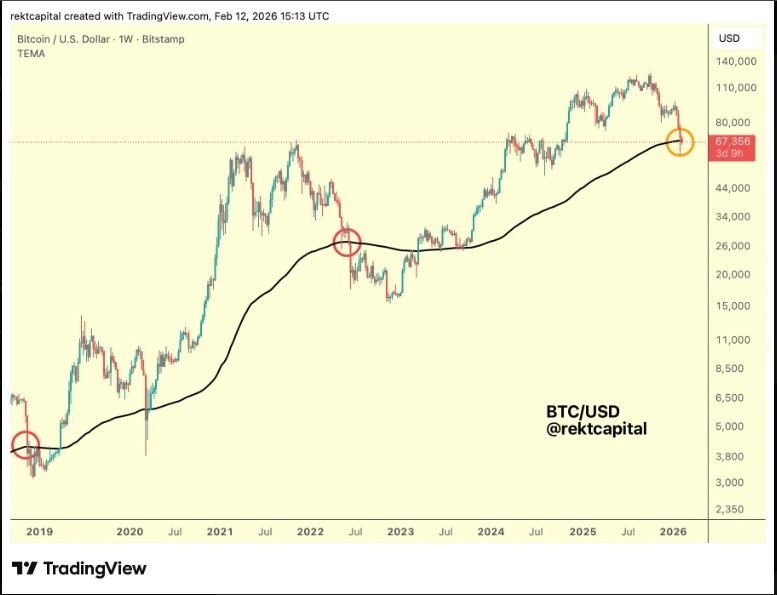
 (@BitPaine)






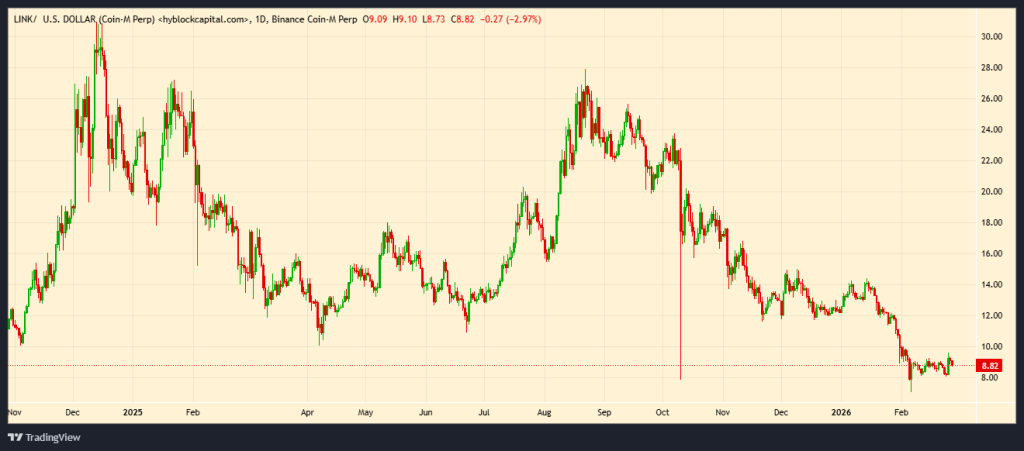
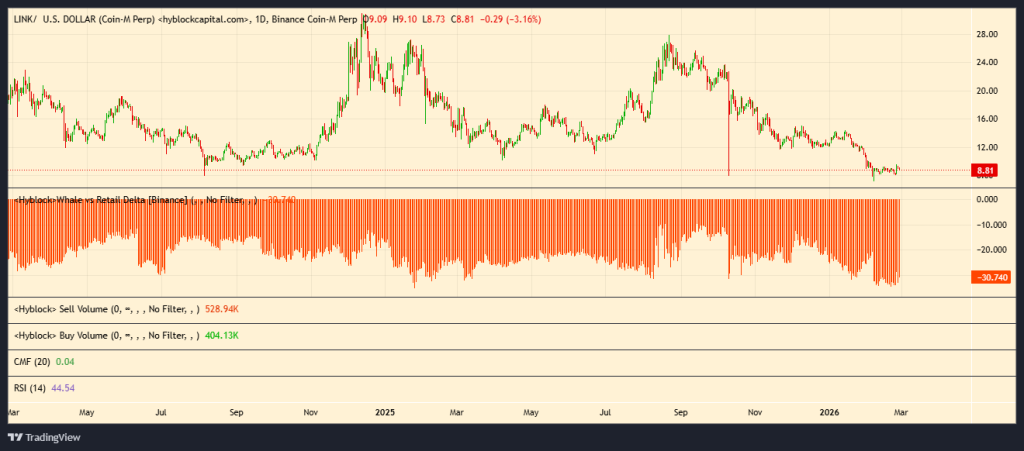
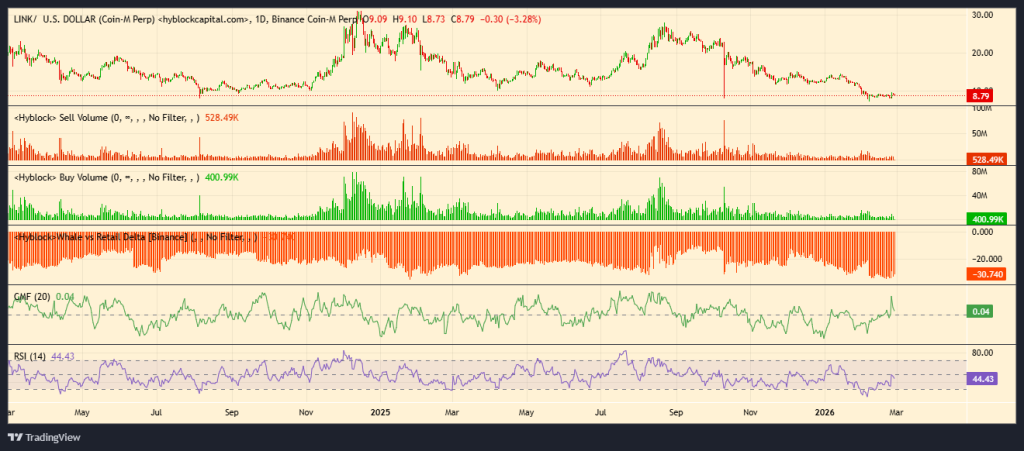


 -2.95%
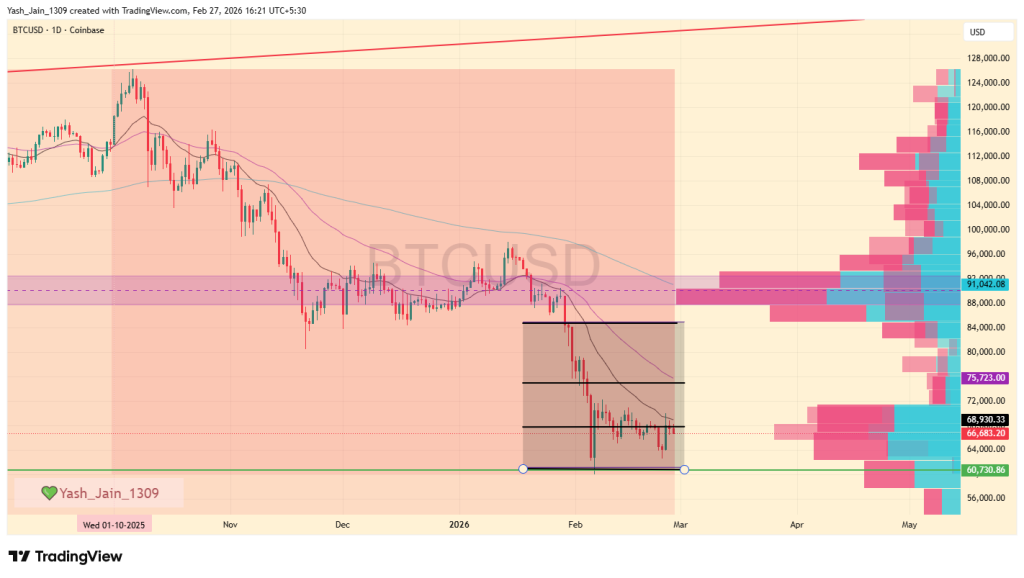
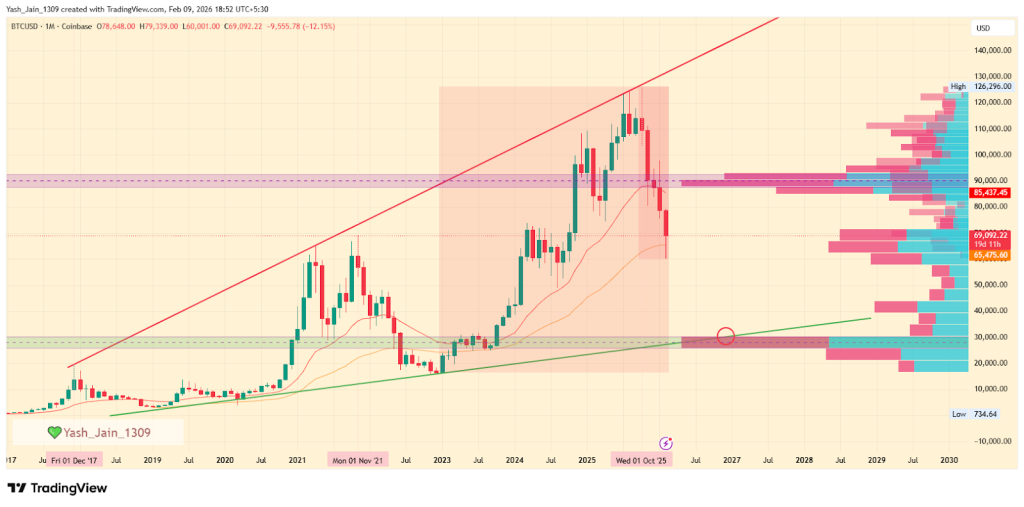
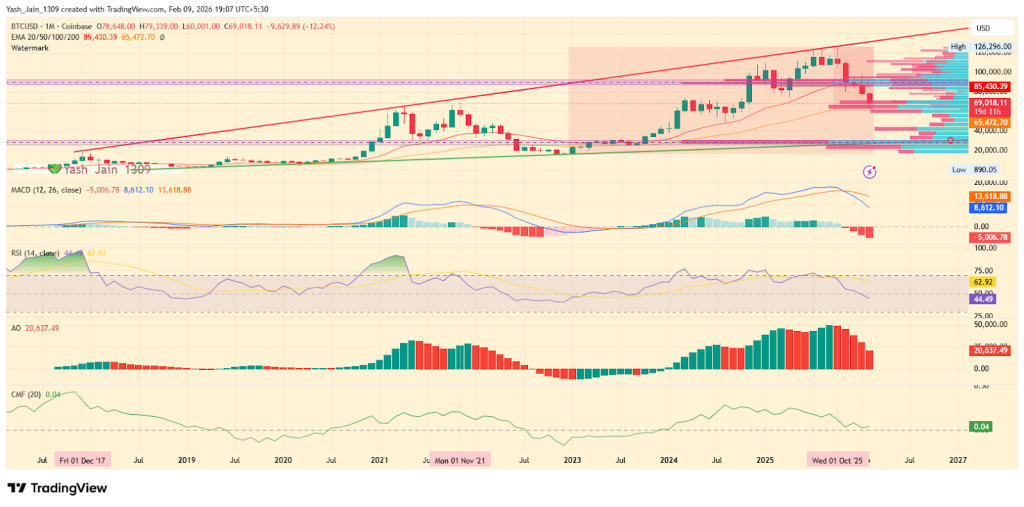
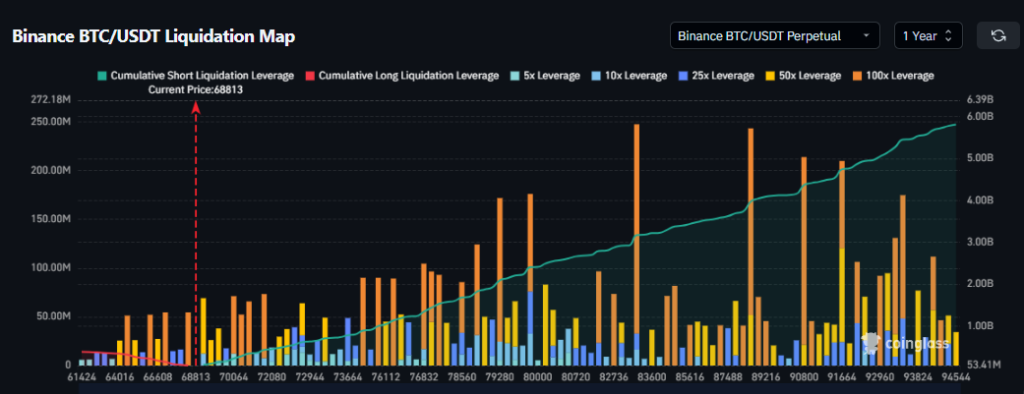
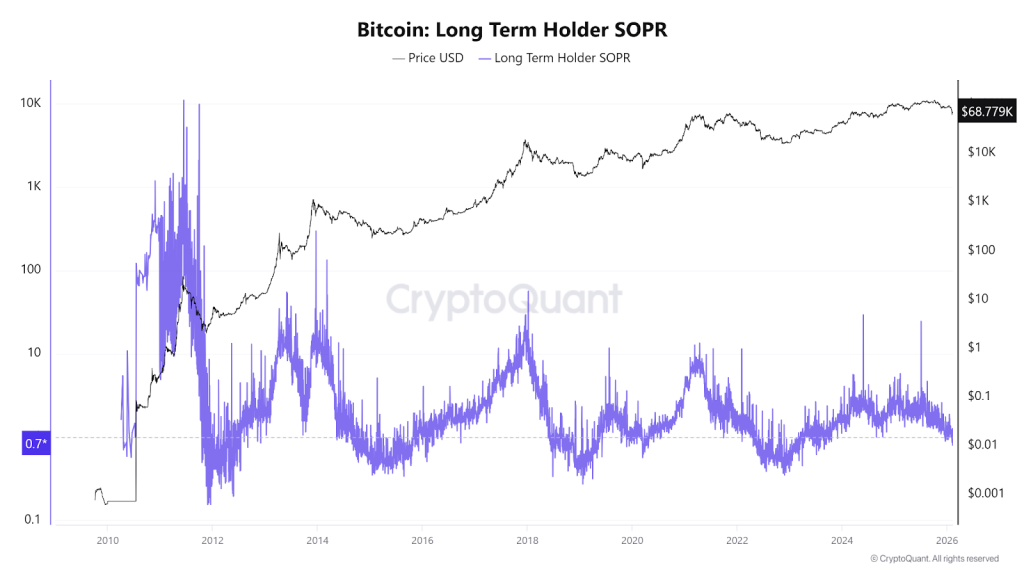

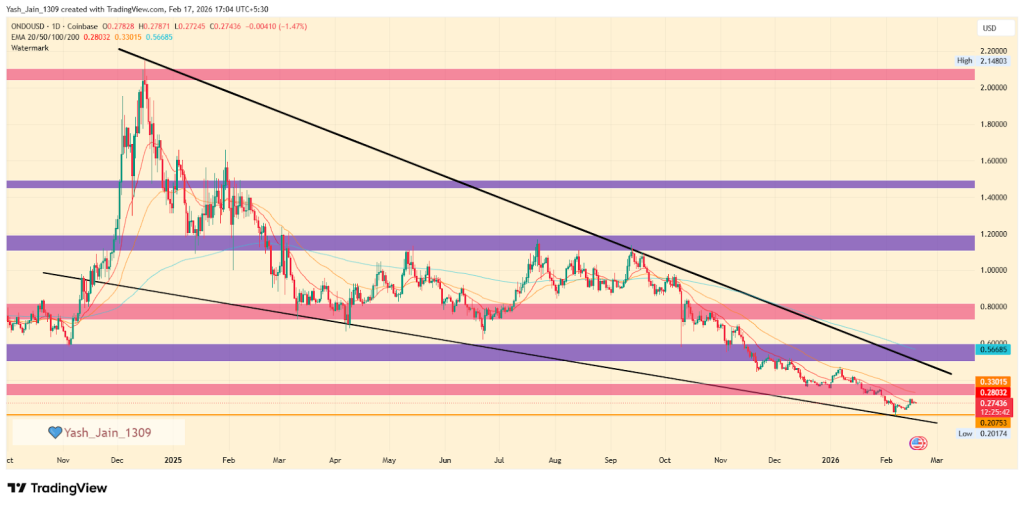
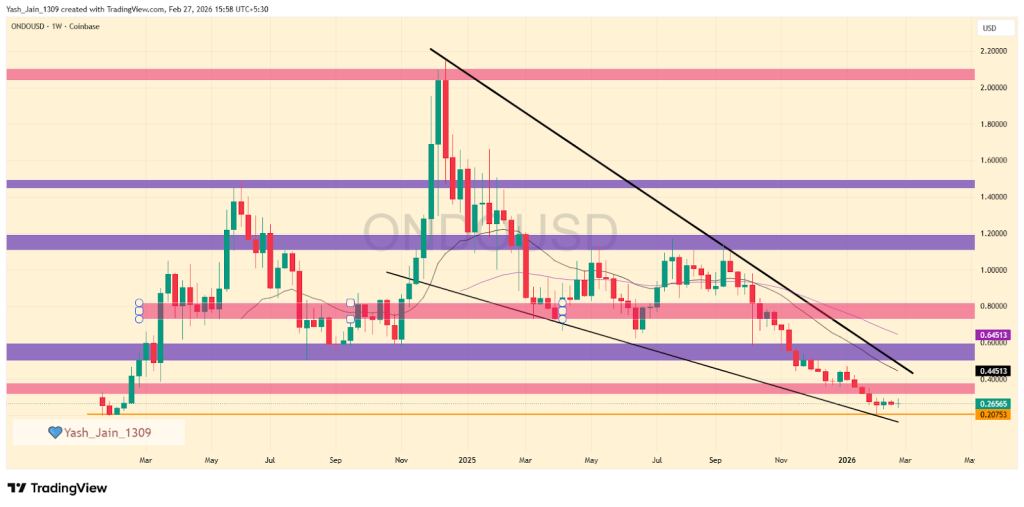
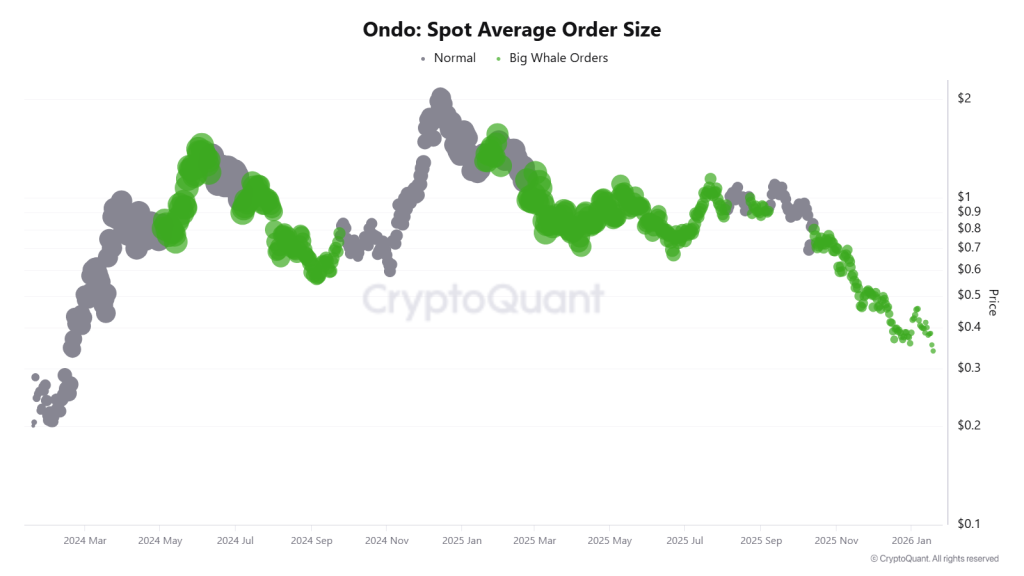

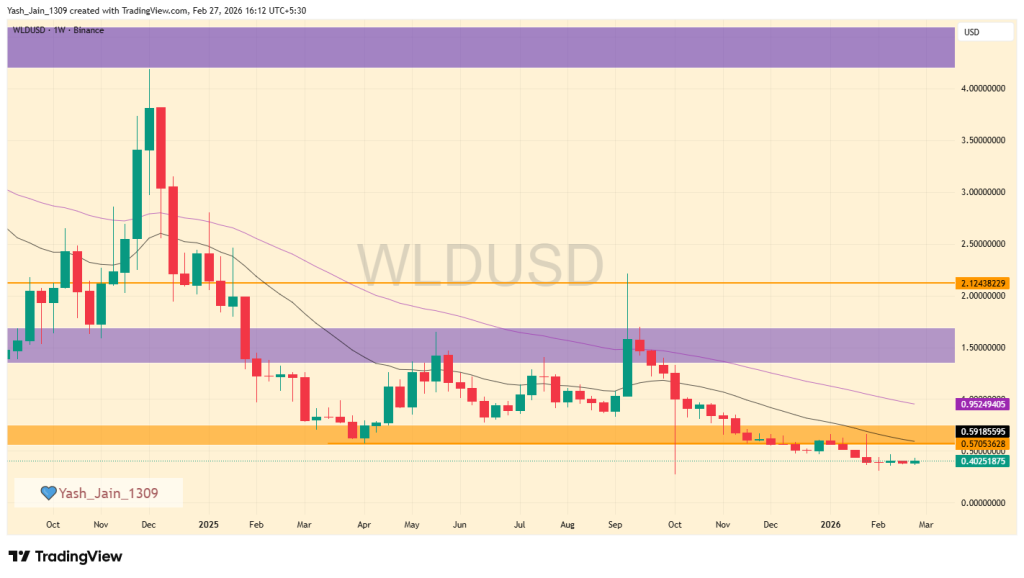
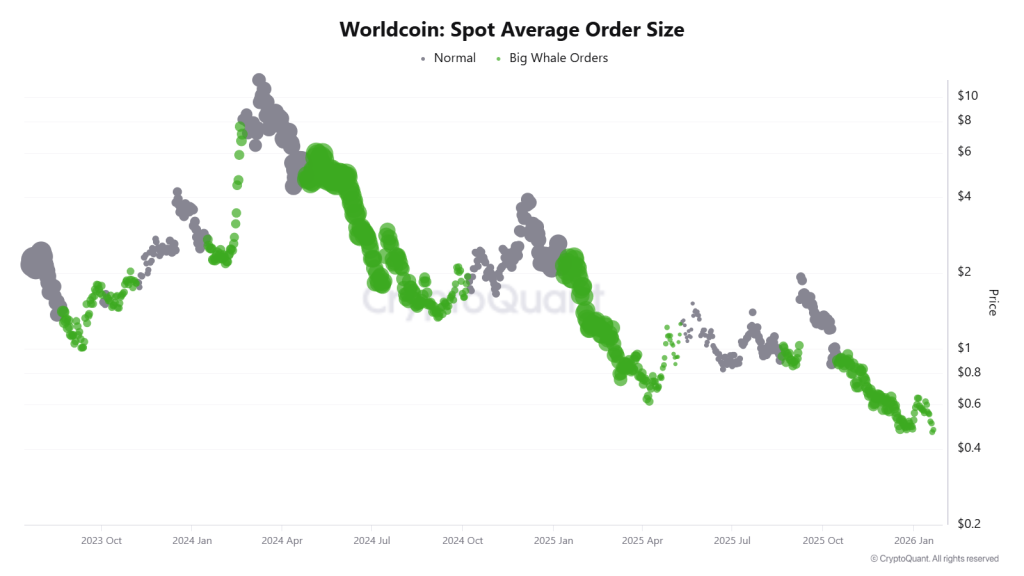
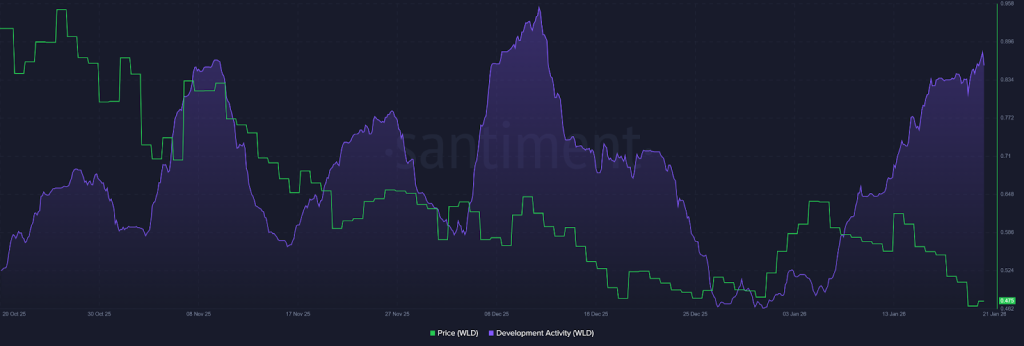

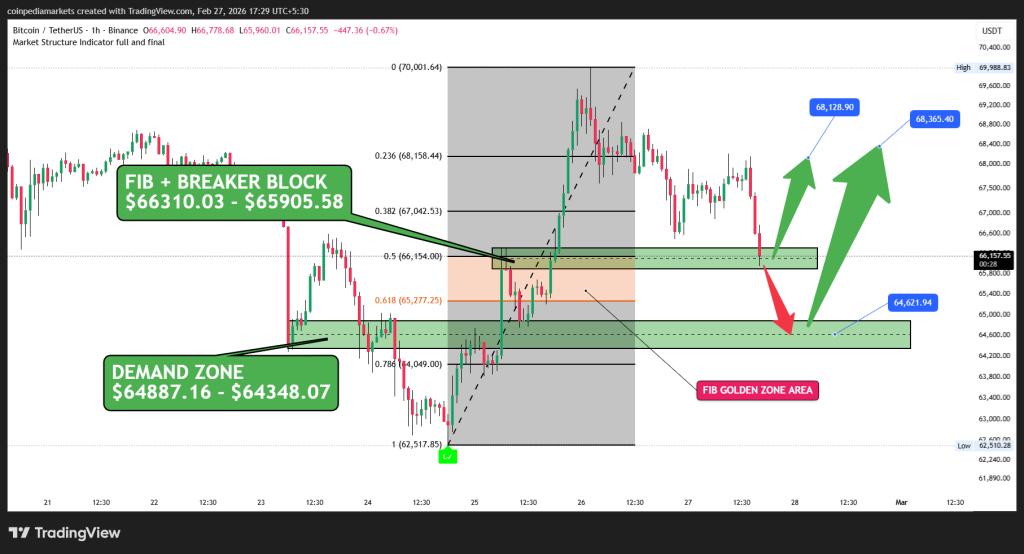
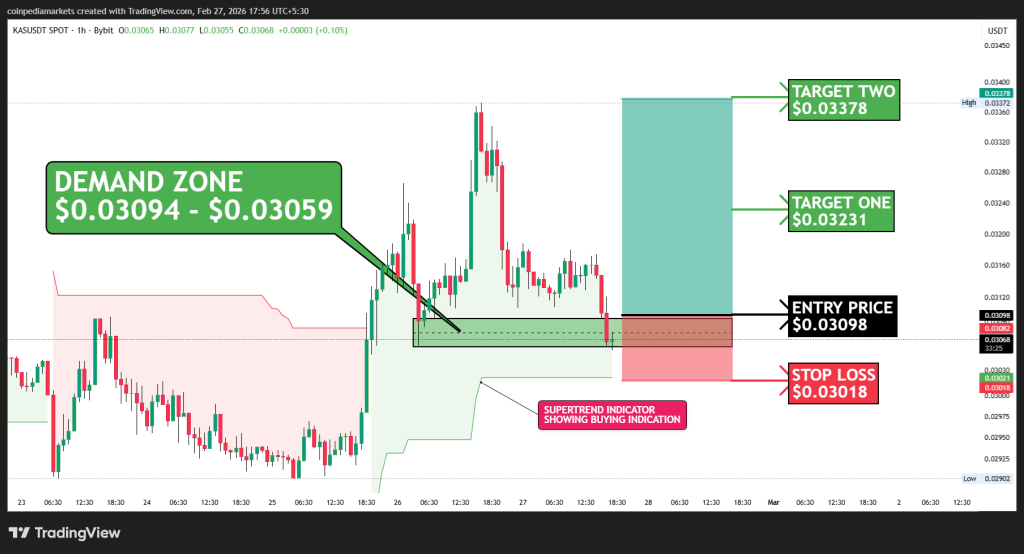
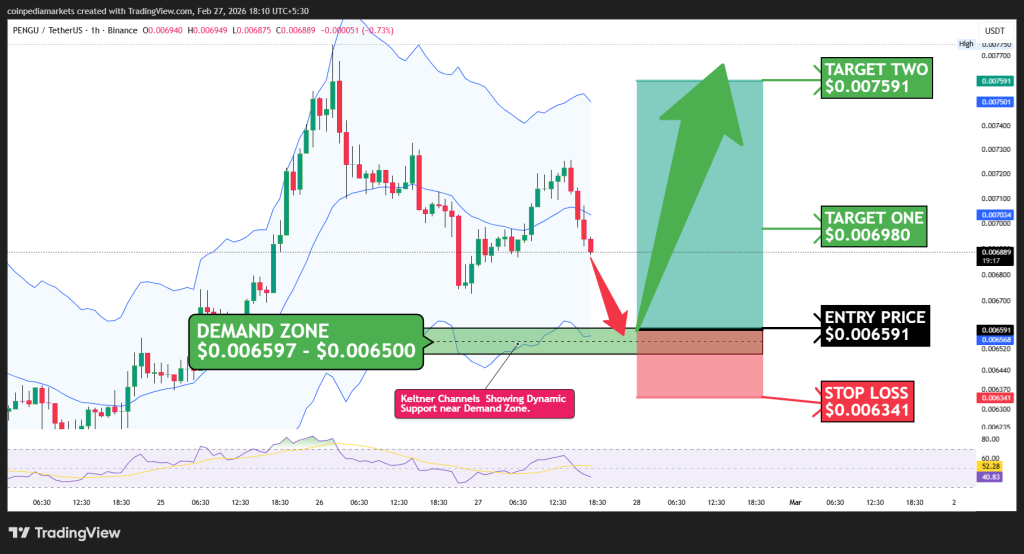


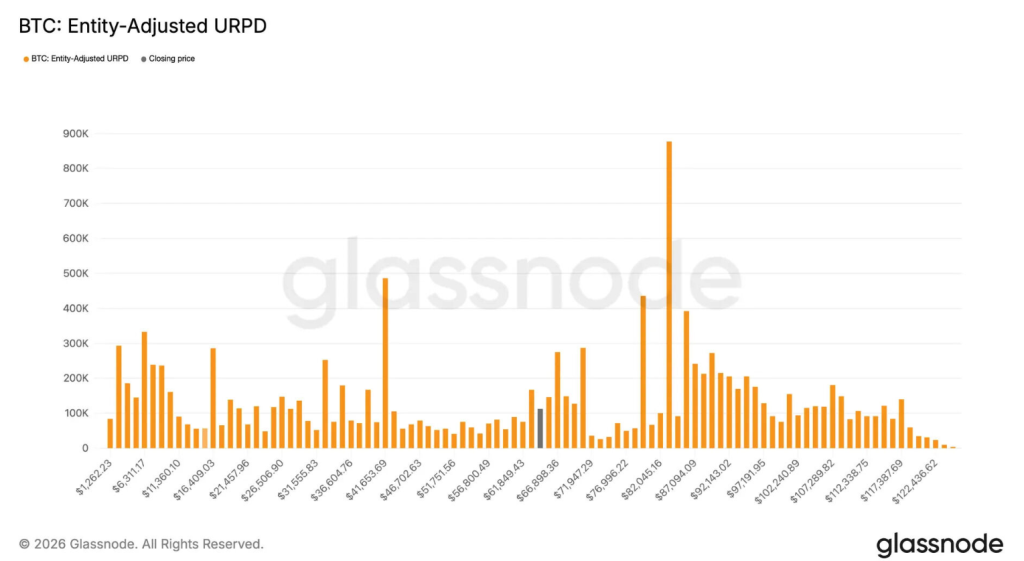
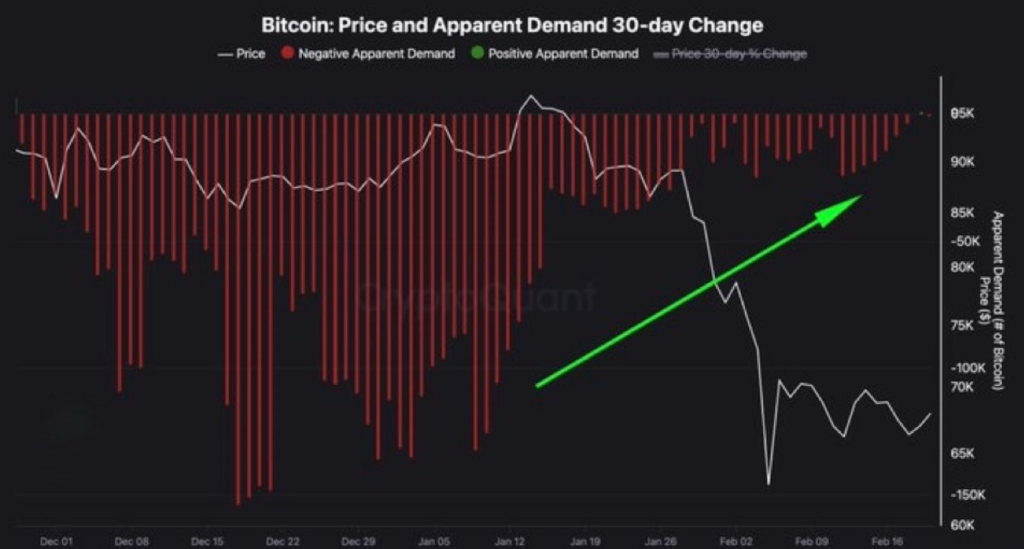
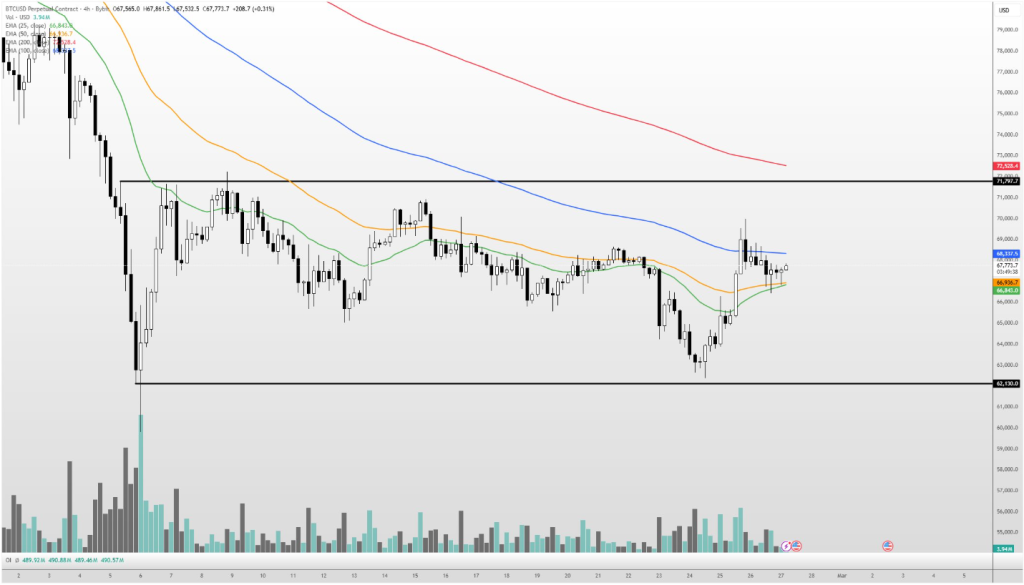

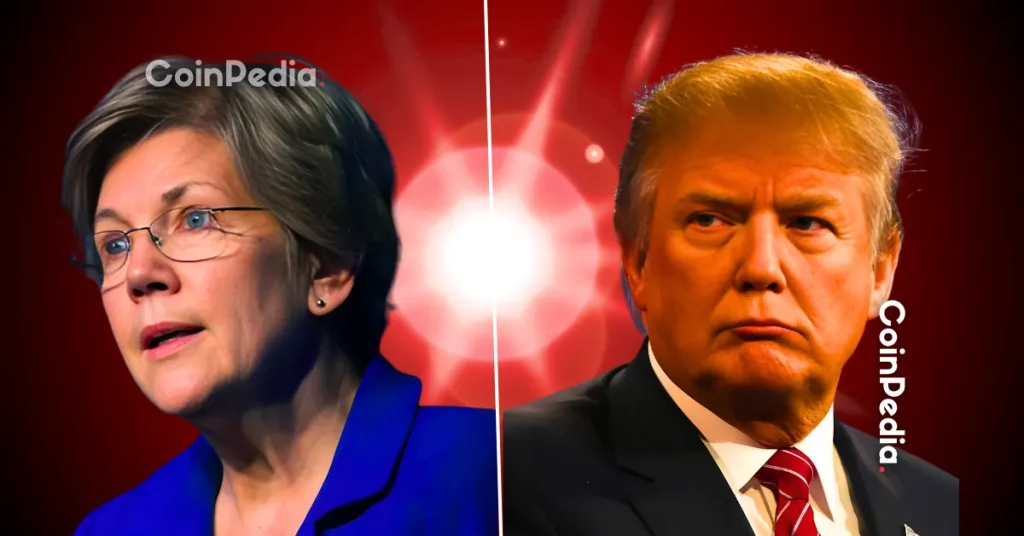
 BREAKING:

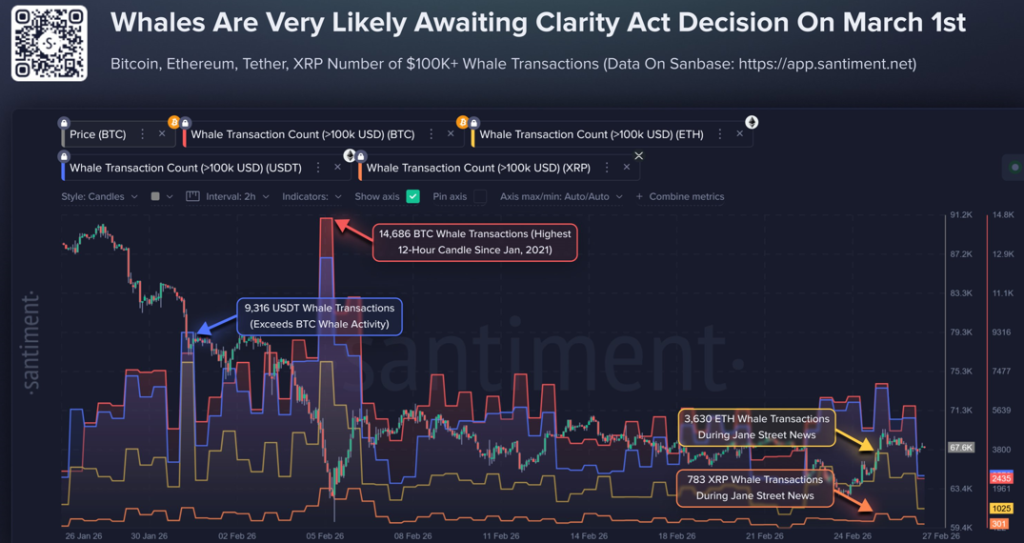
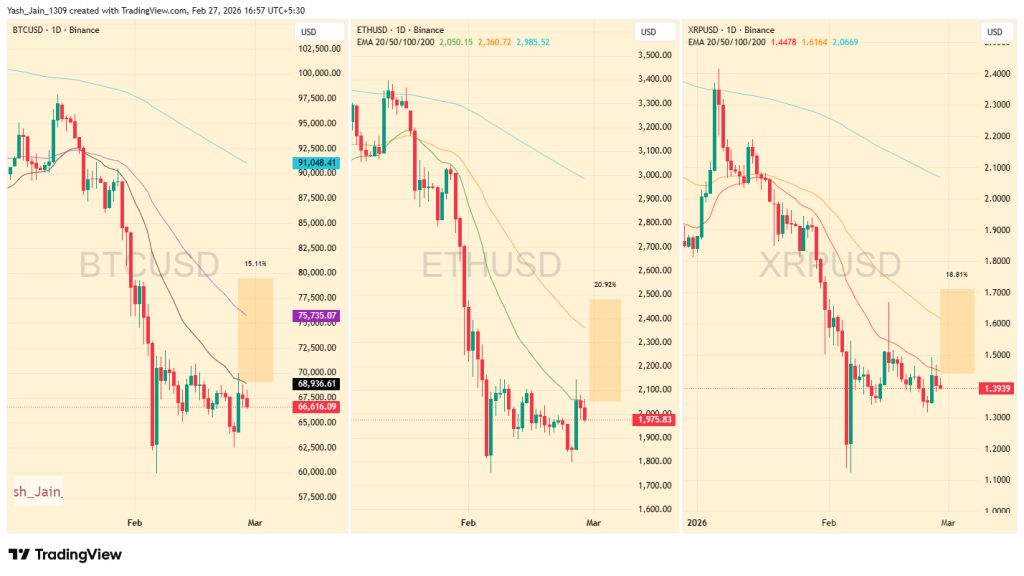


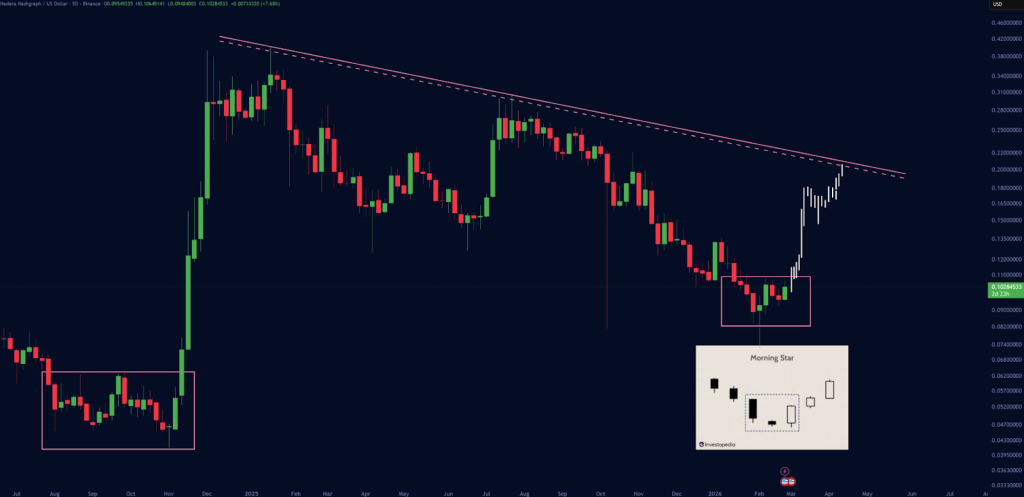






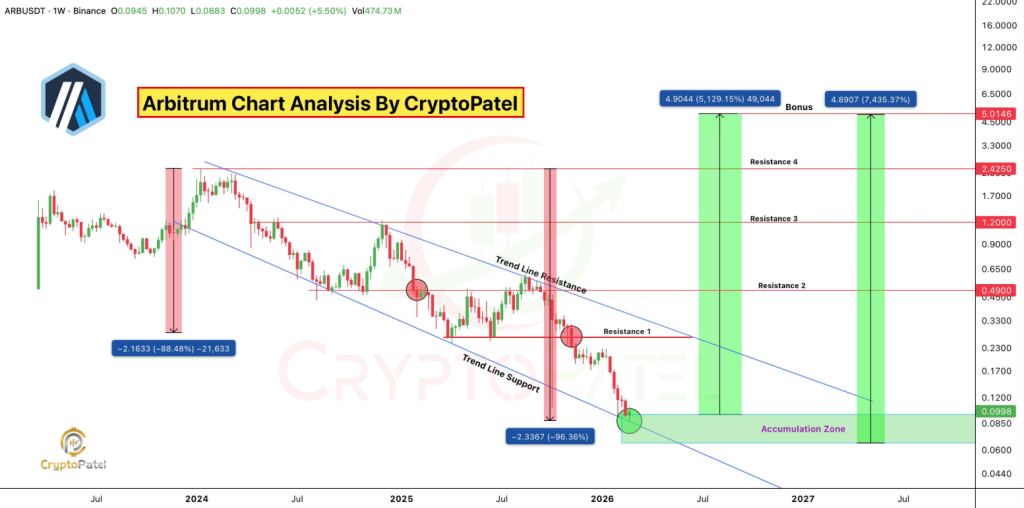
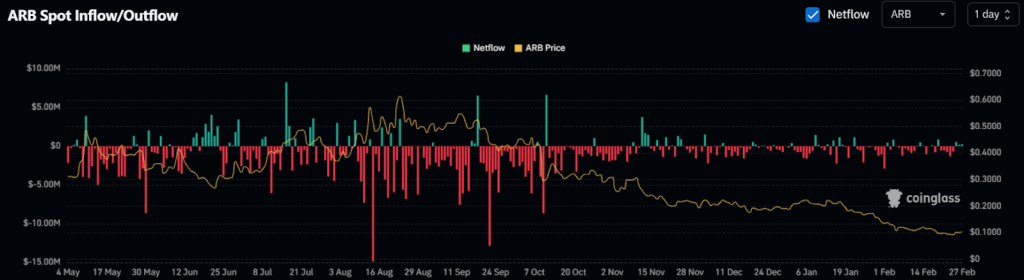
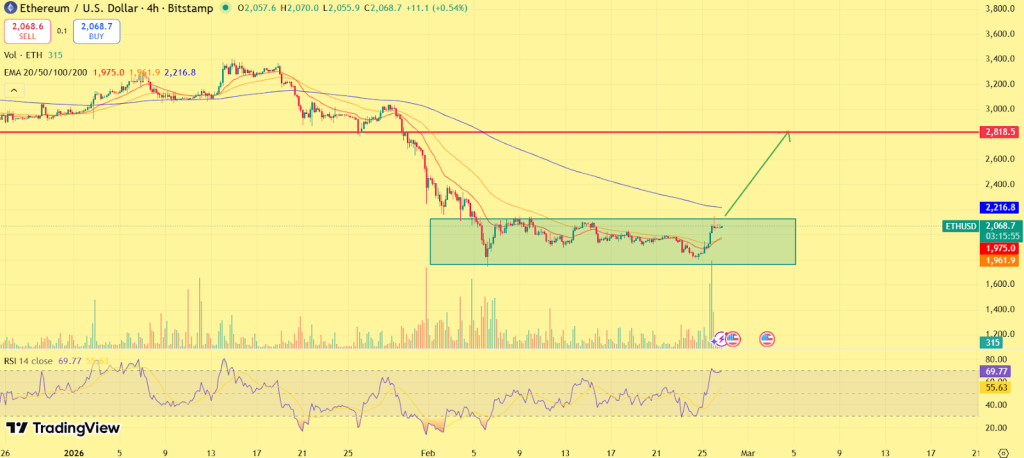
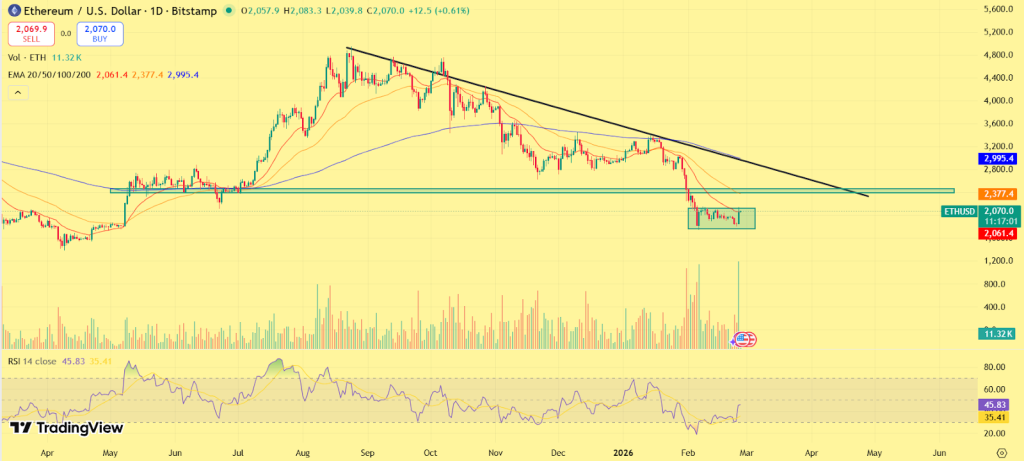
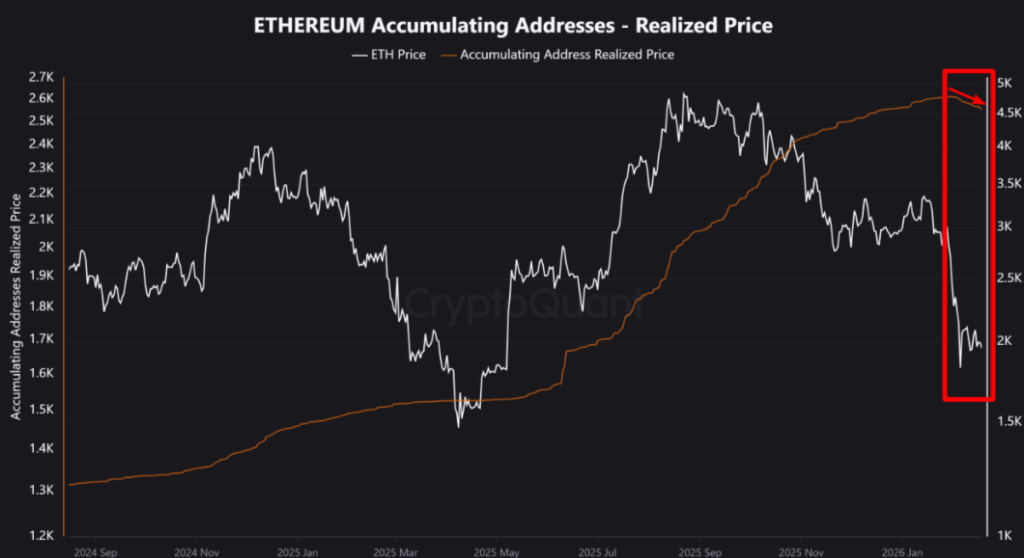




 3.79%
3.79%
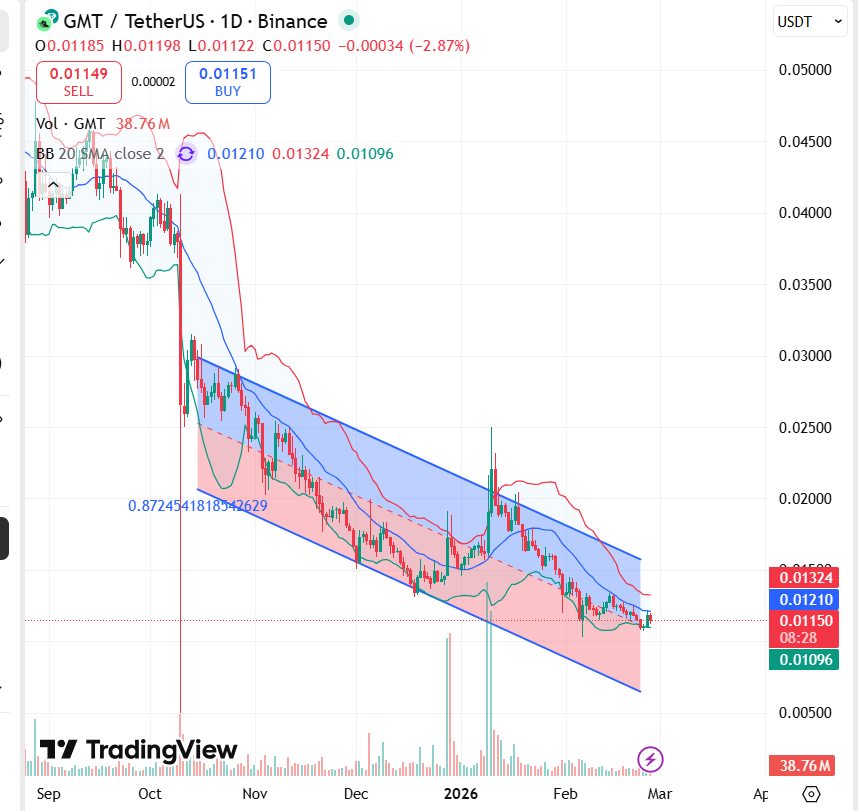





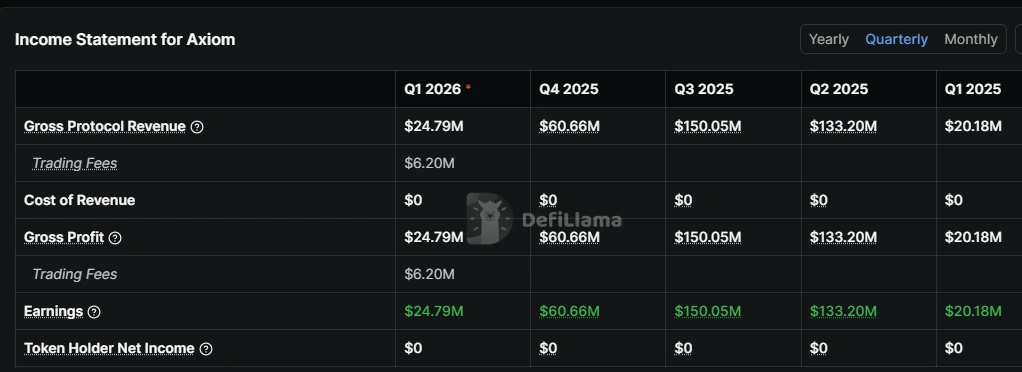

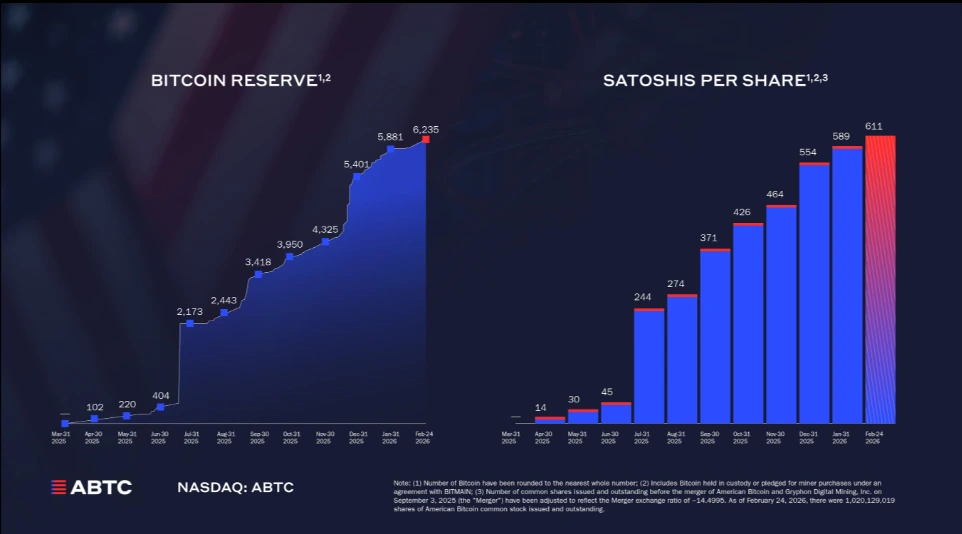
 You should too


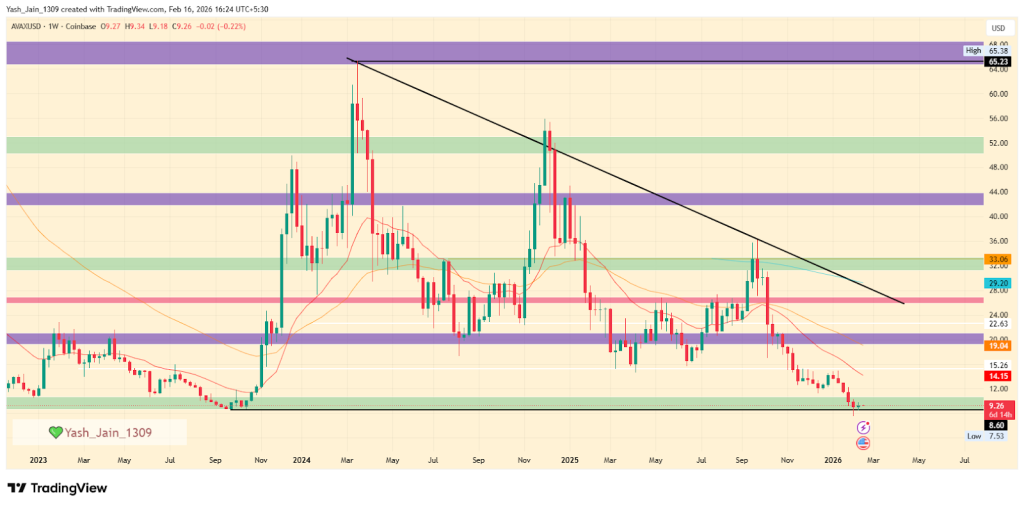
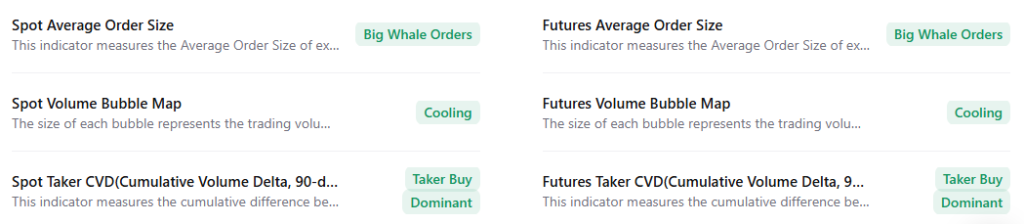

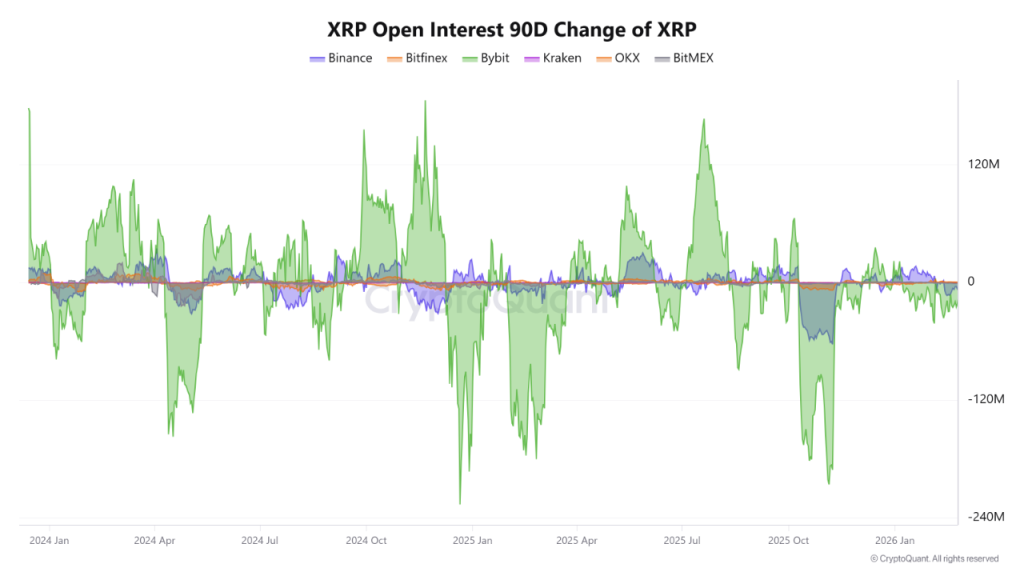
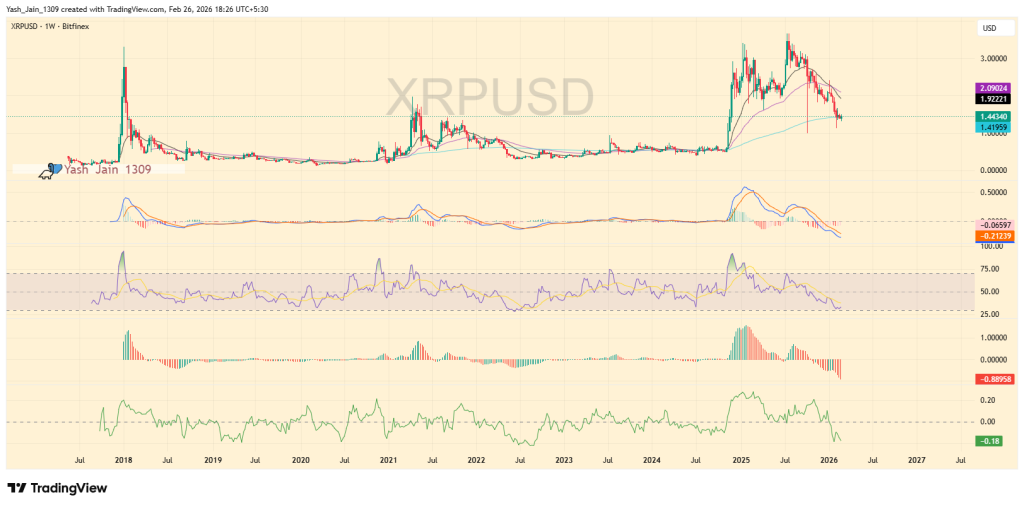
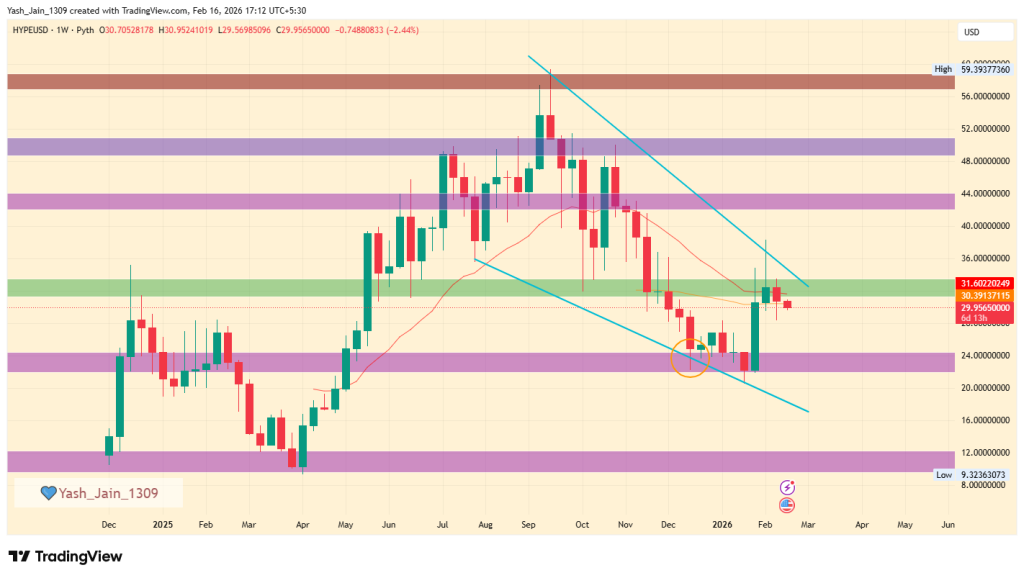
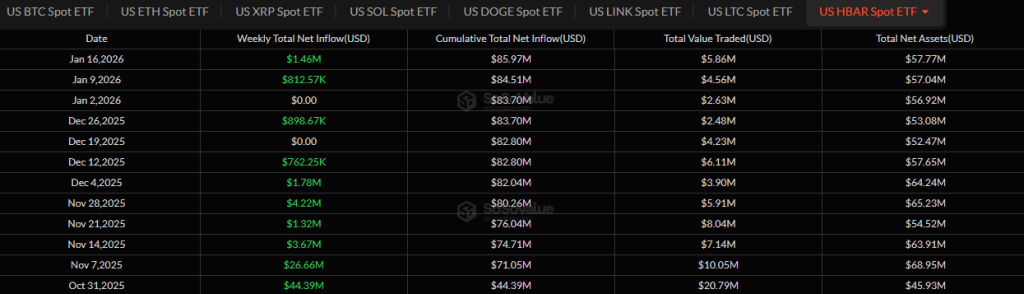
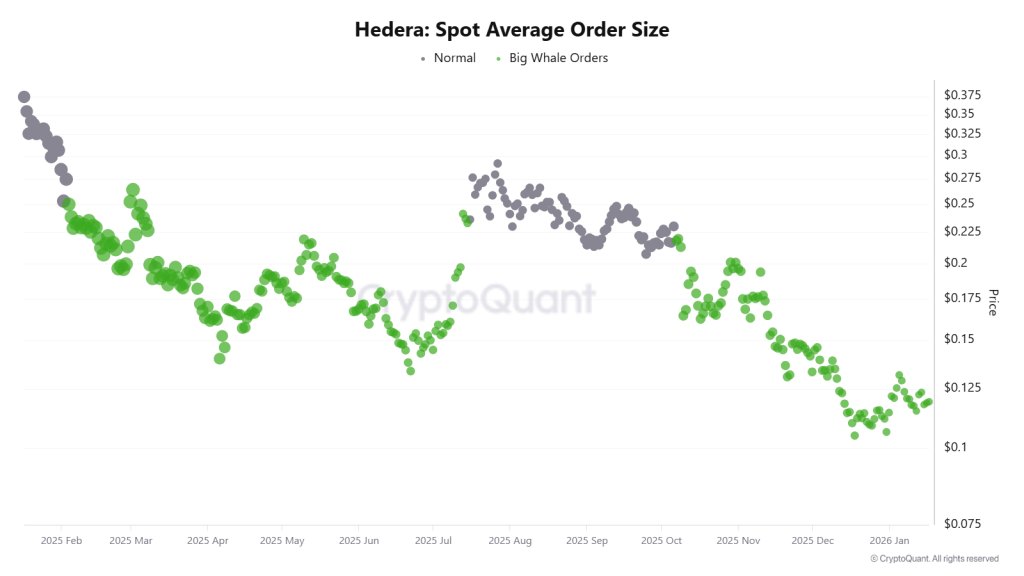
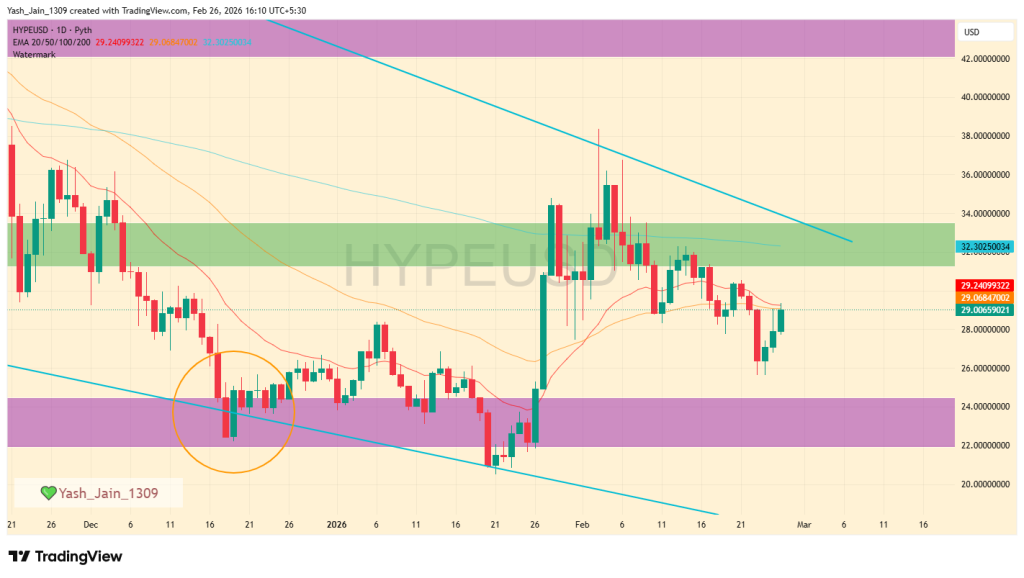
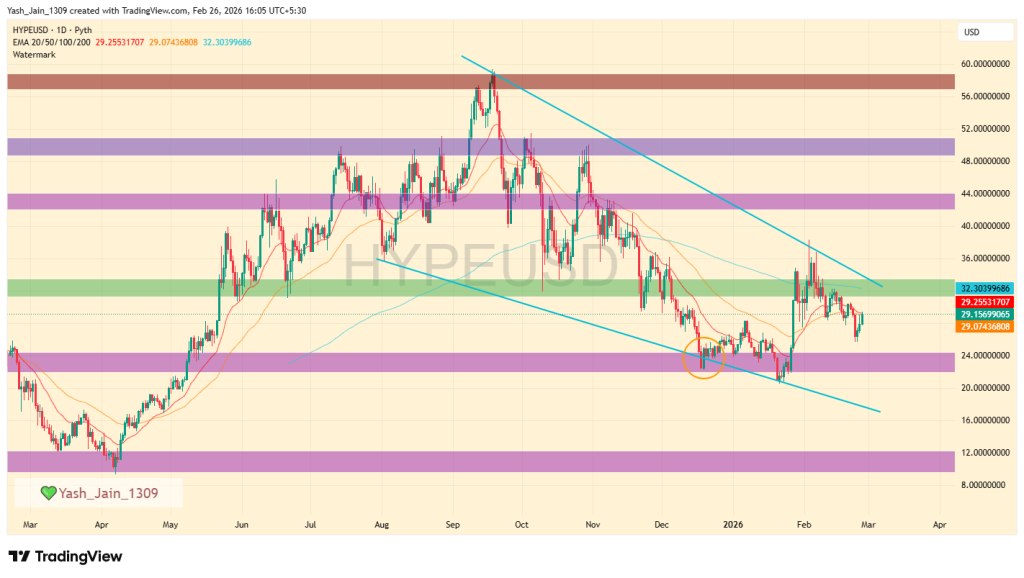


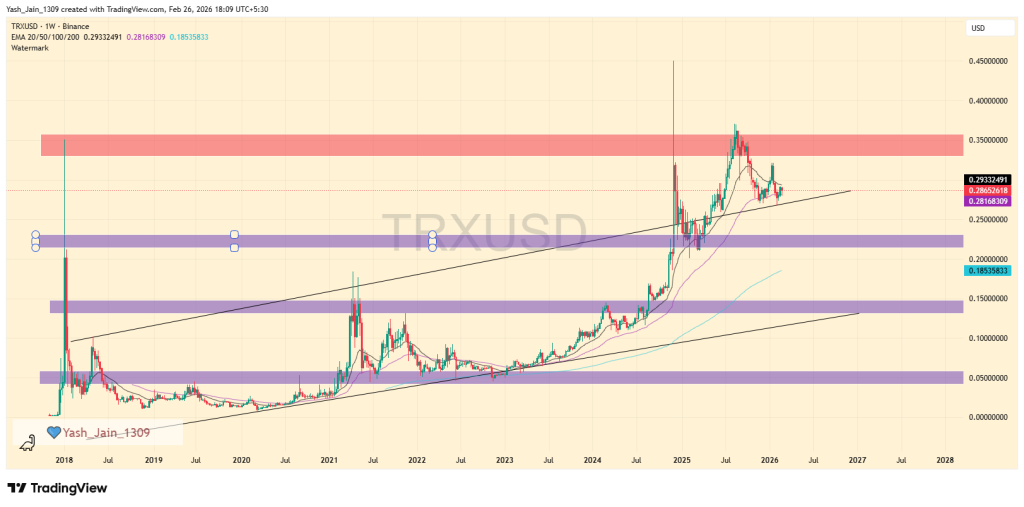
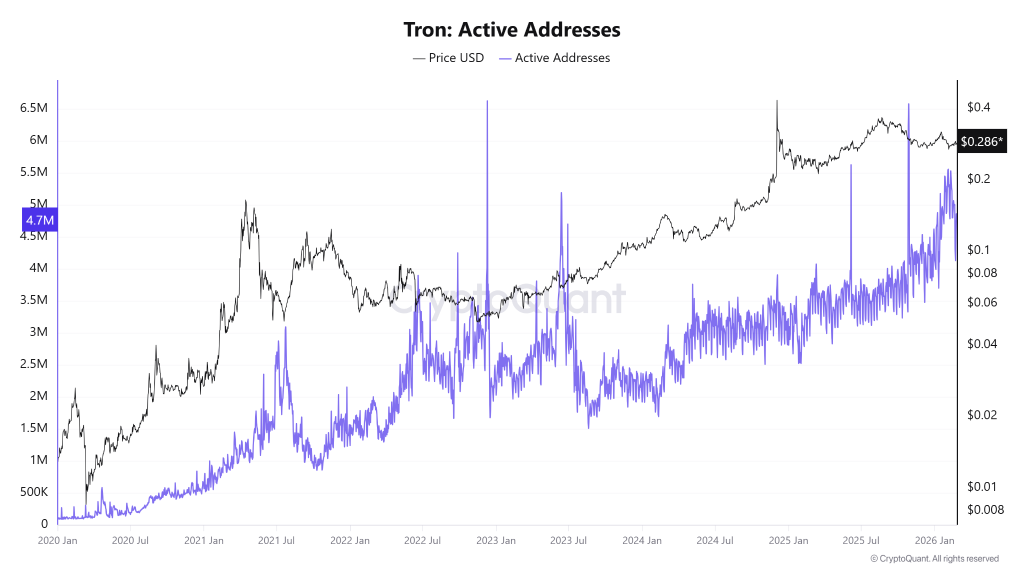



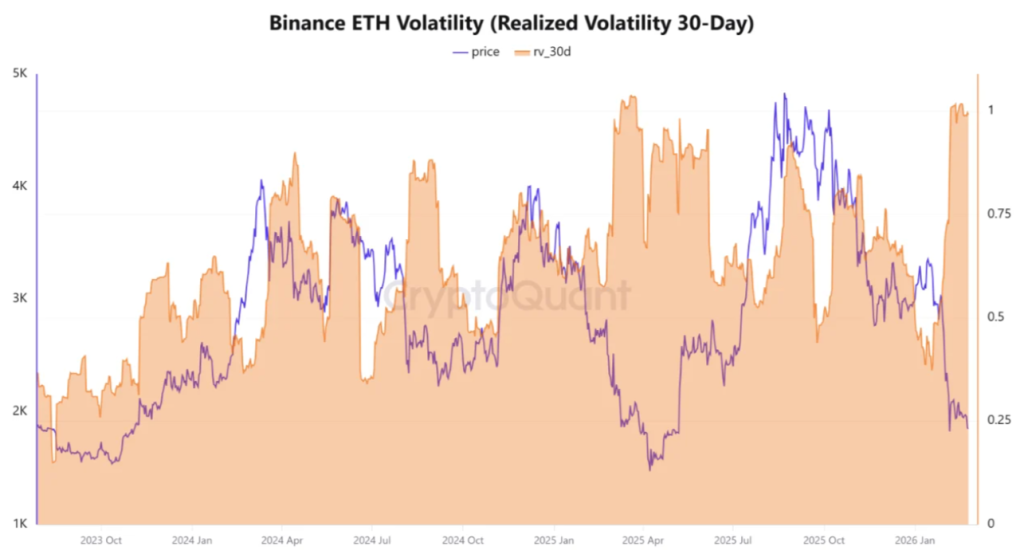
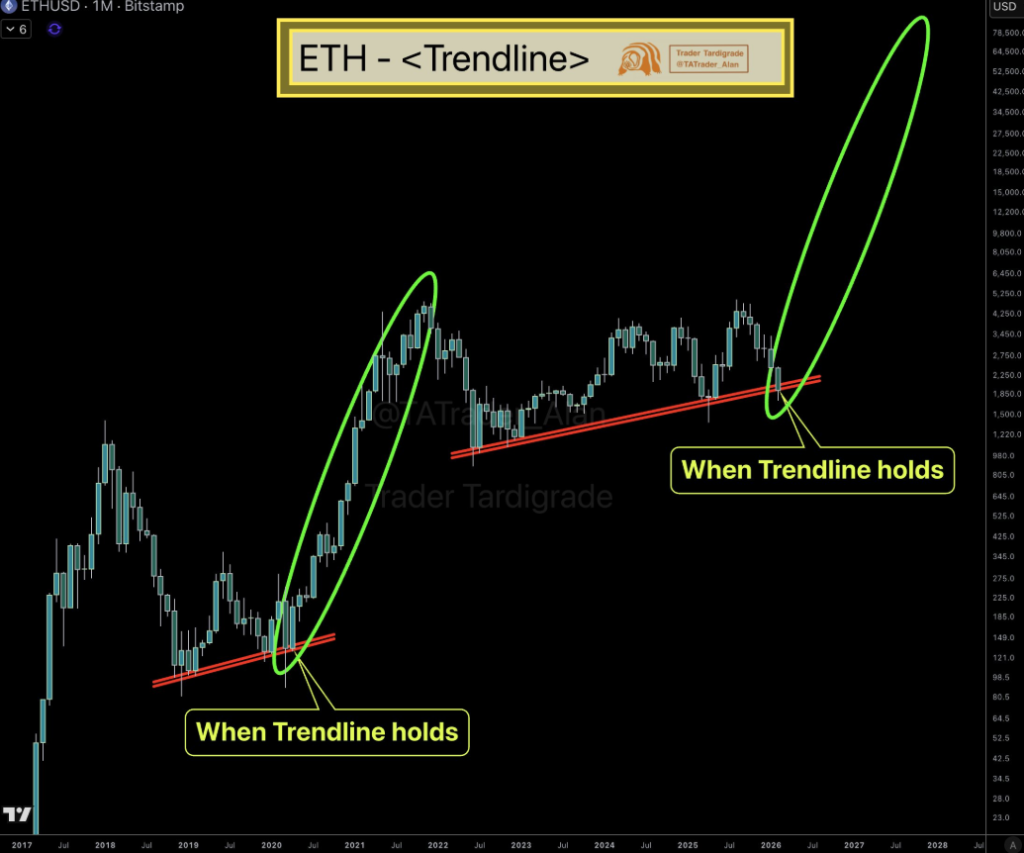


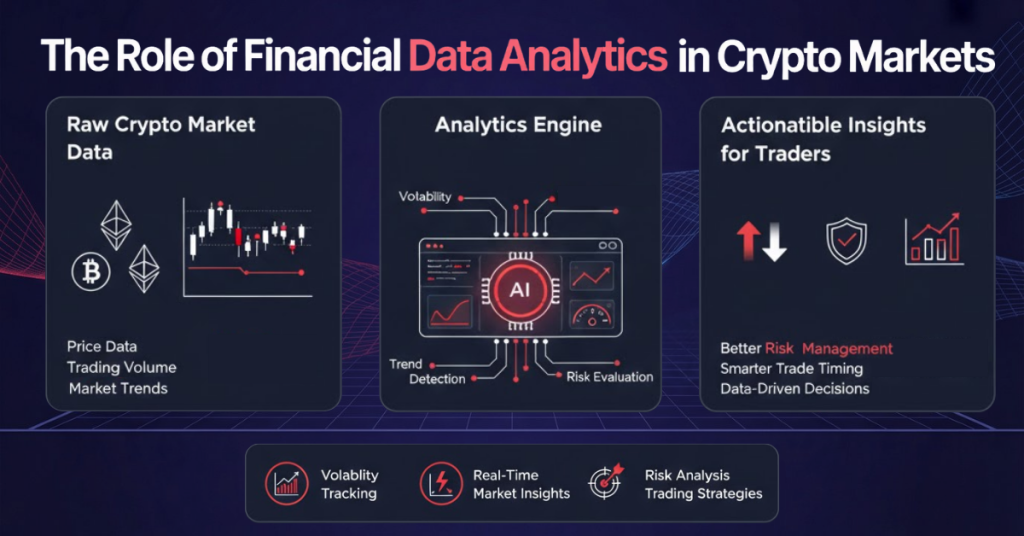

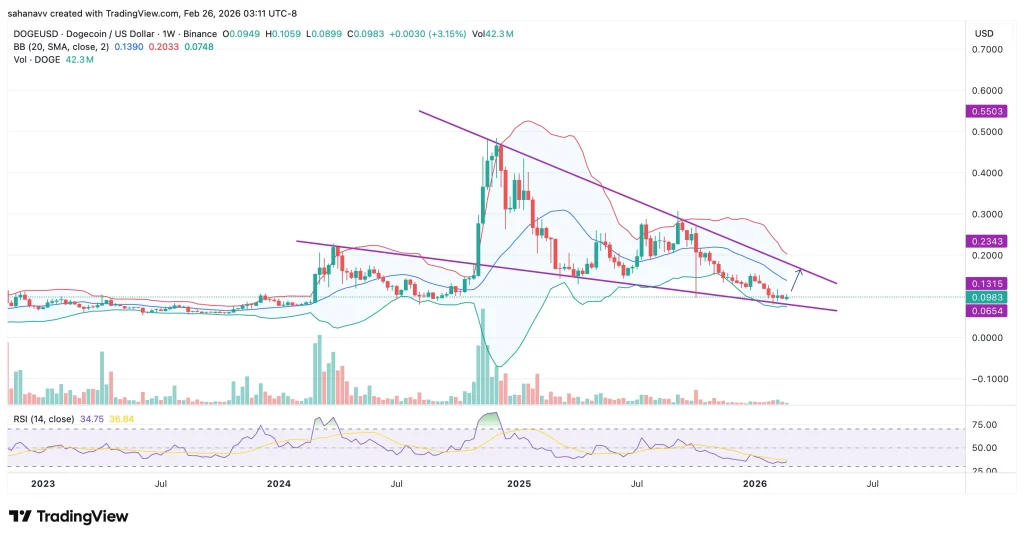

 False
False
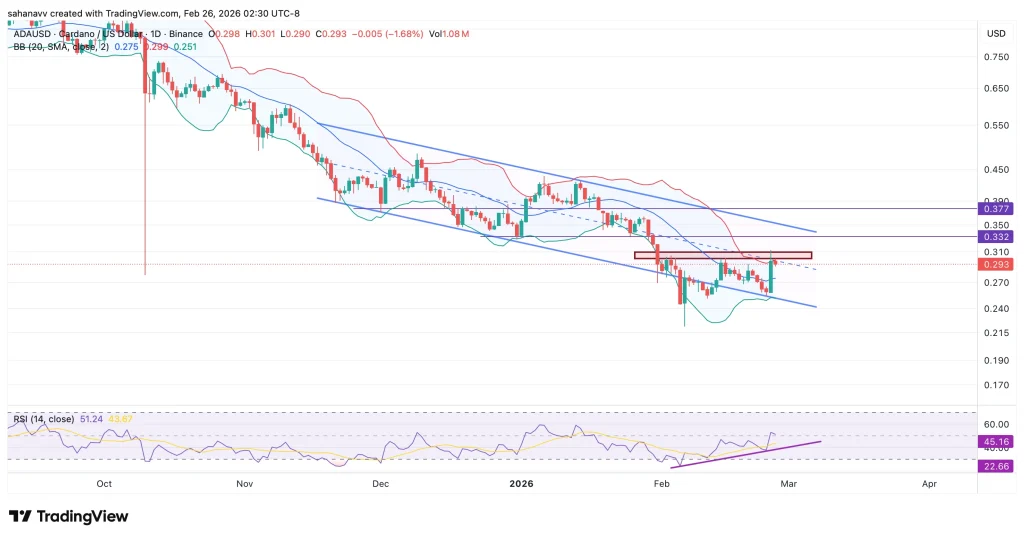
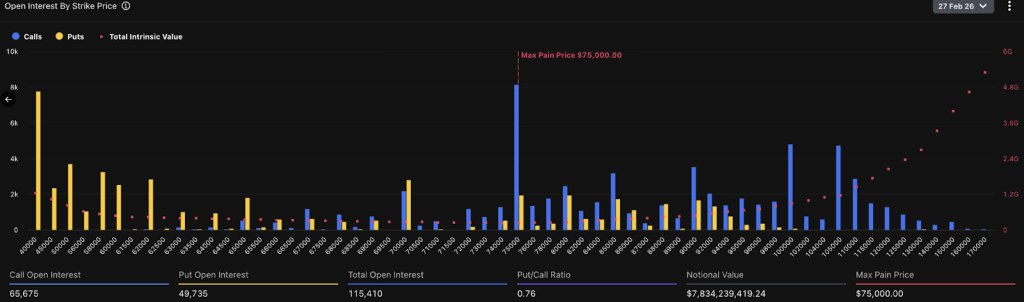
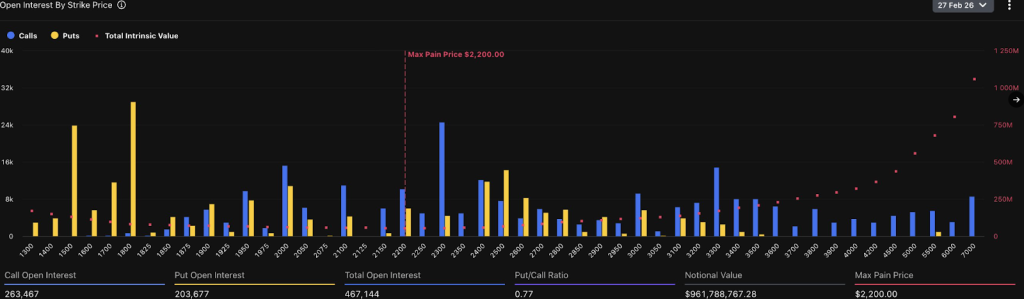

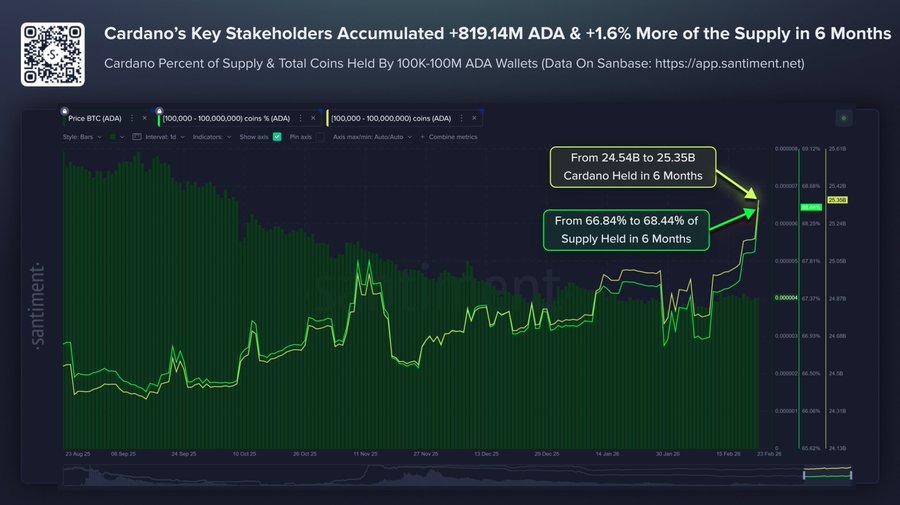
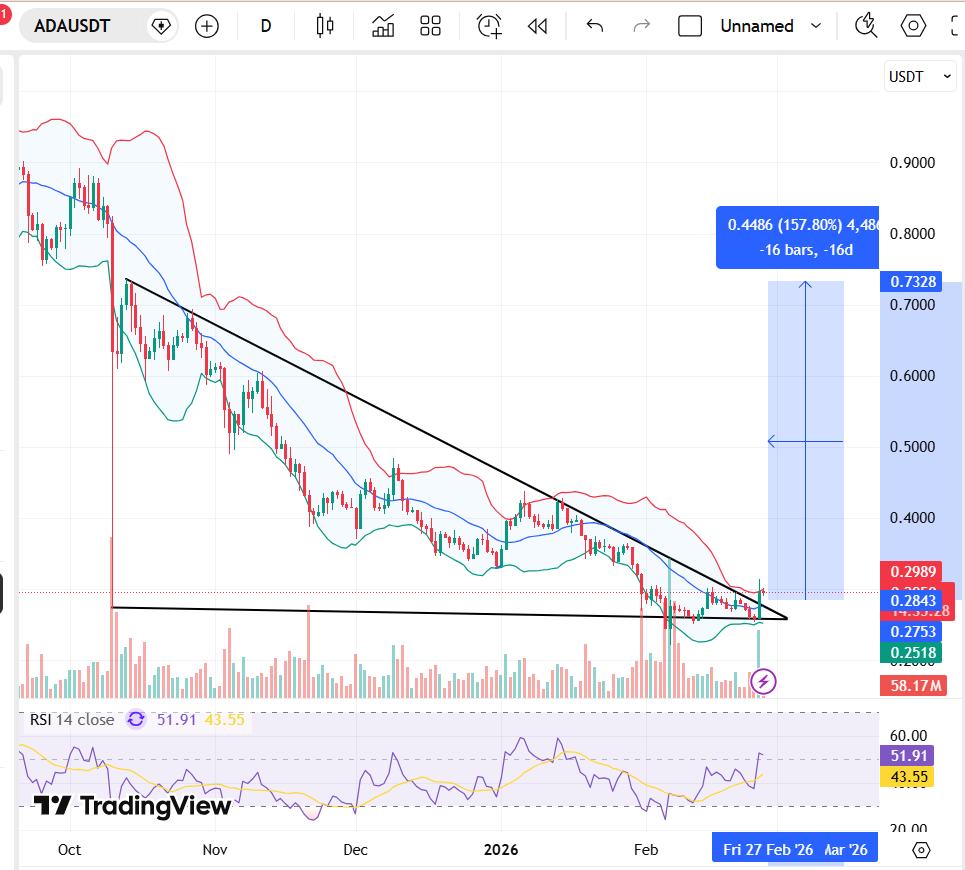

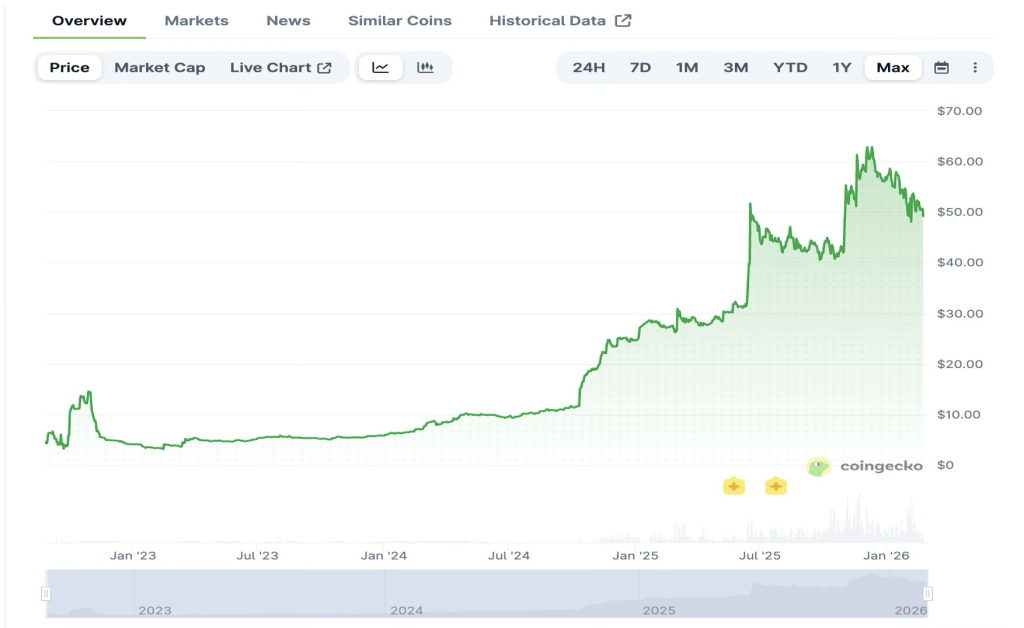

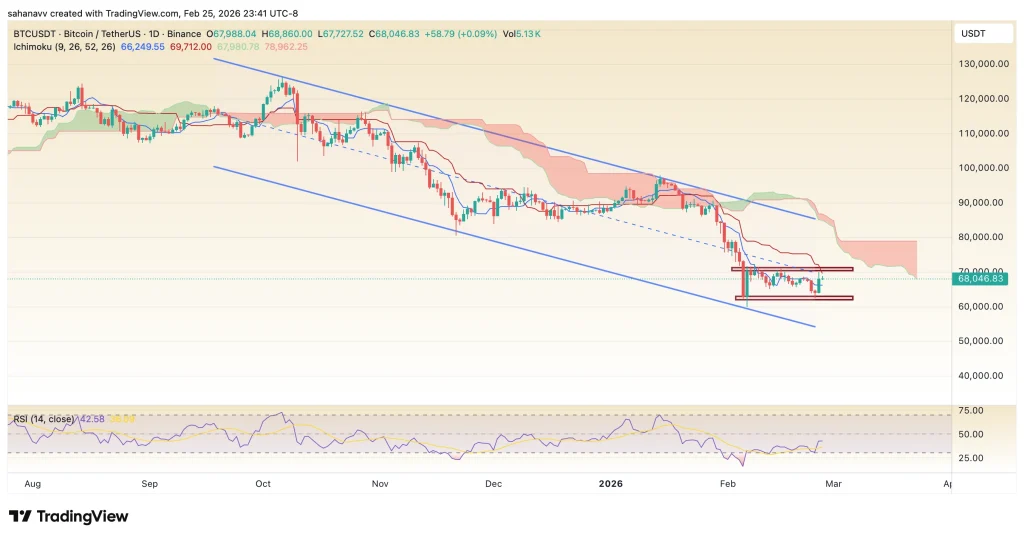
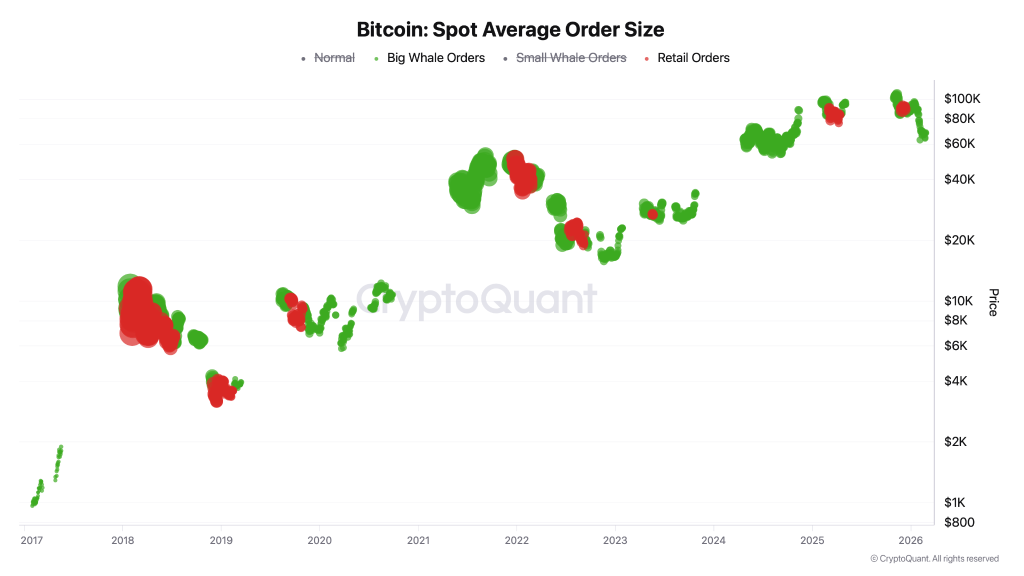
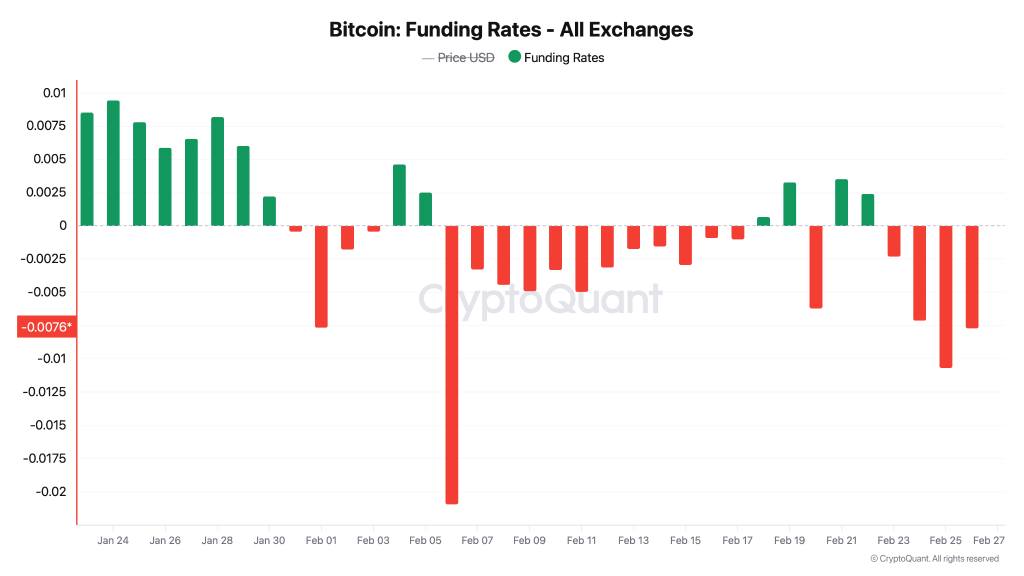

 Following
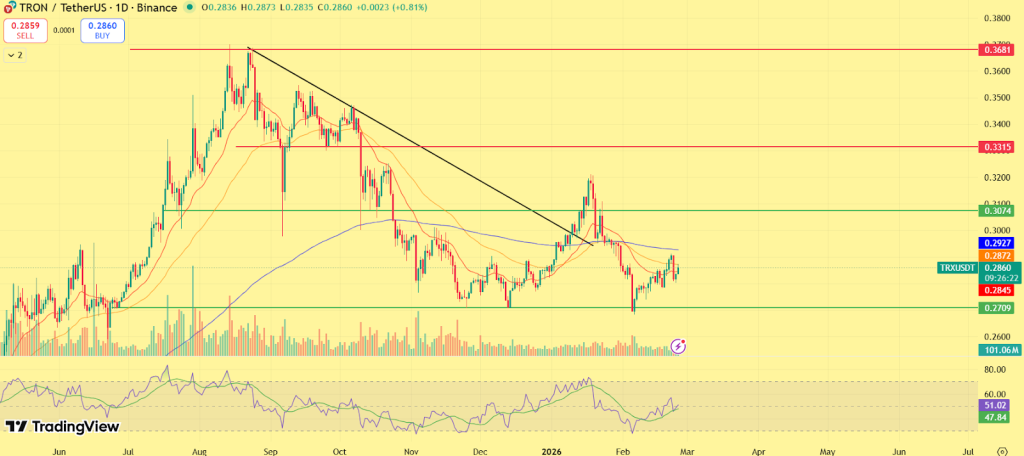




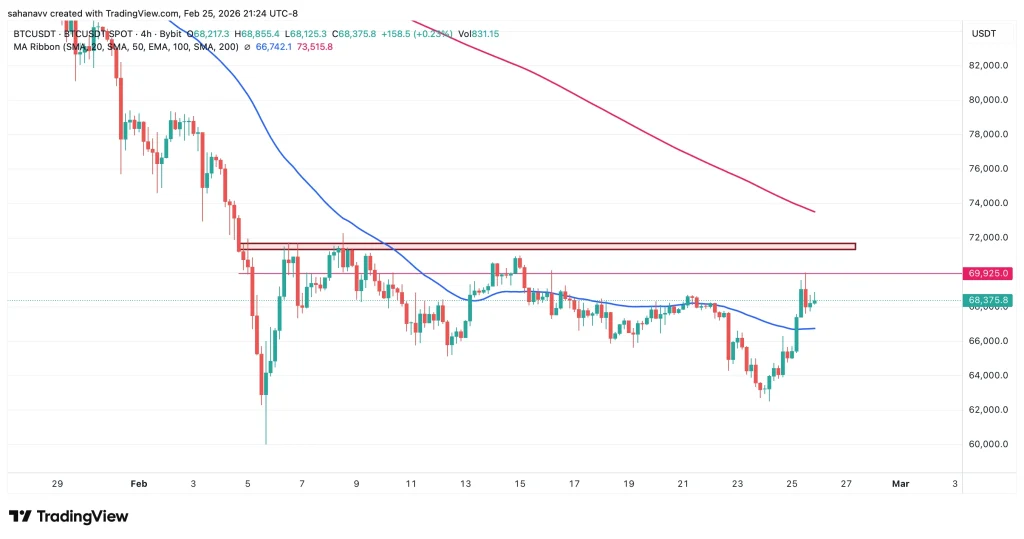
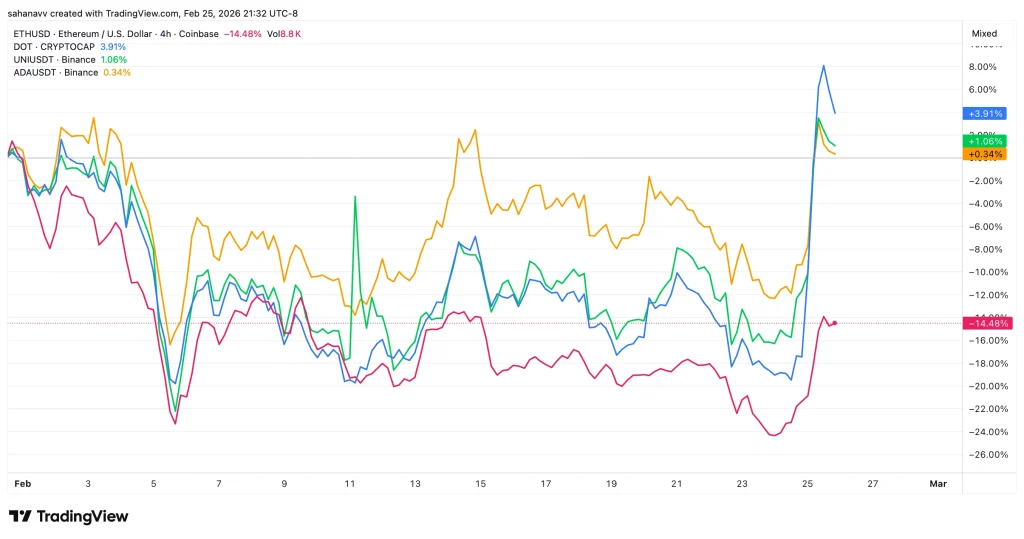
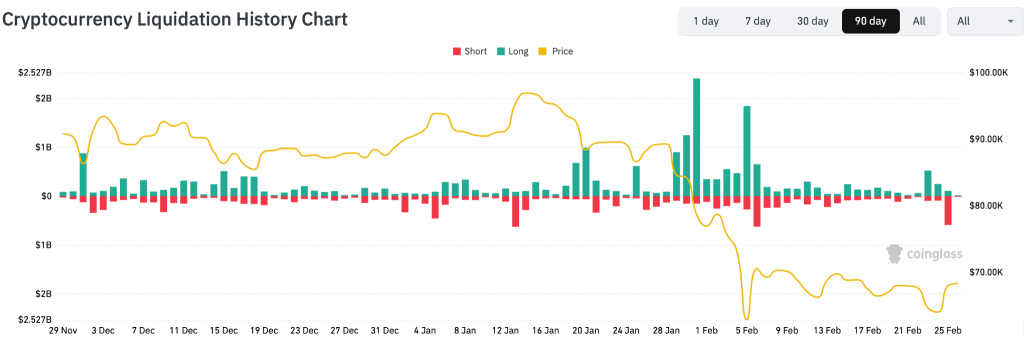
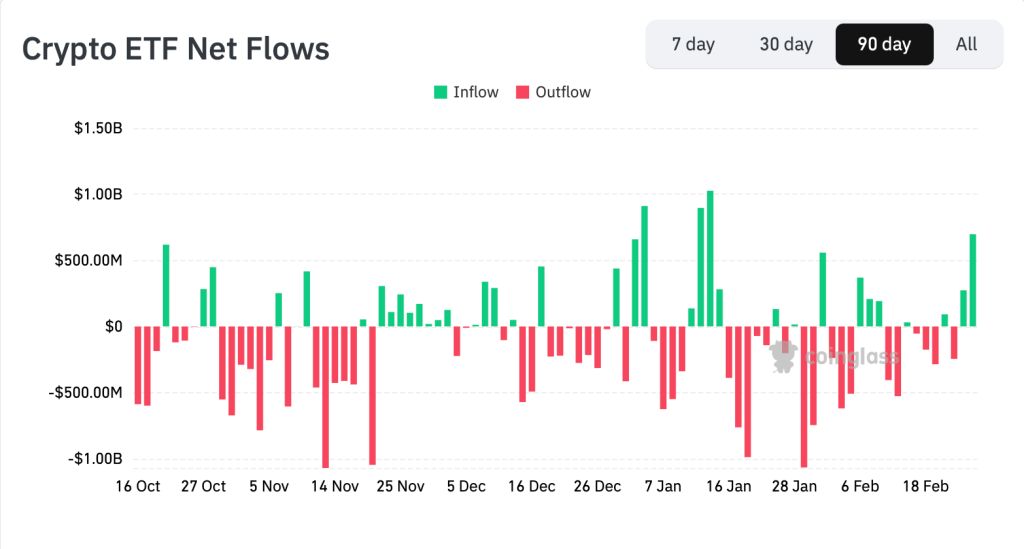

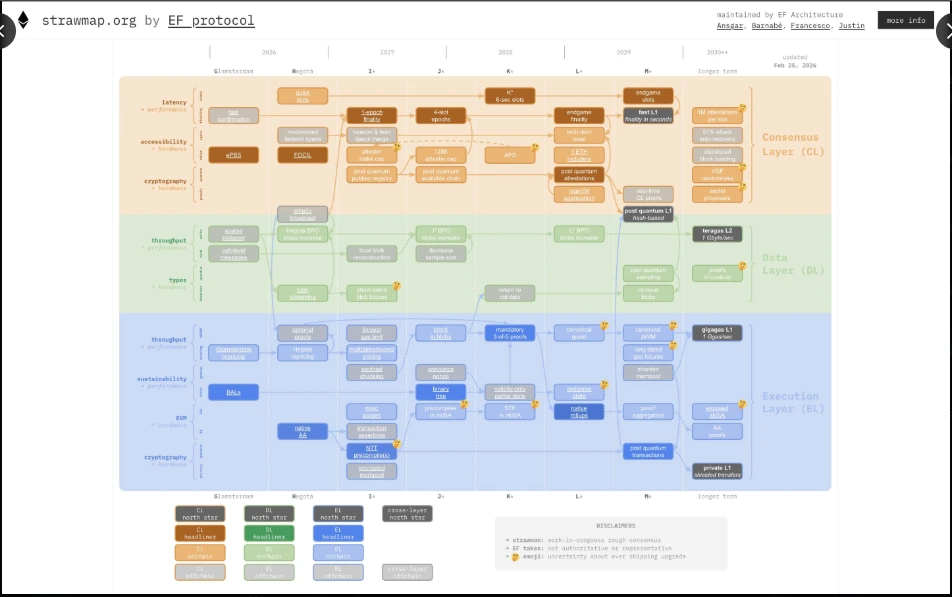
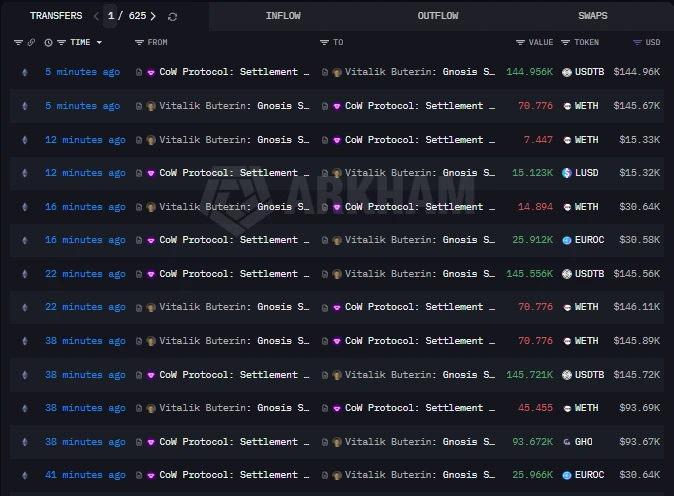
![Why Is Crypto Crashing Today [Live] Updates](https://image.coinpedia.org/wp-content/uploads/2026/02/23165659/Why-Is-Crypto-Crashing-Today-Live-Updates-1-1-1024x536.webp)
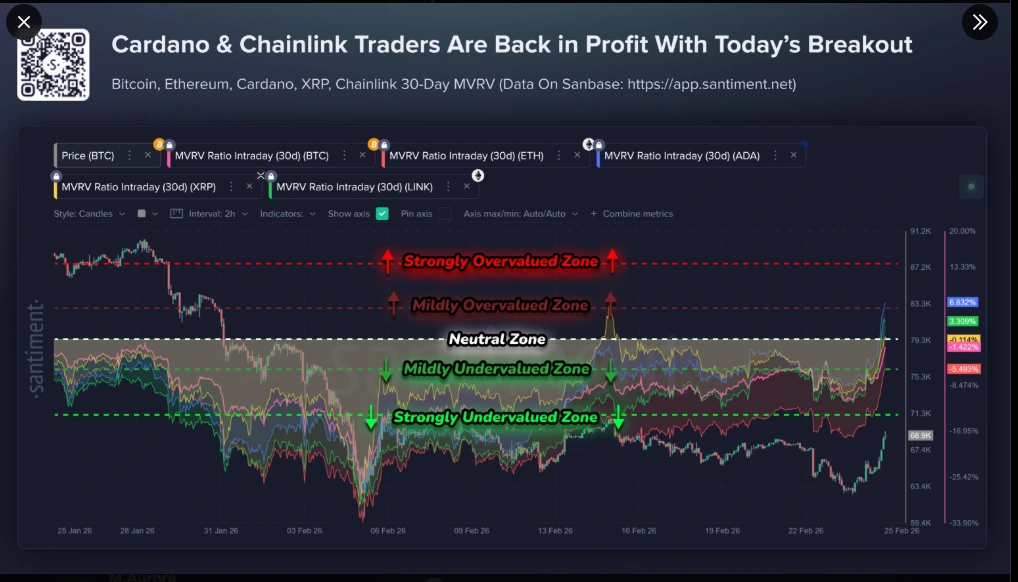
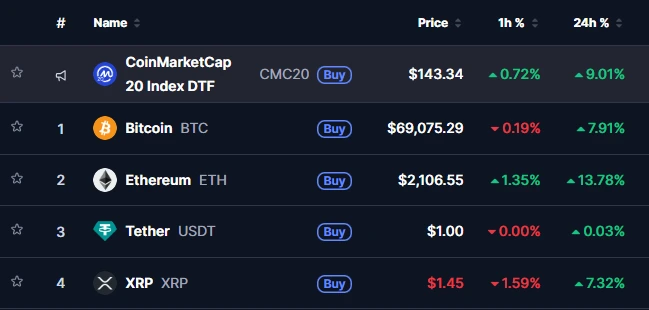
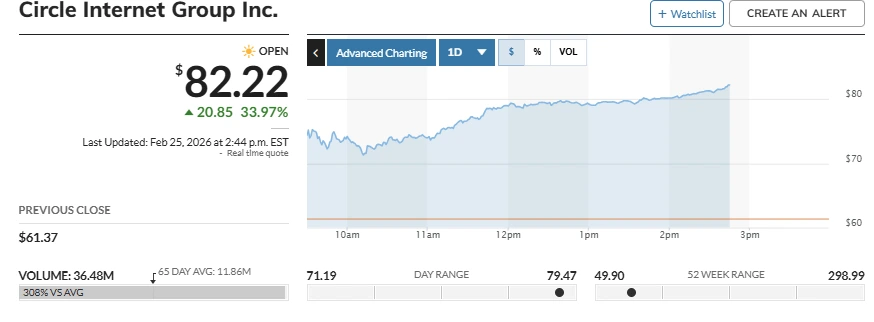

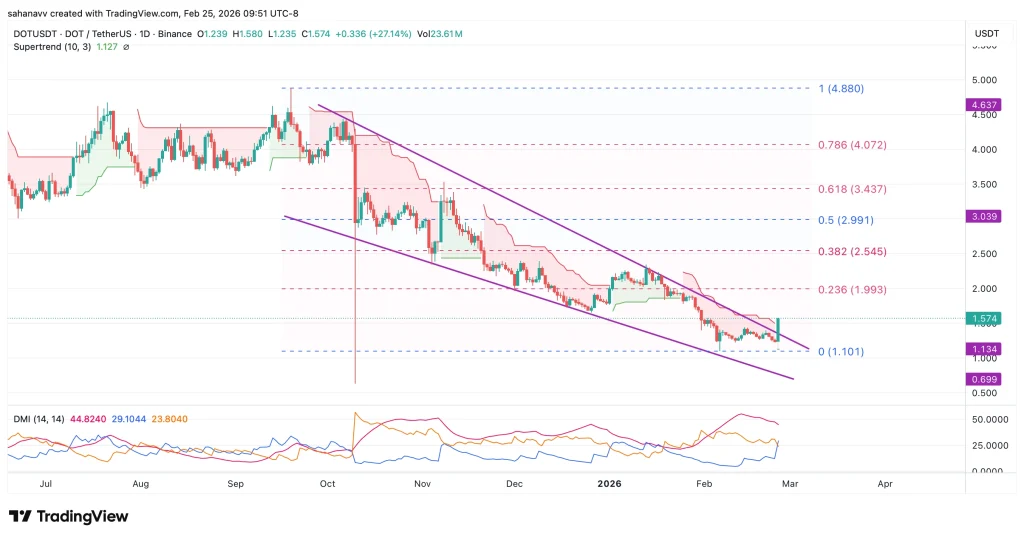




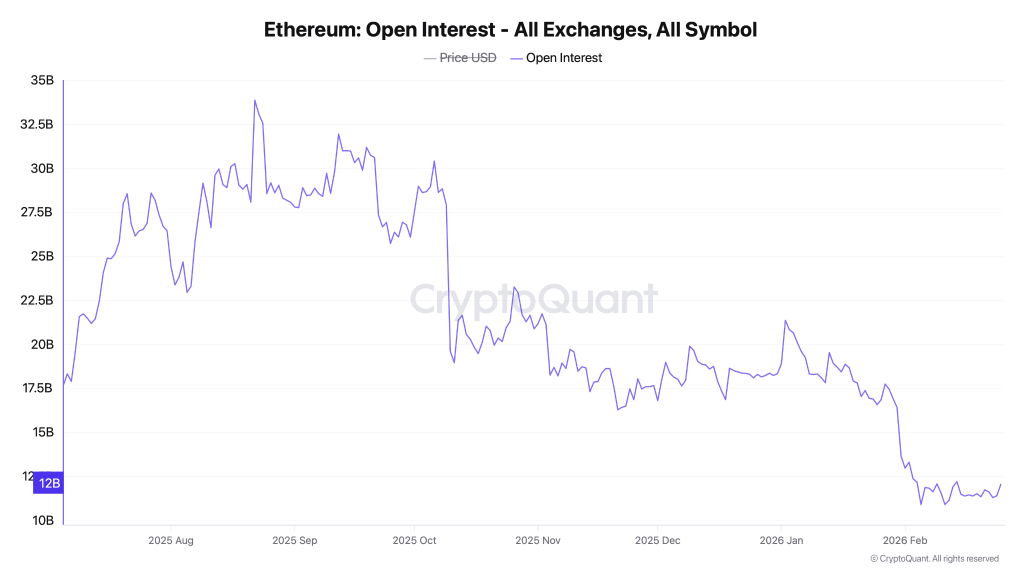
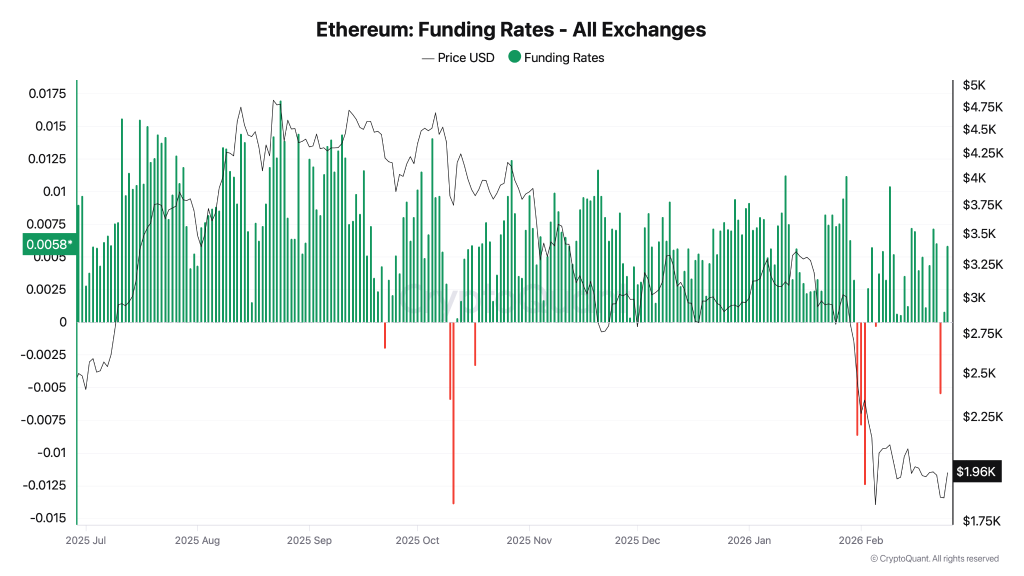
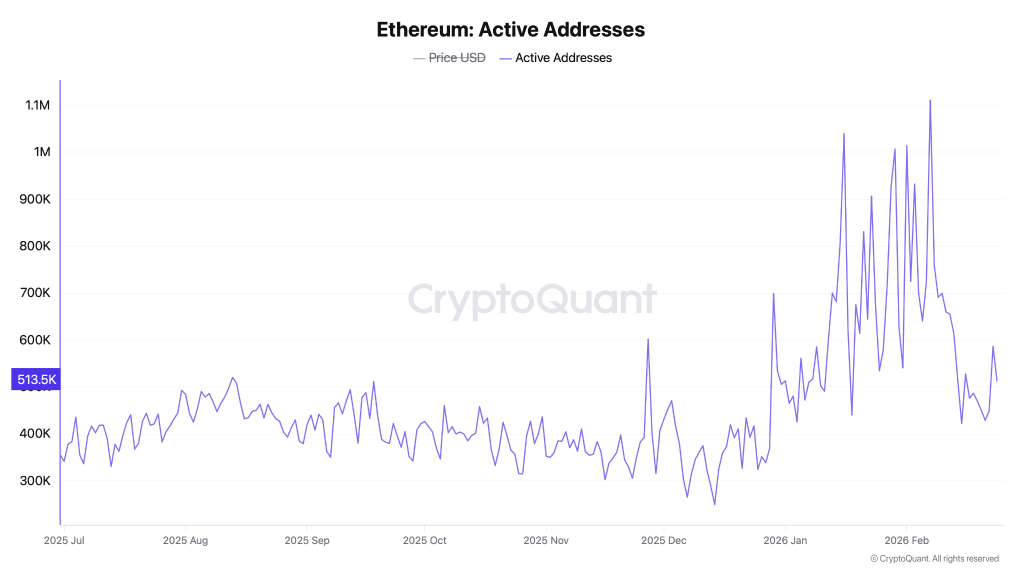
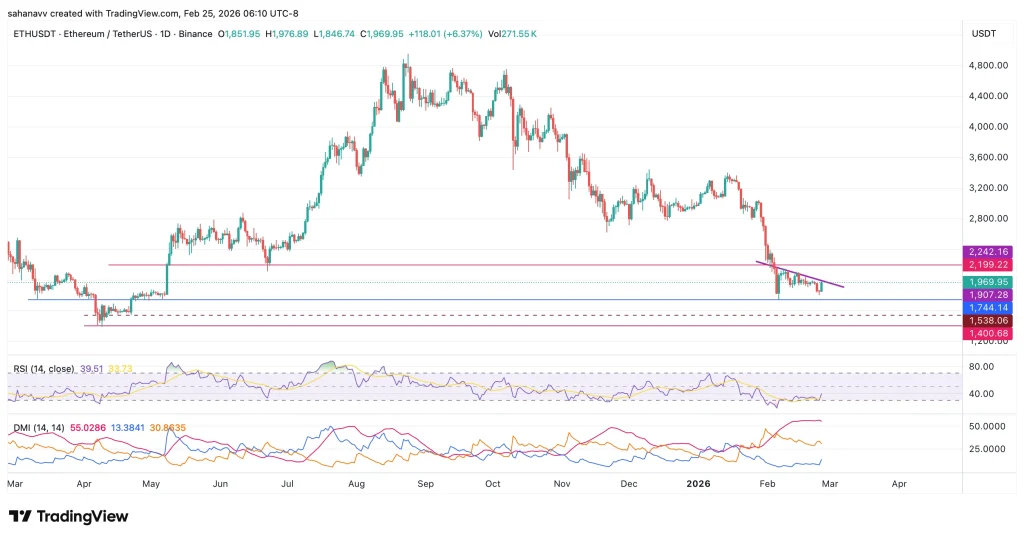


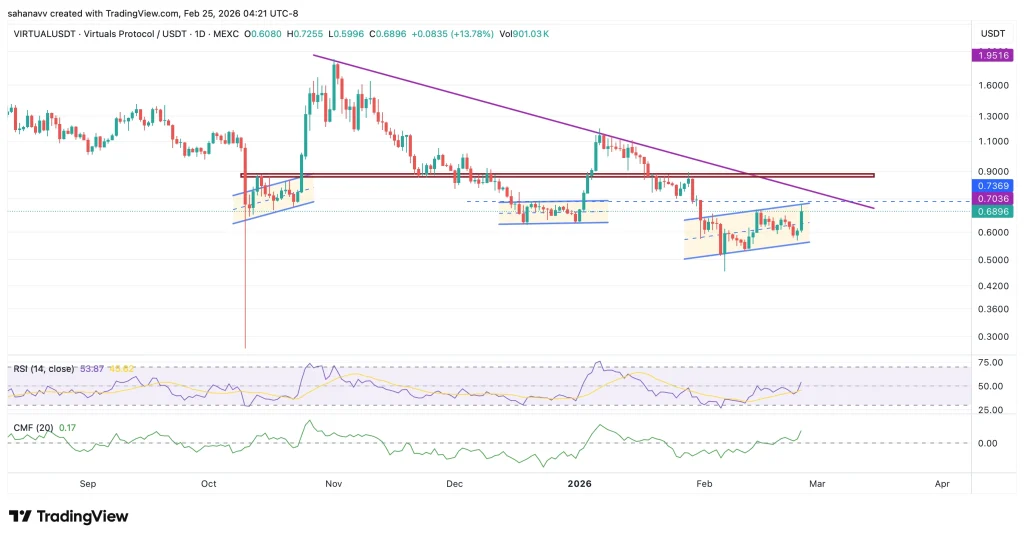

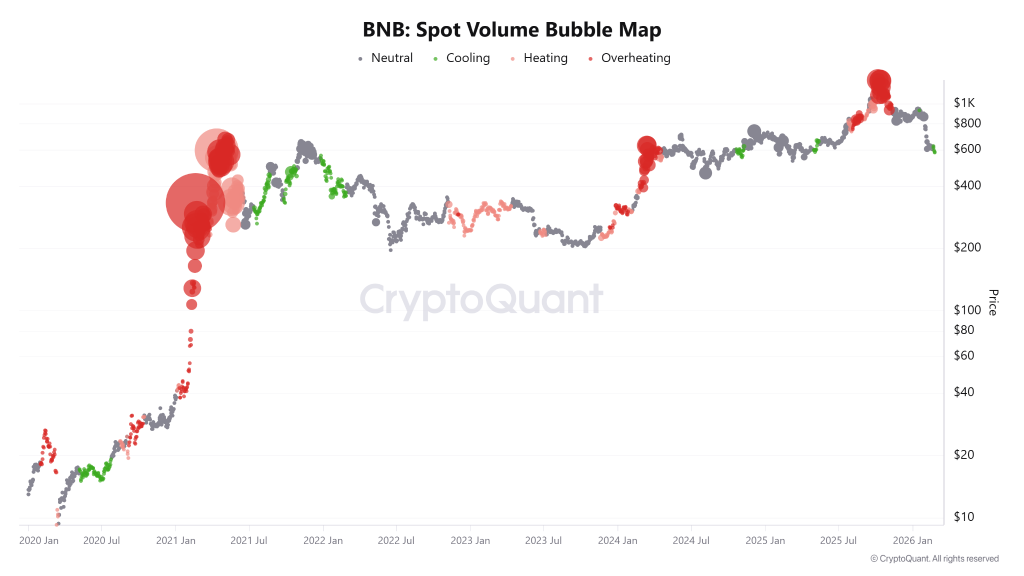
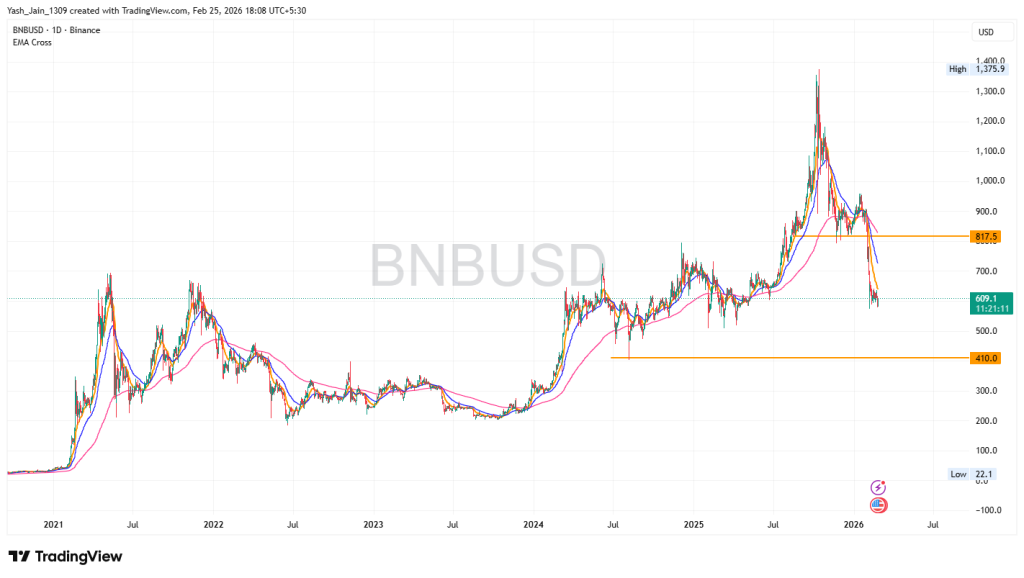
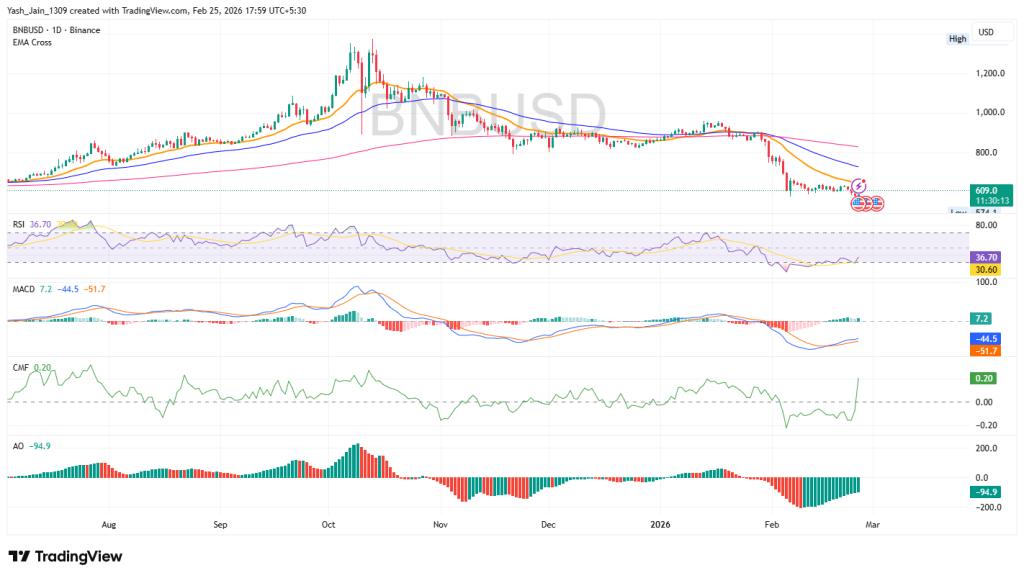

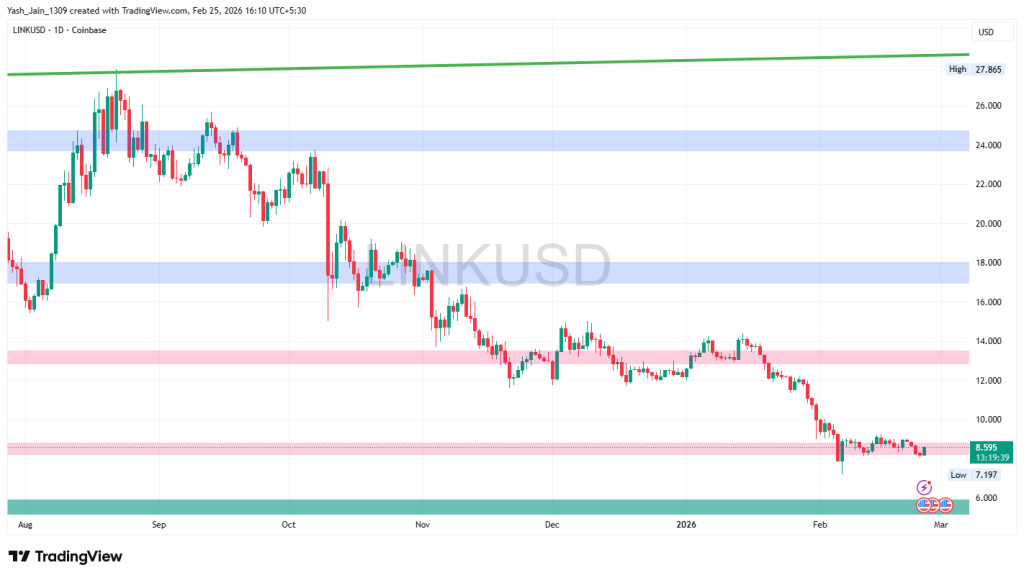
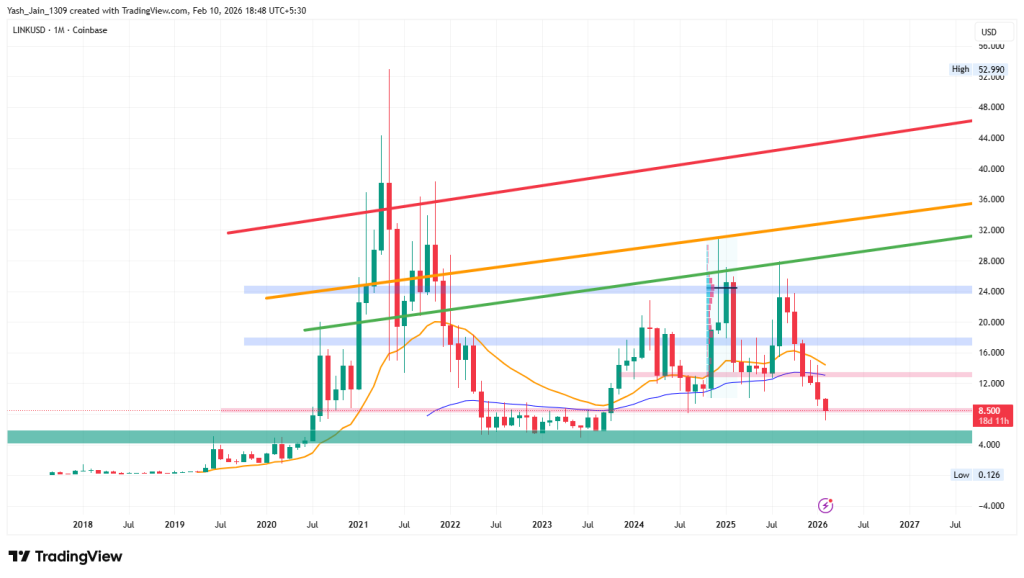
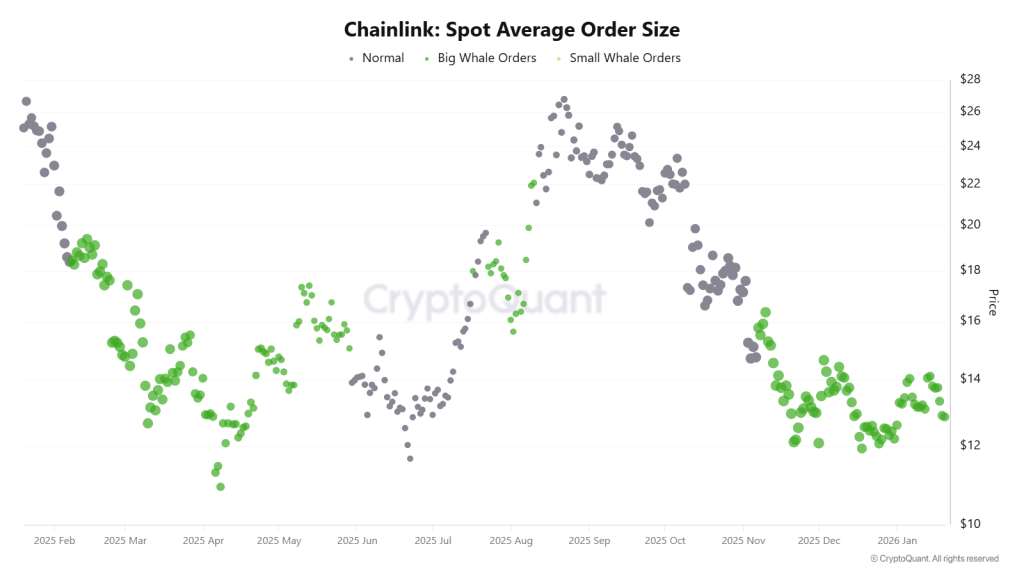
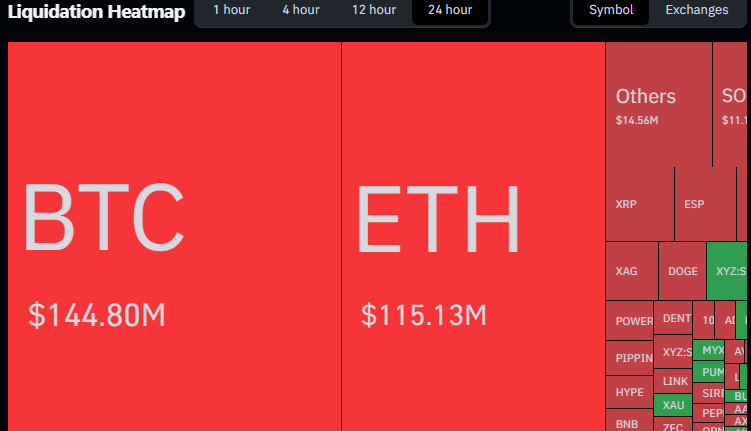

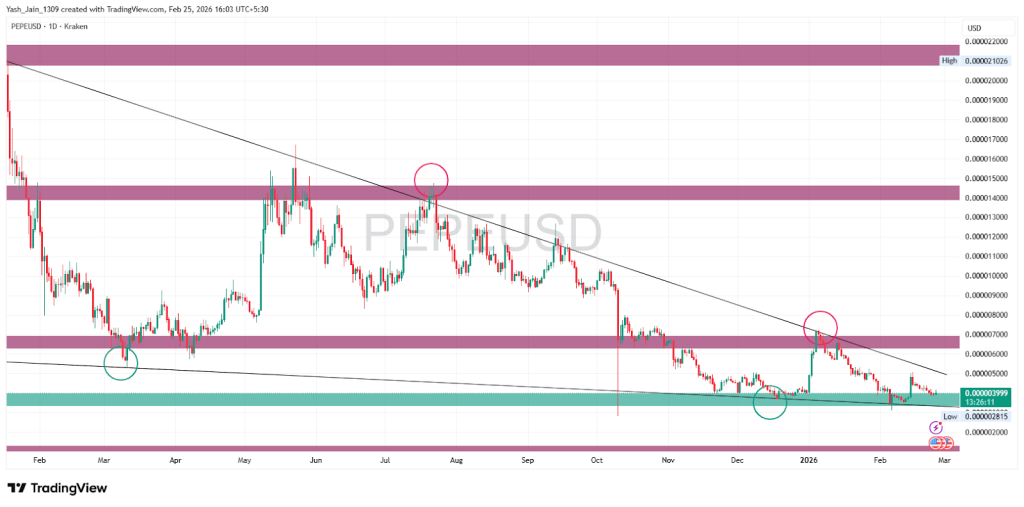
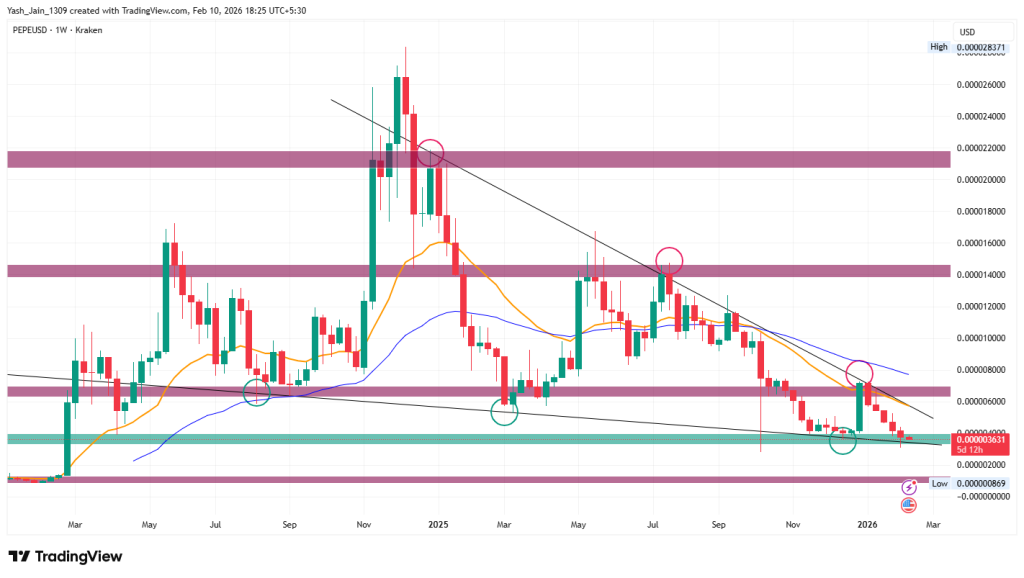
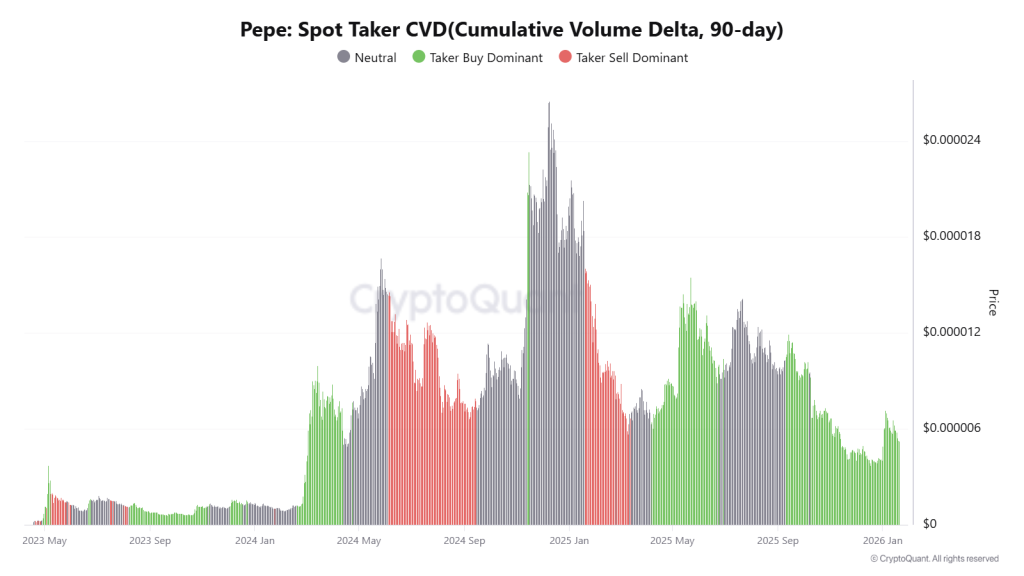

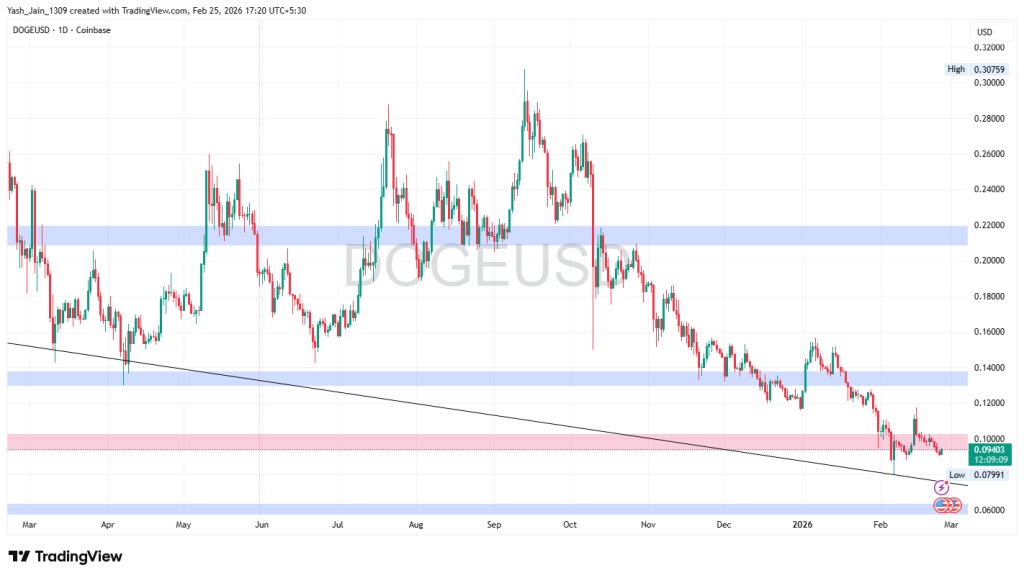
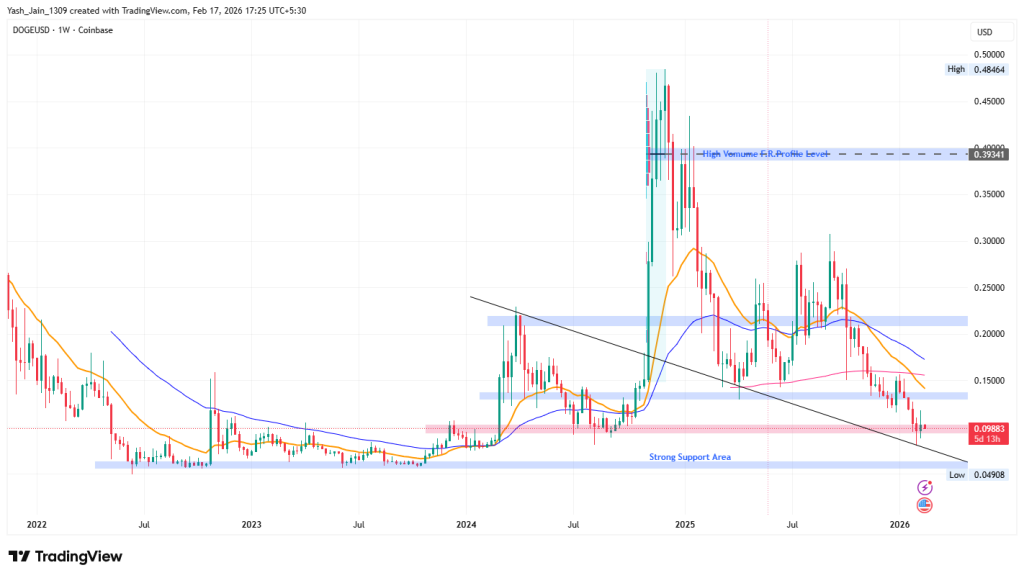
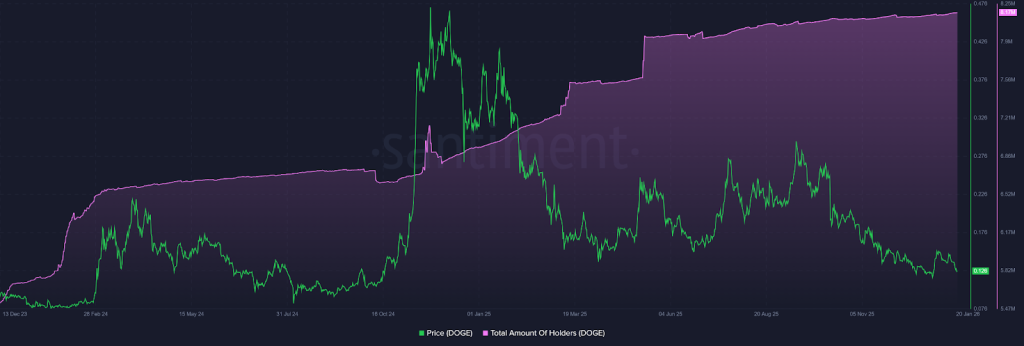
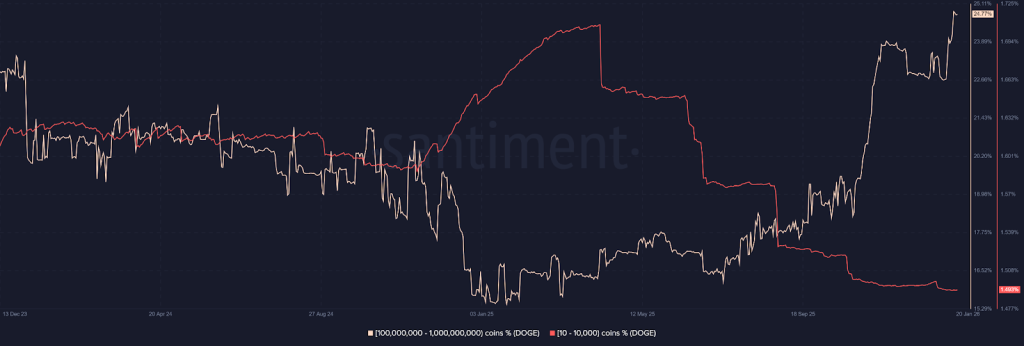
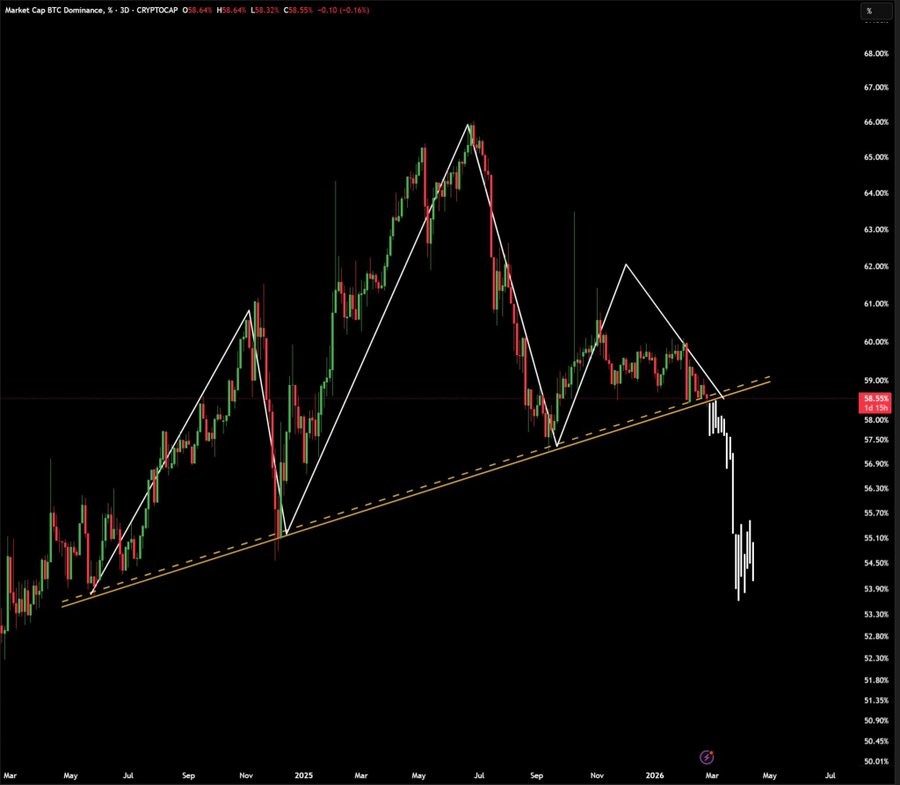
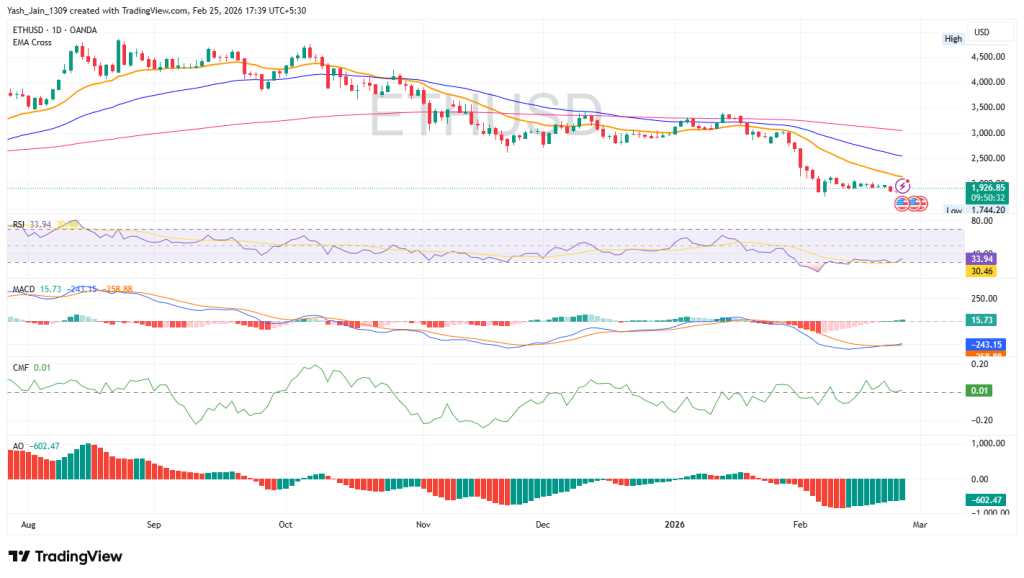
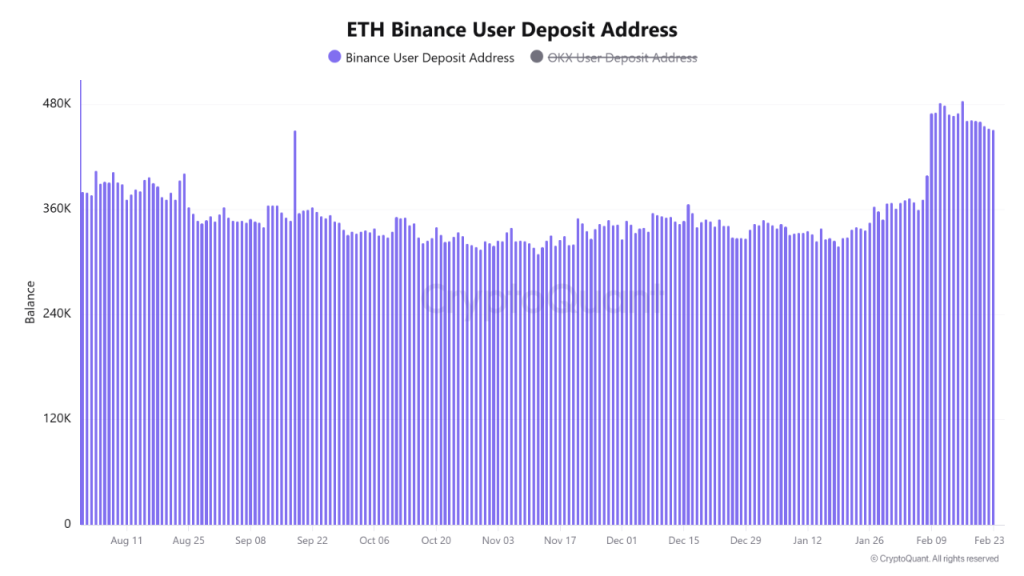




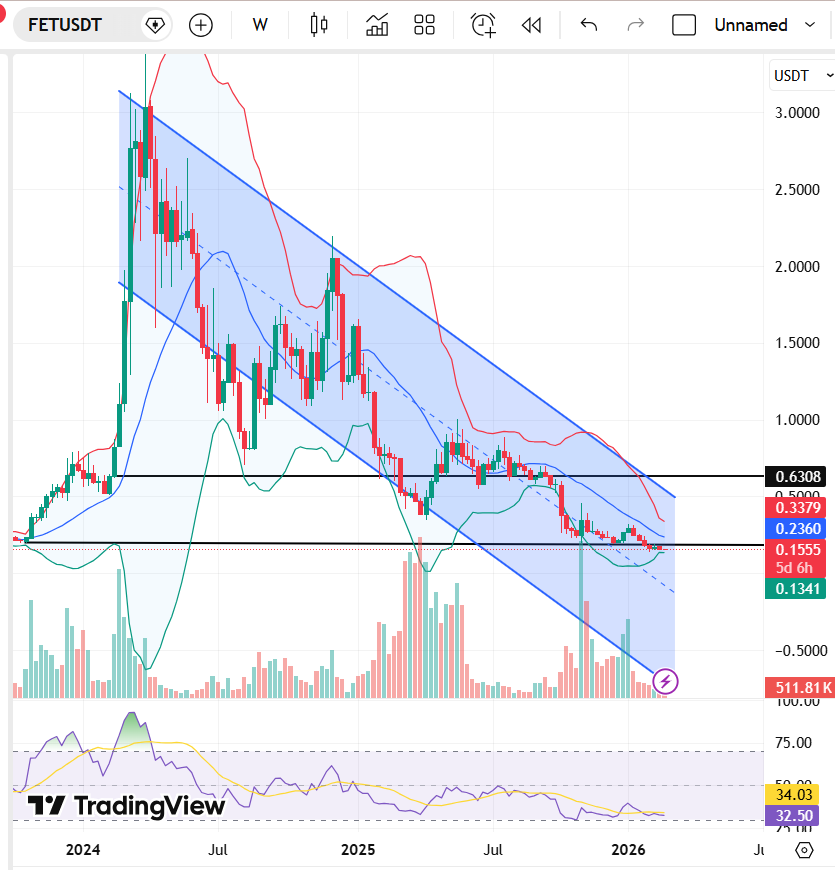
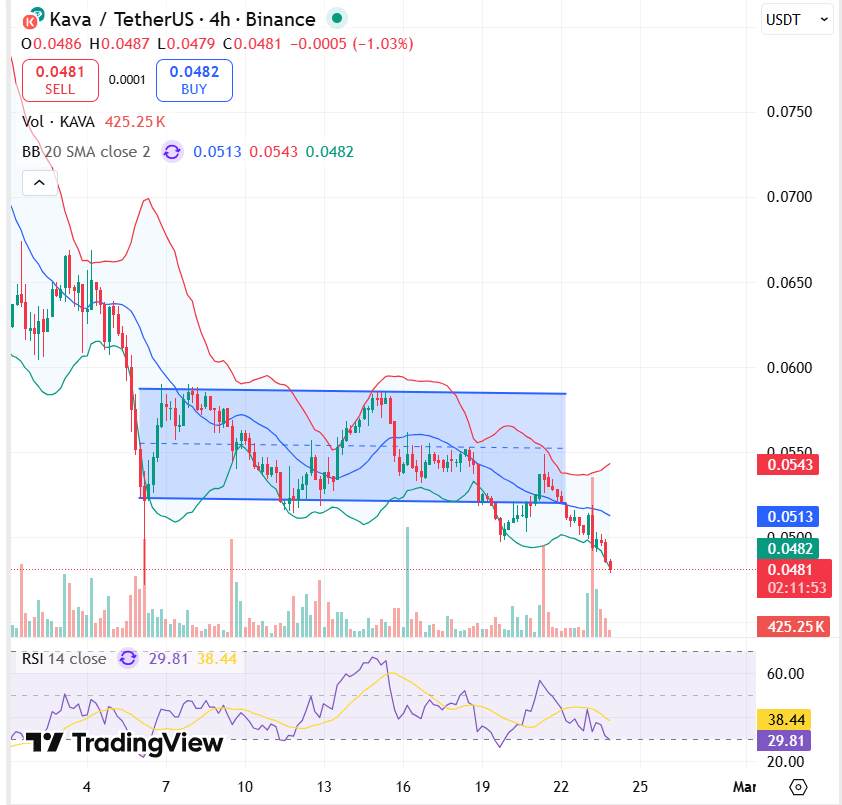

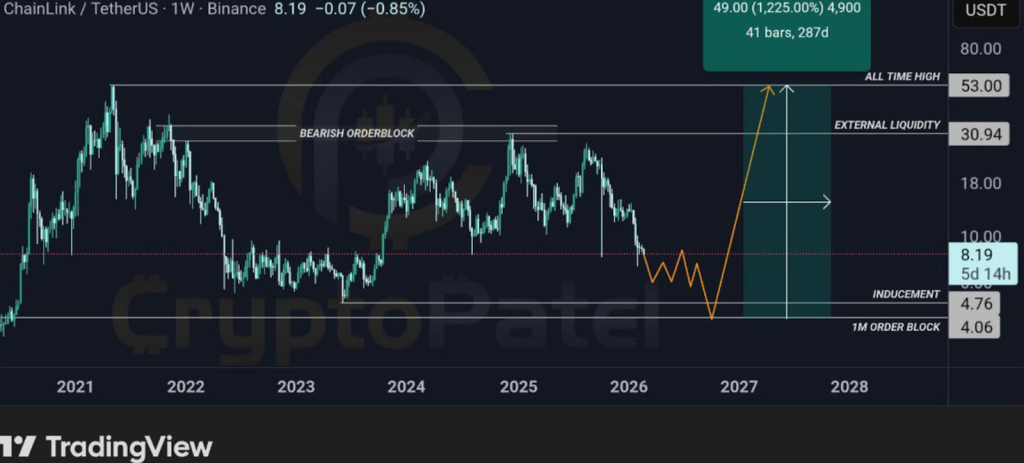

 The case followed user complaints over blocked withdrawals.